A hybrid sharp-diffuse interface approach to accurately model melt pool dynamics with rapid evaporation in laser-based processing of metals
Pith reviewed 2026-06-26 18:32 UTC · model grok-4.3
The pith
Hybrid sharp-diffuse interface model delivers one order of magnitude higher accuracy than pure diffuse models for melt pool dynamics with rapid evaporation.
A machine-rendered reading of the paper's core claim, the machinery that carries it, and where it could break.
Core claim
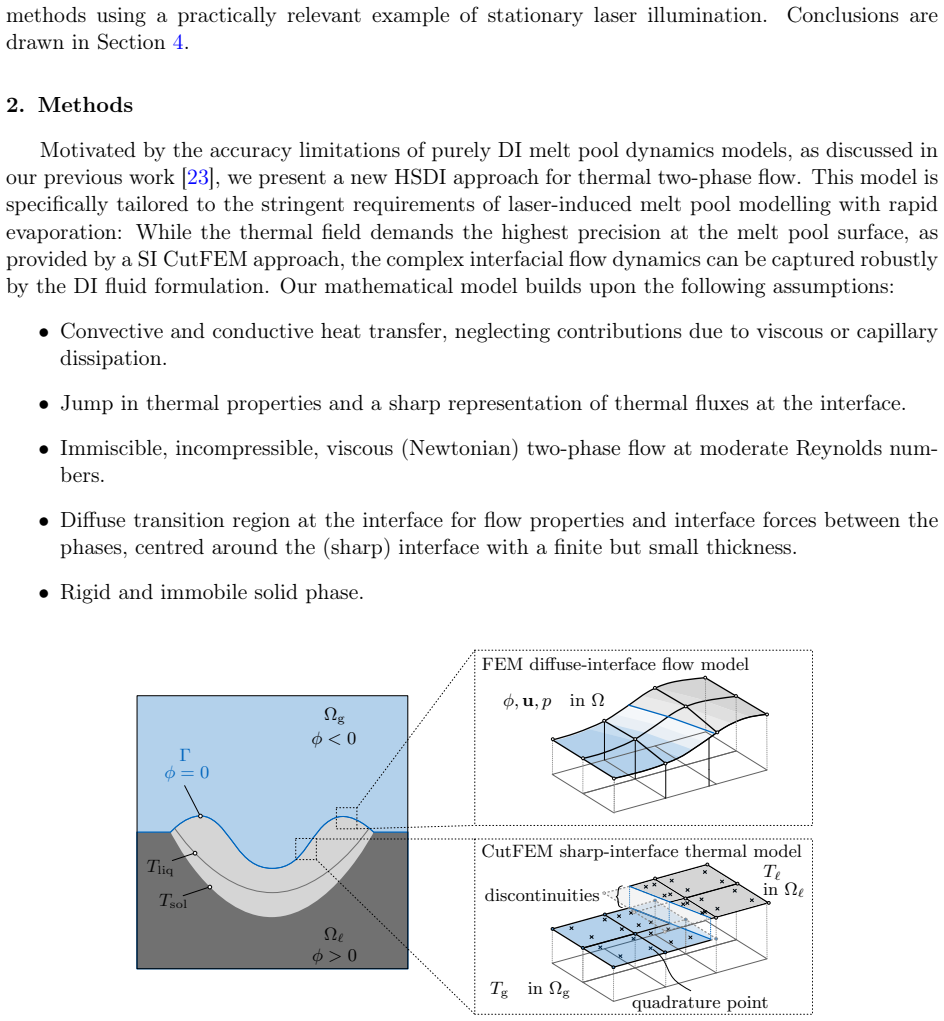
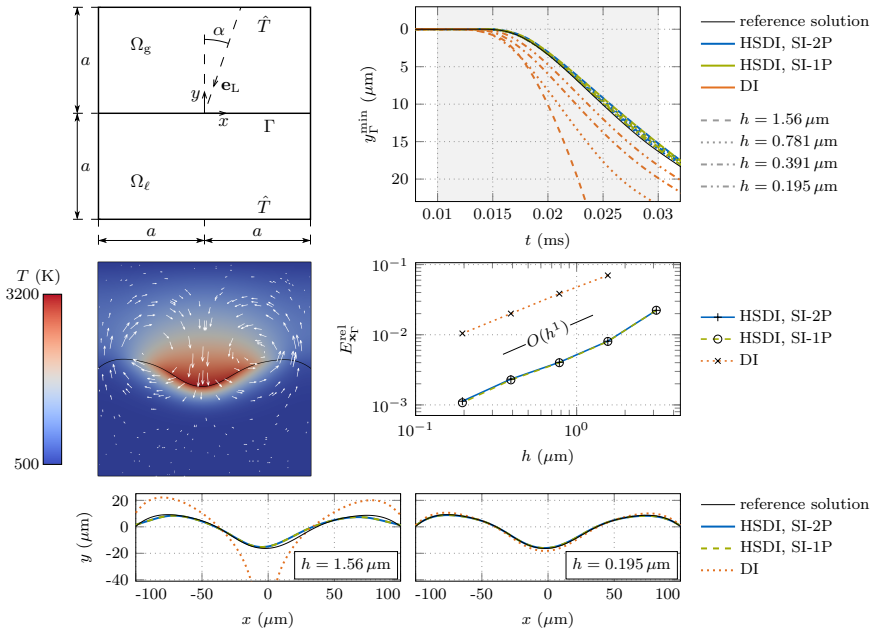
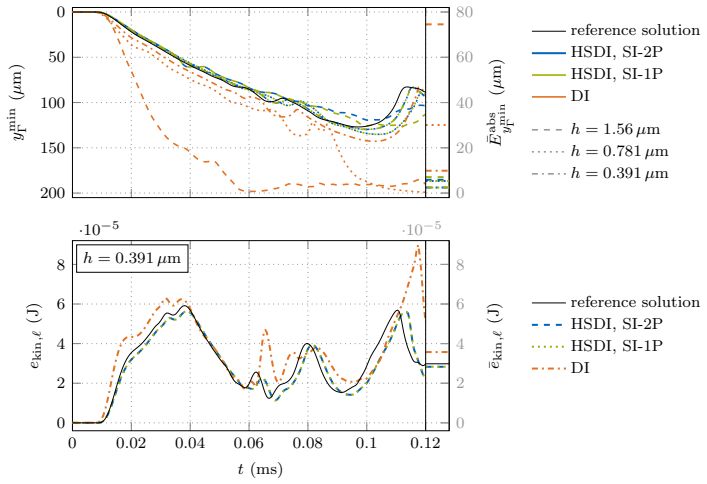
The hybrid sharp-diffuse interface formulation couples a CutFEM sharp-interface heat solver with a level-set one-fluid diffuse-interface flow solver; by extending the sharp temperature field into a narrow interface band, temperature-sensitive interface forces are evaluated accurately enough to raise overall solution accuracy by one order of magnitude relative to a pure diffuse-interface model on the same mesh in laser-metal interaction benchmarks.
What carries the argument
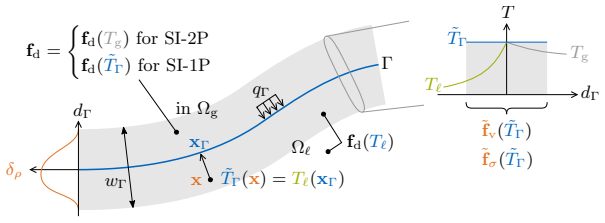
Narrow-band extension of the sharp-interface CutFEM temperature field into the diffuse level-set flow region for consistent evaluation of evaporation recoil and temperature-dependent surface tension.
If this is right
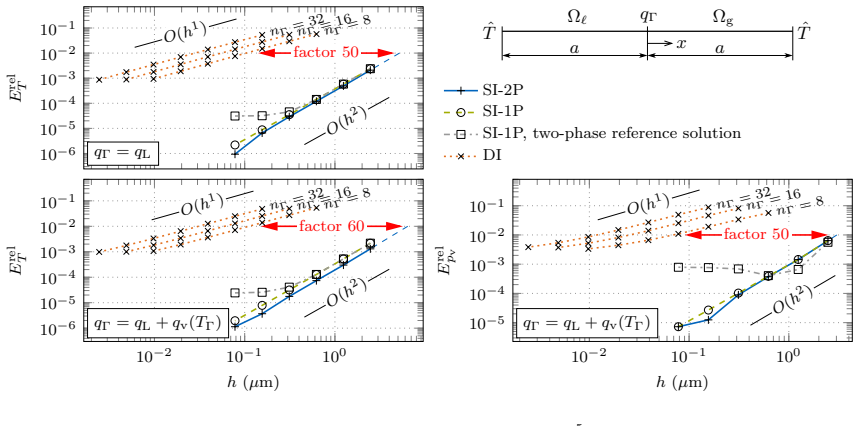
- The sharp thermal solver permits element sizes two orders of magnitude larger than a pure diffuse thermal model while still reaching one-percent temperature accuracy.
- Evaporation recoil pressure and Marangoni forces can be computed from an exponentially accurate temperature field without having to resolve the entire domain at the diffuse-interface scale.
- The same mesh can be used for both thermal and flow sub-problems, removing the need for separate mesh hierarchies in industrial-scale laser-processing simulations.
Where Pith is reading between the lines
- The method's ability to use coarser meshes could extend predictive simulations to larger build volumes or longer process times in additive manufacturing.
- Because the thermal and flow solvers remain independent except for the narrow-band coupling, the hybrid scheme could be combined with existing solidification or powder-bed models without major reformulation.
- If the narrow-band width can be chosen adaptively, the approach might further reduce computational cost while preserving the observed accuracy improvement.
Load-bearing premise
Extending the sharp-interface temperature a short distance into the diffuse flow region supplies sufficiently accurate interface temperatures without introducing coupling errors that would cancel the accuracy gain.
What would settle it
Run the coupled thermo-hydrodynamic benchmark on successively refined meshes and check whether the hybrid method's error in melt-pool depth or surface deformation remains one order of magnitude smaller than the pure diffuse method at every resolution.
Figures
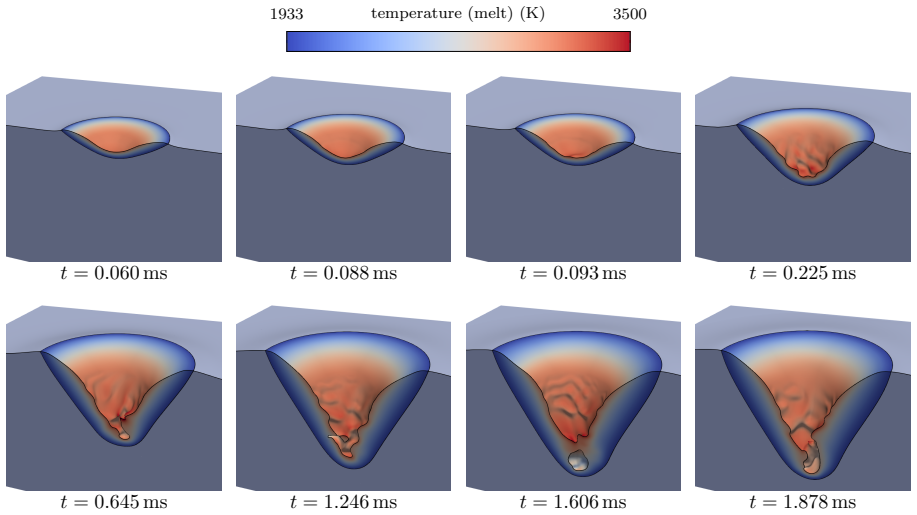
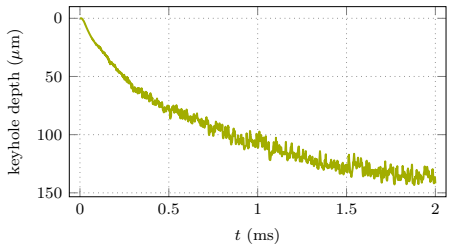
read the original abstract
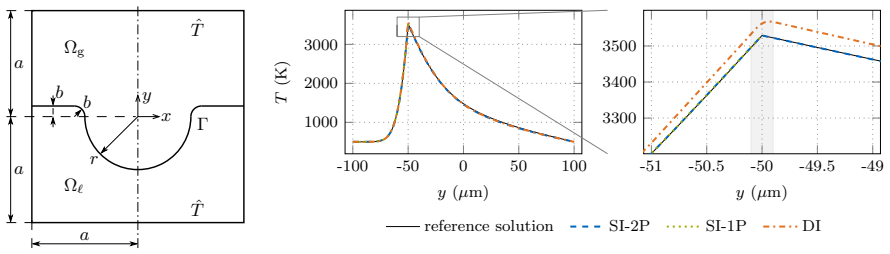
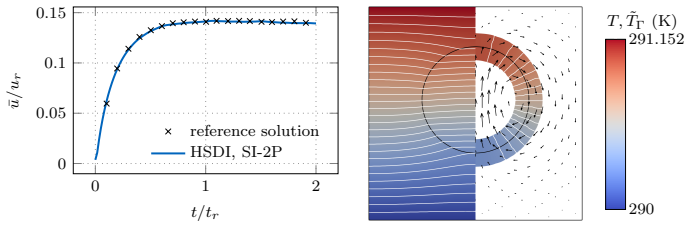
Predictive simulation of melt pool dynamics in laser-based processing of metals, e.g., laser beam welding or laser powder bed fusion additive manufacturing, requires accurate resolution of thermo-hydrodynamic interactions at the melt-gas interface. Here, evaporation-induced recoil pressure and temperature-dependent surface tension govern the flow. Because these mechanisms depend sensitively, often exponentially, on the interface temperature, reliable predictions demand highly accurate heat transfer models. Popular diffuse-interface formulations smear the extreme thermal gradients as typical for laser-metal interactions, leading to interface temperature errors that critically degrade the accuracy of interface force predictions and melt pool dynamics. We present a hybrid sharp-diffuse interface approach for high-fidelity modelling of melt pool thermo-hydrodynamics with rapid evaporation. The heat transfer problem is represented using a sharp-interface unfitted finite element (CutFEM) formulation, enabling accurate prediction of the temperature field. The multi-phase flow problem, characterized by large density ratios and complex interface dynamics, is accurately captured using a robust level-set-based one-fluid diffuse-interface finite element formulation. Consistent coupling is achieved by extending the sharp-interface temperature into a narrow interface region to evaluate temperature-dependent interface forces within the diffuse-interface flow framework. In practically relevant benchmarks, the sharp-interface thermal model exhibits second-order spatial convergence, enabling finite element sizes two orders of magnitude larger than the diffuse-interface approach for 1 accuracy. In a novel coupled thermo-hydrodynamic benchmark representative of laser-metal interactions, the hybrid approach is one order of magnitude more accurate than a purely diffuse-interface model on the same mesh. Robu
Editorial analysis
A structured set of objections, weighed in public.
Referee Report
Summary. The manuscript proposes a hybrid sharp-diffuse interface method for thermo-hydrodynamic simulation of melt pools in laser-based metal processing. Sharp-interface CutFEM is used for heat transfer to resolve extreme gradients accurately, while a level-set one-fluid diffuse-interface formulation handles the multi-phase flow with large density ratios. Consistent coupling is achieved by extending the sharp temperature field into a narrow band to evaluate temperature-dependent evaporation recoil and Marangoni forces. The abstract claims second-order spatial convergence for the thermal model (enabling meshes two orders of magnitude coarser) and an order-of-magnitude accuracy improvement over a pure diffuse-interface model on the same mesh in a novel coupled benchmark representative of laser-metal interactions.
Significance. If the central claims hold, the hybrid approach would represent a meaningful advance for predictive modeling of laser welding and powder-bed fusion by allowing accurate interface force evaluation without the prohibitive refinement required by fully diffuse thermal models, while retaining the robustness of diffuse flow solvers for complex interface dynamics.
major comments (2)
- [Abstract] Abstract: the claim that the hybrid approach is one order of magnitude more accurate than a purely diffuse-interface model on the same mesh in the coupled benchmark rests on the temperature-extension operator into the narrow band supplying sufficiently accurate values for the exponentially sensitive recoil and surface-tension terms; no error bound, convergence analysis of the extension, or demonstration that extension-induced force errors remain smaller than the pure-diffuse thermal error is supplied.
- [Abstract] Abstract: second-order spatial convergence is reported for the thermal model, yet no quantitative error tables, mesh-size details, or derivation of the temperature-extension operator are provided to support the stated accuracy gain or the assertion that finite-element sizes two orders of magnitude larger suffice for 1% accuracy.
minor comments (1)
- [Abstract] Abstract appears truncated at the end ('Robu').
Simulated Author's Rebuttal
We thank the referee for the careful reading and constructive comments. We address each major comment below and will revise the manuscript accordingly to strengthen the presentation of the supporting analyses.
read point-by-point responses
-
Referee: [Abstract] Abstract: the claim that the hybrid approach is one order of magnitude more accurate than a purely diffuse-interface model on the same mesh in the coupled benchmark rests on the temperature-extension operator into the narrow band supplying sufficiently accurate values for the exponentially sensitive recoil and surface-tension terms; no error bound, convergence analysis of the extension, or demonstration that extension-induced force errors remain smaller than the pure-diffuse thermal error is supplied.
Authors: The derivation and implementation of the temperature-extension operator are detailed in Section 3.3, and the coupled benchmark in Section 5 directly compares the hybrid and pure diffuse-interface models on identical meshes, quantifying the accuracy gain for the interface forces. We agree that an explicit a-priori error bound on the extension operator and a dedicated propagation analysis to the recoil/Marangoni terms would further substantiate the claim; these will be added as a new subsection in the revised manuscript, including numerical verification that extension errors remain subordinate to the diffuse-interface thermal error. revision: yes
-
Referee: [Abstract] Abstract: second-order spatial convergence is reported for the thermal model, yet no quantitative error tables, mesh-size details, or derivation of the temperature-extension operator are provided to support the stated accuracy gain or the assertion that finite-element sizes two orders of magnitude larger suffice for 1% accuracy.
Authors: Quantitative L2 and H1 error tables versus mesh size for the sharp-interface thermal model, together with the observed second-order rates, appear in Section 4.1 and Table 1; the derivation of the extension operator is given in Section 3.2. The statement on allowable mesh coarsening follows directly from these rates and is verified in the benchmarks. To make the abstract self-contained, we will revise it to include a brief qualifier referencing the supporting sections and the 1% accuracy threshold used in the mesh-size comparison. revision: yes
Circularity Check
No circularity; accuracy claims rest on independent benchmark comparisons
full rationale
The paper introduces a hybrid sharp-diffuse method with temperature extension for coupling and validates it via convergence studies and a novel coupled thermo-hydrodynamic benchmark, reporting one order of magnitude accuracy gain over pure diffuse on identical meshes. No load-bearing step reduces by construction to fitted inputs, self-definitions, or self-citation chains; the second-order thermal convergence and benchmark deltas are presented as external numerical evidence rather than tautological outputs. The coupling description is a modeling choice whose performance is tested, not presupposed.
Axiom & Free-Parameter Ledger
axioms (1)
- standard math Standard assumptions of unfitted finite element methods (CutFEM) for interface problems and level-set transport for two-phase flow.
Reference graph
Works this paper leans on
-
[1]
I. Gibson, D. Rosen, B. Stucker, M. Khorasani, Additive Manufacturing Technologies, 3rd Edition, Springer International Publishing, Cham, 2021.doi:10.1007/978-3-030-56127-7
-
[2]
Meier, R
C. Meier, R. W. Penny, Y. Zou, J. S. Gibbs, A. J. Hart, Thermophysical phenomena in metal additive manufacturing by selective laser melting: fundamentals, modeling, simulation, and experimentation, Annual Review of Heat Transfer 20 (1) (2017) 241–316.doi:10.1615/ AnnualRevHeatTransfer.2018019042
2017
-
[3]
E. Li, Z. Zhou, L. Wang, R. Zou, A. Yu, Particle scale modelling of powder recoating and melt pool dynamics in laser powder bed fusion additive manufacturing: A review, Powder Technology 409 (July) (2022) 117789.doi:10.1016/j.powtec.2022.117789
-
[4]
R. Cunningham, C. Zhao, N. Parab, C. Kantzos, J. Pauza, K. Fezzaa, T. Sun, A. D. Rollett, Keyhole threshold and morphology in laser melting revealed by ultrahigh-speed x-ray imaging, Science 363 (6429) (2019) 849–852.doi:10.1126/science.aav4687
-
[5]
C. Körner, A. Bauereiß, E. Attar, Fundamental consolidation mechanisms during selective beam melting of powders, Modelling and Simulation in Materials Science and Engineering 21 (8) (2013) 085011.doi:10.1088/0965-0393/21/8/085011
-
[6]
M. C. Brennan, J. S. Keist, T. A. Palmer, Defects in Metal Additive Manufacturing Processes, Journal of Materials Engineering and Performance 30 (7) (2021) 4808–4818.doi:10.1007/ s11665-021-05919-6
2021
-
[7]
P. S. Cook, A. B. Murphy, Simulation of melt pool behaviour during additive manufacturing: Underlying physics and progress, Additive Manufacturing 31 (2020) 100909.doi:10.1016/j. addma.2019.100909
work page doi:10.1016/j 2020
-
[8]
Hansbo, P
A. Hansbo, P. Hansbo, An unfitted finite element method, based on Nitsche’s method, for elliptic interface problems, Computer Methods in Applied Mechanics and Engineering 191 (47-
-
[9]
(2002) 5537–5552.doi:10.1016/S0045-7825(02)00524-8
-
[10]
J. Chessa, P. Smolinski, T. Belytschko, The extended finite element method (XFEM) for solidification problems, International Journal for Numerical Methods in Engineering 53 (8) (2002) 1959–1977.doi:10.1002/nme.386
-
[11]
R. P. Fedkiw, T. Aslam, B. Merriman, S. Osher, A Non-oscillatory Eulerian Approach to Interfaces in Multimaterial Flows (the Ghost Fluid Method), Journal of Computational Physics 152 (2) (1999) 457–492.doi:10.1006/jcph.1999.6236
-
[12]
Burman, Ghost penalty, Comptes Rendus
E. Burman, Ghost penalty, Comptes Rendus. Mathématique 348 (21-22) (2010) 1217–1220. doi:10.1016/j.crma.2010.10.006
-
[13]
C. Hirt, A. Amsden, J. Cook, An arbitrary Lagrangian-Eulerian computing method for all flow speeds, Journal of Computational Physics 14 (3) (1974) 227–253.doi:10.1016/ 0021-9991(74)90051-5. 38
1974
-
[14]
S. Février, E. Fernández, M. Lacroix, R. Boman, J.-P. Ponthot, Simulation of melt pool dynam- ics including vaporization using the particle finite element method, Computational Mechanics 75 (6) (2025) 1787–1815.doi:10.1007/s00466-024-02571-4
-
[15]
G. Tryggvason, R. Scardovelli, S. Zaleski, Direct Numerical Simulations of Gas–Liquid Multi- phaseFlows, CambridgeUniversityPress, Cambridge, 2011.doi:10.1017/CBO9780511975264
-
[16]
S. Pang, L. Chen, J. Zhou, Y. Yin, T. Chen, A three-dimensional sharp interface model for self-consistent keyhole and weld pool dynamics in deep penetration laser welding, Journal of Physics D: Applied Physics 44 (2) (2011) 025301.doi:10.1088/0022-3727/44/2/025301
-
[17]
W. Tan, N. S. Bailey, Y. C. Shin, Investigation of keyhole plume and molten pool based on a three-dimensional dynamic model with sharp interface formulation, Journal of Physics D: Applied Physics 46 (5) (2013) 055501.doi:10.1088/0022-3727/46/5/055501
-
[18]
S. A. Khairallah, A. Anderson, Mesoscopic simulation model of selective laser melting of stain- less steel powder, Journal of Materials Processing Technology 214 (11) (2014) 2627–2636. doi:10.1016/j.jmatprotec.2014.06.001
-
[19]
S. A. Khairallah, A. T. Anderson, A. Rubenchik, W. E. King, Laser powder-bed fusion additive manufacturing: Physics of complex melt flow and formation mechanisms of pores, spatter, and denudation zones, Acta Materialia 108 (2016) 36–45.doi:10.1016/j.actamat.2016.02.014
-
[20]
M. J. Matthews, G. Guss, S. A. Khairallah, A. M. Rubenchik, P. J. Depond, W. E. King, Denudation of metal powder layers in laser powder bed fusion processes, Acta Materialia 114 (2016) 33–42.doi:10.1016/j.actamat.2016.05.017
-
[21]
S. Ly, A. M. Rubenchik, S. A. Khairallah, G. Guss, M. J. Matthews, Metal vapor micro-jet controls material redistribution in laser powder bed fusion additive manufacturing, Scientific Reports 7 (1) (2017) 4085.doi:10.1038/s41598-017-04237-z
-
[22]
A. A. Martin, N. P. Calta, S. A. Khairallah, J. Wang, P. J. Depond, A. Y. Fong, V. Thampy, G. M. Guss, A. M. Kiss, K. H. Stone, C. J. Tassone, J. Nelson Weker, M. F. Toney, T. van Buuren, M. J. Matthews, Dynamics of pore formation during laser powder bed fu- sion additive manufacturing, Nature Communications 10 (1) (2019) 1987.doi:10.1038/ s41467-019-10009-2
2019
-
[23]
J. Brackbill, D. Kothe, C. Zemach, A continuum method for modeling surface tension, Journal of Computational Physics 100 (2) (1992) 335–354.doi:10.1016/0021-9991(92)90240-Y
-
[24]
N. Much, M. Schreter-Fleischhacker, P. Munch, M. Kronbichler, W. A. Wall, C. Meier, Im- proved accuracy of continuum surface flux models for metal additive manufacturing melt pool simulations, Advanced Modeling and Simulation in Engineering Sciences 11 (1) (2024) 16. doi:10.1186/s40323-024-00270-6
-
[25]
M. Schreter-Fleischhacker, N. Much, P. Munch, M. Kronbichler, W. A. Wall, C. Meier, A con- sistent diffuse-interface finite element approach to rapid melt–vapor dynamics with application to metal additive manufacturing, Computer Methods in Applied Mechanics and Engineering 442 (2025) 117985.doi:10.1016/j.cma.2025.117985. 39
-
[26]
R. Andreotta, L. Ladani, W. Brindley, Finite element simulation of laser additive melting and solidification of Inconel 718 with experimentally tested thermal properties, Finite Elements in Analysis and Design 135 (July) (2017) 36–43.doi:10.1016/j.finel.2017.07.002
-
[27]
J. Yan, W. Yan, S. Lin, G. Wagner, A fully coupled finite element formulation for liq- uid–solid–gas thermo-fluid flow with melting and solidification, Computer Methods in Applied Mechanics and Engineering 336 (2018) 444–470.doi:10.1016/j.cma.2018.03.017
-
[28]
Q. Zhu, J. Yan, A mixed interface-capturing/interface-tracking formulation for thermal multi- phase flows with emphasis on metal additive manufacturing processes, Computer Methods in Applied Mechanics and Engineering 383 (2021) 113910.doi:10.1016/j.cma.2021.113910
-
[29]
M. Courtois, M. Carin, P. Le Masson, S. Gaied, M. Balabane, A complete model of keyhole and melt pool dynamics to analyze instabilities and collapse during laser welding, Journal of Laser Applications 26 (4) (2014) 042001.doi:10.2351/1.4886835
-
[30]
K.-H.Leitz, C.Grohs, P.Singer, B.Tabernig, A.Plankensteiner, H.Kestler, L.Sigl, Fundamen- tal analysis of the influence of powder characteristics in Selective Laser Melting of molybdenum based on a multi-physical simulation model, International Journal of Refractory Metals and Hard Materials 72 (November 2017) (2018) 1–8.doi:10.1016/j.ijrmhm.2017.11.034
-
[31]
A. Queva, G. Guillemot, C. Moriconi, C. Metton, M. Bellet, Numerical study of the impact of vaporisation on melt pool dynamics in Laser Powder Bed Fusion - Application to IN718 and Ti–6Al–4V, Additive Manufacturing 35 (February) (2020) 101249.doi:10.1016/j.addma. 2020.101249
-
[32]
C. Panwisawas, C. Qiu, M. J. Anderson, Y. Sovani, R. P. Turner, M. M. Attallah, J. W. Brooks, H. C. Basoalto, Mesoscale modelling of selective laser melting: Thermal fluid dynamics and microstructural evolution, Computational Materials Science 126 (2017) 479–490.doi: 10.1016/j.commatsci.2016.10.011
-
[33]
M. Bayat, S. Mohanty, J. H. Hattel, Multiphysics modelling of lack-of-fusion voids formation and evolution in IN718 made by multi-track/multi-layer L-PBF, International Journal of Heat and Mass Transfer 139 (2019) 95–114.doi:10.1016/j.ijheatmasstransfer.2019.05.003
-
[34]
C. M. Grohol, Y. C. Shin, On the predictive accuracy and sensitivity to property varia- tions in the high-fidelity modeling of the molten pool dynamics in laser melting of met- als, International Journal of Heat and Mass Transfer 232 (June) (2024) 125894.doi: 10.1016/j.ijheatmasstransfer.2024.125894
-
[35]
T. Yu, S. Zhao, J. Zhao, A mechanism-based optimization strategy with adaptive laser power for laser powder bed fusion, Additive Manufacturing 92 (August) (2024) 104403.doi:10. 1016/j.addma.2024.104403
arXiv 2024
-
[36]
M. Geiger, K.-H. Leitz, H. Koch, A. Otto, A 3D transient model of keyhole and melt pool dynamics in laser beam welding applied to the joining of zinc coated sheets, Production Engi- neering 3 (2) (2009) 127–136.doi:10.1007/s11740-008-0148-7
-
[37]
H. Chen, W. Yan, Spattering and denudation in laser powder bed fusion process: Multiphase flow modelling, Acta Materialia 196 (2020) 154–167.doi:10.1016/j.actamat.2020.06.033. 40
-
[38]
Y. S. Lee, W. Zhang, Mesoscopic simulation of heat transfer and fluid flow in laser powder bed additive manufacturing, in: Solid Free Form Fabrication Symposium, University of Texas at Austin, Austin, Texas, USA, 2015, pp. 1154–1165
2015
-
[39]
A. Zakirov, S. Belousov, M. Bogdanova, B. Korneev, I. Iskandarova, A. Perepelkina, B. Potap- kin, KiSSAM: efficient simulation of melt pool dynamics during PBF using GPUs, Progress in Additive Manufacturing 9 (5) (2024) 1491–1508.doi:10.1007/s40964-023-00561-1
-
[40]
K. Ikeda, S. Sakane, T. Aoki, T. Takaki, High-performance phase-field lattice Boltzmann simu- lations for accurate thermal fluid flow in metal additive manufacturing, IOP Conference Series: Materials Science and Engineering 1335 (1) (2025) 012016.doi:10.1088/1757-899X/1335/1/ 012016
-
[41]
R.Ammer, M.Markl, U.Ljungblad, C.Körner, U.Rüde, Simulatingfastelectronbeammelting with a parallel thermal free surface lattice Boltzmann method, Computers & Mathematics with Applications 67 (2) (2014) 318–330.doi:10.1016/j.camwa.2013.10.001
-
[42]
C. Meier, S. L. Fuchs, A. J. Hart, W. A. Wall, A novel smoothed particle hydrodynamics formulation for thermo-capillary phase change problems with focus on metal additive manu- facturing melt pool modeling, Computer Methods in Applied Mechanics and Engineering 381 (2021) 113812.doi:10.1016/j.cma.2021.113812
-
[43]
S. L. Fuchs, P. M. Praegla, C. J. Cyron, W. A. Wall, C. Meier, A versatile SPH modeling framework for coupled microfluid-powder dynamics in additive manufacturing: binder jetting, material jetting, directed energy deposition and powder bed fusion, Engineering with Comput- ers 38 (6) (2022) 4853–4877.doi:10.1007/s00366-022-01724-4
-
[44]
C. Lüthi, M. Afrasiabi, M. Bambach, An adaptive smoothed particle hydrodynamics (SPH) scheme for efficient melt pool simulations in additive manufacturing, Computers & Mathemat- ics with Applications 139 (2023) 7–27.doi:10.1016/j.camwa.2023.03.003
-
[45]
Y. Lin, C. Lüthi, M. Afrasiabi, M. Bambach, Enhanced heat source modeling in particle-based laser manufacturing simulations with ray tracing, International Journal of Heat and Mass Transfer 214 (2023) 124378.doi:10.1016/j.ijheatmasstransfer.2023.124378
-
[46]
Y. Ma, Z. Zhang, C. Weißenfels, M. Zhou, L. Ma, X. Tang, M. Liu, GPU-accelerated multi- phase, multi-resolution SPH method with ray tracing for laser powder bed fusion, Computer Methods in Applied Mechanics and Engineering 448 (July 2025) (2025) 118423.doi:10.1016/ j.cma.2025.118423
arXiv 2025
-
[47]
M. Russell, A. Souto-Iglesias, T. Zohdi, Numerical simulation of Laser Fusion Additive Man- ufacturing processes using the SPH method, Computer Methods in Applied Mechanics and Engineering 341 (2018) 163–187.doi:10.1016/j.cma.2018.06.033
-
[48]
Anisimov, V
S. Anisimov, V. Khokhlov, Instabilities in Laser-Matter Interaction, CRC Press, Boca Raton, FL, 1995
1995
-
[49]
A. J. Ross, I. Bitharas, K. G. Perkins, A. J. Moore, Volumetric heat source calibration for laser powder bed fusion, Additive Manufacturing 60 (2022).doi:10.1016/J.ADDMA.2022.103267. 41
-
[50]
E. Olsson, G. Kreiss, S. Zahedi, A conservative level set method for two phase flow II, Journal of Computational Physics 225 (1) (2007) 785–807.doi:10.1016/j.jcp.2006.12.027
-
[51]
J. Nitsche, Über ein Variationsprinzip zur Lösung von Dirichlet-Problemen bei Verwendung von Teilräumen, die keinen Randbedingungen unterworfen sind, Abhandlungen aus dem Math- ematischen Seminar der Universität Hamburg 36 (1) (1971) 9–15.doi:10.1007/BF02995904
-
[52]
M. Kronbichler, K. Kormann, A generic interface for parallel cell-based finite element operator application, Computers & Fluids 63 (2012) 135–147.doi:10.1016/j.compfluid.2012.04. 012
-
[53]
Journal of Numerical Mathematics 33, 403–415
D. Arndt, W. Bangerth, M. Bergbauer, B. Blais, M. Fehling, R. Gassmöller, T. Heister, L. Heltai, M. Kronbichler, M. Maier, P. Munch, S. Scheuerman, B. Turcksin, S. Uzunbajakau, D. Wells, M. Wichrowski, The deal.II library, version 9.7, Journal of Numerical Mathematics 32 (4) (2025) 369–380.doi:10.1515/jnma-2025-0115
-
[54]
M. Kronbichler, A. Diagne, H. Holmgren, A fast massively parallel two-phase flow solver for microfluidic chip simulation, The International Journal of High Performance Computing Ap- plications 32 (2) (2018) 266–287.doi:10.1177/1094342016671790
-
[55]
M. Sussman, P. Smereka, S. Osher, A Level Set Approach for Computing Solutions to In- compressible Two-Phase Flow, Journal of Computational Physics 114 (1) (1994) 146–159. doi:10.1006/jcph.1994.1155
-
[56]
C. S. Peskin, The immersed boundary method, Acta Numerica 11 (2002) 479–517.doi: 10.1017/S0962492902000077
-
[57]
C. J. Knight, Theoretical Modeling of Rapid Surface Vaporization with Back Pressure, AIAA Journal 17 (5) (1979) 519–523.doi:10.2514/3.61164
-
[58]
V. Voller, C. Prakash, A fixed grid numerical modelling methodology for convection-diffusion mushy region phase-change problems, International Journal of Heat and Mass Transfer 30 (8) (1987) 1709–1719.doi:10.1016/0017-9310(87)90317-6
-
[59]
Schreter-Fleischhacker, P
M. Schreter-Fleischhacker, P. Munch, N. Much, M. Kronbichler, W. A. Wall, C. Meier, A consistent diffuse-interface model for two-phase flow problems with rapid evaporation, Ad- vanced Modeling and Simulation in Engineering Sciences 11 (1) (2024) 19.doi:10.1186/ s40323-024-00276-0
2024
-
[60]
G. Ludvigsson, K. R. Steffen, S. Sticko, S. Wang, Q. Xia, Y. Epshteyn, G. Kreiss, High-Order Numerical Methods for 2D Parabolic Problems in Single and Composite Domains, Journal of Scientific Computing 76 (2) (2018) 812–847.doi:10.1007/s10915-017-0637-y
-
[61]
E. Burman, S. Claus, P. Hansbo, M. G. Larson, A. Massing, CutFEM: Discretizing geometry and partial differential equations, International Journal for Numerical Methods in Engineering 104 (7) (2015) 472–501.doi:10.1002/nme.4823
-
[62]
J. Benzaken, J. A. Evans, R. Tamstorf, Constructing Nitsche’s Method for Variational Prob- lems, Archives of Computational Methods in Engineering 31 (4) (2024) 1867–1896.doi: 10.1007/s11831-023-09953-6. 42
-
[63]
S. Sticko, G. Kreiss, A stabilized Nitsche cut element method for the wave equation, Comput. Methods Appl. Mech. Engrg 309 (2016) 364–387.doi:10.1016/j.cma.2016.06.001
-
[64]
E. Burman, P. Hansbo, Fictitious domain finite element methods using cut elements: II. A stabilized Nitsche method, Applied Numerical Mathematics 62 (4) (2012) 328–341.doi: 10.1016/j.apnum.2011.01.008
-
[65]
L. Lee, R. J. LeVeque, An Immersed Interface Method for Incompressible Navier–Stokes Equations, SIAM Journal on Scientific Computing 25 (3) (2003) 832–856.doi:10.1137/ S1064827502414060
2003
-
[66]
Schreter-Fleischhacker, P
M. Schreter-Fleischhacker, P. Munch, The deal.II tutorial step-87: Evaluation of finite element solutions at arbitrary points within a distributed mesh with application to two-phase flow (2023). URLhttps://dealii.org/developer/doxygen/deal.II/step_87.html
2023
-
[67]
W. E. Lorensen, H. E. Cline, Marching cubes: A high resolution 3D surface construction algorithm, in: Proceedings of the 14th annual conference on Computer graphics and interactive techniques, Vol. 21, ACM, New York, NY, USA, 1987, pp. 163–169.doi:10.1145/37401. 37422
-
[68]
D. Kothe, W. Rider, S. Mosso, J. Brock, J. Hochstein, Volume tracking of interfaces having surface tension in two and three dimensions, in: 34th Aerospace Sciences Meeting and Exhibit, American Institute of Aeronautics and Astronautics, Reston, Virigina, 1996, p. 859.doi: 10.2514/6.1996-859
-
[69]
K. Yokoi, A density-scaled continuum surface force model within a balanced force formulation, Journal of Computational Physics 278 (1) (2014) 221–228.doi:10.1016/j.jcp.2014.08.034
-
[70]
S.Zahedi, M.Kronbichler, G.Kreiss, Spuriouscurrentsinfiniteelementbasedlevelsetmethods for two-phase flow, International Journal for Numerical Methods in Fluids 69 (9) (2012) 1433– 1456.doi:10.1002/fld.2643
-
[71]
M. M. Francois, S. J. Cummins, E. D. Dendy, D. B. Kothe, J. M. Sicilian, M. W. Williams, A balanced-force algorithm for continuous and sharp interfacial surface tension models within a volume tracking framework, Journal of Computational Physics 213 (1) (2006) 141–173.doi: 10.1016/j.jcp.2005.08.004
-
[72]
Schott, Stabilized Cut Finite Element Methods for Complex Interface Coupled Flow Prob- lems, Ph.D
B. Schott, Stabilized Cut Finite Element Methods for Complex Interface Coupled Flow Prob- lems, Ph.D. thesis, Technical University of Munich (2017)
2017
-
[73]
R. I. Saye, High-Order Quadrature Methods for Implicitly Defined Surfaces and Volumes in Hyperrectangles, SIAM Journal on Scientific Computing 37 (2) (2015) A993–A1019.doi: 10.1137/140966290
-
[74]
M. Bergbauer, P. Munch, W. A. Wall, M. Kronbichler, High-Performance Matrix-Free Unfitted Finite Element Operator Evaluation, SIAM Journal on Scientific Computing 47 (3) (2025) B665–B689.doi:10.1137/24M1653689. 43
-
[75]
M. Boivineau, C. Cagran, D. Doytier, V. Eyraud, M. H. Nadal, B. Wilthan, G. Pottlacher, Thermophysical Properties of Solid and Liquid Ti-6Al-4V (TA6V) Alloy, International Journal of Thermophysics 27 (2) (2006) 507–529.doi:10.1007/PL00021868
-
[76]
M. Mohr, R. Wunderlich, R. Novakovic, E. Ricci, H.-J. Fecht, Precise Measurements of Ther- mophysical Properties of Liquid Ti–6Al–4V (Ti64) Alloy On Board the International Space Station, Advanced Engineering Materials 22 (7) (2020).doi:10.1002/adem.202000169
-
[77]
Zhang, J
G. Zhang, J. Chen, M. Zheng, Z. Yan, X. Lu, X. Lin, W. Huang, Element Vaporization of Ti-6Al-4V Alloy during Selective Laser Melting, Metals 10 (4) (2020) 435.doi:10.3390/ met10040435
2020
-
[78]
C. Ma, D. Bothe, Direct numerical simulation of thermocapillary flow based on the Volume of Fluid method, International Journal of Multiphase Flow 37 (9) (2011) 1045–1058.doi: 10.1016/j.ijmultiphaseflow.2011.06.005
-
[79]
M. Minissale, G. T. Zeweldi, R. Bisson, L. Gallais, The effect of surface temperature on optical properties of molybdenum mirrors in the visible and near-infrared domains, Nuclear Fusion 58 (9) (2018) 096012.doi:10.1088/1741-4326/aaca03
-
[80]
B. J. Simonds, J. Tanner, A. Artusio-Glimpse, P. A. Williams, N. Parab, C. Zhao, T. Sun, The causal relationship between melt pool geometry and energy absorption measured in real time during laser-based manufacturing, Applied Materials Today 23 (2021) 101049.doi: 10.1016/j.apmt.2021.101049. 44
discussion (0)
Sign in with ORCID, Apple, or X to comment. Anyone can read and Pith papers without signing in.