REVIEW 2 major objections 2 minor 42 references
REMOP: REmote-Memory-aware OPerator Optimization
T0 review · 2 major / 2 minor · reviewed 2026-06-26 · grok-4.3
Pith's one-line read Accounting for fixed round-trip latency lets database operators partition buffers to cut remote memory transfers by up to 97 percent.
desk verdict REMOP adds round-count awareness to spilling operators in DuckDB and reports clear microbenchmark gains, but leaves the key assumption that per-round latency dominates remote-memory costs untested. read the letter →
The pith
A machine-rendered reading of the paper's core claim, the machinery that carries it, and where it could break.
The reading
What carries the argument
Transfer-round-aware intra-operator memory policies that derive buffer partitions to minimize the number of remote transfers rather than total data volume alone.
What would settle it
A measurement showing that the latency savings from fewer transfer rounds are offset by increased total data movement or contention, so that overall operator runtime does not decrease.
Extended reading notes
Core claim
REMOP is a remote-memory-aware operator optimization framework that incorporates the number of transfer rounds into the latency cost model and instantiates operator-specific buffer-partitioning strategies for blocked nested-loop join, external merge sort, and external hash join, thereby reducing both transfer rounds and operator runtime when queries spill to remote memory.
Load-bearing premise
The dominant extra cost of remote memory is the fixed round-trip latency per transfer, and that operator-specific buffer partitioning can be derived to minimize that count without harming other performance factors.
Editorial extensions
If this is right
- Blocked nested-loop join, external merge sort, and external hash join each receive tailored partitioning rules that lower their transfer-round counts.
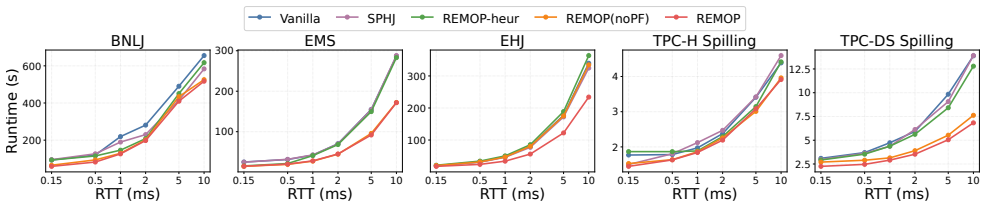
- Spilling TPC-H queries show an average 22.7 percent end-to-end runtime reduction.
- Spilling TPC-DS queries show an average 26.4 percent end-to-end runtime reduction.
- The same policies remain beneficial under tight local memory budgets where classical volume-only heuristics become suboptimal.
Reading between the lines
- Query optimizers could incorporate remote-memory round costs when choosing join algorithms or memory allocations.
- The approach may generalize to additional operators that perform repeated remote accesses.
- Systems with variable network latency could further tune the partitioning rules dynamically.
Signed reviews
Editorial analysis
A structured set of objections, weighed in public.
Referee Report
Summary. The paper presents REMOP, a framework for remote-memory-aware operator optimization in analytical database engines. It augments classical buffer-allocation heuristics with a transfer-round cost model and derives operator-specific partitioning strategies for blocked nested-loop join, external merge sort, and external hash join (instantiated in DuckDB). On a two-node compute-memory testbed, it reports up to 97% fewer transfer rounds and 48% lower operator runtime on spill-heavy microbenchmarks, plus 22.7% and 26.4% end-to-end runtime reductions on spilling TPC-H and TPC-DS queries.
Significance. If the central results hold under rigorous controls, the work addresses a genuine cost-model shift when moving from disk to remote memory and supplies concrete, operator-specific policies that could be adopted in disaggregated-memory engines. The explicit focus on round count rather than volume alone is a clear contribution; reproducible DuckDB integration would strengthen it further.
major comments (2)
- [Evaluation (two-node testbed results and TPC-H/TPC-DS runs)] The central claim that transfer-round-aware partitioning yields the reported speedups rests on the unvalidated assumption that fixed per-transfer round-trip latency dominates remote-memory cost (rather than bandwidth, contention, or CPU overhead). No breakdown of measured transfer time into latency vs. bandwidth components, nor sensitivity analysis varying the latency/bandwidth ratio, appears in the evaluation on the two-node testbed; this directly affects whether the derived partitioning strategies remain beneficial when the assumption does not hold.
- [Evaluation] The abstract and claimed results supply no workload details, error bars, number of runs, or controls for post-hoc selection; without these, the 22.7%/26.4% end-to-end figures cannot be assessed for robustness or confounding factors.
minor comments (2)
- [§3 (model and strategies)] Notation for the latency cost model and buffer-partitioning derivation should be introduced with a single running example before the three operator instantiations to improve readability.
- [Figures in Evaluation] Figure captions for microbenchmark results should explicitly state the memory budget relative to input size and the remote-memory latency/bandwidth parameters used.
Simulated Author's Rebuttal
We thank the referee for the constructive comments. We address each major comment below and will revise the manuscript accordingly to improve the evaluation section.
read point-by-point responses
-
Referee: The central claim that transfer-round-aware partitioning yields the reported speedups rests on the unvalidated assumption that fixed per-transfer round-trip latency dominates remote-memory cost (rather than bandwidth, contention, or CPU overhead). No breakdown of measured transfer time into latency vs. bandwidth components, nor sensitivity analysis varying the latency/bandwidth ratio, appears in the evaluation on the two-node testbed; this directly affects whether the derived partitioning strategies remain beneficial when the assumption does not hold.
Authors: We agree that the evaluation would be strengthened by an explicit sensitivity analysis. The REMOP cost model incorporates fixed round-trip latency as a first-class term because remote-memory transfers (e.g., via RDMA) incur non-negligible per-round overhead even when bandwidth is high; the two-node testbed results are consistent with this model. In the revision we will add (1) a measured breakdown of transfer time into latency and bandwidth components on the testbed and (2) a sensitivity study that varies the latency/bandwidth ratio while keeping the same operator policies, thereby showing under which network conditions the round-aware strategies remain advantageous. revision: yes
-
Referee: The abstract and claimed results supply no workload details, error bars, number of runs, or controls for post-hoc selection; without these, the 22.7%/26.4% end-to-end figures cannot be assessed for robustness or confounding factors.
Authors: We accept that the reporting of experimental methodology must be expanded for reproducibility and statistical rigor. The full manuscript already identifies the spilling TPC-H and TPC-DS queries, but we will revise the evaluation section to state the exact number of runs, report standard deviations or error bars on all aggregate figures, list the precise query set and memory budgets used, and describe the query-selection protocol to rule out post-hoc bias. revision: yes
Circularity Check
No circularity detected; derivation self-contained via new model and empirical evaluation
full rationale
The paper presents a new latency cost model that incorporates transfer-round count and derives operator-specific buffer partitioning for blocked nested-loop join, external merge sort, and external hash join. These strategies are instantiated in DuckDB and evaluated via direct runtime measurements on microbenchmarks and TPC-H/TPC-DS queries. No equations, fitted parameters, or self-citations are shown that reduce the claimed speedups (97% fewer rounds, 48% lower operator time, 22.7-26.4% end-to-end) back to the inputs by construction. Results are reported as observed outcomes on a two-node testbed rather than predictions forced by the model itself. The derivation chain therefore remains independent of the reported measurements.
Assumptions & free parameters
Cite this review
Pith. "Pith review of REMOP: REmote-Memory-aware OPerator Optimization." pith.science (2026). https://pith.science/paper/YTEAYDZI
@misc{pith2026260619576,
  author       = {Pith},
  title        = {Pith review of: REMOP: REmote-Memory-aware OPerator Optimization},
  year         = {2026},
  howpublished = {\url{https://pith.science/paper/YTEAYDZI}},
  note         = {Machine review of arXiv:2606.19576}
}
read the original abstract
Remote and disaggregated memory tiers expand the effective memory capacity of analytical database engines, but they also reshape the cost structure of out-of-memory query processing. When an operator spills beyond local DRAM, moving pages to remote memory incurs both data-transfer time and a fixed round-trip latency per transfer. Classical operator analyses and buffer-allocation heuristics primarily target disk spilling by minimizing total I/O volume. Under remote memory, these strategies can be suboptimal because they may trigger excessive transfer rounds. We present REMOP, a remote-memory-aware operator optimization framework that uses transfer-round-aware intra-operator memory policies to improve out-of-memory execution under tight memory budgets. REMOP introduces the number of transfer rounds into the latency cost model and derives operator-specific buffer-partitioning strategies, instantiating the approach for blocked nested-loop join, external merge sort, and external hash join in DuckDB. Our evaluation on a two-node compute-memory testbed shows that REMOP reduces transfer rounds by up to 97% and operator runtime by up to 48% on spill-heavy microbenchmarks, and lowers the average runtime of spilling TPC-H and TPC-DS queries by 22.7% and 26.4% end-to-end.
Figures


Figures from the paper (10 more)



Reference graph
Works this paper leans on
-
[1]
LeanStore: In-memory data management beyond main memory,
V . Leis, M. Haubenschild, A. Kemper, and T. Neumann, “LeanStore: In-memory data management beyond main memory,” inProceedings of the IEEE 34th International Conference on Data Engineering (ICDE), 2018, pp. 185–196. [Online]. Available: https://doi.org/10.1109/ICDE. 2018.00026
-
[2]
Umbra: A disk-based system with in-memory performance,
T. Neumann and M. J. Freitag, “Umbra: A disk-based system with in-memory performance,” inProceedings of the 10th Conference on Innovative Data Systems Research (CIDR), 2020. [Online]. Available: https://www.vldb.org/cidrdb/papers/2020/p29-neumann-cidr20.pdf
2020
-
[3]
Anti-caching: A new approach to database management system architecture,
J. A. DeBrabant, A. Pavlo, S. Tu, M. Stonebraker, and S. B. Zdonik, “Anti-caching: A new approach to database management system architecture,”Proceedings of the VLDB Endowment, vol. 6, no. 14, pp. 1942–1953, 2013. [Online]. Available: https://www.vldb.org/pvldb/ vol6/p1942-debrabant.pdf
1942
-
[4]
Resource-adaptive query execution with paged memory management,
R. Otaki, J. H. Chang, C. Benello, A. J. Elmore, and G. Graefe, “Resource-adaptive query execution with paged memory management,” in15th Annual Conference on Innovative Data Systems Research (CIDR), 2025. [Online]. Available: https://www.vldb.org/cidrdb/papers/ 2025/p2-otaki.pdf
2025
-
[5]
Dynamic memory allocation for multiple- query workloads,
M. Mehta and D. J. DeWitt, “Dynamic memory allocation for multiple- query workloads,” inProceedings of the 19th International Conference on Very Large Data Bases (VLDB). Morgan Kaufmann, 1993, pp. 354–
1993
-
[6]
Available: https://www.vldb.org/conf/1993/P354.PDF
[Online]. Available: https://www.vldb.org/conf/1993/P354.PDF
1993
-
[7]
Memory allocation strategies for complex decision support queries,
B. Nag and D. J. DeWitt, “Memory allocation strategies for complex decision support queries,” inProceedings of the 7th International Conference on Information and Knowledge Management (CIKM). ACM, 1998, pp. 116–123. [Online]. Available: https: //doi.org/10.1145/288627.288647
-
[8]
Memory-contention responsive hash joins,
D. L. Davison and G. Graefe, “Memory-contention responsive hash joins,” inProceedings of the 20th International Conference on Very Large Data Bases (VLDB). Morgan Kaufmann, 1994, pp. 379–390. [Online]. Available: https://www.vldb.org/conf/1994/P379.PDF
1994
Show all 42 references
-
[9]
Query evaluation techniques for large databases,
G. Graefe, “Query evaluation techniques for large databases,”ACM Computing Surveys, vol. 25, no. 2, pp. 73–169, 1993. [Online]. Available: https://doi.org/10.1145/152610.152611
1993 doi
-
[10]
Join processing in database systems with large main memories,
L. D. Shapiro, “Join processing in database systems with large main memories,”ACM Transactions on Database Systems, vol. 11, no. 3, pp. 239–264, 1986. [Online]. Available: https://doi.org/10.1145/6314.6315
1986 doi
-
[11]
Implementing sorting in database systems,
G. Graefe, “Implementing sorting in database systems,”ACM Computing Surveys, vol. 38, no. 3, p. 10, 2006. [Online]. Available: https://doi.org/10.1145/1132960.1132964
2006 doi
-
[12]
D. E. Knuth,The Art of Computer Programming, Volume 3: Sorting and Searching, 2nd ed. Addison-Wesley, 1998
1998
-
[13]
AIFM: High-performance, application-integrated far memory,
Z. Ruan, M. Schwarzkopf, M. K. Aguilera, and A. Belay, “AIFM: High-performance, application-integrated far memory,” inProceedings of the 14th USENIX Symposium on Operating Systems Design and Implementation (OSDI), 2020, pp. 315–332. [Online]. Available: https://www.usenix.org/...
2020
-
[14]
LegoOS: A disseminated, distributed OS for hardware resource disaggregation,
Y . Shan, Y . Huang, Y . Chen, and Y . Zhang, “LegoOS: A disseminated, distributed OS for hardware resource disaggregation,” inProceedings of the 13th USENIX Symposium on Operating Systems Design and Implementation (OSDI), 2018, pp. 69–87. [Online]. Available: https://www.usen...
2018
-
[15]
Pond: CXL-based memory pooling systems for cloud platforms,
H. Li, D. S. Berger, L. Hsu, D. Ernst, P. Zardoshti, S. Novakovic, M. Shah, S. Rajadnya, S. Lee, I. Agarwal, M. D. Hill, M. Fontoura, and R. Bianchini, “Pond: CXL-based memory pooling systems for cloud platforms,” inProceedings of the 28th ACM International Conference on Archi...
2023 doi
-
[16]
An examination of CXL memory use cases for in-memory database management systems using SAP HANA,
M. Ahn, T. Willhalm, N. May, D. Lee, S. Mutalik Desai, D. Booss, J. Kim, N. Singh, D. Ritter, and O. Rebholz, “An examination of CXL memory use cases for in-memory database management systems using SAP HANA,”Proceedings of the VLDB Endowment, vol. 17, no. 12, pp. 3827–3840, 20...
2024
-
[17]
µscope: Evaluating storage stack robustness against SSD’s latency variation,
S. Bai, H. Chen, K. Tan, L. Xu, X. Zhang, H. Wang, J. Wu, S. Xu, and H. Chen, “µscope: Evaluating storage stack robustness against SSD’s latency variation,”Journal of Systems Architecture, vol. 164, p. 103405, 2025, accessed: 2026-02-18. [Online]. Available: https://doi.org/10...
2025 doi
-
[18]
Latency numbers every programmer should know,
J. Dean, “Latency numbers every programmer should know,” https://gist. github.com/jboner/2841832, 2012, accessed: 2026-02-16
2012
-
[19]
Intel ethernet controller X550: Product brief,
Intel Corporation, “Intel ethernet controller X550: Product brief,” https://cdrdv2-public.intel.com/333293/ 333293-intel-ethernet-controller-x550-brief.pdf, 2016, accessed: 2026-02-18
2016
-
[20]
DDR4 UDIMM (e.g., pc4-3200): Module specifications,
Micron Technology, Inc., “DDR4 UDIMM (e.g., pc4-3200): Module specifications,” https://www.digikey.com/en/products/detail/ micron-technology-inc/MTA8ATF1G64AZ-3G2E1/10425652, 2019, accessed: 2026-02-18
2019
-
[21]
Performance characteristics of common network fabrics,
Microway, “Performance characteristics of common network fabrics,” https://www.microway.com/knowledge-center-articles/ performance-characteristics-of-common-network-fabrics/, 2013, accessed: 2026-02-18
2013
-
[22]
Seagate Nytro 1370 SSD product manual (210603000, rev. a),
Seagate Technology LLC, “Seagate Nytro 1370 SSD product manual (210603000, rev. a),” https://www.seagate.com/content/dam/seagate/ assets/support/enterprise-storage/solid-state-drives/nytro-1370-sata-ssd/ shared/files/Seagate Nytro 1370 SATA SSD Product Manual 210603000A.pdf, 2...
2025
-
[23]
REMON: A remote memory system for database operators,
S. Zhanget al., “REMON: A remote memory system for database operators,” 2026, accepted at IEEE ICDE 2026
2026
-
[24]
Efficient memory disaggregation with Infiniswap,
J. Gu, Y . Lee, Y . Zhang, M. Chowdhury, and K. G. Shin, “Efficient memory disaggregation with Infiniswap,” inProceedings of the 14th USENIX Symposium on Networked Systems Design and Implementation (NSDI), 2017, pp. 649–667. [Online]. Available: https: //www.usenix.org/confere...
2017
-
[25]
Access path selection in a relational database management system,
P. G. Selinger, M. M. Astrahan, D. D. Chamberlin, R. A. Lorie, and T. G. Price, “Access path selection in a relational database management system,” inProceedings of the ACM SIGMOD International Conference on Management of Data, 1979, pp. 23–34
1979
-
[26]
How good are query optimizers, really?
V . Leis, A. Gubichev, A. Mirchev, P. Boncz, A. Kemper, and T. Neumann, “How good are query optimizers, really?”Proceedings of the VLDB Endowment, vol. 9, no. 3, pp. 204–215, 2015. [Online]. Available: https://vldb.org/pvldb/vol9/p204-leis.pdf
2015
-
[27]
The input/output complexity of sorting and related problems,
A. Aggarwal and J. S. Vitter, “The input/output complexity of sorting and related problems,”Communications of the ACM, vol. 31, no. 9, pp. 1116–1127, 1988. [Online]. Available: https: //doi.org/10.1145/48529.48535
1988 doi
-
[28]
Memory-adaptive external sorting,
H. Pang, M. J. Carey, and M. Livny, “Memory-adaptive external sorting,” inProceedings of the 19th International Conference on Very Large Data Bases (VLDB), 1993, pp. 618–629. [Online]. Available: https://www.vldb.org/conf/1993/P618.PDF
1993
-
[29]
DuckDB: An embeddable analytical database,
M. Raasveldt and H. M ¨uhleisen, “DuckDB: An embeddable analytical database,” inProceedings of the ACM SIGMOD International Conference on Management of Data, 2019, pp. 1981–1984. [Online]. Available: https://doi.org/10.1145/3299869.3320212
2019 doi
-
[30]
Saving private hash join,
L. Kuiper, P. Gross, P. Boncz, and H. M ¨uhleisen, “Saving private hash join,”Proceedings of the VLDB Endowment, vol. 18, no. 8, pp. 2748–2760, 2025. [Online]. Available: https://www.vldb.org/pvldb/ vol18/p2748-kuiper.pdf
2025
-
[31]
Robust external hash aggrega- tion in the solid state age,
L. Kuiper, P. Boncz, and H. M ¨uhleisen, “Robust external hash aggrega- tion in the solid state age,” in2024 IEEE 40th International Conference on Data Engineering (ICDE). IEEE, 2024, pp. 3753–3766
2024
-
[32]
TPC-H benchmark,
Transaction Processing Performance Council, “TPC-H benchmark,” https://www.tpc.org/tpch/, 2026, accessed: 2026-02-18
2026
-
[33]
TPC-DS benchmark,
——, “TPC-DS benchmark,” https://www.tpc.org/tpcds/, 2026, ac- cessed: 2026-02-18
2026
-
[34]
tc-netem(8): Network emulator,
S. Hemminger, “tc-netem(8): Network emulator,” https://man7.org/linux/ man-pages/man8/tc-netem.8.html, 2011, accessed: 2026-02-22
2011
-
[35]
Disaggregated memory for expansion and sharing in blade servers,
K. Lim, J. Chang, T. Mudge, P. Ranganathan, S. K. Reinhardt, and T. F. Wenisch, “Disaggregated memory for expansion and sharing in blade servers,” inProceedings of the 36th International Symposium on Computer Architecture (ISCA), 2009, pp. 267–278. [Online]. Available: https:/...
2009 doi
-
[36]
Laser: Buffer-aware learned query scheduling in master-standby databases,
Y . Huang and G. Li, “Laser: Buffer-aware learned query scheduling in master-standby databases,”Proceedings of the VLDB Endowment, vol. 18, no. 3, pp. 743–755, 2024. [Online]. Available: https: //www.vldb.org/pvldb/vol18/p743-huang.pdf
2024
-
[37]
An adaptive hash join algorithm for multiuser environments,
H. Zeller and J. Gray, “An adaptive hash join algorithm for multiuser environments,” inProceedings of the 16th International Conference on Very Large Data Bases (VLDB), 1990, pp. 186–197
1990
-
[38]
Design trade-offs for a robust dynamic hybrid hash join,
S. Jahangiri, M. J. Carey, and J. Freytag, “Design trade-offs for a robust dynamic hybrid hash join,”Proceedings of the VLDB Endowment, vol. 15, no. 10, pp. 2257–2269, 2022. [Online]. Available: https://www.vldb.org/pvldb/vol15/p2257-jahangiri.pdf
2022
-
[39]
Dynamic memory adjustment for external mergesort,
W. Zhang and P.- ˚A. Larson, “Dynamic memory adjustment for external mergesort,” inProceedings of the 23rd International Conference on Very Large Data Bases (VLDB), 1997, pp. 376–385. [Online]. Available: https://www.vldb.org/conf/1997/P376.PDF
1997
-
[40]
Multi-core, main-memory joins: Sort vs. hash revisited,
C. Balkesen, G. Alonso, J. Teubner, and M. T. ¨Ozsu, “Multi-core, main-memory joins: Sort vs. hash revisited,”Proceedings of the VLDB Endowment, vol. 7, no. 1, pp. 85–96, 2013. [Online]. Available: https://www.vldb.org/pvldb/vol7/p85-balkesen.pdf
2013
-
[41]
Efficient graph data access for out-of-memory GPU streaming graph processing,
Y . Wang, D. Li, Y . Qiao, R. Liao, and W. Guo, “Efficient graph data access for out-of-memory GPU streaming graph processing,” Proceedings of the VLDB Endowment, vol. 18, no. 11, pp. 3854– 3867, 2025. [Online]. Available: https://www.vldb.org/pvldb/vol18/ p3854-wang.pdf
2025
-
[42]
A note on operator-level query execution cost modeling,
W. Wu, “A note on operator-level query execution cost modeling,” arXiv, 2020. [Online]. Available: https://arxiv.org/abs/2003.04410
2020
Reviewed June 26, 2026 · model on record in the stance chip above.
Discussion (0). Continue with ORCID to comment.