Query-aware Routing for Filtered Approximate Nearest Neighbors Search
Reviewed by Pith T0 review T1 audit T2 compute T3 formal T4 kernel 2026-06-26 15:28 UTCgrok-4.3pith:ZLIR4YH4record.jsonopen to challenge →
The pith
A lightweight model routes each filtered ANN query to the method with the best recall-QPS tradeoff for that query.
A machine-rendered reading of the paper's core claim, the machinery that carries it, and where it could break.
Core claim
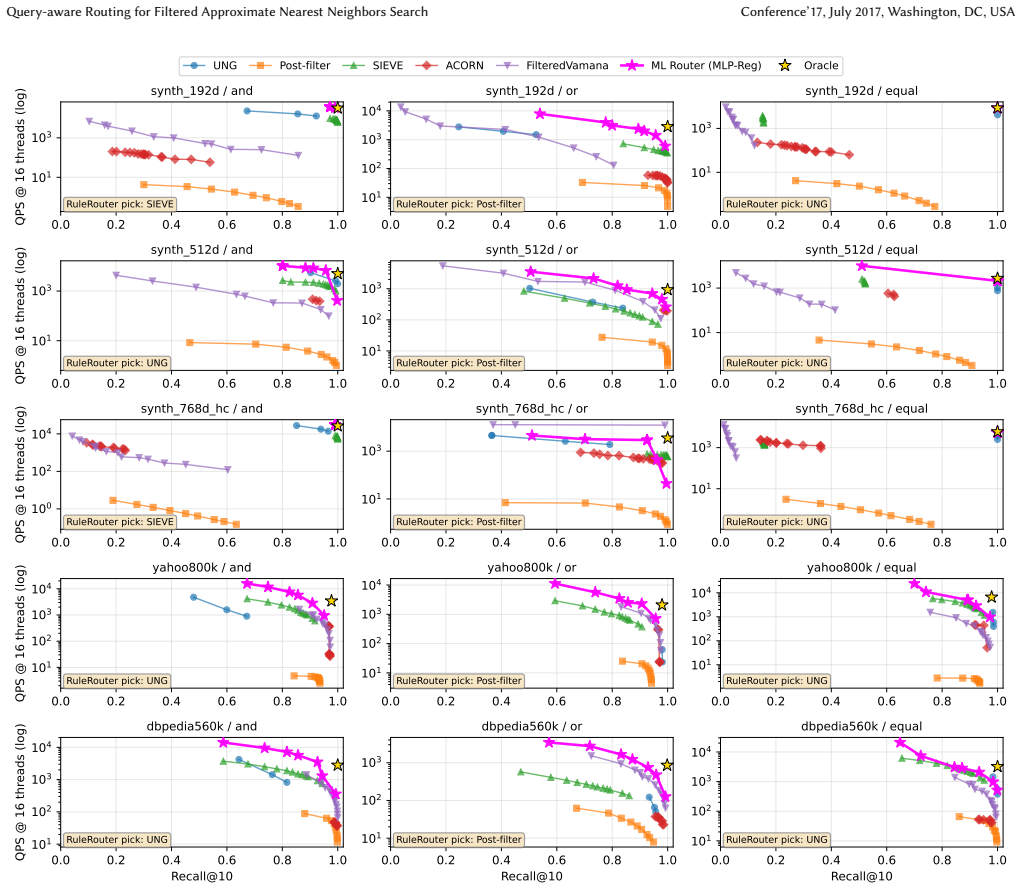
No single categorical filtered ANN method dominates across datasets and predicates, and the best method for a given query can change even within a single dataset and predicate. The query-aware router therefore uses a lightweight regression model, narrowed by ablation to three features, to predict each method's recall on the incoming query; it then consults a precomputed table that records the actual recall and QPS of every method-parameter pair and selects the pair offering the best recall-QPS tradeoff. The model is trained on six real-world datasets and evaluated on five held-out validation datasets, where the router matches or exceeds the recall-QPS frontier of all existing filtered ANN ba
What carries the argument
Query-aware routing framework that combines a three-feature regression recall predictor with an offline benchmark table mapping each method and parameter setting to its measured recall and QPS.
If this is right
- Vector databases can replace a single fixed filtered ANN method with dynamic per-query selection without rebuilding indexes.
- The same router design improves the recall-QPS operating point on every one of the five validation datasets tested.
- Only three query features are required to keep prediction accurate enough for the router to outperform static baselines.
- Adding the router introduces negligible latency overhead while still achieving state-of-the-art balance on unseen data.
Where Pith is reading between the lines
- The routing approach could be applied to other query-time choices in databases, such as selecting between different index structures or join algorithms.
- If the three-feature model continues to generalize, production systems could reduce manual parameter tuning for filtered ANN workloads.
- The technique mirrors cost-model-driven operator selection in traditional query optimizers, suggesting a broader pattern for adaptive retrieval pipelines.
Load-bearing premise
The lightweight regression model trained on six datasets can accurately predict recall for each candidate method on queries from five unseen validation datasets using only the final three features.
What would settle it
Measure whether the router's chosen methods on a sixth unseen dataset actually deliver higher recall at the same QPS than the single best fixed baseline across the same queries.
Figures


read the original abstract
Filtered ANN search, which combines vector similarity with attribute predicates, is a core primitive in modern vector databases and retrieval-augmented generation. We benchmark all major categorical filtered ANN methods across multiple datasets under three predicates and find that no single method dominates. Moreover, even within a single dataset and predicate type, the best method for a query can vary. Therefore, we propose a query-aware routing framework. A lightweight ML model predicts each candidate method's recall on the query, and the router consults an offline benchmark table that maps every method and parameter setting to its measured recall and QPS, then selects the method with the best recall--QPS trade-off. Our ablation study narrows 22 candidate features to a minimal set of three and we adopt regression rather than classification as the prediction target to sharpen accuracy. Our model is trained on six real-world datasets and applied to five unseen validation datasets. The final result shows that our router achieves state-of-the-art recall and QPS balance across all five validation datasets compared to existing filtered ANN baselines, while incurring negligible latency overhead.
Editorial analysis
A structured set of objections, weighed in public.
Referee Report
Summary. The paper benchmarks major categorical filtered ANN methods across datasets and predicates, finding no single method dominates and that the best method can vary even within a dataset. It proposes a query-aware router that trains a lightweight regression model (reduced via ablation from 22 to 3 features) on six datasets to predict per-query recall for candidate methods, then uses an offline table of measured recall/QPS values to select the method-parameter pair with the best trade-off. The model is applied to five unseen validation datasets, with the claim that the router achieves SOTA recall-QPS balance versus baselines at negligible latency cost.
Significance. If the reported generalization holds, the framework addresses a practical limitation in filtered ANN search for vector databases by enabling dynamic, query-specific method selection without significant overhead. The choice of regression over classification and the feature ablation are constructive steps toward deployable systems; the offline table plus predictor approach is a reasonable engineering pattern when the predictor is shown to be reliable.
major comments (3)
- [Abstract] Abstract: the SOTA recall-QPS claim on the five validation datasets is load-bearing on the three-feature regression model's accuracy, yet the manuscript reports no per-dataset prediction error (e.g., MAE, R²), correlation, or ablation-retention metrics on the held-out validation split to confirm that the feature reduction preserves predictive power for unseen data.
- [Experimental results] The experimental results section (and abstract) states consistent gains on five validation sets after training on six others, but provides no error bars, exact dataset statistics, or full experimental protocol (training procedure, hyper-parameters, query sampling), leaving the magnitude and reliability of the gains difficult to assess.
- [Query-aware routing framework] The router's selection logic relies on an external offline benchmark table; it is unclear from the description whether this table was constructed independently for the validation datasets or whether any form of data leakage exists between the table construction and the validation queries.
minor comments (2)
- [Ablation study] Notation for the three retained features after ablation should be defined explicitly (e.g., what the final three features represent) rather than left as 'the final three features.'
- The manuscript would benefit from a table or figure showing the distribution of selected methods across the validation queries to illustrate that routing is indeed query-dependent.
Simulated Author's Rebuttal
We thank the referee for the detailed and constructive feedback. We address each major comment below. Where the comments identify missing details or clarity issues, we will revise the manuscript to incorporate the requested information and clarifications.
read point-by-point responses
-
Referee: [Abstract] Abstract: the SOTA recall-QPS claim on the five validation datasets is load-bearing on the three-feature regression model's accuracy, yet the manuscript reports no per-dataset prediction error (e.g., MAE, R²), correlation, or ablation-retention metrics on the held-out validation split to confirm that the feature reduction preserves predictive power for unseen data.
Authors: We agree that explicit per-dataset metrics on the validation split would better substantiate the generalization claim. In the revision we will add a table reporting MAE, R², Pearson correlation, and ablation-retention statistics for the three-feature model on each of the five held-out validation datasets individually. revision: yes
-
Referee: [Experimental results] The experimental results section (and abstract) states consistent gains on five validation sets after training on six others, but provides no error bars, exact dataset statistics, or full experimental protocol (training procedure, hyper-parameters, query sampling), leaving the magnitude and reliability of the gains difficult to assess.
Authors: The current version indeed omits these details. We will expand the experimental results section to include error bars on all reported recall-QPS figures, exact per-dataset statistics (size, dimensionality, predicate distributions), and a complete protocol subsection specifying training procedure, hyper-parameters, cross-validation folds, and query sampling methodology. revision: yes
-
Referee: [Query-aware routing framework] The router's selection logic relies on an external offline benchmark table; it is unclear from the description whether this table was constructed independently for the validation datasets or whether any form of data leakage exists between the table construction and the validation queries.
Authors: The offline table for each validation dataset was built using a disjoint query workload sampled independently from the queries used to evaluate the router. No queries or embeddings from the validation evaluation set were used to populate the table. We will revise the framework description to state this separation explicitly and add a short paragraph confirming the absence of leakage. revision: yes
Circularity Check
No significant circularity; derivation uses independently measured table and held-out validation data
full rationale
The paper's router selects methods via an offline table of measured QPS/recall values plus a regression model trained on six datasets (with three features from ablation) and applied to five unseen validation datasets. No step reduces a reported gain to a quantity defined by the same fitted parameters, no self-citation is load-bearing, and the central claim rests on external measurements plus generalization to held-out data rather than any self-definitional or fitted-input reduction.
Axiom & Free-Parameter Ledger
Reference graph
Works this paper leans on
-
[1]
Houle, Ken-ichi Kawarabayashi, and Michael Nett
Laurent Amsaleg, Oussama Chelly, Teddy Furon, Stéphane Girard, Michael E. Houle, Ken-ichi Kawarabayashi, and Michael Nett. 2015. Estimating Local In- trinsic Dimensionality. InProceedings of the 21st ACM SIGKDD International Conference on Knowledge Discovery and Data Mining. ACM, 29–38. doi:10.1145/ 2783258.2783405
-
[2]
Martin Aumüller, Erik Bernhardsson, and Alexander Faithfull. 2020. ANN- Benchmarks: A Benchmarking Tool for Approximate Nearest Neighbor Algo- rithms.Information Systems87 (2020), 101374. doi:10.1016/j.is.2019.02.006
-
[3]
Nicolas Bonneel, Julien Rabin, Gabriel Peyré, and Hanspeter Pfister. 2015. Sliced and Radon Wasserstein Barycenters of Measures.Journal of Mathematical Imag- ing and Vision51, 1 (2015), 22–45. Query-aware Routing for Filtered Approximate Nearest Neighbors Search Conference’17, July 2017, Washington, DC, USA 0.0 0.2 0.4 0.6 0.8 1.0 101 103 QPS @ 16 threads...
2015
-
[4]
Yuzheng Cai, Jiayang Shi, Yizhuo Chen, and Weiguo Zheng. 2024. Navigating La- bels and Vectors: A Unified Approach to Filtered Approximate Nearest Neighbor Search.Proceedings of the ACM on Management of Data2, 6, Article 246 (2024), 27 pages. doi:10.1145/3698822
-
[5]
Tingyang Chen, Cong Fu, Jiahua Wu, Haotian Wu, Hua Fan, Xiangyu Ke, Yunjun Gao, Yabo Ni, and Anxiang Zeng. 2026. Reveal Hidden Pitfalls and Navigate Next Generation of Vector Similarity Search from Task-Centric Views. InProceedings of the ACM SIGMOD International Conference on Management of Data (SIGMOD’26). Association for Computing Machinery. arXiv:2512.12980
-
[6]
Joshua Engels, Ben Landrum, Shangdi Yu, Laxman Dhulipala, and Julian Shun
-
[7]
InProceedings of the 41st International Conference on Machine Learning (ICML)
Approximate Nearest Neighbor Search with Window Filters. InProceedings of the 41st International Conference on Machine Learning (ICML). PMLR, 12469– 12490. https://proceedings.mlr.press/v235/engels24a.html
- [8]
-
[9]
Siddharth Gollapudi, Neel Karia, Varun Sivashankar, Ravishankar Krishnaswamy, Nikit Begwani, Swapnil Raz, Yiyong Lin, Yin Zhang, Neelam Mahapatro, Premku- mar Srinivasan, Amit Singh, and Harsha Vardhan Simhadri. 2023. Filtered- DiskANN: Graph Algorithms for Approximate Nearest Neighbor Search with Filters. InProceedings of the ACM Web Conference 2023. Ass...
- [10]
-
[11]
Junfeng He, Sanjiv Kumar, and Shih-Fu Chang. 2012. On the Difficulty of Nearest Neighbor Search. InProceedings of the 29th International Conference on Machine Learning (ICML). 1127–1134
2012
-
[12]
Jeff Johnson, Matthijs Douze, and Hervé Jégou. 2019. Billion-Scale Similarity Search with GPUs.IEEE Transactions on Big Data7, 3 (2019), 535–547
2019
-
[13]
Zhaoheng Li, Silu Huang, Wei Ding, Yongjoo Park, and Jianjun Chen. 2025. SIEVE: Effective Filtered Vector Search with Collection of Indexes. InProceedings of the VLDB Endowment, Vol. 18
2025
-
[14]
Anqi Liang, Pengcheng Zhang, Bin Yao, Zhongpu Chen, Yitong Song, and Guangxu Cheng. 2025. UNIFY: Unified Index for Range Filtered Approximate Nearest Neighbors Search.Proceedings of the VLDB Endowment18, 4 (2025), 1118–1130. doi:10.14778/3717755.3717770
- [15]
-
[16]
Yu. A. Malkov and D. A. Yashunin. 2018. Efficient and Robust Approximate Nearest Neighbor Search Using Hierarchical Navigable Small World Graphs.IEEE Transactions on Pattern Analysis and Machine Intelligence(2018). arXiv:1603.09320
work page internal anchor Pith review Pith/arXiv arXiv 2018
- [17]
-
[18]
Pinecone Systems, Inc. 2024. Pinecone: Vector Database for Machine Learning. https://www.pinecone.io. Accessed: 2025-01-15
2024
-
[19]
John R. Rice. 1976. The Algorithm Selection Problem. InAdvances in Computers. Vol. 15. Elsevier, 65–118. doi:10.1016/S0065-2458(08)60520-3
- [20]
-
[21]
Harsha Vardhan Simhadri, George Williams, Martin Aumüller, Matthijs Douze, Artem Babenko, Dmitry Baranchuk, Qi Chen, Lucas Hosseini, Ravishankar Kr- ishnaswamy, Gopal Srinivasa, Suhas Jayaram Subramanya, and Jingdong Wang
-
[22]
InProceedings of the NeurIPS 2021 Competitions and Demonstra- tions Track
Results of the NeurIPS’21 Challenge on Billion-Scale Approximate Nearest Neighbor Search. InProceedings of the NeurIPS 2021 Competitions and Demonstra- tions Track. PMLR
2021
-
[23]
Suhas Jayaram Subramanya, Fnu Devvrit, Harsha Vardhan Simhadri, Ravishankar Krishnawamy, and Rohan Kadekodi. 2019. DiskANN: Fast Accurate Billion-point Nearest Neighbor Search on a Single Node. InAdvances in Neural Information Processing Systems (NeurIPS), Vol. 32. Curran Associates, Inc
2019
-
[24]
Shamma, Gerald Friedland, Benjamin Elizalde, Karl Ni, Douglas Poland, Damian Borth, and Li-Jia Li
Bart Thomee, David A. Shamma, Gerald Friedland, Benjamin Elizalde, Karl Ni, Douglas Poland, Damian Borth, and Li-Jia Li. 2016. YFCC100M: The New Data in Multimedia Research.Commun. ACM59, 2 (2016), 64–73
2016
-
[25]
Jianguo Wang, Xiaomeng Yi, Rentong Guo, Hai Jin, Peng Xu, Shengjun Li, Xi- angyu Wang, Xiangzhou Guo, Chengming Li, Xiaohai Xu, Kun Yu, Yuxing Yuan, Yinghao Zou, Jiquan Long, Yudong Cai, Zhenxiang Li, Zhifeng Zhang, Yihua Mo, Jun Gu, Ruiyi Jiang, Yi Wei, and Charles Xie. 2021. Milvus: A Purpose- Built Vector Data Management System. InProceedings of the 20...
-
[26]
Mengzhao Wang, Lingwei Lv, Xiaoliang Xu, Yuxiang Wang, Qiang Yue, and Jiongkang Ni. 2023. An Efficient and Robust Framework for Approximate Nearest Neighbor Search with Attribute Constraint. InAdvances in Neural Information Processing Systems (NeurIPS), Vol. 36. 15738–15751
2023
-
[27]
Yuxiang Wang, Ziyuan He, Yongxin Tong, Zimu Zhou, and Yiman Zhong. 2025. Timestamp Approximate Nearest Neighbor Search over High-Dimensional Vec- tor Data. InProceedings of the 2025 IEEE 41st International Conference on Data Engineering (ICDE). IEEE, 3043–3055. doi:10.1109/ICDE65448.2025.00228
-
[28]
Weaviate B.V. 2024. Weaviate: Open-Source Vector Search Engine. https:// weaviate.io. Accessed: 2025-01-15
2024
-
[29]
Chuangxian Wei, Bin Wu, Sheng Wang, Renjie Lou, Chaoqun Zhan, Feifei Li, and Yuanzhe Cai. 2020. AnalyticDB-V: a hybrid analytical engine towards query fusion for structured and unstructured data.Proc. VLDB Endow.13, 12 (2020), 3152–3165
2020
- [30]
-
[31]
Lin Xu, Frank Hutter, Holger H. Hoos, and Kevin Leyton-Brown. 2008. SATzilla: Portfolio-based Algorithm Selection for SAT.Journal of Artificial Intelligence Research32 (2008), 565–606. doi:10.1613/jair.2490
-
[32]
Yuexuan Xu, Jianyang Gao, Yutong Gou, Cheng Long, and Christian S. Jensen
-
[33]
irangegraph: Improvising range-dedicated graphs for range-filtering nearest neighbor search,
iRangeGraph: Improvising Range-dedicated Graphs for Range-filtering Nearest Neighbor Search.Proceedings of the ACM on Management of Data2, 6, Article 239 (2024), 26 pages. doi:10.1145/3698814
-
[34]
Fangyuan Zhang, Mengxu Jiang, Guanhao Hou, Jieming Shi, Hua Fan, Wenchao Zhou, Feifei Li, and Sibo Wang. 2025. Efficient Dynamic Indexing for Range Filtered Approximate Nearest Neighbor Search.Proceedings of the ACM on Management of Data3, 3, Article 152 (2025), 26 pages. doi:10.1145/3725401
-
[35]
Qianxi Zhang, Shuotao Xu, Qi Chen, Guoxin Sui, Jiadong Xie, Zhizhen Cai, Yaoqi Chen, Yinxuan He, Yuqing Yang, Fan Yang, Mao Yang, and Lidong Zhou. 2023. VBASE: Unifying Online Vector Similarity Search and Relational Queries via Relaxed Monotonicity. InProceedings of the 17th USENIX Symposium on Operating Systems Design and Implementation (OSDI 2023). USEN...
2023
-
[36]
Xiang Zhang, Junbo Zhao, and Yann LeCun. 2015. Character-Level Convolutional Networks for Text Classification. InAdvances in Neural Information Processing Systems. 649–657
2015
-
[37]
Chaoji Zuo and Dong Deng. 2023. ARKGraph: All-Range Approximate K-Nearest- Neighbor Graph.Proceedings of the VLDB Endowment16, 10 (2023), 2645–2658. doi:10.14778/3603581.3603601
-
[38]
Chaoji Zuo, Miao Qiao, Wenchao Zhou, Feifei Li, and Dong Deng. 2024. SeRF: Segment Graph for Range-Filtering Approximate Nearest Neighbor Search.Pro- ceedings of the ACM on Management of Data2, 1, Article 69 (2024), 26 pages. doi:10.1145/3639324
discussion (0)
Sign in with ORCID, Apple, or X to comment. Anyone can read and Pith papers without signing in.