A FAST search for radio pulsations during the dormant state of the AMSPs IGR J00291+5934 and MAXI J1957+032
Pith reviewed 2026-06-26 16:16 UTC · model grok-4.3
The pith
No radio pulsations detected from two accreting millisecond pulsars during quiescence, yielding the tightest upper limits yet.
A machine-rendered reading of the paper's core claim, the machinery that carries it, and where it could break.
Core claim
No significant candidate signals for coherent periodicities were identified in the FAST L-band data for IGR J00291+5934 or MAXI J1957+032 at the known spin frequencies or elsewhere. The sources were observed in quiescence based on X-ray and optical upper limits. This non-detection translates to pulsed radio flux density upper limits of 3.3 μJy and 5.6 μJy respectively, the most stringent reported for any persistent accreting millisecond pulsar.
What carries the argument
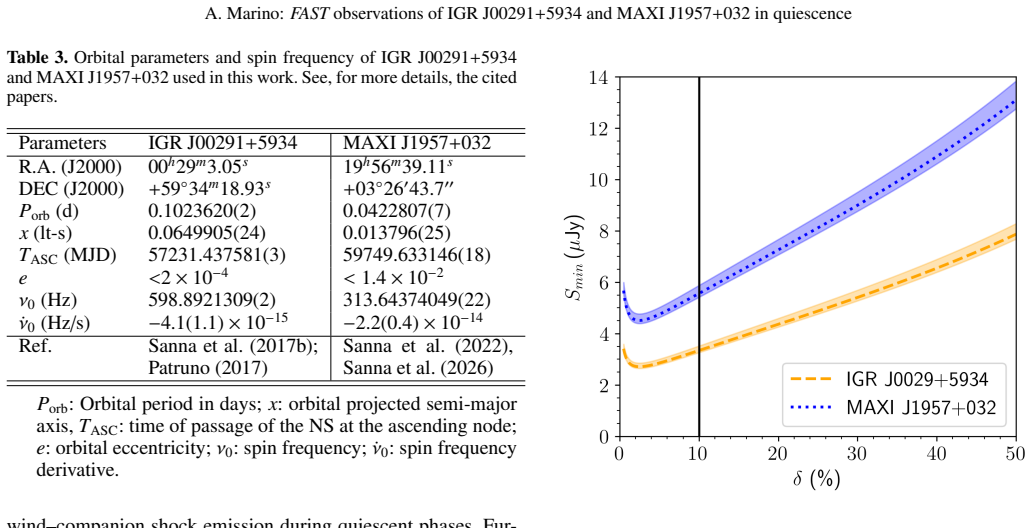
Search for coherent periodic signals in FAST radio time series, with flux-density sensitivity calculated assuming a 10% pulse duty cycle.
If this is right
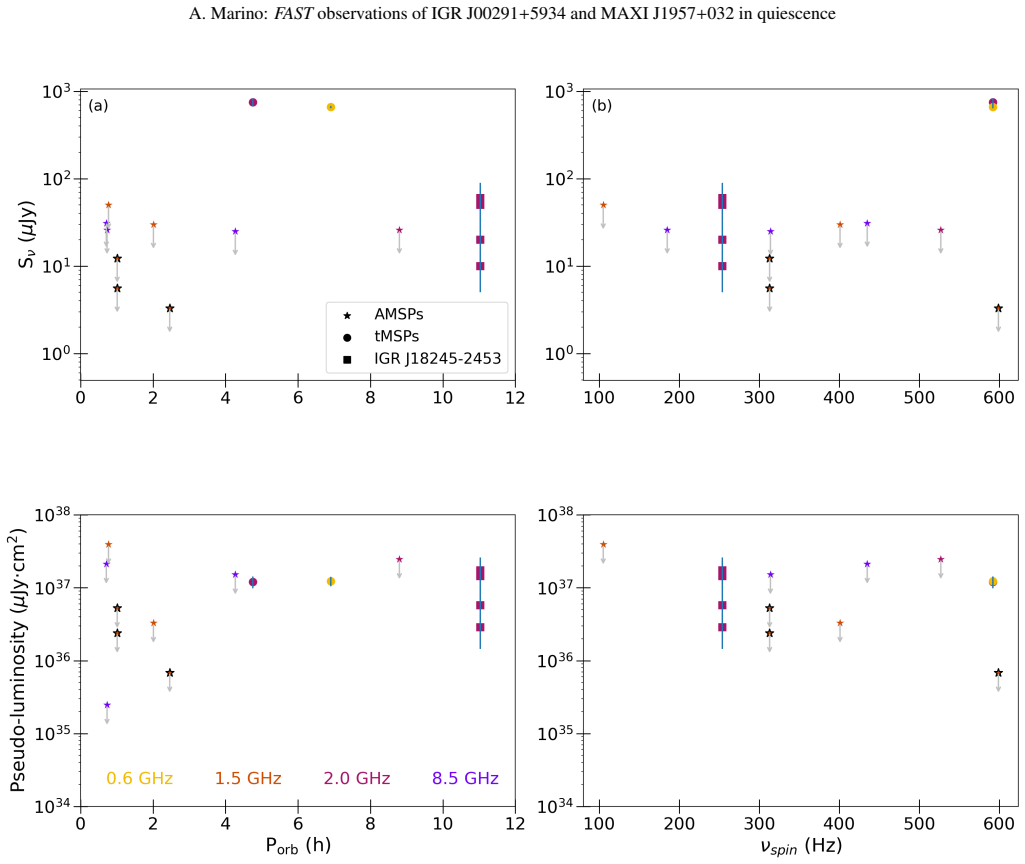
- Persistent AMSPs may remain radio-quiet in quiescence, unlike some tMSPs.
- These flux limits provide the strongest observational benchmark for radio emission models of dormant AMSPs.
- The distinction in radio behavior between AMSPs and tMSPs is reinforced by the absence of detectable pulsations.
- Deeper or multi-frequency observations would be needed to probe emission below the reported thresholds.
Where Pith is reading between the lines
- If the non-detection holds, it may point to differences in magnetic field burial or spin evolution between persistent AMSPs and transitional systems.
- Population synthesis models of recycled pulsars could be updated to account for a possible radio-silent phase in AMSP descendants.
Load-bearing premise
The sources were in a fully quiescent state with no accretion, as inferred from X-ray and optical upper limits.
What would settle it
Detection of pulsed radio emission above 3.3 μJy or 5.6 μJy at the spin frequency during simultaneous confirmation of X-ray quiescence.
Figures
read the original abstract
Accreting millisecond pulsars (AMSPs) and transitional millisecond pulsars (tMSPs) are neutron star low-mass X-ray binaries which can evolve into "recycled" radio millisecond pulsars. In both types of systems, X-ray pulsations have been detected during phases of X-ray activity when matter accretion through a disc is turned on. On the other hand, when accretion stops, and these systems enter the quiescent, low-luminosity X-ray state, only tMSPs become visible as radio pulsars. Despite several attempts, radio pulsations have never been detected in quiescent AMSPs, except for IGR J18245$-$2452. In this manuscript, we present the results of two observational campaigns performed on the AMSPs IGR J00291+5934 and MAXI J1957+032 with the Five-hundred-meter Aperture Spherical Telescope ($\it{FAST}$) in L-band (1-1.5 GHz). Both sources have most likely been observed in quiescence, as suggested by the upper limits on their X-ray and optical flux obtained with Swift and the Las Cumbres Observatory, respectively. We have performed a deep search for coherent periodicities in radio but found no significant candidate signal, either at the known spin frequency of those sources or at other frequencies. Assuming a pulse duty cycle of 10%, we derive upper limits on the pulsed radio flux density of 3.3 $\mu$Jy and 5.6 $\mu$Jy for IGR J00291+5934 and MAXI J1957+032, respectively, which are the most stringent limits so far for any known persistent AMSP.
Editorial analysis
A structured set of objections, weighed in public.
Referee Report
Summary. The paper reports results from FAST L-band observations of two persistent accreting millisecond pulsars (AMSPs), IGR J00291+5934 and MAXI J1957+032. The sources are inferred to have been observed in quiescence based on Swift X-ray and Las Cumbres optical upper limits. A search for coherent radio pulsations at the known spin frequencies and across a broader parameter space yielded no detections. Assuming a 10% pulse duty cycle, the authors derive pulsed flux-density upper limits of 3.3 μJy and 5.6 μJy, respectively, which they state are the most stringent limits obtained for any known persistent AMSP.
Significance. If the quiescence assumption holds, the non-detections and resulting upper limits provide the deepest constraints to date on radio pulsed emission from persistent AMSPs in the dormant state. This is useful for comparing AMSPs to transitional MSPs, which do show radio pulsations in quiescence, and for testing models of accretion-disk–magnetosphere interaction at low luminosities. The use of FAST enables sensitive searches, and the explicit non-detection at the known spin period is a clear observational result.
major comments (1)
- [Abstract, §2] Abstract and §2: The central claim that the derived upper limits constrain dormant-state radio emission rests on the sources having been observed in true quiescence. The manuscript infers this solely from Swift X-ray and Las Cumbres optical upper limits without providing a direct comparison to the sources’ previously established quiescent X-ray luminosities or simultaneous deeper X-ray monitoring. Residual accretion below these limits would place the observations outside the dormant regime, rendering the 3.3/5.6 μJy limits inapplicable to the headline claim.
minor comments (1)
- [Abstract] The assumption of a 10% duty cycle for the upper-limit calculation is stated but not justified against the range of duty cycles observed in other radio MSPs; a brief sensitivity analysis varying this parameter would improve robustness.
Simulated Author's Rebuttal
We thank the referee for their constructive comments on our manuscript. We address the major comment point-by-point below and will revise the paper accordingly where appropriate.
read point-by-point responses
-
Referee: [Abstract, §2] Abstract and §2: The central claim that the derived upper limits constrain dormant-state radio emission rests on the sources having been observed in true quiescence. The manuscript infers this solely from Swift X-ray and Las Cumbres optical upper limits without providing a direct comparison to the sources’ previously established quiescent X-ray luminosities or simultaneous deeper X-ray monitoring. Residual accretion below these limits would place the observations outside the dormant regime, rendering the 3.3/5.6 μJy limits inapplicable to the headline claim.
Authors: We agree that strengthening the quiescence argument with explicit comparisons improves the manuscript. In the revised version we will expand §2 to include direct comparisons between our Swift X-ray upper limits and the previously published quiescent X-ray luminosities for both sources (drawn from the literature). We will also add a brief discussion of the implications of non-simultaneous monitoring and the low probability of undetected residual accretion at the observed flux levels. These additions will make the dormant-state interpretation more robust while preserving the original claim that the observations were most likely in quiescence. revision: yes
Circularity Check
No circularity: upper limits follow directly from non-detection under stated assumptions
full rationale
The paper reports FAST L-band observations of two AMSPs, states that no significant periodic signals were found at the known spin periods or elsewhere, and derives pulsed-flux upper limits (3.3 μJy and 5.6 μJy) by applying a standard sensitivity calculation under an assumed 10% duty cycle. Quiescence is asserted on the basis of separate Swift X-ray and Las Cumbres optical upper limits; this is an external assumption about the accretion state rather than a self-referential step inside the radio analysis. No equations, parameter fits, or self-citations are invoked that reduce the reported limits to the inputs by construction. The result is therefore a direct observational bound and self-contained against external benchmarks.
Axiom & Free-Parameter Ledger
free parameters (1)
- pulse duty cycle =
10%
axioms (1)
- domain assumption Sources were in quiescence during the radio observations
Reference graph
Works this paper leans on
-
[1]
A., Cheng, A
Alpar, M. A., Cheng, A. F., Ruderman, M. A., & Shaham, J. 1982, Nature, 300, 728
1982
-
[2]
2021, Nature Astronomy, 5, 552–559
Ambrosino, F., Miraval Zanon, A., Papitto, A., et al. 2021, Nature Astronomy, 5, 552–559
2021
-
[3]
2017, Nature Astronomy, 1, 854
Ambrosino, F., Papitto, A., Stella, L., et al. 2017, Nature Astronomy, 1, 854
2017
-
[4]
Andersen, B. C. & Ransom, S. M. 2018, ApJ, 863, L13
2018
-
[5]
M., Stairs, I
Archibald, A. M., Stairs, I. H., Ransom, S. M., et al. 2009, Science, 324, 1411 Armas Padilla, M., Corral-Santana, J. M., Borghese, A., et al. 2023, A&A, 677, A186 Armas Padilla, M., Degenaar, N., & Wijnands, R. 2013, MNRAS, 434, 1586
2009
-
[6]
C., Campana, S., D’Avanzo, P., et al
Baglio, M. C., Campana, S., D’Avanzo, P., et al. 2017, A&A, 600, A109
2017
-
[7]
C., Coti Zelati, F., Campana, S., et al
Baglio, M. C., Coti Zelati, F., Campana, S., et al. 2023, A&A, 677, A30
2023
-
[8]
O., Kennea, J
Bahramian, A., Heinke, C. O., Kennea, J. A., et al. 2021, MNRAS, 501, 2790
2021
-
[9]
G., Patruno, A., Hessels, J
Bassa, C. G., Patruno, A., Hessels, J. W. T., et al. 2014, MNRAS, 441, 1825
2014
-
[10]
2019, MNRAS, 486, 1620
Beri, A., Altamirano, D., Wijnands, R., et al. 2019, MNRAS, 486, 1620
2019
-
[11]
M., Bassa, C., et al
Bogdanov, S., Archibald, A. M., Bassa, C., et al. 2015, ApJ, 806, 148
2015
-
[12]
& Halpern, J
Bogdanov, S. & Halpern, J. P. 2015, ApJ, 803, L27
2015
-
[13]
& Esposito, P
Borghese, A. & Esposito, P. 2023, in Handbook of X-ray and Gamma-ray Astro- physics, 146
2023
-
[14]
B., Altamirano, D., et al
Bult, P., Markwardt, C. B., Altamirano, D., et al. 2019, ApJ, 877, 70
2019
-
[15]
M., Ray, P
Bult, P. M., Ray, P. S., Sanna, A., et al. 2022, The Astronomer’s Telegram, 15456, 1
2022
-
[16]
R., & Testa, V
Burderi, L., Di Salvo, T., D’Antona, F., Robba, N. R., & Testa, V . 2003, A&A, 404, L43
2003
-
[17]
2001, ApJ, 560, L71
Burderi, L., Possenti, A., D’Antona, F., et al. 2001, ApJ, 560, L71
2001
-
[18]
2003, ApJ, 589, 902
Burgay, M., Burderi, L., Possenti, A., et al. 2003, ApJ, 589, 902
2003
-
[19]
N., Hill, J
Burrows, D. N., Hill, J. E., Nousek, J. A., et al. 2005, Space Sci. Rev., 120, 165
2005
-
[20]
2004, ApJ, 614, L49
Campana, S., D’Avanzo, P., Casares, J., et al. 2004, ApJ, 614, L49
2004
-
[21]
& Di Salvo, T
Campana, S. & Di Salvo, T. 2018, 457, 149
2018
-
[22]
A., Taylor, J
Cognard, I., Shrauner, J. A., Taylor, J. H., & Thorsett, S. E. 1996, ApJ, 457, L81
1996
-
[23]
Cordes, J. M. & Lazio, T. J. W. 2002, arXiv e-prints, astro Coti Zelati, F., de Martino, D., Dhillon, V . S., et al. 2024, A&A, 690, A220 Coti Zelati, F., Hugo, B., Torres, D. F., et al. 2021, A&A, 655, A52 Coti Zelati, F., Papitto, A., de Martino, D., et al. 2019, A&A, 622, A211 D’Avanzo, P., Campana, S., Casares, J., et al. 2009, A&A, 508, 297 D’Avanzo,...
2002
-
[24]
T., Ray, P
Degenaar, N., Wolff, M. T., Ray, P. S., et al. 2011, MNRAS, 412, 1409
2011
-
[25]
J., Taylor, J
Dewey, R. J., Taylor, J. H., Weisberg, J. M., & Stokes, G. H. 1985, ApJ, 294, L25 Di Salvo, T., Burderi, L., Riggio, A., Papitto, A., & Menna, M. T. 2008, MNRAS, 389, 1851 Di Salvo, T., Papitto, A., Marino, A., Iaria, R., & Burderi, L. 2023, in Handbook of X-ray and Gamma-ray Astrophysics, 147 Di Salvo, T. & Sanna, A. 2022, in Astrophysics and Space Scien...
1985
-
[26]
C., et al
Dickinson, C., Barr, A., Chiang, H. C., et al. 2019, MNRAS, 485, 2844
2019
-
[27]
& Levinson, A
Eichler, D. & Levinson, A. 1988, ApJ, 335, L67
1988
-
[28]
V ., Jaodand, A
Gusinskaia, N. V ., Jaodand, A. D., Hessels, J. W. T., et al. 2025, MNRAS, 536, 99
2025
-
[29]
V ., Russell, T
Gusinskaia, N. V ., Russell, T. D., Hessels, J. W. T., et al. 2020, MNRAS, 492, 1091
2020
-
[30]
Haslam, C. G. T., Salter, C. J., Stoffel, H., & Wilson, W. E. 1982, A&AS, 47, 1
1982
-
[31]
O., Bahramian, A., Degenaar, N., & Wijnands, R
Heinke, C. O., Bahramian, A., Degenaar, N., & Wijnands, R. 2015, MNRAS, 447, 3034
2015
-
[32]
A., Levine, S
Henden, A. A., Levine, S. E., Terrell, D., Smith, T. C., & Welch, D. 2012, JAA VSO, 40, 430
2012
-
[33]
N., Burgay, M., Burderi, L., Possenti, A., & di Salvo, T
Iacolina, M. N., Burgay, M., Burderi, L., Possenti, A., & di Salvo, T. 2009, A&A, 497, 445
2009
-
[34]
N., Burgay, M., Burderi, L., Possenti, A., & di Salvo, T
Iacolina, M. N., Burgay, M., Burderi, L., Possenti, A., & di Salvo, T. 2010, A&A, 519, A13
2010
-
[35]
2026, A&A, 706, A52
Illiano, G., Papitto, A., Campana, S., et al. 2026, A&A, 706, A52
2026
-
[36]
2025, The Astronomer’s Telegram, 17187, 1
Illiano, G., Papitto, A., Marino, A., et al. 2025, The Astronomer’s Telegram, 17187, 1
2025
-
[37]
2023, ApJ, 942, L40
Illiano, G., Papitto, A., Sanna, A., et al. 2023, ApJ, 942, L40
2023
-
[38]
M., Hessels, J
Jaodand, A., Archibald, A. M., Hessels, J. W. T., et al. 2016, ApJ, 830, 122
2016
-
[39]
D., Deller, A
Jaodand, A. D., Deller, A. T., Gusinskaia, N., et al. 2021, ApJ, 923, 3
2021
-
[40]
2020, Research in Astronomy and As- trophysics, 20, 064
Jiang, P., Tang, N.-Y ., Hou, L.-G., et al. 2020, Research in Astronomy and As- trophysics, 20, 064
2020
-
[41]
G., Torres, M
Jonker, P. G., Torres, M. A. P., & Steeghs, D. 2008, ApJ, 680, 615
2008
-
[42]
R., Clark, C
Kennedy, M. R., Clark, C. J., V oisin, G., & Breton, R. P. 2018, MNRAS, 477, 1120
2018
-
[43]
2025, arXiv e-prints, arXiv:2503.07709
Kyer, R., Roy, S., Strader, J., et al. 2025, arXiv e-prints, arXiv:2503.07709
arXiv 2025
-
[44]
Lewis, F., Russell, D. M., Fender, R. P., Roche, P., & Clark, J. S. 2008, arXiv e-prints, arXiv:0811.2336
Pith/arXiv arXiv 2008
-
[45]
M., Jonker, P
Lewis, F., Russell, D. M., Jonker, P. G., et al. 2010, A&A, 517, A72
2010
-
[46]
2026, A&A, 706, A226 Article number, page 8 of 10 A
Li, Z., Kuiper, L., Pan, Y ., et al. 2026, A&A, 706, A226 Article number, page 8 of 10 A. Marino:F ASTobservations of IGR J00291+5934 and MAXI J1957+032 in quiescence Fig. 2.Summary of radio detections/non-detections of AMSPs and tMSPs. In the top panels, we plot the measured value ofS ν vs. the orbital period (a) and spin frequency (b), while in the bott...
2026
-
[47]
2014, ApJ, 795, 72
Linares, M. 2014, ApJ, 795, 72
2014
-
[48]
Lorimer, D. R. 2008, Living Reviews in Relativity, 11, 8
2008
-
[49]
2025, A&A, 695, A187
Manca, A., Coti Zelati, F., Li, J., et al. 2025, A&A, 695, A187
2025
-
[50]
N., Hobbs, G
Manchester, R. N., Hobbs, G. B., Teoh, A., & Hobbs, M. 2005, AJ, 129, 1993
2005
-
[51]
2018, MNRAS, 479, 3634
Marino, A., Degenaar, N., Di Salvo, T., et al. 2018, MNRAS, 479, 3634
2018
-
[52]
2019, A&A, 627, A125
Marino, A., Di Salvo, T., Burderi, L., et al. 2019, A&A, 627, A125
2019
-
[53]
F., et al
Marino, A., Di Salvo, T., Gambino, A. F., et al. 2017, A&A, 603, A137
2017
-
[54]
B., Swank, J
Markwardt, C. B., Swank, J. H., & Strohmayer, T. E. 2004, The Astronomer’s Telegram, 353, 1 Mata Sánchez, D., Charles, P. A., Armas Padilla, M., et al. 2017, MNRAS, 468, 564
2004
-
[55]
D., Stappers, B
Morello, V ., Barr, E. D., Stappers, B. W., Keane, E. F., & Lyne, A. G. 2020, MNRAS, 497, 4654
2020
-
[56]
P., Pfahl, E., Baganoff, F
Muno, M. P., Pfahl, E., Baganoff, F. K., et al. 2005, ApJ, 622, L113
2005
-
[57]
2011, International Journal of Modern Physics D, 20, 989
Nan, R., Li, D., Jin, C., et al. 2011, International Journal of Modern Physics D, 20, 989
2011
-
[58]
S., Bult, P., et al
Ng, M., Ray, P. S., Bult, P., et al. 2021, ApJ, 908, L15
2021
-
[59]
E., et al
Ng, M., Sanna, A., Strohmayer, T. E., et al. 2024, The Astronomer’s Telegram, 16474, 1
2024
-
[60]
& de Martino, D
Papitto, A. & de Martino, D. 2022, in Astrophysics and Space Science Library, V ol. 465, Astrophysics and Space Science Library, ed. S. Bhattacharyya, A. Papitto, & D. Bhattacharya, 157–200
2022
-
[61]
2013, Nature, 501, 517
Papitto, A., Ferrigno, C., Bozzo, E., et al. 2013, Nature, 501, 517
2013
-
[62]
2018, ApJ, 858, L12
Papitto, A., Rea, N., Coti Zelati, F., et al. 2018, ApJ, 858, L12
2018
-
[63]
& Tchekhovskoy, A
Parfrey, K. & Tchekhovskoy, A. 2017, ApJ, 851, L34
2017
-
[64]
& Tchekhovskoy, A
Parfrey, K. & Tchekhovskoy, A. 2024, ApJ, 975, 57
2024
-
[65]
2017, ApJ, 839, 51
Patruno, A. 2017, ApJ, 839, 51
2017
-
[66]
2017, ApJ, 841, 98
Patruno, A., Jaodand, A., Kuiper, L., et al. 2017, ApJ, 841, 98
2017
-
[67]
& Watts, A
Patruno, A. & Watts, A. L. 2021, 461, 143
2021
-
[68]
2025, arXiv e-prints, arXiv:2503.05237
Peng, L., Li, Z., Pan, Y ., et al. 2025, arXiv e-prints, arXiv:2503.05237
arXiv 2025
-
[69]
2020, The Innovation, 1, 100053
Qian, L., Yao, R., Sun, J., et al. 2020, The Innovation, 1, 100053
2020
-
[70]
M., Eikenberry, S
Ransom, S. M., Eikenberry, S. S., & Middleditch, J. 2002, AJ, 124, 1788
2002
-
[71]
J., Bigot-Sazy, M
Remazeilles, M., Dickinson, C., Banday, A. J., Bigot-Sazy, M. A., & Ghosh, T. 2015, MNRAS, 451, 4311
2015
-
[72]
Ridolfi, A., Freire, P. C. C., Torne, P., et al. 2016, MNRAS, 462, 2918
2016
-
[73]
Roberts, M. S. E. 2013, in IAU Symposium, V ol. 291, Neutron Stars and Pulsars: Challenges and Opportunities after 80 years, ed. J. van Leeuwen, 127–132
2013
-
[74]
S., Bhattacharyya, B., et al
Roy, J., Ray, P. S., Bhattacharyya, B., et al. 2015, ApJ, 800, L12
2015
-
[75]
2018, A&A, 610, L2
Sanna, A., Bahramian, A., Bozzo, E., et al. 2018, A&A, 610, L2
2018
-
[76]
2022, MNRAS, 516, L76
Sanna, A., Bult, P., Ng, M., et al. 2022, MNRAS, 516, L76
2022
-
[77]
C., et al
Sanna, A., Illiano, G., Baglio, M. C., et al. 2026, A&A, 706, A204
2026
-
[78]
P., Walton, D
Sathyaprakash, R., Roberts, T. P., Walton, D. J., et al. 2019, MNRAS, 488, L35
2019
-
[79]
O., Ho, W
Servillat, M., Heinke, C. O., Ho, W. C. G., et al. 2012, MNRAS, 423, 1556
2012
-
[80]
E., Mowlavi, N., Rodriguez, J., et al
Shaw, S. E., Mowlavi, N., Rodriguez, J., et al. 2005, A&A, 432, L13
2005
discussion (0)
Sign in with ORCID, Apple, or X to comment. Anyone can read and Pith papers without signing in.