REVIEW 2 minor 30 references
Inner functions associated to lifts of transcendental entire functions
T0 review · 0 major / 2 minor · reviewed 2026-06-26 · grok-4.3
Pith's one-line read If f is a lift of a transcendental entire function h, then the inner function associated to f on U is obtained from the inner function associated to h on the lifted component G.
desk verdict The paper gives a workable general method to get inner functions for lifts of transcendental entire functions by relating them to the base function via the lift on Fatou components. read the letter →
The pith
A machine-rendered reading of the paper's core claim, the machinery that carries it, and where it could break.
The reading
What carries the argument
The lift relation between f and h together with the Riemann maps from the disk to U and G, which compose with the covering map to transfer the inner function from the base to the lift.
What would settle it
A concrete lift f of h together with explicit Riemann maps where the resulting g_f fails to equal the composition that relates it to g_h.
Extended reading notes
Core claim
If f is a lift of a transcendental entire function h, then an inner function associated to f restricted to U can be obtained by relating it to an inner function associated to h restricted to G, where G is the Fatou component that lifts to U. The relation holds whether the components are forward-invariant or wandering, and whether the degree on the component is finite or infinite.
Load-bearing premise
The Fatou component U lifts from G under the given lift relation, and the Riemann maps compose appropriately with f, h, and the covering map.
Editorial extensions
If this is right
- The construction applies directly to several transcendental entire functions already studied in the literature.
- The same relation works for both finite-degree and infinite-degree restrictions to the component.
- The result covers forward-invariant Fatou components and wandering domains alike.
- It recovers and extends the main statement of the theorem by Evdoridou, Rempe and Sixmith.
Reading between the lines
- The method may yield explicit inner functions for additional families of entire functions that admit lifts but lack closed-form expressions today.
- If similar lift relations exist for meromorphic functions, the same transfer could apply beyond the entire case.
- The reduction might simplify iteration studies in the infinite-degree setting by moving computations to the base function h.
Editorial analysis
A structured set of objections, weighed in public.
Referee Report
Summary. The paper claims that if f is a transcendental entire function that is a lift of another such function h, then an inner function g_f associated to f restricted to a Fatou component U (via Riemann maps) can be obtained by relating it to the inner function associated to h restricted to the lifted component G. The result is stated to hold in both finite- and infinite-degree settings and for both forward-invariant and wandering domains, generalizing the main theorem of Evdoridou–Rempe–Sixmith.
Significance. If the derivation holds, the work supplies a systematic method for computing associated inner functions for an entire class of transcendental entire maps arising as lifts. This extends the limited set of explicit examples currently available, particularly in the infinite-degree case, and directly applies to several previously studied functions. The uniform treatment of invariant and wandering components is a notable strengthening.
minor comments (2)
- [§1] §1 (Introduction): the sentence claiming the result 'can be applied to several functions that have been studied so far' would benefit from an explicit list or forward reference to the examples treated in §4 or §5.
- Notation: the covering map relating U to G is introduced without an explicit symbol; adding a consistent notation (e.g., π: U → G) would improve readability when the Riemann-map composition is written out.
Simulated Author's Rebuttal
We thank the referee for their positive assessment of the manuscript, including the recognition that the work provides a systematic method for computing associated inner functions in both finite- and infinite-degree settings and for both invariant and wandering domains. We note the recommendation for minor revision.
Circularity Check
No significant circularity; derivation self-contained via lift relation
full rationale
The paper's central claim constructs an inner function for the lift f|U by composing Riemann maps with the given lift relation to the base function h|G. This step is defined directly from the covering/lift property between domains U and G together with the standard definition of associated inner functions g_f = ψ^{-1} ∘ f ∘ ϕ; it does not reduce to a fitted parameter, self-definition, or load-bearing self-citation. The result is presented as a generalization of an external theorem (Evdoridou–Rempe–Sixmith) whose authors do not overlap with the present author, and the abstract states the construction applies uniformly to finite/infinite degree and invariant/wandering cases without invoking any uniqueness theorem or ansatz imported from the same authors. No equation or normalization in the provided material equates the output inner function to its input by construction.
Assumptions & free parameters
Cite this review
Pith. "Pith review of Inner functions associated to lifts of transcendental entire functions." pith.science (2026). https://pith.science/paper/VQ24EKJN
@misc{pith2026260620147,
  author       = {Pith},
  title        = {Pith review of: Inner functions associated to lifts of transcendental entire functions},
  year         = {2026},
  howpublished = {\url{https://pith.science/paper/VQ24EKJN}},
  note         = {Machine review of arXiv:2606.20147}
}
abstract
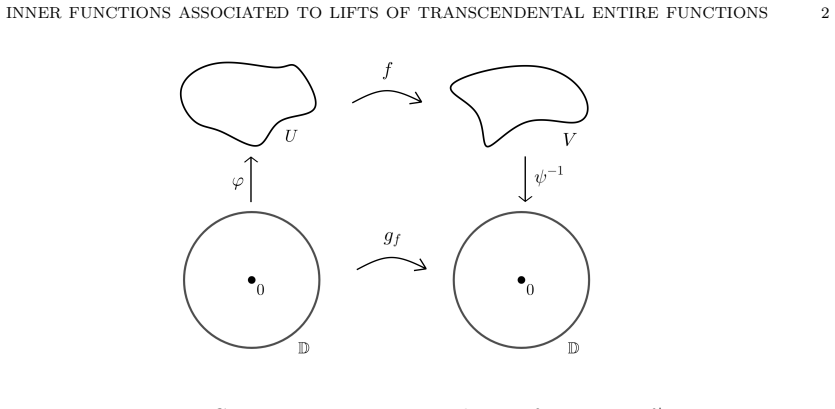
Let $f$ be a transcendental entire function, $V$ be a simply connected Fatou component of $f,$ and $U$ be a Fatou component with $f(U)\subset V.$ There is a natural way to associate $f|_U$ to an inner function, namely a function $g_f:=\psi^{-1}\circ f\circ\varphi,$ where $\varphi:\mathbb{D}\to U$ and $\psi:\mathbb{D}\to V$ are Riemann maps. Inner functions have been used as a tool in the study of the iterates of transcendental entire, and more recently meromorphic, functions. However, there are only a few examples where associated inner functions have been calculated explicitly, with the case where $f$ has infinite degree in $U$ being the least well understood and more complicated. In this paper, we introduce a general method for calculating associated inner functions to a wide class of entire functions arising as `lifts'. In particular, if $f$ is a lift of a transcendental entire function $h,$ we show that an inner function associated to $f|_U$ can be obtained by relating it to an inner function associated to $h|_G,$ where $G$ is the Fatou component that lifts to $U.$ This result significantly generalises the main part of a theorem by Evdoridou, Rempe and Sixmith, and can be applied to several functions that have been studied so far. In both finite- and infinite-degree settings, the results hold for forward-invariant Fatou components as well as for wandering domains.
Figures


Figures from the paper (5 more)


Reference graph
Works this paper leans on
-
[1]
Evdoridou, V. and Fagella, N. and Jarque, X. and Sixsmith, D. J. , TITLE =. J. Math. Anal. Appl. , FJOURNAL =. 2019 , NUMBER =. doi:10.1016/j.jmaa.2019.04.045 , URL =
-
[2]
Bergweiler, W. and Fagella, N. and Rempe-Gillen, L. , TITLE =. Comment. Math. Helv. , FJOURNAL =. 2015 , NUMBER =. doi:10.4171/CMH/371 , URL =
-
[3]
Evdoridou, V. and Rempe, L. and Sixsmith, D. J. , TITLE =. Arnold Math. J. , FJOURNAL =. 2020 , NUMBER =. doi:10.1007/s40598-020-00148-6 , URL =
-
[4]
Baker, I. N. , TITLE =. Proc. London Math. Soc. (3) , FJOURNAL =. 1984 , NUMBER =. doi:10.1112/plms/s3-49.3.563 , URL =
-
[5]
Bara\'nski, K. and Fagella, N. and Jarque, X. and Karpi\'nska, B. , TITLE =. Trans. Amer. Math. Soc. , FJOURNAL =. 2017 , NUMBER =. doi:10.1090/tran/6739 , URL =
-
[6]
Bara\'nski, K. and Jarque, X. and Rempe, L. , TITLE =. Topology Appl. , FJOURNAL =. 2012 , NUMBER =. doi:10.1016/j.topol.2012.02.004 , URL =
-
[7]
Bergweiler, W. , TITLE =. Analysis , FJOURNAL =. 1995 , NUMBER =. doi:10.1524/anly.1995.15.3.251 , URL =
-
[8]
Er\"emenko, A. \`E. and Lyubich, M. Yu. , TITLE =. Ann. Inst. Fourier (Grenoble) , FJOURNAL =. 1992 , NUMBER =. doi:10.5802/aif.1318 , URL =
Show all 30 references
-
[9]
, TITLE =
Bargmann, D. , TITLE =. Transcendental dynamics and complex analysis , SERIES =. 2008 , ISBN =. doi:10.1017/CBO9780511735233.003 , URL =
2008 doi
-
[10]
and Urba\'nski, M
Kotus, J. and Urba\'nski, M. , TITLE =. Discrete Contin. Dyn. Syst. , FJOURNAL =. 2005 , NUMBER =. doi:10.3934/dcds.2005.13.291 , URL =
2005 doi
-
[11]
Baker, I. N. and Dom\'inguez, P. , TITLE =. Ann. Acad. Sci. Fenn. Math. , FJOURNAL =. 1999 , NUMBER =
1999
-
[12]
, TITLE =
Fatou, P. , TITLE =. Acta Math. , FJOURNAL =. 1926 , NUMBER =. doi:10.1007/BF02559517 , URL =
1926 doi
-
[13]
, TITLE =
Bergweiler, W. , TITLE =. Bull. Amer. Math. Soc. (N.S.) , FJOURNAL =. 1993 , NUMBER =. doi:10.1090/S0273-0979-1993-00432-4 , URL =
1993 doi
-
[14]
Benini, A. M. and Evdoridou, V. and Fagella, N. and Rippon, P. J. and Stallard, G. M. , TITLE =. Math. Ann. , FJOURNAL =. 2022 , NUMBER =. doi:10.1007/s00208-021-02252-0 , URL =
2022 doi
-
[15]
and Karpi\'nska, B
Bara\'nski, K. and Karpi\'nska, B. , TITLE =. Nonlinearity , FJOURNAL =. 2007 , NUMBER =. doi:10.1088/0951-7715/20/2/008 , URL =
2007 doi
-
[16]
and Fagella, N
Jov\'e, A. and Fagella, N. , TITLE =. Trans. Amer. Math. Soc. , FJOURNAL =. 2025 , NUMBER =. doi:10.1090/tran/9287 , URL =
2025 doi
-
[17]
Herman, M. R. , TITLE =. Bull. Soc. Math. France , FJOURNAL =. 1984 , NUMBER =
1984
-
[18]
and Rippon, P
Rempe, L. and Rippon, P. J. and Stallard, G. M. , TITLE =. J. Difference Equ. Appl. , FJOURNAL =. 2010 , NUMBER =. doi:10.1080/10236190903282824 , URL =
2010 doi
-
[19]
Rippon, P. J. and Stallard, G. M. , TITLE =. Conform. Geom. Dyn. , FJOURNAL =. 1999 , PAGES =. doi:10.1090/S1088-4173-99-00045-4 , URL =
1999 doi
-
[20]
, TITLE =
Keen, L. , TITLE =. Ergodic Theory Dynam. Systems , FJOURNAL =. 1989 , NUMBER =. doi:10.1017/S0143385700004995 , URL =
1989 doi
-
[21]
2021 , publisher=
A course in complex analysis , author=. 2021 , publisher=
2021
-
[22]
, TITLE =
T\"opfer, H. , TITLE =. Math. Ann. , FJOURNAL =. 1939 , PAGES =. doi:10.1007/BF01450008 , URL =
1939 doi
-
[23]
Devaney, R. L. and Goldberg, L. R. , TITLE =. Duke Math. J. , FJOURNAL =. 1987 , NUMBER =. doi:10.1215/S0012-7094-87-05513-X , URL =
1987 doi
-
[24]
and Eremenko, A
Bergweiler, W. and Eremenko, A. , TITLE =. Rev. Mat. Iberoamericana , FJOURNAL =. 1995 , NUMBER =. doi:10.4171/RMI/176 , URL =
1995 doi
-
[25]
Iversen, F. , url=. Recherches sur les fonctions inverses des fonctions m. 1914 , publisher=
1914
-
[26]
2024 , eprint=
Boundaries of hyperbolic and simply parabolic Baker domains , author=. 2024 , eprint=
2024
-
[27]
2021 , eprint=
Singularities of inverse functions , author=. 2021 , eprint=
2021
-
[28]
and Henriksen, Ch
Fagella, N. and Henriksen, Ch. , TITLE =. Discrete Contin. Dyn. Syst. , FJOURNAL =. 2006 , NUMBER =. doi:10.3934/dcds.2006.15.379 , URL =
2006 doi
-
[29]
, TITLE =
Milnor, J. , TITLE =. 2006 , PAGES =
2006
-
[30]
and Jové, A
Rodrigues Ferreira, G. and Jové, A. , year =. Boundaries of multiply connected Fatou components. A unified approach , doi =
Reviewed June 26, 2026 · model on record in the stance chip above.
Discussion (0). Sign in to comment.