Thermodynamic formalism for non-compact systems with expansivity and specification
Pith reviewed 2026-06-26 15:13 UTC · model grok-4.3
The pith
Strong positive recurrence guarantees existence and uniqueness of equilibrium states for expansive flows on non-compact spaces.
A machine-rendered reading of the paper's core claim, the machinery that carries it, and where it could break.
Core claim
For continuous flows on complete separable metric spaces that satisfy expansivity and specification, the authors introduce strong positive recurrence and prove that this condition is sufficient for the existence and uniqueness of an equilibrium state for a given continuous potential, after first constructing the requisite notions of topological pressure and establishing the variational principle in the non-compact setting.
What carries the argument
Strong positive recurrence, the new condition introduced to ensure enough recurrence in the non-compact setting so that specification can be used to prove uniqueness of equilibrium states.
If this is right
- The variational principle holds and topological pressure is well-defined for these non-compact flows.
- Every strongly positively recurrent potential admits a unique equilibrium state.
- The results apply directly to geodesic flows on negatively curved manifolds without pinching and on CAT(-1) spaces.
- Existence and uniqueness hold for a broad class of continuous potentials under the stated recurrence condition.
Where Pith is reading between the lines
- The same recurrence criterion might be checked on other non-compact systems with expansivity and specification, such as certain countable-state shifts or billiards with infinite measure.
- Once strong positive recurrence is verified for a given geometric flow, statistical properties such as decay of correlations for the equilibrium state become accessible via existing specification techniques.
- The framework suggests a route to pressure computations on CAT(-1) spaces that previously lacked a variational principle.
Load-bearing premise
The flows must satisfy expansivity and specification on a complete separable metric space.
What would settle it
A concrete flow on a complete separable metric space that meets expansivity and specification yet has strong positive recurrence but admits either no equilibrium state or more than one would falsify the central claim.
Figures

read the original abstract
We develop the theory of equilibrium states via specification properties for a wide class of continuous flows on complete separable metric spaces. An important motivating example is geodesic flow over negatively curved manifolds without pinching assumptions and geodesic flow over CAT(-1) spaces. Since our phase space is non-compact, we need to establish all the basic definitions and results to make this theory work, including a suitable notion of topological pressure and fundamental results such as the variational principle. We introduce a notion of strong positive recurrence in this setting and use it as a criterion to prove the existence and uniqueness of an equilibrium state.
Editorial analysis
A structured set of objections, weighed in public.
Referee Report
Summary. The paper develops thermodynamic formalism for continuous flows on non-compact complete separable metric spaces satisfying expansivity and specification. It re-establishes topological pressure and the variational principle in this setting before introducing the notion of strong positive recurrence, which is then used to prove existence and uniqueness of equilibrium states. Motivating examples include geodesic flows on negatively curved manifolds without pinching assumptions and on CAT(-1) spaces.
Significance. If the central results hold, the work extends thermodynamic formalism to important classes of non-compact systems and supplies a verifiable criterion (strong positive recurrence) for equilibrium states. This could facilitate analysis of statistical properties for geodesic flows in the cited geometric settings.
major comments (2)
- [§4] §4 (Variational Principle): The proof that the variational principle holds for non-compact spaces uses specification to construct approximating invariant measures, but it is unclear whether the expansivity assumption suffices to control the contribution of orbits escaping to infinity; an explicit error bound or compactness argument for the pressure functional is needed to support the claim.
- [§6] §6 (Existence and uniqueness via strong positive recurrence): The uniqueness argument in Theorem 6.3 appears to reduce the problem to a Gibbs property derived from strong positive recurrence, yet the reduction step invokes a uniform control on return times that is not obviously implied by the definition in §5.1; this step is load-bearing for the uniqueness claim.
minor comments (2)
- [§2] The notation for the topological pressure P(φ) is defined in §2 but referenced in later sections without a reminder of the non-compact modification; adding a brief recall would improve readability.
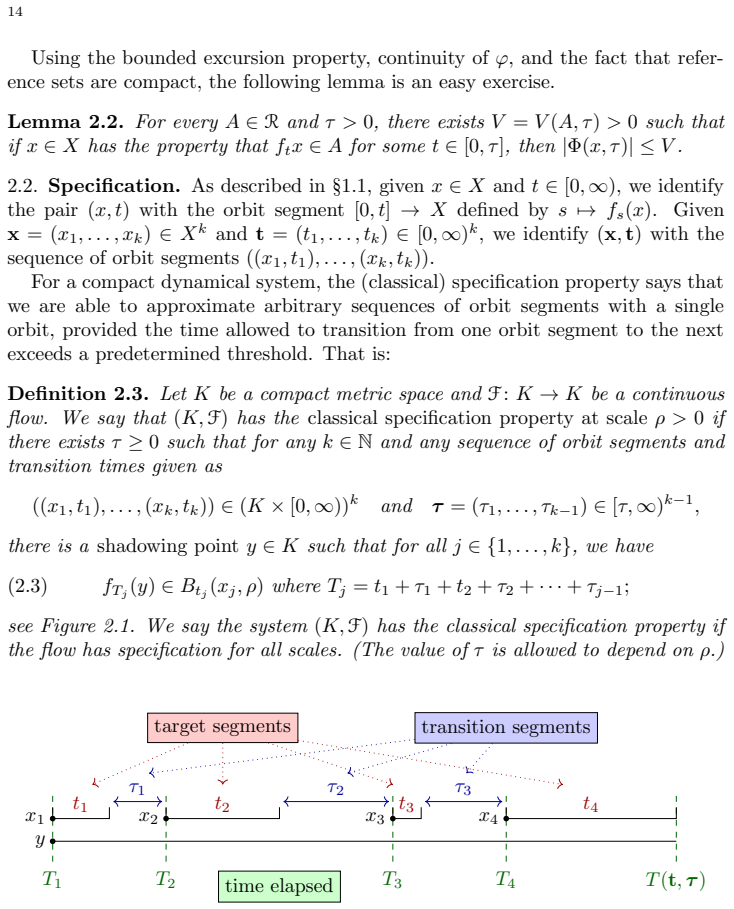
- Figure 1 (schematic of specification) lacks a caption explaining how the non-compact case differs from the standard compact specification diagram.
Simulated Author's Rebuttal
We thank the referee for the careful reading and constructive comments on our manuscript. We address the major comments point by point below.
read point-by-point responses
-
Referee: [§4] §4 (Variational Principle): The proof that the variational principle holds for non-compact spaces uses specification to construct approximating invariant measures, but it is unclear whether the expansivity assumption suffices to control the contribution of orbits escaping to infinity; an explicit error bound or compactness argument for the pressure functional is needed to support the claim.
Authors: In Section 4, expansivity is used to establish upper semi-continuity of the pressure functional on the space of invariant measures, which directly bounds the contribution of measures supported on orbits escaping to infinity. Specification then permits approximation by measures with controlled pressure. We agree an explicit error estimate would clarify the argument and will insert a detailed bound (using the expansivity constant) into the proof of the variational principle. revision: yes
-
Referee: [§6] §6 (Existence and uniqueness via strong positive recurrence): The uniqueness argument in Theorem 6.3 appears to reduce the problem to a Gibbs property derived from strong positive recurrence, yet the reduction step invokes a uniform control on return times that is not obviously implied by the definition in §5.1; this step is load-bearing for the uniqueness claim.
Authors: The definition of strong positive recurrence in §5.1 encodes a uniform bound on return times for the relevant measures via the positive recurrence condition. This bound is invoked to obtain the uniform Gibbs property needed for uniqueness. We acknowledge the reduction step is terse and will add an intermediate lemma in the revision that derives the uniform return-time control explicitly from the definition before applying it in Theorem 6.3. revision: yes
Circularity Check
No significant circularity detected
full rationale
The paper re-establishes foundational elements such as topological pressure and the variational principle for non-compact flows satisfying expansivity and specification, then defines strong positive recurrence as a new sufficient criterion for existence and uniqueness of equilibrium states. This structure is self-contained: the central result is a theorem deriving consequences from the stated assumptions and the newly introduced recurrence notion, without any reduction of a claimed prediction to a fitted parameter, self-referential definition, or load-bearing self-citation chain. No quoted step equates an output to its input by construction.
Axiom & Free-Parameter Ledger
axioms (1)
- domain assumption The phase space is a complete separable metric space carrying a continuous flow that satisfies expansivity and specification.
invented entities (1)
-
strong positive recurrence
no independent evidence
Reference graph
Works this paper leans on
-
[1]
L. M. Abramov, On the entropy of a flow, Dokl. Akad. Nauk SSSR 128 (1959), 873--875. 0113985 (22 \#4816)
1959
-
[2]
25, Birkh\" a user Verlag, Basel, 1995, With an appendix by Misha Brin
Werner Ballmann, Lectures on spaces of nonpositive curvature, DMV Seminar, vol. 25, Birkh\" a user Verlag, Basel, 1995, With an appendix by Misha Brin. 1377265
1995
-
[3]
329, Birkh\" a user/Springer, Cham, 2019, Applications to non-Archimedean Diophantine approximation, Appendix by J\' e r\^ o me Buzzi
Anne Broise-Alamichel, Jouni Parkkonen, and Fr\' e d\' e ric Paulin, Equidistribution and counting under equilibrium states in negative curvature and trees, Progress in Mathematics, vol. 329, Birkh\" a user/Springer, Cham, 2019, Applications to non-Archimedean Diophantine approximation, Appendix by J\' e r\^ o me Buzzi. 3971204
2019
-
[4]
26, Walter de Gruyter & Co., Berlin, 2001, Translated from the German by Robert B.\ Burckel
Heinz Bauer, Measure and integration theory, De Gruyter Studies in Mathematics, vol. 26, Walter de Gruyter & Co., Berlin, 2001, Translated from the German by Robert B.\ Burckel. 1897176
2001
-
[5]
Sergi Burniol Clotet and Fran c oise Dal'Bo, On the non-expansiveness of the geodesic flow on surfaces with cusps, 2026, preprint, arXiv:2603.24310
work page internal anchor Pith review Pith/arXiv arXiv 2026
-
[6]
Burns, V
K. Burns, V. Climenhaga, T. Fisher, and D. J. Thompson, Unique equilibrium states for geodesic flows in nonpositive curvature, Geom. Funct. Anal. 28 (2018), no. 5, 1209--1259. 3856792
2018
-
[7]
J\' e r\^ o me Buzzi, Sylvain Crovisier, and Omri Sarig, Measures of maximal entropy for surface diffeomorphisms, Ann. of Math. (2) 195 (2022), no. 2, 421--508
2022
-
[8]
Igor Belegradek, Topology of open nonpositively curved manifolds, Geometry, topology, and dynamics in negative curvature, London Math. Soc. Lecture Note Ser., vol. 425, Cambridge Univ. Press, Cambridge, 2016, pp. 32--83. 3497257
2016
-
[9]
Bridson and Andr\' e Haefliger, Metric spaces of non-positive curvature, Grundlehren der mathematischen Wissenschaften [Fundamental Principles of Mathematical Sciences], vol
Martin R. Bridson and Andr\' e Haefliger, Metric spaces of non-positive curvature, Grundlehren der mathematischen Wissenschaften [Fundamental Principles of Mathematical Sciences], vol. 319, Springer-Verlag, Berlin, 1999. 1744486
1999
-
[10]
V. I. Bogachev, Measure theory. V ol. I , II , Springer-Verlag, Berlin, 2007. 2267655
2007
-
[11]
318, Birkh\"auser/Springer, [Cham], 2016
David Borthwick, Spectral theory of infinite-area hyperbolic surfaces, second ed., Progress in Mathematics, vol. 318, Birkh\"auser/Springer, [Cham], 2016. 3497464
2016
-
[12]
Rufus Bowen, Periodic points and measures for A xiom A diffeomorphisms , Trans. Amer. Math. Soc. 154 (1971), 377--397. 282372
1971
-
[13]
, Entropy-expansive maps, Trans. Amer. Math. Soc. 164 (1972), 323--331. 0285689 (44 \#2907)
1972
-
[14]
, The equidistribution of closed geodesics, Amer. J. Math. 94 (1972), 413--423. 315742
1972
-
[15]
Systems Theory 8 (1975), no
, Some systems with unique equilibrium states, Math. Systems Theory 8 (1975), no. 3, 193--202. 0399413 (53 \#3257)
1975
-
[16]
Rufus Bowen and David Ruelle, The ergodic theory of A xiom A flows , Invent. Math. 29 (1975), no. 3, 181--202. 0380889 (52 \#1786)
1975
-
[17]
Bonk and O
M. Bonk and O. Schramm, Embeddings of G romov hyperbolic spaces , Geom. Funct. Anal. 10 (2000), no. 2, 266--306. 1771428
2000
-
[18]
Benjamin Call, David Constantine, Alena Erchenko, Noelle Sawyer, and Grace Work, Unique equilibrium states for geodesic flows on flat surfaces with singularities, Int. Math. Res. Not. IMRN (2023), no. 17, 15155--15206. 4637460
2023
-
[19]
Thompson, Equilibrium states for M a\ n\'e diffeomorphisms , Ergodic Theory Dynam
Vaughn Climenhaga, Todd Fisher, and Daniel J. Thompson, Equilibrium states for M a\ n\'e diffeomorphisms , Ergodic Theory Dynam. Systems 39 (2019), no. 9, 2433--2455. 3989124
2019
-
[20]
Dong Chen, Lien-Yung Kao, and Kiho Park, Properties of equilibrium states for geodesic flows over manifolds without focal points, Adv. Math. 380 (2021), Paper No. 107564, 34. 4200468
2021
-
[21]
Vaughn Climenhaga, Specification and towers in shift spaces, Comm. Math. Phys. 364 (2018), no. 2, 441--504. 3869435
2018
-
[22]
Thompson, The weak specification property for geodesic flows on CAT (-1) spaces , Groups Geom
David Constantine, Jean-Fran cois Lafont, and Daniel J. Thompson, The weak specification property for geodesic flows on CAT (-1) spaces , Groups Geom. Dyn. 14 (2020), no. 1, 297--336. 4073229
2020
-
[23]
Thompson, Strong symbolic dynamics for geodesic flows on CAT (-1) spaces and other metric A nosov flows , J
David Constantine, Jean-Fran c ois Lafont, and Daniel J. Thompson, Strong symbolic dynamics for geodesic flows on CAT (-1) spaces and other metric A nosov flows , J. \' E c. polytech. Math. 7 (2020), 201--231. 4054334
2020
-
[24]
Van Cyr and Omri Sarig, Spectral gap and transience for R uelle operators on countable M arkov shifts , Comm. Math. Phys. 292 (2009), no. 3, 637--666. 2551790
2009
-
[25]
Thompson, Equilibrium states beyond specification and the B owen property , J
Vaughn Climenhaga and Daniel J. Thompson, Equilibrium states beyond specification and the B owen property , J. Lond. Math. Soc. (2) 87 (2013), no. 2, 401--427. 3046278
2013
-
[26]
, Unique equilibrium states for flows and homeomorphisms with non-uniform structure, Adv. Math. 303 (2016), 745--799. 3552538
2016
-
[27]
Thompson, Equilibrium states for self-products of flows and the mixing properties of rank 1 geodesic flows, J
Benjamin Call and Daniel J. Thompson, Equilibrium states for self-products of flows and the mixing properties of rank 1 geodesic flows, J. Lond. Math. Soc. (2) 105 (2022), no. 2, 794--824. 4400937
2022
-
[28]
Fran c oise Dal'Bo, Topologie du feuilletage fortement stable, Ann. Inst. Fourier (Grenoble) 50 (2000), no. 3, 981--993. 1779902
2000
-
[29]
thesis, The Ohio State University, 2024
Caleb Dilsavor, Thermodynamic formalism in coarse hyperbolicity, Ph.D. thesis, The Ohio State University, 2024
2024
-
[30]
Thompson, Gibbs measures for geodesic flow on CAT (-1) spaces , Adv
Caleb Dilsavor and Daniel J. Thompson, Gibbs measures for geodesic flow on CAT (-1) spaces , Adv. Math. 469 (2025). 4885892
2025
-
[31]
Patrick Eberlein, Geodesic flows in manifolds of nonpositive curvature, Smooth Ergodic Theory and Its Applications, Proc. Sympos. Pure Math., vol. 69, Amer. Math. Soc., Providence, RI, 2001, pp. 525--571
2001
-
[32]
Todd Fisher and Boris Hasselblatt, Hyperbolic flows, Zurich Lectures in Advanced Mathematics, EMS Publishing House, Berlin, [2019] 2019. 3972204
2019
-
[33]
Gerald B. Folland, Real analysis, second ed., Pure and Applied Mathematics (New York), John Wiley & Sons, Inc., New York, 1999, Modern techniques and their applications, A Wiley-Interscience Publication. 1681462
1999
-
[34]
Ernesto Franco, Flows with unique equilibrium states, Amer. J. Math. 99 (1977), no. 3, 486--514. 0442193 (56 \#579)
1977
- [35]
-
[36]
Katrin Gelfert, Non-hyperbolic behavior of geodesic flows of rank 1 surfaces, Discrete Contin. Dyn. Syst. 39 (2019), no. 1, 521--551. 3918184
2019
-
[37]
S\' e bastien Gou\" e zel, Barbara Schapira, and Samuel Tapie, Pressure at infinity and strong positive recurrence in negative curvature, Comment. Math. Helv. 98 (2023), no. 3, 431--508, With an appendix by Felipe Riquelme. 4668542
2023
-
[38]
Michael Handel and Bruce Kitchens, Metrics and entropy for non-compact spaces, Israel J. Math. 91 (1995), no. 1-3, 253--271, With an appendix by Daniel J. Rudolph. 1348316
1995
-
[39]
Boris Hasselblatt, Zbigniew Nitecki, and James Propp, Topological entropy for nonuniformly continuous maps, Discrete Contin. Dyn. Syst. 22 (2008), no. 1-2, 201--213. 2410955
2008
-
[40]
Katelynn Huneycutt and Daniel J. Thompson, The specification approach to equilibrium states for parabolic rational maps, 2026, preprint, arXiv:2601.04475
-
[41]
Godofredo Iommi, Felipe Riquelme, and Anibal Velozo, Entropy in the cusp and phase transitions for geodesic flows, Israel J. Math. 225 (2018), no. 2, 609--659. 3805660
2018
-
[42]
Khintchine, Eine V ersch\" a rfung des P oincar\' e schen `` W iederkehrsatzes'' , Compositio Math
A. Khintchine, Eine V ersch\" a rfung des P oincar\' e schen `` W iederkehrsatzes'' , Compositio Math. 1 (1935), 177--179. 1556883
1935
-
[43]
Gerhard Knieper, The uniqueness of the measure of maximal entropy for geodesic flows on rank 1 manifolds , Ann. of Math. (2) 148 (1998), no. 1, 291--314
1998
-
[44]
Fran c ois Ledrappier, Entropie et principe variationnel pour le flot g\' e od\' e sique en courbure n\' e gative pinc\' e e , G\' e om\' e trie ergodique, Monogr. Enseign. Math., vol. 43, Enseignement Math., Geneva, 2013, pp. 117--144. 3220553
2013
- [45]
- [46]
-
[47]
Grigoriy A. Margulis, On some aspects of the theory of A nosov systems , Springer Monographs in Mathematics, Springer-Verlag, Berlin, 2004, With a survey by Richard Sharp: Periodic orbits of hyperbolic flows, Translated from the Russian by Valentina Vladimirovna Szulikowska. 2035655
2004
-
[48]
Micha Misiurewicz, A short proof of the variational principle for a Z + N action on a compact space , International C onference on D ynamical S ystems in M athematical P hysics ( R ennes, 1975), Ast\'erisque, vol. No. 40, Soc. Math. France, Paris, 1976, pp. 147--157. 444904
1975
-
[49]
Daniel Mauldin and Mariusz Urba\'nski, Dimensions and measures in infinite iterated function systems, Proc
R. Daniel Mauldin and Mariusz Urba\'nski, Dimensions and measures in infinite iterated function systems, Proc. London Math. Soc. (3) 73 (1996), no. 1, 105--154. 1387085
1996
-
[50]
, Gibbs states on the symbolic space over an infinite alphabet, Israel J. Math. 125 (2001), 93--130. 1853808
2001
-
[51]
148, Cambridge University Press, Cambridge, 2003, Geometry and dynamics of limit sets
, Graph directed M arkov systems , Cambridge Tracts in Mathematics, vol. 148, Cambridge University Press, Cambridge, 2003, Geometry and dynamics of limit sets. 2003772
2003
-
[52]
Tam Nguyen Phan, On finite volume, negatively curved manifolds, 2011, preprint, arXiv:1110.4087
work page internal anchor Pith review Pith/arXiv arXiv 2011
-
[53]
Jean-Pierre Otal and Marc Peign\' e , Principe variationnel et groupes kleiniens, Duke Math. J. 125 (2004), no. 1, 15--44. 2097356
2004
-
[54]
2, Cambridge University Press, Cambridge, 1983
Karl Petersen, Ergodic theory, Cambridge Studies in Advanced Mathematics, vol. 2, Cambridge University Press, Cambridge, 1983. 833286
1983
-
[55]
Pesin and B.S
Y.B. Pesin and B.S. Pitskel, Topological pressure and the variational principle for non-compact sets (English Translation) , Funct. Anal. Appl. 18 (1984), 307--318
1984
-
[56]
373, viii+281
Fr\' e d\' e ric Paulin, Mark Pollicott, and Barbara Schapira, Equilibrium states in negative curvature, Ast\' e risque (2015), no. 373, viii+281. 3444431
2015
-
[57]
Vincent Pit and Barbara Schapira, Finiteness of G ibbs measures on noncompact manifolds with pinched negative curvature , Ann. Inst. Fourier (Grenoble) 68 (2018), no. 2, 457--510. 3803108
2018
-
[58]
Maria Jose Pacifico, Fan Yang, and Jiagang Yang, Equilibrium states for the classical L orenz attractor and sectional-hyperbolic attractors in higher dimensions , Duke Math. J. 174 (2025), no. 10, 1901--2010. 4941878
2025
-
[59]
Theory Dyn
Congcong Qu and Lan Xu, Variational principle for non-additive neutralized B owen topological pressure , Qual. Theory Dyn. Syst. 23 (2024), no. 5, Paper No. 199, 17. 4748283
2024
-
[60]
Felipe Riquelme, Ruelle's inequality in negative curvature, Discrete Contin. Dyn. Syst. 38 (2018), no. 6, 2809--2825. 3809061
2018
-
[61]
Thomas Roblin, Ergodicit\' e et \' e quidistribution en courbure n\' e gative , M\' e m. Soc. Math. Fr. (N.S.) (2003), no. 95, vi+96. 2057305
2003
-
[62]
David Ruelle, Statistical mechanics on a compact set with Z v action satisfying expansiveness and specification , Trans. Amer. Math. Soc. 187 (1973), 237--251. 417391
1973
-
[63]
Sarig, Thermodynamic formalism for countable M arkov shifts , Ergodic Theory Dynam
Omri M. Sarig, Thermodynamic formalism for countable M arkov shifts , Ergodic Theory Dynam. Systems 19 (1999), no. 6, 1565--1593
1999
-
[64]
, Thermodynamic formalism for null recurrent potentials, Israel J. Math. 121 (2001), 285--311. 1818392 (2001m:37059)
2001
-
[65]
, Symbolic dynamics for surface diffeomorphisms with positive entropy, J. Amer. Math. Soc. 26 (2013), no. 2, 341--426
2013
-
[66]
, Thermodynamic formalism for countable M arkov shifts , Hyperbolic dynamics, fluctuations and large deviations, Proc. Sympos. Pure Math., vol. 89, Amer. Math. Soc., Providence, RI, 2015, pp. 81--117. 3309096
2015
-
[67]
79, Springer-Verlag, New York-Berlin, 1982
Peter Walters, An introduction to ergodic theory, Graduate Texts in Mathematics, vol. 79, Springer-Verlag, New York-Berlin, 1982. 648108 (84e:28017)
1982
-
[68]
Roland Zweim\" u ller, Invariant measures for general(ized) induced transformations, Proc. Amer. Math. Soc. 133 (2005), no. 8, 2283--2295. 2138871
2005
discussion (0)
Sign in with ORCID, Apple, or X to comment. Anyone can read and Pith papers without signing in.