Polaronic hybridization of atoms, dimers and trimers in a Bose-Einstein condensate
Pith reviewed 2026-06-26 14:58 UTC · model grok-4.3
The pith
A Bose-Einstein condensate hybridizes an impurity atom with dimer and trimer bound states into observable polaronic superpositions.
A machine-rendered reading of the paper's core claim, the machinery that carries it, and where it could break.
Core claim
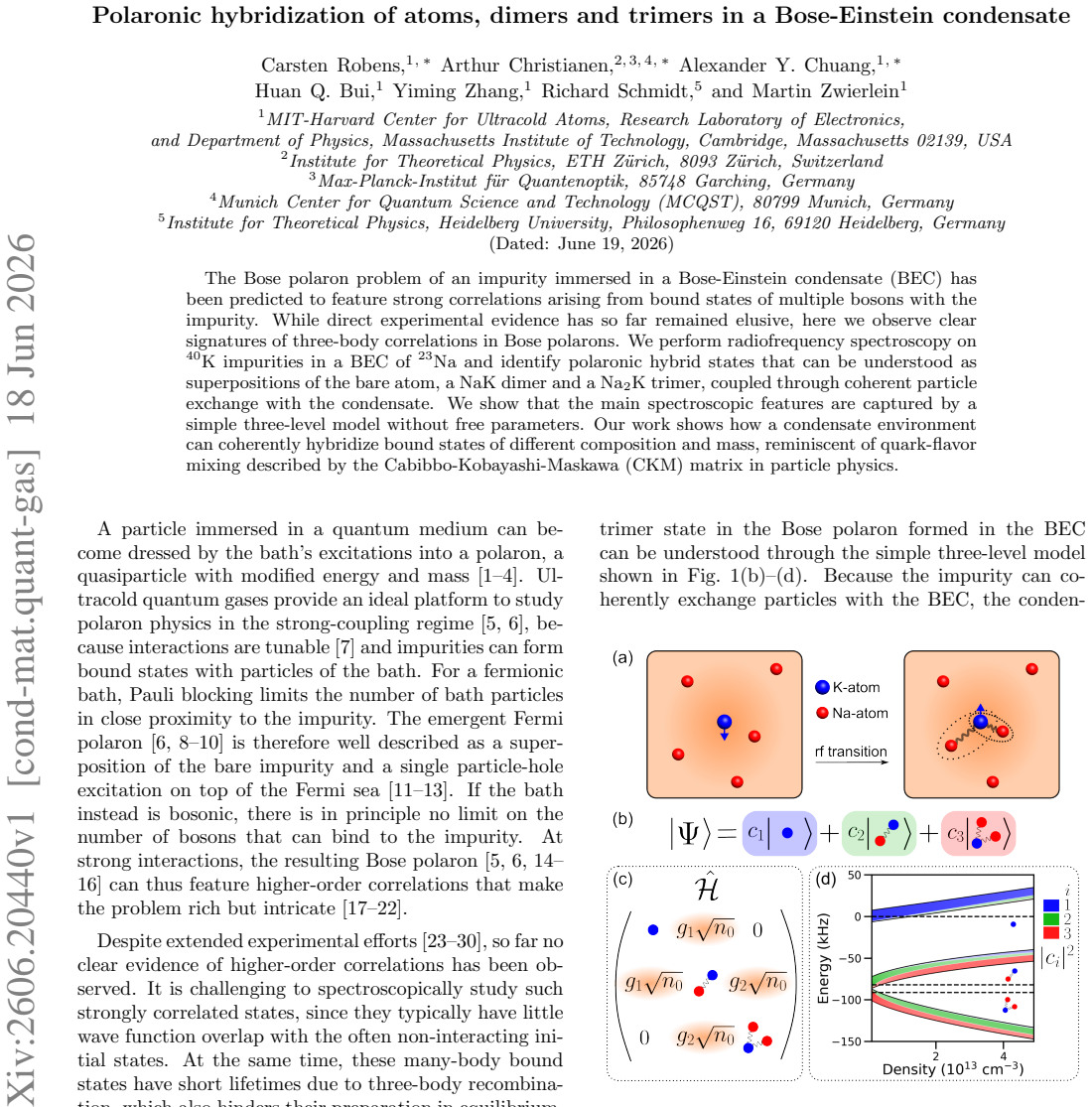
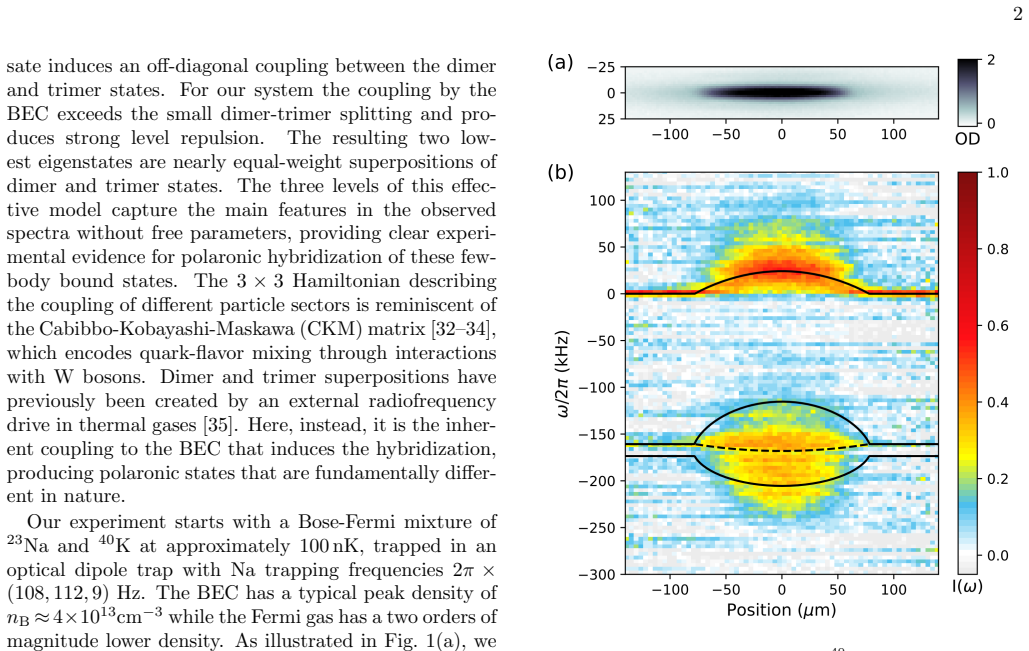
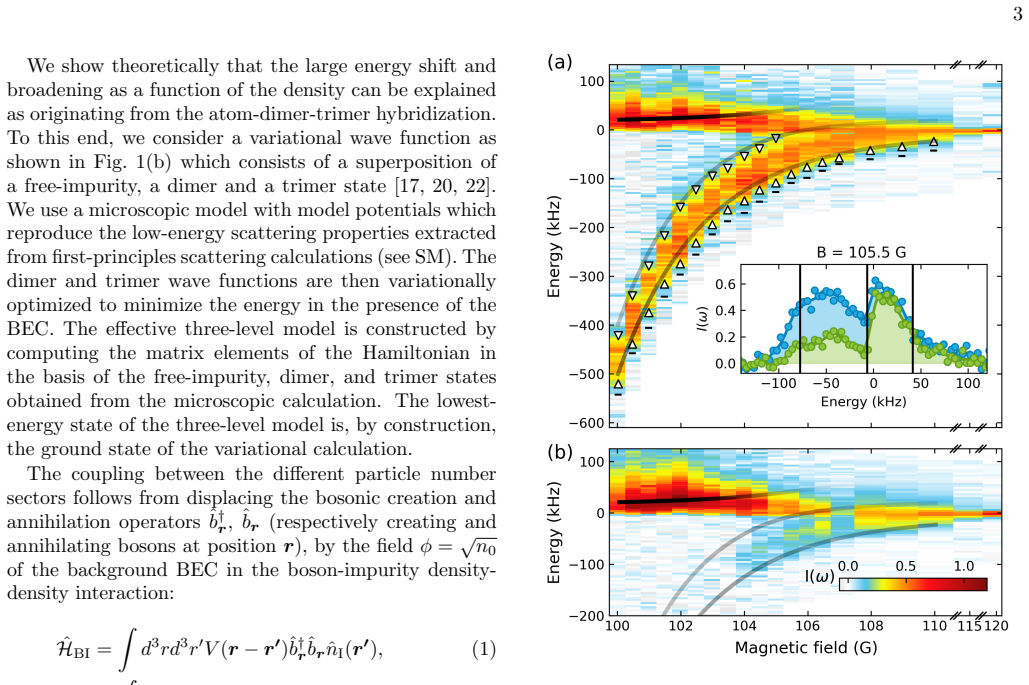
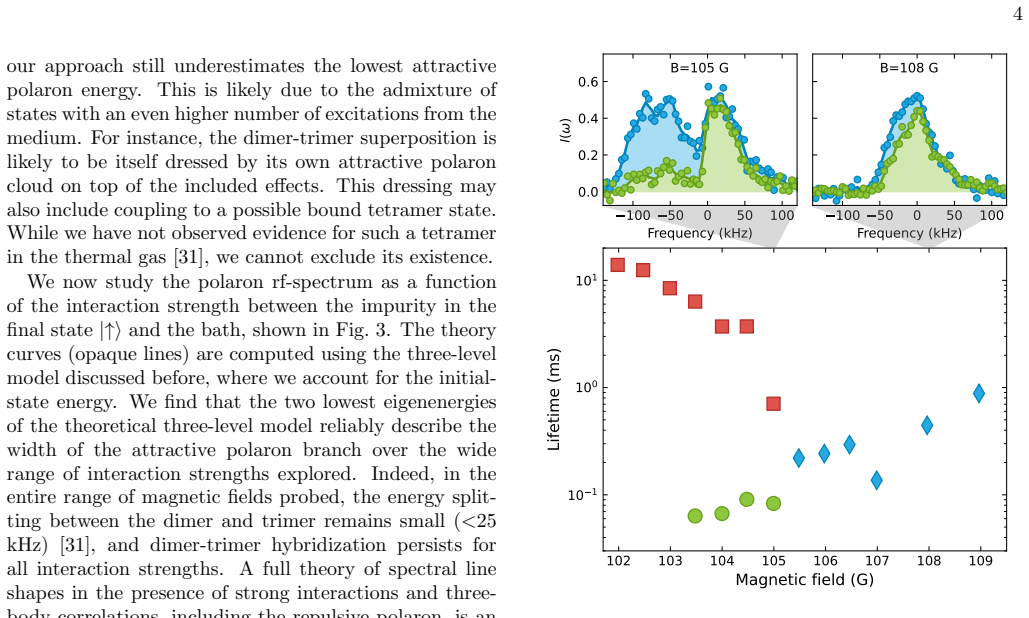
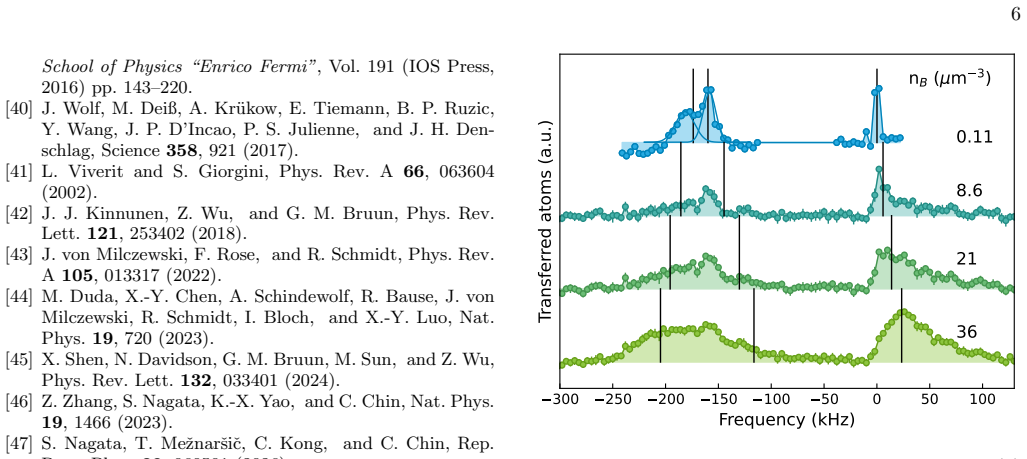
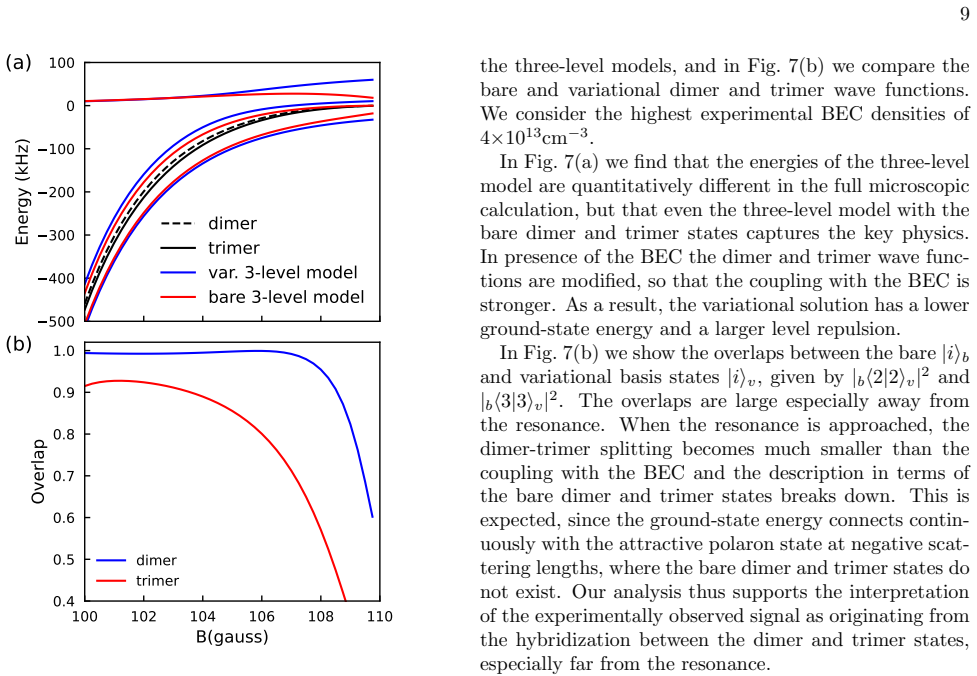
We observe clear signatures of three-body correlations in Bose polarons by performing radiofrequency spectroscopy on potassium impurities in a sodium BEC. We identify polaronic hybrid states understood as superpositions of the bare atom, a NaK dimer and a Na2K trimer, coupled through coherent particle exchange with the condensate. The main spectroscopic features are captured by a simple three-level model without free parameters. This demonstrates how a condensate environment can coherently hybridize bound states of different composition and mass.
What carries the argument
The three-level model describing the hybridization of the bare atom, NaK dimer, and Na₂K trimer states via coherent particle exchange with the BEC.
Load-bearing premise
The spectroscopic features are produced by coherent hybridization among the bare atom, dimer, and trimer configurations rather than by other many-body effects or experimental artifacts.
What would settle it
Measuring the radiofrequency spectrum at varying condensate densities and finding that the positions and relative strengths of the lines deviate from the predictions of the three-level model without any fitting parameters.
Figures
read the original abstract
The Bose polaron problem of an impurity immersed in a Bose-Einstein condensate (BEC) has been predicted to feature strong correlations arising from bound states of multiple bosons with the impurity. While direct experimental evidence has so far remained elusive, here we observe clear signatures of three-body correlations in Bose polarons. We perform radiofrequency spectroscopy on $^{40}$K impurities in a BEC of $^{23}$Na and identify polaronic hybrid states that can be understood as superpositions of the bare atom, a NaK dimer and a Na$_2$K trimer, coupled through coherent particle exchange with the condensate. We show that the main spectroscopic features are captured by a simple three-level model without free parameters. Our work shows how a condensate environment can coherently hybridize bound states of different composition and mass, reminiscent of quark-flavor mixing described by the Cabibbo-Kobayashi-Maskawa (CKM) matrix in particle physics.
Editorial analysis
A structured set of objections, weighed in public.
Referee Report
Summary. The manuscript reports radiofrequency spectroscopy on 40K impurities immersed in a 23Na BEC. It claims to identify spectroscopic signatures of three-body correlations, interpreted as polaronic hybrid states formed by coherent superpositions of the bare atom, a NaK dimer, and a Na2K trimer. These states are coupled via particle exchange with the condensate, and the main features are stated to be reproduced by a simple three-level model containing no free parameters.
Significance. If the interpretation is substantiated, the result supplies experimental evidence for multi-body bound-state hybridization in the Bose polaron problem and illustrates how a condensate can coherently mix states of differing composition and mass. The parameter-free character of the model, if verified, would strengthen the claim by removing adjustable scales from the comparison with data.
major comments (2)
- [Abstract] Abstract: The assertion that the three-level model contains no free parameters is load-bearing for the central claim. The manuscript must demonstrate explicitly how the bare dimer and trimer energies, as well as all coupling matrix elements, are fixed entirely from independent measurements or calculations before comparison with the RF spectra; any implicit scale or background choice would undermine the 'parameter-free' statement.
- [Abstract] Abstract: The mapping of observed RF lines to specific atom-dimer-trimer superpositions requires quantitative exclusion of alternative mechanisms (e.g., finite-temperature broadening, trap inhomogeneity, or incoherent scattering) that could produce similar line positions and shapes. Without such a comparison, the uniqueness of the hybridization interpretation remains open.
minor comments (1)
- The CKM-matrix analogy is mentioned but not developed quantitatively; a brief clarification of the precise correspondence (or its limitations) would aid readers.
Simulated Author's Rebuttal
We thank the referee for the careful reading and constructive comments. We address each major comment below and have revised the manuscript to provide the requested explicit demonstrations and discussions.
read point-by-point responses
-
Referee: [Abstract] Abstract: The assertion that the three-level model contains no free parameters is load-bearing for the central claim. The manuscript must demonstrate explicitly how the bare dimer and trimer energies, as well as all coupling matrix elements, are fixed entirely from independent measurements or calculations before comparison with the RF spectra; any implicit scale or background choice would undermine the 'parameter-free' statement.
Authors: We agree that an explicit demonstration is required. In the revised manuscript we have added Section III.B and Appendix A, which detail the independent inputs: the NaK dimer binding energy is obtained from the literature s-wave scattering length a_NaK = −5.5 a0 (no fitting), the Na2K trimer energy from variational three-body calculations using published Na-Na and Na-K potentials, and the coupling matrix elements from the measured condensate density n0 together with the calibrated RF Rabi frequency Ω. All numerical values and formulas are listed; no background subtraction or scaling is applied to the spectra. revision: yes
-
Referee: [Abstract] Abstract: The mapping of observed RF lines to specific atom-dimer-trimer superpositions requires quantitative exclusion of alternative mechanisms (e.g., finite-temperature broadening, trap inhomogeneity, or incoherent scattering) that could produce similar line positions and shapes. Without such a comparison, the uniqueness of the hybridization interpretation remains open.
Authors: We have added Section IV.C that quantitatively compares the alternatives. Finite-temperature broadening at the measured T/Tc ≈ 0.1 produces linewidths ≪ observed features. Trap inhomogeneity is included via local-density averaging over the measured density profile and already reproduces the line shapes. Incoherent scattering would yield broader, asymmetric spectra inconsistent with the sharp, symmetric lines observed. While a exhaustive scan of every conceivable mechanism is not possible within one paper, the parameter-free match to the three-level model supplies the strongest current support for the hybridization assignment. revision: partial
Circularity Check
No significant circularity; model presented as parameter-free from independent inputs
full rationale
The abstract states that the main spectroscopic features are captured by a simple three-level model without free parameters, with energies and couplings fixed a priori via coherent particle exchange. No load-bearing step reduces by construction to a fit on the target data or to a self-citation chain; the assignment of peaks to atom-dimer-trimer superpositions is interpretive but the model construction is described as independent. The derivation is self-contained against external benchmarks such as prior polaron theory and the CKM analogy, with no quoted equations showing self-definition or renaming of known results.
Axiom & Free-Parameter Ledger
axioms (2)
- standard math Standard many-body quantum mechanics and the existence of coherent particle exchange with the BEC apply to the impurity system.
- domain assumption The dimer and trimer bound states exist as identifiable configurations that can be superposed with the bare atom.
invented entities (1)
-
Polaronic hybrid states (atom-dimer-trimer superpositions)
no independent evidence
Reference graph
Works this paper leans on
-
[1]
Landau, Phys
L. Landau, Phys. Z. Sowjetunion3, 644 (1933)
1933
-
[2]
S. I. Pekar, Zh. Eksp. Teor. Fiz.16, 335 (1946), english translation in Journal of Physics USSR, 10, 341 (1946)
1946
-
[3]
Fr¨ ohlich, Adv
H. Fr¨ ohlich, Adv. Phys.3, 325 (1954)
1954
-
[4]
A. S. Alexandrov and J. T. Devreese,Advances in polaron physics, Vol. 159 (Springer, 2010)
2010
-
[5]
Grusdt, N
F. Grusdt, N. Mostaan, E. Demler, and L. P. Ardila, Reports on Progress in Physics88, 066401 (2025)
2025
-
[6]
P. Massignan, R. Schmidt, G. E. Astrakharchik, A. ˙Imamoglu, M. Zwierlein, J. J. Arlt, and G. M. Bruun, arXiv:2501.09618 (2025)
Pith/arXiv arXiv 2025
-
[7]
C. Chin, R. Grimm, P. Julienne, and E. Tiesinga, Rev. Mod. Phys.82, 1225 (2010)
2010
-
[8]
Schirotzek, C.-H
A. Schirotzek, C.-H. Wu, A. Sommer, and M. Zwierlein, Phys. Rev. Lett.102, 230402 (2009)
2009
-
[9]
Koschorreck, D
M. Koschorreck, D. Pertot, E. Vogt, B. Fr¨ ohlich, M. Feld, and M. K¨ ohl, Nature485, 619 (2012)
2012
-
[10]
Scazza, M
F. Scazza, M. Zaccanti, P. Massignan, M. M. Parish, and J. Levinsen, Atoms10, 55 (2022)
2022
-
[11]
Chevy, Phys
F. Chevy, Phys. Rev. A74, 063628 (2006)
2006
-
[12]
Combescot, A
R. Combescot, A. Recati, C. Lobo, and F. Chevy, Phys. Rev. Lett.98, 180402 (2007)
2007
-
[13]
Prokof’ev and B
N. Prokof’ev and B. Svistunov, Phys. Rev. B77, 20408 (2008)
2008
-
[14]
S. P. Rath and R. Schmidt, Phys. Rev. A88, 053632 (2013)
2013
-
[15]
L. A. Pe˜ na Ardila and S. Giorgini, Phys. Rev. A92, 033612 (2015)
2015
-
[16]
Y. E. Shchadilova, R. Schmidt, F. Grusdt, and E. Dem- ler, Phys. Rev. Lett.117, 113002 (2016)
2016
-
[17]
Levinsen, M
J. Levinsen, M. M. Parish, and G. M. Bruun, Phys. Rev. Lett.115, 125302 (2015)
2015
-
[18]
M. Sun, H. Zhai, and X. Cui, Phys. Rev. Lett.119, 013401 (2017)
2017
-
[19]
Sun and X
M. Sun and X. Cui, Phys. Rev. A96, 022707 (2017)
2017
-
[20]
S. M. Yoshida, S. Endo, J. Levinsen, and M. M. Parish, Phys. Rev. X8, 011024 (2018)
2018
-
[21]
Christianen, J
A. Christianen, J. I. Cirac, and R. Schmidt, Phys. Rev. A105, 053302 (2022)
2022
-
[22]
Christianen, J
A. Christianen, J. I. Cirac, and R. Schmidt, SciPost Phys.16, 067 (2024)
2024
-
[23]
M.-G. Hu, M. J. Van de Graaff, D. Kedar, J. P. Corson, E. A. Cornell, and D. S. Jin, Phys. Rev. Lett.117, 055301 (2016)
2016
-
[24]
N. B. Jørgensen, L. Wacker, K. T. Skalmstang, M. M. Parish, J. Levinsen, R. S. Christensen, G. M. Bruun, and J. J. Arlt, Phys. Rev. Lett.117, 055302 (2016)
2016
-
[25]
Z. Z. Yan, Y. Ni, C. Robens, and M. W. Zwierlein, Science368, 190 (2020)
2020
-
[26]
M. G. Skou, K. K. Nielsen, T. G. Skov, A. M. Morgen, N. B. Jørgensen, A. Camacho-Guardian, T. Pohl, G. M. Bruun, and J. J. Arlt, Phys. Rev. Research4, 043093 (2022)
2022
-
[27]
Morgen, S
A. Morgen, S. Balling, K. K. Nielsen, T. Pohl, G. Bruun, and J. Arlt, Phys. Rev. Research7, L022002 (2025)
2025
-
[28]
Etrych, G
J. Etrych, G. Martirosyan, A. Cao, C. J. Ho, Z. Hadz- ibabic, and C. Eigen, Phys. Rev. X15, 021070 (2025)
2025
- [29]
-
[30]
A. Morgen, S. Balling, M. Strøe, T. Skov, M. Skou, K. Nielsen, A. Camacho-Guardian, G. Bruun, and J. Arlt, arXiv:2604.18033 (2026)
Pith/arXiv arXiv 2026
-
[31]
A. Y. Chuang, H. Q. Bui, A. Christianen, Y. Zhang, Y. Ni, D. Ahmed-Braun, C. Robens, and M. Zwierlein, Phys. Rev. X15, 021098 (2025)
2025
-
[32]
Cabibbo, Phys
N. Cabibbo, Phys. Rev. Lett.10, 531 (1963)
1963
-
[33]
Kobayashi and T
M. Kobayashi and T. Maskawa, Progress of Theoretical Physics49, 652 (1973)
1973
-
[34]
Navaset al.(Particle Data Group Collaboration), Phys
S. Navaset al.(Particle Data Group Collaboration), Phys. Rev. D110, 030001 (2024)
2024
-
[35]
Yudkin, R
Y. Yudkin, R. Elbaz, P. Giannakeas, C. H. Greene, and L. Khaykovich, Phys. Rev. Lett.122, 200402 (2019)
2019
-
[36]
Park, C.-H
J. Park, C.-H. Wu, I. Santiago, T. Tiecke, S. Will, P. Ah- madi, and M. Zwierlein, Phys. Rev. A85, 051602(R) (2012)
2012
-
[37]
Gupta, Z
S. Gupta, Z. Hadzibabic, M. W. Zwierlein, C. A. Stan, K. Dieckmann, C. H. Schunck, E. G. M. van Kempen, B. J. Verhaar, and W. Ketterle, Science300, 1723 (2003)
2003
-
[38]
G. Baym, C. Pethick, Z. Yu, and M. Zwierlein, Phys. Rev. Lett.99, 190407 (2007)
2007
-
[39]
Enrico Fermi
M. W. Zwierlein, inProceedings of the International 6 School of Physics “Enrico Fermi”, Vol. 191 (IOS Press,
-
[40]
J. Wolf, M. Deiß, A. Kr¨ ukow, E. Tiemann, B. P. Ruzic, Y. Wang, J. P. D’Incao, P. S. Julienne, and J. H. Den- schlag, Science358, 921 (2017)
2017
-
[41]
Viverit and S
L. Viverit and S. Giorgini, Phys. Rev. A66, 063604 (2002)
2002
-
[42]
J. J. Kinnunen, Z. Wu, and G. M. Bruun, Phys. Rev. Lett.121, 253402 (2018)
2018
-
[43]
von Milczewski, F
J. von Milczewski, F. Rose, and R. Schmidt, Phys. Rev. A105, 013317 (2022)
2022
-
[44]
Duda, X.-Y
M. Duda, X.-Y. Chen, A. Schindewolf, R. Bause, J. von Milczewski, R. Schmidt, I. Bloch, and X.-Y. Luo, Nat. Phys.19, 720 (2023)
2023
-
[45]
X. Shen, N. Davidson, G. M. Bruun, M. Sun, and Z. Wu, Phys. Rev. Lett.132, 033401 (2024)
2024
-
[46]
Zhang, S
Z. Zhang, S. Nagata, K.-X. Yao, and C. Chin, Nat. Phys. 19, 1466 (2023)
2023
-
[47]
Nagata, T
S. Nagata, T. Meˇ znarˇ siˇ c, C. Kong, and C. Chin, Rep. Prog. Phys.89, 060501 (2026)
2026
-
[48]
R. V. Krems, Phys. Chem. Chem. Phys.10, 4079 (2008)
2008
-
[49]
Karman, M
T. Karman, M. Tomza, and J. P´ erez-R´ ıos, Nat. Phys. 20, 722 (2024)
2024
-
[50]
Ospelkaus, K.-K
S. Ospelkaus, K.-K. Ni, D. Wang, M. De Miranda, B. Neyenhuis, G. Qu´ em´ ener, P. Julienne, J. Bohn, D. Jin, and J. Ye, Science327, 853 (2010)
2010
-
[51]
Liu and K.-K
Y. Liu and K.-K. Ni, Annu. Rev. Phys. Chem.73, 73 (2022)
2022
-
[52]
Y.-X. Liu, L. Zhu, J. Luke, J. A. Houwman, M. C. Babin, M.-G. Hu, and K.-K. Ni, Science384, 1117 (2024)
2024
-
[53]
Reichardt and T
C. Reichardt and T. Welton,Solvents and solvent effects in organic chemistry(John Wiley & Sons, 2010)
2010
-
[54]
N. V. Vitanov, A. A. Rangelov, B. W. Shore, and K. Bergmann, Rev. Mod. Phys.89, 015006 (2017)
2017
-
[55]
Hartmann, T
T. Hartmann, T. A. Schulze, K. K. Voges, P. Gersema, M. W. Gempel, E. Tiemann, A. Zenesini, and S. Os- pelkaus, Phys. Rev. A99, 032711 (2019)
2019
-
[56]
Knoop, T
S. Knoop, T. Schuster, R. Scelle, A. Trautmann, J. App- meier, M. K. Oberthaler, E. Tiesinga, and E. Tiemann, Phys. Rev. A83, 042704 (2011)
2011
-
[57]
Christianen,Chemistry in a quantum medium, Ph.D
A. Christianen,Chemistry in a quantum medium, Ph.D. thesis, Technische Universit¨ at M¨ unchen (2023). SUPPLEMENT AR Y MA TERIAL Spectroscopy and Detection To perform rf injection, we drive with frequencies ∼26 MHz using a broadband, in-vacuum antenna, pro- viding a Rabi frequency of∼2π×10 kHz between the two lowest hyperfine states of 40K, denoted|↓⟩and|...
2023
discussion (0)
Sign in with ORCID, Apple, or X to comment. Anyone can read and Pith papers without signing in.