Correlated Mott semi-metal in the topological heavy fermion model
Pith reviewed 2026-06-26 15:18 UTC · model grok-4.3
The pith
The Hubbard operator method captures non-local correlations in the topological heavy-fermion model and matches exact simulations where local approximations fail.
A machine-rendered reading of the paper's core claim, the machinery that carries it, and where it could break.
Core claim
The Hubbard operator method provides a controlled description of both correlation functions and spectral features over a regime of parameters, in good agreement with exact numerical methods. Local approximations such as Hubbard-I fail to capture the coupling between localized and itinerant degrees of freedom, leading to incorrect spectral properties in the local-moment regime.
What carries the argument
The Hubbard operator approach that incorporates non-local correlations beyond the single-site limit.
If this is right
- Local approximations produce incorrect spectral features in the local-moment regime because they miss inter-site coupling.
- The Hubbard operator method reproduces both correlation functions and spectra in agreement with exact numerics.
- The approach works across a usable window of interaction strengths and fillings for the model.
- It supplies an analytical route to spectral properties that remains controlled when exact methods become costly.
Where Pith is reading between the lines
- The method could be applied to larger lattices or different fillings where Monte Carlo sampling becomes prohibitive.
- Non-local correlations appear essential for any realistic description of the coexistence of moments and Dirac electrons.
- Similar operator techniques might transfer to other lattice models that mix localized and itinerant bands.
Load-bearing premise
The lattice-regularized model used for benchmarking is representative of the full topological heavy fermion model relevant to MATBG physics.
What would settle it
A clear mismatch between Hubbard operator predictions and determinant quantum Monte Carlo results for correlation functions or spectra outside the tested parameter window would falsify the claim of controlled agreement.
Figures
read the original abstract
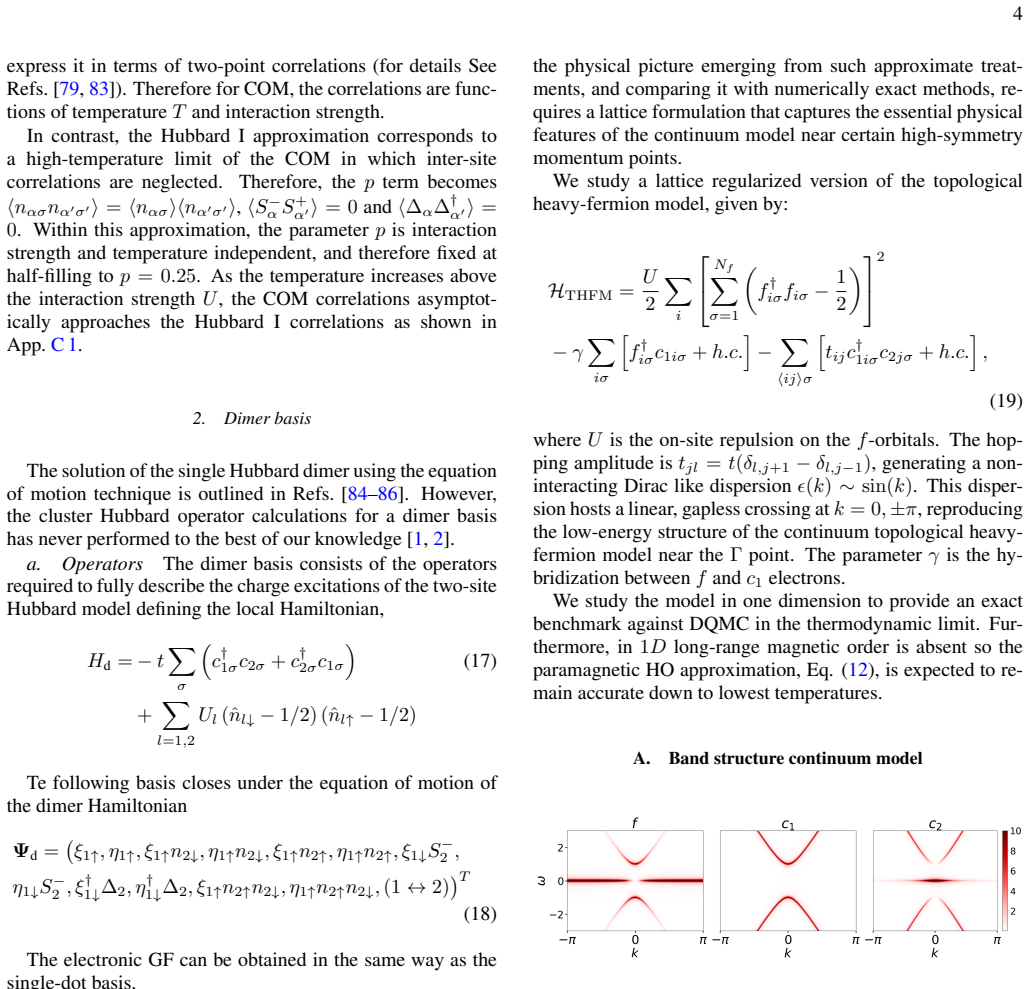
The topological heavy-fermion model provides a minimal framework for describing the coexistence of localized moments and itinerant Dirac electrons in magic-angle twisted bilayer graphene (MATBG). Several analytical and numerical methods have been applied to this model; however, whether they provide a realistic description of MATBG remains incompletely understood. In this work, we develop an Hubbard operator approach that incorporates non-local correlations beyond the single-site limit. We benchmark the approximate calculations against numerically exact determinant quantum Monte Carlo simulations of a lattice-regularized model. We show that commonly used local approximations, such as Hubbard-I, fail to capture the coupling between localized and itinerant degrees of freedom, leading to incorrect spectral properties in the local-moment regime. In contrast, the Hubbard operator method provides a controlled description of both correlation functions and spectral features over a regime of parameters, in good agreement with exact numerical methods.
Editorial analysis
A structured set of objections, weighed in public.
Referee Report
Summary. The manuscript develops a Hubbard operator method for the topological heavy fermion model (THFM) that incorporates non-local correlations beyond single-site approximations. It benchmarks this approach against determinant quantum Monte Carlo (DQMC) on a lattice-regularized version of the model, showing that local approximations such as Hubbard-I fail to capture the coupling between localized moments and itinerant Dirac electrons, while the Hubbard operator method yields spectral and correlation properties in agreement with the numerics over a range of parameters.
Significance. If the benchmarking is representative, the work supplies a controlled analytical tool for correlated topological systems that goes beyond local approximations and aligns with exact numerics, which is a strength for studying MATBG physics.
major comments (2)
- [Benchmarking sections] The central claim rests on the lattice-regularized model being representative of the full THFM; however, no explicit demonstration is given that the regularization preserves the Dirac dispersion, topological features, and non-local moment-electron couplings in the local-moment regime (see the benchmarking sections and the model definition).
- [Results on spectral features] The assertion of 'good agreement with exact numerical methods' for correlation functions and spectra is not supported by quantitative metrics such as integrated errors, peak-position deviations, or error bars on the DQMC comparisons.
minor comments (1)
- [Methods] Notation for the Hubbard operators and the lattice cutoff should be defined more explicitly in the methods section to aid reproducibility.
Simulated Author's Rebuttal
We thank the referee for their careful reading of the manuscript and their constructive comments. Below we provide point-by-point responses to the major comments. We have revised the manuscript to address these points where possible.
read point-by-point responses
-
Referee: [Benchmarking sections] The central claim rests on the lattice-regularized model being representative of the full THFM; however, no explicit demonstration is given that the regularization preserves the Dirac dispersion, topological features, and non-local moment-electron couplings in the local-moment regime (see the benchmarking sections and the model definition).
Authors: We thank the referee for highlighting this important aspect. Upon reflection, we recognize that while the lattice regularization is designed to capture the essential low-energy physics, an explicit verification was not included. In the revised manuscript, we have added an appendix (Appendix A) that demonstrates the preservation of the Dirac dispersion (by showing the band structure along high-symmetry paths), the topological features (via calculation of the Chern number), and the non-local couplings (through comparison of the interaction terms in the local-moment regime). This confirms that the lattice model is representative of the THFM. revision: yes
-
Referee: [Results on spectral features] The assertion of 'good agreement with exact numerical methods' for correlation functions and spectra is not supported by quantitative metrics such as integrated errors, peak-position deviations, or error bars on the DQMC comparisons.
Authors: We agree that providing quantitative metrics would make the comparison more precise and convincing. In the revised version, we have updated the results sections (Sections IV and V) to include quantitative measures: integrated errors for the spectral functions and correlation functions, deviations in the positions of key peaks, and error bars derived from the DQMC data. These additions support our claim of good agreement and are presented in new tables and updated figures. revision: yes
Circularity Check
No significant circularity; validated against independent DQMC
full rationale
The paper develops a Hubbard operator approach for the topological heavy-fermion model and benchmarks it directly against determinant quantum Monte Carlo (DQMC) simulations on a lattice-regularized version. This is external numerical validation rather than any self-referential construction. No steps reduce by definition to inputs, no parameters are fitted and then relabeled as predictions, and no load-bearing self-citations or uniqueness theorems from the same authors are invoked to force the result. The derivation chain remains self-contained because agreement is demonstrated with an independent, exact method outside the approximate scheme itself.
Axiom & Free-Parameter Ledger
Reference graph
Works this paper leans on
-
[1]
OperatorsThe single-dot cluster contains the opera- tors to fully describe the charge excitations of the single-site Hubbard model
Single-site cluster – Composite operator method a. OperatorsThe single-dot cluster contains the opera- tors to fully describe the charge excitations of the single-site Hubbard model. The local Hamiltonian is just the interaction part Hdot =U(ˆn1↑ −1/2) (ˆn1↓ −1/2)(11) The dot basis is composed of the holonsξ 1σ and doublons η1σ, operators given by (in the...
-
[2]
As the temperature increases above the interaction strengthU, the COM correlations asymptot- ically approaches the Hubbard I correlations as shown in App
Within this approximation, the parameterpis interaction strength and temperature independent, and therefore fixed at half-filling top= 0.25. As the temperature increases above the interaction strengthU, the COM correlations asymptot- ically approaches the Hubbard I correlations as shown in App. C 1
-
[3]
Dimer basis The solution of the single Hubbard dimer using the equation of motion technique is outlined in Refs. [84–86]. However, the cluster Hubbard operator calculations for a dimer basis has never performed to the best of our knowledge [1, 2]. a. OperatorsThe dimer basis consists of the operators required to fully describe the charge excitations of th...
-
[4]
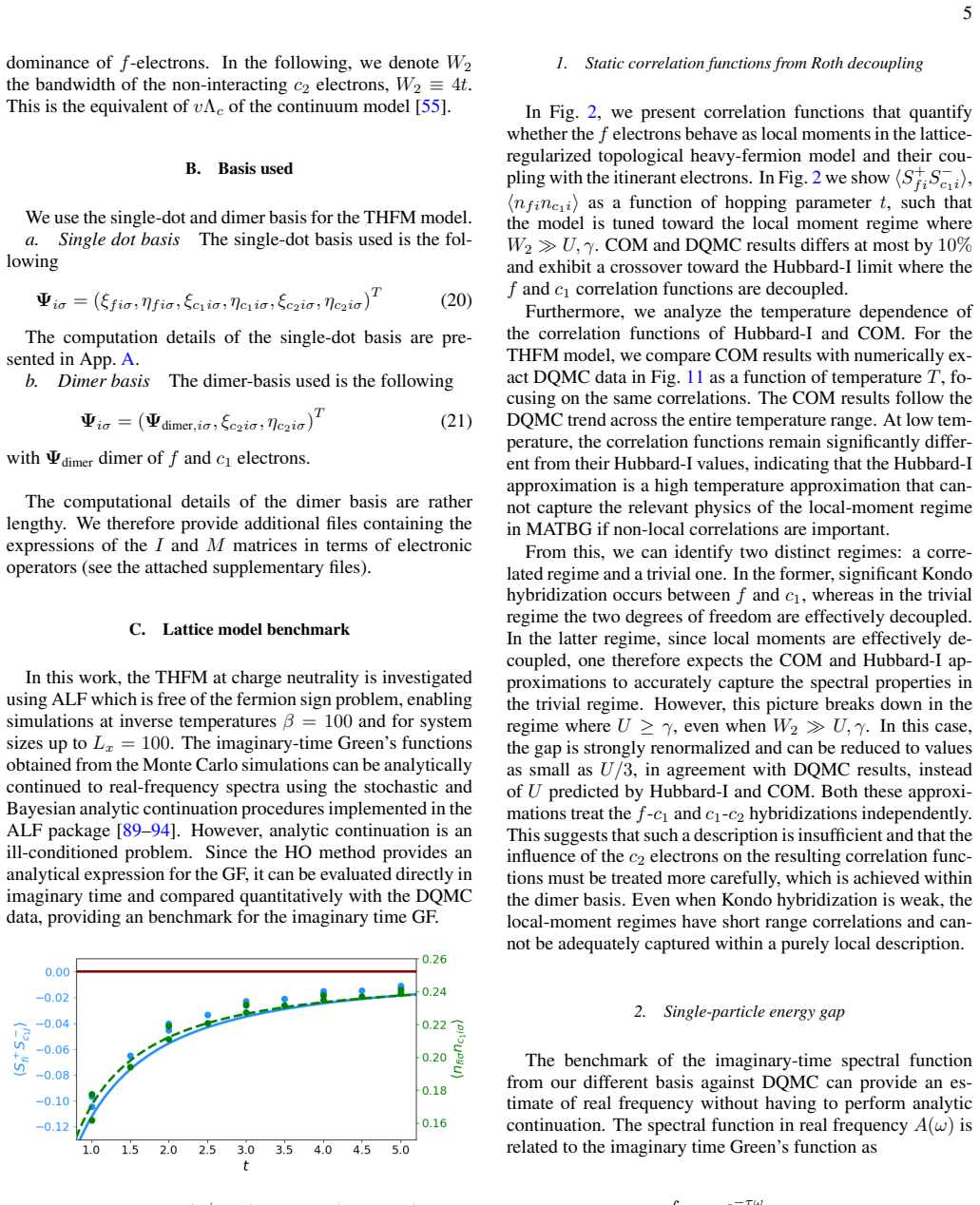
Static correlation functions from Roth decoupling In Fig. 2, we present correlation functions that quantify whether thefelectrons behave as local moments in the lattice- regularized topological heavy-fermion model and their cou- pling with the itinerant electrons. In Fig. 2 we show⟨S+ f iS− c1i⟩, ⟨nf inc1i⟩as a function of hopping parametert, such that th...
-
[5]
The spectral function in real frequencyA(ω)is related to the imaginary time Green’s function as G(τ) =− Z dω e−τ ω 1 +e −βω A(ω)(22) withτ∈[0, β]
Single-particle energy gap The benchmark of the imaginary-time spectral function from our different basis against DQMC can provide an es- timate of real frequency without having to perform analytic continuation. The spectral function in real frequencyA(ω)is related to the imaginary time Green’s function as G(τ) =− Z dω e−τ ω 1 +e −βω A(ω)(22) withτ∈[0, β]...
-
[6]
3, we benchmark the imaginary-time Green’s func- tion against DQMC results atk=π/2where the local- moment regime is expected to be most pronounced
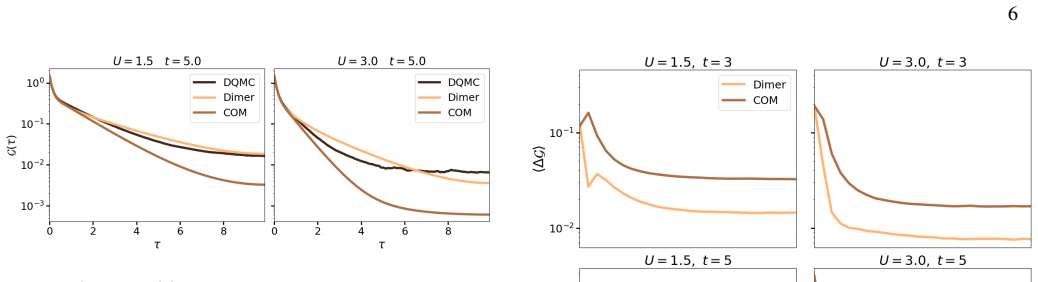
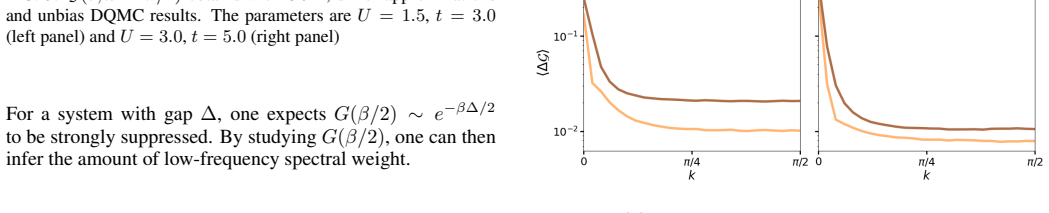
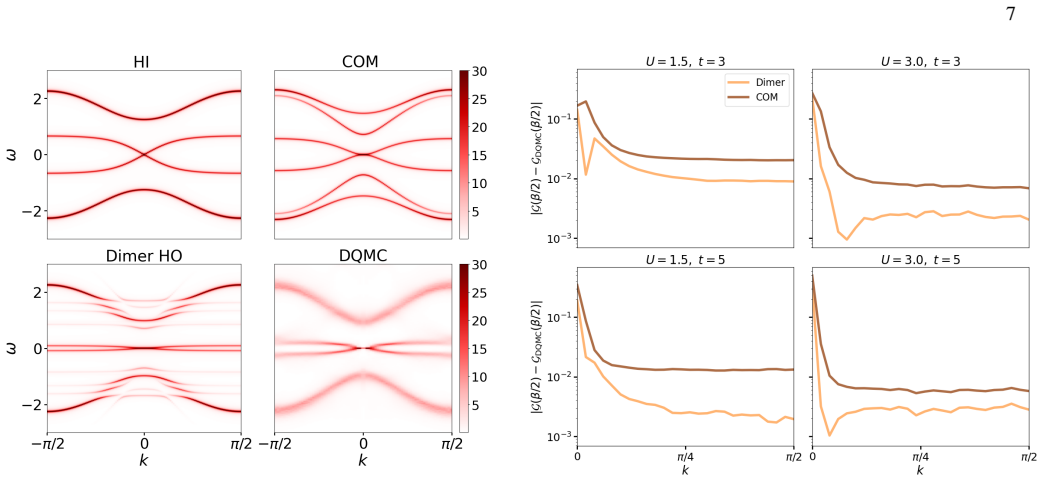
Imaginary time Greens function In Fig. 3, we benchmark the imaginary-time Green’s func- tion against DQMC results atk=π/2where the local- moment regime is expected to be most pronounced. The benchmarks are performed in a parameter regime satisfying W2 ≫U. The COM approximation systematically underes- timates the Green’s function compared to DQMC, indicati...
-
[7]
i − X ⟨ij⟩σ tij h c† 1iσc2jσ +h.c
Topological heavy fermion model In this section, we provide the equations for the single-site basis for the topological heavy fermion model with Hamilto- nian: HTHFM =U X i (ˆnf i↑ −1/2) (ˆnf i↓ −1/2) −γ X iσ h f † iσc1iσ +h.c. i − X ⟨ij⟩σ tij h c† 1iσc2jσ +h.c. i . The operator basis in the COM approximation reads Ψiσ = (ξf iσ, ηf iσ, ξc1iσ, ηc1iσ, ξc2iσ...
-
[8]
Some of these ex- pectation values, such as the density operatorn iσ =⟨c † iσciσ⟩, can be directly computed from the advanced and retarded composite Green’s function
Self-consistent scheme TheMandImatrices depend on certain expectation values that should be computed self-consistently. Some of these ex- pectation values, such as the density operatorn iσ =⟨c † iσciσ⟩, can be directly computed from the advanced and retarded composite Green’s function. To do so, we define the corre- lation function matrixCof two operators...
-
[9]
Nevertheless, the qualitative features of the spectrum near theΓpoint are governed by low- energy physics and are therefore insensitive to lattice details
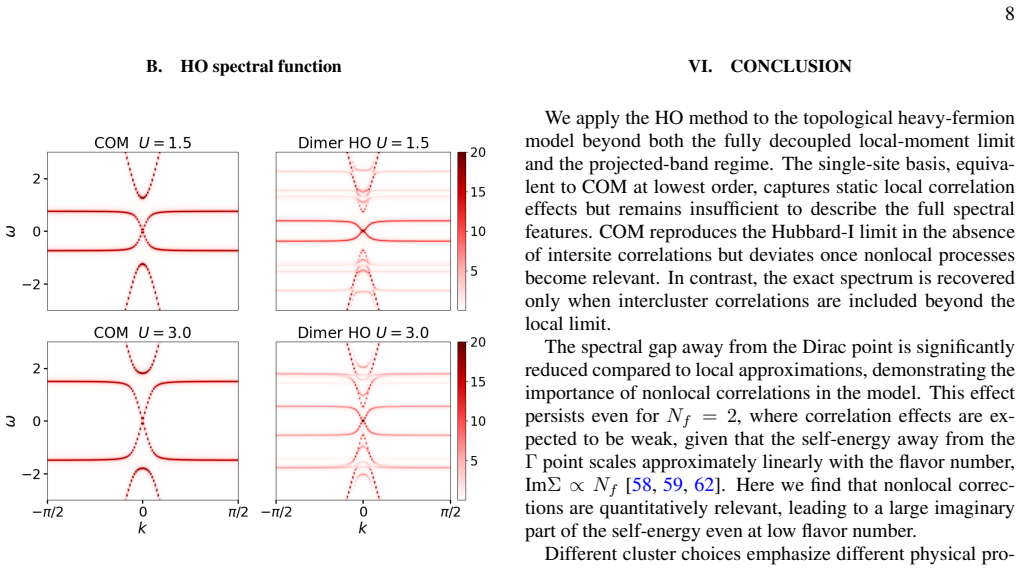
Limitation of composite operator method We have performed the self-consistent calculation only for the lattice-regularized model. Nevertheless, the qualitative features of the spectrum near theΓpoint are governed by low- energy physics and are therefore insensitive to lattice details. The COM approach relies on an enlarged operator basis, al- lowing for c...
-
[10]
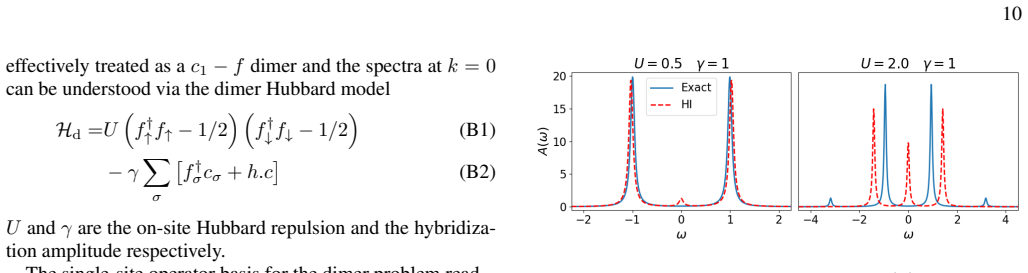
Dimer limit Atk= 0, the equations of motion for the gapless THFM nearly close: thec 2 electrons are decoupled, and the residual c1−c2 coupling enters only at higher order. The system can be 10 effectively treated as ac 1 −fdimer and the spectra atk= 0 can be understood via the dimer Hubbard model Hd =U f † ↑ f↑ −1/2 f † ↓ f↓ −1/2 (B1) −γ X σ f † σcσ +h.c ...
-
[11]
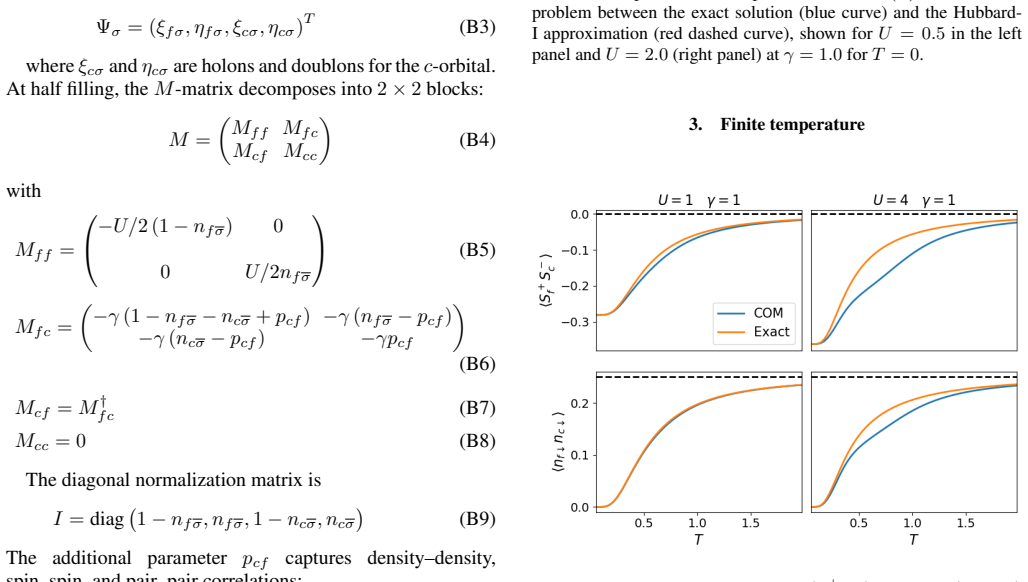
Zero-temperature limit For the dimer at half-filling atT= 0, the Roth decoupling becomes exact and therefore COM reproduce the exact spec- trum for allU. Fig. 8 compares the exact spectral function at T= 0with the Hubbard-I approximation for several values ofUat fixed hybridizationγ= 1.0. The Hubbard-I approx- imation, which restricts the Green’s function...
-
[12]
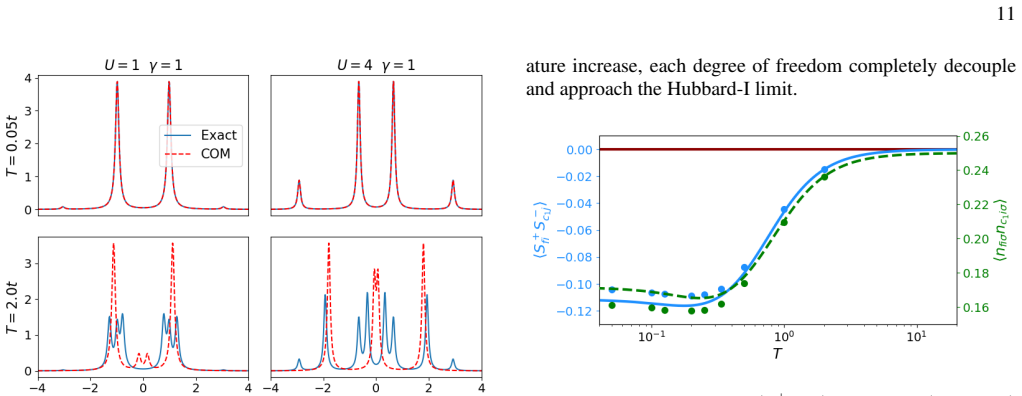
Finite temperature FIG. 9. Temperature dependence of⟨S + f S− c ⟩(top) and⟨n f↓ nc↓⟩ (bottom) for the dimer. Exact results are in orange, COM in blue, and Hubbard-I in black are shown forU= 1.0(left) andU= 4.0 (right), withγ= 1.0. ForT̸= 0, the COM becomes approximate, as the four- pole ansatz no longer captures all thermally activated excita- tions. In F...
-
[13]
11, we present local correlation function between fandc 1 electrons as a function of temperature
Correlation function as a function of temperature In Fig. 11, we present local correlation function between fandc 1 electrons as a function of temperature. The main insight is that COM results are very close from DQMC data for the whole temperature range, fromT≪t, UtoT≫U where the system is completely incoherent. As the temper- ature increase, each degree...
-
[14]
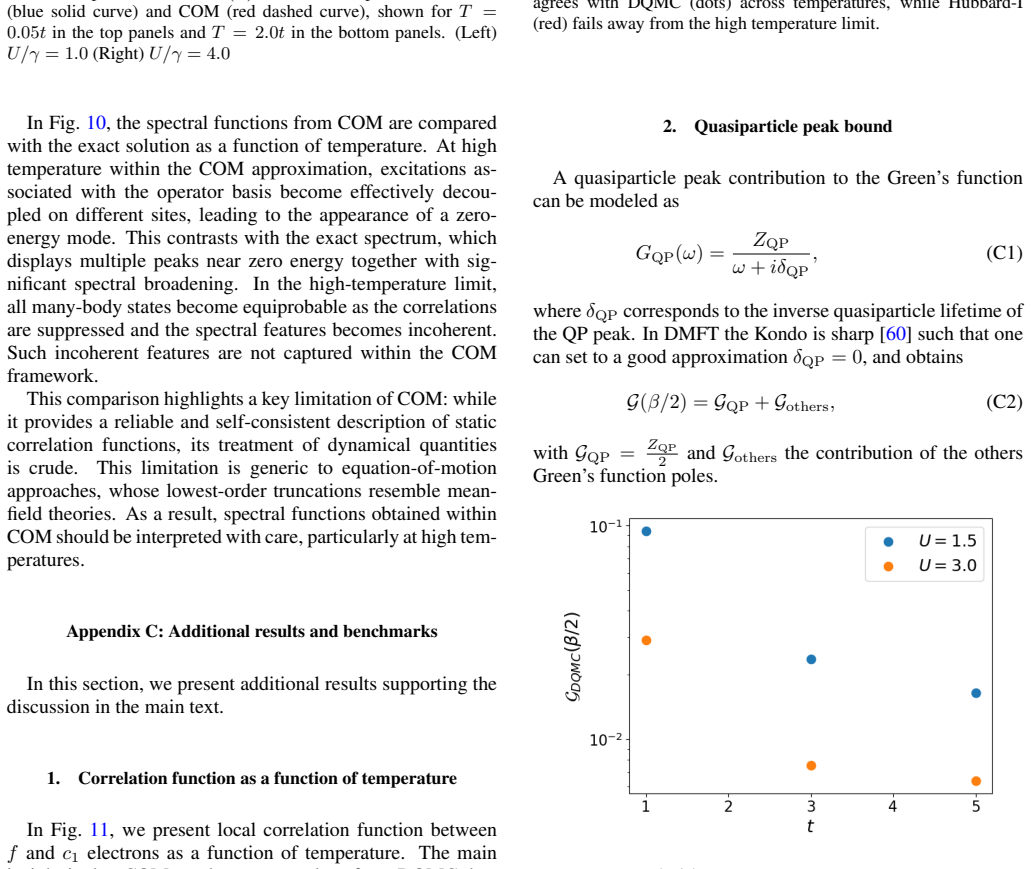
Quasiparticle peak bound A quasiparticle peak contribution to the Green’s function can be modeled as GQP(ω) = ZQP ω+iδ QP ,(C1) whereδ QP corresponds to the inverse quasiparticle lifetime of the QP peak. In DMFT the Kondo is sharp [60] such that one can set to a good approximationδ QP = 0, and obtains G(β/2) =G QP +G others,(C2) withG QP = ZQP 2 andG othe...
-
[15]
Hubbard, Electron correlations in narrow energy bands, Pro- ceedings of the Royal Society of London
J. Hubbard, Electron correlations in narrow energy bands, Pro- ceedings of the Royal Society of London. Series A. Mathemat- ical and Physical Sciences276, 238 (1963)
1963
-
[16]
Hubbard, Electron correlations in narrow energy bands
J. Hubbard, Electron correlations in narrow energy bands. ii. the degenerate band case, Proceedings of the Royal Society of Lon- don. A. Mathematical and Physical Sciences277, 237 (1964)
1964
-
[17]
Georges, G
A. Georges, G. Kotliar, W. Krauth, and M. J. Rozenberg, Dy- namical mean-field theory of strongly correlated fermion sys- tems and the limit of infinite dimensions, Rev. Mod. Phys.68, 13 (1996)
1996
-
[18]
Imada, A
M. Imada, A. Fujimori, and Y . Tokura, Metal-insulator transi- tions, Rev. Mod. Phys.70, 1039 (1998)
1998
-
[19]
D. P. Arovas, E. Berg, S. A. Kivelson, and S. Raghu, The hub- bard model, Annual Review of Condensed Matter Physics13, 239 (2022)
2022
-
[20]
M. Qin, T. Sch¨afer, S. Andergassen, P. Corboz, and E. Gull, The hubbard model: A computational perspective, Annual Review of Condensed Matter Physics13, 275 (2022)
2022
-
[21]
Zondiner, A
U. Zondiner, A. Rozen, D. Rodan-Legrain, Y . Cao, R. Queiroz, T. Taniguchi, K. Watanabe, Y . Oreg, F. von Oppen, A. Stern, E. Berg, P. Jarillo-Herrero, and S. Ilani, Cascade of phase tran- sitions and dirac revivals in magic-angle graphene, Nature582, 203 (2020)
2020
-
[22]
Rozen, J
A. Rozen, J. M. Park, U. Zondiner, Y . Cao, D. Rodan-Legrain, T. Taniguchi, K. Watanabe, Y . Oreg, A. Stern, E. Berg,et al., Entropic evidence for a pomeranchuk effect in magic-angle graphene, Nature592, 214 (2021)
2021
-
[23]
Saito, F
Y . Saito, F. Yang, J. Ge, X. Liu, T. Taniguchi, K. Watanabe, J. Li, E. Berg, and A. F. Young, Isospin pomeranchuk effect in twisted bilayer graphene, Nature592, 220 (2021)
2021
-
[24]
Datta, M
A. Datta, M. J. Calder ´on, A. Camjayi, and E. Bascones, Heavy quasiparticles and cascades without symmetry breaking in twisted bilayer graphene, Nature Communications14, 5036 (2023)
2023
-
[25]
R. L. Merino, D. C ˘alug˘aru, H. Hu, J. D ´ıez-M´erida, A. D ´ıez- Carl´on, T. Taniguchi, K. Watanabe, P. Seifert, B. A. Bernevig, and D. K. Efetov, Interplay between light and heavy electron bands in magic-angle twisted bilayer graphene, Nature Physics 21, 1078 (2025)
2025
-
[26]
J. Xiao, A. Inbar, J. Birkbeck, N. Gershon, Y . Zamir, T. Taniguchi, K. Watanabe, E. Berg, and S. Ilani, The inter- acting energy bands of magic angle twisted bilayer graphene revealed by the quantum twisting microscope, arXiv preprint arXiv:2506.20738 (2025)
arXiv 2025
- [27]
-
[28]
Kang and O
J. Kang and O. Vafek, Symmetry, maximally localized wannier states, and a low-energy model for twisted bilayer graphene nar- row bands, Phys. Rev. X8, 031088 (2018)
2018
-
[29]
Z. Song, Z. Wang, W. Shi, G. Li, C. Fang, and B. A. Bernevig, All magic angles in twisted bilayer graphene are topological, Phys. Rev. Lett.123, 036401 (2019)
2019
-
[30]
H. C. Po, L. Zou, T. Senthil, and A. Vishwanath, Faithful tight- binding models and fragile topology of magic-angle bilayer graphene, Phys. Rev. B99, 195455 (2019)
2019
-
[31]
J. Ahn, S. Park, and B.-J. Yang, Failure of nielsen-ninomiya theorem and fragile topology in two-dimensional systems with space-time inversion symmetry: Application to twisted bilayer graphene at magic angle, Phys. Rev. X9, 021013 (2019)
2019
-
[32]
Khalaf, A
E. Khalaf, A. J. Kruchkov, G. Tarnopolsky, and A. Vishwanath, Magic angle hierarchy in twisted graphene multilayers, Phys. Rev. B100, 085109 (2019)
2019
-
[33]
Tarnopolsky, A
G. Tarnopolsky, A. J. Kruchkov, and A. Vishwanath, Origin of magic angles in twisted bilayer graphene, Phys. Rev. Lett.122, 106405 (2019)
2019
-
[34]
Xie and A
M. Xie and A. H. MacDonald, Nature of the correlated insulator states in twisted bilayer graphene, Phys. Rev. Lett.124, 097601 (2020)
2020
-
[35]
S. Wu, Z. Zhang, K. Watanabe, T. Taniguchi, and E. Y . An- drei, Chern insulators, van hove singularities and topological flat bands in magic-angle twisted bilayer graphene, Nature Ma- terials20, 488 (2021)
2021
-
[36]
B. A. Bernevig, Z.-D. Song, N. Regnault, and B. Lian, Twisted bilayer graphene. iii. interacting hamiltonian and exact symme- tries, Physical Review B103, 205413 (2021)
2021
-
[37]
B. Zhou and Y .-H. Zhang, Symmetric topological mott insulator and mott semimetal (2026), arXiv:2601.02485 [cond-mat.str- el]
arXiv 2026
-
[38]
Y . Cao, V . Fatemi, A. Demir, S. Fang, S. L. Tomarken, J. Y . Luo, J. D. Sanchez-Yamagishi, K. Watanabe, T. Taniguchi, E. Kaxi- ras, R. C. Ashoori, and P. Jarillo-Herrero, Correlated insulator behaviour at half-filling in magic-angle graphene superlattices, Nature556, 80 (2018)
2018
-
[39]
Y . Choi, J. Kemmer, Y . Peng, A. Thomson, H. Arora, R. Polski, Y . Zhang, H. Ren, J. Alicea, G. Refael, F. von Oppen, K. Watan- abe, T. Taniguchi, and S. Nadj-Perge, Electronic correlations in twisted bilayer graphene near the magic angle, Nature Physics 15, 1174 (2019)
2019
-
[40]
Kerelsky, L
A. Kerelsky, L. J. McGilly, D. M. Kennes, L. Xian, M. Yankowitz, S. Chen, K. Watanabe, T. Taniguchi, J. Hone, C. Dean, A. Rubio, and A. N. Pasupathy, Maximized electron interactions at the magic angle in twisted bilayer graphene, Na- ture572, 95 (2019)
2019
-
[41]
Y . Xie, B. Lian, B. J ¨ack, X. Liu, C.-L. Chiu, K. Watanabe, T. Taniguchi, B. A. Bernevig, and A. Yazdani, Spectroscopic signatures of many-body correlations in magic-angle twisted bi- layer graphene, Nature572, 101 (2019)
2019
-
[42]
Bultinck, E
N. Bultinck, E. Khalaf, S. Liu, S. Chatterjee, A. Vishwanath, and M. P. Zaletel, Ground state and hidden symmetry of magic- angle graphene at even integer filling, Phys. Rev. X10, 031034 (2020)
2020
-
[43]
N. Wei, F. von Oppen, and L. I. Glazman, Dirac-point spec- troscopy of flat-band systems with the quantum twisting micro- scope, Physical Review B111, 085128 (2025)
2025
-
[44]
Y . Cao, V . Fatemi, S. Fang, K. Watanabe, T. Taniguchi, E. Kaxi- ras, and P. Jarillo-Herrero, Unconventional superconductivity in magic-angle graphene superlattices, Nature556, 43 (2018). 13
2018
-
[45]
X. Lu, P. Stepanov, W. Yang, M. Xie, M. A. Aamir, I. Das, C. Urgell, K. Watanabe, T. Taniguchi, G. Zhang, A. Bachtold, A. H. MacDonald, and D. K. Efetov, Superconductors, orbital magnets and correlated states in magic-angle bilayer graphene, Nature574, 653 (2019)
2019
-
[46]
Khalaf, S
E. Khalaf, S. Chatterjee, N. Bultinck, M. P. Zaletel, and A. Vishwanath, Charged skyrmions and topological origin of superconductivity in magic-angle graphene, Science Advances 7, eabf5299 (2021)
2021
-
[47]
Yankowitz, S
M. Yankowitz, S. Chen, H. Polshyn, Y . Zhang, K. Watanabe, T. Taniguchi, D. Graf, A. F. Young, and C. R. Dean, Tuning su- perconductivity in twisted bilayer graphene, Science363, 1059 (2019)
2019
-
[48]
Stepanov, I
P. Stepanov, I. Das, X. Lu, A. Fahimniya, K. Watanabe, T. Taniguchi, F. H. L. Koppens, J. Lischner, L. Levitov, and D. K. Efetov, Untying the insulating and superconducting or- ders in magic-angle graphene, Nature583, 375 (2020)
2020
-
[49]
Saito, J
Y . Saito, J. Ge, K. Watanabe, T. Taniguchi, and A. F. Young, In- dependent superconductors and correlated insulators in twisted bilayer graphene, Nature Physics16, 926 (2020)
2020
-
[50]
D. Wong, K. P. Nuckolls, M. Oh, B. Lian, Y . Xie, S. Jeon, K. Watanabe, T. Taniguchi, B. A. Bernevig, and A. Yazdani, Cascade of electronic transitions in magic-angle twisted bilayer graphene, Nature582, 198 (2020)
2020
-
[51]
I. Das, X. Lu, J. Herzog-Arbeitman, Z.-D. Song, K. Watanabe, T. Taniguchi, B. A. Bernevig, and D. K. Efetov, Symmetry- broken chern insulators and rashba-like landau-level cross- ings in magic-angle bilayer graphene, Nature Physics17, 710 (2021)
2021
-
[52]
A. L. Sharpe, E. J. Fox, A. W. Barnard, J. Finney, K. Watan- abe, T. Taniguchi, M. A. Kastner, and D. Goldhaber- Gordon, Emergent ferromagnetism near three-quarters fill- ing in twisted bilayer graphene, Science365, 605 (2019), https://www.science.org/doi/pdf/10.1126/science.aaw3780
-
[53]
Y . H. Kwan, G. Wagner, T. Soejima, M. P. Zaletel, S. H. Simon, S. A. Parameswaran, and N. Bultinck, Kekul´e spiral order at all nonzero integer fillings in twisted bilayer graphene, Phys. Rev. X11, 041063 (2021)
2021
-
[54]
Shavit, E
G. Shavit, E. Berg, A. Stern, and Y . Oreg, Theory of correlated insulators and superconductivity in twisted bilayer graphene, Phys. Rev. Lett.127, 247703 (2021)
2021
-
[55]
Jaoui, I
A. Jaoui, I. Das, G. Di Battista, J. D ´ıez-M´erida, X. Lu, K. Watanabe, T. Taniguchi, H. Ishizuka, L. Levitov, and D. K. Efetov, Quantum critical behaviour in magic-angle twisted bi- layer graphene, Nature Physics18, 633 (2022)
2022
-
[56]
Wagner, Y
G. Wagner, Y . H. Kwan, N. Bultinck, S. H. Simon, and S. A. Parameswaran, Global phase diagram of the normal state of twisted bilayer graphene, Phys. Rev. Lett.128, 156401 (2022)
2022
-
[57]
H. Tian, X. Gao, Y . Zhang, S. Che, T. Xu, P. Cheung, K. Watan- abe, T. Taniguchi, M. Randeria, F. Zhang, C. N. Lau, and M. W. Bockrath, Evidence for dirac flat band superconductivity en- abled by quantum geometry, Nature614, 440 (2023)
2023
-
[58]
Y . H. Kwan, G. Wagner, N. Bultinck, S. H. Simon, E. Berg, and S. A. Parameswaran, Electron-phonon coupling and competing kekul´e orders in twisted bilayer graphene, Phys. Rev. B110, 085160 (2024)
2024
-
[59]
J.-Y . Zhao and Y .-H. Zhang, Resonating-valence-bond super- conductor from small fermi surface in twisted bilayer graphene, arXiv preprint arXiv:2510.26801 (2025)
arXiv 2025
-
[60]
H. Hu, G. Rai, L. Crippa, J. Herzog-Arbeitman, D. C ˘alug˘aru, T. Wehling, G. Sangiovanni, R. Valent ´ı, A. M. Tsvelik, and B. A. Bernevig, Symmetric kondo lattice states in doped strained twisted bilayer graphene, Phys. Rev. Lett.131, 166501 (2023)
2023
-
[61]
N. Wei, F. Guinea, F. von Oppen, and L. I. Glazman, Theory of plasmon spectroscopy with the quantum twisting microscope, Phys. Rev. B112, 155157 (2025)
2025
-
[62]
Waschitz, A
Y . Waschitz, A. Stern, and Y . Oreg, Momentum-resolved spec- troscopy of superconductivity with the quantum twisting micro- scope, Phys. Rev. Lett.136, 156501 (2026)
2026
-
[63]
N. Wei, F. von Oppen, and L. I. Glazman, Tunneling spec- troscopy of two-dimensional superconductors with the quantum twisting microscope, Phys. Rev. B113, 064502 (2026)
2026
-
[64]
R. Bistritzer and A. H. MacDonald, Moir ´e bands in twisted double-layer graphene, Proceedings of the National Academy of Sciences108, 12233 (2011), https://www.pnas.org/doi/pdf/10.1073/pnas.1108174108
-
[65]
H. C. Po, L. Zou, A. Vishwanath, and T. Senthil, Origin of Mott Insulating Behavior and Superconductivity in Twisted Bilayer Graphene, Physical Review X8, 031089 (2018)
2018
-
[66]
J.-Y . Zhao, B. Zhou, and Y .-H. Zhang, Topological mott local- ization and pseudogap metal in twisted bilayer graphene, Phys. Rev. B112, 085107 (2025)
2025
-
[67]
P. J. Ledwith, J. Dong, A. Vishwanath, and E. Khalaf, Nonlo- cal moments and mott semimetal in the chern bands of twisted bilayer graphene, Phys. Rev. X15, 021087 (2025)
2025
-
[68]
P. A. Nosov, E. Khalaf, and P. Ledwith, Controlled expansion for correlated electrons with concentrated kinematics, arXiv preprint arXiv:2605.20171 (2026)
Pith/arXiv arXiv 2026
-
[69]
Song and B
Z.-D. Song and B. A. Bernevig, Magic-angle twisted bilayer graphene as a topological heavy fermion problem, Phys. Rev. Lett.129, 047601 (2022)
2022
-
[70]
L. L. Lau and P. Coleman, Topological mixed valence model for twisted bilayer graphene, Physical Review X15, 021028 (2025)
2025
- [71]
-
[72]
H. Hu, Y . Shao, L. Crippa, D. C ˘alug˘aru, G. Sangiovanni, T. Wehling, L. I. Glazman, and B. A. Bernevig, Twisted bilayer graphene lifetimes at integer fillings: An analytic result (2026), arXiv:2604.14303 [cond-mat.str-el]
Pith/arXiv arXiv 2026
-
[73]
N. Wei, F. von Oppen, and L. I. Glazman, Lifetime and spectral function of topological heavy fermions (2026), arXiv:2604.14369 [cond-mat.str-el]
Pith/arXiv arXiv 2026
-
[74]
D. C ˘alug˘aru, H. Hu, L. Crippa, G. Rai, N. Regnault, T. O. Wehling, R. Valent ´ı, G. Sangiovanni, and B. A. Bernevig, Obtaining the spectral function of moir\’e graphene heavy- fermions using iterative perturbation theory, arXiv preprint arXiv:2509.18256 (2025)
arXiv 2025
-
[75]
L. Crippa, G. Rai, D. C ˘alug˘aru, H. Hu, J. Herzog-Arbeitman, B. A. Bernevig, R. Valent ´ı, G. Sangiovanni, and T. Wehling, Dynamical correlation effects in twisted bilayer graphene under strain and lattice relaxation, arXiv preprint arXiv:2509.19436 (2025)
Pith/arXiv arXiv 2025
-
[76]
Y . Vituri and E. Berg, Controlled loop expansion for the topo- logical heavy fermion model (2026), arXiv:2604.14278 [cond- mat.str-el]
Pith/arXiv arXiv 2026
-
[77]
S. G. Ovchinnikov and V . V . Val’kov,Hubbard operators in the theory of strongly correlated electrons(World Scientific, 2004)
2004
-
[78]
Mancini and A
F. Mancini and A. Avella, The hubbard model within the equa- tions of motion approach, Advances in Physics53, 537 (2004)
2004
-
[79]
L. M. Roth, Electron correlation in narrow energy bands. i. the two-pole approximation in a narrowsband, Phys. Rev.184, 451 (1969)
1969
-
[80]
J.-Y . Zhao, B. Zhou, and Y .-H. Zhang, Mixed-valence mott in- sulator and composite excitation in twisted bilayer graphene, Phys. Rev. B112, 235144 (2025). 14
2025
discussion (0)
Sign in with ORCID, Apple, or X to comment. Anyone can read and Pith papers without signing in.