Raising the reionization optical depth with inflationary CMB features
Pith reviewed 2026-06-26 15:56 UTC · model grok-4.3
The pith
Interpreting the CMB low-power feature as inflationary raises the upper limit on reionization optical depth to 0.082.
A machine-rendered reading of the paper's core claim, the machinery that carries it, and where it could break.
Core claim
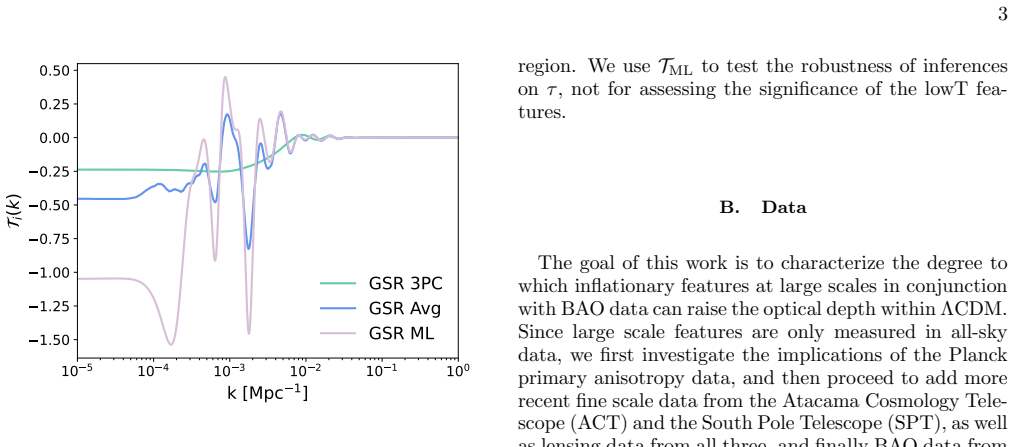
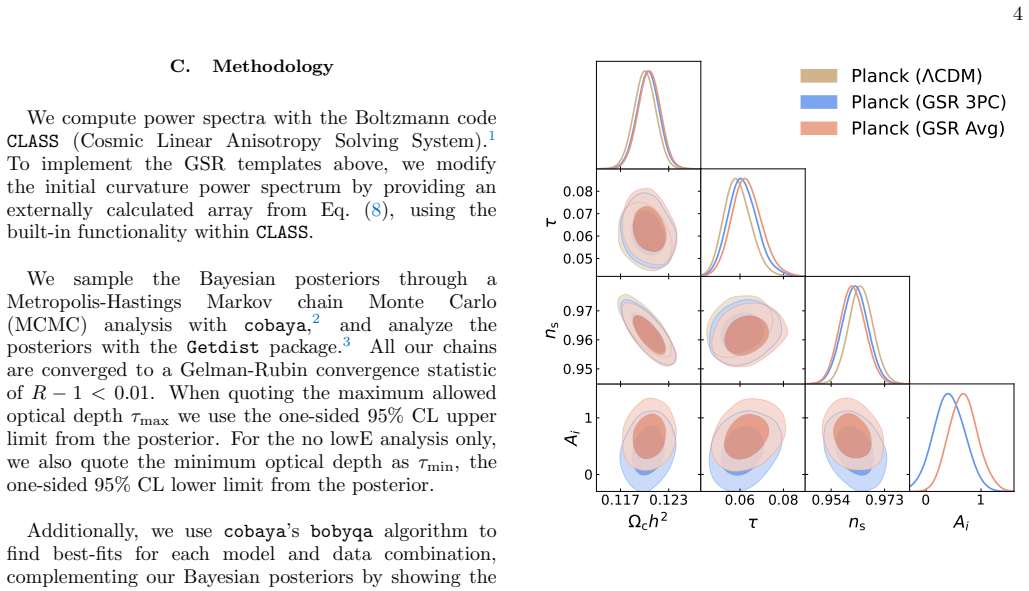
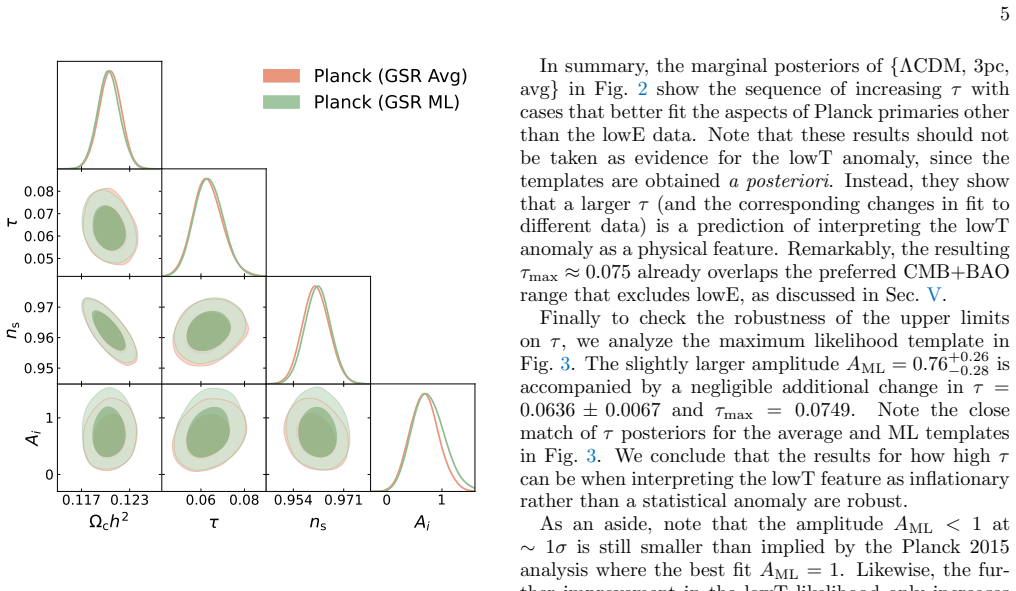
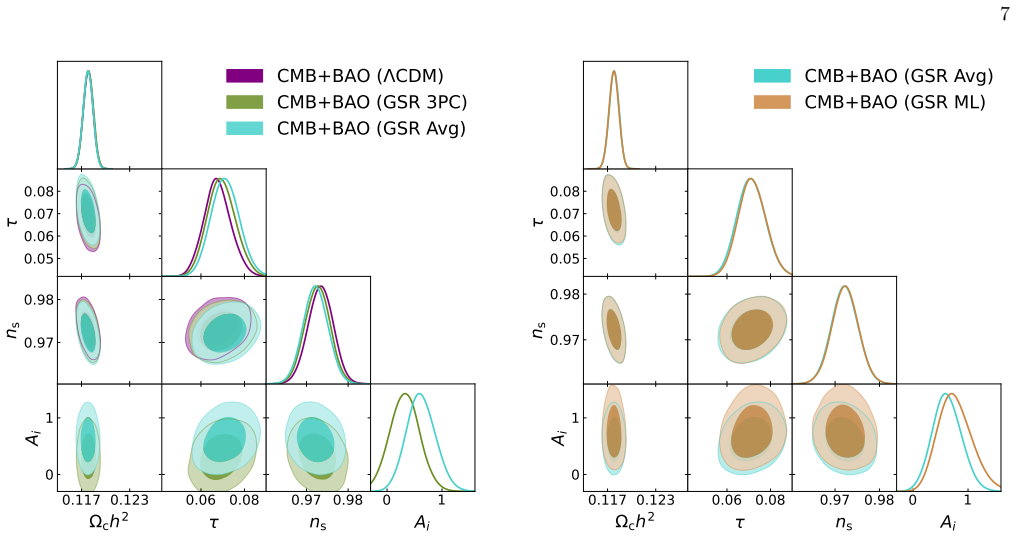
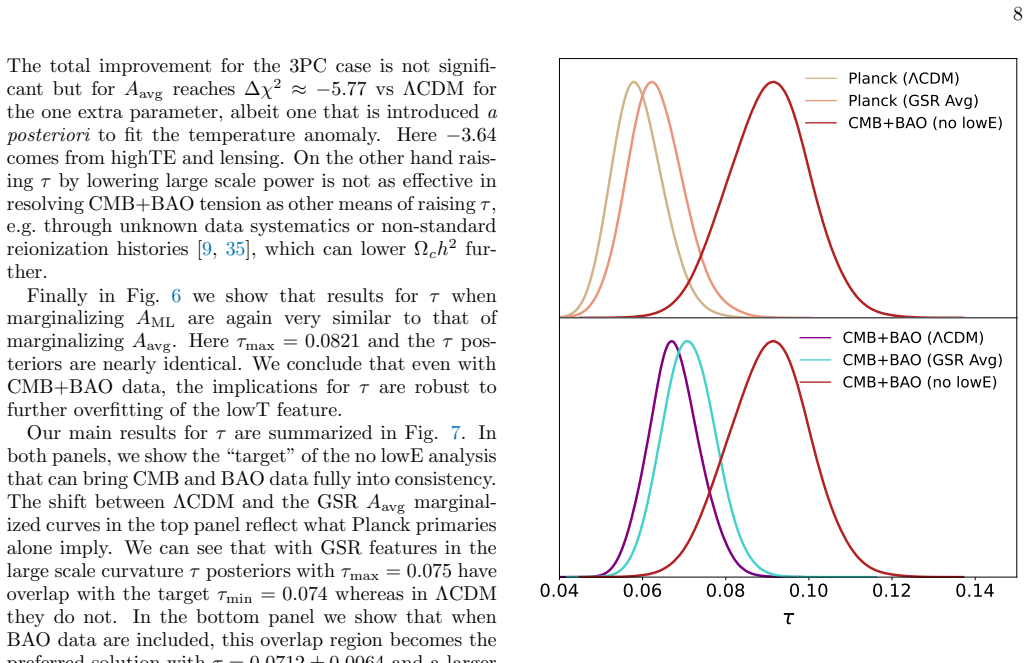
If the long-standing low-power feature of the temperature measurements is interpreted as physically originating from inflation then τ inferred from large-angle polarization becomes larger. Marginalizing over templates of the low-power feature based on the generalized slow-roll formalism of inflation raises the Planck maximum to a more compatible τ_max=0.075 which further increases to τ_max = 0.082 with the inclusion of all CMB+BAO data. This marginalization does not assess the statistical significance of the low-power feature itself; rather, it shows that allowing a higher τ is a consequence of interpreting the anomaly as a physical feature instead of a statistical fluctuation.
What carries the argument
Templates of the low-power feature based on the generalized slow-roll formalism of inflation, which are marginalized over to adjust the inference of the reionization optical depth τ from large-angle polarization data.
If this is right
- The 95% upper limit on τ from Planck data alone increases to 0.075.
- With the full combination of CMB and BAO data the limit reaches 0.082 and becomes compatible with independent lower bounds.
- Treating the low-power anomaly as a physical inflationary effect rather than a fluctuation directly permits these higher values of τ.
- The reconciliation occurs without any change to the standard reionization model or slow-roll assumptions outside the feature templates.
Where Pith is reading between the lines
- The same marginalization technique could be applied to other early-universe features to check their effect on late-time parameter tensions.
- Independent probes of reionization such as 21cm observations could provide a cross-check on whether the higher τ values are realized in nature.
- If the feature templates prove robust, they might systematically shift inferences for other parameters that correlate with the large-scale power spectrum.
Load-bearing premise
The low-power feature originates from inflation and is adequately captured by generalized slow-roll templates rather than being a statistical fluctuation or arising from other systematics.
What would settle it
Future CMB data with higher sensitivity to large-angle polarization or small-scale power spectrum measurements that either confirm or rule out the low-power feature at high significance while holding τ fixed would test whether the raised upper limits persist.
Figures
read the original abstract
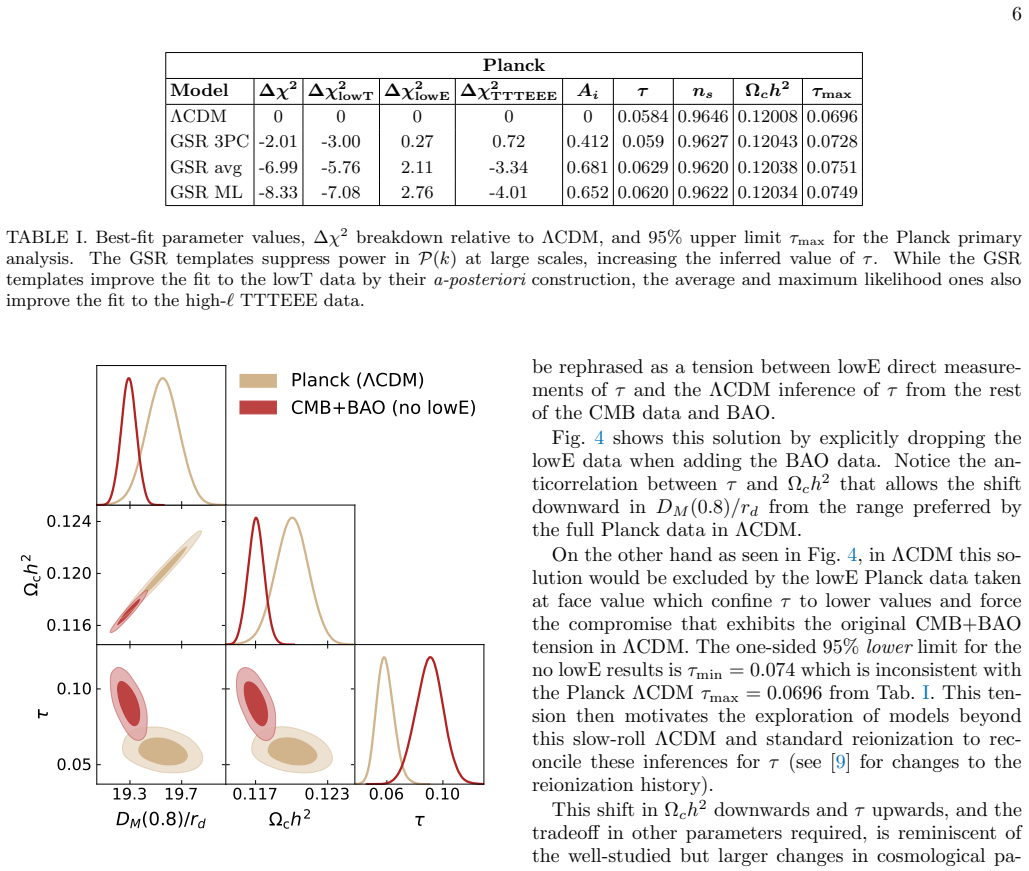
Within the highly successful $\Lambda$CDM paradigm established with cosmic microwave background (CMB) anisotropy measurements, the optical depth through reionization $\tau$ is the most uncertain due both to the difficulty in measuring large-angle polarization and the assumptions made in their interpretation. Currently, for the Planck primary data in the flat $\Lambda$CDM cosmology with slow-roll inflation and standard reionization, the one-sided 95% upper limit for $\tau$ is $\tau_{\rm max}=0.0696$. Yet when all current CMB measurements excluding large-angle polarization are combined with baryon acoustic oscillation (BAO) measurements, the one-sided 95% lower limit is an incompatible $\tau_{\rm min}=0.074$. If the long-standing low-power feature of the temperature measurements is interpreted as physically originating from inflation then $\tau$ inferred from large-angle polarization becomes larger. Marginalizing over templates of the low-power feature based on the generalized slow-roll formalism of inflation raises the Planck maximum to a more compatible $\tau_{\rm max}=0.075$ which further increases to $\tau_{\rm max} = 0.082$ with the inclusion of all CMB+BAO data. This marginalization does not assess the statistical significance of the low-power feature itself; rather, it shows that allowing a higher $\tau$ is a consequence of interpreting the anomaly as a physical feature instead of a statistical fluctuation.
Editorial analysis
A structured set of objections, weighed in public.
Referee Report
Summary. The paper claims that interpreting the low-power feature in CMB temperature data as an inflationary effect captured by generalized slow-roll (GSR) templates, and marginalizing over those templates when analyzing large-angle polarization, raises the one-sided 95% upper limit on the reionization optical depth τ from 0.0696 to 0.075 (Planck primary data) or 0.082 (all CMB+BAO data). This conditional result is presented as a consequence of the physical interpretation rather than an assessment of the feature's statistical significance, and is intended to address apparent tension with the τ_min=0.074 lower limit from other data combinations.
Significance. If the marginalization is correctly implemented, the result illustrates the sensitivity of τ constraints to assumptions about the primordial power spectrum and provides a mechanism to reconcile limits without invoking new reionization physics. The explicit conditional framing and disclaimer on significance assessment are strengths that keep the claim proportionate. The work could inform how low-power anomalies are treated in future CMB analyses combining temperature and polarization.
major comments (1)
- [Methods/Results] The central numerical results (raised τ_max=0.075 and 0.082) depend on the marginalization procedure over GSR templates, yet the manuscript provides insufficient detail on the template parameterization, the range of feature amplitudes and scales, the priors, and the exact likelihood construction when combining with polarization data. This information is required to verify the reported shifts and is load-bearing for the claim.
minor comments (1)
- Notation for one-sided limits (τ_max, τ_min) is used without a dedicated definition or table summarizing the exact confidence levels and data combinations; adding this would aid readability.
Simulated Author's Rebuttal
We thank the referee for the constructive assessment and for highlighting the need for greater methodological transparency. We address the major comment below and will revise the manuscript accordingly.
read point-by-point responses
-
Referee: [Methods/Results] The central numerical results (raised τ_max=0.075 and 0.082) depend on the marginalization procedure over GSR templates, yet the manuscript provides insufficient detail on the template parameterization, the range of feature amplitudes and scales, the priors, and the exact likelihood construction when combining with polarization data. This information is required to verify the reported shifts and is load-bearing for the claim.
Authors: We agree that the current manuscript provides insufficient detail on the GSR marginalization for full reproducibility. In the revised manuscript we will add an expanded methods subsection that specifies: (i) the exact functional form and parameterization of the GSR templates, (ii) the prior ranges adopted for feature amplitudes and scales, and (iii) the precise likelihood construction used when marginalizing over the templates jointly with the large-angle polarization data. These additions will allow independent verification of the reported shifts in the one-sided 95% upper limits on τ. revision: yes
Circularity Check
No significant circularity identified
full rationale
The paper's derivation consists of marginalizing the posterior for τ over additional parameters in GSR templates that model the low-power feature in temperature data. This is a direct statistical consequence of the marginalization and does not reduce by construction to any input quantity, self-definition, or fitted parameter renamed as a prediction. The GSR formalism is treated as an external prior input rather than derived within the paper, and no load-bearing self-citation, uniqueness theorem, or ansatz smuggling appears in the stated logic. The result is explicitly conditional on the interpretation of the feature and remains self-contained against external benchmarks.
Axiom & Free-Parameter Ledger
axioms (2)
- domain assumption Generalized slow-roll formalism generates valid templates for the low-power feature
- domain assumption Baseline flat ΛCDM with slow-roll inflation and standard reionization
Reference graph
Works this paper leans on
-
[1]
oscillatory residuals
where Ω ch2 = 0.1138±0.0045 was even lower (and τ= 0.089±0.014) or Planck TTℓ <1000 [7]. In the data, these were driven by the smoothness of the acoustic peaks or “oscillatory residuals” atℓ >1000 and the interpre- tation of the lowT anomaly within ΛCDM [7]. Lowering Ωch2 in ΛCDM creates tension in both the primary CMB anisotropy and, if too far, CMB lens...
2015
-
[2]
A. Kogutet al.(WMAP), Astrophys. J. Suppl.148, 161 (2003), arXiv:astro-ph/0302213
Pith/arXiv arXiv 2003
-
[3]
Hinshawet al.(WMAP), Astrophys
G. Hinshawet al.(WMAP), Astrophys. J. Suppl.208, 19 (2013), arXiv:1212.5226 [astro-ph.CO]
Pith/arXiv arXiv 2013
-
[4]
P. A. R. Adeet al.(Planck), Astron. Astrophys.571, A16 (2014), arXiv:1303.5076 [astro-ph.CO]
Pith/arXiv arXiv 2014
-
[5]
P. A. R. Adeet al.(Planck), Astron. Astrophys.594, A13 (2016), arXiv:1502.01589 [astro-ph.CO]
Pith/arXiv arXiv 2016
-
[6]
N. Aghanimet al.(Planck), Astron. Astrophys.641, A6 (2020), [Erratum: Astron.Astrophys. 652, C4 (2021)], arXiv:1807.06209 [astro-ph.CO]
Pith/arXiv arXiv 2020
- [7]
-
[8]
N. Aghanimet al.(Planck), Astron. Astrophys.607, A95 (2017), arXiv:1608.02487 [astro-ph.CO]
Pith/arXiv arXiv 2017
-
[9]
Abdul Karimet al.(DESI), (2025), arXiv:2503.14738 [astro-ph.CO]
M. Abdul Karimet al.(DESI), (2025), arXiv:2503.14738 [astro-ph.CO]
Pith/arXiv arXiv 2025
-
[10]
T. Jhaveri, T. Karwal, and W. Hu, Phys. Rev. D112, 043541 (2025), arXiv:2504.21813 [astro-ph.CO]
arXiv 2025
- [11]
-
[12]
S. L. Finkelsteinet al., Astrophys. J. Lett.969, L2 (2024), arXiv:2311.04279 [astro-ph.GA]
arXiv 2024
-
[13]
M. Castellanoet al., Astrophys. J. Lett.938, L15 (2022), arXiv:2207.09436 [astro-ph.GA]. 10
arXiv 2022
-
[14]
D. J. Eisensteinet al., arXiv e-prints , arXiv:2306.02465 (2023), arXiv:2306.02465 [astro-ph.GA]
Pith/arXiv arXiv 2023
-
[15]
Y. Harikaneet al., Astrophys. J. Supp.265, 5 (2023), arXiv:2208.01612 [astro-ph.GA]
arXiv 2023
-
[16]
Y. Akramiet al.(Planck), Astron. Astrophys.641, A7 (2020), arXiv:1906.02552 [astro-ph.CO]
arXiv 2020
-
[17]
M. J. Mortonson and W. Hu, Phys. Rev. D80, 027301 (2009), arXiv:0906.3016 [astro-ph.CO]
Pith/arXiv arXiv 2009
-
[18]
Huang, (2025), arXiv:2509.09086 [astro-ph.CO]
Z. Huang, (2025), arXiv:2509.09086 [astro-ph.CO]
arXiv 2025
-
[19]
U. Upadhyay, Y. Tiwari, and T. Souradeep, JCAP06, 019, arXiv:2602.16659 [astro-ph.CO]
-
[20]
G. Obied, C. Dvorkin, C. Heinrich, W. Hu, and V. Mi- randa, Phys. Rev. D98, 043518 (2018), arXiv:1803.01858 [astro-ph.CO]
Pith/arXiv arXiv 2018
-
[21]
C. Dvorkin and W. Hu, Phys. Rev. D81, 023518 (2010), arXiv:0910.2237 [astro-ph.CO]
Pith/arXiv arXiv 2010
-
[22]
E. D. Stewart, Phys. Rev. D65, 103508 (2002), arXiv:astro-ph/0110322
Pith/arXiv arXiv 2002
-
[23]
S. Dodelson and E. Stewart, Phys. Rev. D65, 101301 (2002), arXiv:astro-ph/0109354
Pith/arXiv arXiv 2002
-
[24]
J. Choe, J.-O. Gong, and E. D. Stewart, JCAP07, 012, arXiv:hep-ph/0405155
-
[25]
K. Kadota, S. Dodelson, W. Hu, and E. D. Stewart, Phys. Rev. D72, 023510 (2005), arXiv:astro-ph/0505158
Pith/arXiv arXiv 2005
-
[26]
H. Motohashi and W. Hu, Phys. Rev. D96, 023502 (2017), arXiv:1704.01128 [hep-th]
Pith/arXiv arXiv 2017
-
[27]
G. Obied, C. Dvorkin, C. Heinrich, W. Hu, and V. Mi- randa, Phys. Rev. D96, 083526 (2017), arXiv:1706.09412 [astro-ph.CO]
Pith/arXiv arXiv 2017
-
[28]
J. M. Delouis, L. Pagano, S. Mottet, J. L. Puget, and L. Vibert, Astron. Astrophys.629, A38 (2019), arXiv:1901.11386 [astro-ph.CO]
arXiv 2019
-
[29]
Louiset al.(ACT), (2025), arXiv:2503.14452 [astro- ph.CO]
T. Louiset al.(ACT), (2025), arXiv:2503.14452 [astro- ph.CO]
Pith/arXiv arXiv 2025
-
[30]
W. Hu and G. P. Holder, Phys. Rev. D68, 023001 (2003), arXiv:astro-ph/0303400
Pith/arXiv arXiv 2003
-
[31]
M. J. Mortonson, C. Dvorkin, H. V. Peiris, and W. Hu, Phys. Rev. D79, 103519 (2009), arXiv:0903.4920 [astro- ph.CO]
Pith/arXiv arXiv 2009
-
[32]
R. Liu, Y. Zhu, W. Hu, and V. Miranda, (2025), arXiv:2510.14957 [astro-ph.CO]
arXiv 2025
- [33]
-
[34]
Geet al.(SPT-3G), (2024), arXiv:2411.06000 [astro- ph.CO]
F. Geet al.(SPT-3G), (2024), arXiv:2411.06000 [astro- ph.CO]
arXiv 2024
- [35]
-
[36]
J. C. Tan and E. Komatsu, (2025), arXiv:2510.19647 [astro-ph.CO]
Pith/arXiv arXiv 2025
-
[37]
J. B. Mu˜ noz, J. Mirocha, J. Chisholm, S. R. Furlanetto, and C. Mason, Mon. Not. Roy. Astron. Soc.535, L37 (2024), arXiv:2404.07250 [astro-ph.CO]
arXiv 2024
-
[38]
Witstoket al., Nature (London)639, 897 (2025), arXiv:2408.16608 [astro-ph.GA]
J. Witstoket al., Nature (London)639, 897 (2025), arXiv:2408.16608 [astro-ph.GA]
arXiv 2025
-
[39]
C. Cain, A. Van Engelen, K. S. Croker, D. Kramer, A. D’Aloisio, and G. Lopez, (2025), arXiv:2505.15899 [astro-ph.CO]
arXiv 2025
-
[40]
O. Garcia-Gallego, V. Irˇ siˇ c, M. G. Haehnelt, and J. S. Bolton, (2025), arXiv:2510.00107 [astro-ph.CO]
arXiv 2025
discussion (0)
Sign in with ORCID, Apple, or X to comment. Anyone can read and Pith papers without signing in.