Receptivity and Biorthogonal Decomposition in a Reacting Temporal Mixing Layer
Pith reviewed 2026-06-26 15:21 UTC · model grok-4.3
The pith
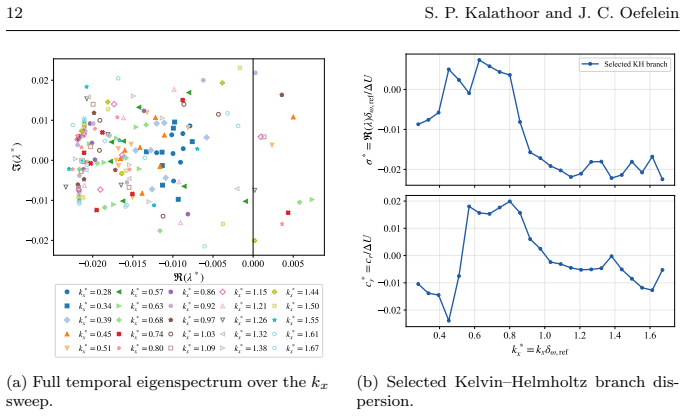
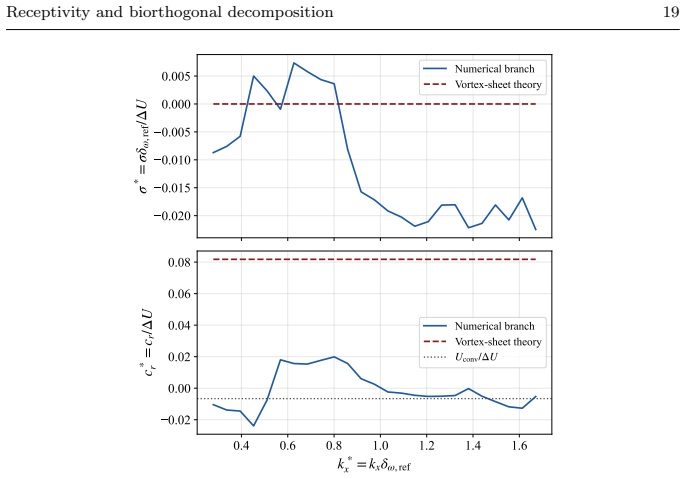
A reacting temporal mixing layer supports an unstable finite-thickness Kelvin-Helmholtz family even when the discontinuous reference is neutral.
A machine-rendered reading of the paper's core claim, the machinery that carries it, and where it could break.
Core claim
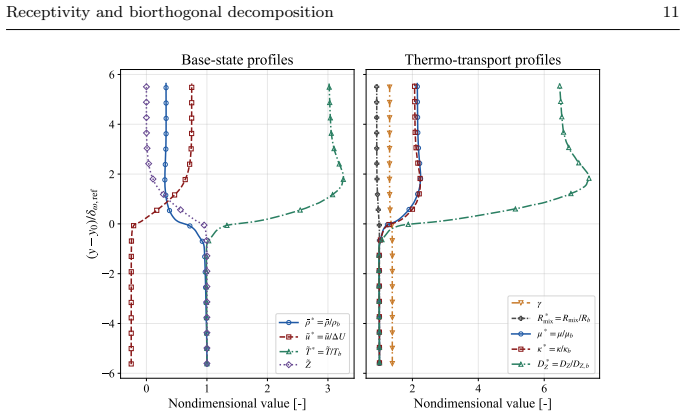
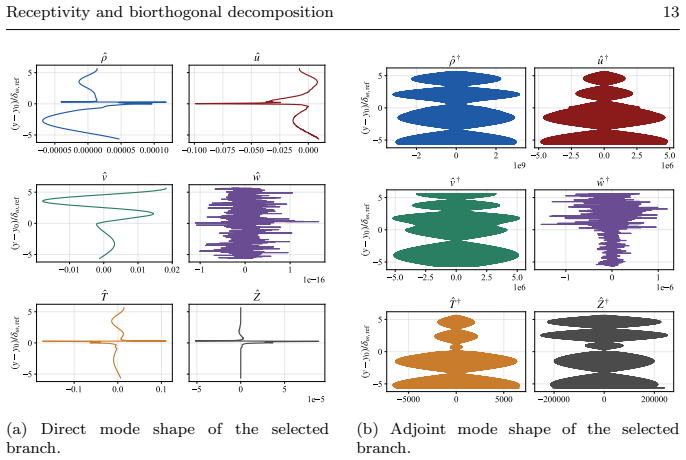
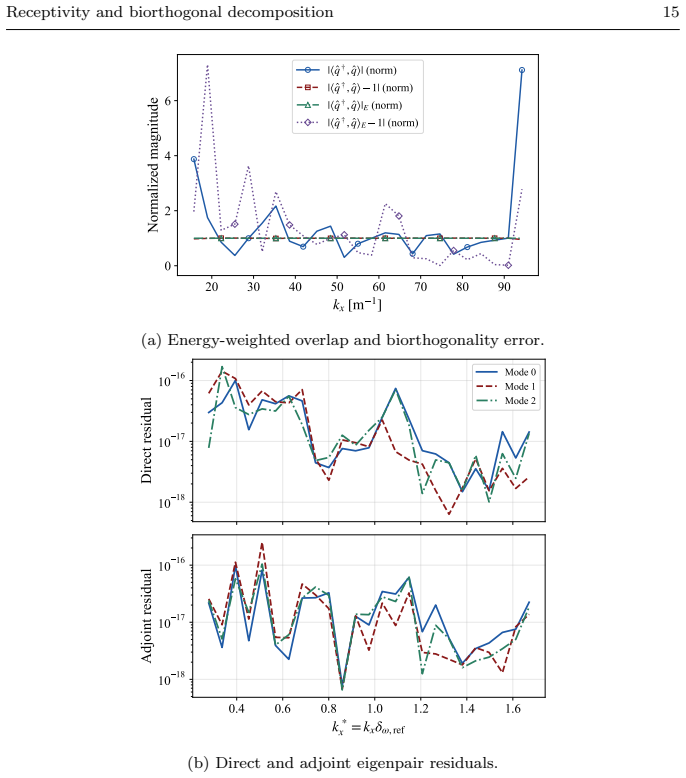
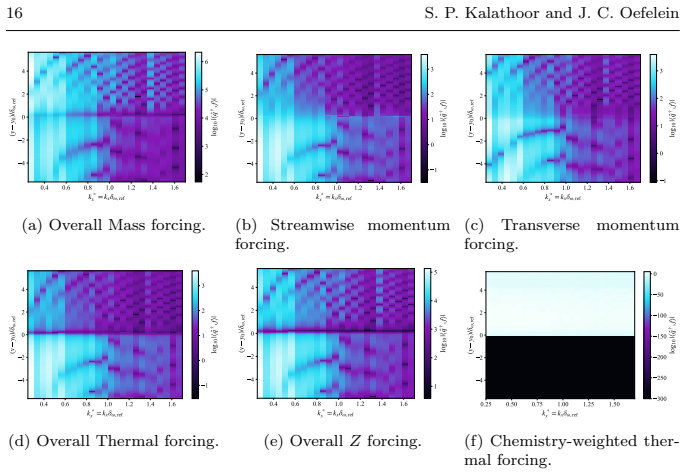
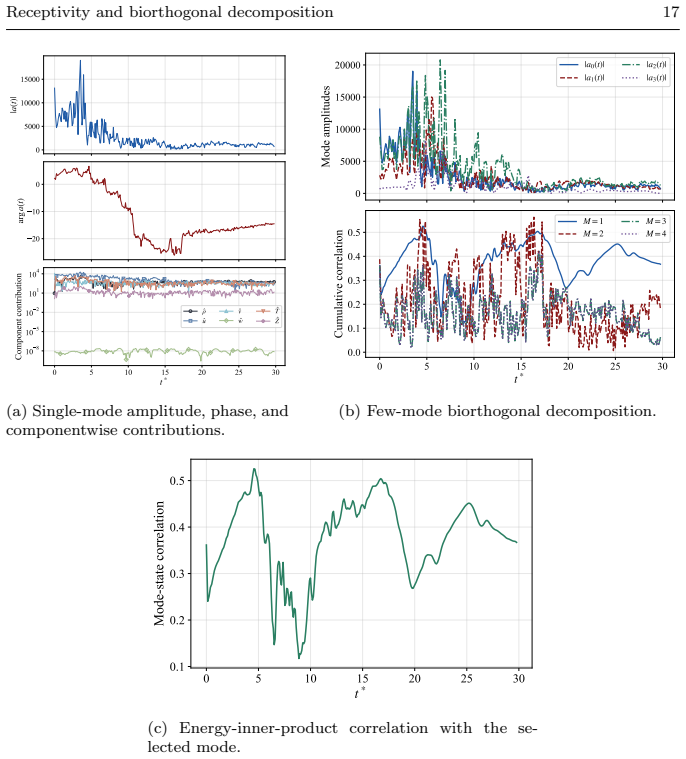
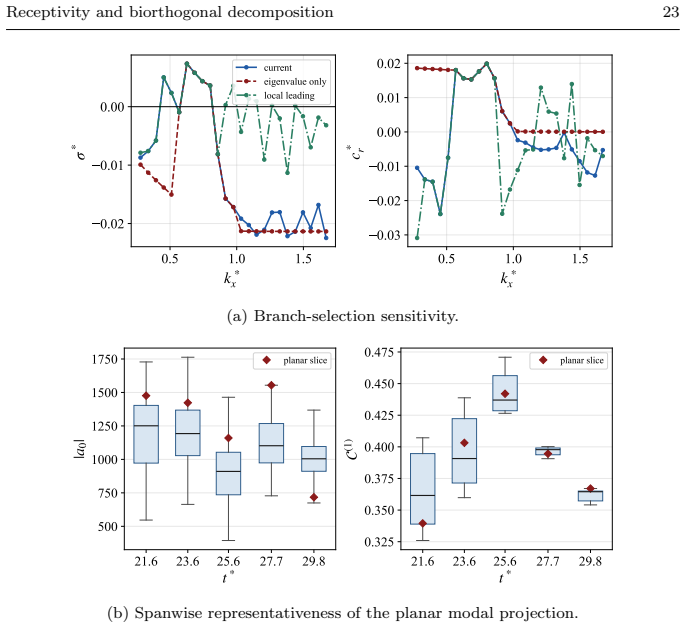
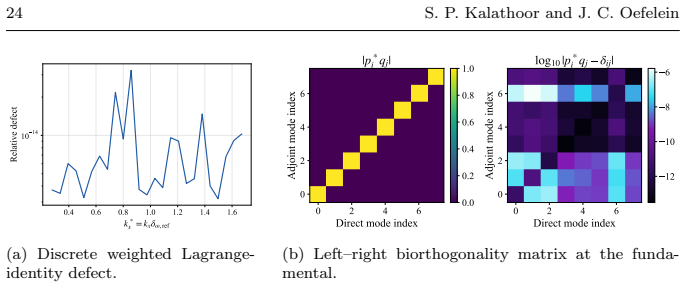
The reacting layer supports an unstable finite-thickness Kelvin--Helmholtz family over low-to-moderate wavenumbers even though the discontinuous reference is essentially neutral. Receptivity maps are constructed for mass, momentum, thermal, and mixture-fraction forcing channels using an energy-weighted adjoint projection, with biorthogonality enforced by the corresponding direct-adjoint inner product. The finite-thickness branch is interpreted against a compressible vortex-sheet reference built from the outer-stream states, and the associated modal family appears in time-resolved planar simulation data through cumulative few-mode reconstructions.
What carries the argument
Finite-thickness compressible linearized operator built from the mean reacting base state, together with its direct and adjoint eigenmodes used for energy-weighted adjoint projection and biorthogonal decomposition.
If this is right
- Mass forcing leads the raw localized receptivity maps.
- Mixture-fraction forcing contributes through composition-pressure coupling.
- Chemistry-weighted thermal forcing identifies the strongest thermochemical support of the same family.
- The reorganized instability branch remains embedded in the nonlinear flow.
Where Pith is reading between the lines
- The receptivity maps could indicate preferred locations for localized actuation in related reacting shear configurations.
- The biorthogonal decomposition approach may quantify modal content in other reacting flows where a steady mean base state can be extracted.
- Altering the base state through different chemistry models would likely shift the range of unstable wavenumbers.
Load-bearing premise
The mean reacting base state extracted from simulation or theory is sufficiently accurate and steady to serve as the foundation for a valid finite-thickness compressible linearized operator whose eigenmodes represent the physical instability.
What would settle it
A direct mismatch between the growth rates or structures of the extracted eigenmodes and the dominant features observed in the time-resolved simulation data at the fundamental streamwise wavenumber would falsify the claim that the linearized operator captures the physical instability.
Figures
read the original abstract
We examine receptivity and biorthogonal decomposition in a reacting temporal mixing layer using direct and adjoint eigenmodes of a finite-thickness compressible linearized operator built from the mean reacting base state. The analysis focuses on the Kelvin--Helmholtz branch and asks how the reacting base state modifies the selected temporal instability, where localized forcing most efficiently excites it, and how strongly the associated modal family is represented in time-resolved planar simulation data. Receptivity maps are constructed for mass, momentum, thermal, and mixture-fraction forcing channels using an energy-weighted adjoint projection, with biorthogonality enforced by the corresponding direct--adjoint inner product. A complementary biorthogonal decomposition provides modal amplitudes and cumulative few-mode reconstructions at the fundamental streamwise wavenumber. The finite-thickness branch is interpreted against a compressible vortex-sheet reference built from the outer-stream states. The reacting layer supports an unstable finite-thickness Kelvin--Helmholtz family over low-to-moderate wavenumbers even though the discontinuous reference is essentially neutral. Mass forcing leads the raw localized receptivity maps, mixture-fraction forcing follows through composition-pressure coupling, and chemistry-weighted thermal forcing identifies the strongest thermochemical support of the same family. The results show how distributed reacting thermodynamics reorganize compressible shear-layer instability and how that reorganized branch remains embedded in the nonlinear flow.
Editorial analysis
A structured set of objections, weighed in public.
Referee Report
Summary. The paper constructs a finite-thickness compressible linearized operator from the mean reacting base state of a temporal mixing layer and performs receptivity analysis and biorthogonal decomposition using direct and adjoint eigenmodes of the Kelvin-Helmholtz branch. Receptivity maps are built for mass, momentum, thermal, and mixture-fraction forcing via energy-weighted adjoint projection with biorthogonality enforced by the direct-adjoint inner product. A complementary decomposition yields modal amplitudes and few-mode reconstructions at the fundamental wavenumber. The finite-thickness reacting layer is claimed to support an unstable KH family over low-to-moderate wavenumbers, in contrast to an essentially neutral compressible vortex-sheet reference built from outer-stream states. Mass forcing dominates raw receptivity maps, with mixture-fraction and chemistry-weighted thermal forcing also significant.
Significance. If the base state is a valid steady equilibrium and the unshown eigenmode computations are accurate, the work would illustrate how reacting thermodynamics reorganize compressible shear-layer instability and supply a biorthogonal framework for receptivity in reacting flows, with relevance to combustion and mixing-layer dynamics.
major comments (2)
- [Abstract] The abstract describes the operator construction, projection method, and claims about instability support and receptivity but supplies no numerical results, convergence checks, error estimates, or validation against nonlinear simulation data. The central claim that the reacting layer supports an unstable finite-thickness KH family therefore rests on unshown eigenmode computations.
- [Description of the mean reacting base state and linearized operator construction] No verification is reported that the extracted mean reacting base state satisfies the steady reacting equations (continuity, momentum, energy, species) to within discretization error. If residuals are appreciable, the eigenmodes and receptivity maps of the compressible linear operator do not correspond to the simulated flow.
minor comments (1)
- Specify the precise definition of the energy-weighted inner product used for the adjoint projection and confirm that the biorthogonality condition is satisfied to machine precision in the reported decompositions.
Simulated Author's Rebuttal
We thank the referee for the thorough review and constructive feedback on our manuscript concerning receptivity and biorthogonal decomposition in a reacting temporal mixing layer. We address each major comment below and have prepared revisions to strengthen the presentation of results and verification procedures.
read point-by-point responses
-
Referee: [Abstract] The abstract describes the operator construction, projection method, and claims about instability support and receptivity but supplies no numerical results, convergence checks, error estimates, or validation against nonlinear simulation data. The central claim that the reacting layer supports an unstable finite-thickness KH family therefore rests on unshown eigenmode computations.
Authors: The abstract is intentionally concise and does not contain numerical values or detailed validation, as is standard. The full manuscript reports the eigenmode spectra, growth rates for the KH branch, receptivity maps, and biorthogonal reconstructions with comparisons to the vortex-sheet reference in Sections 3–5, including direct comparison to the underlying nonlinear simulation data. To improve clarity, we will revise the abstract to incorporate key quantitative findings, such as the peak temporal growth rate of the unstable finite-thickness mode and the relative magnitudes of the dominant forcing channels. revision: yes
-
Referee: [Description of the mean reacting base state and linearized operator construction] No verification is reported that the extracted mean reacting base state satisfies the steady reacting equations (continuity, momentum, energy, species) to within discretization error. If residuals are appreciable, the eigenmodes and receptivity maps of the compressible linear operator do not correspond to the simulated flow.
Authors: The base state is obtained via long-time averaging of the nonlinear reacting simulation, which is designed to reach a statistically steady regime. We agree that explicit residual checks on the steady reacting equations were not included in the original submission. In the revised manuscript we will add a dedicated verification subsection reporting the L2 norms of the residuals for continuity, momentum, energy, and species equations evaluated on the extracted profile, confirming they lie within the expected discretization tolerance of the underlying simulation. revision: yes
Circularity Check
No significant circularity; derivation is self-contained via standard linear methods
full rationale
The paper constructs a compressible linearized operator from an externally extracted mean reacting base state, computes direct and adjoint eigenmodes, and enforces biorthogonality via the conventional direct-adjoint inner product. Receptivity maps and modal decompositions follow directly from these standard operations. The vortex-sheet reference is built from outer-stream states and compared externally. No step reduces by definition to its own output, no fitted parameter is relabeled as a prediction, and no load-bearing premise rests on a self-citation chain. The central claim that the finite-thickness reacting layer supports unstable KH modes follows from solving the operator on the supplied base state and is independent of the resulting eigenmodes.
Axiom & Free-Parameter Ledger
axioms (1)
- domain assumption The mean reacting base state is an appropriate and sufficiently accurate input for constructing the finite-thickness compressible linearized operator.
Reference graph
Works this paper leans on
-
[1]
Journal of Fluid Mechanics969, A1 (2023)
Al Hasnine, S.M.A., Russo, V., Tumin, A., Brehm, C.: Biorthogonal decomposition of the disturbance flow field generated by particle impingement on a hypersonic boundary layer. Journal of Fluid Mechanics969, A1 (2023). DOI 10.1017/jfm.2023.531
-
[2]
Journal of Fluid Mechanics187, 155–177 (1988)
Balsa, T.F.: On the receptivity of free shear layers to two-dimensional external excita- tion. Journal of Fluid Mechanics187, 155–177 (1988). DOI 10.1017/S0022112088000382
-
[3]
Journal of Fluid Mechanics540, 301–335 (2005)
Barone, M.F., Lele, S.K.: Receptivity of the compressible mixing layer. Journal of Fluid Mechanics540, 301–335 (2005). DOI 10.1017/S0022112005005884
-
[4]
Bellan, J.: Direct numerical simulation of a high-pressure turbulent reacting tem- poral mixing layer. Combustion and Flame176, 245–262 (2017). DOI 10.1016/j. combustflame.2016.09.026
work page doi:10.1016/j 2017
-
[5]
Journal of Fluid Mechanics40(4), 769–781 (1970)
Blumen, W.: Shear layer instability of an inviscid compressible fluid. Journal of Fluid Mechanics40(4), 769–781 (1970). DOI 10.1017/S0022112070000435
-
[6]
Blumen, W., Drazin, P.G., Billings, D.F.: Shear layer instability of an inviscid com- pressible fluid. Part 2. Journal of Fluid Mechanics71(2), 305–316 (1975). DOI 10.1017/S0022112075002595
-
[7]
Journal of Fluid Mechanics109, 1–24 (1981)
Breidenthal, R.E.: Structure in turbulent mixing layers and wakes using a chemical re- action. Journal of Fluid Mechanics109, 1–24 (1981). DOI 10.1017/S0022112081000906
-
[8]
Journal of Fluid Mechanics125, 397–410 (1982)
Broadwell, J.E., Breidenthal, R.E.: A simple model of mixing and chemical reaction in a turbulent shear layer. Journal of Fluid Mechanics125, 397–410 (1982). DOI 10.1017/S0022112082003401 26 S. P. Kalathoor and J. C. Oefelein
-
[9]
Journal of Fluid Mechanics64(4), 775–816 (1974)
Brown, G.L., Roshko, A.: On density effects and large structure in turbulent mix- ing layers. Journal of Fluid Mechanics64(4), 775–816 (1974). DOI 10.1017/ S002211207400190X
1974
-
[10]
Chu, B.T.: On the energy transfer to small disturbances in fluid flow (Part I). Acta Mechanica1, 215–234 (1965). DOI 10.1007/BF01387235
-
[11]
Journal of Fluid Mechanics284, 171–216 (1995)
Clemens, N.T., Mungal, M.G.: Large-scale structure and entrainment in the su- personic mixing layer. Journal of Fluid Mechanics284, 171–216 (1995). DOI 10.1017/S0022112095000358
-
[12]
Journal of Fluid Mechanics78(3), 535–560 (1976)
Dimotakis, P.E., Brown, G.L.: The mixing layer at high Reynolds number: large- structure dynamics and entrainment. Journal of Fluid Mechanics78(3), 535–560 (1976). DOI 10.1017/S0022112076002590
-
[13]
Drazin, P.G., Davey, A.: Shear layer instability of an inviscid compressible fluid. Part 3. Journal of Fluid Mechanics82(2), 255–283 (1977). DOI 10.1017/S0022112077000640
-
[14]
Physics of Fluids A2(7), 1231–1240 (1990)
Elliott, G.S., Samimy, M.: Compressibility effects in free shear layers. Physics of Fluids A2(7), 1231–1240 (1990). DOI 10.1063/1.857816
-
[15]
Theoretical and Computational Fluid Dynamics24(6), 565–588 (2010)
Foysi, H., Sarkar, S.: The compressible mixing layer: an LES study. Theoretical and Computational Fluid Dynamics24(6), 565–588 (2010). DOI 10.1007/s00162-009-0176-8
-
[16]
Freund, J.B., Lele, S.K., Moin, P.: Compressibility effects in a turbulent annular mixing layer. Part 1. turbulence and growth rate. Journal of Fluid Mechanics421, 229–267 (2000). DOI 10.1017/S0022112000001622
-
[17]
Jour- nal of Fluid Mechanics127, 59–81 (1983)
Goldstein, M.E.: The evolution of Tollmien–Schlichting waves near a leading edge. Jour- nal of Fluid Mechanics127, 59–81 (1983). DOI 10.1017/S002211208300261X
-
[18]
Journal of Fluid Mechanics154, 509–529 (1985)
Goldstein, M.E.: Scattering of acoustic waves into Tollmien–Schlichting waves by small streamwise variations in surface geometry. Journal of Fluid Mechanics154, 509–529 (1985). DOI 10.1017/S0022112085001641
-
[19]
Journal of Fluid Mechanics199, 333–375 (1989)
Hermanson, J.C., Dimotakis, P.E.: Effects of heat release in a turbulent, react- ing shear layer. Journal of Fluid Mechanics199, 333–375 (1989). DOI 10.1017/ S0022112089000406
1989
-
[20]
Journal of Fluid Mechanics292, 183–204 (1995)
Hill, D.C.: Adjoint systems and their role in the receptivity problem for boundary layers. Journal of Fluid Mechanics292, 183–204 (1995). DOI 10.1017/S0022112095001480
-
[21]
Journal of Fluid Mechanics208, 609–637 (1989)
Jackson, T.L., Grosch, C.E.: Inviscid spatial stability of a compressible mixing layer. Journal of Fluid Mechanics208, 609–637 (1989). DOI 10.1017/S002211208900296X
-
[22]
Jackson, T.L., Grosch, C.E.: Inviscid spatial stability of a compressible mixing layer. part 2. the flame sheet model. Journal of Fluid Mechanics217, 391–420 (1990). DOI 10.1017/S0022112090000775
-
[23]
Journal of Fluid Mechanics797, 564–603 (2016)
Jahanbakhshi, R., Madnia, C.K.: Entrainment in a compressible turbulent shear layer. Journal of Fluid Mechanics797, 564–603 (2016). DOI 10.1017/jfm.2016.296
-
[24]
Journal of Fluid Mechanics844, 92–126 (2018)
Jahanbakhshi, R., Madnia, C.K.: The effect of heat release on the entrainment in a turbulent mixing layer. Journal of Fluid Mechanics844, 92–126 (2018). DOI 10.1017/ jfm.2018.122
2018
-
[25]
Journal of Fluid Mechanics626, 67–109 (2009)
Knaus, R.C., Pantano, C.: On the effect of heat release in turbulence spectra of non- premixed reacting shear layers. Journal of Fluid Mechanics626, 67–109 (2009). DOI 10.1017/S0022112008005636
-
[26]
Journal of Fluid Mechanics593, 171–180 (2007)
Mahle, S., Dowling, A.P., Luo, K.H., Sandham, N.D.: On the turbulence structure in inert and reacting compressible mixing layers. Journal of Fluid Mechanics593, 171–180 (2007). DOI 10.1017/S0022112007008919
-
[27]
Journal of Fluid Mechanics900, A5 (2020)
Matsuno, K., Lele, S.K.: Internal regulation in compressible turbulent shear layers. Journal of Fluid Mechanics900, A5 (2020). DOI 10.1017/jfm.2020.492
-
[28]
Journal of Fluid Mechanics199, 297–332 (1989)
McMurtry, P.A., Riley, J.J., Metcalfe, R.W.: Effects of heat release on the large-scale structure in turbulent mixing layers. Journal of Fluid Mechanics199, 297–332 (1989). DOI 10.1017/S002211208900039X
-
[29]
Journal of Fluid Mechanics 4(5), 538–552 (1958)
Miles, J.W.: On the disturbed motion of a plane vortex sheet. Journal of Fluid Mechanics 4(5), 538–552 (1958). DOI 10.1017/S0022112058000653
-
[30]
In: Turbulent Mixing and Beyond, pp
Pantano, C., Sarkar, S., Williams, F.A.: The interaction of scalar mixing and heat release in a reacting shear layer. In: Turbulent Mixing and Beyond, pp. 137–148. Springer, Dordrecht (2002). DOI 10.1007/978-94-017-1998-8 11
-
[31]
Journal of Fluid Mechanics481, 291–328 (2003)
Pantano, C., Sarkar, S., Williams, F.A.: Mixing of a conserved scalar in a turbulent reacting shear layer. Journal of Fluid Mechanics481, 291–328 (2003). DOI 10.1017/ Receptivity and biorthogonal decomposition 27 S0022112003003872
2003
-
[32]
Journal of Fluid Mechanics197, 453–477 (1988)
Papamoschou, D., Roshko, A.: The compressible turbulent shear layer: an experi- mental study. Journal of Fluid Mechanics197, 453–477 (1988). DOI 10.1017/ S0022112088003325
1988
-
[33]
AIAA Journal28(4), 618–624 (1990)
Sandham, N.D., Reynolds, W.C.: Compressible mixing layer: linear theory and direct simulation. AIAA Journal28(4), 618–624 (1990). DOI 10.2514/3.10437
-
[34]
Journal of Fluid Mechanics224, 133–158 (1991)
Sandham, N.D., Reynolds, W.C.: Three-dimensional simulations of large eddies in the compressible mixing layer. Journal of Fluid Mechanics224, 133–158 (1991). DOI 10.1017/S0022112091001719
-
[35]
Journal of Fluid Mechanics282, 163–186 (1995)
Sarkar, S.: The stabilizing effect of compressibility in turbulent shear flow. Journal of Fluid Mechanics282, 163–186 (1995). DOI 10.1017/S0022112095000134
-
[36]
Annual Review of Fluid Mechanics39, 129– 162 (2007)
Schmid, P.J.: Nonmodal stability theory. Annual Review of Fluid Mechanics39, 129– 162 (2007). DOI 10.1146/annurev.fluid.38.050304.092139
-
[37]
Taira, K., Hemati, M.S., Brunton, S.L., Sun, Y., Duraisamy, K., Bagheri, S., Dawson, S.T.M., Yeh, C.A.: Modal analysis of fluid flows: an overview. AIAA Journal55(12), 4013–4041 (2017). DOI 10.2514/1.J056060
-
[38]
Journal of Fluid Mechanics89(2), 357–371 (1978)
Tam, C.K.W.: Excitation of instability waves in a two-dimensional shear layer by sound. Journal of Fluid Mechanics89(2), 357–371 (1978). DOI 10.1017/S0022112078002674
-
[39]
Physics of Fluids19(1), 014,101 (2007)
Tumin, A., Wang, X., Zhong, X.: Direct numerical simulation and the theory of re- ceptivity in a hypersonic boundary layer. Physics of Fluids19(1), 014,101 (2007). DOI 10.1063/1.2409731
-
[40]
Journal of Fluid Mechanics320, 235–258 (1996)
Vreman, A.W., Sandham, N.D., Luo, K.H.: Compressible mixing layer growth rate and turbulence characteristics. Journal of Fluid Mechanics320, 235–258 (1996). DOI 10.1017/S0022112096007525
-
[41]
In: AIAA Scitech 2019 Forum, pp
Wu, L., Tumin, A.: Receptivity of turbulent compressible mixing layers to localized energy deposition. In: AIAA Scitech 2019 Forum, pp. 2019–1652 (2019). DOI 10.2514/ 6.2019-1652
2019
discussion (0)
Sign in with ORCID, Apple, or X to comment. Anyone can read and Pith papers without signing in.