Neural network approximation in discrete dual norms with adaptive test spaces
Pith reviewed 2026-06-26 15:54 UTC · model grok-4.3
The pith
A computable refinement indicator under the saturation assumption reliably estimates the discrepancy between discrete and continuous Riesz representatives in RVPINNs.
A machine-rendered reading of the paper's core claim, the machinery that carries it, and where it could break.
Core claim
The central claim is that within the RVPINN framework, an adaptive algorithm enriches the test space only where the error between the discrete and continuous Riesz representatives is pronounced, supported by theoretical error bounds and a computable refinement indicator that under the saturation assumption reliably and efficiently estimates the discrepancy between those representatives.
What carries the argument
The refinement indicator for the discrepancy between discrete and continuous Riesz representatives of the variational residual, which serves as an error estimator under the saturation assumption.
If this is right
- The remainder term in the loss function robustness guarantee can be controlled through targeted test space enrichment.
- Fixed coarse test spaces can be avoided in favor of adaptive ones for efficiency in problems with localized features.
- Theoretical error bounds are derived for the adaptive strategies in the RVPINN setting.
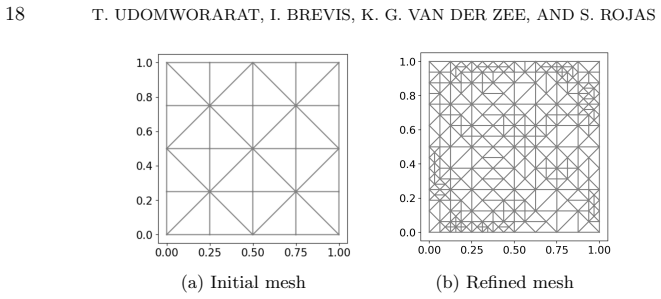
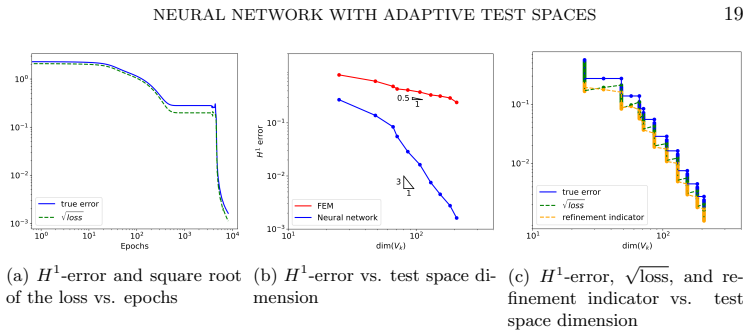
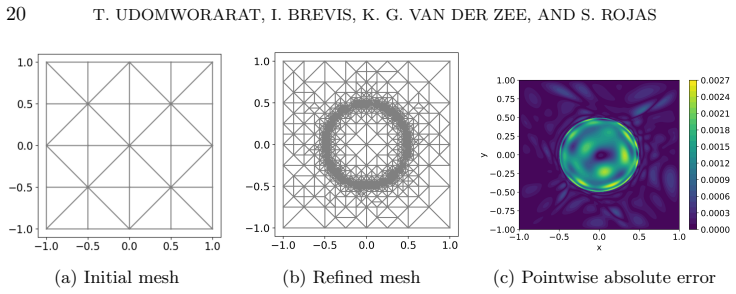
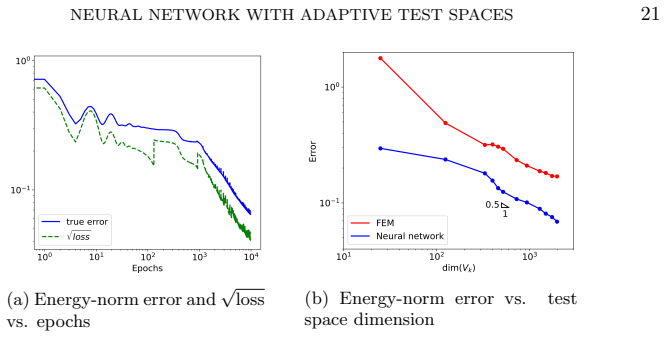
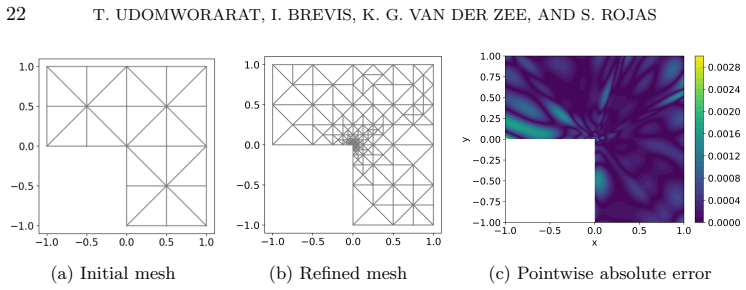
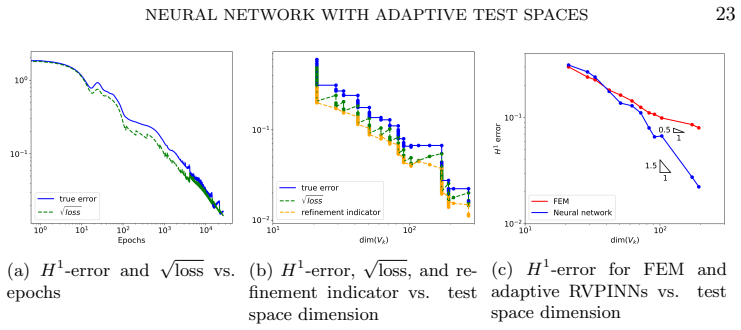
- Numerical experiments confirm the practical adaptive algorithm's effectiveness on elliptic Dirichlet problems.
Where Pith is reading between the lines
- If the saturation assumption holds across a broader class of problems, the method could reduce computational costs in training neural networks for variational problems with sharp features.
- The approach might be combined with other residual-based adaptation techniques in finite element methods.
- Verification of the saturation assumption in specific applications would strengthen the practical utility of the estimator.
Load-bearing premise
The saturation assumption is required to prove that the refinement indicator is reliable and efficient, but its validity is not established for general cases.
What would settle it
A numerical test case where the saturation assumption does not hold and the refinement indicator fails to bound or efficiently estimate the actual discrepancy between the discrete and continuous Riesz representatives.
Figures
read the original abstract
In robust variational physics-informed neural networks (RVPINNs), the loss function is formulated in terms of the Riesz representative of the variational residual within a discrete test space. This approach guarantees that the loss function is robust with respect to the true error in the energy norm up to a remainder term that depends on both the neural network approximation and the discrete space configuration. However, in problems with localized singularities, steep gradients, or interface layers, a fixed coarse test space may fail to resolve the continuous Riesz representative of the residual during training. Although this can be avoided by using a sufficiently fine test space from the start, doing so may be computationally inefficient. We therefore propose an adaptive algorithm that enriches the test space only where the error between the discrete and continuous Riesz representatives is pronounced. We establish theoretical adaptive strategies within the RVPINN framework and derive their error bounds. Furthermore, we propose a computable refinement indicator and prove that, under the saturation assumption, it serves as a reliable and efficient error estimator for the non-computable discrepancy between the discrete and continuous Riesz representatives. Finally, we propose a practical adaptive algorithm and demonstrate its effectiveness through numerical experiments on elliptic Dirichlet problems.
Editorial analysis
A structured set of objections, weighed in public.
Referee Report
Summary. The paper proposes an adaptive enrichment strategy for the discrete test space in robust variational physics-informed neural networks (RVPINNs) to better approximate the continuous Riesz representative of the variational residual. It derives theoretical adaptive strategies and associated error bounds, introduces a computable refinement indicator, and proves that this indicator is reliable and efficient for estimating the non-computable discrepancy between discrete and continuous Riesz representatives under a saturation assumption. The approach is demonstrated via numerical experiments on elliptic Dirichlet problems with localized features.
Significance. If the saturation assumption is satisfied throughout the adaptive process, the work provides a theoretically grounded and practically useful mechanism for dynamically refining test spaces in RVPINNs, improving efficiency for problems with singularities or layers without requiring an a priori fine discretization. The combination of error bounds, a computable indicator, and numerical validation on model problems strengthens the contribution to adaptive PINN methodologies.
major comments (1)
- [Abstract / proof of refinement indicator] Abstract and the section presenting the proof of the refinement indicator: the reliability and efficiency of the proposed computable indicator are established only conditionally on the saturation assumption, yet no derivation, sufficient conditions, or numerical verification is supplied showing that the assumption holds (or can be ensured) for the specific adaptive enrichment algorithm when the enriched discrete space is still approximating the continuous Riesz representative.
minor comments (2)
- Notation for the discrete and continuous Riesz representatives should be introduced with explicit definitions before the refinement indicator is defined, to improve readability of the error bounds.
- The numerical experiments section would benefit from a table comparing iteration counts or degrees of freedom against a fixed fine test-space baseline to quantify the efficiency gain.
Simulated Author's Rebuttal
We thank the referee for the detailed review and constructive feedback. We address the single major comment below and are prepared to revise the manuscript accordingly.
read point-by-point responses
-
Referee: [Abstract / proof of refinement indicator] Abstract and the section presenting the proof of the refinement indicator: the reliability and efficiency of the proposed computable indicator are established only conditionally on the saturation assumption, yet no derivation, sufficient conditions, or numerical verification is supplied showing that the assumption holds (or can be ensured) for the specific adaptive enrichment algorithm when the enriched discrete space is still approximating the continuous Riesz representative.
Authors: The manuscript states explicitly that the reliability and efficiency of the computable refinement indicator hold under the saturation assumption (see abstract and the relevant theorem). This is a standard hypothesis in the a posteriori error estimation and adaptive finite-element literature, used to guarantee that the discrete test space remains sufficiently rich relative to the continuous Riesz representative. Deriving general sufficient conditions that guarantee the assumption throughout the specific adaptive enrichment procedure lies outside the scope of the present contribution, which focuses on establishing the indicator properties once the assumption is granted. Nevertheless, the numerical experiments on elliptic problems with localized singularities (Section 5) show that the adaptive algorithm converges reliably and that the discrete-continuous discrepancy decreases, providing indirect evidence that the assumption is satisfied in the tested regimes. We agree that a short additional discussion of the saturation assumption, together with a simple numerical check of the discrepancy evolution during adaptation, would strengthen the presentation and will incorporate such material in the revised version. revision: yes
Circularity Check
No circularity; claims explicitly conditional on saturation assumption with independent derivation
full rationale
The paper proposes an adaptive enrichment algorithm for test spaces in RVPINNs and derives error bounds for a computable refinement indicator. The key statement is that the indicator 'serves as a reliable and efficient error estimator ... under the saturation assumption' for the discrepancy between discrete and continuous Riesz representatives. This is an explicit premise rather than a derived or fitted quantity; no equation reduces to itself by definition, no parameter is fitted to data and renamed a prediction, and no load-bearing step relies on a self-citation chain or imported uniqueness theorem. The derivation chain remains self-contained once the assumption is granted, with no renaming of known results or ansatz smuggling visible in the text.
Axiom & Free-Parameter Ledger
axioms (1)
- domain assumption Saturation assumption
Reference graph
Works this paper leans on
-
[1]
doi:10.1137/140951758 , journal =
An Adaptive Shifted Power Method for Computing Generalized Tensor Eigenpairs , author =. doi:10.1137/140951758 , journal =
-
[2]
Nick Higham , title =
-
[3]
Kolda and Ali Pinar , eprint =
Chengbin Peng and Tamara G. Kolda and Ali Pinar , eprint =. Accelerating Community Detection by Using
-
[4]
and Zhang, Shanrong and Merritt, Matthew E
Woessner, Donald E. and Zhang, Shanrong and Merritt, Matthew E. and Sherry, A. Dean , title =. Magnetic Resonance in Medicine , doi =
-
[5]
Properties of Highly Clustered Networks , author =. 2003 , eid =. doi:10.1103/PhysRevE.68.026121 , journal =
-
[6]
Clawpack Software , author =
-
[7]
: A Document Preparation System
Leslie Lamport. : A Document Preparation System. 1986
1986
-
[8]
Frank Mittlebach and Michel Goossens , title =
-
[9]
and Van Loan, Charles F
Golub, Gene H. and Van Loan, Charles F. , title =
-
[10]
Paul Dawkins , title =
-
[11]
User's Guide for the
-
[12]
Michael Downes , title =
-
[13]
Christian Feuers\"anger , title =
-
[14]
Computer Methods in Applied Mechanics and Engineering , volume=
Multi-level neural networks for accurate solutions of boundary-value problems , author=. Computer Methods in Applied Mechanics and Engineering , volume=. 2024 , publisher=
2024
-
[15]
Computer Methods in Applied Mechanics and Engineering , volume=
Adaptive finite element interpolated neural networks , author=. Computer Methods in Applied Mechanics and Engineering , volume=. 2025 , publisher=
2025
-
[16]
Journal of Scientific Computing , volume=
Variational physics informed neural networks: the role of quadratures and test functions , author=. Journal of Scientific Computing , volume=. 2022 , publisher=
2022
-
[17]
2024 , publisher=
Berrone, Stefano and Pintore, Moreno , journal=. 2024 , publisher=
2024
-
[18]
2022 , publisher=
Brevis, Ignacio and Muga, Ignacio and van der Zee, Kristoffer G , journal=. 2022 , publisher=
2022
-
[19]
Annual review of fluid mechanics , volume=
Machine learning for fluid mechanics , author=. Annual review of fluid mechanics , volume=. 2020 , publisher=
2020
-
[20]
2021 , publisher=
Cai, Shengze and Mao, Zhiping and Wang, Zhicheng and Yin, Minglang and Karniadakis, George Em , journal=. 2021 , publisher=
2021
-
[21]
SIAM Journal on Numerical Analysis , volume=
Quasi-optimal convergence rate for an adaptive finite element method , author=. SIAM Journal on Numerical Analysis , volume=. 2008 , publisher=
2008
-
[22]
Optics express , volume=
Physics-informed neural networks for inverse problems in nano-optics and metamaterials , author=. Optics express , volume=. 2020 , publisher=
2020
-
[23]
2012 , publisher=
Cohen, Albert and DeVore, Ronald and Nochetto, Ricardo H , journal=. 2012 , publisher=
2012
-
[24]
Demkowicz, Leszek , journal=
-
[25]
The double adaptivity paradigm:(How to circumvent the discrete inf--sup conditions of Babu
Demkowicz, Leszek and F. The double adaptivity paradigm:(How to circumvent the discrete inf--sup conditions of Babu. Computers & Mathematics with Applications , volume=. 2021 , publisher=
2021
-
[26]
SIAM Journal on Numerical Analysis , volume=
D. SIAM Journal on Numerical Analysis , volume=. 1996 , publisher=
1996
-
[27]
arXiv preprint arXiv:2507.06017 , year=
A posteriori analysis of neural network approximations , author=. arXiv preprint arXiv:2507.06017 , year=
-
[28]
2023 , publisher=
Gao, Zhiwei and Yan, Liang and Zhou, Tao , journal=. 2023 , publisher=
2023
-
[29]
2024 , publisher=
Gao, Zhiwei and Tang, Tao and Yan, Liang and Zhou, Tao , journal=. 2024 , publisher=
2024
-
[30]
2026 , issn =
Computer Methods in Applied Mechanics and Engineering , volume =. 2026 , issn =
2026
-
[31]
2021 , publisher=
Kharazmi, Ehsan and Zhang, Zhongqiang and Karniadakis, George Em , journal=. 2021 , publisher=
2021
-
[32]
arXiv preprint arXiv:1912.00873 , year=
Variational physics-informed neural networks for solving partial differential equations , author=. arXiv preprint arXiv:1912.00873 , year=
arXiv 1912
-
[33]
Kingma, Diederik P and Ba, Jimmy , journal=
-
[34]
Nature Reviews Genetics , volume=
Machine learning applications in genetics and genomics , author=. Nature Reviews Genetics , volume=. 2015 , publisher=
2015
-
[35]
2020 , publisher=
Mao, Zhiping and Jagtap, Ameya D and Karniadakis, George Em , journal=. 2020 , publisher=
2020
-
[36]
SIAM Journal on Numerical Analysis , volume=
An adaptive superconvergent mixed finite element method based on local residual minimization , author=. SIAM Journal on Numerical Analysis , volume=. 2023 , publisher=
2023
-
[37]
Foundations of computational mathematics , volume=
Topological properties of the set of functions generated by neural networks of fixed size , author=. Foundations of computational mathematics , volume=. 2021 , publisher=
2021
-
[38]
Journal of Computational physics , volume=
Physics-informed neural networks: A deep learning framework for solving forward and inverse problems involving nonlinear partial differential equations , author=. Journal of Computational physics , volume=. 2019 , publisher=
2019
-
[39]
2022 , publisher=
Rasht-Behesht, Majid and Huber, Christian and Shukla, Khemraj and Karniadakis, George Em , journal=. 2022 , publisher=
2022
-
[40]
Computer Methods in Applied Mechanics and Engineering , volume=
Robust variational physics-informed neural networks , author=. Computer Methods in Applied Mechanics and Engineering , volume=. 2024 , publisher=
2024
-
[41]
2018 , publisher=
Sirignano, Justin and Spiliopoulos, Konstantinos , journal=. 2018 , publisher=
2018
-
[42]
2023 , publisher=
Tang, Kejun and Wan, Xiaoliang and Yang, Chao , journal=. 2023 , publisher=
2023
-
[43]
Neural network methods for Neumann series problems of
Udomworarat, Tanakorn and Brevis, Ignacio and Richter, Martin and Rojas, Sergio and Van Der Zee, Kristoffer G , journal=. Neural network methods for Neumann series problems of. 2026 , publisher=
2026
-
[44]
Journal of Computational Physics , volume=
A mesh-free method for interface problems using the deep learning approach , author=. Journal of Computational Physics , volume=. 2020 , publisher=
2020
-
[45]
2018 , publisher=
Yu, Bing and E, Weinan , journal=. 2018 , publisher=
2018
-
[46]
2025 , publisher=
Zhang, Zhengqi and Li, Jing and Liu, Bin , journal=. 2025 , publisher=
2025
-
[47]
Ainsworth, Mark and Oden, J Tinsley , year=
-
[48]
2013 , publisher=
Mixed finite element methods and applications , author=. 2013 , publisher=
2013
-
[49]
2011 , publisher=
Brezis, Haim and Br. 2011 , publisher=
2011
-
[50]
2012 , publisher=
Di Pietro, Daniele Antonio and Ern, Alexandre , volume=. 2012 , publisher=
2012
-
[51]
2010 , publisher=
Partial differential equations , author=. 2010 , publisher=
2010
-
[52]
Mathematical Aspects of Deep Learning , publisher=
Gühring, Ingo and Raslan, Mones and Kutyniok, Gitta , editor=. Mathematical Aspects of Deep Learning , publisher=. 2022 , pages=
2022
discussion (0)
Sign in with ORCID, Apple, or X to comment. Anyone can read and Pith papers without signing in.