Movement synchronization in complex and dynamic team coordination: Relationship with mutual anticipation
Pith reviewed 2026-06-26 12:56 UTC · model grok-4.3
The pith
Coaching advice on offensive strategy raises the probability of synchronized movements among 3-on-3 basketball players to 70 percent or higher.
A machine-rendered reading of the paper's core claim, the machinery that carries it, and where it could break.
Core claim
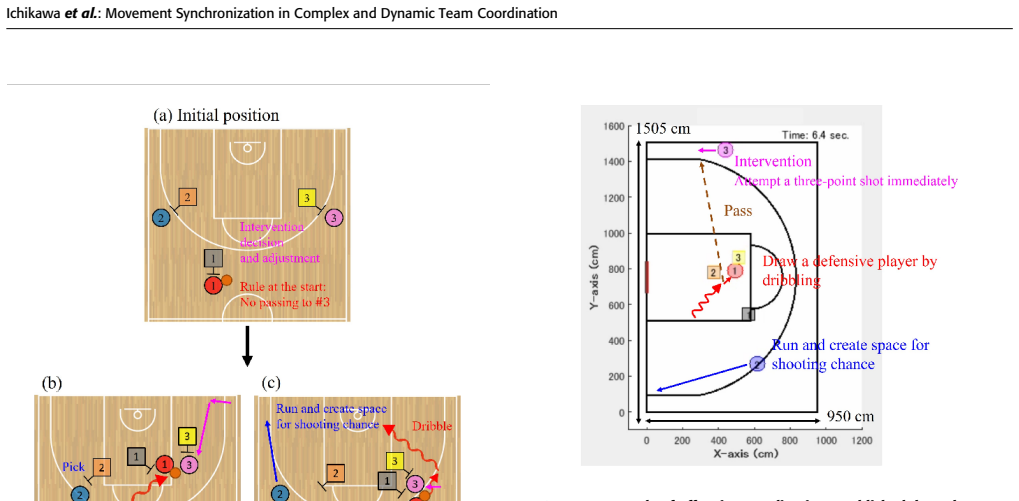
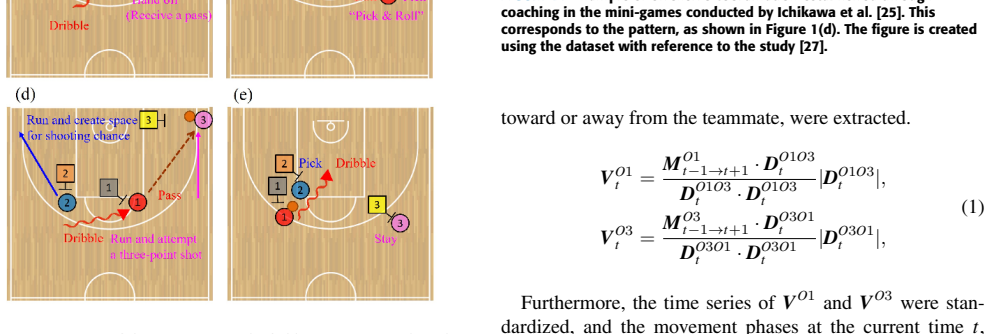
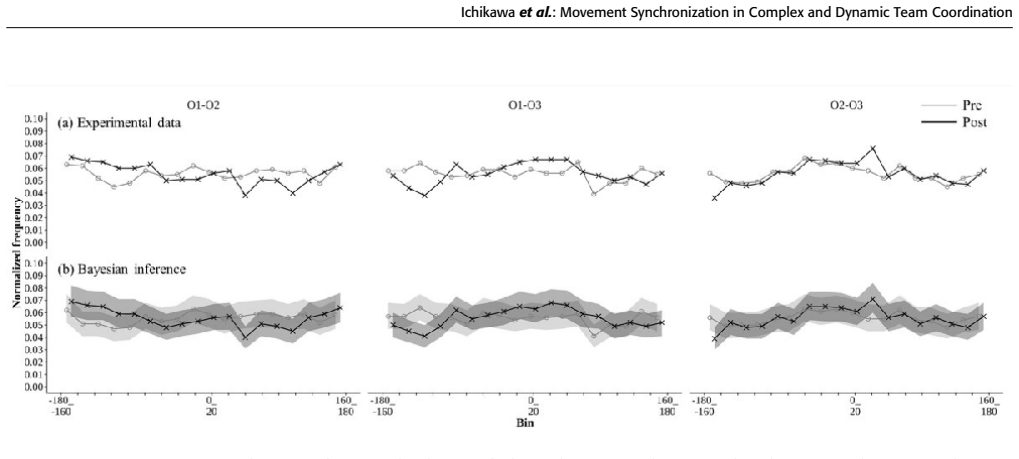
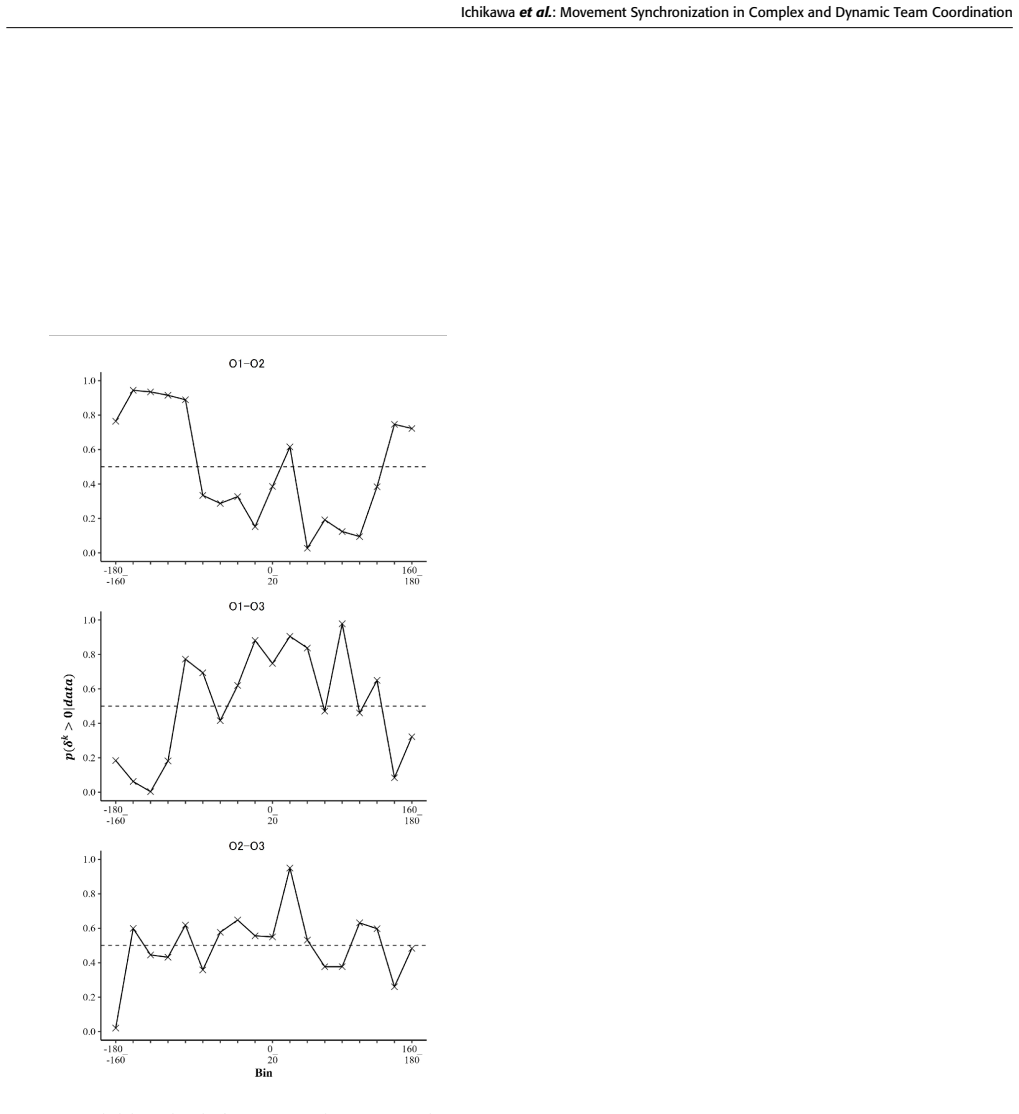
Relative phases were extracted from the movements of offensive players in 3-on-3 basketball mini-games. Frequency distributions of these phases were estimated with Bayesian methods and compared before versus after advice on team offensive coordination. The probability that a synchronization trend appeared after advice, relative to before, reached 70 percent or higher. The authors interpret this shift as a signature of mutual anticipation grounded in the shared strategy conveyed through coaching.
What carries the argument
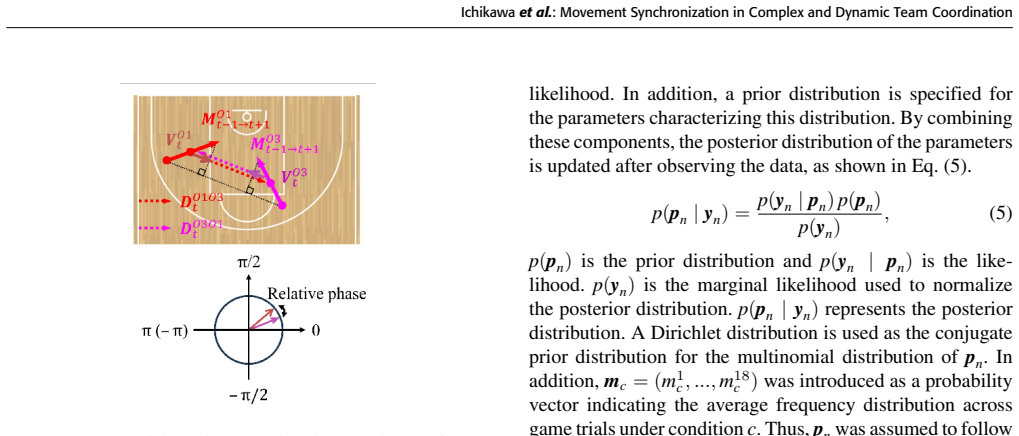
Relative phase calculation between pairs of offensive players, combined with Bayesian estimation of phase-frequency distributions to detect changes in temporal stability before and after advice.
If this is right
- Synchronization marks a temporally stable pattern of interaction that allows teammates to act without waiting for visible cues.
- Mutual anticipation reduces gaps that opponents can exploit in direct-competition settings.
- Advice that establishes a common team strategy can measurably increase the likelihood of this stable pattern.
- Bayesian comparison of phase distributions supplies a probabilistic test for coordination changes in evolving, heterogeneous teams.
Where Pith is reading between the lines
- The same phase-distribution method could be applied to non-sport team tasks where roles shift rapidly, such as emergency medical teams or small-unit military maneuvers.
- If synchronization reliably precedes better scoring or defensive outcomes, coaches could monitor phase trends as an in-game feedback signal.
- Controlled experiments that hold opponent pressure constant would help isolate whether the observed synchronization gain is specific to anticipation or partly reflects general arousal from the coaching session.
Load-bearing premise
Observed shifts in the relative-phase distributions are driven mainly by changes in mutual anticipation rather than by opponent behavior, fatigue, or other game-specific factors.
What would settle it
A follow-up trial in which the same advice is delivered yet the post-advice synchronization probability remains at or below the pre-advice baseline under matched opponent and fatigue conditions.
Figures
read the original abstract
Mutual anticipation of teammates' actions enables efficient interactions in team coordination that achieves a common goal and high performance. In team sports involving direct competition, such implicit and non-verbal interactions within short periods are required. If players begin moving only after observing their teammates, gaps may emerge, allowing opponents to interfere. When mutual anticipation functions properly, players' interactions are smooth without gaps, and their movements are expected to become synchronized. Synchronization represents a temporally stable structure in interactions and its mechanisms have been examined in previous studies. However, few studies have investigated synchronization in real-world coordination involving heterogeneous roles and interactions evolving over time, or quantitatively examined how temporally stable structures differ from a baseline. In our approach, we utilized team sports and introduced a statistical method to probabilistically examine these differences. The purpose of this study was to extract the temporal components of movement using 3-on-3 basketball. We calculated the relative phases in which players approached or moved away from their teammates during mini-games in a field experiment that investigated the effects of advice on offensive coordination. These frequency distributions were estimated using Bayesian inference and were compared before and after advice. The results showed that the probability of a synchronization trend among the offensive players after advice compared with before advice reached 70\% or higher. This may be a typical case that is related to mutual anticipation based on the team strategy established through coaching. These findings contribute to a quantitative understanding of coordination processes.
Editorial analysis
A structured set of objections, weighed in public.
Referee Report
Summary. The manuscript claims that in a 3-on-3 basketball field experiment, Bayesian estimation of relative-phase frequency distributions (players approaching or moving away from teammates) yields a posterior probability of 70% or higher for a synchronization trend among offensive players after coaching advice on offensive coordination, compared with before advice; this is interpreted as evidence that the change reflects increased mutual anticipation arising from an established team strategy.
Significance. If the reported probability can be shown to isolate the effect of advice after accounting for game-level factors, the work supplies a probabilistic method for detecting shifts in temporal stability of interpersonal movement in heterogeneous, competitive team settings. The Bayesian treatment of phase distributions is a methodological strength for handling noisy, short-duration observations typical of real-world coordination.
major comments (2)
- [Abstract] Abstract and implied Methods: the before-versus-after comparison of marginal relative-phase frequency distributions does not incorporate game-level covariates (opponent identity, score/time context, or fatigue proxies), nor a no-advice control arm; because the design is within-subject and competitive, any systematic shift in defender positioning or mini-game context across the advice window can produce the observed change in phase locking without requiring mutual anticipation.
- [Abstract] Abstract/Results: no sample size, number of mini-games, number of offensive triads, prior specifications, or posterior credible intervals are reported for the Bayesian model; without these quantities the claim that P(synchronization trend after advice) ≥ 70% cannot be evaluated for robustness or sensitivity to modeling choices.
minor comments (1)
- The abstract refers to 'mini-games in a field experiment' but supplies no description of trial structure, randomization of advice, or how relative phases were extracted from position time series.
Simulated Author's Rebuttal
We thank the referee for their detailed and constructive review of our manuscript on movement synchronization in 3-on-3 basketball. We address each major comment point by point below, providing the strongest honest defense and indicating where revisions will be incorporated.
read point-by-point responses
-
Referee: [Abstract] Abstract and implied Methods: the before-versus-after comparison of marginal relative-phase frequency distributions does not incorporate game-level covariates (opponent identity, score/time context, or fatigue proxies), nor a no-advice control arm; because the design is within-subject and competitive, any systematic shift in defender positioning or mini-game context across the advice window can produce the observed change in phase locking without requiring mutual anticipation.
Authors: We agree that the analysis relies on marginal before-after comparisons without explicit game-level covariates or a control arm, which is a genuine limitation of the within-subject field design. This leaves open the possibility that changes in defensive positioning or other contextual factors could contribute to the observed shift in phase distributions. A no-advice control arm was not included in the original experimental protocol, so we cannot add one. In revision we will expand the Discussion to explicitly address these potential confounds and their implications for attributing the change to mutual anticipation. We will also examine whether any recorded contextual variables (e.g., score or elapsed time) can be added as covariates in a supplementary analysis. revision: partial
-
Referee: [Abstract] Abstract/Results: no sample size, number of mini-games, number of offensive triads, prior specifications, or posterior credible intervals are reported for the Bayesian model; without these quantities the claim that P(synchronization trend after advice) ≥ 70% cannot be evaluated for robustness or sensitivity to modeling choices.
Authors: The full manuscript reports the sample size, number of mini-games, number of offensive triads, prior specifications, and posterior credible intervals in the Methods and Results sections. We will revise the abstract to include these quantitative details (e.g., observation counts and the exact posterior probability with credible intervals) so that readers can directly assess robustness and sensitivity. revision: yes
Circularity Check
No circularity: standard Bayesian comparison of observed phase distributions
full rationale
The paper applies Bayesian inference directly to empirical relative-phase frequency distributions collected before versus after advice in the 3-on-3 experiment. The reported posterior probability (≥70%) that a synchronization trend exists after advice is the direct numerical output of that comparison on the observed data; it is not obtained by fitting a parameter to the target quantity, by self-definition of the synchronization metric, or by any self-citation chain that imports the result. No equations or derivations in the described method reduce the central claim to its own inputs by construction. The analysis therefore remains self-contained against external benchmarks of Bayesian model comparison on time-series phase data.
Axiom & Free-Parameter Ledger
axioms (1)
- domain assumption Relative phase distributions capture temporally stable synchronization structures arising from mutual anticipation in team coordination.
Reference graph
Works this paper leans on
-
[1]
R. L. Goldstone, E. J. Andrade-Lotero, R. D. Hawkins, and M. E. Roberts, ‘‘The emergence of specialized roles within groups,’’Top. Cogn. Sci., vol. 16, no. 2, pp. 257–281, Apr. 2024, 10.1111/tops.12644
-
[2]
Knoblich, S
G. Knoblich, S. Butterfill, and N. Sebanz, ‘‘Psychological research on joint action: Theory and data,’’ inThe Psychology of Learning and Motivation: Advances in Research and Theory, B. Ross, Ed. Academic Press, 2011, pp. 59–101
2011
-
[3]
K. Y okoyama, H. Shima, K. Fujii, N. Tabuchi, and Y . Y amamoto, ‘‘Social forces for team coordination in ball possession game,’’Phys. Rev. E, vol. 97, Art. no. 022410, Feb. 2018, 10.1103/PhysRevE.97.022410
-
[4]
J. C. Gorman, ‘‘Team coordination and dynamics: Two central issues,’’ Curr . Dir . Psychol. Sci., vol. 23, no. 5, pp. 355–360, Oct. 2014
2014
-
[5]
S. Steiner, A. C. Macquet, and R. Seiler, ‘‘An integrative perspective on interpersonal coordination in interactive team sports,’’Front. Psychol., vol. 8, Art. no. 1440, Aug. 2017, 10.3389/fpsyg.2017.01440
-
[6]
D. Farrow and B. Abernethy, ‘‘Do expertise and the degree of perception– action coupling affect natural anticipatory performance?,’’Perception, vol. 32, no. 9, pp. 1127–1139, Oct. 2003, doi: 10.1068/p3323
-
[7]
S. Mori and T. Shimada, ‘‘Expert anticipation from deceptive action,’’ Atten. Percept. Psychophys., vol. 75, no. 4, pp. 751–770, Feb. 2013, 10.3758/s13414-013-0435-z
-
[8]
S. Müller, K. Morris-Binelli, D. Z. Hambrick, and B. N. Macnamara, ‘‘Accelerating visual anticipation in sport through temporal occlusion train- ing: A meta-analysis,’’Sports Med., vol. 54, pp. 2597–2606, Aug. 2024, 10.1007/s40279-024-02073-6
-
[9]
D. Shimizu and T. Okada, ‘‘Synchronization and coordination of art per- formances in highly competitive contexts: Battle scenes of expert break- dancers,’’Front. Psychol., vol. 12, Art. no. 635534, Apr. 2021, 10.3389/fp- syg.2021.635534
work page doi:10.3389/fp- 2021
-
[10]
D. Shimizu and T. Okada, ‘‘Coordination dynamics of back-and-forth movement among expert performers: Interaction in the battle scene of breaking,’’Front. Psychol., vol. 16, Art. no. 1441378, Jul. 2025, 10.3389/fpsyg.2025.1441378
-
[11]
J. Buck and E. Buck, ‘‘Biology of synchronous flashing of fireflies,’’ Nature, vol. 211, pp. 562–564, Aug. 1966, 10.1038/211562a0
-
[12]
Y . Ma, E. W. M. Lee, M. Shi, and R. K. K. Y uen, ‘‘Spontaneous synchro- nization of motion in pedestrian crowds of different densities,’’Nat. Hum. Behav., vol. 5, pp. 447–457, Jan. 2021, 10.1038/s41562-020-00997-3. 6 VOLUME 11, 2023 Ichikawaet al.: Movement Synchronization in Complex and Dynamic Team Coordination TABLE 1.Estimations of Bayesian inference...
-
[13]
Z. Néda, E. Ravasz, Y . Brechet, T. Vicsek, and A. L. Barabási, ‘‘The sound of many hands clapping,’’Nature, vol. 403, pp. 849–850, Feb. 2000, 10.1038/35002660
-
[14]
A. R. Willms, P . M. Kitanov, and W. F. Langford, ‘‘Huygens’ clocks revisited,’’R. Soc. Open Sci., vol. 4, Art. no. 170777, Sep. 2017, 10.1098/rsos.170777
-
[15]
Y . Kuramoto and I. Nishikawa, ‘‘Statistical macrodynamics of large dy- namical systems: Case of a phase transition in oscillator communities,’’J. Stat. Phys., vol. 49, pp. 569–605, Nov. 1987, 10.1007/BF01009349
-
[16]
R. C. Schmidt, C. Carello, and M. T. Turvey, ‘‘Phase transitions and critical fluctuations in the visual coordination of rhythmic movements between people,’’J. Exp. Psychol. Hum. Percept. Perform., vol. 16, no. 2, pp. 227– 247, May 1990, 10.1037/0096-1523.16.2.227
-
[17]
J. Launay, B. Tarr, and R. I. Dunbar, ‘‘Synchrony as an adaptive mechanism for large-scale human social bonding,’’Ethology, vol. 122, no. 10, pp. 779– 789, Aug. 2016, 10.1111/eth.12528
-
[18]
P . V aldesolo and D. DeSteno, ‘‘Synchrony and the social tuning of compas- sion,’’Emotion, vol. 11, no. 2, pp. 262–266, Apr. 2011, 10.1037/a0021302
-
[19]
S. S. Wiltermuth and C. Heath, ‘‘Synchrony and cooperation,’’Psychol. Sci., vol. 20, no. 1, pp.1–5, Jan. 2009, 10.1111/j.1467-9280.2008.02253.x
-
[20]
L. Y an, C. Na, and J. Kang, ‘‘The impact of team synchrony on argument construction and science knowledge acquisition: Insights from a science learning game,’’J. Sci. Educ. Technol., vol. 33, pp. 633–646, May 2024, 10.1007/s10956-024-10110-2
-
[21]
K. Y okoyama and Y . Y amamoto, ‘‘Three people can synchronize as cou- pled oscillators during sports activities,’’PLoS Comput. Biol., vol. 7, no. 10, Art. no. e1002181, Oct. 2011, 10.1371/journal.pcbi.1002181
-
[22]
A. Kijima, K. Kadota, K. Y okoyama, M. Okumura, H. Suzuki, R. C. Schmidt, and Y . Y amamoto, ‘‘Switching dynamics in an interpersonal com- petition brings about ‘‘deadlock’’ synchronization of players,’’PLoS One, vol. 7, no. 11, Art. no. e47911, Nov. 2012, 10.1371/journal.pone.0047911
-
[23]
M. Okumura, A. Kijima, K. Kadota, K. Y okoyama, H. Suzuki, and Y . Y amamoto, ‘‘A critical interpersonal distance switches between two co- ordination modes in Kendo matches,’’PLoS One, vol. 7, no. 12, Art. no. e51877, Dec. 2012, 10.1371/journal.pone.0051877
-
[24]
R. Santos, J. Garganta, R. J. Lopes, K. Davids, and J. Ribeiro, ‘‘Capturing homeostatic behaviour in elite football teams: Synchronisation tendencies of cooperative and oppositional dynamics,’’Int. J. Data Sci. Anal., vol. 21, Art. no. 10, Nov. 2025, 10.1007/s41060-025-00970-1
-
[25]
J. Ichikawa, M. Y amada, and K. Fujii, ‘‘Analyzing coordinated group behavior through role-sharing: A pilot study in female 3-on-3 basketball with practical application,’’Front. Sports Act. Living, vol. 7, Art. no. 1513982, May 2025, 10.3389/fspor.2025.1513982
-
[26]
J. Ichikawa, M. Y amada, Y . Iwaihara, G. Ichinose, and K. Fujii, ‘‘Applying team strategies for dynamic coordination: A comparative study of expertise using 3-on-3 basketball,’’PLoS One, vol. 21, no. 2, Art. no. e0343077, Feb. 2026, 10.1371/journal.pone.0343077
-
[27]
J. Ichikawa, M. Y amada, K. Fujii, and Y . Takeuchi, ‘‘Understanding role- sharing in coordinated group interaction: Proposal of an integrative group processing model based on top-down and bottom-up mechanisms,’’Cog- nitive Studies: Bulletin of the Japanese Cognitive Science Society, vol. 33, no.2, Jun. 2026, 10.11225/cs.2025.059
-
[28]
J. K. Kruschke, ‘‘Bayesian data analysis,’’Cogn. Sci., vol. 1, no. 5, pp. 658–676, Apr. 2010, 10.1002/wcs.72
-
[29]
J. K. Kruschke, ‘‘Bayesian estimation supersedes the t test,’’J. Exp. Psy- chol. Gen., vol. 142, no. 2, pp. 573–603, May 2013, 10.1037/a0029146
-
[30]
M. F. da Silva, Á. Novillo, A. Aleta, R. López del Campo, R. Resta, Y . Moreno, and J. M. Buldú, ‘‘The interplay between pitch control and top speed in soccer considering the stamina factor,’’Sci. Rep., vol. 15, Art. no. 38799, Nov. 2025, 10.1038/s41598-025-22778-6
-
[31]
Y . Wu, D. Deng, X. Xie, M. He, J. Xu, H. Zhang, H. Zhang, and Y . Wu, ‘‘OBTracker: Visual analytics of off-ball movements in basketball,’’ IEEE Trans. Vis. Comput. Graph., vol. 29, no. 1, pp. 929–939, Sep. 2022, 10.1109/TVCG.2022.3209373
-
[32]
S. Y agi, J. Ichikawa, and G. Ichinose, ‘‘Analysis of line break prediction models for detecting defensive breakthrough in football,’’arXiv, Oct. 2025, 10.48550/arXiv.2511.00121. VOLUME 11, 2023 7 Ichikawaet al.: Movement Synchronization in Complex and Dynamic Team Coordination FIGURE 5.Probabilities that the frequencies in the posttest condition exceeded...
discussion (0)
Sign in with ORCID, Apple, or X to comment. Anyone can read and Pith papers without signing in.