Reducing the rate of personal insults in social media with bystander bots
Reviewed by Pith T0 review T1 audit T2 compute T3 formal T4 kernel 2026-06-26 13:08 UTCgrok-4.3pith:FZ2H6PXLrecord.jsonopen to challenge →
The pith
Automated replies to insults on Reddit reduce their rate, with appreciation replies performing best.
A machine-rendered reading of the paper's core claim, the machinery that carries it, and where it could break.
Core claim
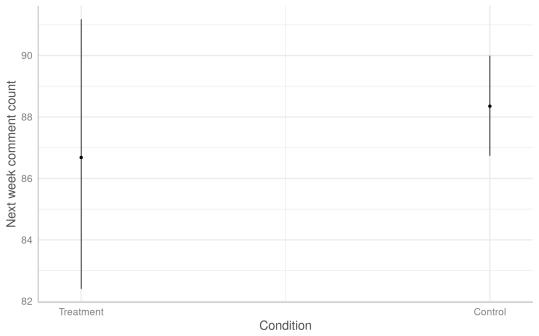
In a randomized controlled trial, automated replies generated from five deescalation strategies and posted to insulting comments on Reddit reduced the rate of personal insults, with appreciation replies performing best. Not every strategy produced a reduction. The authors conclude that automated responses constitute a viable tool for addressing some problematic behaviors in online communities.
What carries the argument
Bystander bots that automatically post replies drawn from deescalation strategies to detected insulting comments.
If this is right
- Automated replies can lower the rate of personal insults on social media platforms.
- Appreciation-based replies outperform other tested deescalation strategies.
- Not every deescalation message produces the same reduction in insults.
- Automated responses offer a scalable method for addressing problematic online behaviors.
- Such bots have both potential utility and clear limitations in practice.
Where Pith is reading between the lines
- The same bot approach might work on other platforms if insult detection remains accurate and users do not quickly learn to ignore automated replies.
- Combining appreciation replies with other moderation tools could produce larger effects than either alone.
- Longer-term studies would reveal whether the reduction persists or whether users adapt their behavior around the bots.
- The method raises questions about how users perceive and respond to automated interventions versus human ones.
Load-bearing premise
The trial design isolates the causal effect of the reply strategy itself rather than the mere presence of any reply, detection of automation, or unrelated changes in user behavior.
What would settle it
Repeating the experiment with a no-reply control group and finding no reduction in insult rates from the appreciation condition would falsify the central claim.
Figures



read the original abstract
Prompted by previous research on strategies for reducing interpersonal conflict and addressing problematic behaviors in online communities, a randomized controlled trial on Reddit compared various responses for reducing the rate of personal insults users post to the site. We generated replies from five deescalation strategies and used an automated procedure for posting them as replies to insulting comments. The findings reveal that automated replies to insults can effectively reduce their rate. Appreciation performed best. Not all strategies performed well, though. We conclude that automated responses are a viable tool for addressing some problematic behaviors. We discuss their potential utility and limitations.
Editorial analysis
A structured set of objections, weighed in public.
Referee Report
Summary. The paper reports results from a randomized controlled trial on Reddit testing automated replies based on five deescalation strategies posted in response to insulting comments. It claims that such replies can effectively reduce the subsequent rate of personal insults posted by users, with the appreciation strategy performing best, while not all strategies were effective. The authors conclude that automated bystander responses are a viable tool for addressing problematic online behaviors.
Significance. If the causal claims hold after addressing design details, the work offers a practical, scalable demonstration of using bots to apply deescalation tactics in real social media environments. The RCT format provides direct empirical evidence rather than simulation or observational data, and the differential performance across strategies supplies a falsifiable prediction about which content works. This could inform moderation tools in online communities.
major comments (2)
- [Methods] Methods/Experimental Design: The manuscript provides no information on sample size, statistical power, how insults were measured or attributed across time, handling of multiple comparisons, or checks for confounds such as users detecting automation. These omissions prevent verification that the directional findings support the central claim of strategy-specific reductions.
- [Experimental Design] Experimental Design: No no-reply control arm is described. Without it, observed reductions cannot be attributed to the specific deescalation content (e.g., appreciation) rather than the mere presence of any automated reply or the intervention's visibility, which is load-bearing for the claim that appreciation performed best.
minor comments (1)
- [Abstract] Abstract: Key quantitative details such as effect sizes, confidence intervals, or exact p-values for the strategy comparisons are absent, which would strengthen the directional claims.
Simulated Author's Rebuttal
We thank the referee for the constructive feedback on our manuscript. The comments identify key areas where additional detail and clarification will improve the work. We respond to each major comment below.
read point-by-point responses
-
Referee: [Methods] Methods/Experimental Design: The manuscript provides no information on sample size, statistical power, how insults were measured or attributed across time, handling of multiple comparisons, or checks for confounds such as users detecting automation. These omissions prevent verification that the directional findings support the central claim of strategy-specific reductions.
Authors: We agree that these methodological details are necessary for readers to evaluate the study. The revised manuscript will expand the Methods section to report the total sample size, a priori power analysis, the precise operationalization and measurement of personal insults (including the classifier or coding scheme and the temporal window for attribution to the same user), the procedure for handling multiple comparisons, and any post-experiment checks for users detecting automated replies (such as analysis of reply timing or user comments). revision: yes
-
Referee: [Experimental Design] Experimental Design: No no-reply control arm is described. Without it, observed reductions cannot be attributed to the specific deescalation content (e.g., appreciation) rather than the mere presence of any automated reply or the intervention's visibility, which is load-bearing for the claim that appreciation performed best.
Authors: The design compared five active deescalation strategies to identify relative differences in effectiveness, consistent with the goal of determining which bystander content is most useful. We acknowledge that the lack of a no-reply control prevents strong claims about absolute reduction versus receiving any reply. The revision will add an explicit discussion of this design decision in the Methods and Limitations sections, reframing the primary conclusions around comparative strategy performance while noting the limitation for absolute-effect interpretations. revision: partial
Circularity Check
Empirical RCT reports observed outcomes with no derivation chain
full rationale
The paper is a randomized controlled trial that posts automated replies according to five strategies and measures subsequent insult rates. No equations, fitted parameters, or first-principles derivations are present; results are reported as direct experimental comparisons. No step reduces a claimed prediction to its own inputs by construction, and the design does not rely on self-citation for its central empirical claim.
Axiom & Free-Parameter Ledger
Reference graph
Works this paper leans on
-
[1]
Social exclusion causes self-defeating behavior
Twenge, Jean M and Catanese, Kathleen R and Baumeister, Roy F. Social exclusion causes self-defeating behavior. J. Pers. Soc. Psychol
-
[2]
Automatic identification of personal insults on social news sites
Sood, Sara Owsley and Churchill, Elizabeth F and Antin, Judd. Automatic identification of personal insults on social news sites. J. Am. Soc. Inf. Sci. Technol
-
[3]
BERT: Pre-training of Deep Bidirectional Transformers for Language Understanding
Devlin, Jacob and Chang, Ming-Wei and Lee, Kenton and Toutanova, Kristina. BERT : Pre-training of Deep Bidirectional Transformers for Language Understanding. arXiv:1810.04805
work page internal anchor Pith review Pith/arXiv arXiv
-
[4]
Characterizations of online harassment: Comparing policies across social media platforms
Pater, Jessica A and Kim, Moon K and Mynatt, Elizabeth D and Fiesler, Casey. Characterizations of online harassment: Comparing policies across social media platforms. Proceedings of the 19th International Conference on Supporting Group Work
-
[5]
Automated Hate Speech Detection and the Problem of Offensive Language
Davidson, Thomas and Warmsley, Dana and Macy, Michael and Weber, Ingmar. Automated Hate Speech Detection and the Problem of Offensive Language. Eleventh International AAAI Conference on Web and Social Media
-
[6]
Democracy online: Civility, politeness, and the democratic potential of online political discussion groups
Papacharissi, Zizi. Democracy online: Civility, politeness, and the democratic potential of online political discussion groups. New media & society
-
[7]
Anyone can become a troll: Causes of trolling behavior in online discussions
Cheng, Justin and Bernstein, Michael and Danescu-Niculescu-Mizil, Cristian and Leskovec, Jure. Anyone can become a troll: Causes of trolling behavior in online discussions. Proceedings of the 2017 ACM conference on computer supported cooperative work and social computing
2017
-
[8]
Tweetment effects on the tweeted: Experimentally reducing racist harassment
Munger, Kevin. Tweetment effects on the tweeted: Experimentally reducing racist harassment. Political Behavior
-
[9]
Beat them or ban them: the characteristics and social functions of anger and contempt
Fischer, Agneta H and Roseman, Ira J. Beat them or ban them: the characteristics and social functions of anger and contempt. J. Pers. Soc. Psychol
-
[10]
Behind the Screen: Content Moderation in the Shadows of Social Media
Roberts, Sarah T. Behind the Screen: Content Moderation in the Shadows of Social Media
-
[11]
Abusive Language Detection in Online User Content
Nobata, Chikashi and Tetreault, Joel and Thomas, Achint and Mehdad, Yashar and Chang, Yi. Abusive Language Detection in Online User Content. Proceedings of the 25th International Conference on World Wide Web
-
[12]
A Survey on Automatic Detection of Hate Speech in Text
Fortuna, Paula and Nunes, S \'e rgio. A Survey on Automatic Detection of Hate Speech in Text. ACM Comput. Surv
-
[13]
Combating hate speech using an adaptive ensemble learning model with a case study on COVID-19
Agarwal, Shivang and Chowdary, C Ravindranath. Combating hate speech using an adaptive ensemble learning model with a case study on COVID-19. Expert Syst. Appl
-
[14]
Nearly Eight-in-Ten Reddit Users Get News on the Site
Barthel, Michael and Stocking, Galen and Holcomb, Jesse and Mitchell, Amy. Nearly Eight-in-Ten Reddit Users Get News on the Site
-
[15]
Comparing BERT Against Traditional Machine Learning Models in Text Classification
Garrido-Merchan, Eduardo C and Gozalo-Brizuela, Roberto and Gonzalez-Carvajal, Santiago. Comparing BERT Against Traditional Machine Learning Models in Text Classification. JCCE
-
[16]
To Act or Not to Act, That Is the Question? Barriers and Facilitators of Bystander Intervention
Bennett, Sidney and Banyard, Victoria L and Garnhart, Lydia. To Act or Not to Act, That Is the Question? Barriers and Facilitators of Bystander Intervention. J. Interpers. Violence
-
[17]
Bystander Intervention in Cyberbullying and Online Harassment: The Role of Expectancy Violations
Brody, Nicholas. Bystander Intervention in Cyberbullying and Online Harassment: The Role of Expectancy Violations. Int. J. Commun. Syst
-
[18]
Evaluation of a Bystander-Focused Interpersonal Violence Prevention Program with High School Students
Edwards, Katie M and Banyard, Victoria L and Sessarego, Stephanie N and Waterman, Emily A and Mitchell, Kimberly J and Chang, Hong. Evaluation of a Bystander-Focused Interpersonal Violence Prevention Program with High School Students. Prev. Sci
-
[19]
The bystander-effect: a meta-analytic review on bystander intervention in dangerous and non-dangerous emergencies
Fischer, Peter and Krueger, Joachim I and Greitemeyer, Tobias and Vogrincic, Claudia and Kastenm \"u ller, Andreas and Frey, Dieter and Heene, Moritz and Wicher, Magdalena and Kainbacher, Martina. The bystander-effect: a meta-analytic review on bystander intervention in dangerous and non-dangerous emergencies. Psychol. Bull
-
[20]
Convolutional Neural Networks for Toxic Comment Classification
Georgakopoulos, Spiros V and Tasoulis, Sotiris K and Vrahatis, Aristidis G and Plagianakos, Vassilis P. Convolutional Neural Networks for Toxic Comment Classification. Proceedings of the 10th Hellenic Conference on Artificial Intelligence
-
[21]
The effects of machine-powered platform governance: An empirical study of content moderation
He, Qinglai and Hong, Yili and Raghu, T S. The effects of machine-powered platform governance: An empirical study of content moderation. Available at SSRN 3767680
-
[22]
There Is Virtually No Excuse: The Frequency and Predictors of College Students' Bystander Intervention Behaviors Directed at Online Victimization
Henson, Billy and Fisher, Bonnie S and Reyns, Bradford W. There Is Virtually No Excuse: The Frequency and Predictors of College Students' Bystander Intervention Behaviors Directed at Online Victimization. Violence Against Women
-
[23]
Did you suspect the post would be removed?
Jhaver, Shagun and Appling, Darren Scott and Gilbert, Eric and Bruckman, Amy. Did you suspect the post would be removed?. Proc. ACM Hum. Comput. Interact
-
[24]
Moderator Chatbot for Deliberative Discussion: Effects of Discussion Structure and Discussant Facilitation
Kim, Soomin and Eun, Jinsu and Seering, Joseph and Lee, Joonhwan. Moderator Chatbot for Deliberative Discussion: Effects of Discussion Structure and Discussant Facilitation. Proc. ACM Hum.-Comput. Interact
-
[25]
Does Danger Level Affect Bystander Intervention in Real-Life Conflicts? Evidence From CCTV Footage
Lindegaard, Marie Rosenkrantz and Liebst, Lasse Suonper \"a and Philpot, Richard and Levine, Mark and Bernasco, Wim. Does Danger Level Affect Bystander Intervention in Real-Life Conflicts? Evidence From CCTV Footage. Soc. Psychol. Personal. Sci
-
[26]
The Impact of Toxic Language on the Health of Reddit Communities
Mohan, Shruthi and Guha, Apala and Harris, Michael and Popowich, Fred and Schuster, Ashley and Priebe, Chris. The Impact of Toxic Language on the Health of Reddit Communities. Advances in Artificial Intelligence
-
[27]
Vulnerable community identification using hate speech detection on social media
Mossie, Zewdie and Wang, Jenq-Haur. Vulnerable community identification using hate speech detection on social media. Inf. Process. Manag
-
[28]
A Systematic Review of Bystander Interventions for the Prevention of Sexual Violence
Mujal, Gabriela N and Taylor, Meghan E and Fry, Jessica L and Gochez-Kerr, Tatiana H and Weaver, Nancy L. A Systematic Review of Bystander Interventions for the Prevention of Sexual Violence. Trauma Violence Abuse
-
[29]
Detecting Community Sensitive Norm Violations in Online Conversations
Park, Chan Young and Mendelsohn, Julia and Radhakrishnan, Karthik and Jain, Kinjal and Kanakagiri, Tushar and Jurgens, David and Tsvetkov, Yulia. Detecting Community Sensitive Norm Violations in Online Conversations. arXiv:2110.04419
-
[30]
A Meta-Analysis of School-Based Bullying Prevention Programs' Effects on Bystander Intervention Behavior
Polanin, Joshua R and Espelage, Dorothy L and Pigott, Therese D. A Meta-Analysis of School-Based Bullying Prevention Programs' Effects on Bystander Intervention Behavior. School Psych. Rev
-
[31]
Impact of SMOTE on Imbalanced Text Features for Toxic Comments Classification Using RVVC Model
Rupapara, Vaibhav and Rustam, Furqan and Shahzad, Hina Fatima and Mehmood, Arif and Ashraf, Imran and Choi, Gyu Sang. Impact of SMOTE on Imbalanced Text Features for Toxic Comments Classification Using RVVC Model. IEEE Access
-
[32]
Quantifying social organization and political polarization in online platforms
Waller, Isaac and Anderson, Ashton. Quantifying social organization and political polarization in online platforms. Nature
-
[33]
The Effect of Moderator Bots on Abusive Language Use
Young, Li-Yin. The Effect of Moderator Bots on Abusive Language Use. Proceedings of the International Conference on Pattern Recognition and Artificial Intelligence
-
[34]
Critical Perspectives: A Benchmark Revealing Pitfalls in P erspective API
Rosenblatt, Lucas and Piedras, Lorena and Wilkins, Julia. Critical Perspectives: A Benchmark Revealing Pitfalls in P erspective API. Proceedings of the Second Workshop on NLP for Positive Impact ( NLP4PI )
-
[35]
Challenges and frontiers in abusive content detection
Vidgen, Bertie and Harris, Alex and Nguyen, Dong and Tromble, Rebekah and Hale, Scott and Margetts, Helen. Challenges and frontiers in abusive content detection. Proceedings of the Third Workshop on Abusive Language Online
-
[36]
Toolkit for Civil Society and Moderation Inventory
Lo, Kat. Toolkit for Civil Society and Moderation Inventory
-
[37]
``HOT'' ChatGPT : The Promise of ChatGPT in Detecting and Discriminating Hateful, Offensive, and Toxic Comments on Social Media
Li, Lingyao and Fan, Lizhou and Atreja, Shubham and Hemphill, Libby. ``HOT'' ChatGPT : The Promise of ChatGPT in Detecting and Discriminating Hateful, Offensive, and Toxic Comments on Social Media. ACM Trans. Web
-
[38]
Empirical Analysis of Multi-Task Learning for Reducing Identity Bias in Toxic Comment Detection
Vaidya, Ameya and Mai, Feng and Ning, Yue. Empirical Analysis of Multi-Task Learning for Reducing Identity Bias in Toxic Comment Detection. ICWSM
-
[39]
Measuring and Mitigating Unintended Bias in Text Classification
Dixon, Lucas and Li, John and Sorensen, Jeffrey and Thain, Nithum and Vasserman, Lucy. Measuring and Mitigating Unintended Bias in Text Classification. Proceedings of the 2018 AAAI/ACM Conference on AI , Ethics, and Society
2018
-
[40]
Mea Culpa: A Sociology of Apology and Reconciliation
Tavuchis, Nicholas. Mea Culpa: A Sociology of Apology and Reconciliation
-
[41]
The managerial grid: key orientations for achieving production through people
Blake, Robert R and Mouton, Jane S. The managerial grid: key orientations for achieving production through people
-
[42]
Social exclusion decreases prosocial behavior
Twenge, Jean M and Baumeister, Roy F and DeWall, C Nathan and Ciarocco, Natalie J and Bartels, J Michael. Social exclusion decreases prosocial behavior. J. Pers. Soc. Psychol
-
[43]
If you can't join them, beat them: effects of social exclusion on aggressive behavior
Twenge, J M and Baumeister, R F and Tice, D M and Stucke, T S. If you can't join them, beat them: effects of social exclusion on aggressive behavior. J. Pers. Soc. Psychol
-
[44]
Social exclusion impairs self-regulation
Baumeister, Roy F and DeWall, C Nathan and Ciarocco, Natalie J and Twenge, Jean M. Social exclusion impairs self-regulation. J. Pers. Soc. Psychol
-
[45]
Detection of toxicity in social media based on Natural Language Processing methods
Taleb, Mohammed and Hamza, Alami and Zouitni, Mohamed and Burmani, Nabil and Lafkiar, Said and En-Nahnahi, Noureddine. Detection of toxicity in social media based on Natural Language Processing methods. 2022 International Conference on Intelligent Systems and Computer Vision ( ISCV )
2022
-
[46]
A lexicon-based approach for hate speech detection
Gitari, Njagi Dennis and Zhang, Zuping and Damien, Hanyurwimfura and Long, Jun. A lexicon-based approach for hate speech detection. Int. J. Multimed. Ubiquitous Eng
-
[47]
Inducing a lexicon of abusive words -- a feature-based approach
Wiegand, Michael and Ruppenhofer, Josef and Schmidt, Anna and Greenberg, Clayton. Inducing a lexicon of abusive words -- a feature-based approach. Proceedings of the 2018 Conference of the North American Chapter of the Association for Computational Linguistics: Human Language Technologies, Volume 1 (Long Papers)
2018
-
[48]
An Italian lexical resource for incivility detection in online discourses
Tontodimamma, Alice and Fontanella, Lara and Anzani, Stefano and Basile, Valerio. An Italian lexical resource for incivility detection in online discourses. Qual. Quant
-
[49]
Hate Hurts: Exploring the Impact of Online Hate on LGBTQ+ Young People
Keighley, R. Hate Hurts: Exploring the Impact of Online Hate on LGBTQ+ Young People. Women & Criminal Justice
-
[50]
Censored, suspended, shadowbanned: User interpretations of content moderation on social media platforms
Myers West, Sarah. Censored, suspended, shadowbanned: User interpretations of content moderation on social media platforms. New Media & Society
-
[51]
Bystander intervention in emergencies: diffusion of responsibility
Darley, J M and Latan \'e , B. Bystander intervention in emergencies: diffusion of responsibility. J. Pers. Soc. Psychol
-
[52]
Efficient Toxic Content Detection by Bootstrapping and Distilling Large Language Models
Zhang, Jiang and Wu, Qiong and Xu, Yiming and Cao, Cheng and Du, Zheng and Psounis, Konstantinos. Efficient Toxic Content Detection by Bootstrapping and Distilling Large Language Models. AAAI
-
[53]
A little goes a long way: Improving toxic language classification despite data scarcity
Juuti, Mika and Gr \"o ndahl, Tommi and Flanagan, Adrian and Asokan, N. A little goes a long way: Improving toxic language classification despite data scarcity. Findings of the Association for Computational Linguistics: EMNLP 2020
2020
-
[54]
Who Uses Bots? A Statistical Analysis of Bot Usage in Moderation Teams
Kiene, Charles and Hill, Benjamin Mako. Who Uses Bots? A Statistical Analysis of Bot Usage in Moderation Teams. Extended Abstracts of the 2020 CHI Conference on Human Factors in Computing Systems
2020
-
[55]
Intergroup emotions: explaining offensive action tendencies in an intergroup context
Mackie, D M and Devos, T and Smith, E R. Intergroup emotions: explaining offensive action tendencies in an intergroup context. J. Pers. Soc. Psychol
-
[56]
What predicts divorce? the relationship between marital processes and marital outcomes
Gottman, John Mordechai. What predicts divorce? the relationship between marital processes and marital outcomes
-
[57]
Remove, Reduce, Inform: What Actions do People Want Social Media Platforms to Take on Potentially Misleading Content?
Atreja, Shubham and Hemphill, Libby and Resnick, Paul. Remove, Reduce, Inform: What Actions do People Want Social Media Platforms to Take on Potentially Misleading Content?. Proc. ACM Hum.-Comput. Interact
-
[58]
How well do hate speech, toxicity, abusive and offensive language classification models generalize across datasets?
Fortuna, Paula and Soler-Company, Juan and Wanner, Leo. How well do hate speech, toxicity, abusive and offensive language classification models generalize across datasets?. Inf. Process. Manag
-
[59]
Perspective API - How it works
-
[60]
Is Your Toxicity My Toxicity? Exploring the Impact of Rater Identity on Toxicity Annotation
Goyal, Nitesh and Kivlichan, Ian and Rosen, Rachel and Vasserman, Lucy. Is Your Toxicity My Toxicity? Exploring the Impact of Rater Identity on Toxicity Annotation. arXiv:2205.00501
-
[61]
The Psychology of Insults
Barber, N. The Psychology of Insults. Psychology Today
-
[62]
Annotators with Attitudes: How Annotator Beliefs And Identities Bias Toxic Language Detection
Sap, Maarten and Swayamdipta, Swabha and Vianna, Laura and Zhou, Xuhui and Choi, Yejin and Smith, Noah A. Annotators with Attitudes: How Annotator Beliefs And Identities Bias Toxic Language Detection. Proceedings of the 2022 Conference of the North American Chapter of the Association for Computational Linguistics: Human Language Technologies
2022
-
[63]
Cyberbullying bystander intervention: The number of offenders and retweeting predict likelihood of helping a cyberbullying victim
Kazerooni, F and Taylor, S H and Bazarova, N N and others. Cyberbullying bystander intervention: The number of offenders and retweeting predict likelihood of helping a cyberbullying victim. Journal of Computer
-
[64]
The moral emotions: a social-functionalist account of anger, disgust, and contempt
Hutcherson, Cendri A and Gross, James J. The moral emotions: a social-functionalist account of anger, disgust, and contempt. J. Pers. Soc. Psychol
-
[65]
White supremacy culture
Okun, Tema. White supremacy culture
-
[66]
Getting better and staying better: assessing civility, incivility, distress, and job attitudes one year after a civility intervention
Leiter, Michael P and Day, Arla and Oore, Debra Gilin and Spence Laschinger, Heather K. Getting better and staying better: assessing civility, incivility, distress, and job attitudes one year after a civility intervention. J. Occup. Health Psychol
-
[67]
Civility, Respect, Engagement in the Workforce ( CREW) : Nationwide Organization Development Intervention at Veterans Health Administration
Osatuke, Katerine and Moore, Scott C and Ward, Christopher and Dyrenforth, Sue R and Belton, Linda. Civility, Respect, Engagement in the Workforce ( CREW) : Nationwide Organization Development Intervention at Veterans Health Administration. J. Appl. Behav. Sci
-
[68]
Managing conflict in today's organizations
Lippitt, Gordan L. Managing conflict in today's organizations. Train. Dev. J
-
[69]
Accountability and empathy by design: Encouraging bystander intervention to cyberbullying on social media
Taylor, S H and DiFranzo, D and Choi, Y H and Sannon, S and others. Accountability and empathy by design: Encouraging bystander intervention to cyberbullying on social media. Proceedings of the
-
[70]
Toxic, Hateful, Offensive or Abusive? What Are We Really Classifying? An Empirical Analysis of Hate Speech Datasets
Fortuna, Paula and Soler, Juan and Wanner, Leo. Toxic, Hateful, Offensive or Abusive? What Are We Really Classifying? An Empirical Analysis of Hate Speech Datasets. Proceedings of the Twelfth Language Resources and Evaluation Conference
-
[71]
What predicts change in marital interaction over time? A study of alternative models
Gottman, J M and Levenson, R W. What predicts change in marital interaction over time? A study of alternative models. Fam. Process
-
[72]
The unresponsive bystander: Why doesn't he help?
Latan \'e , Bibb and Darley, John M. The unresponsive bystander: Why doesn't he help?
-
[73]
Styles of Bystander Intervention in Cyberbullying Incidents
Moxey, Natasha and Bussey, Kay. Styles of Bystander Intervention in Cyberbullying Incidents. International Journal of Bullying Prevention
-
[74]
Some Statistical Models for Limited Dependent Variables with Application to the Demand for Durable Goods
Cragg, John G. Some Statistical Models for Limited Dependent Variables with Application to the Demand for Durable Goods. Econometrica
discussion (0)
Sign in with ORCID, Apple, or X to comment. Anyone can read and Pith papers without signing in.