Interfacial Roughness Spectra and Finite-Depth Salt-Finger Mixing at a Two-Layer Thermohaline Interface
Pith reviewed 2026-06-26 13:25 UTC · model grok-4.3
The pith
The horizontal spectrum of roughness at a thermohaline interface selects whether salt-finger mixing stays localized, penetrates rapidly, or forms a plume forest.
A machine-rendered reading of the paper's core claim, the machinery that carries it, and where it could break.
Core claim
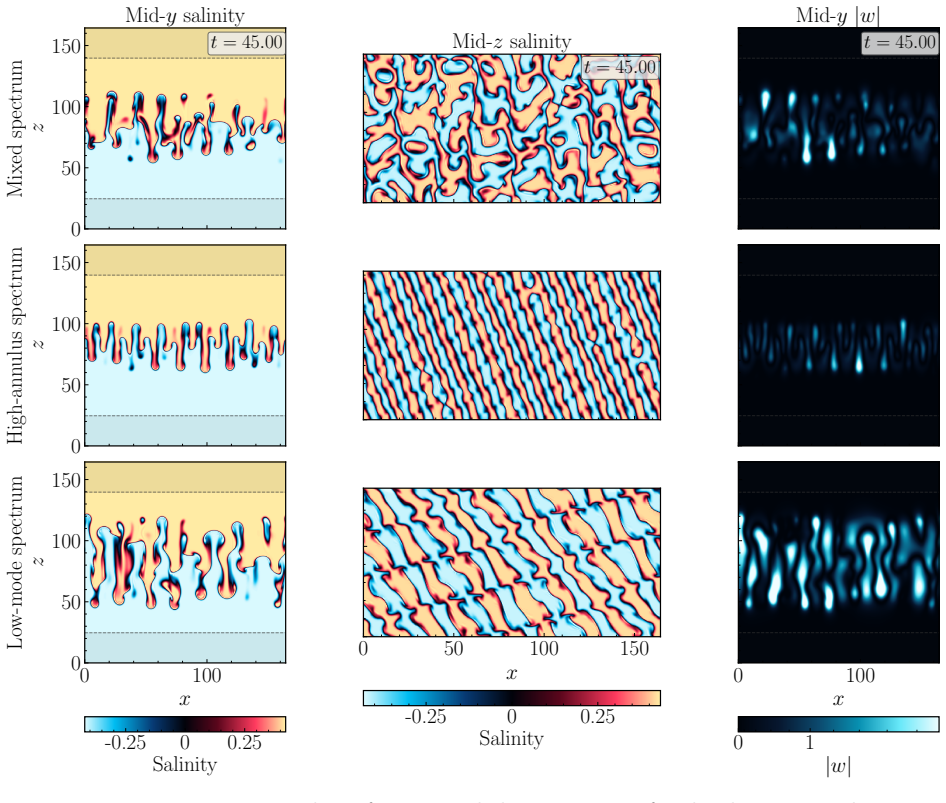
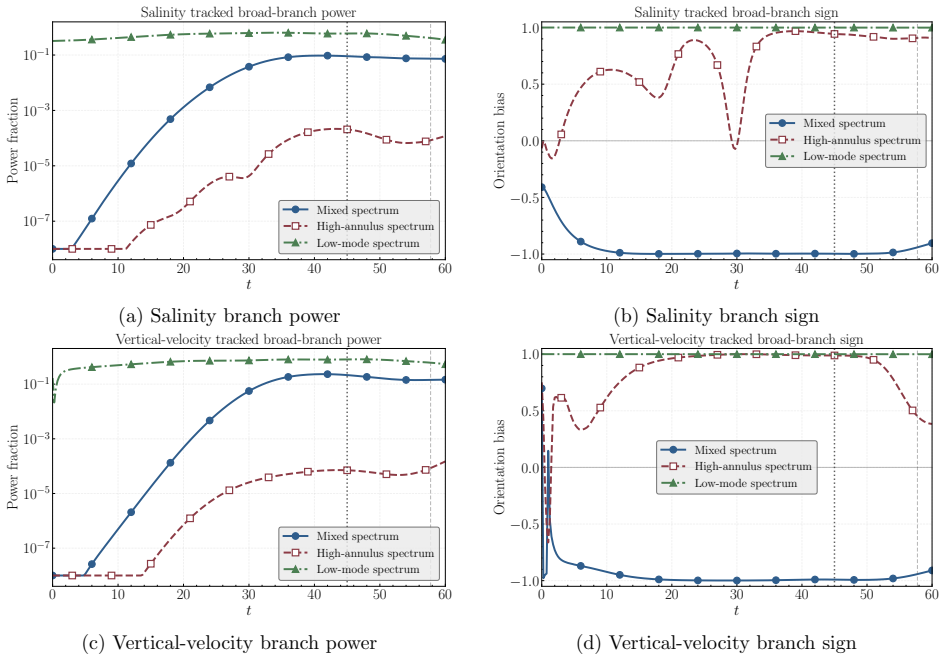
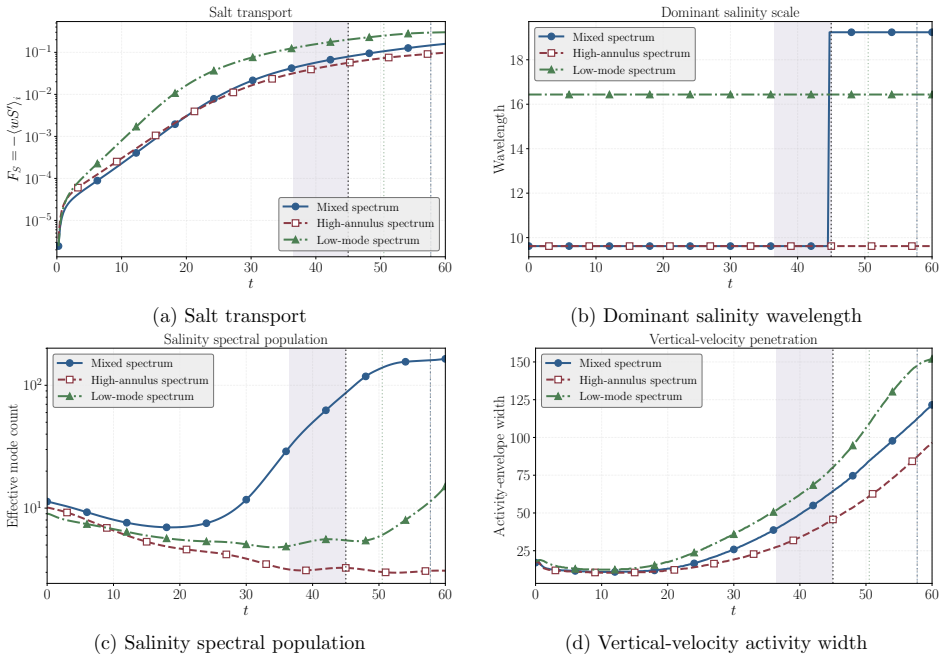
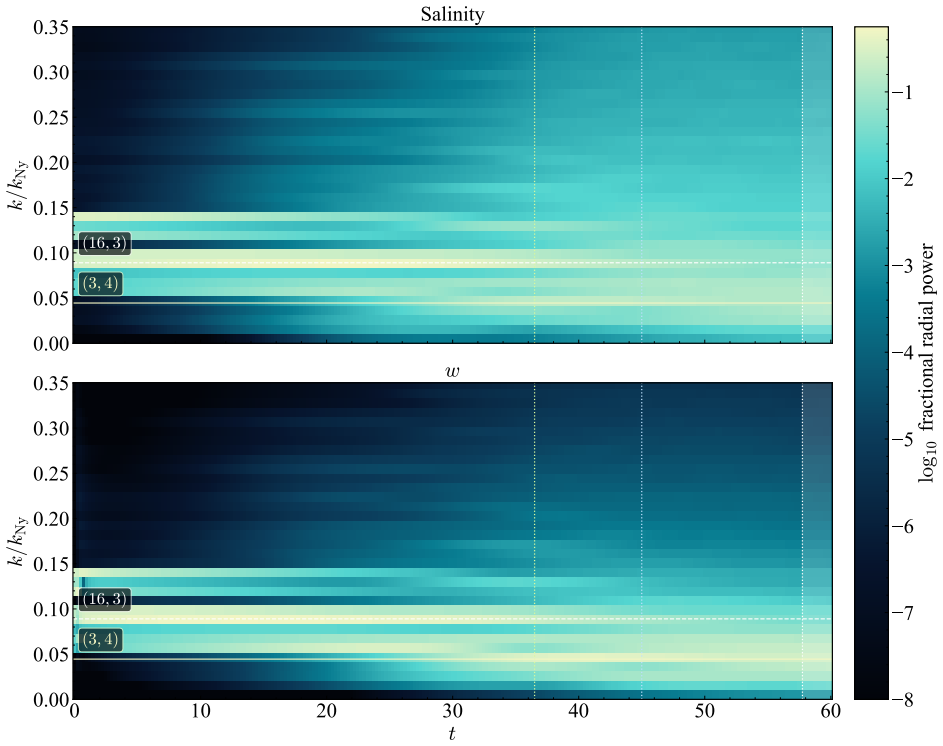
A finite-depth thermohaline interface retains spectral memory of its initial roughness spectrum, which selects the route to vertical exchange: high-annulus spectra keep mixing compact without broad-branch transition, low-mode spectra produce early strong transport and boundary arrival, and mixed spectra follow a velocity-led pathway with highest effective mode count and delayed modal handoff to a plume forest.
What carries the argument
The imposed horizontal roughness spectrum (high-annulus, low-mode, or mixed), which selects branch type, transition timing, and planform population through modal handoff.
If this is right
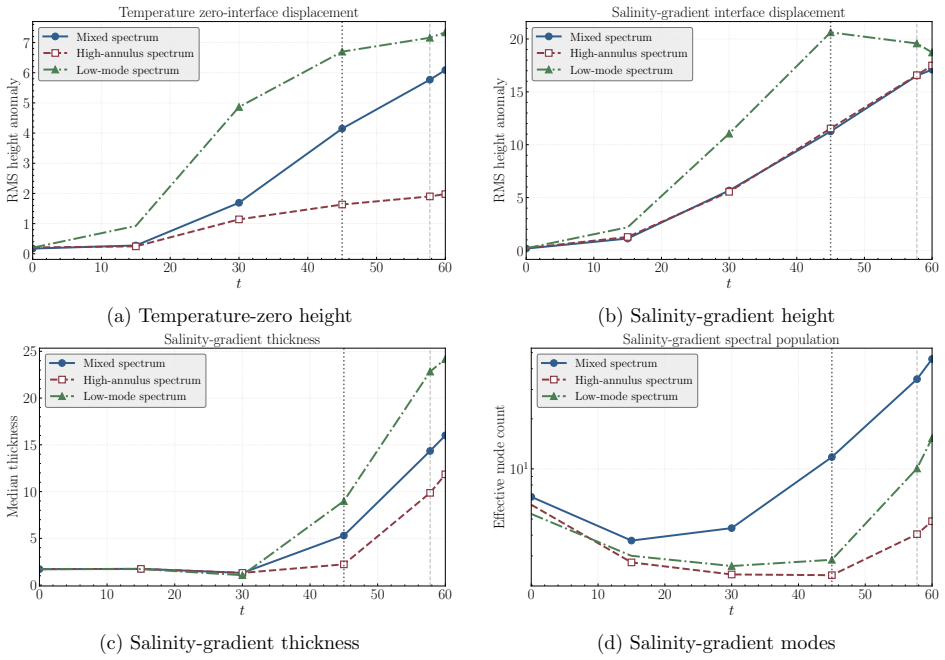
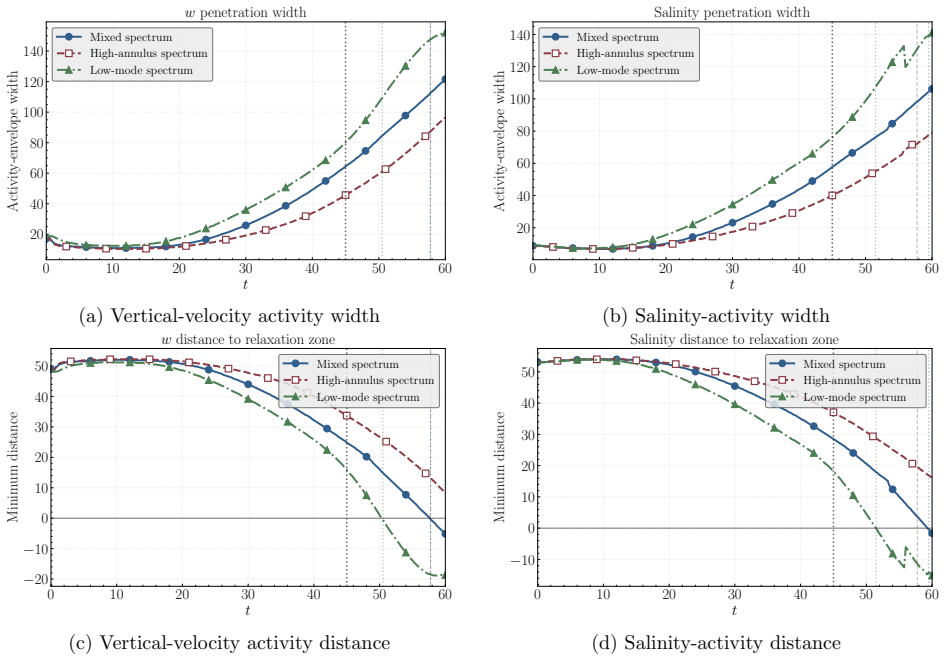
- High-annulus roughness keeps the mixing compact and branch-locked through at least t=60 without a tracked broad-branch transition.
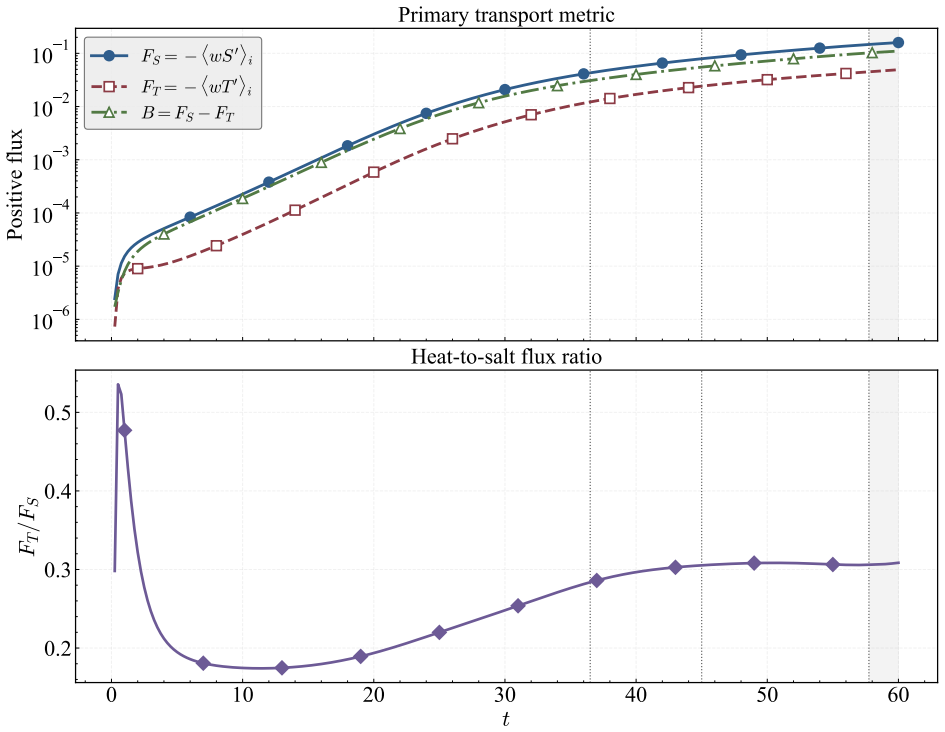
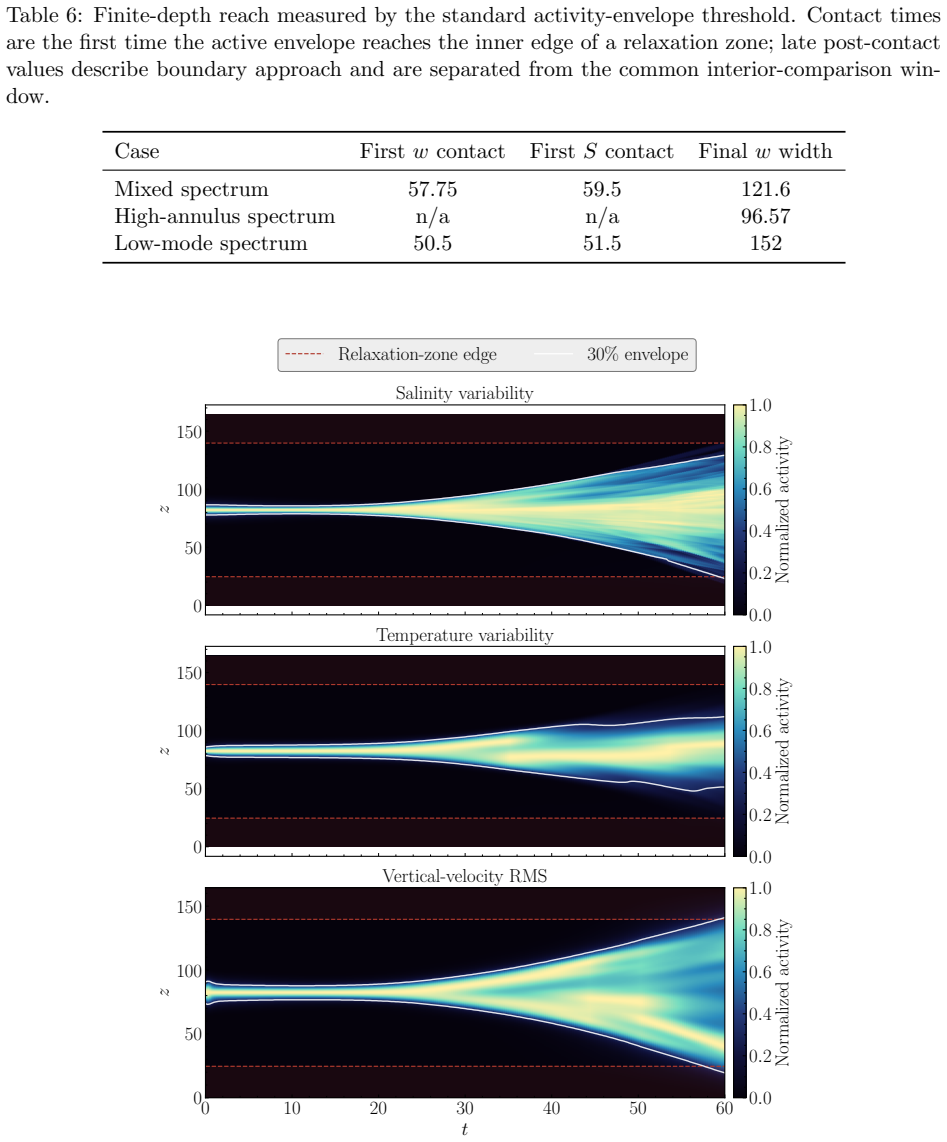
- Low-mode roughness begins on the broad branch, yields the strongest salinity transport at t=45, and reaches the finite-depth boundary region first.
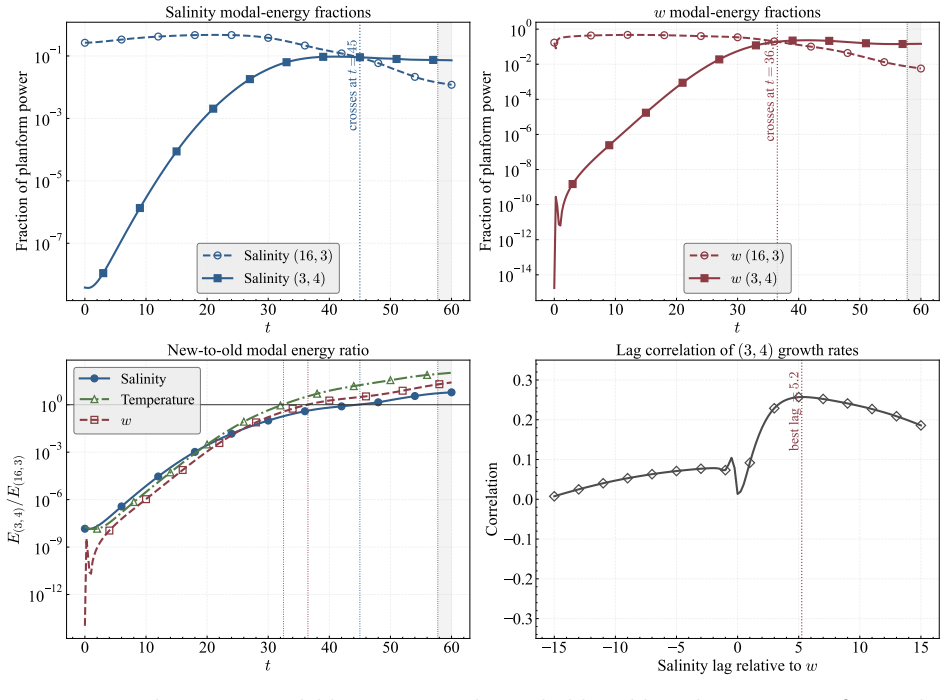
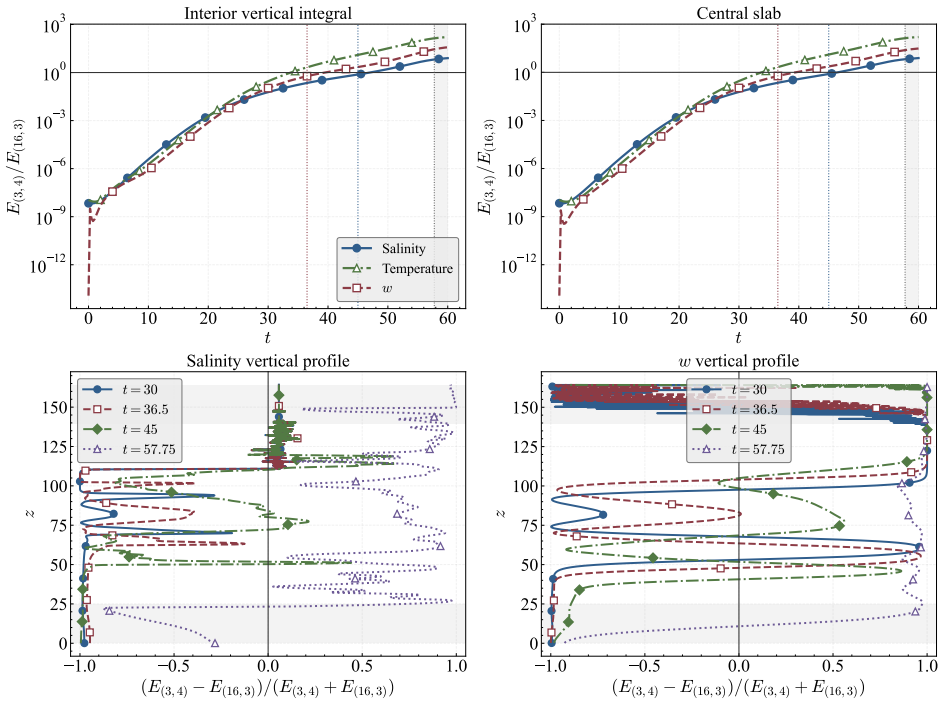
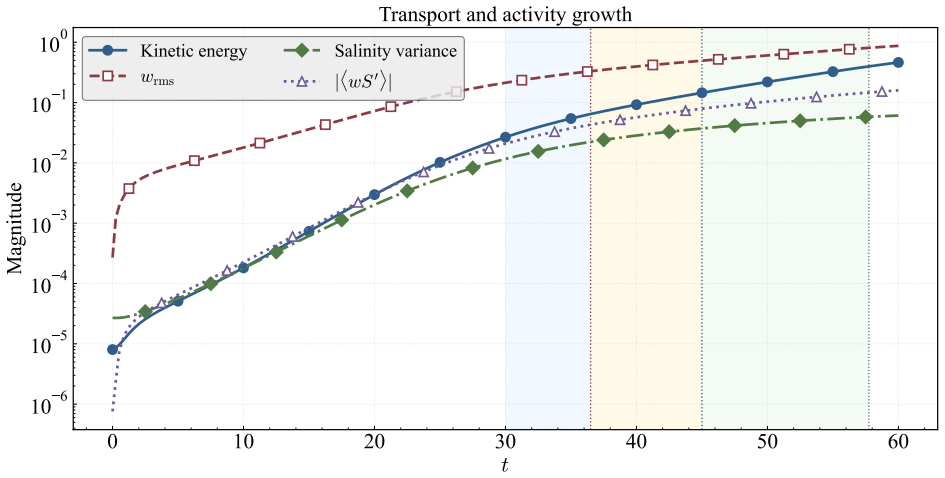
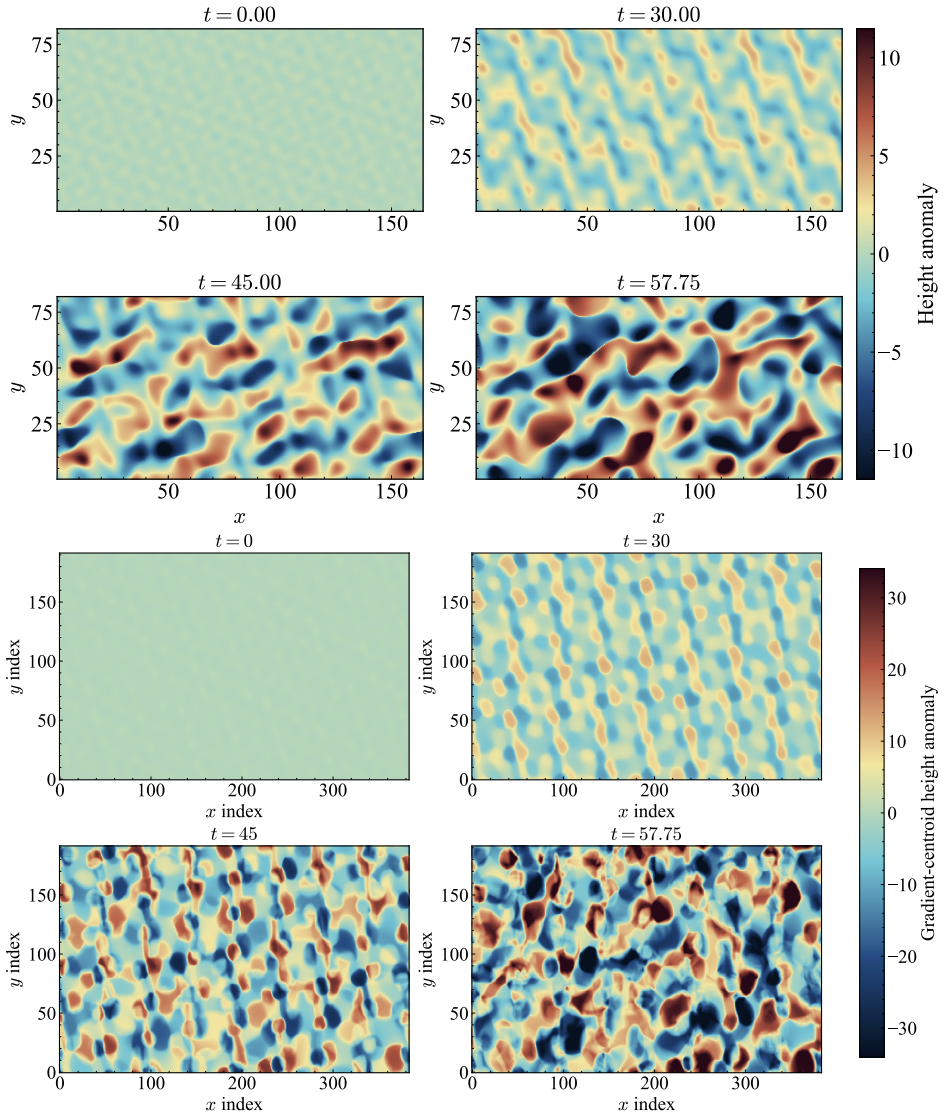
- Mixed roughness follows a velocity-led route in which vertical velocity selects the broad branch before salinity, producing the highest effective mode count of 86.66 at t=45.
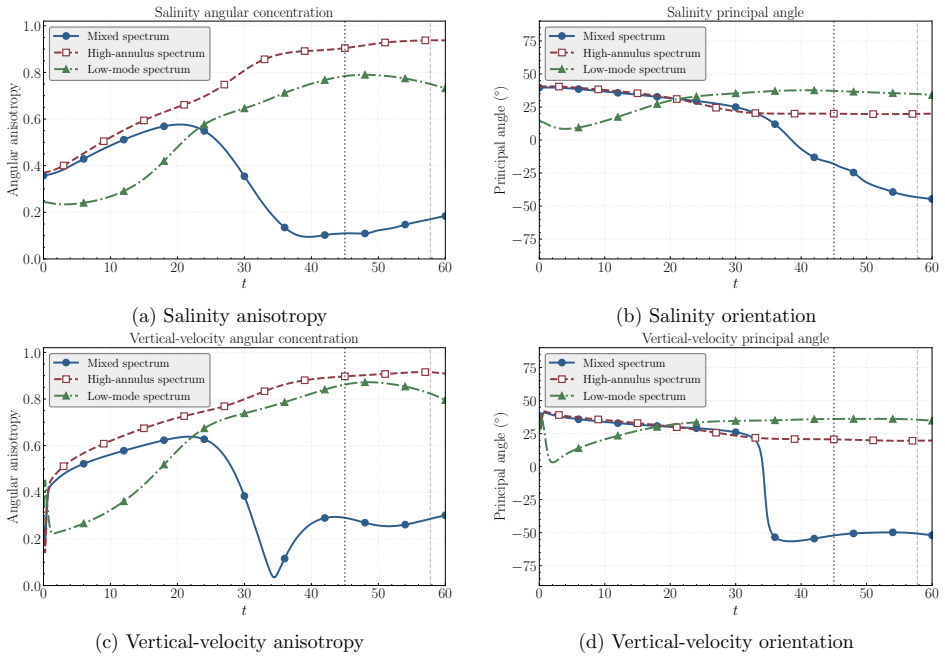
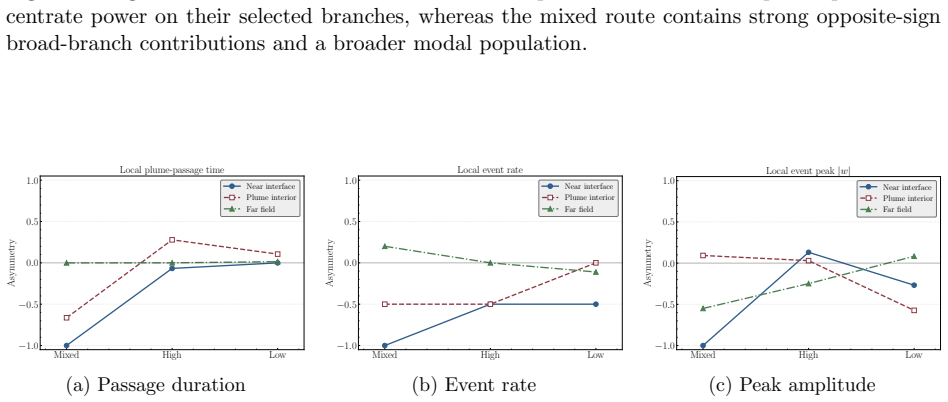
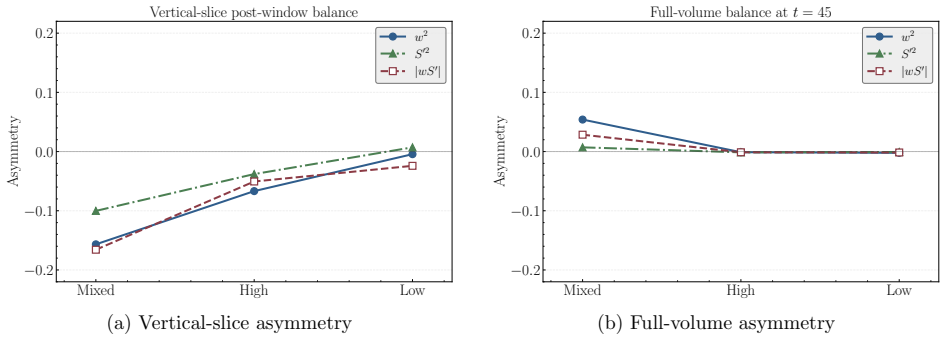
- Angular and signed-branch measures reveal branch-dependent diagonal organization, while local plume asymmetry does not produce large global upper/lower imbalance.
- A replicate mixed realization preserves the same velocity-led route, only with shifted transition times.
Where Pith is reading between the lines
- Natural roughness generated by internal waves or shear intrusions could therefore be used to forecast whether a given interface will support localized fingers or a broad plume forest.
- The mechanism supplies a possible explanation for spatial variability in observed diapycnal mixing rates across different oceanic fronts.
- Extending the same spectral-forcing protocol to a range of density ratios would test whether the memory effect survives changes in the background stratification.
- The same roughness-spectrum control may operate in other double-diffusive systems such as diffusive layering or ice-ocean interfaces.
Load-bearing premise
The chosen parameters and imposed roughness spectra represent oceanic conditions without simulation-domain or boundary artifacts that would erase the spectral memory effect.
What would settle it
An ocean or laboratory observation of two interfaces with measurably different roughness spectra but identical mixing routes (or identical spectra but different routes) would falsify the claim that the spectrum controls the pathway.
Figures

read the original abstract
Salt fingering drives diapycnal scalar exchange across thermohaline interfaces that are statically stable but double-diffusively unstable. Oceanic interfaces are finite-depth structures and may carry roughness inherited from waves, shear, intrusions, or prior mixing. We test how the horizontal spectrum of that roughness controls the route from a two-layer interface to a finite-depth salt-finger plume forest. Direct simulations of the modeled Boussinesq equations are performed at $\mathrm{Pr}=7$, $\tau=0.01$, and $\mathrm{R}_\rho=1.2$, with matched domain, grid, amplitude, boundary treatment, and analysis measures. The imposed spectra are high-annulus, low-mode, and mixed; a second mixed realization tests robustness. The imposed spectrum selects distinct routes to vertical exchange. High-annulus roughness remains compact and branch-locked through $t=60$, without a tracked broad-branch transition. Low-mode roughness begins on the broad branch, produces the strongest salinity transport at $t=45$, and reaches the finite-depth boundary region first. Mixed roughness follows a velocity-led pathway: vertical velocity selects the broad branch before salinity, while salinity develops the richest planform spectral population. At $t=45$, the mixed salinity effective mode count is $86.66$, compared with $3.26$ for high-annulus forcing and $5.46$ for low-mode forcing. Angular and signed-branch measures show branch-dependent diagonal organization, and probe/volume measures show that local plume-passage asymmetry does not imply large global upper/lower imbalance. The replicate preserves the mixed route with shifted transition times. Thus a finite-depth thermohaline interface can retain spectral memory, controlling whether salt-finger mixing remains localized, penetrates rapidly, or forms a scalar-rich plume forest through delayed modal handoff.
Editorial analysis
A structured set of objections, weighed in public.
Referee Report
Summary. The paper reports direct numerical simulations of the Boussinesq equations for salt fingering across a finite-depth two-layer thermohaline interface at fixed Pr=7, τ=0.01, R_ρ=1.2. It claims that varying only the initial horizontal roughness spectrum (high-annulus, low-mode, mixed, with one replicate) produces distinct vertical-exchange routes: high-annulus remains compact and branch-locked, low-mode begins on the broad branch with strongest transport and earliest penetration, and mixed follows a velocity-led pathway yielding the richest salinity planform (effective mode count 86.66 at t=45 versus 3.26 and 5.46 for the other cases). The conclusion is that finite-depth interfaces retain spectral memory that selects among localized, rapid-penetration, or plume-forest outcomes via delayed modal handoff.
Significance. If the results hold, the work demonstrates that initial interfacial roughness spectra can control salt-finger development pathways and penetration in finite-depth settings, providing a mechanism that may influence oceanic diapycnal mixing. The matched-domain, matched-grid design across cases isolates the spectral effect and the replicate mixed run offers a basic robustness check.
major comments (1)
- [Abstract and simulation setup] Abstract and simulation description: all cases share identical Pr=7, τ=0.01, R_ρ=1.2, domain extent, grid, and boundary treatment, with variation confined to the initial roughness spectrum. Because R_ρ=1.2 is strongly supercritical, the reported branch selection, mode-count differences, and penetration-time ordering could be regime-specific or sensitive to the chosen vertical domain; the central claim that spectral memory controls the route therefore rests on a single point in parameter space without sweeps or alternative boundary conditions to test generality.
minor comments (2)
- [Abstract] The effective mode count values (86.66, 3.26, 5.46) are reported without an explicit formula or sensitivity test to wavenumber cutoff; adding this definition would clarify the quantitative comparison.
- [Abstract] The replicate mixed case is stated to preserve the route but with shifted transition times; tabulating those times alongside the primary mixed run would strengthen the robustness statement.
Simulated Author's Rebuttal
We thank the referee for the positive assessment of the work and for the constructive comment on the simulation setup. We address the major comment point by point below.
read point-by-point responses
-
Referee: [Abstract and simulation setup] Abstract and simulation description: all cases share identical Pr=7, τ=0.01, R_ρ=1.2, domain extent, grid, and boundary treatment, with variation confined to the initial roughness spectrum. Because R_ρ=1.2 is strongly supercritical, the reported branch selection, mode-count differences, and penetration-time ordering could be regime-specific or sensitive to the chosen vertical domain; the central claim that spectral memory controls the route therefore rests on a single point in parameter space without sweeps or alternative boundary conditions to test generality.
Authors: We agree that the simulations are performed at a single point in parameter space with fixed Pr=7, τ=0.01, and R_ρ=1.2, and that the observed differences in branch selection, mode counts, and penetration times could be regime-specific. The experimental design holds all parameters constant except the initial roughness spectrum precisely to isolate its effect on the route to vertical exchange. The central claim of the manuscript is therefore that spectral memory can select among the reported pathways under these conditions, which is supported by the matched-domain comparisons. We will revise the abstract, introduction, and conclusions to state the parameter values more explicitly and to acknowledge that the mechanism's generality across other values of R_ρ, domain aspect ratios, or boundary conditions remains to be tested. This is a partial revision. revision: partial
Circularity Check
No circularity: results are direct numerical outcomes
full rationale
The manuscript reports direct numerical simulations of the Boussinesq equations at fixed Pr=7, τ=0.01, R_ρ=1.2 with varied initial roughness spectra. No derivation chain, fitted parameters renamed as predictions, self-citations, or ansatzes are invoked; all reported quantities (mode counts, branch selection, penetration times) are computed outputs of the time integration under the stated initial conditions and boundary treatment. The central claim of spectral memory is therefore an empirical observation from the simulations rather than a quantity forced by construction or prior self-referential results.
Axiom & Free-Parameter Ledger
free parameters (3)
- Pr =
7
- τ =
0.01
- R_ρ =
1.2
axioms (1)
- domain assumption Boussinesq equations model the flow at the chosen parameters.
Reference graph
Works this paper leans on
-
[1]
Brown, Pascale Garaud, and Stephan Stellmach
Justin M. Brown, Pascale Garaud, and Stephan Stellmach. Chemical transport and sponta- neous layer formation in fingering convection in astrophysics.The Astrophysical Journal, 768 (1):34, 2013. doi: 10.1088/0004-637X/768/1/34
-
[2]
Salvatore Durante, Katrin Schroeder, Lorenzo Mazzei, Stefano Pierini, and Mireno Borghini. Permanent thermohaline staircases in the Tyrrhenian Sea.Geophysical Research Letters, 46 (3):1562–1570, 2019. doi: 10.1029/2018GL081747
-
[3]
Pascale Garaud. Double-diffusive convection at low Prandtl number.Annual Review of Fluid Mechanics, 50(1):275–298, 2018. doi: 10.1146/annurev-fluid-122316-045234
-
[4]
Ann E. Gargett. Differential diffusion: An oceanographic primer.Progress in Oceanography, 56(3–4):559–570, 2003. doi: 10.1016/S0079-6611(03)00025-9
-
[5]
J. Y. Holyer. The stability of long, steady, two-dimensional salt fingers.Journal of Fluid Mechanics, 147:169–185, 1984. doi: 10.1017/S0022112084002044
-
[6]
Huppert and John Stewart Turner
Herbert E. Huppert and John Stewart Turner. Double-diffusive convection.Journal of Fluid Mechanics, 106:299–329, 1981. doi: 10.1017/S0022112081001614
-
[7]
Sriram P. Kalathoor. Data for: Interfacial roughness spectra and finite-depth salt-finger mix- ing at a two-layer thermohaline interface, 2026. URLhttps://doi.org/10.5281/zenodo. 20756111
-
[8]
D. E. Kelley, H. J. S. Fernando, A. E. Gargett, J. Tanny, and E. Ozsoy. The diffusive regime of double-diffusive convection.Progress in Oceanography, 56(3–4):461–481, 2003. doi: 10.1016/ S0079-6611(03)00026-0
2003
-
[9]
Limits on growing, finite-length salt fingers: A richardson number constraint
Eric Kunze. Limits on growing, finite-length salt fingers: A richardson number constraint. Journal of Marine Research, 45(3):533–556, 1987. doi: 10.1357/002224087788326885
-
[10]
The Connection between Bubble Size Spectra and Energy Dissipation Rates in the Upper Ocean , url =
William J. Merryfield. Origin of thermohaline staircases.Journal of Physical Oceanography, 30(5):1046–1068, 2000. doi: 10.1175/1520-0485(2000)030⟨1046:OOTS⟩2.0.CO;2. 32
-
[11]
Timour Radko. A mechanism for layer formation in a double-diffusive fluid.Journal of Fluid Mechanics, 497:365–380, 2003. doi: 10.1017/S0022112003006785
-
[12]
Cambridge University Press, 2013
Timour Radko.Double-Diffusive Convection. Cambridge University Press, 2013
2013
-
[13]
Timour Radko, A. Bulters, J. D. Flanagan, and Jean-Michel Campin. Double-diffusive recipes. part I: Large-scale dynamics of thermohaline staircases.Journal of Physical Oceanography, 44 (5):1269–1284, 2014. doi: 10.1175/JPO-D-13-0155.1
-
[14]
Ali Ramadhan, Gregory L. Wagner, Chris Hill, Jean-Michel Campin, Valentin Churavy, Andre Souza, Alan Edelman, Raffaele Ferrari, and John Marshall. Oceananigans.jl: Fast and friendly geophysical fluid dynamics on GPUs.Journal of Open Source Software, 5(53):2018, 2020. doi: 10.21105/joss.02018
-
[15]
Barry R. Ruddick. A practical indicator of the stability of the water column to double-diffusive activity.Deep-Sea Research Part A, 30(10):1105–1107, 1983. doi: 10.1016/0198-0149(83) 90063-8
-
[16]
Raymond W. Schmitt. The growth rate of super-critical salt fingers.Deep-Sea Research Part A, 26(1):23–40, 1979. doi: 10.1016/0198-0149(79)90083-9
-
[17]
Raymond W. Schmitt. Form of the temperature-salinity relationship in the central water: Evidence for double-diffusive mixing.Journal of Physical Oceanography, 11(7):1015–1026,
-
[18]
doi: 10.1175/1520-0485(1981)011⟨1015:FOTTSR⟩2.0.CO;2
-
[19]
Raymond W. Schmitt. Double diffusion in oceanography.Annual Review of Fluid Mechanics, 26(1):255–285, 1994. doi: 10.1146/annurev.fl.26.010194.001351
-
[20]
Raymond W. Schmitt, James R. Ledwell, Ellyn T. Montgomery, Kurt L. Polzin, and John M. Toole. Enhanced diapycnal mixing by salt fingers in the thermocline of the tropical atlantic. Science, 308(5722):685–688, 2005. doi: 10.1126/science.1108678
-
[21]
2017 Spatial variability of the Arctic Ocean 's double-diffusive staircase
Nicole C. Shibley, Mary-Louise Timmermans, Jeffrey R. Carpenter, and John M. Toole. Spatial variability of the Arctic Ocean’s double-diffusive staircase.Journal of Geophysical Research: Oceans, 122(2):980–994, 2017. doi: 10.1002/2016JC012419
-
[22]
Julian A. Simeonov, Melvin E. Stern, and Timour Radko. Direct numerical simulation of 3d salt fingers: From secondary instability to chaotic convection, 2009. URLhttps://arxiv. org/abs/0910.2434
Pith/arXiv arXiv 2009
-
[23]
Traxler, Pascale Garaud, Nicholas Brummell, and Timour Radko
Stephan Stellmach, Adrienne L. Traxler, Pascale Garaud, Nicholas Brummell, and Timour Radko. Dynamics of fingering convection. Part 2. The formation of thermohaline staircases. Journal of Fluid Mechanics, 677:554–571, 2011. doi: 10.1017/jfm.2011.99
-
[24]
Melvin E. Stern. The salt-fountain and thermohaline convection.Tellus, 12(2):172–175, 1960. doi: 10.3402/tellusa.v12i2.9378
-
[25]
Melvin E. Stern. Collective instability of salt fingers.Journal of Fluid Mechanics, 35(2): 209–218, 1969. doi: 10.1017/S0022112069001066
-
[26]
Melvin E. Stern and John Stewart Turner. Salt fingers and convecting layers.Deep-Sea Re- search and Oceanographic Abstracts, 16(5):497–511, 1969. doi: 10.1016/0011-7471(69)90038-2. 33
-
[27]
Henry Stommel, Arnold B. Arons, and Duncan Blanchard. An oceanographical curiosity: The perpetual salt fountain.Deep-Sea Research, 3(2):152–153, 1956. doi: 10.1016/0146-6313(56) 90095-8
-
[28]
Mary-Louise Timmermans, John M. Toole, Richard Krishfield, and Peter Winsor. Ice-tethered profiler observations of the double-diffusive staircase in the Canada Basin thermocline.Journal of Geophysical Research: Oceans, 113:C00A02, 2008. doi: 10.1029/2008JC004829
-
[29]
Traxler, Stephan Stellmach, Pascale Garaud, Timour Radko, and Nicholas Brum- mell
Adrienne L. Traxler, Stephan Stellmach, Pascale Garaud, Timour Radko, and Nicholas Brum- mell. Dynamics of fingering convection. Part 1. Small-scale fluxes and large-scale instabilities. Journal of Fluid Mechanics, 677:530–553, 2011. doi: 10.1017/S002211201100098X
-
[30]
Cambridge University Press, 1973
John Stewart Turner.Buoyancy Effects in Fluids. Cambridge University Press, 1973
1973
-
[31]
Double-diffusive phenomena.Annual Review of Fluid Mechanics, 6(1): 37–54, 1974
John Stewart Turner. Double-diffusive phenomena.Annual Review of Fluid Mechanics, 6(1): 37–54, 1974. doi: 10.1146/annurev.fl.06.010174.000345
-
[32]
Multicomponent convection.Annual Review of Fluid Mechanics, 17(1): 11–44, 1985
John Stewart Turner. Multicomponent convection.Annual Review of Fluid Mechanics, 17(1): 11–44, 1985. doi: 10.1146/annurev.fl.17.010185.000303
-
[33]
John Stewart Turner and Henry Stommel. A new case of convection in the presence of combined vertical salinity and temperature gradients.Proceedings of the National Academy of Sciences of the United States of America, 52(1):49–53, 1964. doi: 10.1073/pnas.52.1.49
-
[34]
Wagner, Simone Silvestri, Navid C
Gregory L. Wagner, Simone Silvestri, Navid C. Constantinou, Ali Ramadhan, Jean-Michel Campin, Chris Hill, Tomas Chor, Jago Strong-Wright, Xin Kai Lee, Francis Poulin, Andre Souza, Keaton J. Burns, Siddhartha Bishnu, John Marshall, and Raffaele Ferrari. High- level, high-resolution ocean modeling at all scales with Oceananigans, 2025. URLhttps: //arxiv.org...
arXiv 2025
-
[35]
Yuzhu You. A global ocean climatological atlas of the Turner angle: implications for double- diffusion and water-mass structure.Deep-Sea Research Part I, 49(11):2075–2093, 2002. doi: 10.1016/S0967-0637(02)00099-7. 34
discussion (0)
Sign in with ORCID, Apple, or X to comment. Anyone can read and Pith papers without signing in.