A semi-Lagrangian method for the polyatomic ESBGK model
Pith reviewed 2026-06-26 13:43 UTC · model grok-4.3
The pith
A semi-Lagrangian scheme for the polyatomic ESBGK model converges asymptotically to the compressible Navier-Stokes equations with correct transport coefficients.
A machine-rendered reading of the paper's core claim, the machinery that carries it, and where it could break.
Core claim
The semi-Lagrangian discretization of the polyatomic ESBGK equation is asymptotic preserving and stiffly accurate; the first-order version of the scheme converges in the vanishing Knudsen limit to a consistent discretization of the compressible Navier-Stokes equations that carries the correct transport coefficients derived from the ESBGK collision operator.
What carries the argument
Reformulation of the implicit A-stable linear multistep treatment of the BGK relaxation term into an explicit cheap time-stepping scheme that preserves the equilibrium states exactly.
If this is right
- In the hydrodynamic limit the scheme reduces to a consistent discretization of the Euler equations.
- The first-order scheme recovers the compressible Navier-Stokes equations together with the exact transport coefficients of the polyatomic ESBGK model.
- The proposed inflow and outflow boundary conditions remain consistent with the underlying kinetic equation.
- The method remains stable for time steps much larger than the mean collision time.
Where Pith is reading between the lines
- The same reformulation technique may extend directly to other relaxation-type kinetic models that share an analogous equilibrium projector.
- Higher-order versions of the scheme would be expected to retain the same asymptotic accuracy provided the multistep coefficients are chosen consistently.
- The boundary-condition construction could be adapted to other deterministic kinetic solvers without requiring Monte-Carlo sampling.
- Coupling the method to moving-boundary problems beyond the orifice test case would test whether the characteristic tracing remains conservative at the discrete level.
Load-bearing premise
The BGK operator's specific structure permits the implicit multistep treatment of relaxation to be rewritten as a cheap explicit update without losing stability or accuracy.
What would settle it
A numerical experiment in the small-Knudsen regime that produces a viscosity or thermal conductivity coefficient differing from the analytic value obtained from the ESBGK model by more than the expected truncation error.
Figures
read the original abstract
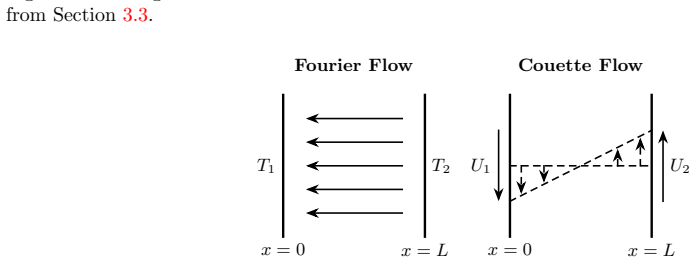
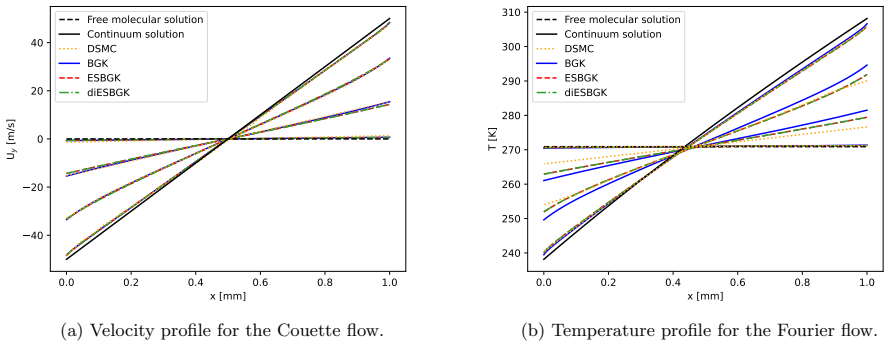
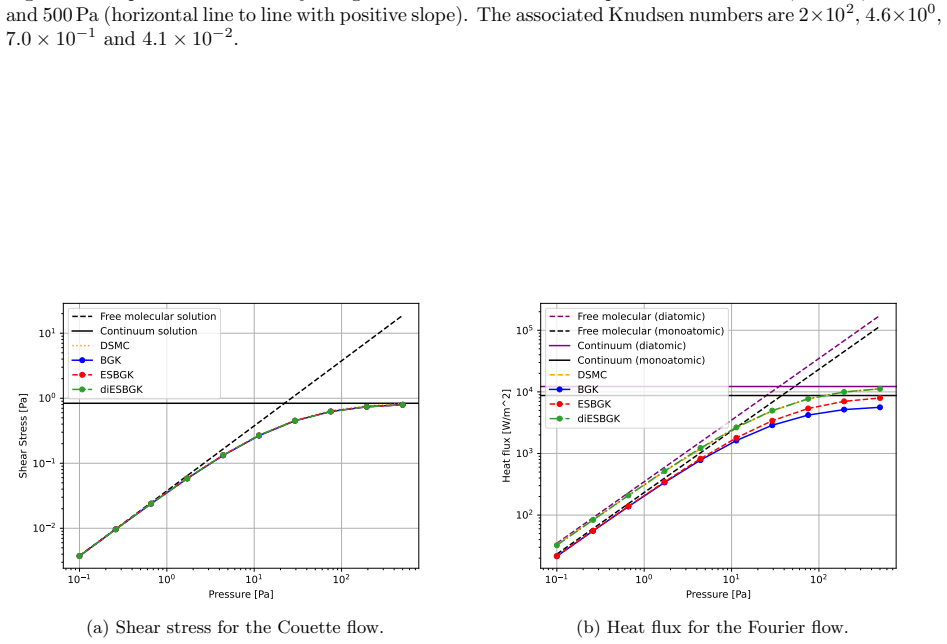
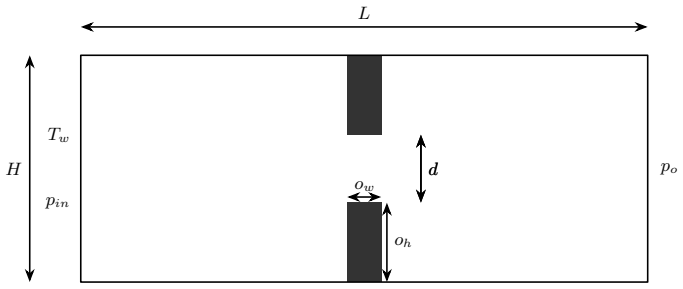
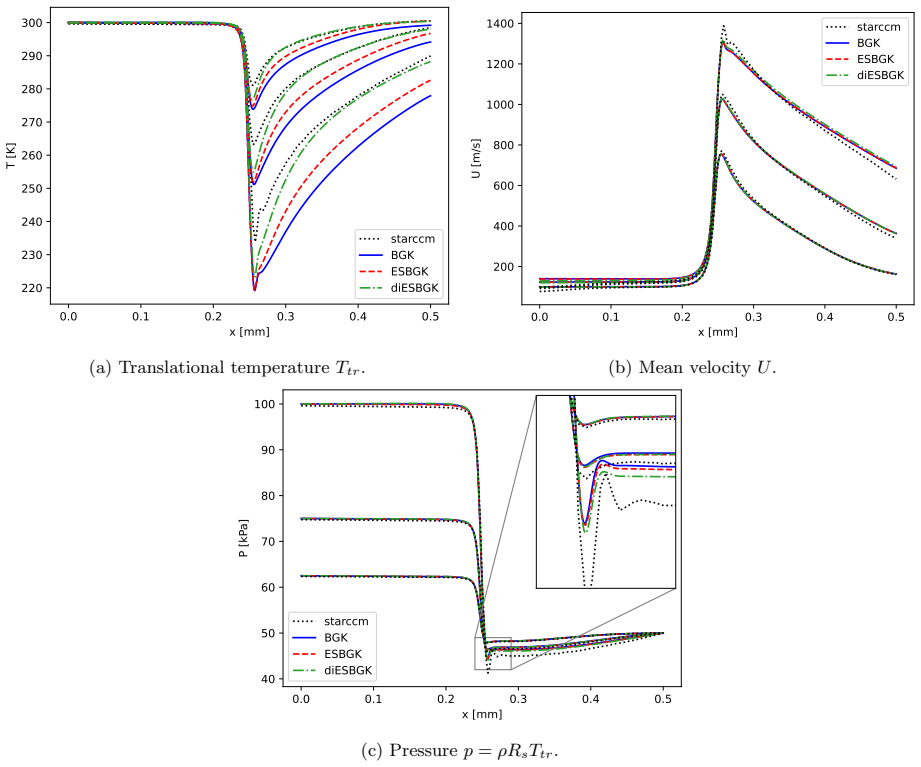
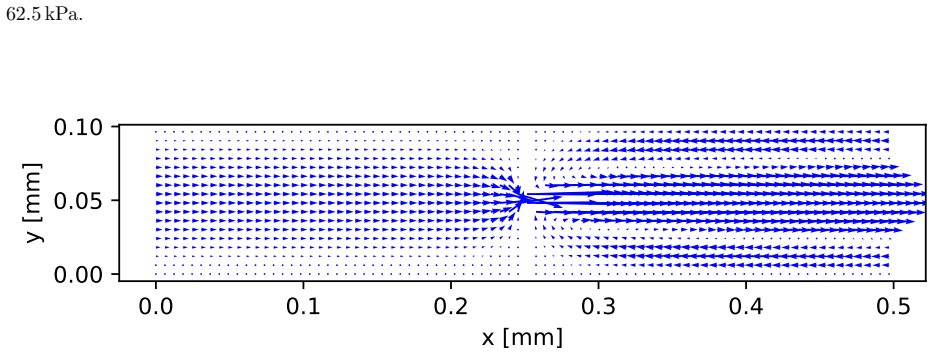
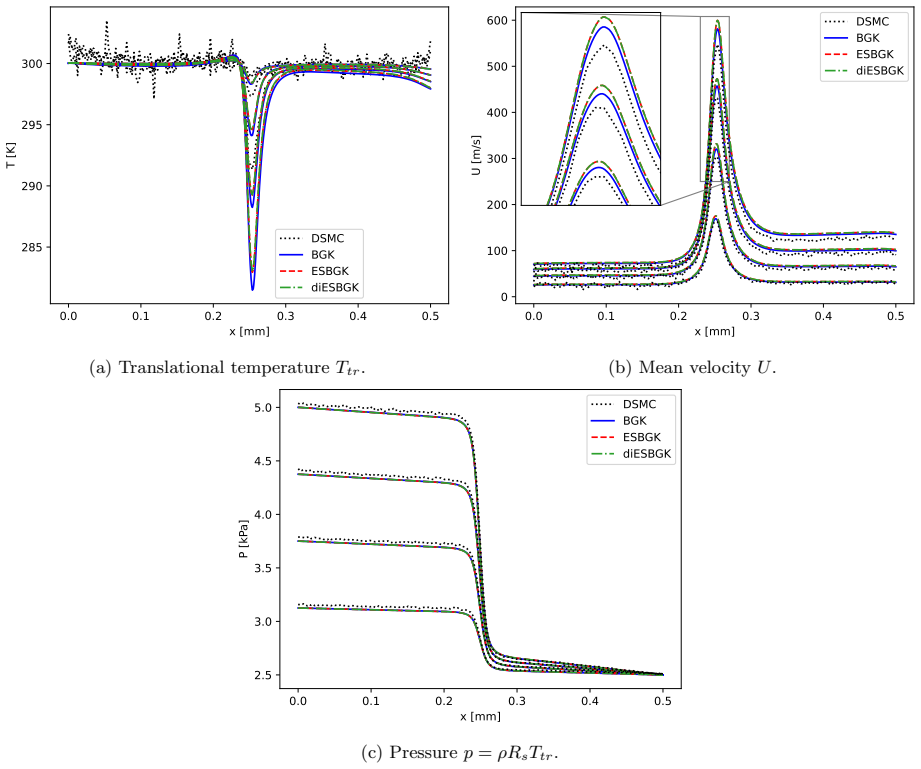
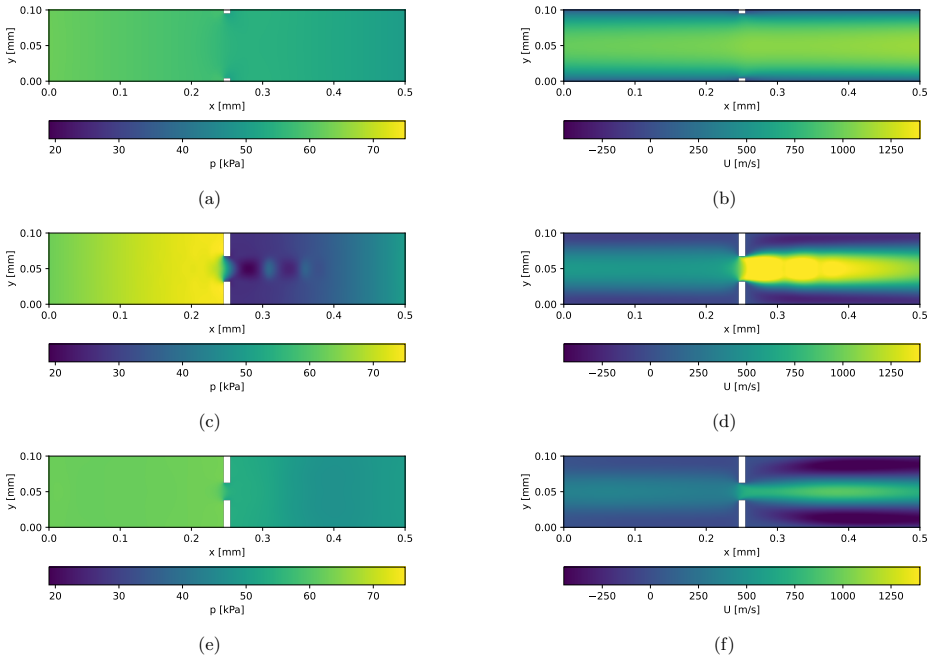
Polyatomic kinetic models are essential for accurately capturing the thermodynamic behavior of real gases, as internal energy modes significantly influence transport coefficients, relaxation processes, and non-equilibrium effects that cannot be represented by monoatomic models. The polyatomic ESBGK model describes molecular collisions as a relaxation towards a generalized Gaussian distribution with an anisotropic covariance matrix and an exponentially decaying internal energy distribution. We present a new semi-Lagrangian scheme for the polyatomic Ellipsoidal Statistical BGK (ESBGK) model of the Boltzmann equation. The semi-Lagrangian framework, being deterministic and grid-based, removes the time-step restriction associated with the linear transport term by following the method of characteristics. The potentially stiff relaxation term is treated using an implicit A-stable linear multistep method which, owing to the structure of the BGK operator, can be reformulated into a cheap time-stepping scheme. This yields a highly efficient and numerically stable method. The numerical method is asymptotic preserving and stiffly accurate, meaning the scheme asymptotically converges to a scheme for the Euler equations in the vanishing Knudsen limit. In addition, we prove that the first-order scheme, asymptotically converges to the compressible Navier-Stokes equation with correct transport coefficients. Finally, we propose inflow and outflow boundary conditions suitable for BGK-type kinetic equations. We perform simulations of the Fourier and Couette test case to compare the BGK model with Direct Simulation Monte Carlo (DSMC). To conclude, we demonstrate the method on a challenging orifice flow test case with moving boundaries.
Editorial analysis
A structured set of objections, weighed in public.
Referee Report
Summary. The paper presents a semi-Lagrangian numerical scheme for the polyatomic ESBGK kinetic model. Transport is discretized via the method of characteristics while the stiff relaxation term is treated by an implicit A-stable linear multistep method that is algebraically reformulated into an inexpensive explicit update exploiting the BGK structure. The scheme is asserted to be asymptotic-preserving and stiffly accurate; the first-order variant is claimed to converge, in the small-Knudsen limit, to a consistent discretization of the compressible Navier-Stokes equations with the correct polyatomic transport coefficients. Inflow/outflow boundary conditions adapted to BGK-type equations are introduced, and the method is demonstrated on Fourier, Couette, and moving-boundary orifice flows with DSMC comparisons.
Significance. If the discrete Chapman-Enskog analysis is verified, the work supplies a deterministic, grid-based alternative to DSMC that automatically recovers the correct viscosity, thermal conductivity, and bulk viscosity for polyatomic gases. The combination of unconditional stability for the relaxation term, asymptotic preservation to Euler, and the proposed boundary conditions would constitute a practical advance for rarefied polyatomic flows.
major comments (2)
- [Abstract / asymptotic-analysis section] Abstract and the section containing the asymptotic analysis: the claim that the first-order scheme recovers the compressible Navier-Stokes equations with the exact polyatomic transport coefficients rests on a Chapman-Enskog expansion of the fully discrete scheme. Because the relaxation operator acts on an anisotropic covariance matrix together with a non-equilibrium internal-energy distribution, the moment closure contains additional cross terms; the manuscript does not exhibit the explicit expansion or verify that these terms vanish identically under the chosen semi-Lagrangian and multistep discretizations.
- [Abstract] Abstract, paragraph on the relaxation-term treatment: the reformulation of the implicit A-stable linear multistep method into a cheap time-stepping scheme is stated to follow from the structure of the BGK operator. For the polyatomic ESBGK model the target distribution is no longer a standard Maxwellian; it is not shown whether the algebraic cancellation that produces the cheap update continues to hold without additional moment evaluations or hidden isotropy assumptions.
minor comments (1)
- The abstract states that the scheme is 'stiffly accurate' yet the precise definition used for the polyatomic case (i.e., whether the numerical equilibrium is exactly the continuous ESBGK equilibrium) is not restated in the main text.
Simulated Author's Rebuttal
We thank the referee for the thorough reading and insightful comments on our manuscript. The two major comments both concern the level of detail provided for the discrete asymptotic analysis and the algebraic structure of the time-stepping scheme. We address each point below and will incorporate clarifications and explicit derivations in a revised version.
read point-by-point responses
-
Referee: [Abstract / asymptotic-analysis section] Abstract and the section containing the asymptotic analysis: the claim that the first-order scheme recovers the compressible Navier-Stokes equations with the exact polyatomic transport coefficients rests on a Chapman-Enskog expansion of the fully discrete scheme. Because the relaxation operator acts on an anisotropic covariance matrix together with a non-equilibrium internal-energy distribution, the moment closure contains additional cross terms; the manuscript does not exhibit the explicit expansion or verify that these terms vanish identically under the chosen semi-Lagrangian and multistep discretizations.
Authors: We agree that the current manuscript states the result of the discrete Chapman-Enskog analysis but does not display the full expansion. In the revision we will add an appendix (or expanded subsection) that carries out the explicit expansion of the fully discrete scheme, showing term-by-term that the additional cross terms arising from the anisotropic covariance and internal-energy distribution cancel identically under the chosen semi-Lagrangian transport and linear-multistep relaxation discretizations. This will make the proof of correct polyatomic transport coefficients fully transparent. revision: yes
-
Referee: [Abstract] Abstract, paragraph on the relaxation-term treatment: the reformulation of the implicit A-stable linear multistep method into a cheap time-stepping scheme is stated to follow from the structure of the BGK operator. For the polyatomic ESBGK model the target distribution is no longer a standard Maxwellian; it is not shown whether the algebraic cancellation that produces the cheap update continues to hold without additional moment evaluations or hidden isotropy assumptions.
Authors: The algebraic cancellation that converts the implicit multistep update into an explicit, moment-free step follows from the fact that the ESBGK target is still a linear combination of the conserved moments (density, momentum, total energy, and the anisotropic stress tensor) and the internal-energy variable. Because these moments are exactly preserved by the relaxation operator, the same linear algebra that eliminates the implicit dependence on the unknown distribution at the new time level continues to hold without requiring isotropy or extra moment evaluations. In the revision we will insert a short derivation immediately after the description of the time-stepping scheme that verifies this cancellation explicitly for the polyatomic target distribution. revision: yes
Circularity Check
No significant circularity; derivation relies on independent Chapman-Enskog analysis and standard multistep methods.
full rationale
The paper claims an asymptotic-preserving property and a proof that the first-order semi-Lagrangian scheme converges to the compressible Navier-Stokes equations with correct polyatomic transport coefficients. No quoted equations or steps in the provided abstract or description reduce any prediction or coefficient to a fitted input, self-definition, or self-citation chain. The reformulation of the implicit multistep treatment is presented as exploiting the BGK operator structure without circular redefinition of the target limit. External DSMC comparisons are referenced as validation, and the central convergence statement is framed as a derived result rather than a renaming or imported uniqueness theorem. This is the normal case of a self-contained numerical analysis paper.
Axiom & Free-Parameter Ledger
axioms (2)
- domain assumption The polyatomic ESBGK model accurately captures thermodynamic behavior via relaxation to a generalized Gaussian with anisotropic covariance and exponential internal energy decay.
- domain assumption The BGK relaxation operator structure permits cheap reformulation of the implicit multistep scheme.
Reference graph
Works this paper leans on
-
[1]
Ching Shen.Rarefied gas dynamics: fundamentals, simulations and micro flows. eng. Springer e-books. Berlin New York, NY: Springer, 2005.isbn: 978-3-540-27230-4
2005
-
[2]
G. A. Bird.The DSMC method. en. Version 1.2. S.l.: G. A. Bird, 2013.isbn: 978-1-4921-1290-7
2013
-
[3]
Discrete velocity model and implicit scheme for the BGK equation of rarefied gas dynamics
Luc Mieussens. “Discrete velocity model and implicit scheme for the BGK equation of rarefied gas dynamics”. en. In:Mathematical Models and Methods in Applied Sciences10.08 (Nov. 2000), pp. 1121– 1149.issn: 0218-2025, 1793-6314.doi:10.1142/S0218202500000562.url:https://www.worldscientific. com/doi/abs/10.1142/S0218202500000562(visited on 10/19/2023)
work page doi:10.1142/s0218202500000562.url:https://www.worldscientific 2000
-
[4]
A Fourier spectral method for homogeneous boltzmann equa- tions
Lorenzo Pareschi and Benoit Perthame. “A Fourier spectral method for homogeneous boltzmann equa- tions”. en. In:Transport Theory and Statistical Physics25.3-5 (Apr. 1996), pp. 369–382.issn: 0041- 1450, 1532-2424.doi:10.1080/00411459608220707.url:http://www.tandfonline.com/doi/abs/ 10.1080/00411459608220707(visited on 04/30/2025)
work page doi:10.1080/00411459608220707.url:http://www.tandfonline.com/doi/abs/ 1996
-
[5]
Implicit–Explicit Runge–Kutta Schemes and Applications to Hyperbolic Systems with Relaxation
Lorenzo Pareschi and Giovanni Russo. “Implicit–Explicit Runge–Kutta Schemes and Applications to Hyperbolic Systems with Relaxation”. en. In:Journal of Scientific Computing25.1 (Oct. 2005), pp. 129–155.issn: 0885-7474, 1573-7691.doi:10.1007/s10915-004- 4636-4.url:https://link. springer.com/10.1007/s10915-004-4636-4(visited on 10/19/2023)
-
[6]
High order central WENO-Implicit-Explicit Runge Kutta schemes for the BGK model on general polygonal meshes
Walter Boscheri and Giacomo Dimarco. “High order central WENO-Implicit-Explicit Runge Kutta schemes for the BGK model on general polygonal meshes”. en. In:Journal of Computational Physics 422 (Dec. 2020), p. 109766.issn: 00219991.doi:10 . 1016 / j . jcp . 2020 . 109766.url:https : / / linkinghub.elsevier.com/retrieve/pii/S0021999120305404(visited on 07/04/2024)
2020
-
[7]
A Cartesian cut cell method for rarefied flow simulations around moving obstacles
G. Dechrist´ e and L. Mieussens. “A Cartesian cut cell method for rarefied flow simulations around moving obstacles”. en. In:Journal of Computational Physics314 (June 2016), pp. 465–488.issn: 00219991.doi:10.1016/j.jcp.2016.03.024.url:https://linkinghub.elsevier.com/retrieve/ pii/S0021999116001765(visited on 10/30/2023)
work page doi:10.1016/j.jcp.2016.03.024.url:https://linkinghub.elsevier.com/retrieve/ 2016
-
[8]
A unified gas-kinetic scheme for continuum and rarefied flows
Kun Xu and Juan-Chen Huang. “A unified gas-kinetic scheme for continuum and rarefied flows”. en. In:Journal of Computational Physics229.20 (Oct. 2010), pp. 7747–7764.doi:10.1016/j.jcp.2010. 06.032.url:https://www.sciencedirect.com/science/article/abs/pii/S0021999110003475? via%3Dihub
-
[9]
High order semi-Lagrangian methods for the BGK equation
M. Groppi, G. Russo, and G. Stracquadanio.High order semi-Lagrangian methods for the BGK equa- tion. en. arXiv:1411.7929 [math]. Nov. 2014.doi:10.48550/arXiv.1411.7929.url:http://arxiv. org/abs/1411.7929(visited on 07/12/2025)
work page internal anchor Pith review Pith/arXiv arXiv doi:10.48550/arxiv.1411.7929.url:http://arxiv 2014
-
[10]
Conservative semi-Lagrangian schemes for kinetic equations Part I: Reconstruc- tion
Seung Yeon Cho et al. “Conservative semi-Lagrangian schemes for kinetic equations Part I: Reconstruc- tion”. en. In:Journal of Computational Physics432 (May 2021). arXiv:2007.13167 [cs, math], p. 110159. issn: 00219991.doi:10.1016/j.jcp.2021.110159.url:http://arxiv.org/abs/2007.13167(vis- ited on 10/11/2023)
work page doi:10.1016/j.jcp.2021.110159.url:http://arxiv.org/abs/2007.13167(vis- 2021
-
[11]
Conservative semi-Lagrangian schemes for kinetic equations Part II: Ap- plications
Seung Yeon Cho et al. “Conservative semi-Lagrangian schemes for kinetic equations Part II: Ap- plications”. en. In:Journal of Computational Physics436 (July 2021). arXiv:2007.13166 [cs, math], p. 110281.issn: 00219991.doi:10.1016/j.jcp.2021.110281.url:http://arxiv.org/abs/2007. 13166(visited on 10/11/2023)
work page doi:10.1016/j.jcp.2021.110281.url:http://arxiv.org/abs/2007 2021
-
[12]
A conservative semi-Lagrangian scheme for the ellipsoidal BGK model of the Boltzmann equation
Sebastiano Boscarino et al. “A conservative semi-Lagrangian scheme for the ellipsoidal BGK model of the Boltzmann equation”. en. In:Journal of Scientific Computing105.1 (Oct. 2025), p. 9.issn: 0885-7474, 1573-7691.doi:10.1007/s10915-025-03033-6.url:https://link.springer.com/10. 1007/s10915-025-03033-6(visited on 09/29/2025)
work page doi:10.1007/s10915-025-03033-6.url:https://link.springer.com/10 2025
-
[13]
Local discrete velocity grids for deterministic rarefied flow simulations
S. Brull and L. Mieussens. “Local discrete velocity grids for deterministic rarefied flow simulations”. en. In:Journal of Computational Physics266 (June 2014), pp. 22–46.issn: 00219991.doi:10.1016/ j.jcp.2014.01.050.url:https://linkinghub.elsevier.com/retrieve/pii/S0021999114001016 (visited on 02/03/2026)
2014
-
[14]
A local velocity grid conservative semi- Lagrangian schemes for BGK model
Sebastiano Boscarino, Seung Yeon Cho, and Giovanni Russo. “A local velocity grid conservative semi- Lagrangian schemes for BGK model”. en. In:Journal of Computational Physics460 (July 2022), p. 111178.issn: 00219991.doi:10.1016/j.jcp.2022.111178.url:https://linkinghub.elsevier. com/retrieve/pii/S0021999122002406(visited on 07/05/2024)
work page doi:10.1016/j.jcp.2022.111178.url:https://linkinghub.elsevier 2022
-
[15]
Conservative semi-Lagrangian schemes for a general consistent BGK model for inert gas mixtures
Seung Yeon Cho et al. “Conservative semi-Lagrangian schemes for a general consistent BGK model for inert gas mixtures”. en. In:Communications in Mathematical Sciences20.3 (2022), pp. 695–725. 23 issn: 15396746, 19450796.doi:10.4310/CMS.2022.v20.n3.a4.url:https://link.intlpress.com/ JDetail/1806261544969261058(visited on 04/18/2025)
work page doi:10.4310/cms.2022.v20.n3.a4.url:https://link.intlpress.com/ 2022
-
[16]
An Asymptotic Preserving Scheme for the ES-BGK Model of the Boltz- mann Equation
Francis Filbet and Shi Jin. “An Asymptotic Preserving Scheme for the ES-BGK Model of the Boltz- mann Equation”. en. In:Journal of Scientific Computing46.2 (Feb. 2011), pp. 204–224.issn: 0885- 7474, 1573-7691.doi:10.1007/s10915-010-9394-x.url:http://link.springer.com/10.1007/ s10915-010-9394-x(visited on 09/29/2025)
work page doi:10.1007/s10915-010-9394-x.url:http://link.springer.com/10.1007/ 2011
-
[17]
Boundary conditions for semi-Lagrangian methods for the BGK model
Maria Groppi, Giovanni Russo, and Giuseppe Stracquadanio. “Boundary conditions for semi-Lagrangian methods for the BGK model”. en. In:Communications in Applied and Industrial Mathematics7.3 (Sept. 2016), pp. 138–164.issn: 2038-0909.doi:10 . 1515 / caim - 2016 - 0025.url:https : / / www . sciendo.com/article/10.1515/caim-2016-0025(visited on 03/20/2024)
-
[18]
M. A. Gallis and J. R. Torczynski. “Investigation of the ellipsoidal-statistical Bhatnagar–Gross–Krook kinetic model applied to gas-phase transport of heat and tangential momentum between parallel walls”. en. In:Physics of Fluids23.3 (Mar. 2011), p. 030601.issn: 1070-6631, 1089-7666.doi:10.1063/1. 3558869.url:https://pubs.aip.org/pof/article/23/3/030601/2...
work page doi:10.1063/1 2011
-
[19]
Numerical comparison between the Boltzmann and ES-BGK models for rarefied gases
Pierre Andries et al. “Numerical comparison between the Boltzmann and ES-BGK models for rarefied gases”. en. In:Computer Methods in Applied Mechanics and Engineering191.31 (May 2002), pp. 3369– 3390.issn: 00457825.doi:10.1016/S0045-7825(02)00253-0.url:https://linkinghub.elsevier. com/retrieve/pii/S0045782502002530(visited on 10/17/2025)
work page doi:10.1016/s0045-7825(02)00253-0.url:https://linkinghub.elsevier 2002
-
[20]
Marcel Pfeiffer, Paul Nizenkov, and Stefanos Fasoulas. “Extension of particle-based BGK models to polyatomic species in hypersonic flow around a flat-faced cylinder”. In:AIP Conference Proceedings 2132.1 (Aug. 2019). eprint: https://pubs.aip.org/aip/acp/article-pdf/doi/10.1063/1.5119596/7676068/100001 1 online.pdf, p. 100001.issn: 0094-243X.doi:10.1063/1....
-
[21]
Adaptation of the Unified Gas-Kinetic Scheme to ES-BGK Models
C´ eline Baranger, Alexis Co¨ epeau, and Luc Mieussens. “Adaptation of the Unified Gas-Kinetic Scheme to ES-BGK Models”. en. In:Rarefied Gas Dynamics. Ed. by Martin Grabe, Georgii Oblapenko, and Manuel Torrilhon. Series Title: Springer Aerospace Technology. Cham: Springer Nature Switzerland, 2026, pp. 391–400.isbn: 978-3-032-00093-4 978-3-032-00094-1.doi:...
-
[22]
Carlo Cercignani.The Boltzmann Equation and Its Applications. en. Ed. by F. John, J. E. Marsden, and L. Sirovich. Vol. 67. Applied Mathematical Sciences. New York, NY: Springer New York, 1988. isbn: 978-1-4612-6995-3 978-1-4612-1039-9.doi:10.1007/978-1-4612-1039-9.url:https://link. springer.com/10.1007/978-1-4612-1039-9(visited on 10/13/2023)
work page doi:10.1007/978-1-4612-1039-9.url:https://link 1988
-
[23]
Henning Struchtrup, ed.Macroscopic Transport Equations for Rarefied Gas Flows: Approximation Methods in Kinetic Theory. en. Interaction of Mechanics and Mathematics. Berlin, Heidelberg: Springer- Verlag Berlin Heidelberg, 2005.isbn: 978-3-540-24542-1 978-3-540-32386-0.doi:10 . 1007 / 3 - 540 - 32386-4
2005
-
[24]
Numerical comparison of Bhatnagar–Gross–Krook models with proper Prandtl number
Luc Mieussens and Henning Struchtrup. “Numerical comparison of Bhatnagar–Gross–Krook models with proper Prandtl number”. en. In:Physics of Fluids16.8 (Aug. 2004), pp. 2797–2813.issn: 1070- 6631, 1089-7666.doi:10.1063/1.1758217.url:https://pubs.aip.org/pof/article/16/8/2797/ 255889/Numerical-comparison-of-Bhatnagar-Gross-Krook(visited on 08/28/2025)
work page doi:10.1063/1.1758217.url:https://pubs.aip.org/pof/article/16/8/2797/ 2004
-
[25]
Generalization of the Krook kinetic relaxation equation
E. M. Shakhov. “Generalization of the Krook kinetic relaxation equation”. en. In:Fluid Dynamics 3.5 (1972), pp. 95–96.issn: 0015-4628, 1573-8507.doi:10.1007/BF01029546.url:http://link. springer.com/10.1007/BF01029546(visited on 02/02/2026)
-
[26]
Kinetic Theory of Shock Structure Using an Ellipsoidal Distribution Function
Lowell H. Holway Jr. “Kinetic Theory of Shock Structure Using an Ellipsoidal Distribution Function”. In:Proceedings of the fourth international symposium on rarefied gas dynamics. Vol. 1. Conference Name: Rarefied Gas Dynamics, Volume 1 ADS Bibcode: 1965rgd1.conf..193H. Toronto, Jan. 1965, p. 193.url:https://ui.adsabs.harvard.edu/abs/1965rgd1.conf..193H(v...
1965
-
[27]
A new approach for the ellipsoidal statistical model
St´ ephane Brull and Jacques Schneider. “A new approach for the ellipsoidal statistical model”. en. In: Continuum Mechanics and Thermodynamics20.2 (May 2008), pp. 63–74.issn: 0935-1175, 1432-0959. doi:10.1007/s00161-008-0068-y.url:http://link.springer.com/10.1007/s00161-008-0068- y(visited on 02/02/2026)
work page doi:10.1007/s00161-008-0068-y.url:http://link.springer.com/10.1007/s00161-008-0068- 2008
-
[28]
The ES-BGK model equation with correct Prandtl number
Pierre Andries. “The ES-BGK model equation with correct Prandtl number”. en. In:AIP Conference Proceedings. Vol. 585. Sydney (Australia): AIP, 2001, pp. 30–36.doi:10 . 1063 / 1 . 1407539.url: https://pubs.aip.org/aip/acp/article/585/1/30-36/577706(visited on 07/31/2025). 24
2001
-
[29]
An ellipsoidal statistical model for gas mixtures
St´ ephane Brull. “An ellipsoidal statistical model for gas mixtures”. en. In:Communications in Mathe- matical Sciences13.1 (2015), pp. 1–13.issn: 15396746, 19450796.doi:10.4310/CMS.2015.v13.n1.a1. url:https://link.intlpress.com/JDetail/1806264400858271745(visited on 10/01/2025)
-
[30]
A general consistent BGK model for gas mixtures
Alexander V. Bobylev et al. “A general consistent BGK model for gas mixtures”. en. In:Kinetic & Related Models11.6 (2018), pp. 1377–1393.issn: 1937-5077.doi:10 . 3934 / krm . 2018054.url: http://aimsciences.org//article/doi/10.3934/krm.2018054(visited on 10/13/2023)
-
[31]
The Gaussian-BGK model of Boltzmann equation with small Prandtl number
Pierre Andries et al. “The Gaussian-BGK model of Boltzmann equation with small Prandtl number”. en. In:European Journal of Mechanics - B/Fluids19.6 (Nov. 2000), pp. 813–830.issn: 09977546.doi: 10 . 1016 / S0997 - 7546(00 ) 01103 - 1.url:https : / / linkinghub . elsevier . com / retrieve / pii / S0997754600011031(visited on 12/13/2024)
2000
-
[32]
Kinetic-Theoretic Description of the Formation of a Shock Wave
C. K. Chu. “Kinetic-Theoretic Description of the Formation of a Shock Wave”. en. In:The Physics of Fluids8.1 (Jan. 1965), pp. 12–22.issn: 0031-9171.doi:10.1063/1.1761077.url:https://pubs. aip.org/pfl/article/8/1/12/957838/Kinetic-Theoretic-Description-of-the-Formation-of (visited on 11/13/2023)
-
[33]
The Exponentially Convergent Trapezoidal Rule
Lloyd N. Trefethen and J. A. C. Weideman. “The Exponentially Convergent Trapezoidal Rule”. en. In: SIAM Review56.3 (Jan. 2014), pp. 385–458.issn: 0036-1445, 1095-7200.doi:10.1137/130932132. url:http://epubs.siam.org/doi/10.1137/130932132(visited on 03/20/2025)
-
[34]
Three-dimensional unsteady Euler equations solution using flux vector splitting
D. Whitfield. “Three-dimensional unsteady Euler equations solution using flux vector splitting”. en. In:17th Fluid Dynamics, Plasma Dynamics, and Lasers Conference. Snowmass,CO,U.S.A.: American Institute of Aeronautics and Astronautics, June 1984.doi:10 . 2514 / 6 . 1984 - 1552.url:https : //arc.aiaa.org/doi/10.2514/6.1984-1552(visited on 09/26/2025)
-
[35]
Simulations for gas flows in microgeometries using the direct simulation Monte Carlo method
Moran Wang and Zhixin Li. “Simulations for gas flows in microgeometries using the direct simulation Monte Carlo method”. en. In:International Journal of Heat and Fluid Flow25.6 (Dec. 2004), pp. 975– 985.issn: 0142727X.doi:10.1016/j.ijheatfluidflow.2004.02.024.url:https://linkinghub. elsevier.com/retrieve/pii/S0142727X04000426(visited on 10/21/2025)
work page doi:10.1016/j.ijheatfluidflow.2004.02.024.url:https://linkinghub 2004
-
[36]
Role of boundary conditions in Monte Carlo simulation of MEMS devices
Robert Nance et al. “Role of boundary conditions in Monte Carlo simulation of MEMS devices”. en. In:35th Aerospace Sciences Meeting and Exhibit. Reno,NV,U.S.A.: American Institute of Aeronautics and Astronautics, Jan. 1997.doi:10.2514/6.1997- 375.url:https://arc.aiaa.org/doi/10. 2514/6.1997-375(visited on 09/26/2025)
-
[37]
2026.url:https://gitlab.kuleuven.be/numa/public/sl4bgk#
Klaas Willems.SL4BGK. 2026.url:https://gitlab.kuleuven.be/numa/public/sl4bgk#
2026
-
[38]
Ab Initio Transport Coefficients of Gaseous Hydrogen
James B. Mehl, Marcia L. Huber, and Allan H. Harvey. “Ab Initio Transport Coefficients of Gaseous Hydrogen”. en. In:International Journal of Thermophysics31.4-5 (May 2010), pp. 740–755.issn: 0195-928X, 1572-9567.doi:10.1007/s10765- 009- 0697- 9.url:http://link.springer.com/10. 1007/s10765-009-0697-9(visited on 01/28/2026)
-
[39]
Jianping Meng et al. “Assessment of the ellipsoidal-statistical Bhatnagar–Gross–Krook model for force- driven Poiseuille flows”. en. In:Journal of Computational Physics251 (Oct. 2013), pp. 383–395.issn: 00219991.doi:10.1016/j.jcp.2013.05.045.url:https://linkinghub.elsevier.com/retrieve/ pii/S0021999113004129(visited on 10/01/2025). 25
work page doi:10.1016/j.jcp.2013.05.045.url:https://linkinghub.elsevier.com/retrieve/ 2013
discussion (0)
Sign in with ORCID, Apple, or X to comment. Anyone can read and Pith papers without signing in.