Direct evidence for projectile electronic structure effects in slow multielectron capture collisions
Pith reviewed 2026-06-26 12:56 UTC · model grok-4.3
The pith
Projectile electronic structure affects kinetic energy release distributions in multielectron capture collisions.
A machine-rendered reading of the paper's core claim, the machinery that carries it, and where it could break.
Core claim
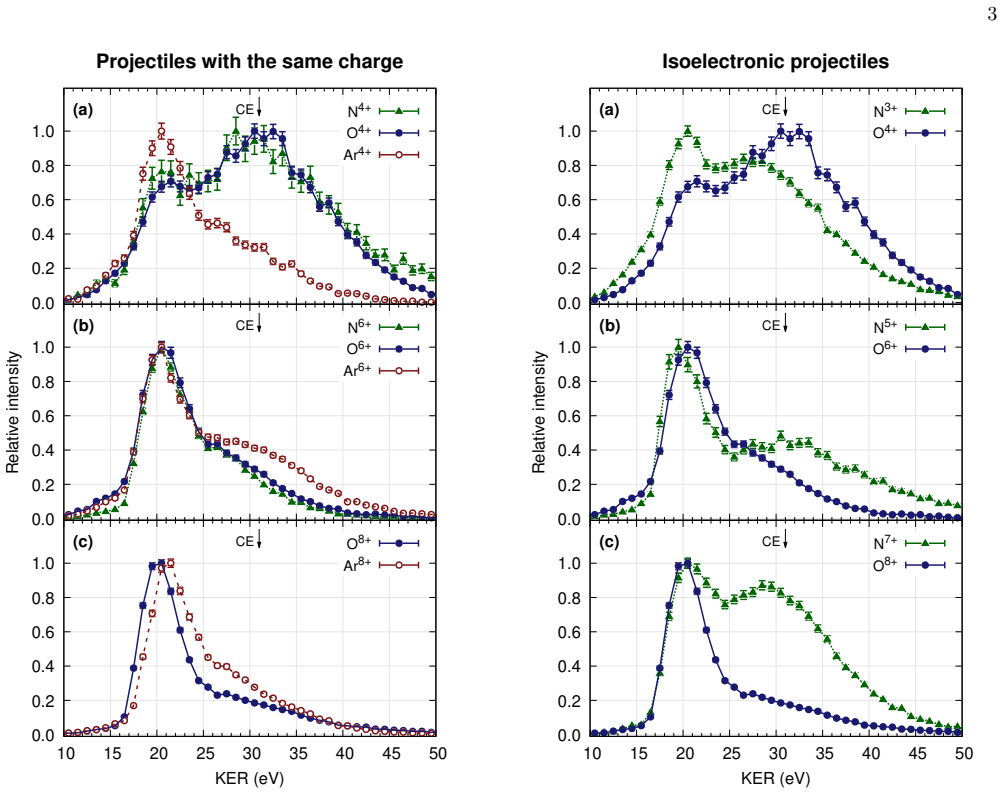
By comparing KERDs from N^{q+} and O^{q+} projectiles at q=4 and 6, which are similar to each other but differ from prior Ar results, and finding pronounced differences between isoelectronic N^{q+} and O^{(q+1)+} for q=3,5,7, the measurements demonstrate that projectile electronic structure plays a critical role in determining the outcomes of multielectron capture in slow collisions with CO2.
What carries the argument
Kinetic energy release distributions (KERDs) measured for the CO2^{3+} -> O+:C+:O+ fragmentation channel under equi-velocity impacts.
If this is right
- Multielectron capture models must incorporate details of the projectile's electronic configuration.
- Fragmentation patterns in molecular targets can be tuned by choice of projectile electronic structure at fixed velocity and charge.
- The role of projectile structure is evident even at very low impact velocities of 0.31 a.u.
- Similar effects may appear in other molecular breakup channels induced by capture.
Where Pith is reading between the lines
- If the electronic structure effect holds, then charge-state dependent cross sections for capture would also show differences between isoelectronic projectiles.
- These findings suggest that previous interpretations of KERDs using only target properties may need revision to include projectile contributions.
- Extending the comparison to other isoelectronic sequences could test the generality of the effect.
Load-bearing premise
The observed differences in KERDs between different projectiles are due to their electronic structures rather than variations in experimental conditions such as beam composition or target pressure.
What would settle it
Repeating the KERD measurements for isoelectronic N and O projectiles while controlling for all other variables and finding no differences would falsify the claim of a critical role for electronic structure.
Figures
read the original abstract
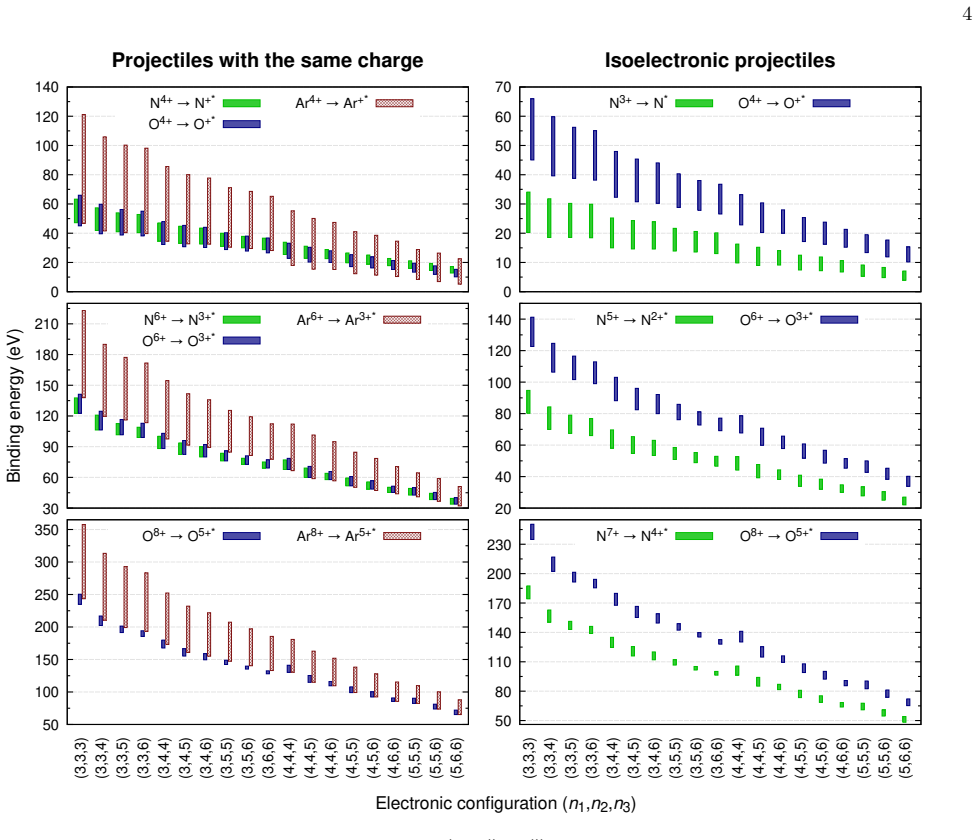
We investigate the role of the electronic structure of the projectile in ionization and subsequent fragmentation of CO$_2$ induced by multielectron capture in collisions at 0.31 a.u. impact velocity. Focusing on the $\text{CO}_2^{3+} \rightarrow \text{O}^+:\text{C}^+:\text{O}^+$ break-up channel as a representative channel, we report kinetic energy release distributions (KERDs) for collisions with equi-velocity N$^{q+}$ and O$^{q+}$ projectiles. We consider two complementary categories of measurements. In the first category, in which different projectiles of the same charge are considered, we find that KERDs obtained with N$^{q+}$ and O$^{q+}$ impact ($q=4,6$) are broadly similar, but they differ significantly from the earlier reported KERD with Ar$^{q+}$ impact. In the second category, pronounced differences are observed between the KERDs obtained with isoelectronic N$^{q+}$ and O$^{(q+1)+}$ ($q=3,5,7$) projectiles. These results provide direct evidence that projectile electronic structure plays a critical role in multielectron capture collisions.
Editorial analysis
A structured set of objections, weighed in public.
Referee Report
Summary. The manuscript reports measurements of kinetic energy release distributions (KERDs) in the CO₂^{3+} → O⁺:C⁺:O⁺ breakup channel following multielectron capture in 0.31 a.u. collisions of CO₂ with equi-velocity N^{q+} and O^{q+} projectiles. Two measurement categories are presented: (i) same-charge comparisons (q=4,6) where N and O KERDs are similar to each other but differ from prior Ar^{q+} results, and (ii) isoelectronic comparisons (N^{q+} vs. O^{(q+1)+} for q=3,5,7) showing pronounced KERD differences. The central claim is that these results constitute direct evidence that projectile electronic structure plays a critical role in multielectron capture.
Significance. If the observed KERD differences can be shown to arise specifically from electronic structure (rather than net charge or experimental systematics), the result would be significant for atomic collision physics because it would demonstrate that charge-state scaling alone is insufficient to describe multielectron capture probabilities and final-state distributions. The equi-velocity beam approach is a methodological strength that helps isolate velocity effects.
major comments (1)
- [Abstract] Abstract (second category): The isoelectronic comparison uses N^{q+} and O^{(q+1)+} projectiles that differ by one unit of net charge. Because multielectron capture cross sections and the resulting target dication/trication populations depend exponentially on projectile charge via the over-barrier model and interaction radius, the reported KERD differences could originate from charge-dependent dynamics rather than electronic structure. The manuscript must demonstrate (e.g., via charge-normalized cross sections, beam-purity checks, or explicit modeling in the results/discussion) that charge effects have been isolated; absent such separation the attribution to electronic structure is not load-bearing.
minor comments (1)
- [Abstract] The abstract refers to 'earlier reported KERD with Ar^{q+} impact' without a citation; the reference should be supplied.
Simulated Author's Rebuttal
We thank the referee for their detailed review and for highlighting the need to more clearly separate charge-dependent effects from electronic structure effects in the isoelectronic comparisons. We address this point directly below.
read point-by-point responses
-
Referee: [Abstract] Abstract (second category): The isoelectronic comparison uses N^{q+} and O^{(q+1)+} projectiles that differ by one unit of net charge. Because multielectron capture cross sections and the resulting target dication/trication populations depend exponentially on projectile charge via the over-barrier model and interaction radius, the reported KERD differences could originate from charge-dependent dynamics rather than electronic structure. The manuscript must demonstrate (e.g., via charge-normalized cross sections, beam-purity checks, or explicit modeling in the results/discussion) that charge effects have been isolated; absent such separation the attribution to electronic structure is not load-bearing.
Authors: We agree that the isoelectronic pairs (N^{q+} vs. O^{(q+1)+}) differ in net charge and that capture cross sections are sensitive to charge state. The same-charge data (N^{q+} vs. O^{q+} at q=4,6) already show that N and O produce nearly identical KERDs that differ markedly from Ar^{q+}, supporting a role for projectile electronic structure at fixed charge. However, the referee is correct that this does not automatically isolate electronic structure in the isoelectronic series. We will revise the manuscript by adding (i) a quantitative estimate, based on the over-barrier model, of the expected change in capture radius and final-state population between charge q and q+1 at fixed velocity, and (ii) a discussion of why the observed KERD shape differences exceed what would be expected from charge scaling alone. If beam-purity or normalized cross-section data are available from the experiment, they will also be included. These additions will appear in a new subsection of the results/discussion. revision: yes
Circularity Check
No circularity: purely experimental comparison of measured distributions
full rationale
The paper reports direct experimental measurements of KERDs in the CO2^{3+} fragmentation channel for collisions with N^{q+} and O^{q+} projectiles at fixed velocity. Two categories of comparisons are presented: same-q projectiles (N^{q+} vs O^{q+}) and isoelectronic pairs (N^{q+} vs O^{(q+1)+}). The central claim follows immediately from the observed similarities and differences in the measured distributions, without any equations, fitting procedures, predictions, or self-citations that reduce the result to its inputs by construction. No derivation chain exists; the evidence is the raw data comparison itself.
Axiom & Free-Parameter Ledger
Reference graph
Works this paper leans on
-
[1]
H. Luna, A. L. F. de Barros, J. A. Wyer, S. W. J. Scully, J. Lecointre, P. M. Y. Garcia, G. M. Sigaud, A. C. F. Santos, V. Senthil, M. B. Shah, C. J. Latimer, and E. C. 5 Montenegro, Phys. Rev. A75, 042711 (2007)
2007
-
[2]
Neumann, D
N. Neumann, D. Hant, L. P. H. Schmidt, J. Titze, T. Jahnke, A. Czasch, M. S. Sch¨ offler, K. Kreidi, O. Jagutzki, H. Schmidt-B¨ ocking, and R. D¨ orner, Phys. Rev. Lett.104, 103201 (2010)
2010
-
[3]
E. Wang, X. Shan, Z. Shen, M. Gong, Y. Tang, Y. Pan, K.-C. Lau, and X. Chen, Phys. Rev. A91, 052711 (2015)
2015
-
[4]
A. Khan, L. C. Tribedi, and D. Misra, Phys. Rev. A92, 030701 (2015)
2015
-
[5]
H. Luna, W. Wolff, E. C. Montenegro, A. C. Tavares, H. J. L¨ udde, G. Schenk, M. Horbatsch, and T. Kirchner, Phys. Rev. A93, 052705 (2016)
2016
-
[6]
Srivastav, A
S. Srivastav, A. Sen, D. Sharma, and B. Bapat, Phys. Rev. A103, 032821 (2021)
2021
-
[7]
Srivastav and B
S. Srivastav and B. Bapat, Phys. Rev. A105, 012801 (2022)
2022
-
[8]
Rajput, T
J. Rajput, T. Severt, B. Berry, B. Jochim, P. Feizol- lah, B. Kaderiya, M. Zohrabi, U. Ablikim, F. Ziaee, K. Raju P., D. Rolles, A. Rudenko, K. D. Carnes, B. D. Esry, and I. Ben-Itzhak, Phys. Rev. Lett.120, 103001 (2018)
2018
-
[9]
Severt, J
T. Severt, J. Rajput, B. Berry, B. Jochim, P. Feizollah, B. Kaderiya, M. Zohrabi, F. Ziaee, K. R. P., D. Rolles, A. Rudenko, K. D. Carnes, B. D. Esry, and I. Ben-Itzhak, Phys. Rev. A110, 053104 (2024)
2024
-
[10]
Srivastav, S
A. Srivastav, S. Srivastav, and B. Bapat, Phys. Rev. A 113, 052811 (2026)
2026
-
[11]
A. Srivastav, S. Srivastav, V. P, and B. Bapat, arXiv e-prints , arXiv:2604.09348 (2026)
Pith/arXiv arXiv 2026
-
[12]
Vancura, J
J. Vancura, J. J. Perotti, J. Flidr, and V. O. Kostroun, Phys. Rev. A49, 2515 (1994)
1994
-
[13]
W. Wu, C. L. Cocke, J. P. Giese, F. Melchert, M. L. A. Raphaelian, and M. St¨ ockli, Phys. Rev. Lett.75, 1054 (1995)
1995
-
[14]
Wells, V
E. Wells, V. Krishnamurthi, K. D. Carnes, N. G. John- son, H. D. Baxter, D. Moore, K. M. Bloom, B. M. Barnes, H. Tawara, and I. Ben-Itzhak, Phys. Rev. A72, 022726 (2005)
2005
-
[15]
R. J. Mawhorter, A. Chutjian, T. E. Cravens, N. Djuri´ c, S. Hossain, C. M. Lisse, J. A. MacAskill, S. J. Smith, J. Simcic, and I. D. Williams, Phys. Rev. A75, 032704 (2007)
2007
-
[16]
Y. Wu, H. Yin, X. Tan, P. Ma, T. Meng, J. Xiao, K. Yao, Y. Zou, B. Tu, and B. Wei, Phys. Rev. A112, 022805 (2025)
2025
-
[17]
Bohr and J
N. Bohr and J. Lindhard, Kgl. Danske Videnskab. Selsk. Mat.-fys. Medd.28, 7(1954)
1954
-
[18]
B´ ar´ any, G
A. B´ ar´ any, G. Astner, H. Cederquist, H. Danared, S. Huldt, P. Hvelplund, A. Johnson, H. Knudsen, L. Lil- jeby, and K.-G. Rensfelt, Nuclear Instruments and Meth- ods in Physics Research Section B: Beam Interactions with Materials and Atoms9, 397 (1985)
1985
-
[19]
Niehaus, Journal of Physics B: Atomic and Molecular Physics19, 2925 (1986)
A. Niehaus, Journal of Physics B: Atomic and Molecular Physics19, 2925 (1986)
1986
-
[20]
H. O. Folkerts, R. Hoekstra, and R. Morgenstern, Phys. Rev. Lett.77, 3339 (1996)
1996
-
[21]
A. Khan, L. C. Tribedi, and D. Misra, Journal of Physics B: Atomic, Molecular and Optical Physics54, 135201 (2021)
2021
-
[22]
Kumar, M
K. Kumar, M. A. Kalam Azad Siddiki, J. Mukherjee, H. Singh, and D. Misra, New Journal of Physics26, 053014 (2024)
2024
-
[23]
Bapat, D
B. Bapat, D. Sharma, and S. Srivastav, Journal of Physics: Conference Series1412, 152070 (2020)
2020
-
[24]
W. C. Wiley and I. H. McLaren, Review of Scientific Instruments26, 1150 (1955)
1955
-
[25]
Sharma and B
V. Sharma and B. Bapat, The European Physical Journal D - Atomic, Molecular, Optical and Plasma Physics37, 223 (2006)
2006
-
[26]
Srivastav and B
S. Srivastav and B. Bapat, Review of Scientific Instru- ments93, 113306 (2022)
2022
-
[27]
C. L. Cocke, R. DuBois, T. J. Gray, E. Justiniano, and C. Can, Phys. Rev. Lett.46, 1671 (1981)
1981
-
[28]
Simcic, D
J. Simcic, D. R. Schultz, R. J. Mawhorter, I. ˇCadeˇ z, J. B. Greenwood, A. Chutjian, C. M. Lisse, and S. J. Smith, Phys. Rev. A81, 062715 (2010)
2010
-
[29]
S. Yan, X. L. Zhu, P. Zhang, X. Ma, W. T. Feng, Y. Gao, S. Xu, Q. S. Zhao, S. F. Zhang, D. L. Guo, D. M. Zhao, R. T. Zhang, Z. K. Huang, H. B. Wang, and X. J. Zhang, Phys. Rev. A94, 032708 (2016)
2016
-
[30]
M. F. Gu, Canadian Journal of Physics86, 675 (2008)
2008
discussion (0)
Sign in with ORCID, Apple, or X to comment. Anyone can read and Pith papers without signing in.