Using Distributional Regression Networks to Retrieve Cloud Properties from Solar Satellite Channels for Data Assimilation
Pith reviewed 2026-06-26 12:48 UTC · model grok-4.3
The pith
A distributional regression network retrieves unbiased cloud properties from six solar satellite channels as an alternative to direct reflectance assimilation.
A machine-rendered reading of the paper's core claim, the machinery that carries it, and where it could break.
Core claim
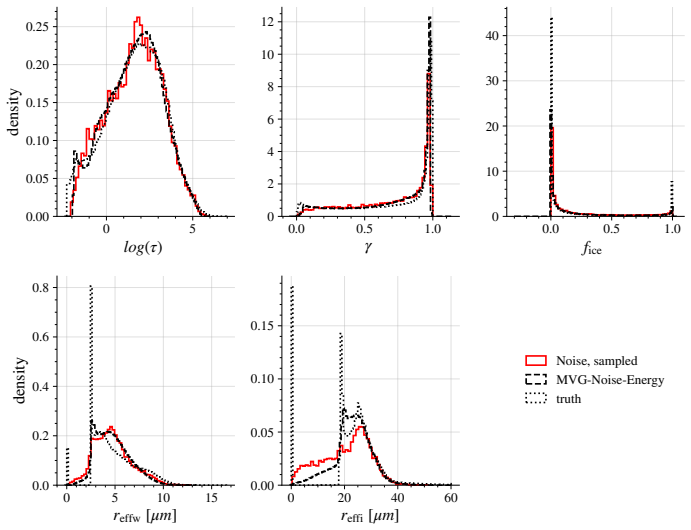
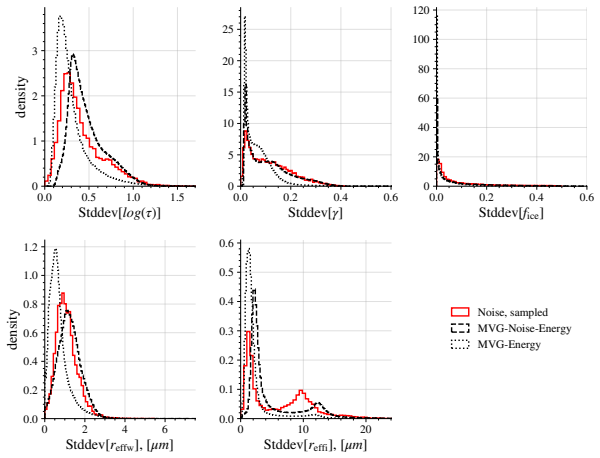
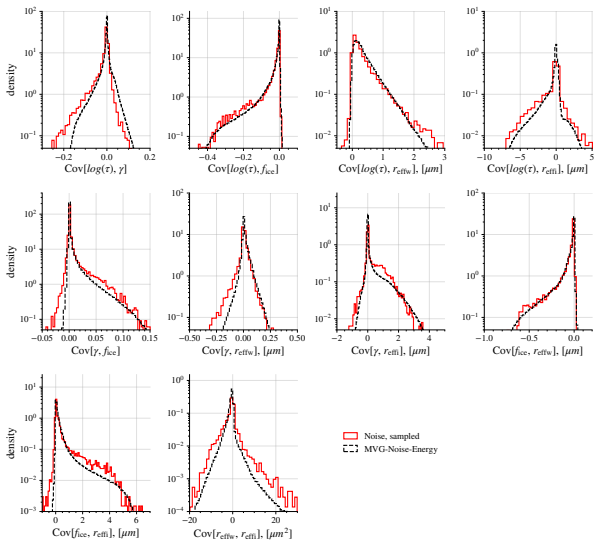
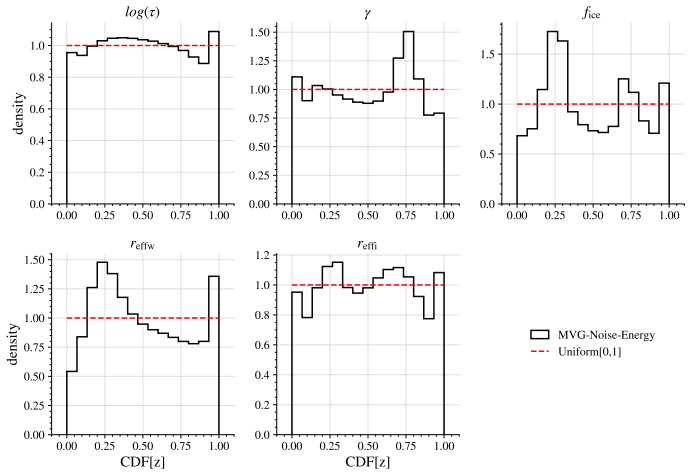
The paper claims that a distributional regression network trained on synthetic satellite images from a regional NWP model produces multivariate Gaussian estimates of total optical thickness, column cloud fraction, ice fraction, and effective radii of water and ice from six solar channels of the Flexible Combined Imager. These predictions are unbiased and well-calibrated with realistic, situation-dependent covariance structures, and performance improves substantially when multiple channels are combined. Because the operator needs no prior information, remains consistent with an existing forward operator, and yields variables more linearly related to the model state, the retrieved cloud proper
What carries the argument
The Backward Operator (BO), a distributional regression network that maps multispectral solar reflectances to multivariate Gaussian probability distributions over cloud properties.
If this is right
- Combining multiple solar channels yields substantial performance improvements despite strong inter-channel correlations.
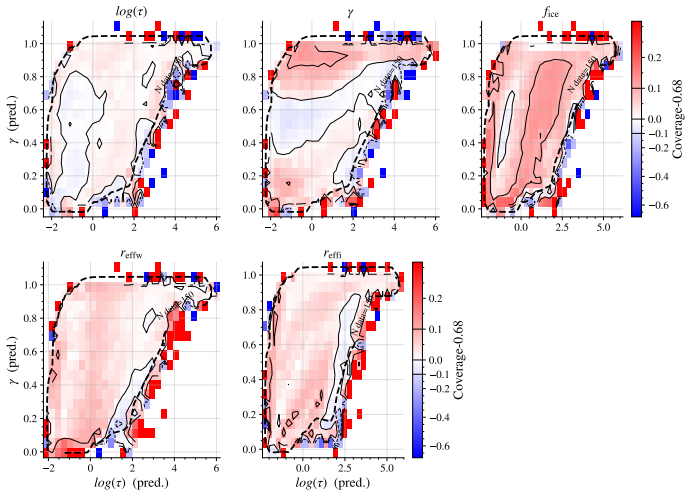
- The BO predictions remain unbiased and well-calibrated with realistic, situation-dependent covariance structures.
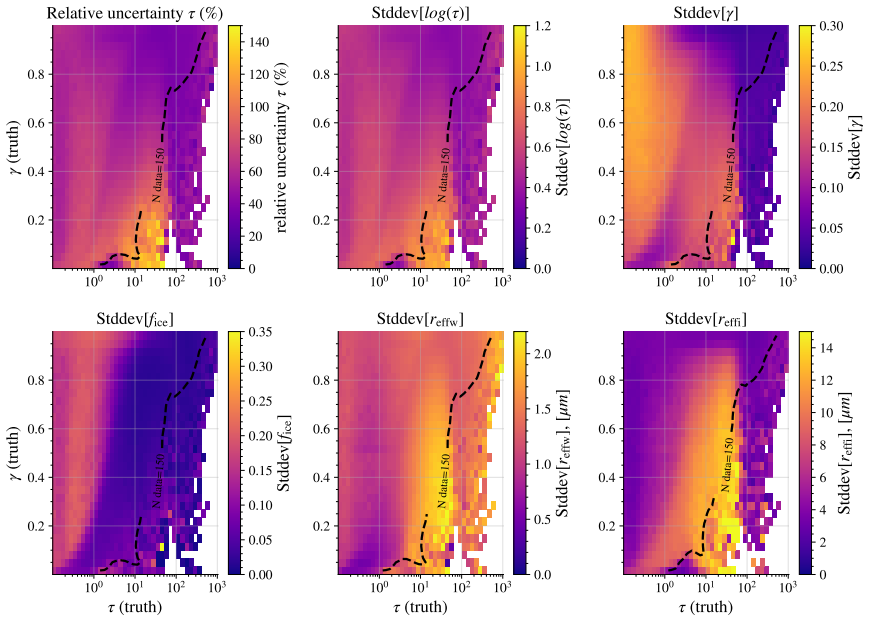
- The retrieved cloud variables can be overall usefully constrained without requiring prior information.
- Assimilating the retrieved variables could be a viable alternative to direct reflectance assimilation because they relate more linearly to the NWP model state.
Where Pith is reading between the lines
- If the synthetic-to-real gap is small, the same network architecture could be retrained periodically on updated model climatologies without new observational priors.
- The non-trivial covariances produced by the BO could be directly ingested by ensemble data-assimilation systems to update cross-variable error correlations.
- Because the BO is consistent with an existing forward operator, its outputs could be used to diagnose or correct biases in that forward operator itself.
Load-bearing premise
The synthetic images from the NWP regional model run used for training and evaluation accurately represent the statistical relationships present in real satellite observations of clouds.
What would settle it
Applying the trained network to real FCI observations and comparing the resulting cloud-property statistics and error covariances against independent retrievals or in-situ measurements would show whether the unbiased and well-calibrated behavior holds outside the synthetic training distribution.
Figures
read the original abstract
Satellite observations in the solar spectrum (including visible and near-infrared channels) offer high-resolution information on clouds and atmospheric properties valuable for data assimilation. While forward operators for a direct assimilation of solar images have become available recently and a first visible channel is already used operationally, their assimilation remains challenging due to strong non-linearities, ambiguities and high inter-channel correlations. This study addresses two central questions: what is the potential impact of assimilating multiple solar channels jointly, and can observed reflectances be transformed into physically meaningful, uncertainty-quantified variables better suited to assimilation than the raw reflectances themselves? As a proof of concept, we assess the joint information content of six solar channels from the Flexible Combined Imager (FCI) onboard Meteosat Third Generation and introduce a novel "Backward Operator" (BO) for probabilistic retrievals of cloud-related variables. The BO is implemented in a machine learning approach as a distributional regression network that is trained on synthetic images from a NWP regional model run and produces multivariate Gaussian estimates of total optical thickness, column cloud fraction, ice fraction, and effective radii of water and ice. The BO predictions are unbiased and well-calibrated, with realistic, situation-dependent and non-trivial covariance structures. The retrieved variables can be overall usefully constrained. Despite strong inter-channel correlations, combining multiple channels yields substantial performance improvements. As the BO does not require prior information, is consistent with an existing forward operator, and yields cloud variables more linearly related to the NWP model state, assimilating these variables could be a viable alternative to direct reflectance assimilation.
Editorial analysis
A structured set of objections, weighed in public.
Referee Report
Summary. The manuscript proposes a 'Backward Operator' (BO) implemented via a distributional regression network to retrieve cloud optical thickness, column cloud fraction, ice fraction, and effective radii of water/ice from six solar channels of the Meteosat Third Generation FCI instrument. Trained and evaluated on synthetic images generated by an NWP regional model, the BO is claimed to yield unbiased, well-calibrated multivariate Gaussian outputs with realistic situation-dependent covariances; multiple channels provide substantial gains despite inter-channel correlations; and the retrieved variables are more linearly related to the model state, making them a viable alternative to direct reflectance assimilation without requiring prior information.
Significance. If the calibration and covariance claims hold under real observations, the approach could offer a practical route to assimilate cloud information in data assimilation systems by converting non-linear reflectance observations into more linear, uncertainty-quantified state variables while remaining consistent with existing forward operators.
major comments (2)
- Abstract: the claims that 'The BO predictions are unbiased and well-calibrated, with realistic, situation-dependent and non-trivial covariance structures' and that 'combining multiple channels yields substantial performance improvements' are presented without any quantitative metrics, bias statistics, calibration scores, or error analysis to support them.
- Evaluation (synthetic data setup): all reported performance, including unbiasedness, calibration, and realistic covariances, is obtained exclusively on synthetic images produced by the same NWP regional model run used to generate the training data. This creates a circularity risk; the joint statistics of cloud variables versus FCI channels in the model may not match real Meteosat observations, undermining the assimilation-viability argument.
Simulated Author's Rebuttal
We thank the referee for these constructive comments on the abstract and the synthetic-data evaluation. We address each point below and will revise the manuscript accordingly where appropriate.
read point-by-point responses
-
Referee: Abstract: the claims that 'The BO predictions are unbiased and well-calibrated, with realistic, situation-dependent and non-trivial covariance structures' and that 'combining multiple channels yields substantial performance improvements' are presented without any quantitative metrics, bias statistics, calibration scores, or error analysis to support them.
Authors: We agree that the abstract would be strengthened by including quantitative support for these claims. The manuscript body reports specific metrics (near-zero biases, CRPS-based calibration diagnostics, and relative error reductions when moving from single- to multi-channel inputs), but these were omitted from the abstract. In the revised manuscript we will insert concise quantitative statements (e.g., mean bias values, average CRPS, and percentage skill gains) directly into the abstract. revision: yes
-
Referee: Evaluation (synthetic data setup): all reported performance, including unbiasedness, calibration, and realistic covariances, is obtained exclusively on synthetic images produced by the same NWP regional model run used to generate the training data. This creates a circularity risk; the joint statistics of cloud variables versus FCI channels in the model may not match real Meteosat observations, undermining the assimilation-viability argument.
Authors: The concern is valid: the reported statistics are conditioned on the model’s own cloud–reflectance joint distribution. The study is explicitly framed as a proof-of-concept that isolates the BO’s statistical properties under perfect forward-model consistency. We will expand the discussion and limitations sections to state this scope clearly, to quantify the expected mismatch with real observations, and to outline the additional steps required for real-data validation. No new experiments are feasible within the current manuscript, but the added text will temper the assimilation-viability claim accordingly. revision: partial
Circularity Check
No significant circularity detected
full rationale
The paper trains a distributional regression network (the Backward Operator) on synthetic images generated from an NWP regional model run and reports empirical performance metrics such as unbiasedness, calibration, and covariance structure on (presumably held-out) synthetic test data. These metrics are not equivalent to the training inputs by construction; they reflect the learned mapping from channels to cloud variables. No equations, self-citations, or steps are quoted that reduce a claimed prediction or uniqueness result to a fitted parameter or prior self-citation by definition. The consistency statement with an existing forward operator is presented as a property of the approach rather than a derived result that collapses to the synthetic data generation process. This is a standard supervised learning setup for retrieval methods and remains self-contained against external benchmarks.
Axiom & Free-Parameter Ledger
free parameters (1)
- Distributional regression network parameters
axioms (2)
- domain assumption The mapping from reflectances to cloud properties can be represented by a multivariate Gaussian distribution
- domain assumption Synthetic images from the NWP model capture the relevant statistical relationships for real satellite data
invented entities (1)
-
Backward Operator (BO)
no independent evidence
Reference graph
Works this paper leans on
-
[1]
Monthly Weather Review , author =
Stephan Rasp and Sebastian Lerch. Neural Networks for Postprocessing Ensemble Weather Forecasts. Monthly Weather Review. 2018. doi:10.1175/MWR-D-18-0187.1
-
[2]
Strictly Proper Scoring Rules, Prediction, and Estimation , volume =
Gneiting, Tilmann and Raftery, Adrian , year =. Strictly Proper Scoring Rules, Prediction, and Estimation , volume =. Journal of the American Statistical Association , doi =
-
[3]
2025 , eprint=
Graph Neural Networks for Enhancing Ensemble Forecasts of Extreme Rainfall , author=. 2025 , eprint=
2025
-
[4]
2025 , eprint=
Uncertainty Quantification for Regression: A Unified Framework based on kernel scores , author=. 2025 , eprint=
2025
-
[5]
Chapman and Luca Delle Monache and Stefano Alessandrini and Aneesh C
William E. Chapman and Luca Delle Monache and Stefano Alessandrini and Aneesh C. Subramanian and F. Martin Ralph and Shang-Ping Xie and Sebastian Lerch and Negin Hayatbini. Probabilistic Predictions from Deterministic Atmospheric River Forecasts with Deep Learning. Monthly Weather Review. 2022. doi:10.1175/MWR-D-21-0106.1
-
[6]
Benedikt Schulz and Sebastian Lerch. Machine Learning Methods for Postprocessing Ensemble Forecasts of Wind Gusts: A Systematic Comparison. Monthly Weather Review. 2022. doi:10.1175/MWR-D-21-0150.1
-
[7]
Tilmann Gneiting and Adrian E. Raftery and Anton H. Westveld and Tom Goldman. Calibrated Probabilistic Forecasting Using Ensemble Model Output Statistics and Minimum CRPS Estimation. Monthly Weather Review. 2005. doi:10.1175/MWR2904.1
-
[8]
and Pillai, Natesh and Park, Ju-Hyun , number =
Gneiting, Tilmann and Balabdaoui, Fadoua and Raftery, Adrian E. , title =. Journal of the Royal Statistical Society: Series B (Statistical Methodology) , volume =. 2007 , number =. doi:https://doi.org/10.1111/j.1467-9868.2007.00587.x , url =. https://rss.onlinelibrary.wiley.com/doi/pdf/10.1111/j.1467-9868.2007.00587.x , abstract =
-
[9]
Neyman, J. , title =. Philosophical Transactions of the Royal Society of London, Series A: Mathematical and Physical Sciences , volume =. 1937 , month =. doi:10.1098/rsta.1937.0005 , url =
-
[10]
Hyndman and David M
Rob J. Hyndman and David M. Bashtannyk and Gary K. Grunwald , journal =. Estimating and Visualizing Conditional Densities , urldate =
-
[11]
Inferring Team Strengths Using a Discrete Markov Random Field
Alan Agresti and Brent A. Coull , title =. The American Statistician , volume =. 1998 , publisher =. doi:10.1080/00031305.1998.10480550 , URL =
work page internal anchor Pith review Pith/arXiv arXiv doi:10.1080/00031305.1998.10480550 1998
-
[12]
Quarterly Journal of the Royal Meteorological Society , volume =
Kugler, Lukas and Weissmann, Martin , title =. Quarterly Journal of the Royal Meteorological Society , volume =. doi:https://doi.org/10.1002/qj.4970 , url =. https://rmets.onlinelibrary.wiley.com/doi/pdf/10.1002/qj.4970 , abstract =
-
[13]
A fast radiative transfer method for the simulation of visible satellite imagery , journal =
Leonhard Scheck and Pascal Frèrebeau and Robert Buras-Schnell and Bernhard Mayer , keywords =. A fast radiative transfer method for the simulation of visible satellite imagery , journal =. 2016 , issn =. doi:https://doi.org/10.1016/j.jqsrt.2016.02.008 , url =
-
[14]
Leonhard Scheck and Martin Weissmann and Bernhard Mayer. Efficient Methods to Account for Cloud-Top Inclination and Cloud Overlap in Synthetic Visible Satellite Images. Journal of Atmospheric and Oceanic Technology. 2018. doi:10.1175/JTECH-D-17-0057.1
-
[15]
Bodo Ritter and Jean-Francois Geleyn. A Comprehensive Radiation Scheme for Numerical Weather Prediction Models with Potential Applications in Climate Simulations. Monthly Weather Review. 1992. doi:10.1175/1520-0493(1992)120<0303:ACRSFN>2.0.CO;2
-
[16]
Condensation and Cloud Parameterization Studies with a Mesoscale Numerical Weather Prediction Model
Hilding Sundqvist and Erik Berge and Jón Egill Kristjánsson. Condensation and Cloud Parameterization Studies with a Mesoscale Numerical Weather Prediction Model. Monthly Weather Review. 1989. doi:10.1175/1520-0493(1989)117<1641:CACPSW>2.0.CO;2
-
[17]
Quarterly Journal of the Royal Meteorological Society , volume =
Scheck, Leonhard and Weissmann, Martin and Bach, Liselotte , title =. Quarterly Journal of the Royal Meteorological Society , volume =. doi:https://doi.org/10.1002/qj.3840 , url =. https://rmets.onlinelibrary.wiley.com/doi/pdf/10.1002/qj.3840 , abstract =
-
[18]
A neural network based forward operator for visible satellite images and its adjoint , journal =
Leonhard Scheck , keywords =. A neural network based forward operator for visible satellite images and its adjoint , journal =. 2021 , issn =. doi:https://doi.org/10.1016/j.jqsrt.2021.107841 , url =
-
[19]
and Scheck, L
Baur, F. and Scheck, L. and Stumpf, C. and K\"opken-Watts, C. and Potthast, R. , TITLE =. Atmospheric Measurement Techniques , VOLUME =. 2023 , NUMBER =
2023
-
[20]
Jason A. Otkin and Roland Potthast. Assimilation of All-Sky SEVIRI Infrared Brightness Temperatures in a Regional-Scale Ensemble Data Assimilation System. Monthly Weather Review. 2019. doi:10.1175/MWR-D-19-0133.1
-
[21]
Quarterly Journal of the Royal Meteorological Society , volume =
Gustafsson, Nils and Janjić, Tijana and Schraff, Christoph and Leuenberger, Daniel and Weissmann, Martin and Reich, Hendrik and Brousseau, Pierre and Montmerle, Thibaut and Wattrelot, Eric and Bučánek, Antonín and Mile, Máté and Hamdi, Rafiq and Lindskog, Magnus and Barkmeijer, Jan and Dahlbom, Mats and Macpherson, Bruce and Ballard, Sue and Inverarity, G...
-
[22]
Geer, A. J. and Migliorini, S. and Matricardi, M. , TITLE =. Atmospheric Measurement Techniques , VOLUME =. 2019 , NUMBER =
2019
-
[23]
Geer, Alan J. and Lonitz, Katrin and Weston, Peter and Kazumori, Masahiro and Okamoto, Kozo and Zhu, Yanqiu and Liu, Emily Huichun and Collard, Andrew and Bell, William and Migliorini, Stefano and Chambon, Philippe and Fourrié, Nadia and Kim, Min-Jeong and Köpken-Watts, Christina and Schraff, Christoph , title =. Quarterly Journal of the Royal Meteorologi...
-
[24]
Teruyuki Nakajima and Michael D. King. Determination of the Optical Thickness and Effective Particle Radius of Clouds from Reflected Solar Radiation Measurements. Part I: Theory. Journal of Atmospheric Sciences. 1990. doi:10.1175/1520-0469(1990)047<1878:DOTOTA>2.0.CO;2
-
[25]
Watts, P. D. and Bennartz, R. and Fell, F. , title =. Journal of Geophysical Research: Atmospheres , volume =. doi:https://doi.org/10.1029/2011JD015883 , url =. https://agupubs.onlinelibrary.wiley.com/doi/pdf/10.1029/2011JD015883 , abstract =
-
[26]
Poulsen, C. A. and Siddans, R. and Thomas, G. E. and Sayer, A. M. and Grainger, R. G. and Campmany, E. and Dean, S. M. and Arnold, C. and Watts, P. D. , TITLE =. Atmospheric Measurement Techniques , VOLUME =. 2012 , NUMBER =
2012
-
[27]
Machine Learning-Based Retrieval of Cloud Droplet Number Concentration and Liquid Water Path From Satellite Spectral Data , year=
Gonzalez, Jessenia and Dipu, Sudhakar and Jimenez, Gabriel and Camps-Valls, Gustau and Quaas, Johannes , journal=. Machine Learning-Based Retrieval of Cloud Droplet Number Concentration and Liquid Water Path From Satellite Spectral Data , year=
-
[28]
Remote Sensing , VOLUME =
Chen, Xingfeng and Zhao, Limin and Zheng, Fengjie and Li, Jiaguo and Li, Lei and Ding, Haonan and Zhang, Kainan and Liu, Shumin and Li, Donghui and de Leeuw, Gerrit , TITLE =. Remote Sensing , VOLUME =. 2022 , NUMBER =
2022
-
[29]
and Li, Zhengqiang and de Leeuw, Gerrit and Huang, Bo , TITLE =
She, Lu and Zhang, Hankui K. and Li, Zhengqiang and de Leeuw, Gerrit and Huang, Bo , TITLE =. Remote Sensing , VOLUME =. 2020 , NUMBER =
2020
-
[30]
Disong Fu and Hongrong Shi and Christian A. Gueymard and Dazhi Yang and Yu Zheng and Huizheng Che and Xuehua Fan and Xinlei Han and Lin Gao and Jianchun Bian and Minzheng Duan and Xiangao Xia , keywords =. A Deep-Learning and Transfer-Learning Hybrid Aerosol Retrieval Algorithm for FY4-AGRI: Development and Verification over Asia , journal =. 2024 , issn ...
-
[31]
Physics-Constrained Bayesian Neural Networks for Aerosol Retrieval From Hyperspectral Satellite Measurements With Integrated Uncertainty Quantification , year=
Rao, Lanlan and Efremenko, Dmitry and Doicu, Adrian and Shi, Chong and Yin, Shuai and Letu, Husi and Xu, Jian , journal=. Physics-Constrained Bayesian Neural Networks for Aerosol Retrieval From Hyperspectral Satellite Measurements With Integrated Uncertainty Quantification , year=
-
[32]
Quarterly Journal of the Royal Meteorological Society , author =
Zängl, Günther and Reinert, Daniel and Rípodas, Pilar and Baldauf, Michael , title =. Quarterly Journal of the Royal Meteorological Society , volume =. doi:https://doi.org/10.1002/qj.2378 , url =. https://rmets.onlinelibrary.wiley.com/doi/pdf/10.1002/qj.2378 , abstract =
-
[33]
and Hocking, J
Saunders, R. and Hocking, J. and Turner, E. and Rayer, P. and Rundle, D. and Brunel, P. and Vidot, J. and Roquet, P. and Matricardi, M. and Geer, A. and Bormann, N. and Lupu, C. , TITLE =. Geoscientific Model Development , VOLUME =. 2018 , NUMBER =
2018
-
[34]
K. Holmlund and J. Grandell and J. Schmetz and R. Stuhlmann and B. Bojkov and R. Munro and M. Lekouara and D. Coppens and B. Viticchie and T. August and B. Theodore and P. Watts and M. Dobber and G. Fowler and S. Bojinski and A. Schmid and K. Salonen and S. Tjemkes and D. Aminou and P. Blythe. Meteosat Third Generation (MTG): Continuation and Innovation o...
-
[35]
Remote Sensing , volume =
Wang, Zheng Qi and Randriamampianina, Roger , title =. Remote Sensing , volume =. 2021 , number =
2021
-
[36]
and Hutt, Axel and Linguet, Laurent and Lajoie, Gilles and Potthast, Roland
Kurzrock, Frederik and Cros, Sylvain and Ming, Fabrice Chane and Otkin, Jason A. and Hutt, Axel and Linguet, Laurent and Lajoie, Gilles and Potthast, Roland. A Review of the Use of Geostationary Satellite Observations in Regional-Scale Models for Short-term Cloud Forecasting. Meteorologische Zeitschrift. doi:10.1127/metz/2018/0904
-
[37]
Improved Coastal Precipitation Forecasts with Direct Assimilation of GOES-11/12 Imager Radiances
Xiaolei Zou and Zhengkun Qin and Fuzhong Weng. Improved Coastal Precipitation Forecasts with Direct Assimilation of GOES-11/12 Imager Radiances. Monthly Weather Review. 2011. doi:10.1175/MWR-D-10-05040.1
-
[38]
Yang, Chun and Liu, Zhiquan and Gao, Feng and Childs, Peter P. and Min, Jinzhong , title =. Journal of Geophysical Research: Atmospheres , volume =. doi:https://doi.org/10.1002/2016JD026436 , url =. https://agupubs.onlinelibrary.wiley.com/doi/pdf/10.1002/2016JD026436 , abstract =
-
[39]
Coopmann, O. and Fourrié, N. and Chambon, P. and Vidot, J. and Brousseau, P. and Martet, M. and Birman, C. , title =. Quarterly Journal of the Royal Meteorological Society , volume =. doi:https://doi.org/10.1002/qj.4548 , url =. https://rmets.onlinelibrary.wiley.com/doi/pdf/10.1002/qj.4548 , abstract =
-
[40]
Niels Bormann and Heather Lawrence and Jacqueline Farnan , title =. 2019 , journal =. doi:10.21957/sr184iyz , language =
-
[41]
2024 , month =
FCI L1 Operational Product Report , author =. 2024 , month =
2024
-
[42]
Remote Sensing , VOLUME =
Vidot, Jérôme and Brunel, Pascal and Dumont, Marie and Carmagnola, Carlo and Hocking, James , TITLE =. Remote Sensing , VOLUME =. 2018 , NUMBER =
2018
-
[43]
Eyre, J. R. and Bell, W. and Cotton, J. and English, S. J. and Forsythe, M. and Healy, S. B. and Pavelin, E. G. , title =. Quarterly Journal of the Royal Meteorological Society , volume =. doi:https://doi.org/10.1002/qj.4228 , url =. https://rmets.onlinelibrary.wiley.com/doi/pdf/10.1002/qj.4228 , abstract =
-
[44]
and Guidard, V
Coopmann, O. and Guidard, V. and Fourri\'e, N. and Josse, B. and Mar\'ecal, V. , TITLE =. Atmospheric Measurement Techniques , VOLUME =. 2020 , NUMBER =
2020
-
[45]
and Mcnally, Anthony , year =
Eresmaa, Reima and Bormann, N. and Mcnally, Anthony , year =. Implications of observation error correlation on the assimilation of interferometric radiances , doi =. , pages =
-
[46]
and Ceamanos, X
Georgeot, A. and Ceamanos, X. and Atti\'e, J.-L. and Juncu, D. and Gasteiger, J. and Compi\`egne, M. , TITLE =. Atmospheric Measurement Techniques , VOLUME =. 2025 , NUMBER =
2025
-
[47]
Quarterly Journal of the Royal Meteorological Society , volume =
Chen, Haiqin and Gao, Jidong and Wang, Yunheng and Chen, Yaodeng and Sun, Tao and Carlin, Jacob and Zheng, Yu , title =. Quarterly Journal of the Royal Meteorological Society , volume =. doi:https://doi.org/10.1002/qj.4031 , url =. https://rmets.onlinelibrary.wiley.com/doi/pdf/10.1002/qj.4031 , abstract =
-
[48]
Thomas A. Jones and Patrick Skinner and Nusrat Yussouf and Kent Knopfmeier and Anthony Reinhart and Xuguang Wang and Kristopher Bedka and William Smith and Rabindra Palikonda. Assimilation of GOES-16 Radiances and Retrievals into the Warn-on-Forecast System. Monthly Weather Review. 2020. doi:10.1175/MWR-D-19-0379.1
-
[49]
Thomas A. Jones and Kent Knopfmeier and Dustan Wheatley and Gerald Creager and Patrick Minnis and Rabindra Palikonda. Storm-Scale Data Assimilation and Ensemble Forecasting with the NSSL Experimental Warn-on-Forecast System. Part II: Combined Radar and Satellite Data Experiments. Weather and Forecasting. 2016. doi:10.1175/WAF-D-15-0107.1
-
[50]
Jones and David Stensrud and Louis Wicker and Patrick Minnis and Rabindra Palikonda
Thomas A. Jones and David Stensrud and Louis Wicker and Patrick Minnis and Rabindra Palikonda. Simultaneous Radar and Satellite Data Storm-Scale Assimilation Using an Ensemble Kalman Filter Approach for 24 May 2011. Monthly Weather Review. 2015. doi:10.1175/MWR-D-14-00180.1
-
[51]
2018 , eprint=
Tune: A Research Platform for Distributed Model Selection and Training , author=. 2018 , eprint=
2018
-
[52]
Transactions on Machine Learning Research , issn =
Probabilistic neural operators for functional uncertainty quantification , author =. Transactions on Machine Learning Research , issn =. 2025 , url =
2025
-
[53]
2020 , eprint=
A System for Massively Parallel Hyperparameter Tuning , author=. 2020 , eprint=
2020
-
[54]
and Simon, Thorsten and Umlauf, Nikolaus and Zeileis, Achim , year = 2024, month = jan, journal =
Muschinski, Thomas and Mayr, Georg J. and Simon, Thorsten and Umlauf, Nikolaus and Zeileis, Achim , year = 2024, month = jan, journal =. Cholesky-Based Multivariate. doi:10.1016/j.ecosta.2022.03.001 , urldate =
-
[55]
2025 , eprint=
Asymmetric Penalties Underlie Proper Loss Functions in Probabilistic Forecasting , author=. 2025 , eprint=
2025
-
[56]
Reliable training and estimation of variance networks , url =
Skafte, Nicki and J rgensen, Martin and Hauberg, S ren , booktitle =. Reliable training and estimation of variance networks , url =
-
[57]
Effective Bayesian Heteroscedastic Regression with Deep Neural Networks , url =
Immer, Alexander and Palumbo, Emanuele and Marx, Alexander and Vogt, Julia , booktitle =. Effective Bayesian Heteroscedastic Regression with Deep Neural Networks , url =
-
[58]
Probabilistic Forecasting with Generative Networks via Scoring Rule Minimization , author =
-
[59]
Journal of the Royal Statistical Society Series B: Statistical Methodology , author =
Shen, Xinwei and Meinshausen, Nicolai , year = 2025, month = jul, journal =. Engression: Extrapolation through the Lens of Distributional Regression , shorttitle =. doi:10.1093/jrsssb/qkae108 , urldate =
-
[60]
The Annals of Applied Statistics , volume =
Generative Machine Learning Methods for Multivariate Ensemble Postprocessing , author =. The Annals of Applied Statistics , volume =. doi:10.1214/23-AOAS1784 , urldate =
-
[61]
Martin János Mayer and Ágnes Baran and Sebastian Lerch and Nina Horat and Dazhi Yang and Sándor Baran , keywords =. Post-processing of ensemble photovoltaic power forecasts with distributional and quantile regression methods , journal =. 2026 , issn =. doi:https://doi.org/10.1016/j.solener.2026.114361 , url =
-
[62]
2025 , eprint=
Probabilistic intraday electricity price forecasting using generative machine learning , author=. 2025 , eprint=
2025
-
[63]
Journal of Multivariate Analysis , volume =
A New Test for Multivariate Normality , author =. Journal of Multivariate Analysis , volume =. doi:10.1016/j.jmva.2003.12.002 , urldate =
-
[64]
Friederichs, Petra and Thorarinsdottir, Thordis L. , title =. Environmetrics , volume =. doi:https://doi.org/10.1002/env.2176 , url =. https://onlinelibrary.wiley.com/doi/pdf/10.1002/env.2176 , abstract =
-
[65]
Rage Against the Mean – A Review of Distributional Regression Approaches , journal =
Thomas Kneib and Alexander Silbersdorff and Benjamin Säfken , keywords =. Rage Against the Mean – A Review of Distributional Regression Approaches , journal =. 2023 , issn =. doi:https://doi.org/10.1016/j.ecosta.2021.07.006 , url =
-
[66]
Kaps, Arndt and Lauer, Axel and Camps-Valls, Gustau and Gentine, Pierre and Gomez-Chova, Luis and Eyring, Veronika , year=. Machine-Learned Cloud Classes From Satellite Data for Process-Oriented Climate Model Evaluation , volume=. doi:10.1109/tgrs.2023.3237008 , journal=
-
[67]
and Stapelberg, S
Stengel, M. and Stapelberg, S. and Sus, O. and Schlundt, C. and Poulsen, C. and Thomas, G. and Christensen, M. and Carbajal Henken, C. and Preusker, R. and Fischer, J. and Devasthale, A. and Will\'en, U. and Karlsson, K.-G. and McGarragh, G. R. and Proud, S. and Povey, A. C. and Grainger, R. G. and Meirink, J. F. and Feofilov, A. and Bennartz, R. and Boja...
2017
-
[68]
William B. Rossow and Robert A. Schiffer. Advances in Understanding Clouds from ISCCP. Bulletin of the American Meteorological Society. 1999. doi:10.1175/1520-0477(1999)080<2261:AIUCFI>2.0.CO;2
-
[69]
and King, Michael D
Platnick, Steven and Meyer, Kerry G. and King, Michael D. and Wind, Galina and Amarasinghe, Nandana and Marchant, Benjamin and Arnold, G. Thomas and Zhang, Zhibo and Hubanks, Paul A. and Holz, Robert E. and Yang, Ping and Ridgway, William L. and Riedi, Jérôme , journal=. The MODIS Cloud Optical and Microphysical Products: Collection 6 Updates and Examples...
-
[70]
Pincus, Robert and Batstone, Crispian P. and Hofmann, Robert J. Patrick and Taylor, Karl E. and Glecker, Peter J. , title =. Journal of Geophysical Research: Atmospheres , volume =. doi:https://doi.org/10.1029/2007JD009334 , url =. https://agupubs.onlinelibrary.wiley.com/doi/pdf/10.1029/2007JD009334 , abstract =
-
[71]
Graeme L. Stephens. Cloud Feedbacks in the Climate System: A Critical Review. Journal of Climate. 2005. doi:10.1175/JCLI-3243.1
-
[72]
Quarterly Journal of the Royal Meteorological Society , volume=
Assimilation of TOVS radiance information through one-dimensional variational analysis , author=. Quarterly Journal of the Royal Meteorological Society , volume=. 1993 , publisher=
1993
-
[73]
Bouttier, F. and Kelly, G. , title =. Quarterly Journal of the Royal Meteorological Society , volume =. doi:https://doi.org/10.1002/qj.49712757419 , url =. https://rmets.onlinelibrary.wiley.com/doi/pdf/10.1002/qj.49712757419 , abstract =
-
[74]
Niels Bormann and Sami Saarinen and Graeme Kelly and Jean-Noël Thépaut. The Spatial Structure of Observation Errors in Atmospheric Motion Vectors from Geostationary Satellite Data. Monthly Weather Review. 2003. doi:10.1175/1520-0493(2003)131<0706:TSSOOE>2.0.CO;2
-
[75]
2000 , url=
Inverse Methods for Atmospheric Sounding: Theory and Practice , author=. 2000 , url=
2000
-
[76]
Palmer, Paul I. and Barnett, J. J. and Eyre, J. R. and Healy, S. B. , year=. A nonlinear optimal estimation inverse method for radio occultation measurements of temperature, humidity, and surface pressure , volume=. Journal of Geophysical Research: Atmospheres , publisher=. doi:10.1029/2000jd900151 , number=
-
[77]
Hotta, Daisuke and Ota, Yoichiro , year=. Why does EnKF suffer from analysis overconfidence? An insight into exploiting the ever‐increasing volume of observations , volume=. Quarterly Journal of the Royal Meteorological Society , publisher=. doi:10.1002/qj.3970 , number=
-
[78]
Desroziers, G. and Berre, L. and Chapnik, B. and Poli, P. , title =. Quarterly Journal of the Royal Meteorological Society , volume =. doi:https://doi.org/10.1256/qj.05.108 , url =. https://rmets.onlinelibrary.wiley.com/doi/pdf/10.1256/qj.05.108 , abstract =
-
[79]
Journal of the Meteorological Society of Japan
An Introduction to Himawari-8/9 - Japan's New-Generation Geostationary Meteorological Satellites , author=. Journal of the Meteorological Society of Japan. Ser. II , volume=. 2016 , doi=
2016
-
[80]
Koji Terasaki and Takemasa Miyoshi. Including the Horizontal Observation Error Correlation in the Ensemble Kalman Filter: Idealized Experiments with NICAM-LETKF. Monthly Weather Review. 2024. doi:10.1175/MWR-D-23-0053.1
discussion (0)
Sign in with ORCID, Apple, or X to comment. Anyone can read and Pith papers without signing in.