Enhanced Heat Transfer through Density- and Pressure-Driven Flow at Fracture Intersections With Dead-Ends
Pith reviewed 2026-06-26 13:18 UTC · model grok-4.3
The pith
Fluid flow in dead-end fractures enhances heat transfer to the rock matrix by sustaining higher temperature differences.
A machine-rendered reading of the paper's core claim, the machinery that carries it, and where it could break.
Core claim
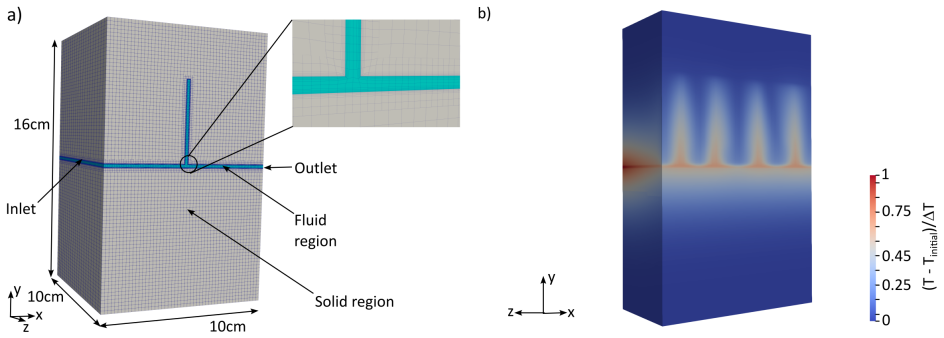
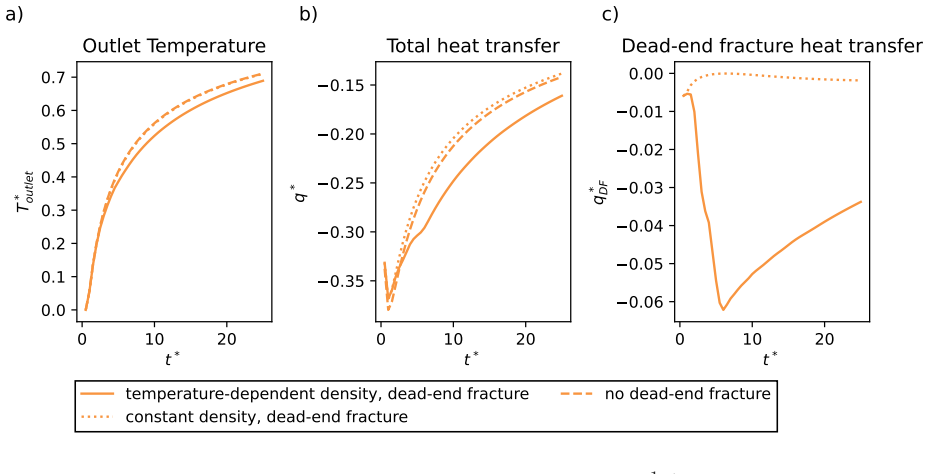
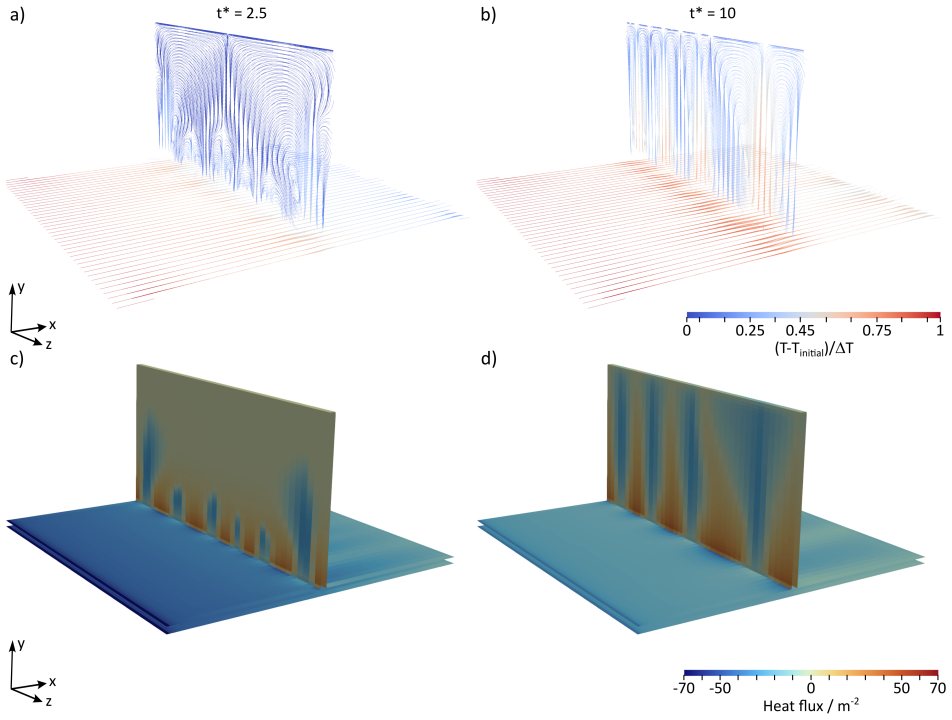
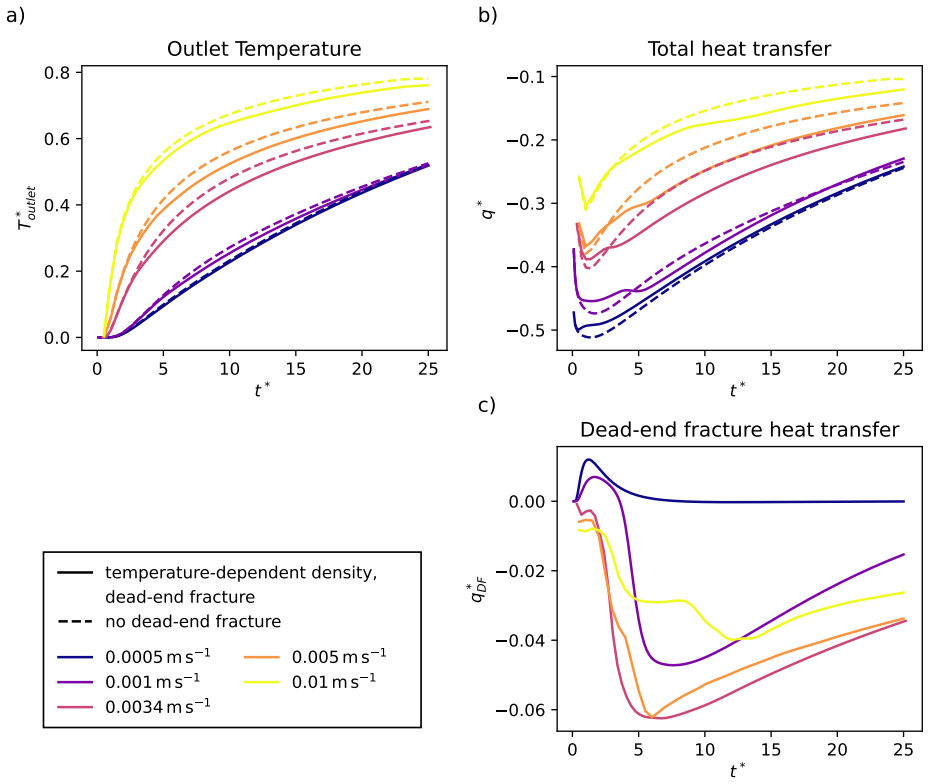
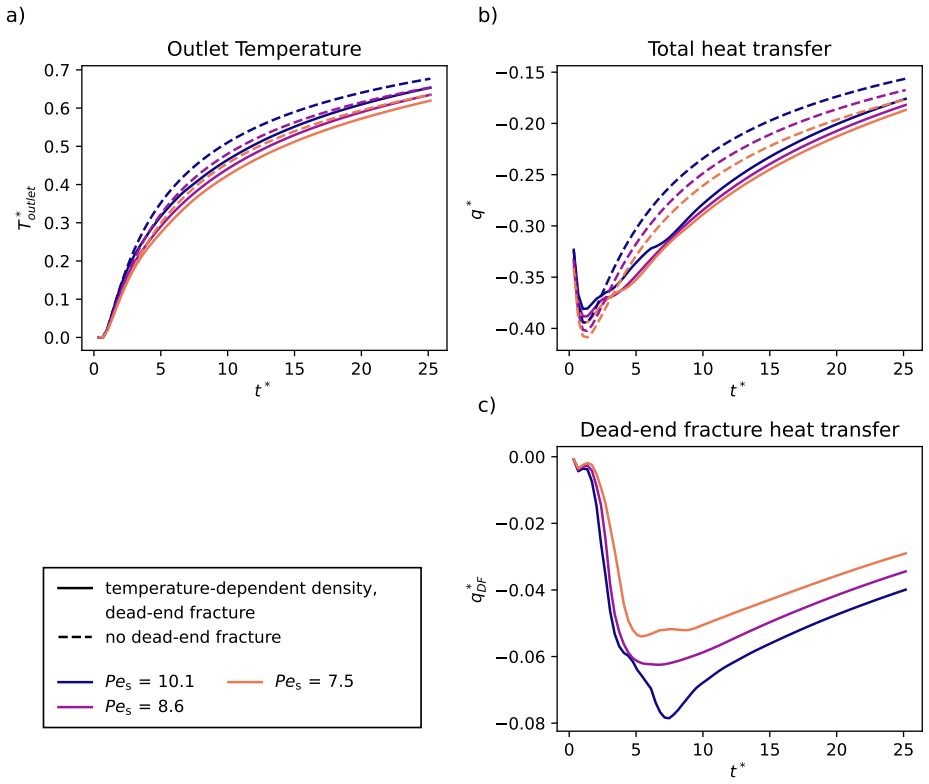
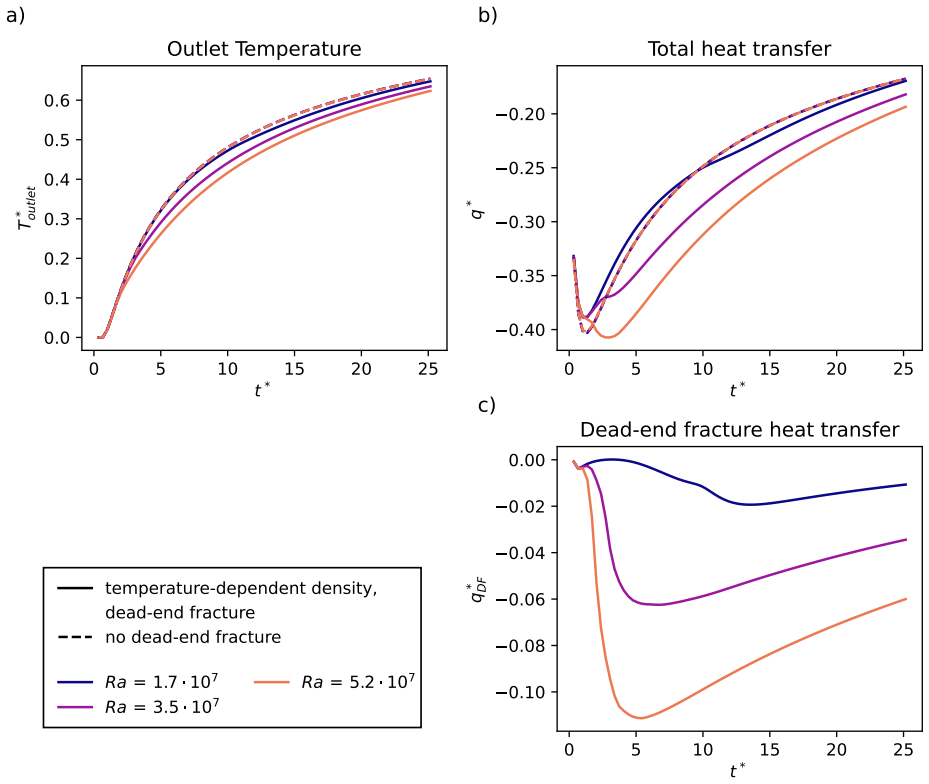
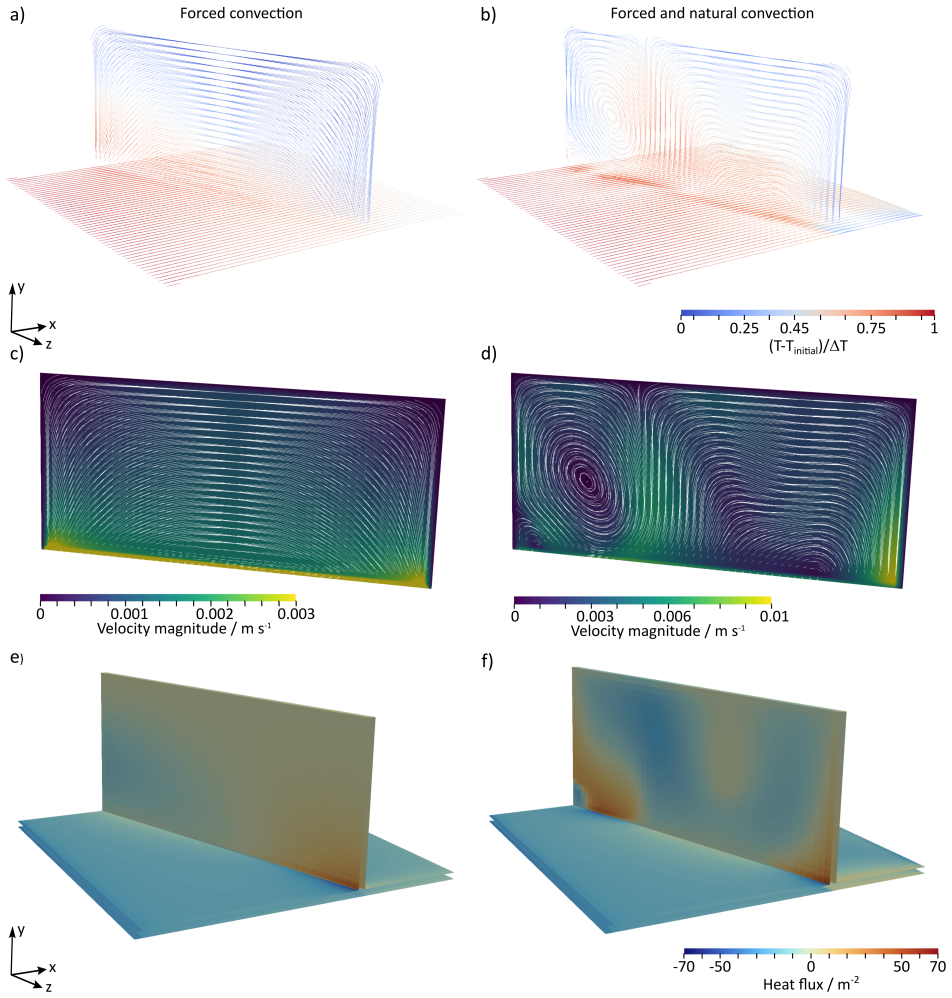
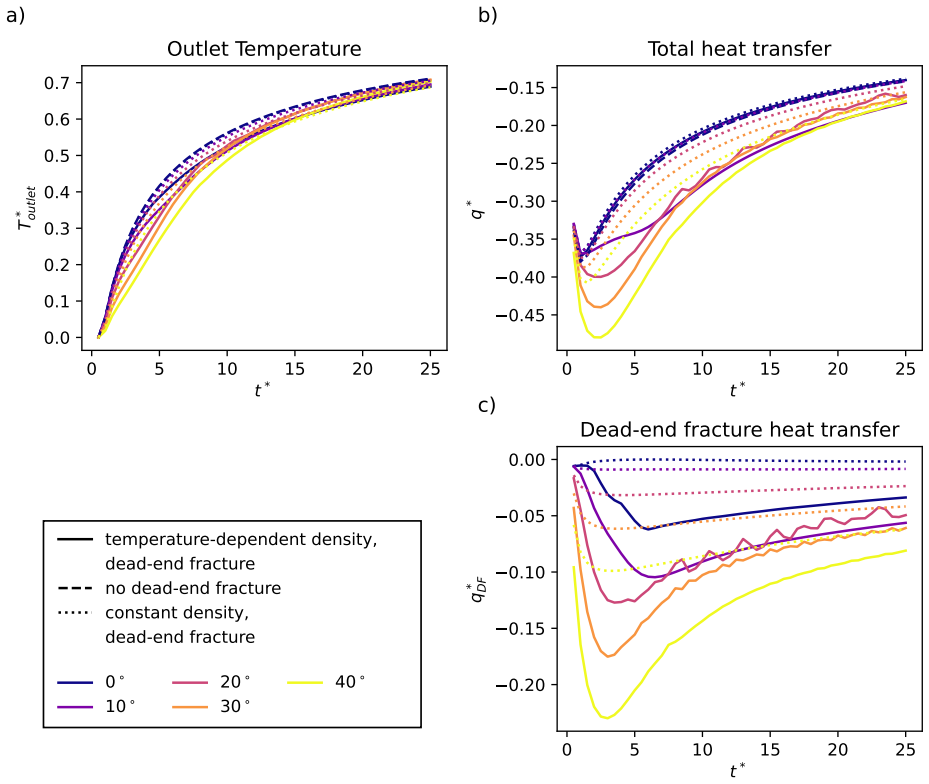
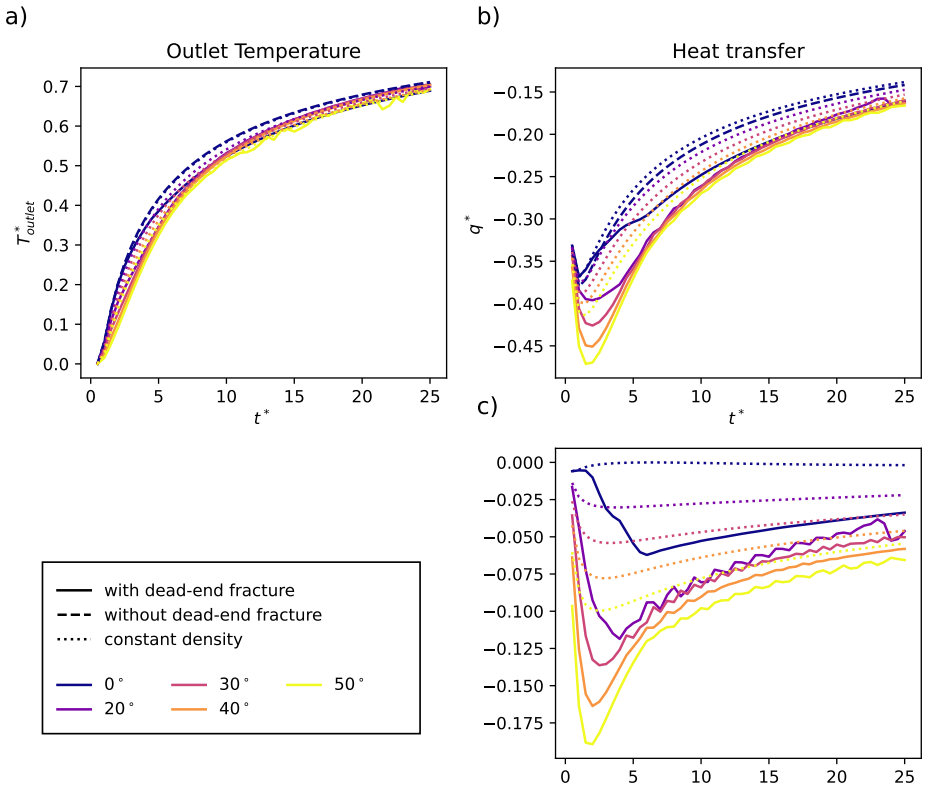
The simulations consistently show that heat transfer from the fluid to the matrix is enhanced when fluid flow occurs within the dead-end fracture, since such fluid flow maintains a higher temperature difference between the matrix and the fluid. This flow arises either from buoyancy-driven natural convection due to temperature-dependent fluid density or from a pressure gradient imposed by the orientation of the dead-end fracture with respect to the flow direction in the horizontal fracture. Natural convection dominates at high flow rate, Rayleigh, and Peclet numbers, whereas pressure-driven flow becomes the controlling mechanism for an increasing deviation from the orthogonal configuration of
What carries the argument
Numerical solution of mass, momentum, and energy conservation equations in the fluid-filled fractures coupled to conduction in the impermeable matrix, with dead-end flow driven by density variations or imposed pressure gradients.
If this is right
- Natural convection inside the dead-end dominates heat transport once Rayleigh and Peclet numbers become large.
- Pressure-driven flow in the dead-end takes over when the intersection angle deviates from 90 degrees.
- Below critical thresholds in inlet velocity, Rayleigh number, or Peclet number, the dead-end branch reverts to pure conduction.
- The orientation of the dead-end relative to the main flow direction controls whether pressure gradients induce circulation.
Where Pith is reading between the lines
- The same flow mechanism could raise effective heat exchange rates in any network containing blind fracture branches.
- Laboratory setups with tilted dead-ends under controlled pressure gradients could isolate the pressure-driven contribution.
- The reported enhancement may alter estimates of thermal breakthrough times in geothermal or nuclear waste applications that model only matrix conduction.
Load-bearing premise
The rock matrix is impermeable, so heat moves through it only by conduction with no Darcy flow paths inside the solid.
What would settle it
A direct measurement or simulation in which heat transfer rates remain unchanged or decrease when flow is forced inside the dead-end fracture under otherwise identical boundary conditions.
Figures
read the original abstract
Heat transport in fractured media is governed by coupled thermal-hydraulic (TH) processes. This study evaluates TH processes at fracture intersections, focusing on T-intersections where one horizontal fracture is subjected to a pressure gradient while the other forms a vertical dead-end fracture. Using numerical simulations, we investigate the influence of the inlet velocity, thermal P\'eclet, and Rayleigh numbers, and the impact of a pressure gradient along the T-intersection, on the resulting heat transport. The model domain consists of a fluid and a solid region. Fluid flow and heat transport in the fractures are described by the conservation equations for mass, momentum, and energy. The rock matrix is considered impermeable, therefore, it is governed by heat conduction. The simulations consistently show that heat transfer from the fluid to the matrix is enhanced when fluid flow occurs within the dead-end fracture, since such fluid flow maintains a higher temperature difference between the matrix and the fluid. This flow arises either from buoyancy-driven natural convection due to temperature-dependent fluid density or from a pressure gradient imposed by the orientation of the dead-end fracture with respect to the flow direction in the horizontal fracture. Natural convection dominates at high flow rate, Rayleigh, and P\'eclet numbers, whereas pressure-driven flow becomes the controlling mechanism for an increasing deviation from the orthogonal configuration of the two fracture planes and under higher flow rates. At low flow rates, P\'eclet, or Rayleigh numbers, no flow develops in the dead-end fracture, and heat transport in the dead-end fracture becomes conduction-dominated.
Editorial analysis
A structured set of objections, weighed in public.
Referee Report
Summary. The paper uses numerical simulations of mass, momentum, and energy conservation in fluid-filled fractures (with an impermeable matrix governed by conduction) to study T-intersections consisting of a pressure-driven horizontal fracture and a vertical dead-end branch. It reports that heat transfer to the matrix is enhanced when flow develops in the dead-end fracture—either via buoyancy-driven natural convection (dominant at high inlet velocity, Rayleigh, and Péclet numbers) or pressure-driven flow (dominant for non-orthogonal orientations and higher flow rates)—because this flow sustains a larger fluid-matrix temperature difference; at low parameter values the dead-end branch is conduction-dominated.
Significance. If the simulation results are reliable, the work identifies a concrete mechanism by which dead-end fractures can actively enhance heat transport in fractured media through induced flows, rather than acting as passive conduction paths. The parametric exploration of inlet velocity, Péclet, and Rayleigh numbers, together with orientation effects, maps regime transitions between convection- and conduction-dominated transport and could inform TH modeling for geothermal or thermal-storage applications.
major comments (2)
- [Abstract and Numerical Methods] Abstract and Numerical Methods section: the central claim of consistent enhancement rests entirely on simulation outputs, yet the manuscript supplies no information on mesh convergence or grid-independence tests, the spatial discretization scheme, solver tolerances, or validation against analytical solutions (e.g., pure conduction limits) or benchmark experiments. This absence is load-bearing because the reported qualitative trends cannot be assessed for numerical artifact without these checks.
- [Abstract] Model setup (Abstract): the impermeable-matrix assumption is required to isolate the temperature-difference mechanism to fracture flow alone, but the paper does not quantify how sensitive the enhancement is to even modest matrix permeability; a small Darcy flow component could open additional heat-transport paths and alter the reported mechanism.
minor comments (1)
- [Abstract] Abstract: the reference length and velocity scales used to define the thermal Péclet and Rayleigh numbers are not stated, making it difficult to reproduce the reported regime boundaries.
Simulated Author's Rebuttal
We thank the referee for their constructive comments, which help improve the clarity and rigor of our work. We respond to each major comment below.
read point-by-point responses
-
Referee: [Abstract and Numerical Methods] Abstract and Numerical Methods section: the central claim of consistent enhancement rests entirely on simulation outputs, yet the manuscript supplies no information on mesh convergence or grid-independence tests, the spatial discretization scheme, solver tolerances, or validation against analytical solutions (e.g., pure conduction limits) or benchmark experiments. This absence is load-bearing because the reported qualitative trends cannot be assessed for numerical artifact without these checks.
Authors: We agree these details are necessary to establish reliability. The revised manuscript will expand the Numerical Methods section with the spatial discretization scheme (finite volume), solver tolerances, results of mesh convergence and grid-independence tests, and validation against the analytical pure-conduction limit. revision: yes
-
Referee: [Abstract] Model setup (Abstract): the impermeable-matrix assumption is required to isolate the temperature-difference mechanism to fracture flow alone, but the paper does not quantify how sensitive the enhancement is to even modest matrix permeability; a small Darcy flow component could open additional heat-transport paths and alter the reported mechanism.
Authors: The impermeable-matrix assumption isolates the fracture-flow mechanism under study. We will add a paragraph in the Model Setup section discussing the assumption's validity for low-permeability rock and noting that the reported enhancement persists provided fracture permeability greatly exceeds matrix permeability; a full parametric sensitivity study lies outside the present scope. revision: partial
Circularity Check
No significant circularity
full rationale
The paper reports outcomes from direct numerical solution of the standard conservation equations (mass, momentum, energy) for fluid in fractures coupled to conduction in an impermeable matrix, under explicitly stated boundary conditions and parameter ranges (inlet velocity, Pe, Ra). The central observation—that flow in the dead-end branch sustains a larger temperature difference—is presented as a simulation result, not as a derived prediction obtained by fitting or by reducing to an input quantity. No self-citations, fitted parameters renamed as predictions, ansatzes smuggled via prior work, or uniqueness theorems appear in the provided text. The matrix-impermeability assumption is stated upfront and scopes the model; it does not create a self-referential loop. The derivation chain is therefore self-contained against external benchmarks (the governing PDEs).
Axiom & Free-Parameter Ledger
axioms (2)
- standard math Conservation equations for mass, momentum, and energy govern fluid flow and heat transport in the fractures.
- domain assumption The rock matrix is impermeable and heat transport within it occurs solely by conduction.
Reference graph
Works this paper leans on
-
[1]
Abdallah, G., Thoraval, A., Sfeir, A., and Piguet, J. (1995). Thermal convection of fluid in fractured media.International Journal of Rock Mechanics and Mining Sciences & Geomechanics,32(5), 481–490. https://doi.org/10.1016/0148-9062(95)00037-H. Andrade, J., Henrique, E., Almeida, M., and Costa, M. (2004). Heat transport through rough chan- nels.Physica A...
-
[2]
Blum, P., Menberg, K., Koch, F., Benz, S
https://doi.org/10.1016/j.jconhyd.2022.104021. Blum, P., Menberg, K., Koch, F., Benz, S. A., Tissen, C., Hemmerle, H., and Bayer, P. (2021). Is thermal use of groundwater a pollution?Journal of Contaminant Hydrology,239, 103
-
[3]
Bonnet, E., Bour, O., Odling, N
https://doi.org/10.1016/j.jconhyd.2021.103791. Bonnet, E., Bour, O., Odling, N. E., Davy, P., Main, I., Cowie, P., and Berkowitz, B. (2001). Scaling of fracture systems in geological media.Rev. Geophys.,39(3), 347–383. Cao, H., Yoon, S., Xu, Z., Pyrak-Nolte, L. J., Bresciani, E., and Kang, P. K. (2023). Emergence of unstable focused flow induced by variab...
-
[4]
Chen, Y., Zhao, Z., and Peng, H
https://doi.org/10.1029/2023WR034729. Chen, Y., Zhao, Z., and Peng, H. (2022). Convective heat transfer of water flow in intersected rock fractures for enhanced geothermal extraction.Journal of Rock Mechanics and Geotechnical Engineering,14(1), 108–122. https://doi.org/10.1016/j.jrmge.2021.05.005. Darcel, C., Courtois, Q., Svensson, U., Le Goc, R., Pinier...
-
[5]
Davy, P., Le Goc, R., Darcel, C., Pinier, B., Selroos, J.-O., and Le Borgne, T
https://doi.org/ https://doi.org/10.3389/fnuen.2026.1760157. Davy, P., Le Goc, R., Darcel, C., Pinier, B., Selroos, J.-O., and Le Borgne, T. (2024). Struc- tural and hydrodynamic controls on fluid travel time distributions across fracture networks. Proceedings of the National Academy of Sciences,121(47), e2414901
-
[6]
https://doi.org/ 10.1073/pnas.2414901121. De La Bernardie, J., Bour, O., Le Borgne, T., Guih´ eneuf, N., Chatton, E., Labasque, T., Le Lay, H., and Gerard, M.-F. (2018). Thermal attenuation and lag time in fractured rock: Theory and field measurements from joint heat and solute tracer tests.Water Resources Research,54(12). https://doi.org/10.1029/2018WR02...
-
[7]
https://doi.org/10.1016/j.jhydrol.2021.127157. 26 Doonechaly, N. G., Halter, T., Shakas, A., Hefny, M., Brehme, M., Hertrich, M., and Giardini, D. (2024). Thermal energy storage and recovery in fractured granite reservoirs: Numerical modeling and efficiency analysis.Geosciences,14(12),
-
[8]
Duwiquet, H., Genter, A., Guillou-Frottier, L., Donz´ e, F
https://doi.org/10.3390/geosciences14120357. Duwiquet, H., Genter, A., Guillou-Frottier, L., Donz´ e, F. V., Ledru, P., Magri, F., Guillon, T., Horne, R. N., Arbaret, L., and Souque, C. (2024). Advanced 3D TH and THM modeling to shed light on thermal convection in fault zones with varying thicknesses.Journal of Geophysical Research: Solid Earth,129(4), e2023JB028
-
[9]
https://doi.org/10.1029/2023JB028205. Elder, J. W. (1967). Transient convection in a porous medium.Journal of Fluid Mechanics,27(3), 609–623. https://doi.org/10.1017/S0022112067000576. Follin, S., Lev´ en, J., Hartley, L., Jackson, P., Joyce, S., Roberts, D., and Swift, B. (2007), Hydro- geological characterisation and modelling of deformation zones and f...
-
[10]
Gelet, R., Loret, B., and Khalili, N
https://doi.org/10.1186/s40517-015-0039-z. Gelet, R., Loret, B., and Khalili, N. (2013). Thermal recovery from a fractured medium in lo- cal thermal non-equilibrium.International Journal for Numerical and Analytical Methods in Geomechanics,37(15), 2471–2501. https://doi.org/10.1002/nag.2145. Gisladottir, V. R., Roubinet, D., and Tartakovsky, D. M. (2016)....
-
[11]
Heldt, S., Beyer, C., and Bauer, S
https://doi.org/10.1038/s41467-023-36034-w. Heldt, S., Beyer, C., and Bauer, S. (2026). Impact of subsurface heterogeneity and thermally induced buoyancy-driven flow on high-temperature aquifer thermal energy storage.Geothermics, 138, 103
-
[12]
Huang, Y., Zhang, Y., Yu, Z., Ma, Y., and Zhang, C
https://doi.org/10.1016/j.geothermics.2026.103641. Huang, Y., Zhang, Y., Yu, Z., Ma, Y., and Zhang, C. (2019). Experimental investigation of seepage and heat transfer in rough fractures for enhanced geothermal systems.Renewable Energy,135, 846–855. https://doi.org/10.1016/j.renene.2018.12.063. Jin, Y., Zou, L., Yao, C., Zhou, C., and Cvetkovic, V. (2024)....
-
[13]
27 Johnson, J., Brown, S., and Stockman, H
https://doi.org/ 10.1016/j.energy.2024.132756. 27 Johnson, J., Brown, S., and Stockman, H. (2006). Fluid flow and mixing in rough-walled frac- ture intersections.Journal of Geophysical Research: Solid Earth,111(B12), 2005JB004
-
[14]
https://doi.org/10.1029/2005JB004087. Kang, Q., Hyman, J. D., Stauffer, P. H., and Viswanathan, H. (2025). Numerical simulation of flow and mixing in fracture intersections.International Journal of Thermofluids,27, 101
-
[15]
Klepikova, M., Le Borgne, T., Bour, O., Dentz, M., Hochreutener, R., and Lavenant, N
https://doi.org/10.1016/j.ijft.2025.101229. Klepikova, M., Le Borgne, T., Bour, O., Dentz, M., Hochreutener, R., and Lavenant, N. (2016). Heat as a tracer for understanding transport processes in fractured media: Theory and field assessment from multiscale thermal push-pull tracer tests.Water Resources Research,52(7), 5442–5457. https://doi.org/10.1002/20...
-
[16]
Klepikova, M., Bense, V., Le Borgne, T., Guih´ eneuf, N., and Bour, O
https://doi.org/10.1016/j.advwatres.2021.104042. Klepikova, M., Bense, V., Le Borgne, T., Guih´ eneuf, N., and Bour, O. (2025). Impact of groundwa- ter extraction on subsurface thermal regimes.Environmental Research Letters,20(5), 054
-
[17]
https://doi.org/10.1088/1748-9326/adc8bb. Kolditz, O. (1995). Modelling flow and heat transfer in fractured rocks: Conceptual model of a 3-D deterministic fracture network.Geothermics,24(3), 451–470. https://doi.org/10.1016/0375- 6505(95)00020-Q. Lee, S. H. and Kang, P. K. (2020). Three-dimensional vortex-induced reaction hot spots at flow intersections.P...
-
[18]
https://doi.org/ 10.1103/PhysRevLett.124.144501. Lei, Q. and Tsang, C.-F. (2025). Coupled processes in fractured media: a key to the energy transition.GeoEnergy Communications,1(1),
-
[19]
Lenci, A., M´ eheust, Y., Klepikova, M., Di Federico, V., and Tartakovsky, D
https://doi.org/10.1007/s44421-025-00011-4. Lenci, A., M´ eheust, Y., Klepikova, M., Di Federico, V., and Tartakovsky, D. M. (2026). Effects of wall roughness on coupled flow and heat transport in fractured media.Journal of Fluid Mechanics, 1032, A61. https://doi.org/10.1017/jfm.2026.11403. Li, B., Mo, Y., Zou, L., Liu, R., and Cvetkovic, V. (2020). Influ...
-
[20]
Li, Z.-W., Feng, X.-T., Zhang, Y.-J., Zhang, C., Xu, T.-F., and Wang, Y.-S
https://doi.org/10.1016/j.jhydrol.2019.124284. Li, Z.-W., Feng, X.-T., Zhang, Y.-J., Zhang, C., Xu, T.-F., and Wang, Y.-S. (2017). Experimental research on the convection heat transfer characteristics of distilled water in manmade smooth and rough rock fractures.Energy,133, 206–218. https://doi.org/10.1016/j.energy.2017.05.127. Luna, E., Medina, A., Perez...
-
[21]
Medina, A., Luna, E., P´ erez-Rosales, C., and Higuera, F
https://doi.org/10.1186/s40517-014-0017-x. Medina, A., Luna, E., P´ erez-Rosales, C., and Higuera, F. J. (2002). Thermal convection in tilted porous fractures.Journal of Physics: Condensed Matter,14(9), 2467–2474. https://doi.org/ 10.1088/0953-8984/14/9/334. Mezon, C., Mourzenko, V. V., Thovert, J.-F., Antoine, R., Fontaine, F., Finizola, A., and Adler, P...
-
[22]
https://doi.org/10.1103/PhysRevE.97.013106. Murphy, H. D. (1979). Convective instabilities in vertical fractures and faults.Journal of Geophysical Research: Solid Earth,84(B11), 6121–6130. https://doi.org/10.1029/JB084iB11p06121. Neuville, A., Toussaint, R., and Schmittbuhl, J. (2010). Hydrothermal coupling in a self-affine rough fracture.Physical Review ...
-
[23]
https://doi.org/10.1103/PhysRevE.82.036317. Neuville, A., Flekkøy, E. G., and Toussaint, R. (2013). Influence of asperities on fluid and thermal flow in a fracture: A coupled lattice Boltzmann study.Journal of Geophysical Research: Solid Earth,118(7), 3394–3407. https://doi.org/10.1002/jgrb.50256. Patterson, J. W., Driesner, T., Matthai, S., and Tomlinson...
-
[24]
Sun, H., Lei, D., Zhang, Y., Qian, J., and Yu, X
https://doi.org/ 10.1016/j.advwatres.2025.104988. Sun, H., Lei, D., Zhang, Y., Qian, J., and Yu, X. (2025). Predicting transient anomalous transport in two-dimensional discrete fracture networks with dead-end fractures.Water Resources Research, 61(1), e2024WR038
-
[25]
https://doi.org/10.1029/2024WR038731. VDI e. V., ed. (2010).VDI heat atlas. VDI-buch, 2nd edn., Springer, Berlin London. Viswanathan, H. S., Ajo-Franklin, J., Birkholzer, J. T., Carey, J. W., Guglielmi, Y., Hyman, J. D., Karra, S., Pyrak-Nolte, L. J., Rajaram, H., Srinivasan, G., and Tartakovsky, D. M. (2022). From fluid flow to coupled processes in fract...
-
[26]
https://doi.org/10.1029/2021RG000744. Vujevi´ c, K. and Graf, T. (2015). Combined inter- and intra-fracture free convection in fracture networks embedded in a low-permeability matrix.Advances in Water Resources,84, 52–63. https://doi.org/10.1016/j.advwatres.2015.07.014. Vujevi´ c, K., Graf, T., Simmons, C. T., and Werner, A. D. (2014). Impact of fracture ...
-
[27]
Zhang, C.-L., Conil, N., and Armand, G
https://doi.org/10.1029/2023JB026648. Zhang, C.-L., Conil, N., and Armand, G. (2017). Thermal effects on clay rocks for deep disposal of high-level radioactive waste.Journal of Rock Mechanics and Geotechnical Engineering,9(3), 463–478. https://doi.org/10.1016/j.jrmge.2016.08.006. Zhao, Z. (2014). On the heat transfer coefficient between rock fracture wall...
discussion (0)
Sign in with ORCID, Apple, or X to comment. Anyone can read and Pith papers without signing in.