rush: Scalable Asynchronous Distributed Computing via Shared State in R
Pith reviewed 2026-06-26 12:59 UTC · model grok-4.3
The pith
rush provides a Redis-based shared-state layer enabling asynchronous decentralized parallel algorithms in R.
A machine-rendered reading of the paper's core claim, the machinery that carries it, and where it could break.
Core claim
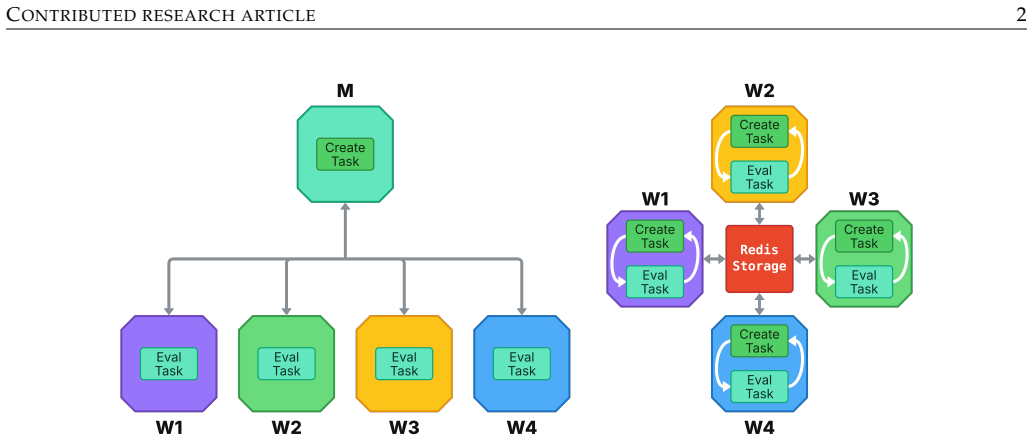
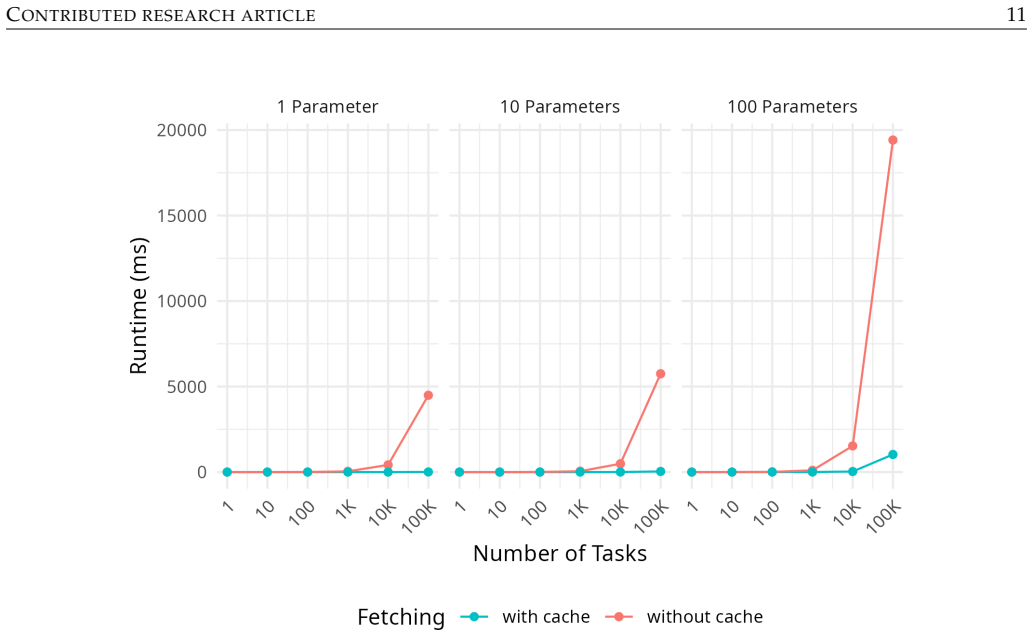
rush is an R package supplying a shared-state coordination layer for asynchronously parallelized iterative algorithms; it uses a Redis database as a shared key-value store so that workers read and write task data through the database and execute their own independent loops, delivering a high-level API for task management with sub-millisecond per-task overhead, robust error handling including automatic lost-worker detection, and efficient caching.
What carries the argument
The Redis-based shared key-value store that lets workers coordinate tasks and lifecycle without a central controller.
If this is right
- Asynchronous decentralized Bayesian optimization becomes directly usable inside R for hyperparameter tuning.
- The mlr3 ecosystem gains native support for async optimization through bbotk and mlr3tuning.
- Task management with automatic worker-failure handling and caching works at scale up to at least 448 workers on LightGBM datasets.
- Other iterative algorithms in statistics and machine learning that rely on shared state can be implemented without a central dispatcher.
Where Pith is reading between the lines
- The same shared-state pattern could be ported to other languages whose parallel packages remain centralized.
- Performance under heterogeneous or high-latency networks would need separate validation beyond the reported benchmark.
- The caching layer may reduce redundant evaluations in longer-running black-box optimization loops.
Load-bearing premise
A Redis key-value store can deliver sub-millisecond overhead and reliable error handling for lost workers under real network conditions and failures without additional mechanisms.
What would settle it
A benchmark of the described asynchronous Bayesian optimization run that measures average per-task overhead above one millisecond or fails to detect lost workers automatically.
Figures

read the original abstract
Many algorithms in statistics and machine learning can be parallelized in an asynchronous manner where workers need to communicate through shared state rather than execute independent tasks dispatched by a central controller. Especially in modern hyperparameter optimization and parallel black-box optimization with expensive objectives, this decentralized approach has become widespread, and several Python frameworks adopt it (e.g., Optuna, DeepHyper, and Hyperopt). However, all popular R packages for parallel computing follow a centralized controller-worker architecture that does not support this pattern. We present rush, an R package that provides a shared-state coordination layer for asynchronously parallelized iterative algorithms. rush uses a Redis database as a shared key-value store: workers read and write task data through the database and independently execute their own loops. The package provides a high-level API for managing tasks and their lifecycle, featuring sub-millisecond per-task overhead, robust error handling with automatic detection of lost workers, and efficient caching. rush optionally integrates with the mlr3 ecosystem, powering asynchronous optimization in the bbotk and mlr3tuning packages. We demonstrate the practical utility of rush by implementing asynchronous decentralized Bayesian optimization (ADBO) and benchmarking it on hyperparameter optimization of LightGBM across four datasets using 448 workers.
Editorial analysis
A structured set of objections, weighed in public.
Referee Report
Summary. The manuscript introduces the rush R package for scalable asynchronous distributed computing using a Redis shared state for task management in iterative algorithms, particularly for hyperparameter optimization. It claims sub-millisecond per-task overhead, robust error handling including automatic lost worker detection, and efficient caching, demonstrated through an implementation of asynchronous decentralized Bayesian optimization on LightGBM hyperparameter tuning with 448 workers across four datasets, integrated with the mlr3 ecosystem.
Significance. If the performance and robustness claims hold, rush would fill a gap in R's parallel computing tools by supporting decentralized asynchronous patterns used in modern ML optimization frameworks like Optuna, potentially benefiting the mlr3 ecosystem. The high-level API and practical demonstration are strengths, but the lack of quantitative results limits evaluation of its significance.
major comments (2)
- [Abstract] Abstract: The claims of 'sub-millisecond per-task overhead' and 'robust error handling with automatic detection of lost workers' lack any supporting quantitative benchmark data, implementation details on Redis operations (such as SET/GET patterns, EXPIRE, WATCH/MULTI, or client-side recovery logic), or measurements under network conditions, making it impossible to verify if these are achieved or merely asserted.
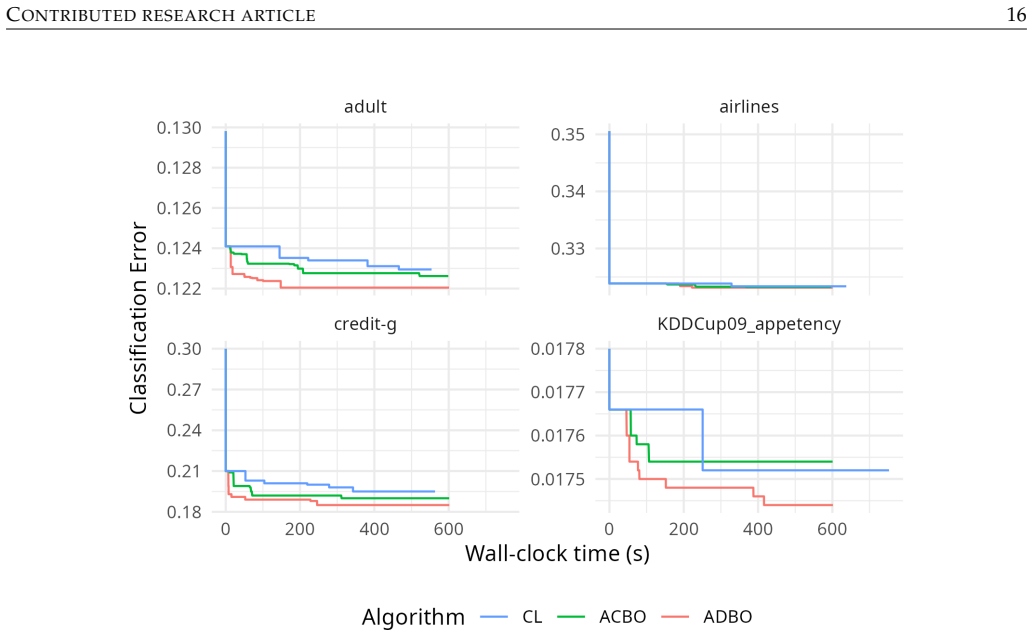
- [Abstract] Abstract: The demonstration of asynchronous decentralized Bayesian optimization is described as using 448 workers across four datasets, but no results, timings, error rates, or comparisons are provided, so the practical utility cannot be assessed from the given information.
Simulated Author's Rebuttal
We thank the referee for their comments. We agree that the abstract would be strengthened by direct references to supporting data and results, and we will revise it in the next version of the manuscript.
read point-by-point responses
-
Referee: [Abstract] Abstract: The claims of 'sub-millisecond per-task overhead' and 'robust error handling with automatic detection of lost workers' lack any supporting quantitative benchmark data, implementation details on Redis operations (such as SET/GET patterns, EXPIRE, WATCH/MULTI, or client-side recovery logic), or measurements under network conditions, making it impossible to verify if these are achieved or merely asserted.
Authors: We acknowledge that the abstract presents these performance and robustness claims without inline quantitative support or implementation specifics. The full manuscript contains benchmark results and Redis usage details in later sections, but the abstract does not reference them. We will revise the abstract to incorporate key quantitative findings and a concise description of the Redis operations and recovery logic. revision: yes
-
Referee: [Abstract] Abstract: The demonstration of asynchronous decentralized Bayesian optimization is described as using 448 workers across four datasets, but no results, timings, error rates, or comparisons are provided, so the practical utility cannot be assessed from the given information.
Authors: We agree that the abstract summarizes the experimental setup but omits outcome metrics. The manuscript's experimental section reports the results of the ADBO runs. We will revise the abstract to include a brief summary of the key timings, error rates, and performance observations from those experiments. revision: yes
Circularity Check
No circularity: software package description with empirical benchmarks only
full rationale
The manuscript presents the rush R package for shared-state asynchronous coordination via Redis. No derivation chain, equations, fitted parameters, or predictions exist. Claims rest on API design, implementation details, and runtime benchmarks (e.g., sub-millisecond overhead on 448 workers for LightGBM tuning). These are direct measurements, not reductions to self-referential inputs. No self-citation load-bearing steps or uniqueness theorems are invoked. The paper is self-contained as an engineering artifact against external benchmarks.
Axiom & Free-Parameter Ledger
Reference graph
Works this paper leans on
-
[1]
doi: 10.1145/3292500.3330701. [p3, 8] T. Barrett, M. Dowle, A. Srinivasan, J. Gorecki, M. Chirico, T. Hocking, B. Schwendinger, and I. Krylov. Data.T able: Extension of Data.Frame,
-
[2]
URL https://doi.org/10.32614/CRAN.package.data. table. R package version 1.18.4. [p4] The R Journal Vol. XX/YY, AAAA 20ZZ ISSN 2073-4859 CONTRIBUTED RESEARCH ARTICLE 17 M. Becker, M. Lang, B. Bischl, and J. Richter. Mlr3tuning: Hyperparameter Optimization for ’mlr3’. Zenodo, July
-
[3]
mlr3mbo: Bayesian Optimization in R
URLhttps://doi.org/10.5281/zenodo.15852621. [p1, 12] M. Becker, J. Richter, M. Lang, L. Schneider, B. Bischl, P . Schratz, M. Binder, S. Fischer, M. Chirico, M. López-Ibáñez, L. Henry, and L. Burk. Bbotk: Black-Box Optimization Toolkit. Zenodo, June 2026a. URLhttps://doi.org/10.5281/zenodo.20669808. [p1] M. Becker, L. Schneider, M. Binder, L. Kotthoff, an...
work page internal anchor Pith review Pith/arXiv arXiv doi:10.5281/zenodo.15852621
-
[4]
ISSN 2073-4859. doi: 10.32614/RJ-2021-048. [p1, 2] J. Bergstra, D. Yamins, and D. Cox. Making a Science of Model Search: Hyperparameter Optimization in Hundreds of Dimensions for Vision Architectures. InProceedings of the 30th International Conference on Machine Learning, pages 115–123. PMLR, Feb
-
[5]
ISSN 1942-4795. doi: 10.1002/widm.1484. [p1] B. Bischl, G. Casalicchio, T. Das, M. Feurer, S. Fischer, P . Gijsbers, S. Mukherjee, A. C. Müller, L. Németh, L. Oala, L. Purucker, S. Ravi, J. N. van Rijn, P . Singh, J. Vanschoren, J. van der Velde, and M. Wever. OpenML: Insights from 10 years and more than a thousand papers.Patterns, 6(7):101317,
-
[6]
doi: 10.1016/j.patter.2025.101317. [p15] X. Bouthillier, C. Tsirigotis, F. Corneau-Tremblay, T. Schweizer, L. Dong, P . Delaunay, F. Normandin, M. Bronzi, D. Suhubdy, R. Askari, M. Noukhovitch, C. Xue, S. Ortiz-Gagné, O. Breuleux, A. Bergeron, O. Bilaniuk, S. Bocco, H. Bertrand, G. Alain, D. Serdyuk, P . Henderson, P . Lamblin, and C. Beckham. Orion: Asyn...
-
[7]
URL https: //doi.org/10.5281/zenodo.3478592. [p3] R. Carnell.Lhs: Latin Hypercube Samples,
-
[8]
URL https://doi.org/10.32614/CRAN.package.lhs. R package version 1.2.1. [p9] R. Egelé, I. Guyon, V . Vishwanath, and P . Balaprakash. Asynchronous decentralized bayesian opti- mization for large scale hyperparameter optimization. In2023 IEEE 19th International Conference on E-Science (e-Science), pages 1–10. IEEE,
-
[9]
doi: 10.1109/e-Science58273.2023.10254839. [p1, 2, 8, 12] R. Egelé, P . Balaprakash, G. M. Wiggins, and B. Eiffert. DeepHyper: A Python Package for Massively Parallel Hyperparameter Optimization in Machine Learning.Journal of Open Source Software, 10 (109):7975, May
-
[10]
ISSN 2475-9066. doi: 10.21105/joss.07975. [p3] S. Fischer, J. Zobolas, R. Sonabend, M. Becker, M. Lang, M. Binder, L. Schneider, L. Burk, P . Schratz, B. C. Jaeger, S. A. Lauer, L. A. Kapsner, M. Mücke, Z. Wang, D. Pulatov, K. Ganz, H. Funk, L. Harutyunyan, P . Camilleri, P . Kopper, A. Bender, B. Zhou, N. German, L. Koers, A. Nazarova, and B. Bischl. Mlr...
-
[11]
ISSN 2475-9066. doi: 10.21105/joss.08331. [p11] R. FitzJohn and R. Ashton.Rrq: Simple Redis Queue,
-
[12]
URL https://doi.org/10.32614/CRAN. package.lgr. R package version 0.5.2. [p6] C. Gao. Mirai: Minimalist Async Evaluation Framework for R. Zenodo, May
-
[13]
URL https: //doi.org/10.5281/zenodo.7912722. [p1, 2, 4] D. Gelernter. Generative communication in Linda.ACM T ransactions on Programming Languages and Systems (TOPLAS), 7(1):80–112, Jan
-
[14]
ISSN 0164-0925. doi: 10.1145/2363.2433. [p1] D. Ginsbourger, R. Le Riche, and L. Carraro. Kriging Is Well-Suited to Parallelize Optimization. In Y. Tenne and C.-K. Goh, editors,Computational Intelligence in Expensive Optimization Problems, pages 131–162. Springer International Publishing, Berlin/Heidelberg,
-
[15]
doi: 10.1007/978-3-642-10701- 6_6. [p1, 11] The R Journal Vol. XX/YY, AAAA 20ZZ ISSN 2073-4859 CONTRIBUTED RESEARCH ARTICLE 18 D. Golovin, B. Solnik, S. Moitra, G. Kochanski, J. Karro, and D. Sculley. Google Vizier: A Service for Black-Box Optimization. InProceedings of the 23rd ACM SIGKDD International Conference on Knowledge Discovery and Data Mining, K...
-
[16]
doi: 10.1145/3097983.3098043. [p1, 3] T. Head, K. Shi, Z. Vinícius, C. Schröder, N. Campos, S. Cereda, T. Fan, K. Shi, J. Schwabedal, M. Pak, F. Callaway, L. Estève, L. Besson, M. Cherti, K. Pfannschmidt, F. Linzberger, C. Cauet, A. Gut, A. Mueller, and A. Fabisch. Scikit-optimize. Zenodo, Mar
-
[17]
URL https://papers.nips.cc/paper_ files/paper/2017/hash/6449f44a102fde848669bdd9eb6b76fa-Abstract.html. [p11] W. M. Landau.Crew: A Distributed Worker Launcher Framework,
2017
-
[18]
URL https://doi.org/ 10.32614/CRAN.package.mlr3oml. R package version 0.12.0. [p11] M. Lang, B. Bischl, and D. Surmann. Batchtools: Tools for R to work on batch systems.The Journal of Open Source Software, 2(10):135, Feb
-
[19]
ISSN 2475-9066. doi: 10.21105/joss.00135. [p1, 2] M. Lang, M. Binder, J. Richter, P . Schratz, F. Pfisterer, S. Coors, Q. Au, G. Casalicchio, L. Kotthoff, and B. Bischl. Mlr3: A modern object-oriented machine learning framework in R.Journal of Open Source Software, 4(44):1903, Dec
-
[20]
ISSN 2475-9066. doi: 10.21105/joss.01903. [p1] L. Li, K. Jamieson, A. Rostamizadeh, E. Gonina, J. Ben-tzur, M. Hardt, B. Recht, and A. Talwalkar. A System for Massively Parallel Hyperparameter Tuning.Proceedings of Machine Learning and Systems, 2:230–246, Mar
-
[21]
URL https://proceedings.mlsys.org/paper_files/paper/2020/ hash/a06f20b349c6cf09a6b171c71b88bbfc-Abstract.html. [p1] R. Liaw, E. Liang, R. Nishihara, P . Moritz, J. E. Gonzalez, and I. Stoica. Tune: A Research Platform for Distributed Model Selection and Training, July
2020
-
[22]
Tune: A Research Platform for Distributed Model Selection and Training
URL https://doi.org/10.48550/arXiv. 1807.05118. Comment: 8 Pages, Presented at the 2018 ICML AutoML workshop. [p3] M. Lindauer, K. Eggensperger, M. Feurer, A. Biedenkapp, D. Deng, C. Benjamins, T. Ruhkopf, R. Sass, and F. Hutter. SMAC3: A Versatile Bayesian Optimization Package for Hyperparame- ter Optimization.Journal of Machine Learning Research, 23(54):1–9,
work page internal anchor Pith review Pith/arXiv arXiv doi:10.48550/arxiv 2018
-
[23]
doi: 10.1609/aimag.v7i2.537. [p1] M. Olson, E. Santorella, L. C. Tiao, S. Cakmak, M. Garrard, S. Daulton, Z. J. Lin, S. Ament, B. Beckerman, E. Onofrey, P . Igusti, C. Lara, B. Letham, C. Cardoso, S. S. Shen, A. C. Lin, M. Grange, E. Kashtelyan, D. Eriksson, M. Balandat, and E. Bakshy. Ax: A Platform for Adaptive Experimentation. In Proceedings of the Fou...
-
[24]
[p3] The R Journal Vol
URL https://github.com/keras-team/keras-tuner. [p3] The R Journal Vol. XX/YY, AAAA 20ZZ ISSN 2073-4859 CONTRIBUTED RESEARCH ARTICLE 19 R Special Interest Group on Databases (R-SIG-DB), H. Wickham, and K. Müller.DBI: R Database Interface,
2073
-
[25]
doi: 10.25080/Majora-7b98e3ed-013. [p3] A. J. Rossini, L. Tierney, and N. Li. Simple Parallel Statistical Computing in R.Journal of Computational and Graphical Statistics, 16(2):399–420,
-
[26]
ISSN 1061-8600. doi: 10.1198/106186007X178979. [p2] D. Salinas, M. Seeger, A. Klein, V . Perrone, M. Wistuba, and C. Archambeau. Syne Tune: A Library for Large Scale Hyperparameter Tuning and Reproducible Research. InProceedings of the First International Conference on Automated Machine Learning, pages 16/1–23. PMLR, Sept
-
[27]
URL https://doi.org/10.32614/CRAN.package.scales. R package version 1.4.0. [p10] C. O. Wilke.Cowplot: Streamlined Plot Theme and Plot Annotations for ’Ggplot2’,
-
[28]
Gupta, Vittorio Orlandi, Chia-Rui Chang, Tianyu Wang, Marco Morucci, Pritam Dey, Thomas J
ISSN 1548-7660. doi: 10.18637/jss. v077.i01. [p8] Marc Becker Ludwig-Maximilians-Universität München Department of Statistics Munich, Germany Munich Center for Machine Learning (MCML) Munich, Germany ORCiD: 0000-0002-8115-0400 marc.becker@stat.uni-muenchen.de Bernd Bischl Ludwig-Maximilians-Universität München Department of Statistics Munich, Germany Muni...
discussion (0)
Sign in with ORCID, Apple, or X to comment. Anyone can read and Pith papers without signing in.