pith. sign in

arxiv: 2606.21449 · v1 · pith:LCWS7O4Hnew · submitted 2026-06-19 · 🧮 math.AG · math.CO

Hilbert's 16th problem for arrangements of curves on a surface

Pith reviewed 2026-06-26 12:57 UTC · model grok-4.3

classification 🧮 math.AG math.CO
keywords Hilbert's sixteenth problemreal curve arrangementscombinatorial encodingDyck wordsrooted treespatchworkingtransverse curvesBézout obstructions
0
0 comments X

The pith

A triple of numbers, Dyck words and trees encodes every topological type of a curve crossing a fixed arrangement on a real surface.

A machine-rendered reading of the paper's core claim, the machinery that carries it, and where it could break.

The paper defines a combinatorial triple (n, W, T) that records how a new curve crosses the cells of a fixed arrangement on a compact real surface: n counts intersections with each fixed component, W is a Dyck word that tracks the order of crossings around each cell, and T is a rooted tree that records how the regions nest. This encoding converts the geometric question of which arrangements are possible into a finite search over triples. The authors then apply the encoding to a direct generalization of Hilbert's sixteenth problem and obtain a complete list of all possible arrangements of three lines with one cubic curve, plus a partial list for three lines with one quartic curve. The classification rests on Bézout obstructions that rule out many triples, on Viro patchworking constructions that realize the surviving triples, and on systematic computer enumeration.

Core claim

Every topological type of a curve transverse to a fixed cellular arrangement of curves on a compact real surface is captured exactly by a triple (n, W, T), where n is the vector of intersection numbers, W is a collection of Dyck words, and T is a collection of rooted trees; this triple is used to enumerate all realizable arrangements of three lines plus a cubic (complete) or quartic (partial) by eliminating impossible intersection data and constructing the rest via patchworking.

What carries the argument

The triple (n, W, T) that records intersection numbers, crossing sequences as Dyck words, and nesting of regions as rooted trees.

If this is right

  • All topological types of three lines plus a cubic are listed by exhaustive search over admissible triples.
  • Bézout-type numerical obstructions eliminate many candidate triples before construction begins.
  • Viro patchworking supplies explicit realizations for the triples that survive the obstructions.
  • A computer library can enumerate and store the complete set of admissible triples for low-degree cases.
  • The same encoding applies directly to any fixed cellular arrangement on a compact surface.

Where Pith is reading between the lines

These are editorial extensions of the paper, not claims the author makes directly.

  • The method could be extended to count arrangements of four lines with a cubic or to surfaces of higher genus by enlarging the fixed arrangement.
  • If the encoding is complete, it supplies a decision procedure for the existence question in the generalized Hilbert problem for any fixed degree and number of components.
  • The tree component of the triple may reveal new combinatorial invariants that distinguish isotopic classes even when intersection numbers agree.

Load-bearing premise

The triple (n, W, T) records every possible topological type of a transverse curve without omissions or duplicates.

What would settle it

Discovery of two distinct triples that describe the same topological type, or of a realizable curve whose crossing data cannot be written as any triple (n, W, T).

Figures
Figures reproduced from arXiv: 2606.21449 by Giacomo Maletto.

Figure 1
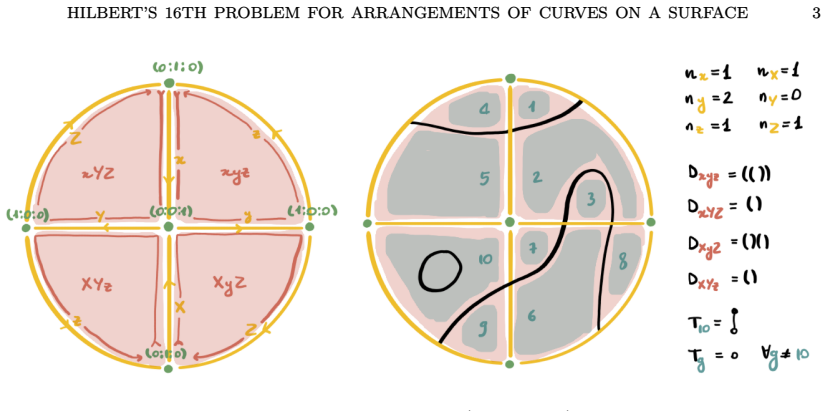
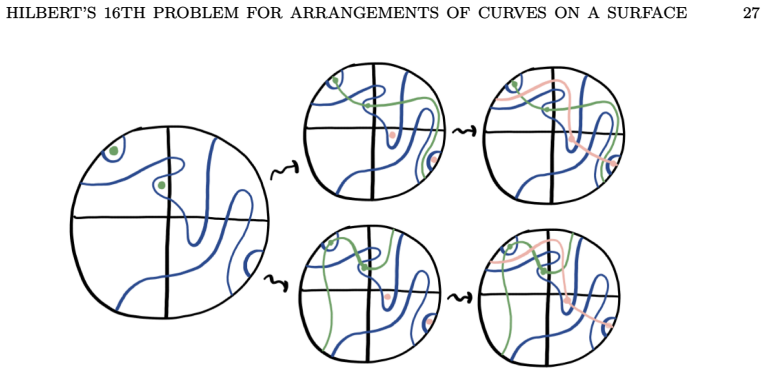
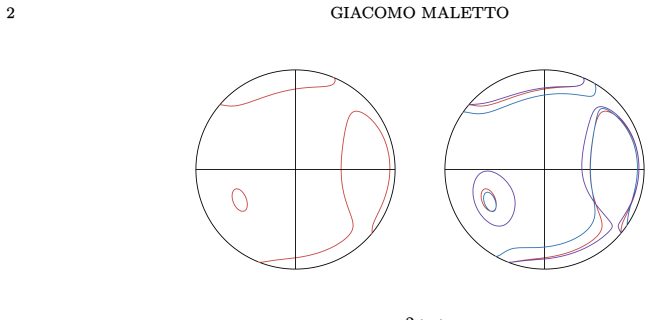
Figure 1. Figure 1: The curve f = 0 in P 2 (R) and some curves with the same topological type. is to frame the classification in combinatorial terms: concretely, we have developed the Julia [21] library NWT [14] to handle large databases of combinatorial curves, and every operation described in this paper has an implementation in this library. Using it, we focus in particular on (1, 1, 1, 3)- and (1, 1, 1, 4)-realizability, i… view at source ↗
Figure 2
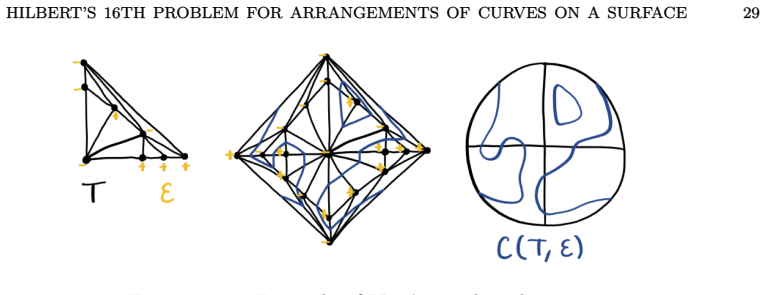
Figure 2. Figure 2: The cell complex induced by (Lx,Ly,Lz) and the combina￾torial curve (n, W, T) induced by (Lx,Ly,Lz, C). We would like to give a “label” to this arrangement, in the same way that the topo￾logical type of a single curve is given by a rooted tree and the information of whether it has a pseudoline or not [§1.2.1]. A natural way to do so is the following: notice first that the base arrangement (Lx,Ly,Lz) divide… view at source ↗
Figure 3
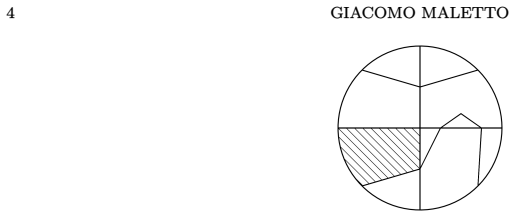
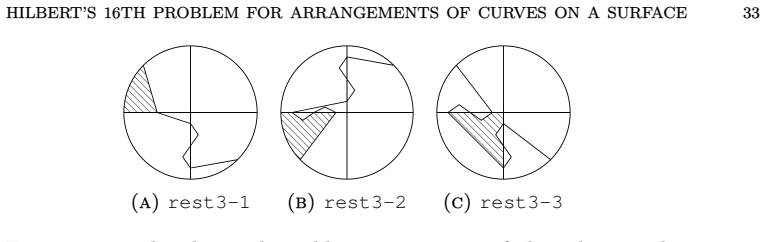
Figure 3. Figure 3: The combinatorial curve nwt drawn with the library NWT. The shading represents a region with a single floating oval. example, we can input the combinatorial curve we just saw as follows (see Remark 3.5 for an explanation of the conventions used): ✞ ☎ nwt = NWT(lines_xyz, #combinatorial cell complex formed by 3 lines on P^2(R) [1, 2, 1, 1, 0, 1], #n [[1, 1, 0, 0], [1, 0], [1, 0, 1, 0], [1, 0]], #W, with 1="… view at source ↗
Figure 4
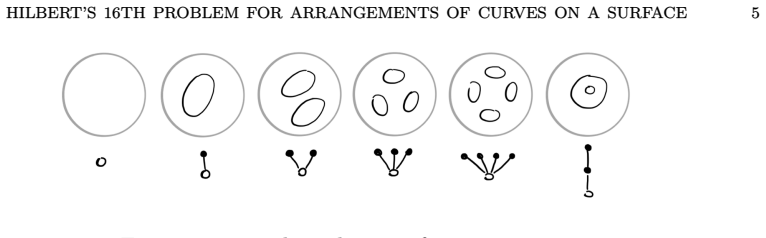
Figure 4. Figure 4: Topological types of quartic curves [PITH_FULL_IMAGE:figures/full_fig_p005_4.png] view at source ↗
Figure 5
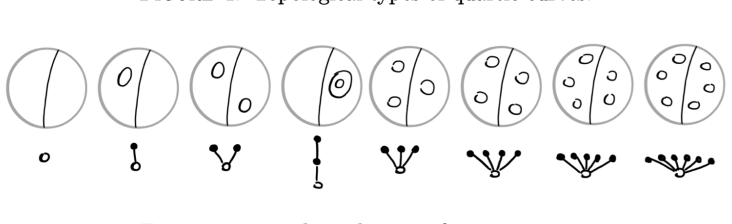
Figure 5. Figure 5: Topological types of quintic curves. • those connected components that are non-trivial as elements of π1(P 2 (R)) are called pseudolines, and there are none if d is even and one if d is odd; • the connected components trivial in π1(P 2 (R)) are called ovals, and each of them separates P 2 (R) into two connected components, one of which is orientable and is called the interior of the oval. A region is a con… view at source ↗
Figure 6
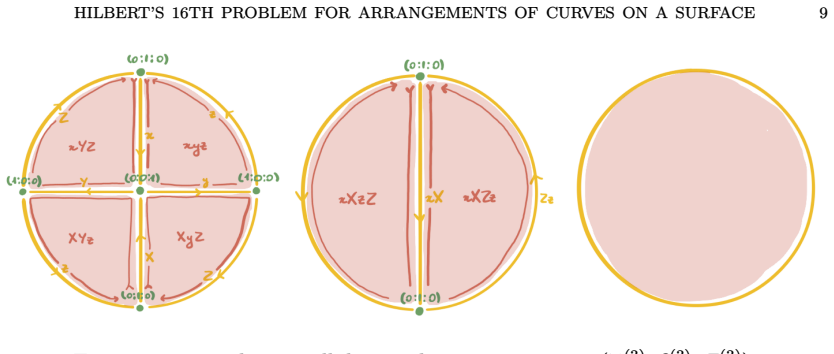
Figure 6. Figure 6: The cellular decompositions (V (3) , E (3) , F (3)), (V (2) , E (2) , F (2)) and the arrangement of one line. • the faces F are the connected components of S \ ( Sk i=0 Ei ∪ V). If e ∈ Ei we say that e has index i. 2.4. Definition. An arrangement (C1, . . . , Ck) is cellular if the induced tuple (V, E, F) is a cellular decomposition. 2.5. Example. On P 2 (R) with homogeneous coordinates (x : y : z) conside… view at source ↗
Figure 7
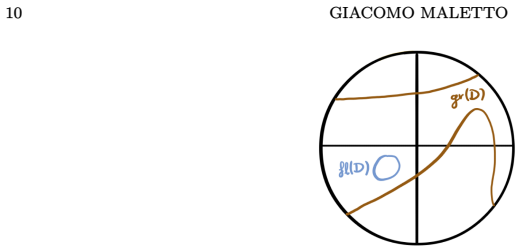
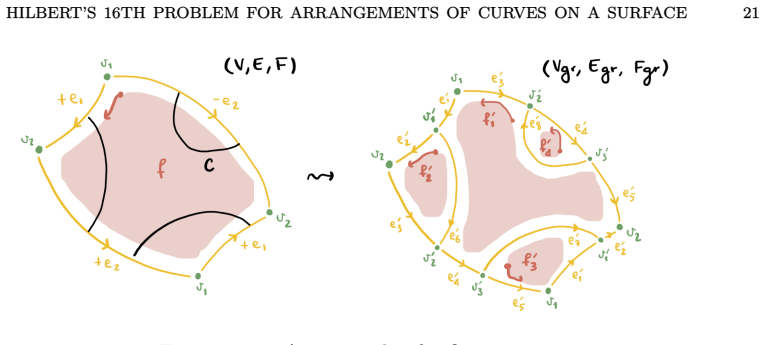
Figure 7. Figure 7: The ground and floating parts of a curve. if their closure meet S E, and floating regions otherwise. We call ground faces the elements of Fgr(D) : each ground face contains exactly one ground region and some floating regions, whose arrangement will be encoded in the floating trees in Definition 3.4. If fl(D) is empty, we say that D is floatless. We first need some definitions and lemmas which will also be … view at source ↗
Figure 8
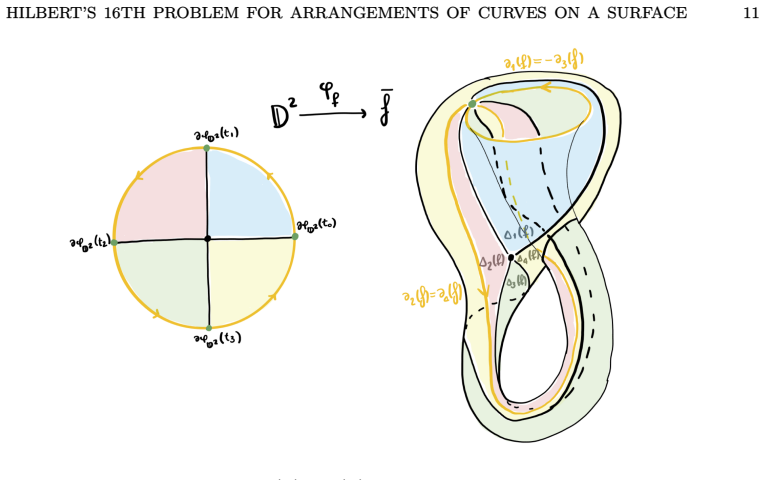
Figure 8. Figure 8: The values of ∂i(f), ∆i(f) for a face whose closure is home￾omorphic to the Klein bottle. two subsets resp. U1, U2 both homeomorphic to B 2 and whose closure is homeomorphic to D 2 ; this proves the first part of the assertion. For uniqueness, consider another curve C ′ with the same properties as C and such that C ′ ∩ ∂D 2 = {p, q}. In the same way as before, the closed curves C ′ ∪ L1, C ′ ∪ L2 enclose r… view at source ↗
Figure 9
Figure 9. Figure 9: The group of automorphisms of (V (3), E(3), F(3)) and (V (2), E(2), F(2)), illustrated through their action on a combinatorial curve. In both cases the first column is the subgroup of i-automorphisms. ∂ϕD2 , adding a “(” or a “)” to the end of the word whenever a component of C is met resp. for the first or second time. 3.4. Definition. Let (V, E, F) be a combinatorial cell complex on S. A combinatorial cu… view at source ↗
Figure 10
Figure 10. Figure 10: An example of refinement. 4.2. Example [PITH_FULL_IMAGE:figures/full_fig_p021_10.png] view at source ↗
Figure 11
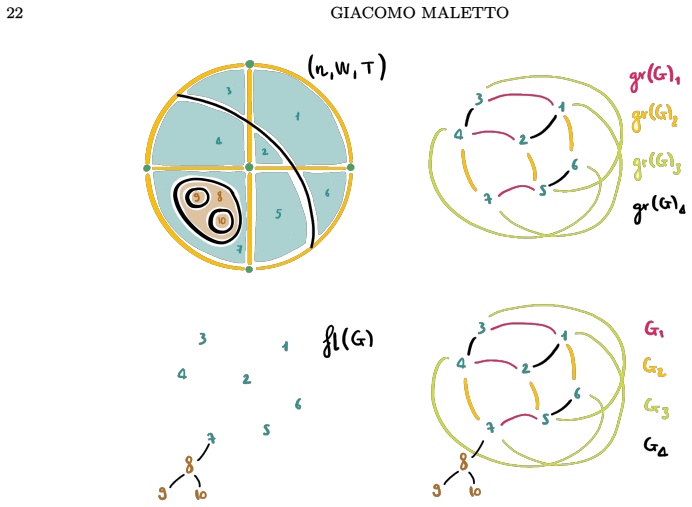
Figure 11. Figure 11: An example of ground, floating and region graphs of a com￾binatorial curve. regions, thus seeing the ground graph gr(G)i as a subgraph of the region graph Gi for all i. 4.4. Removal of edges. Let (V, E, F) be a cellular decomposition with an index func￾tion i: E → {0, 1}. Let D ⋔ (V, E, F) and extend i: Egr → {0, 1, 2} by setting i(e) = 2 for every e ⊂ D. Suppose we are interested in removing from (V, E, … view at source ↗
Figure 12
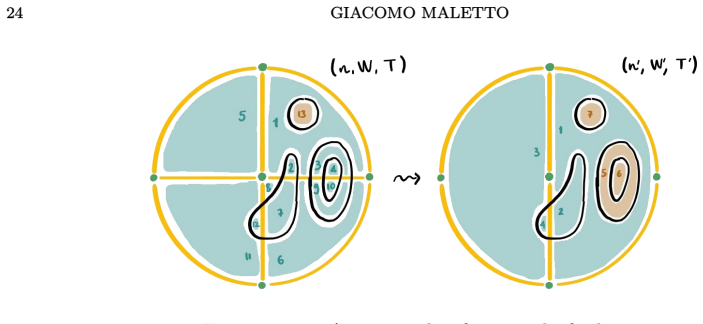
Figure 12. Figure 12: An example of removal of edges. 4.5. Example. In [PITH_FULL_IMAGE:figures/full_fig_p024_12.png] view at source ↗
Figure 13
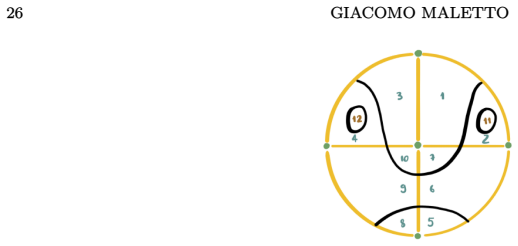
Figure 13. Figure 13: A curve satisfying basic Bézout but not Bézout at order 0 for d = (1, 1, 1, 4). Note that there is a closed walk through regions 11 and 12 crossing the curve 4 times, but no such walk which also crosses each axis exactly once. L transverse to (C1, . . . , Ck, D) going through those regions, which translates to the existence of a combinatorial line satisfying the above requirements on its intersection numb… view at source ↗
Figure 14
Figure 14. Figure 14: An example of combinatorial curve that respects Bézout at order 0 but not at order 1. passing through p ′ i edges of Gi and a walk from r ′ to r passing through p ′′ i edges of Gi : by joining them we get the required combinatorial line. □ 5.6. Bézout’s criterion of order n. The following is a family of Bézout criteria defined for floatless curves. Consider as before a (1, d2, . . . , dk)-arrangement (C1 … view at source ↗
Figure 15
Figure 15. Figure 15: Example of Viro’s patchworking. 6.2. Theorem (Viro). The combinatorial curve C(T , ε) is (1, 1, 1, d)-realizable from the polynomial ft(x, y, z) = X (a,b)∈V ε(a, b)t h(a,b)x a y b z d−a−b for any t > 0 sufficiently small. Proof. Let Ct = {ft = 0}. As stated in [6][Page 382], for t > 0 sufficiently small, the curve Ct is nonsingular, intersects the axes xyz = 0 transversely, and its isotopy type in the spa… view at source ↗
Figure 16
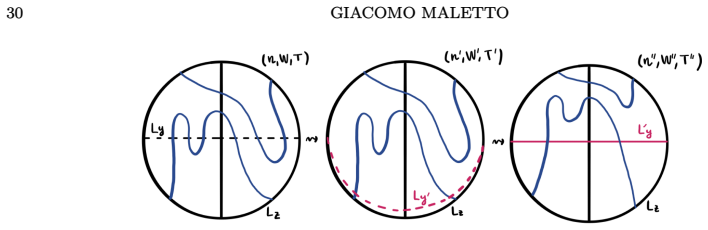
Figure 16. Figure 16: Example of a translation. while the floating trees T ′′ are inherited from T ′ on the faces xyz, xY Z and are trivial on XyZ, XY z. The result (n ′′, W′′, T′′) is the combinatorial curve Dy0 we were looking for. Other trans￾lations can be obtained from this one by applying the automorphisms of (V (3), E(3), F(3)), which do not affect the algebraicity or the degree of the curve since every such auto￾morphi… view at source ↗
Figure 17
Figure 17. Figure 17: The three admissible arrangements of three lines and a cubic not obtainable through Viro’s patchworking [PITH_FULL_IMAGE:figures/full_fig_p033_17.png] view at source ↗
Figure 18
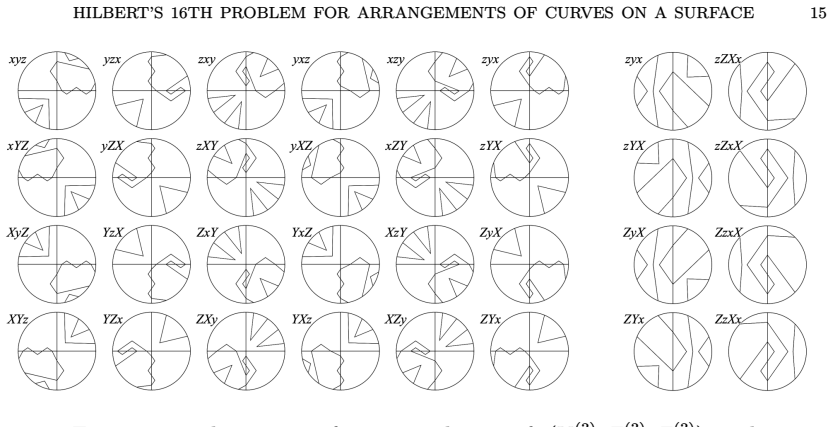
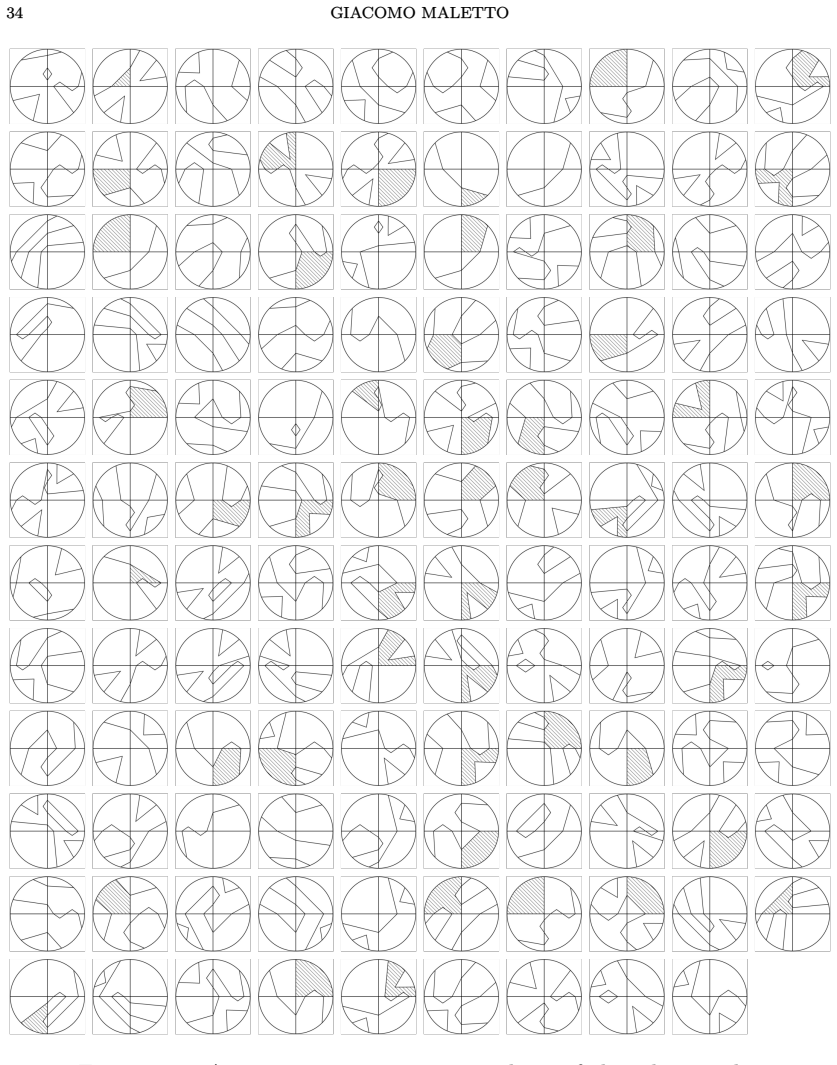
Figure 18. Figure 18: Arrangements up to automorphism of three lines and a cubic. If we specialize our results to floatless configurations ( [PITH_FULL_IMAGE:figures/full_fig_p034_18.png] view at source ↗
Figure 19
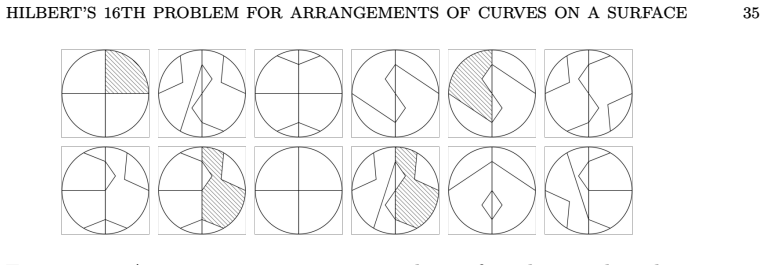
Figure 19. Figure 19: Arrangements up to automorphism of two lines and a cubic [PITH_FULL_IMAGE:figures/full_fig_p035_19.png] view at source ↗
Figure 20
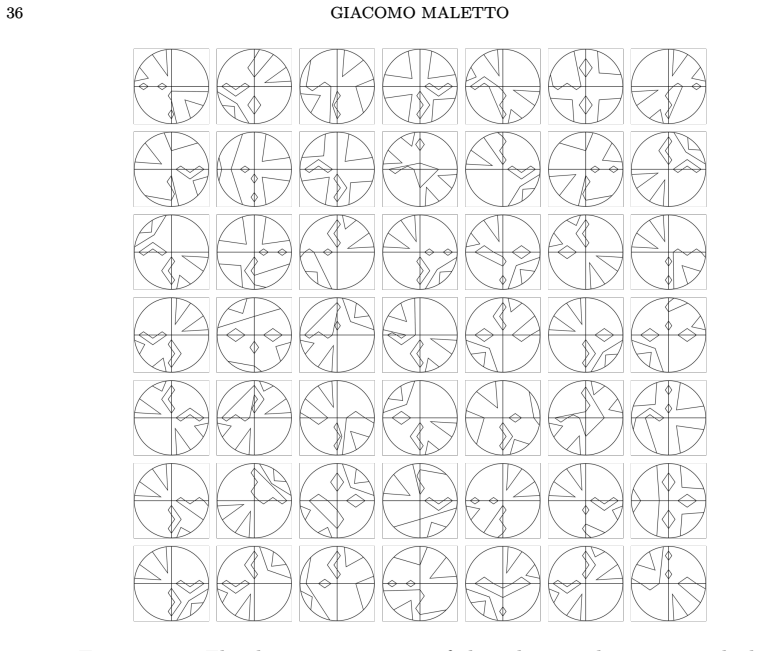
Figure 20. Figure 20: Floatless arrangements of three lines and a quartic which are admissible but not realized [PITH_FULL_IMAGE:figures/full_fig_p036_20.png] view at source ↗
Figure 21
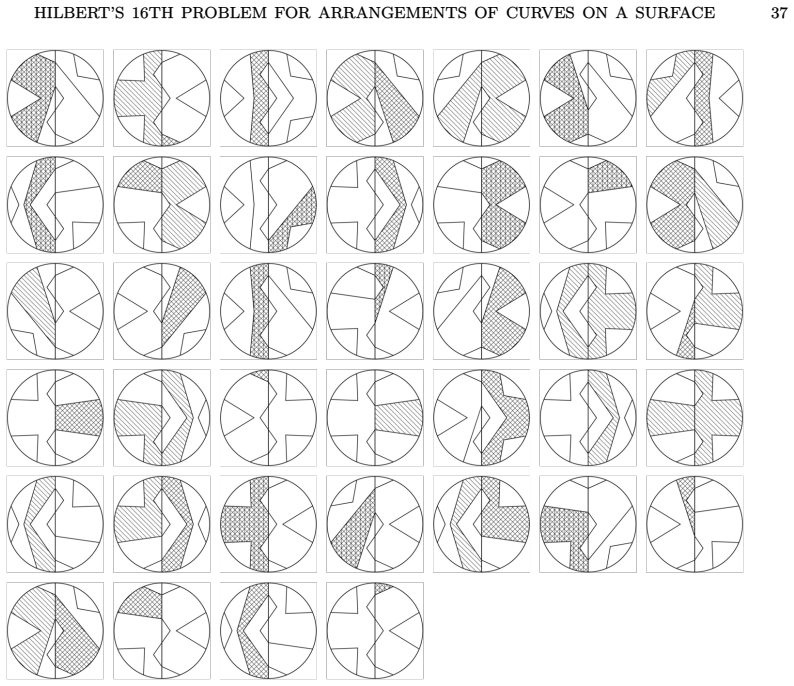
Figure 21. Figure 21: Arrangements of two lines and a quartic curve which are admissible but not realized. The shading represents the number of float￾ing ovals in each ground region [PITH_FULL_IMAGE:figures/full_fig_p037_21.png] view at source ↗
read the original abstract

We introduce a combinatorial structure $(n,W,T)$ encoding the topological type of a curve transverse to a fixed cellular arrangement of curves on a compact real surface, in terms of intersection numbers, Dyck words and rooted trees. We apply this formalism to analyze a natural generalization of Hilbert's 16th problem to arrangements of curves. We obtain a complete classification of arrangements of three lines and a cubic, and a partial classification of arrangements of three lines and a quartic. This is achieved using B\'ezout-type obstructions, Viro's patchworking and translations, and by developing the Julia library NWT to handle large databases of curves.

Editorial analysis

A structured set of objections, weighed in public.

Desk editor's note, referee report, simulated authors' rebuttal, and a circularity audit. Tearing a paper down is the easy half of reading it; the pith above is the substance, this is the friction.

Referee Report

0 major / 2 minor

Summary. The manuscript introduces a combinatorial structure (n,W,T) encoding the topological type of a curve transverse to a fixed cellular arrangement of curves on a compact real surface, expressed via intersection numbers, Dyck words, and rooted trees. It uses this to provide a complete classification of arrangements of three lines and a cubic curve, and a partial classification for three lines and a quartic, leveraging Bézout-type obstructions, Viro's patchworking, and the Julia library NWT for database management.

Significance. Should the (n,W,T) structure prove to be a faithful and complete invariant, and the enumerations exhaustive, this represents a systematic advancement in the study of real curve arrangements on surfaces, extending ideas from Hilbert's 16th problem. The development and use of the NWT library for handling large numbers of curves is a strength, providing a tool for verification and extension of the results.

minor comments (2)
  1. [Introduction] A brief comparison with existing classifications for lower degree cases would help contextualize the new results.
  2. Ensure that all figures illustrating the patchworking constructions are clearly labeled with the corresponding (n,W,T) values.

Simulated Author's Rebuttal

0 responses · 0 unresolved

We thank the referee for their positive assessment of the manuscript and for recommending minor revision. The report accurately summarizes our contributions regarding the (n,W,T) encoding and its applications to Hilbert's 16th problem for curve arrangements. Since no specific major comments or points of criticism were raised, we have no point-by-point rebuttals to provide at this stage.

Circularity Check

0 steps flagged

No significant circularity; classification uses external theorems

full rationale

The paper defines the combinatorial structure (n,W,T) as an encoding of topological types for curves transverse to a fixed arrangement, then enumerates admissible tuples, applies Bézout-type obstructions, and realizes examples via Viro patchworking. These filtering and realization steps rely on standard external results (Bézout theorem, Viro's patchworking) rather than reducing to the paper's own fitted quantities or self-citations. The Julia library NWT is an implementation aid, not a load-bearing derivation step. No quoted equation or claim shows a prediction or classification that is equivalent to its inputs by construction.

Axiom & Free-Parameter Ledger

0 free parameters · 3 axioms · 1 invented entities

The central claim rests on the correctness of the newly introduced (n,W,T) encoding and on the applicability of Bézout-type counting and Viro patchworking to produce the listed classifications. No free parameters are mentioned. The structure itself is an invented combinatorial object whose completeness is assumed.

axioms (3)
  • standard math Standard properties of intersection numbers and topology on compact real surfaces
    Invoked when defining the (n,W,T) structure from intersection data
  • standard math Bézout's theorem supplies valid obstructions to realizability
    Cited as one of the tools used for classification
  • domain assumption Viro's patchworking can realize prescribed topological types
    Used together with translations to construct the classified arrangements
invented entities (1)
  • (n,W,T) combinatorial structure no independent evidence
    purpose: Encoding the topological type of a transverse curve via intersection numbers, Dyck words and rooted trees
    Newly defined in the paper; no independent evidence supplied in the abstract

pith-pipeline@v0.9.1-grok · 5623 in / 1539 out tokens · 32713 ms · 2026-06-26T12:57:58.507879+00:00 · methodology

discussion (0)

Sign in with ORCID, Apple, or X to comment. Anyone can read and Pith papers without signing in.

Reference graph

Works this paper leans on

29 extracted references · 1 canonical work pages

  1. [1]

    Béguin, S

    F. Béguin, S. Crovisier, and F. Le Roux. Fixed point sets of isotopies on surfaces.Journal of the European Mathematical Society (EMS Publishing), 22(6), 2020

  2. [2]

    A. I. Degtyarev.Topology of algebraic curves: an approach via dessins d’enfants, volume 44. Walter de Gruyter, 2012

  3. [3]

    A. I. Degtyarev, I. Itenberg, and V. I. Zvonilov. Real trigonal curves and real elliptic surfaces of type i.arXiv preprint arXiv:1102.3414, 2011

  4. [4]

    A. I. Degtyarev and V. I. Zvonilov. Rigid isotopy classification of real algebraic curves of bidegree (3, 3) on quadrics.Mathematical Notes, 66(6):670–674, 1999

  5. [5]

    Folkman and J

    J. Folkman and J. Lawrence. Oriented matroids.Journal of Combinatorial Theory, Series B, 25(2):199–236, 1978

  6. [6]

    I. M. Gelfand, M. M. Kapranov, and A. V. Zelevinsky.Discriminants, Resultants, and Multidimensional Determinants. Birkhäuser, 1994

  7. [7]

    Gondran and M

    M. Gondran and M. Minoux.Graphs, dioids and semirings: new models and algorithms. Springer, 2008

  8. [8]

    D. R. Grayson and M. E. Stillman. Macaulay2, a software system for research in algebraic geometry, version 1.25.11. Available athttp://www2.macaulay2.com

  9. [9]

    Hatcher.Algebraic Topology

    A. Hatcher.Algebraic Topology. Cambridge University Press, Cambridge, 2002

  10. [10]

    D. Hilbert. Mathematical problems.Bulletin of the American Mathematical Society, 8:437–479, 1902

  11. [11]

    M. W. Hirsch.Differential topology. Springer Science & Business Media, 2012

  12. [12]

    W. R. Inc. Mathematica, Version 14.2.0.0. Champaign, IL, 2026

  13. [13]

    Maclagan and B

    D. Maclagan and B. Sturmfels.Introduction to tropical geometry, volume 161. American Mathematical Soc., 2015

  14. [14]

    G. Maletto. NWT.https://doi.org/10.5281/zenodo.20742383, 2026

  15. [15]

    Manzaroli

    M. Manzaroli. Real algebraic curves of bidegree (5, 5) on the quadric ellipsoid.St. Petersburg Mathematical Journal, 32(2):279–306, 2021

  16. [16]

    Manzaroli

    M. Manzaroli. Real algebraic curves on real del Pezzo surfaces.International Mathematics Research Notices, 2022(2):1350–1413, 2022

  17. [17]

    S. Y. Orevkov. Classification of flexible m-curves of degree 8 up to isotopy.Geometric & Functional Analysis GAFA, 12(4):723–755, 2002

  18. [18]

    Plaumann, B

    D. Plaumann, B. Sturmfels, and C. Vinzant. Quartic curves and their bitangents.Journal of Symbolic Computation, 46(6):712–733, 2011

  19. [19]

    V. A. Rokhlin. Complex topological characteristics of real algebraic curves.Russian Mathematical Surveys, 33(5):85–98, 1978

  20. [20]

    Stillman

    M. Stillman. Topcom: AMacaulay2package. Version 0.95. AMacaulay2package available at https://github.com/Macaulay2/M2/tree/stable/M2/Macaulay2/packages

  21. [21]

    Julia, Version 1.12.6, 2026

    The Julia Language Contributors. Julia, Version 1.12.6, 2026

  22. [22]

    Thomassen

    C. Thomassen. The Jordan-Schönflies theorem and the classification of surfaces.The American Mathematical Monthly, 99(2):116–130, 1992

  23. [23]

    C. D. Toth, J. O’Rourke, and J. E. Goodman.Handbook of discrete and computational geometry. CRC press, 2017

  24. [24]

    O. Viro. Curves of degree 7, curves of degree 8 and the Ragsdale conjecture. InDokl. Akad. Nauk SSSR, volume 254, pages 1305–1310, 1980

  25. [25]

    O. Viro. Patchworking real algebraic varieties.arXiv preprint math/0611382, 2006

  26. [26]

    O. Viro. From the sixteenth Hilbert problem to tropical geometry.Japanese Journal of Mathematics, 3(2):185–214, 2008

  27. [27]

    G. Wilson. Hilbert’s sixteenth problem.Topology, 17(1):53–73, 1978

  28. [28]

    V. I. Zvonilov. Isotopies of real trigonal curves on hirzebruch surfaces.Journal of Mathematical Sciences, 113(6):804–809, 2003

  29. [29]

    V. I. Zvonilov. Chambers and walls in spaces of real algebraic curves of small degrees.arXiv e-prints, pages arXiv–2510, 2025