Linear Tearing Growth and Onset of Relativistic Magnetic Reconnection in the Presence of Shear Flows and a Guide Field
Pith reviewed 2026-06-26 12:39 UTC · model grok-4.3
The pith
Shear flows and guide fields slow the linear growth of the relativistic tearing instability and delay magnetic reconnection onset.
A machine-rendered reading of the paper's core claim, the machinery that carries it, and where it could break.
Core claim
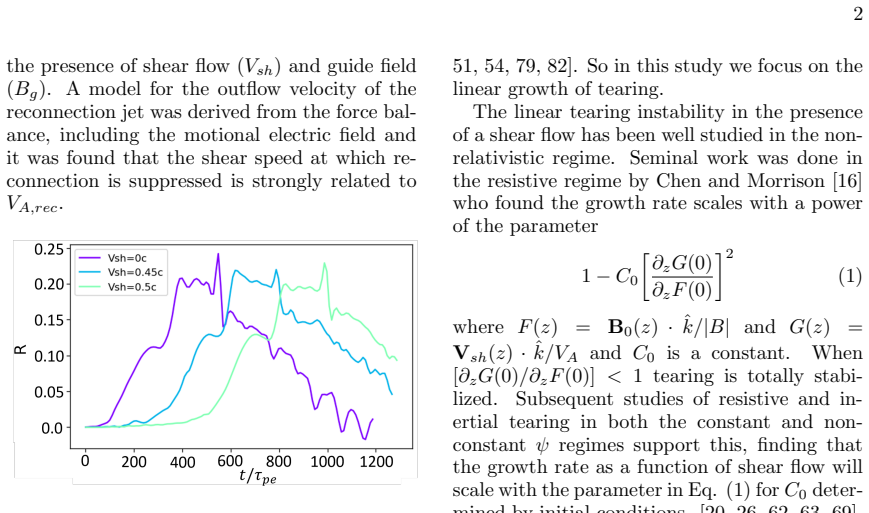
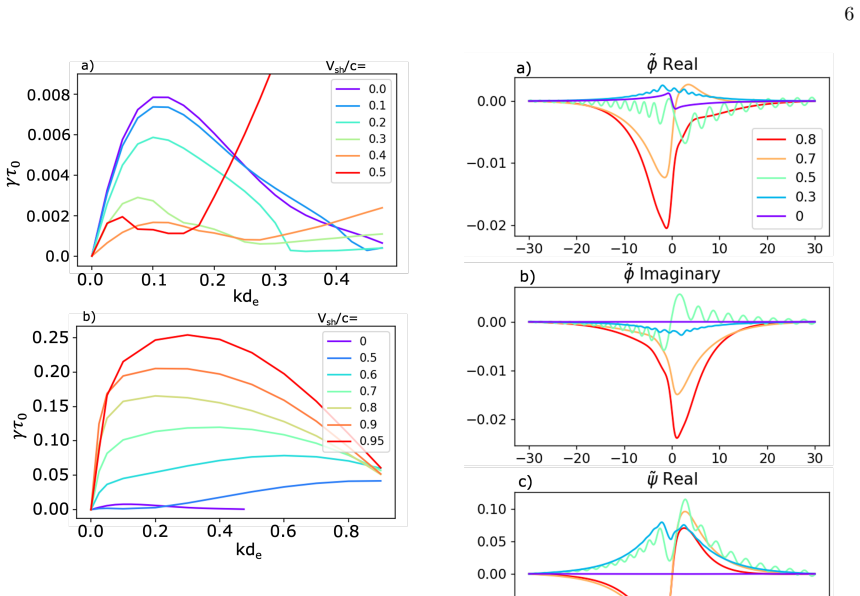
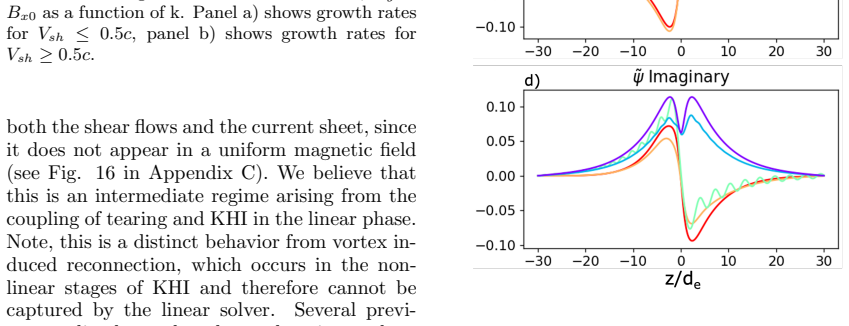
Using particle-in-cell simulations, the authors show that shear flows slow the linear phase of relativistic tearing instability and can delay the onset of magnetic reconnection, with analogous slowing from guide field strength; at higher shear the system passes through an intermediate regime into linear Kelvin-Helmholtz instability. The results are obtained with a new numerical solver for the relativistic tearing growth rate that includes the previously omitted motional electric field.
What carries the argument
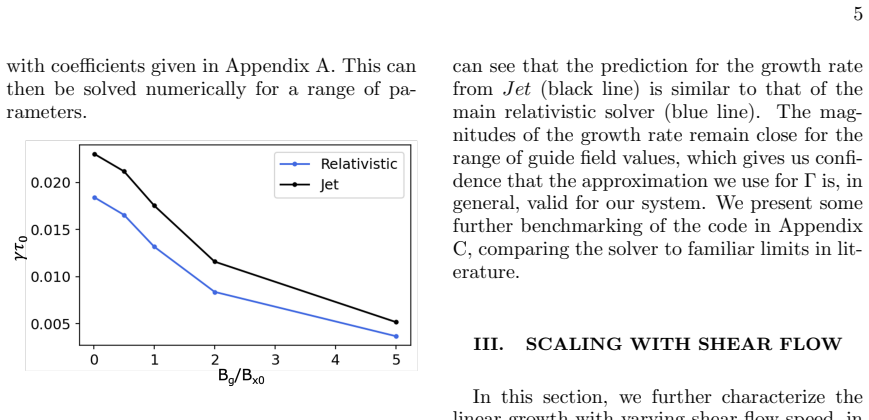
Numerical solver for the growth rate of the relativistic linear tearing instability that incorporates the motional electric field.
If this is right
- Reconnection onset is delayed by the presence of shear flows.
- Increasing guide field strength also reduces the tearing growth rate.
- Above a threshold shear the instability switches to Kelvin-Helmholtz.
- These modifications to onset time apply inside relativistic plasma regimes.
Where Pith is reading between the lines
- The reported dependence on shear and guide field could be tested in laboratory relativistic plasma experiments that control flow shear.
- The solver might be extended to predict onset times in three-dimensional or pair-plasma configurations not examined here.
- Similar slowing effects may appear in other current-sheet instabilities when motional electric fields are retained.
Load-bearing premise
The numerical solver for the relativistic linear tearing instability growth rate accurately incorporates the effects of the motional electric field.
What would settle it
Direct comparison of simulated linear growth rates against the numerical solver predictions across a range of shear-flow speeds and guide-field strengths; systematic mismatch would falsify the reported slowing and transition behaviors.
Figures
read the original abstract
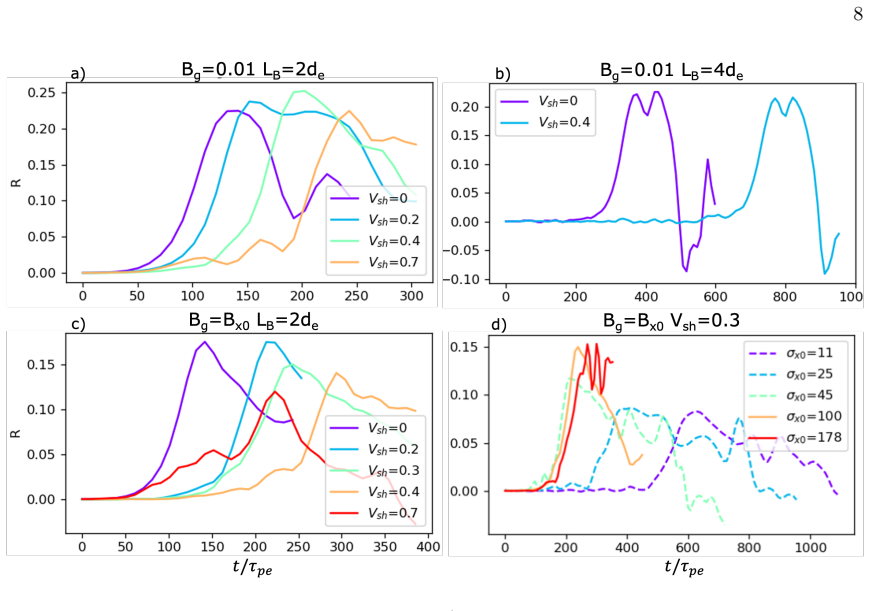
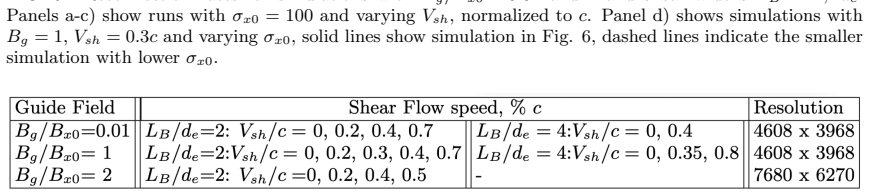
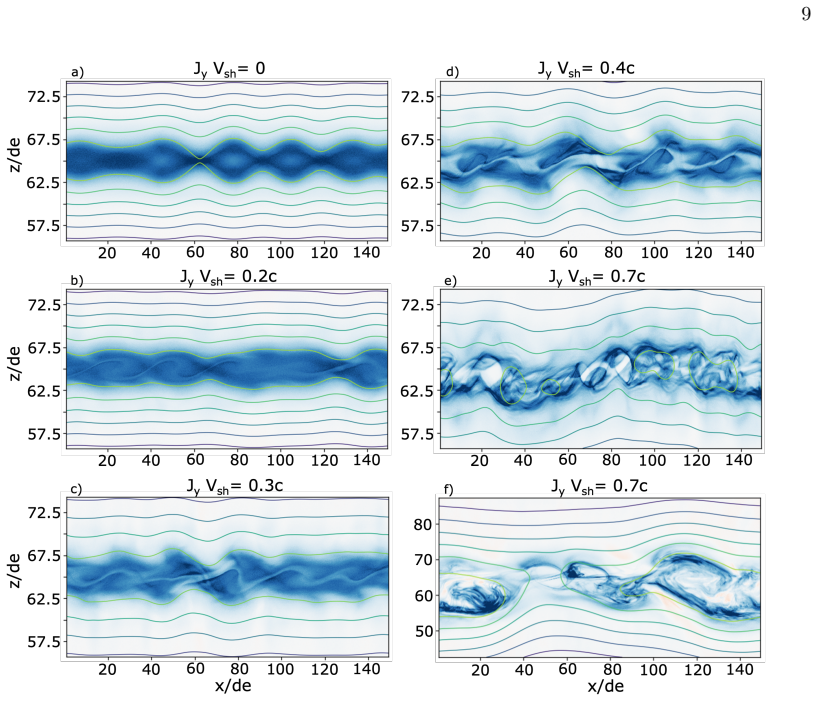
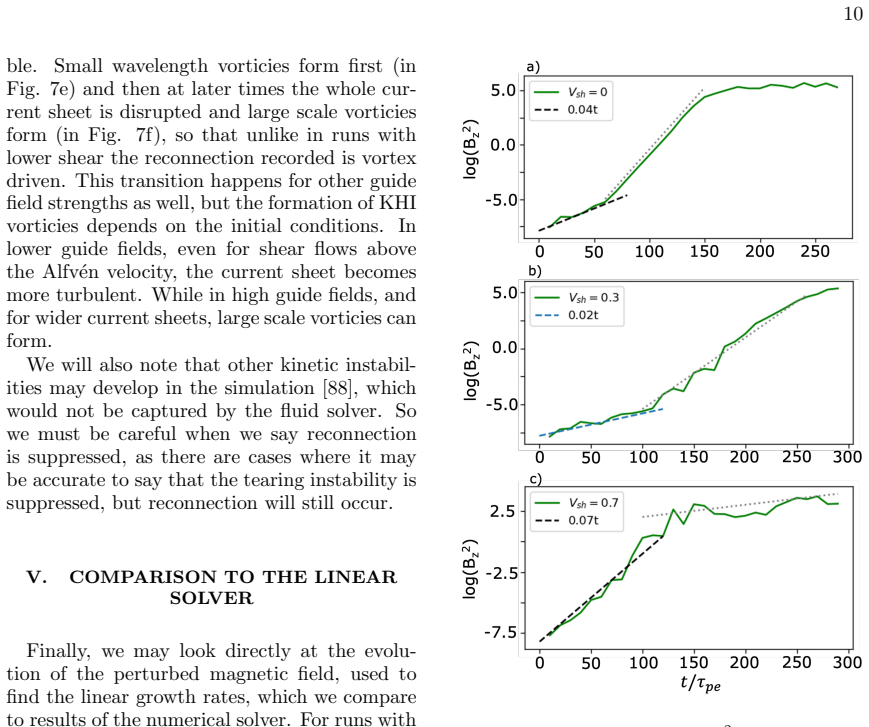
It has been shown in non-relativistic tearing theory that shear flows will slow the linear phase of tearing instability and can delay onset of magnetic reconnection. We find using kinetic particle-in-cell simulations that shear flow as well as guide field strength affect the onset time of relativistic magnetic reconnection. To model this we develop a numerical solver for the growth rate of the relativistic linear tearing instability, including effects of the motional electric field which has not previously been done. We find slowing of growth due to both shear flows and guide field, and at higher flow shear, transition through an intermediate regime to linear Kelvin-Helmholtz instability.
Editorial analysis
A structured set of objections, weighed in public.
Referee Report
Summary. The manuscript develops a numerical solver for the relativistic linear tearing instability growth rate that includes motional electric field effects (previously unaddressed) and uses kinetic PIC simulations to show that both shear flow and guide-field strength slow the linear phase and delay the onset of relativistic magnetic reconnection, with a transition to Kelvin-Helmholtz instability at sufficiently high shear.
Significance. If the solver implementation and its predictions are confirmed, the work would advance understanding of reconnection onset conditions in relativistic plasmas with flows, relevant to astrophysical environments such as pulsar winds or AGN jets. The explicit treatment of motional E in the linear solver is a technical contribution that could be reusable.
major comments (2)
- [solver description and results section] The central claim that shear flow and guide field affect onset time rests on the new relativistic tearing solver (including motional E). No benchmarks are reported against the incompressible MHD tearing mode with flow (standard literature) or the zero-guide-field relativistic limit; without such tests the reported slowing and KH transition cannot be verified as physical rather than numerical artifacts.
- [simulation results] The PIC simulation results on onset times are presented without accompanying error analysis, resolution studies, or demonstration that post-hoc parameter choices (e.g., box size, particle number) do not shift the reported transition thresholds; this is load-bearing for the quantitative statements about onset delay.
minor comments (2)
- [linear solver] Notation for the motional electric field term and its insertion into the dispersion relation should be made explicit with an equation number for reproducibility.
- [figures] Figure captions should state the exact shear parameter values and guide-field strengths used so that the transition to KH can be directly compared with the linear solver output.
Simulated Author's Rebuttal
We thank the referee for their constructive feedback on our manuscript. We address each major comment below and will revise the manuscript accordingly to strengthen the validation of the solver and the robustness of the simulation results.
read point-by-point responses
-
Referee: [solver description and results section] The central claim that shear flow and guide field affect onset time rests on the new relativistic tearing solver (including motional E). No benchmarks are reported against the incompressible MHD tearing mode with flow (standard literature) or the zero-guide-field relativistic limit; without such tests the reported slowing and KH transition cannot be verified as physical rather than numerical artifacts.
Authors: We agree that explicit benchmarks would strengthen confidence in the solver. Although the motional-E term is a novel addition without direct prior literature for benchmarking, the solver reduces to known limits (non-relativistic MHD with flow and relativistic tearing without guide field) that can be compared against established analytical and numerical results. We will add these benchmark comparisons in a revised section to demonstrate that the reported slowing and KH transition are physical. revision: yes
-
Referee: [simulation results] The PIC simulation results on onset times are presented without accompanying error analysis, resolution studies, or demonstration that post-hoc parameter choices (e.g., box size, particle number) do not shift the reported transition thresholds; this is load-bearing for the quantitative statements about onset delay.
Authors: We acknowledge the need for quantitative assessment of numerical uncertainties. In the revised manuscript we will include resolution studies, error estimates on onset times, and explicit checks showing that the reported transition thresholds remain stable under variations in box size and particle number. revision: yes
Circularity Check
No significant circularity; results from independent solver and simulations
full rationale
The paper develops a new numerical solver for relativistic linear tearing growth rates (including motional E) and reports PIC simulation results on onset times. No quoted equations or claims show growth rates or onset times reducing to fitted parameters from the same data, self-definitions, or load-bearing self-citations. The derivation chain is self-contained against external benchmarks.
Axiom & Free-Parameter Ledger
Reference graph
Works this paper leans on
-
[1]
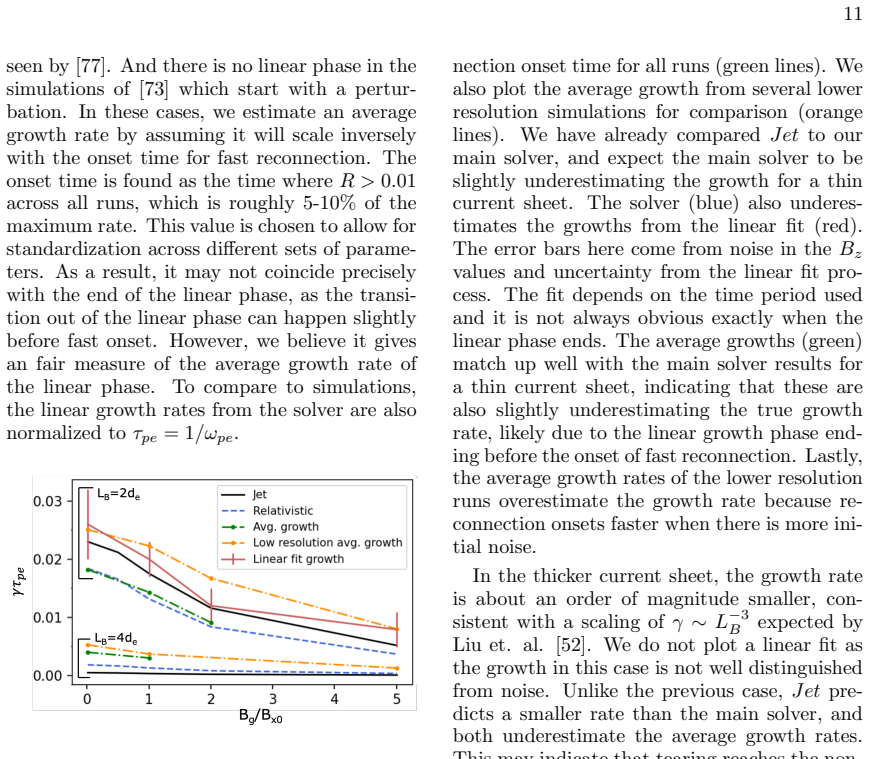
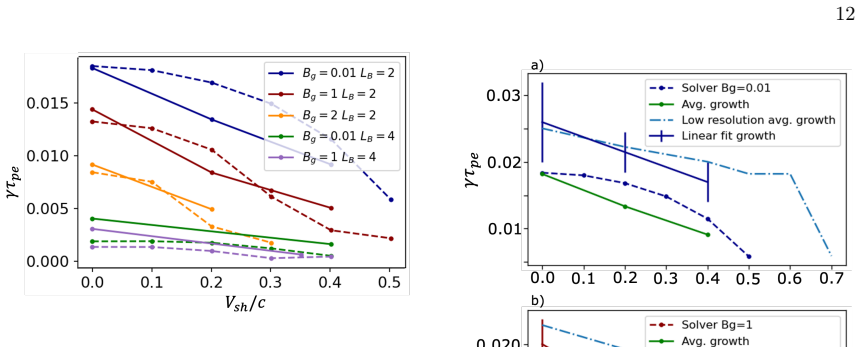
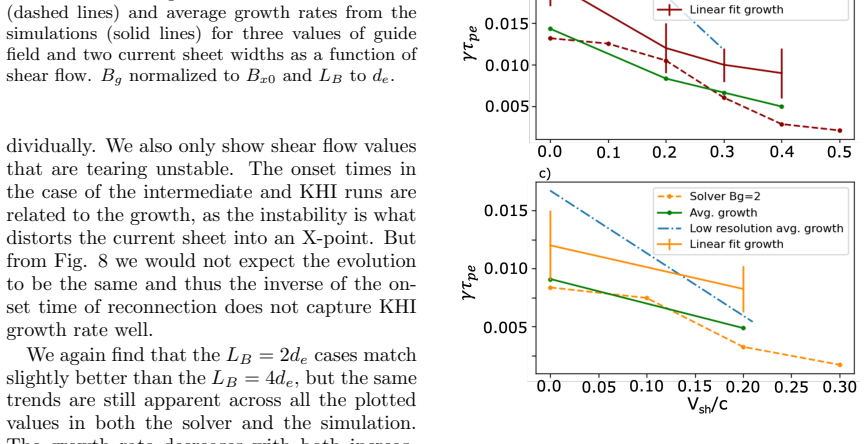
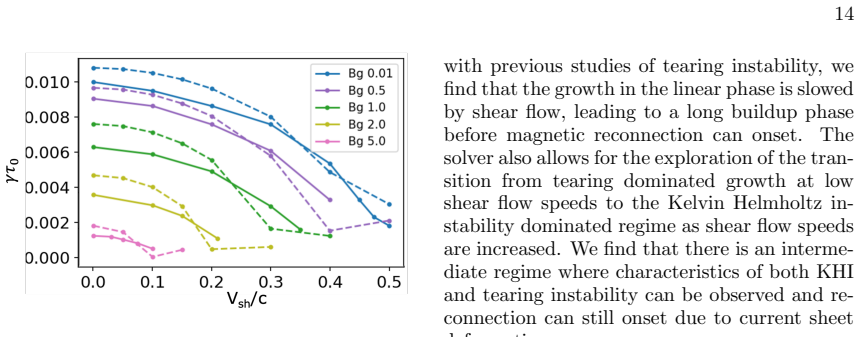
and include for the first time, the effects of the motional electric field, which is not negli- gible when the guide field is finite. Consistent with previous studies of tearing instability, we find that the growth in the linear phase is slowed by shear flow, leading to a long buildup phase before magnetic reconnection can onset. The solver also allows fo...
-
[2]
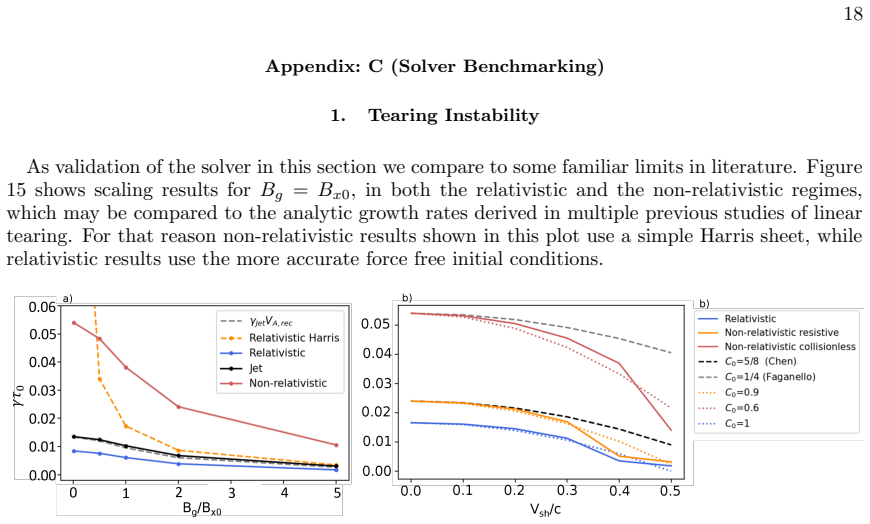
T earing Instability As validation of the solver in this section we compare to some familiar limits in literature. Figure 15 shows scaling results forB g =B x0, in both the relativistic and the non-relativistic regimes, which may be compared to the analytic growth rates derived in multiple previous studies of linear tearing. For that reason non-relativist...
-
[3]
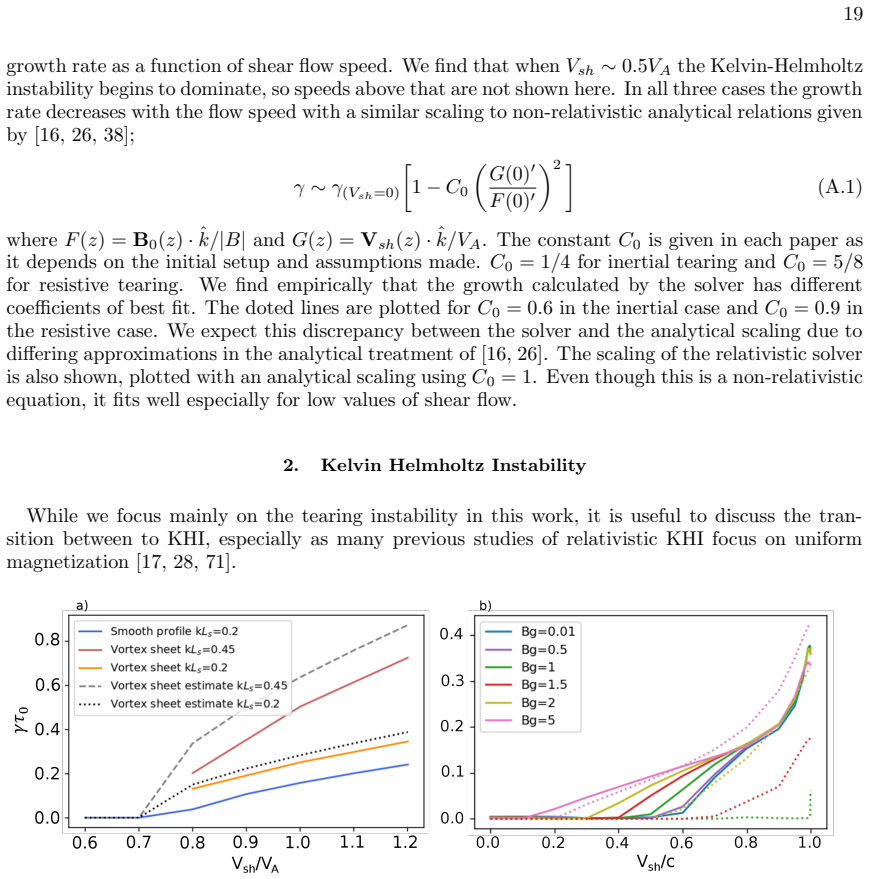
Kelvin Helmholtz Instability While we focus mainly on the tearing instability in this work, it is useful to discuss the tran- sition between to KHI, especially as many previous studies of relativistic KHI focus on uniform magnetization [17, 28, 71]. FIG. 16. Panel a) shows scaling of KHI with uniformB x0 for a smooth velocity profile withkL s = 0.2, (blue...
2048
-
[4]
2014, Physics of Plasmas, 21, 052312
Ali, A., Li, J., & Kishimoto, Y. 2014, Physics of Plasmas, 21, 052312
2014
-
[5]
2012, Space Science Reviews, 173, 341
Arons, J. 2012, Space Science Reviews, 173, 341
2012
-
[6]
D., Bhattacharjee, A., & Huang, Y.-M
Baalrud, S. D., Bhattacharjee, A., & Huang, Y.-M. 2012, Physics of Plasmas, 19, 022101
2012
-
[7]
V., & Komissarov, S
Barkov, M. V., & Komissarov, S. S. 2016, Monthly Notices of the Royal Astronomical Society, 458, 1939
2016
-
[8]
2017, Monthly Notices of the Royal Astronomical Society, 469, 4957
Barniol Duran, R., Tchekhovskoy, A., & Giannios, D. 2017, Monthly Notices of the Royal Astronomical Society, 469, 4957
2017
-
[9]
2019, Monthly Notices of the Royal Astronomical Society, 485, 908
Berlok, T., & Pfrommer, C. 2019, Monthly Notices of the Royal Astronomical Society, 485, 908
2019
-
[10]
2020, Physics of Plasmas, 27, 102106
Betar, H., Del Sarto, D., Ottaviani, M., & Ghizzo, A. 2020, Physics of Plasmas, 27, 102106
2020
-
[11]
2022, Journal of Plasma Physics, 88, 925880601
—. 2022, Journal of Plasma Physics, 88, 925880601
2022
-
[12]
A., Nakamura, T
Blasl, K. A., Nakamura, T. K. M., Plaschke, F., et al. 2022, Physics of Plasmas, 29, 012105
2022
-
[13]
P., Bach, U., et al
Boccardi, B., Krichbaum, T. P., Bach, U., et al. 2016, A&A, 585, A33
2016
-
[14]
J., Albright, B
Bowers, K. J., Albright, B. J., Yin, L., et al. 2009, 180, 012055
2009
-
[15]
A., & Begelman, M
Cerutti, B., Uzdensky, D. A., & Begelman, M. C. 2012, The Astrophysical Journal, 746, 148
2012
-
[16]
R., Uzdensky, D
Cerutti, B., Werner, G. R., Uzdensky, D. A., & Begelman, M. C. 2014, The Astrophysical Journal, 782, 104
2014
-
[17]
1961, Hydrodynamic and hydromagnetic stability (Oxford-Clarendon Press and New York-Oxford Univ
Chandrasekhar, S. 1961, Hydrodynamic and hydromagnetic stability (Oxford-Clarendon Press and New York-Oxford Univ. Press)
1961
-
[18]
1997, Journal of Geophysical Research: Space Physics, 102, 151
Chen, Q., Otto, A., & Lee, L. 1997, Journal of Geophysical Research: Space Physics, 102, 151
1997
-
[19]
1990, Physics of Fluids B Plasma Physics, 2, 495
Chen, X., & Morrison, P. 1990, Physics of Fluids B Plasma Physics, 2, 495
1990
-
[20]
E., Sironi, L., et al
Chow, A., Rowan, M. E., Sironi, L., et al. 2023, Monthly Notices of the Royal Astronomical Society, 524, 90
2023
-
[21]
1976, Resistive internal kink modes, Tech
Coppi, B., Galvao, R., Pellat, R., Rosenbluth, M., & Rutherford, P. 1976, Resistive internal kink modes, Tech. rep., Princeton Plasma Physics Lab. (PPPL), Princeton, NJ (United States).https: //www.osti.gov/biblio/7268294
arXiv 1976
-
[22]
Coroniti, F. V. 1990, Astrophys. J., 349, 538
1990
-
[23]
2024, Physics of Plasmas, 31, 032106
De Jonghe, J., & Keppens, R. 2024, Physics of Plasmas, 31, 032106
2024
-
[24]
2016, Monthly Notices of the Royal Astronomical Society, 460, 3753
Del Zanna, L., Papini, E., Landi, S., Bugli, M., & Bucciantini, N. 2016, Monthly Notices of the Royal Astronomical Society, 460, 3753
2016
-
[25]
2024, Journal of Plasma Physics, 90, 905900619
Demidov, I., & Lyubarsky, Y. 2024, Journal of Plasma Physics, 90, 905900619
2024
-
[26]
2025, The Astrophysical Journal, 979, 104
—. 2025, The Astrophysical Journal, 979, 104
2025
-
[27]
Drenkhahn, G., & Spruit, H. C. 2002, A&A, 391, 1141
2002
-
[28]
1986, The Physics of Fluids, 29, 2563 22
Einaudi, G., & Rubini, F. 1986, The Physics of Fluids, 29, 2563 22
1986
-
[29]
2010, Physics of Plasmas, 17, 062102
Faganello, M., Pegoraro, F., Califano, F., & Marradi, L. 2010, Physics of Plasmas, 17, 062102
2010
-
[30]
2021, Plasma Physics and Controlled Fusion
Faganello, M., Sisti, M., Califano, F., & Lavraud, B. 2021, Plasma Physics and Controlled Fusion
2021
-
[31]
1980, Monthly Notices of the Royal Astronomical Society, 193, 469
Ferrari, A., Trussoni, E., & Zaninetti, L. 1980, Monthly Notices of the Royal Astronomical Society, 193, 469
1980
-
[32]
2024, AA, 690, A389
Figueiredo, E., Cerutti, B., Mehlhaff, J., & Scepi, N. 2024, AA, 690, A389
2024
-
[33]
P., Killeen, J., & Rosenbluth, M
Furth, H. P., Killeen, J., & Rosenbluth, M. N. 1963, The Physics of Fluids, 6, 459
1963
-
[34]
N., & Hollerbach, R
Gourgouliatos, K. N., & Hollerbach, R. 2016, Monthly Notices of the Royal Astronomical Society, 463, 3381
2016
-
[35]
2009, Nonlinear Processes in Geophysics, 16, 241
Grasso, D., Borgogno, D., Pegoraro, F., & Tassi, E. 2009, Nonlinear Processes in Geophysics, 16, 241. https://npg.copernicus.org/articles/16/241/2009/
2009
-
[36]
1996, Journal of Atmospheric and Terrestrial Physics, 58, 613
Gudkov, M., & Troshichev, O. 1996, Journal of Atmospheric and Terrestrial Physics, 58, 613
1996
-
[37]
2014, Phys
Guo, F., Li, H., Daughton, W., & Liu, Y.-H. 2014, Phys. Rev. Lett., 113, 155005
2014
-
[38]
2015, The Astrophysical Journal, 806, 167
Guo, F., Liu, Y.-H., Daughton, W., & Li, H. 2015, The Astrophysical Journal, 806, 167
2015
-
[39]
Hamlin, N. D. 2012, Phd thesis, UCLA
2012
-
[40]
D., & Newman, W
Hamlin, N. D., & Newman, W. I. 2013, Phys. Rev. E, 87, 043101
2013
-
[41]
1975, Plasma Physics, 17, 143.https://dx.doi.org/10.1088/0032-1028/17/2/005
Hofman, I. 1975, Plasma Physics, 17, 143.https://dx.doi.org/10.1088/0032-1028/17/2/005
-
[42]
2021, Physics of Plasmas, 28, 062106
Hoshino, M. 2021, Physics of Plasmas, 28, 062106
2021
-
[43]
2012, Space Science Reviews, 173, 521–533
Hoshino, M., & Lyubarsky, Y. 2012, Space Science Reviews, 173, 521–533
2012
-
[44]
2018, Physics of Plasmas, 25, 102117
Hosseinpour, M., Chen, Y., & Zenitani, S. 2018, Physics of Plasmas, 25, 102117
2018
-
[45]
2015, Journal of Plasma Physics, 81, 905810606
Jain, N., & Buchner, J. 2015, Journal of Plasma Physics, 81, 905810606
2015
-
[46]
2015, Space Science Reviews, 191, 545
Kagan, D., Sironi, L., Cerutti, B., & Giannios, D. 2015, Space Science Reviews, 191, 545
2015
-
[47]
Keppens, R., Toth, G., Westermann, R. H. J., & Goedbloed, J. P. 1999, Journal of Plasma Physics, 61, 1–19
1999
-
[48]
G., & Skjæraasen, O
Kirk, J. G., & Skjæraasen, O. 2003, Astrophys. J., 591, 366
2003
-
[49]
2009, The Astrophysical Journal, 696, 2220
Koide, S. 2009, The Astrophysical Journal, 696, 2220
2009
-
[50]
S., Barkov, M., & Lyutikov, M
Komissarov, S. S., Barkov, M., & Lyutikov, M. 2006, Monthly Notices of the Royal Astronomical Society, 374, 415
2006
-
[51]
1983, Plasma Physics and Controlled Fusion, 89, 293
Landi, S., Papini, E., Del Zanna, L., Tenerani, A., & Pucci, F. 1983, Plasma Physics and Controlled Fusion, 89, 293
1983
-
[52]
H., & Ma, Z
Li, J. H., & Ma, Z. W. 2010, Journal of Geophysical Research: Space Physics, 115
2010
-
[53]
C., Liu, Y.-H., & Qi, Y
Li, T. C., Liu, Y.-H., & Qi, Y. 2021, The Astrophysical Journal Letters, 909, L28
2021
-
[54]
2020, The Astrophysical Journal Letters, 890, L15
Liu, D., Lu, S., Lu, Q., Ding, W., & Wang, S. 2020, The Astrophysical Journal Letters, 890, L15
2020
-
[55]
2014, Physics of Plasmas, 21
Liu, Y.-H., Daughton, W., Karimabadi, H., Li, H., & Peter Gary, S. 2014, Physics of Plasmas, 21
2014
-
[56]
2020, The Astrophysical Journal, 892, L13
Liu, Y.-H., Lin, S.-C., Hesse, M., et al. 2020, The Astrophysical Journal, 892, L13
2020
-
[57]
F., Cowley, S
Loureiro, N. F., Cowley, S. C., Dorland, W. D., Haines, M. G., & Schekochihin, A. A. 2005, Phys. Rev. Lett., 95, 235003
2005
-
[58]
2013, Plasma Physics and Controlled Fusion, 55, 085019
Lu, Q., Lu, S., Huang, C., Wu, M., & Wang, S. 2013, Plasma Physics and Controlled Fusion, 55, 085019
2013
-
[59]
Lyubarsky, Y., & Kirk, J. G. 2001, Astrophys. J., 547, 437
2001
-
[60]
2002, The Astrophysical Journal, 580, L65
Lyutikov, M. 2002, The Astrophysical Journal, 580, L65
2002
-
[61]
2003, The Astrophysical Journal, 589, 893–901
Lyutikov, M., & Uzdensky, D. 2003, The Astrophysical Journal, 589, 893–901
2003
-
[62]
2018, Journal of Plasma Physics, 84, 905840501
MacTaggart, D. 2018, Journal of Plasma Physics, 84, 905840501
2018
-
[63]
2020, The Tearing Instability of Resistive Magnetohydrodynamics, ed
—. 2020, The Tearing Instability of Resistive Magnetohydrodynamics, ed. D. MacTaggart & A. Hillier (Cham: Springer International Publishing), 37–67
2020
-
[64]
2021, Physics of Plasmas, 28, 072103
Mahapatra, J., Bokshi, A., Ganesh, R., & Sen, A. 2021, Physics of Plasmas, 28, 072103
2021
-
[65]
2025, Journal of Plasma Physics, 91, E62
Mallet, A., Eriksson, S., Swisdak, M., & Juno, J. 2025, Journal of Plasma Physics, 91, E62
2025
-
[66]
2025, Journal of Plasma Physics, 91, E146
—. 2025, Journal of Plasma Physics, 91, E146
2025
-
[67]
2022, Physical Review Letters, 128
Mbarek, R., Haggerty, C., Sironi, L., Shay, M., & Caprioli, D. 2022, Physical Review Letters, 128
2022
-
[68]
Miura, A., & Pritchett, P. L. 1982, Journal of Geophysical Research: Space Physics, 87, 7431
1982
-
[69]
2013, Journal of Geophysical Research, 118, 5742
Nakamura, T., Daughton, W., Karimabadi, H., & Eriksson, S. 2013, Journal of Geophysical Research, 118, 5742
2013
-
[70]
Nakamura, T. K. M., Hasegawa, H., Shinohara, I., & Fujimoto, M. 2011, Journal of Geophysical Research (Space Physics), 116, A03227 23
2011
-
[71]
Nakamura, T. K. M., Blasl, K. A., Hasegawa, H., et al. 2022, Physics of Plasmas, 29, 012901
2022
-
[72]
J., & Steinolfson, R
Ofman, L., Morrison, P. J., & Steinolfson, R. S. 1993, Physics of Fluids B: Plasma Physics, 5, 376
1993
-
[73]
1972, Planetary and Space Science, 20, 1
Ong, R., & Roderick, N. 1972, Planetary and Space Science, 20, 1
1972
-
[74]
2008, AA, 490, 493
Osmanov, Z., Mignone, A., Massaglia, S., Bodo, G., & Ferrari, A. 2008, AA, 490, 493
2008
-
[75]
1993, Phys
Ottaviani, M., & Porcelli, F. 1993, Phys. Rev. Lett., 71, 3802.https://link.aps.org/doi/10.1103/ PhysRevLett.71.3802
1993
-
[76]
2024, The Astrophysical Journal, 964, 144
Peery, S., Liu, Y.-H., & Li, X. 2024, The Astrophysical Journal, 964, 144
2024
-
[77]
2025, Physics of Plasmas, 32, 042112
Peyrichon, G., El-Rabii, H., Ripoll, J.-F., et al. 2025, Physics of Plasmas, 32, 042112
2025
-
[78]
Roychoudhury, S., & Lovelace, R. V. E. 1986, Astrophys. J., 302, 188
1986
-
[79]
2008, Physics of Plasmas, 15, 082901
Roytershteyn, V., & Daughton, W. 2008, Physics of Plasmas, 15, 082901
2008
-
[80]
2025, Journal of Plasma Physics, 91, E42
Schoeffler, K., Eichmann, B., Pucci, F., & Innocenti, M. 2025, Journal of Plasma Physics, 91, E42
2025
discussion (0)
Sign in with ORCID, Apple, or X to comment. Anyone can read and Pith papers without signing in.