Relating tournaments and permutations with xrays
Pith reviewed 2026-06-26 13:42 UTC · model grok-4.3
The pith
A construction uses any permutation to build 1- and 2-tournaments whose score sequences equal the permutation's xray.
A machine-rendered reading of the paper's core claim, the machinery that carries it, and where it could break.
Core claim
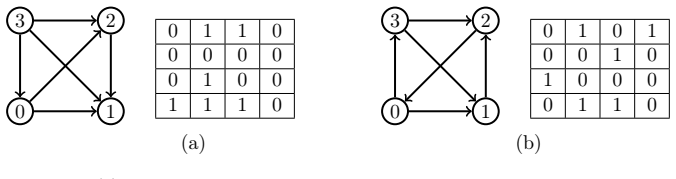
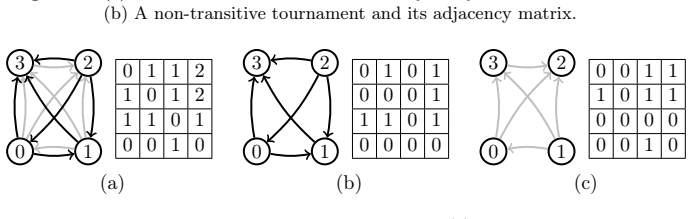
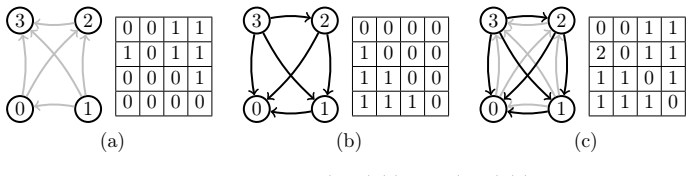
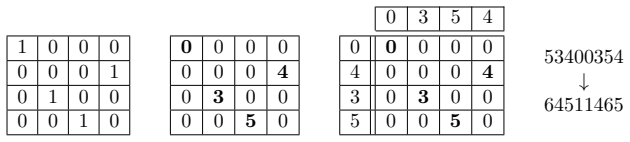
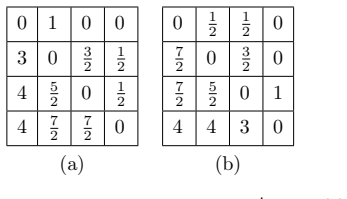
We first introduce the concept of a transitive tournament decomposition of k-tournaments, then present a construction by which a permutation is used to build 1- and 2-tournaments whose score sequences agree with the xray of the permutation in the manner outlined by Bebeacua et al. and Brualdi and Fritscher. We close with an investigation of xrays with restricted terms, including binary xrays, and show that the recent conjectures by Bebeacua et al. and Brualdi and Fritscher are special cases of a more general statement, which we conjecture and for which we provide supporting evidence.
What carries the argument
The transitive tournament decomposition of k-tournaments, which is used to turn the xray entries of a permutation into the out-degrees of the constructed 1- and 2-tournaments.
If this is right
- The conjectures of Bebeacua et al. and Brualdi and Fritscher hold as immediate special cases.
- The same correspondence holds for every admissible restriction on the terms of the xray.
- Every admissible xray term set is realized as the score sequence of some tournament obtained from the construction.
- Binary xrays are realized precisely by the score sequences of ordinary tournaments via this method.
Where Pith is reading between the lines
- The explicit mapping supplies a uniform generator for families of tournaments and 2-tournaments indexed by permutations.
- The method suggests a route for extending the correspondence to k-tournaments when k exceeds 2 by iterating the decomposition.
- Verification of the general conjecture on small permutations would give concrete evidence that can be checked by direct computation of xrays and constructed scores.
Load-bearing premise
The construction always produces a valid tournament or 2-tournament whose scores exactly equal the given xray for every permutation and every admissible choice of restricted terms.
What would settle it
Any specific permutation together with an admissible xray term set for which the constructed directed graph either contains a pair of vertices with no edge or two edges in opposite directions, or for which at least one vertex score differs from the corresponding xray value.
Figures
read the original abstract
In a 2005 paper, Bebeacua et al. investigated the xrays of permutations, and conjectured a correspondence between binary xrays and score sequences of tournaments. In 2014, Brualdi and Fritscher conjectured a possible correspondence between score sequences of $2$-tournaments and (not necessarily binary) xrays of permutations. In this paper, we first introduce the concept of a transitive tournament decomposition of $k$-tournaments, then present a construction by which a permutation is used to build $1$- and $2$-tournaments whose score sequences agree with the xray of the permutation in the manner outlined by Bebeacua et al. and Brualdi and Fritscher. We close with an investigation of xrays with restricted terms, including binary xrays, and show that the recent conjectures by Bebeacua et al. and Brualdi and Fritscher are special cases of a more general statement, which we conjecture and for which we provide supporting evidence.
Editorial analysis
A structured set of objections, weighed in public.
Referee Report
Summary. The paper introduces the notion of a transitive tournament decomposition for k-tournaments and gives an explicit construction that, for any permutation, produces a 1-tournament and a 2-tournament whose score sequences equal the x-ray of the permutation (in the sense of Bebeacua et al. and Brualdi-Fritscher). It then shows that the two existing conjectures are special cases of a more general statement about x-rays with restricted terms, states that general statement as a conjecture, and supplies supporting evidence (primarily for binary x-rays).
Significance. If the construction is shown to be valid for every permutation and every admissible term restriction, the work would resolve the two cited conjectures and supply a uniform combinatorial bridge between permutation x-rays and tournament score sequences. The explicit construction and the reduction of prior conjectures to a single statement are the main contributions.
major comments (3)
- [§3] §3 (Construction): the manuscript asserts that the mapping from permutation to 1-tournament always yields a complete oriented graph (exactly one directed edge between every pair), yet supplies neither an inductive argument nor a direct verification that out-degrees are correctly realized for arbitrary n. A small-n exhaustive check or a short proof that the orientation rule never produces bidirectional or missing edges is required.
- [§4] §4 (2-tournaments and general x-rays): the claim that the same construction produces a 2-tournament whose score sequence exactly matches an arbitrary admissible x-ray term set rests on the definition of the edge multiplicities; no general argument is given that the resulting multiset of out-degrees coincides with the prescribed x-ray for every choice of term restrictions. The supporting evidence appears to be computational for small cases only.
- [§5] §5 (Restricted-term conjecture): the new general conjecture is stated, but the reduction showing that the Bebeacua et al. and Brualdi-Fritscher statements are literal special cases is only sketched; an explicit substitution of the term restrictions into the general statement is needed to confirm the claim.
minor comments (2)
- [§2] Notation for x-ray terms is introduced without a displayed equation; a single displayed definition would improve readability.
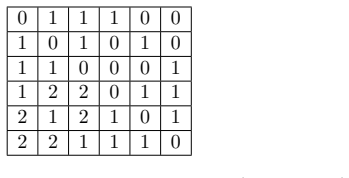
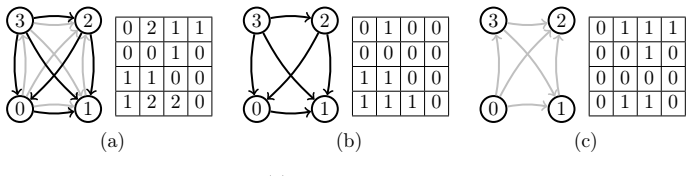
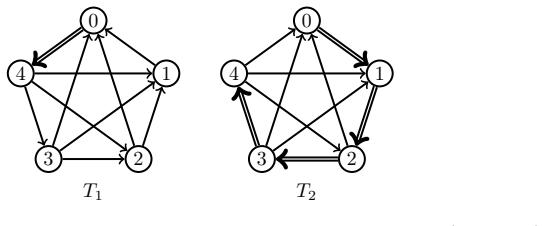
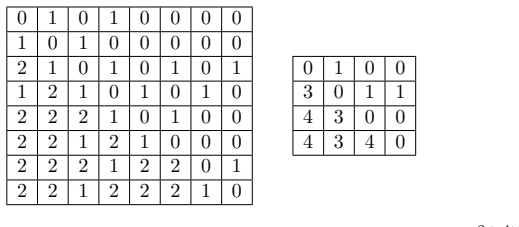
- Several figures illustrating the construction would benefit from explicit labeling of the permutation and the resulting score sequence.
Simulated Author's Rebuttal
We thank the referee for the careful reading and constructive suggestions. We respond to each major comment below and will revise the manuscript accordingly.
read point-by-point responses
-
Referee: [§3] §3 (Construction): the manuscript asserts that the mapping from permutation to 1-tournament always yields a complete oriented graph (exactly one directed edge between every pair), yet supplies neither an inductive argument nor a direct verification that out-degrees are correctly realized for arbitrary n. A small-n exhaustive check or a short proof that the orientation rule never produces bidirectional or missing edges is required.
Authors: We agree that the manuscript lacks an explicit verification. In the revision we will add a short inductive proof on n establishing that the orientation rule produces exactly one directed edge between each pair and realizes the correct out-degrees. We will also include an exhaustive computational check for all permutations of length at most 6. revision: yes
-
Referee: [§4] §4 (2-tournaments and general x-rays): the claim that the same construction produces a 2-tournament whose score sequence exactly matches an arbitrary admissible x-ray term set rests on the definition of the edge multiplicities; no general argument is given that the resulting multiset of out-degrees coincides with the prescribed x-ray for every choice of term restrictions. The supporting evidence appears to be computational for small cases only.
Authors: The observation is accurate: a general argument is not supplied. We will insert a direct proof that, for any admissible term restriction, the out-degree multiset of the constructed 2-tournament equals the prescribed x-ray, using the multiplicity definition. This will complement the existing small-case computations. revision: yes
-
Referee: [§5] §5 (Restricted-term conjecture): the new general conjecture is stated, but the reduction showing that the Bebeacua et al. and Brualdi-Fritscher statements are literal special cases is only sketched; an explicit substitution of the term restrictions into the general statement is needed to confirm the claim.
Authors: We accept that the reduction requires explicit verification. The revised manuscript will contain the direct substitution of the term restrictions from each prior conjecture into the general statement, confirming they arise as special cases. revision: yes
Circularity Check
Explicit construction from permutations to tournaments is self-contained
full rationale
The paper introduces the independent concept of transitive tournament decomposition and then defines an explicit construction that maps any permutation to 1- and 2-tournaments whose score sequences are asserted to match the permutation's xray. No parameters are fitted to data, no predictions are made from subsets of the same data, and no load-bearing steps rely on self-citation of the authors' prior results. The cited conjectures of Bebeacua et al. and Brualdi-Fritscher are external and treated as special cases of a new conjecture; the construction itself supplies the claimed correspondence without reducing to a definitional tautology or renamed input.
Axiom & Free-Parameter Ledger
Reference graph
Works this paper leans on
-
[1]
Rubey, Martin , title =. J. Integer Seq. , issn =. 2021 , language =
2021
-
[2]
Nordh, Gustav , title =. Discrete Math. , issn =. 2008 , language =. doi:10.1016/j.disc.2006.12.003 , keywords =
-
[3]
Bebeacua, Cecilia and Mansour, Toufik and Postnikov, Alex and Severini, Simone , title =. Proceedings of the workshop on discrete tomography and its applications, New York, NY, USA, June 13--15, 2005 , pages =. 2005 , publisher =. doi:10.1016/j.endm.2005.05.063 , keywords =
-
[4]
and Fritscher, Eliseu , title =
Brualdi, Richard A. and Fritscher, Eliseu , title =. Linear Algebra Appl. , issn =. 2014 , language =. doi:10.1016/j.laa.2014.02.037 , keywords =
-
[5]
2017 , howpublished =
Nordh, Gustav , title =. 2017 , howpublished =
2017
-
[6]
, title =
Brualdi, Richard A. , title =. 2006 , publisher =
2006
-
[7]
Brualdi, Richard A. and Kiernan, Kathleen P. and Meyer, Seth A. and Schroeder, Michael W. , title =. Linear Algebra Appl. , issn =. 2013 , language =. doi:10.1016/j.laa.2012.03.009 , keywords =
-
[8]
Electron
Zeilberger, Doron , title =. Electron. J. Comb. , issn =. 1996 , language =
1996
-
[9]
Kuperberg, Greg , title =. Int. Math. Res. Not. , issn =. 1996 , language =. doi:10.1155/S1073792896000128 , keywords =
-
[10]
, title =
Bressoud, David M. , title =. 1999 , publisher =
1999
-
[11]
Mills, W. H. and Robbins, David P. and Rumsey, Howard jun. , title =. J. Comb. Theory, Ser. A , issn =. 1983 , language =. doi:10.1016/0097-3165(83)90068-7 , keywords =
-
[12]
Lattices and bases of
Lascoux, Alain and Sch. Lattices and bases of. Electron. J. Comb. , issn =. 1996 , language =
1996
-
[13]
1996 , publisher =
Yu, Wenci , title =. 1996 , publisher =
1996
-
[14]
Brunetti, S. and Del Lungo, A. and Gritzmann, P. and de Vries, S. , title =. Theor. Comput. Sci. , issn =. 2008 , language =. doi:10.1016/j.tcs.2008.06.014 , keywords =
-
[15]
Del Lungo, Alberto , title =. Theor. Comput. Sci. , issn =. 2002 , language =. doi:10.1016/S0304-3975(02)00015-4 , keywords =
-
[16]
Hall, Marshall Jr. , title =. Proc. Am. Math. Soc. , issn =. 1952 , language =. doi:10.2307/2032592 , zbMATH =
-
[17]
2026 , eprint=
Relating tournaments and permutations with xrays , author=. 2026 , eprint=
2026
discussion (0)
Sign in with ORCID, Apple, or X to comment. Anyone can read and Pith papers without signing in.