From Embedding Geometry to Spectral Search: Energy Dispersion Networks For Vector Retrieval
Pith reviewed 2026-06-26 12:52 UTC · model grok-4.3
The pith
Coupling geometric similarity with spectral information from embedding feature graphs improves retrieval coherence and semantic alignment.
A machine-rendered reading of the paper's core claim, the machinery that carries it, and where it could break.
Core claim
Vector spaces need not be analyzed solely through pointwise geometry; they can be interpreted as energy networks through the spectral graph induced by the topology of their column vectors. Building on this, Graph Wiring exploits feature-space spectral structure, and Spectral Indexing instantiates it for vector search, improving head-tail coherence and semantic alignment while supporting adaptive tau-modulation.
What carries the argument
Graph Wiring framework, which couples geometric similarity with spectral information from the feature-space graph induced by column vector topology.
If this is right
- Improves head-tail coherence relative to purely geometric retrieval methods.
- Enhances semantic alignment in vector search tasks.
- Supports adaptive search behavior through tau-modulation for RAG pipelines.
- Provides a complete algorithmic pipeline with theoretical foundation in epiplexity.
Where Pith is reading between the lines
- The approach could generalize to other embedding-based tasks beyond retrieval, such as clustering or classification.
- Integration with existing vector databases might require minimal changes if the spectral computation is precomputed.
- Performance gains may vary depending on the density and structure of the embedding space.
Load-bearing premise
The spectral graph induced by the topology of the column vectors of the embedding matrix encodes task-relevant structure that is not already captured by standard geometric similarity measures.
What would settle it
A direct comparison of retrieval metrics on a dataset where head-tail coherence is measured, showing whether adding the spectral component yields statistically significant improvement over pure geometric baselines.
Figures



read the original abstract
Vector spaces, such as embedding spaces that encode dense semantic information, need not be analyzed solely through pointwise geometry. They can also be interpreted as energy networks through the spectral graph induced by the topology of their column vectors, i.e., their feature-space structure. Building on this perspective, we introduce Graph Wiring, a general framework for exploiting feature-space spectral structure, together with Spectral Indexing, its task-specific instantiation for vector search. By coupling geometric similarity with spectral information, the proposed method improves head-tail coherence and semantic alignment relative to purely geometric retrieval methods. It further supports adaptive search behavior through tau-modulation, providing the flexibility increasingly required by modern Retrieval-Augmented Generation (RAG) pipelines. We present the complete algorithmic pipeline, establish its theoretical foundation through epiplexity, and evaluate the approach across benchmark and industrial settings using the open-source arrowspace library.
Editorial analysis
A structured set of objections, weighed in public.
Referee Report
Summary. The manuscript proposes that embedding spaces can be analyzed not only via pointwise geometry but also as energy networks through the spectral graph induced by the topology of column vectors. It introduces the Graph Wiring framework and its task-specific Spectral Indexing instantiation for vector retrieval. By coupling geometric similarity with spectral information, the method is claimed to improve head-tail coherence and semantic alignment over purely geometric baselines, while supporting adaptive search via tau-modulation. The work establishes a theoretical foundation called epiplexity, presents the full algorithmic pipeline, and reports evaluations on benchmark and industrial settings using the open-source arrowspace library.
Significance. If the spectral augmentation supplies task-relevant structure independent of standard geometric similarity, the approach could provide a principled way to enhance coherence in vector retrieval for RAG pipelines and enable tunable behavior through tau. The release of the arrowspace library supports reproducibility and allows direct testing of the claims.
major comments (1)
- [Abstract] Abstract: The central claim that the spectral graph induced by column-vector topology encodes task-relevant structure not already captured by geometric similarity is not supported by an explicit separation argument or ablation isolating the spectral term. Since the graph is constructed from the same embedding matrix whose inner products define the geometry, any reported gains in head-tail coherence could arise from wiring choices or tau-modulation rather than genuine spectral augmentation; a concrete test (e.g., comparison against a null graph with identical degree sequence) is required to establish independence.
minor comments (1)
- [Abstract] The abstract invokes 'epiplexity' as the theoretical foundation but provides no definition, axioms, or derivation sketch; this should be expanded with a brief formal statement in the main text.
Simulated Author's Rebuttal
We thank the referee for their constructive feedback on the manuscript. We address the major comment below.
read point-by-point responses
-
Referee: [Abstract] Abstract: The central claim that the spectral graph induced by column-vector topology encodes task-relevant structure not already captured by geometric similarity is not supported by an explicit separation argument or ablation isolating the spectral term. Since the graph is constructed from the same embedding matrix whose inner products define the geometry, any reported gains in head-tail coherence could arise from wiring choices or tau-modulation rather than genuine spectral augmentation; a concrete test (e.g., comparison against a null graph with identical degree sequence) is required to establish independence.
Authors: We agree that an explicit ablation isolating the spectral contribution is necessary to substantiate the claim of independence from geometric similarity. Although the Graph Wiring construction uses column-vector topology in a manner distinct from direct inner-product geometry, the current evaluations compare only against purely geometric baselines and do not include a null-model control preserving degree sequence. In the revised manuscript we will add this experiment on the benchmark datasets, reporting head-tail coherence and semantic alignment metrics to demonstrate whether gains persist beyond wiring choices or tau-modulation. revision: yes
Circularity Check
No circularity: framework presented as novel coupling without equations or self-referential fitting visible
full rationale
The provided abstract and description introduce Graph Wiring and Spectral Indexing as a new framework coupling geometric similarity with spectral graph structure from column vectors, but contain no equations, no fitting procedures, no parameter estimation steps, and no self-citations invoked as load-bearing uniqueness theorems. The central claim of improved head-tail coherence is presented as an empirical outcome of the coupling rather than a quantity derived by construction from the inputs. Without any reduction of a 'prediction' to a fitted input or ansatz smuggled via prior self-work, the derivation chain is self-contained against external benchmarks and receives the default non-finding.
Axiom & Free-Parameter Ledger
Reference graph
Works this paper leans on
-
[1]
Graph-based vector search: An experimental evaluation of the state-of-the-art.Proceedings of the ACM on Management of Data, 3(1):1–31, 2025
Ilias Azizi, Karima Echihabi, and Themis Palpanas. Graph-based vector search: An experimental evaluation of the state-of-the-art.Proceedings of the ACM on Management of Data, 3(1):1–31, 2025
2025
-
[2]
Results of the big ann: Neurips’23 competition.arXiv preprint arXiv:2409.17424, 2024
Harsha Vardhan Simhadri, Martin Aumüller, Amir Ingber, Matthijs Douze, George Williams, Magdalen Dobson Manohar, Dmitry Baranchuk, Edo Liberty, Frank Liu, Ben Landrum, et al. Results of the big ann: Neurips’23 competition.arXiv preprint arXiv:2409.17424, 2024
-
[3]
Steck, C
H. Steck, C. Ekanadham, and N. Kallus. Is cosine-similarity of embeddings really about similarity? InWWW ’24 Companion, 2024
2024
-
[4]
Kuffo, I
L. Kuffo, I. Tsakalidou, R. De Viti, A. Angel, J. Isa, and R. Lenhardt. Semantic recall for vector search. InSIGIR, 2026
2026
- [5]
-
[6]
Rag problems persist
IBM. Rag problems persist. here are five ways to fix them. https://www.ibm.com/think/insights/rag-problems, 2025
2025
-
[7]
The role of local dimensionality measures in benchmarking nearest neighbor search.Information Systems, 101:101807, 2021
Martin Aumüller and Matteo Ceccarello. The role of local dimensionality measures in benchmarking nearest neighbor search.Information Systems, 101:101807, 2021
2021
-
[8]
Moriondo
L. Moriondo. Arrowspace: introducing spectral indexing for vector search.Journal of Open Source Software, 10(113):9002, 2025
2025
-
[9]
L. Moriondo. Epiplexity and graph wiring: An empirical study. https://doi.org/10.22541/au.177430060.02394540/ v1, 2026
-
[10]
D. I. Shuman, S. K. Narang, P. Frossard, A. Ortega, and P. Vandergheynst. The emerging field of signal processing on graphs.IEEE Signal Processing Magazine, 30(3):83–98, 2013
2013
-
[11]
X. Dong, D. Thanou, P. Frossard, and P. Vandergheynst. Learning laplacian matrix in smooth graph signal representations.IEEE Transactions on Signal Processing, 64(23):6160–6173, 2016
2016
-
[12]
Sandryhaila and J
A. Sandryhaila and J. M. F. Moura. Discrete signal processing on graphs.IEEE Transactions on Signal Processing, 61(7):1644–1656, 2013
2013
-
[13]
From entropy to epiplexity: Rethinking infor- mation for computationally bounded intelligence,
M. Finzi, A. Potapczynski, M. Goldblum, and A. G. Wilson. From entropy to epiplexity: Rethinking information for computationally bounded intelligence.arXiv preprint arXiv:2601.03220, 2026
-
[14]
PyArrowSpace
tuned-org-uk. PyArrowSpace. https://github.com/tuned-org-uk/pyarrowspace, 2026. GitHub repository
2026
-
[15]
P. M. B. Vitanyi and M. Li. Minimum description length induction, bayesianism, and kolmogorov complexity. IEEE Transactions on Information Theory, 46(2):446–464, 2000
2000
-
[16]
P. D. Grunwald.The Minimum Description Length Principle. MIT Press, 2007. 9 Running Title for Header
2007
-
[17]
D. A. Spielman. Spectral graph theory lecture notes. https://www.cs.yale.edu/..., 2007
2007
-
[18]
von Luxburg
U. von Luxburg. A tutorial on spectral clustering.Statistics and Computing, 17(4):395–416, 2007
2007
-
[19]
Johnson and Joram Lindenstrauss
William B. Johnson and Joram Lindenstrauss. Extensions of lipschitz mappings into a hilbert space.Contemporary Mathematics, 26:189–206, 1984
1984
-
[20]
Macmillan and Co., 1877
John William Strutt.The Theory of Sound, volume 1. Macmillan and Co., 1877. Reprinted 1945, Dover Publications
1945
-
[21]
Evans.Partial Differential Equations, volume 19 ofGraduate Studies in Mathematics
Lawrence C. Evans.Partial Differential Equations, volume 19 ofGraduate Studies in Mathematics. American Mathematical Society, Providence, RI, 1998
1998
-
[22]
F. Chung. The heat kernel as the pagerank of a graph.PNAS, 104(50):19735–19740, 2007
2007
-
[23]
PhD thesis, University of York, 2007
Xiao Bai.Heat Kernel Analysis on Graphs. PhD thesis, University of York, 2007
2007
-
[24]
Cve™: Common vulnerabilities and exposures dataset
MITRE Corporation. Cve™: Common vulnerabilities and exposures dataset. https://www.cve.org/Legal/ TermsOfUse, 2026
2026
-
[25]
V oorhees, William Hersh, Max Crammer, and Nancy Ide
Ellen M. V oorhees, William Hersh, Max Crammer, and Nancy Ide. Trec-covid: Constructing a pandemic information retrieval test collection.SIGIR Forum, 54(1):1–12, 2021
2021
-
[26]
Magesh, F
V . Magesh, F. Surani, M. Dahl, A. Sklar, R. Tseng, R. Guha, D. E. Ho, and C. D. Manning. Hallucination-free? assessing the reliability of leading ai legal research tools.Journal of Empirical Legal Studies, 22(2):216–242, 2025
2025
-
[27]
Sentence-bert: Sentence embeddings using siamese bert-networks
Nils Reimers and Iryna Gurevych. Sentence-bert: Sentence embeddings using siamese bert-networks. In Proceedings of the 2019 Conference on Empirical Methods in Natural Language Processing, pages 3982–3992. Association for Computational Linguistics, 2019
2019
-
[28]
Graph wiring epiplexity
tuned-org-uk. Graph wiring epiplexity. https://github.com/tuned-org-uk/graph-wiring-epiplexity, 2026. GitHub repository
2026
-
[29]
N. D. Matsakis and J. Stone. Rayon: A data-parallelism library for rust. https://docs.rs/rayon/latest/rayon/, 2025
2025
-
[30]
Reimers and I
N. Reimers and I. Gurevych. Sentence-bert: Sentence embeddings using siamese bert-networks. InEMNLP, 2019
2019
-
[31]
L. Moriondo. Graph wiring: Eigenstructures for vector datasets and llm operations. https://www.techrxiv.org/doi/ full/10.36227/techrxiv.177220780.02840438/v1, 2026
-
[32]
Spectral-aware unique identifiers for generative retrieval and vector search.Authorea Preprints, 2026
Lorenzo Moriondo. Spectral-aware unique identifiers for generative retrieval and vector search.Authorea Preprints, 2026. 10 Running Title for Header Appendix: Retrieval Metrics We evaluate retrieval quality using both classical relevance metrics and graph-signal-aware measures in order to capture semantic consistency, ranking stability, and structural coh...
2026
-
[33]
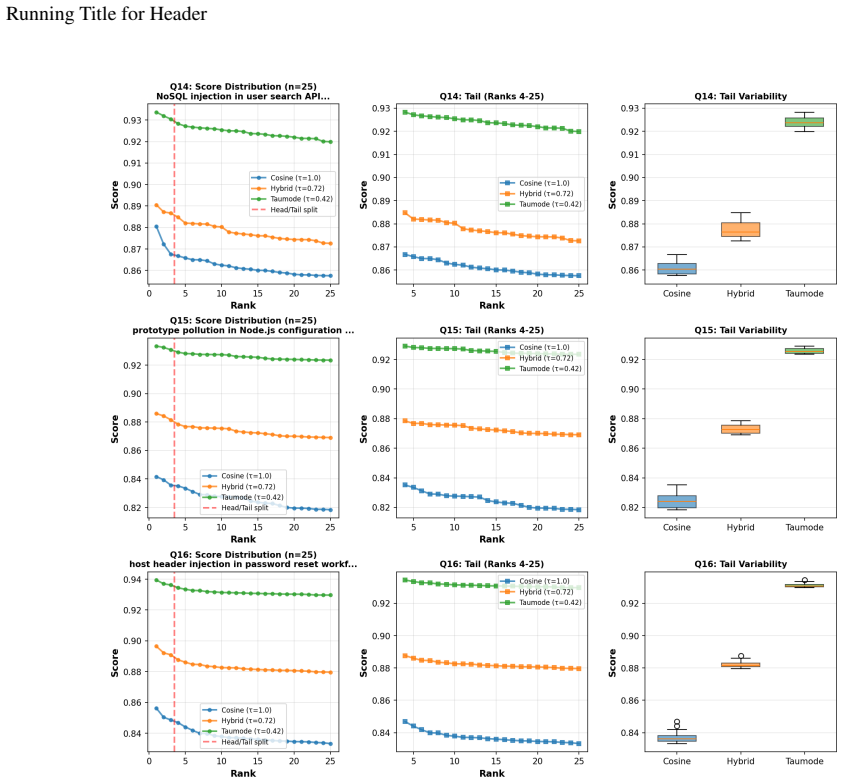
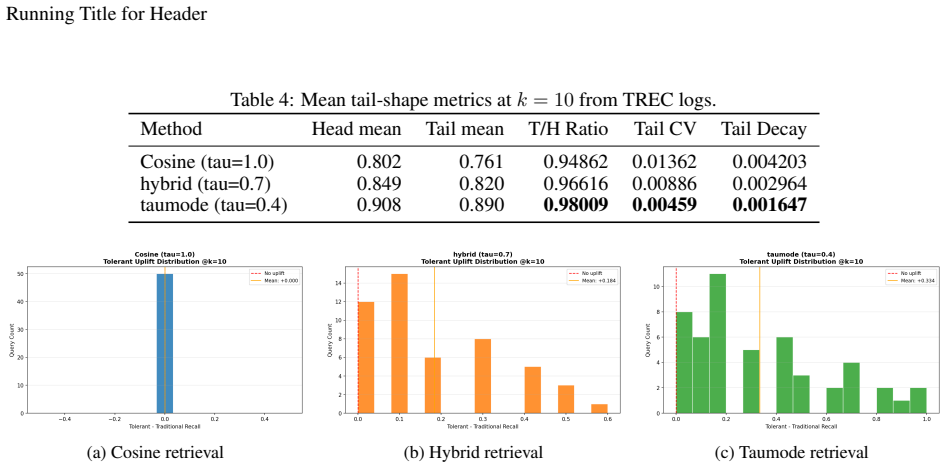
Large tail-shape improvement under spectral reranking: a substantially higher tail/head ratio or lower tail CV for Taumode than Cosine. Because test_17_CVE_neurips.py calls random.shuffle(queries) before evaluation, theeffectivequery order is the one preserved in the CSV outputs (query_id1–50). Subsections below use that order. For each selected query we ...
-
[34]
the τ= 0.72 crossover already lies inside the spectral regime for this corpus
Hybrid is not always between Cosine and Taumode.Q2, Q9, Q47, and Q50 show Hybrid and Taumode agreeing with each other whilebothdiffer sharply from Cosine — i.e. the τ= 0.72 crossover already lies inside the spectral regime for this corpus. For Q27 the opposite holds: Hybrid tracks Cosine almost perfectly while Taumode wanders. 4.Tail-shape gains can be de...
-
[35]
The clearest semantic win in the selected set is Q47(arbitrary file upload → RCE), where Hybrid produces a semantic-recall jump from0.0to1.0while keeping all of cosine’s score-band leaders
-
[36]
(no title)
Many “(no title)” CVEs in this corpusmake individual verdicts uncertain: across the 11 selected queries, only a minority of the spectral top-5 entries are titled. A reproducibility recommendation for the paper is 21 Running Title for Header to extend extract_text to surface CVE™ descriptions in the search-results CSV so that future per-query analyses can ...
-
[37]
race condition in temporary file creation
The pattern is consistent with the paper’s headline claim —spectral reranking changes theshapeof the top- 25 score distribution and moves between embedding neighborhoods—while urging careful interpretation of NDCG and Kendall τ on small intersections, and acknowledging that for queries whose intent is poorly represented in the loaded CVE™ corpus (Q34, Q50...
2008
discussion (0)
Sign in with ORCID, Apple, or X to comment. Anyone can read and Pith papers without signing in.