Transonic Solutions for Recombination-Driven Stellar Winds
Pith reviewed 2026-06-26 13:13 UTC · model grok-4.3
The pith
Recombination energy in evolved star envelopes powers transonic winds with critical points at 10-100 AU.
A machine-rendered reading of the paper's core claim, the machinery that carries it, and where it could break.
Core claim
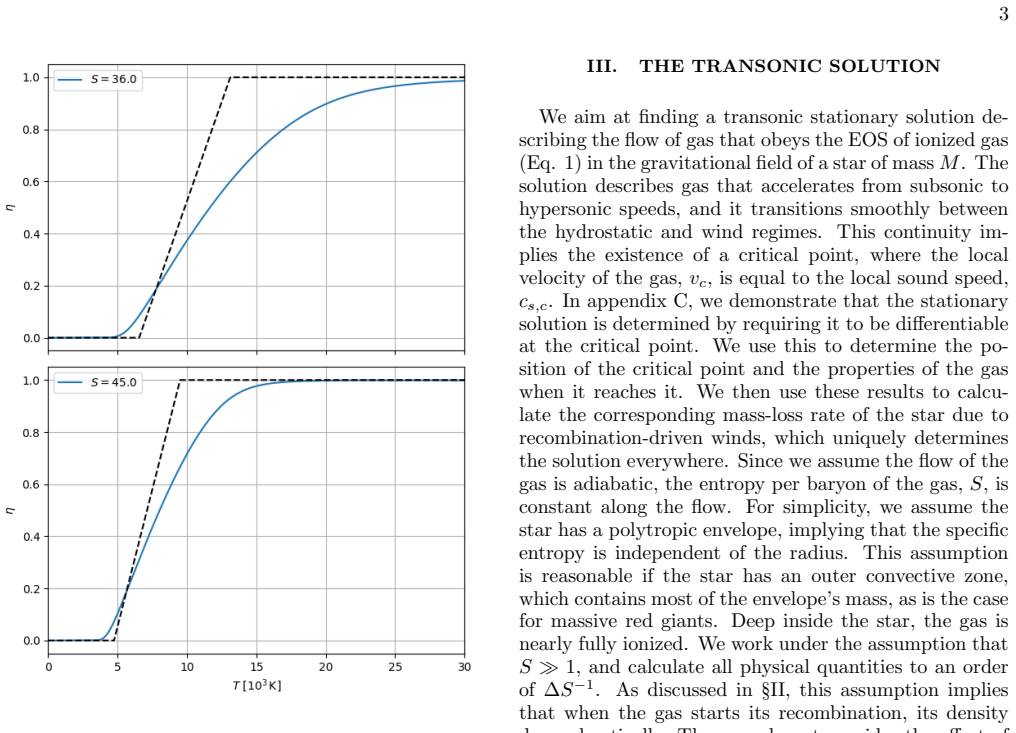
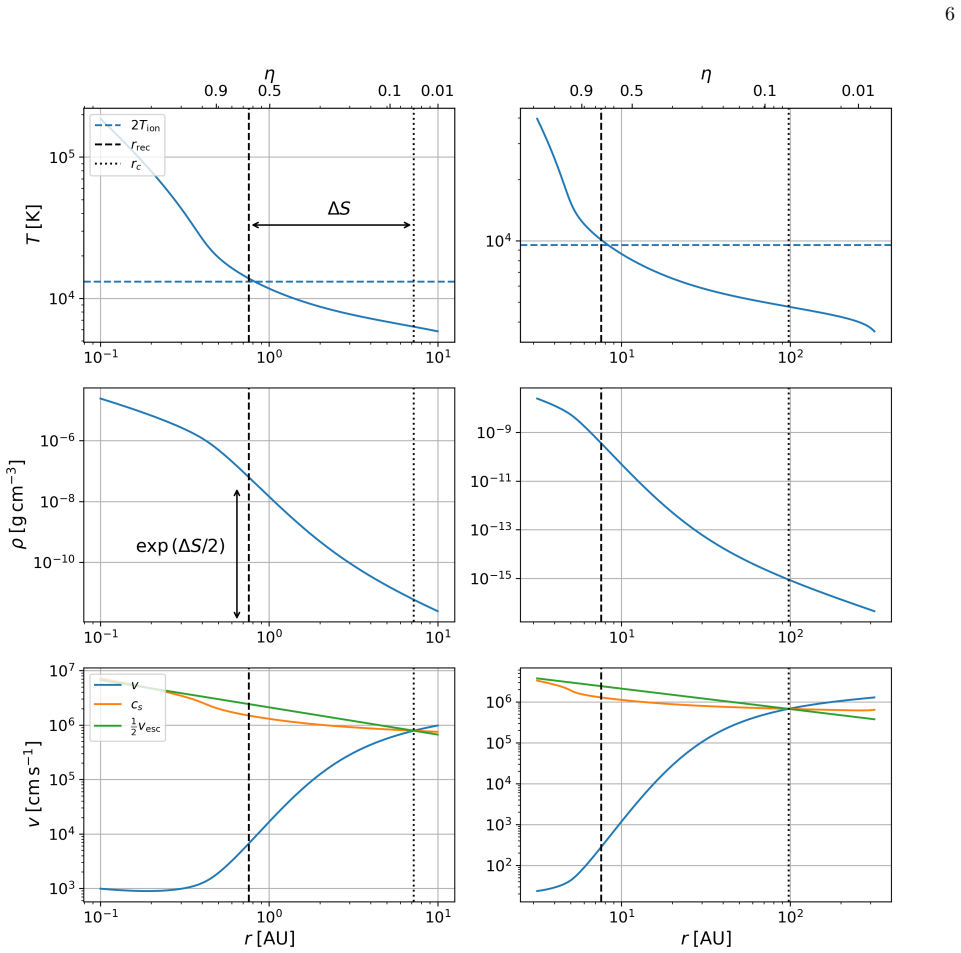
We present an analytical stationary isentropic solution of the spherically symmetric Euler equations in the gravitational field of a star using an equation of state of ionizable monatomic gas. The solution consists of a fully ionized hydrostatic inner region, followed by a thick hydrostatic recombination region where the density decreases by orders of magnitude, the radius increases by about an order of magnitude and the temperature decreases by a factor of two. Within this recombination region, a large portion of the recombination energy is used for lifting the gas subsonically. This region ends at a critical point, located roughly at 10-100 AU, where the gas is mostly recombined, beyond wh
What carries the argument
The transonic critical-point solution for isentropic spherical flow, in which the recombination region functions as a subsonic hydrostatic accelerator powered by ionization energy.
If this is right
- Mass-loss rate is obtained as an explicit function of time for a sequence of solutions that the star passes through as its envelope is removed.
- Recombination-driven winds begin once the stellar radius reaches about 1 AU times M/M_sun and cease after most of the high-entropy envelope has been lost.
- The entire process unfolds on timescales of 10 to 10,000 years and supplies a physical channel for envelope ejection in common-envelope binary evolution.
- The critical point lies at 10-100 AU where the gas is already mostly recombined and the flow becomes supersonic.
Where Pith is reading between the lines
- The predicted runaway mass-loss history could be compared with observed orbital-period distributions of post-common-envelope binaries to test whether recombination alone can account for observed ejection efficiencies.
- If spherical symmetry is approximately preserved, the model implies that recombination-driven winds may leave detectable density or velocity signatures at tens of AU in young planetary nebulae.
- Relaxing the isentropic assumption to include radiative losses or time-dependent ionization could reveal how sensitive the critical-point location remains to realistic thermodynamics.
- The mechanism suggests a sharp threshold in envelope radius beyond which rapid mass loss begins, which could be checked against population-synthesis calculations of binary evolution.
Load-bearing premise
The flow remains stationary, isentropic, and spherically symmetric throughout the recombination region, with recombination energy used primarily for subsonic lifting rather than other channels.
What would settle it
Direct measurement of mass-loss rates or velocity profiles from evolved stars showing that the transition to supersonic flow occurs at radii or densities inconsistent with the predicted critical point at 10-100 AU.
Figures
read the original abstract
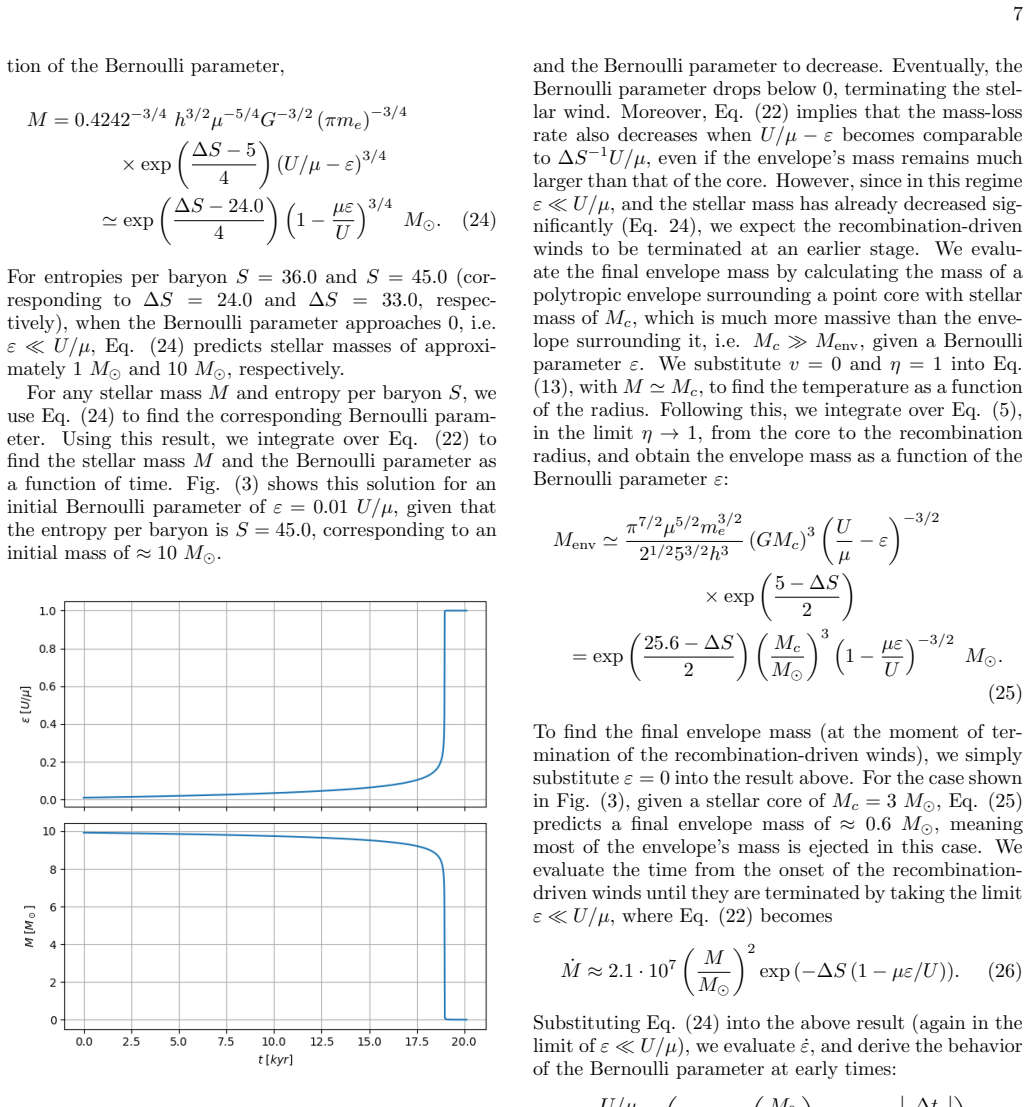
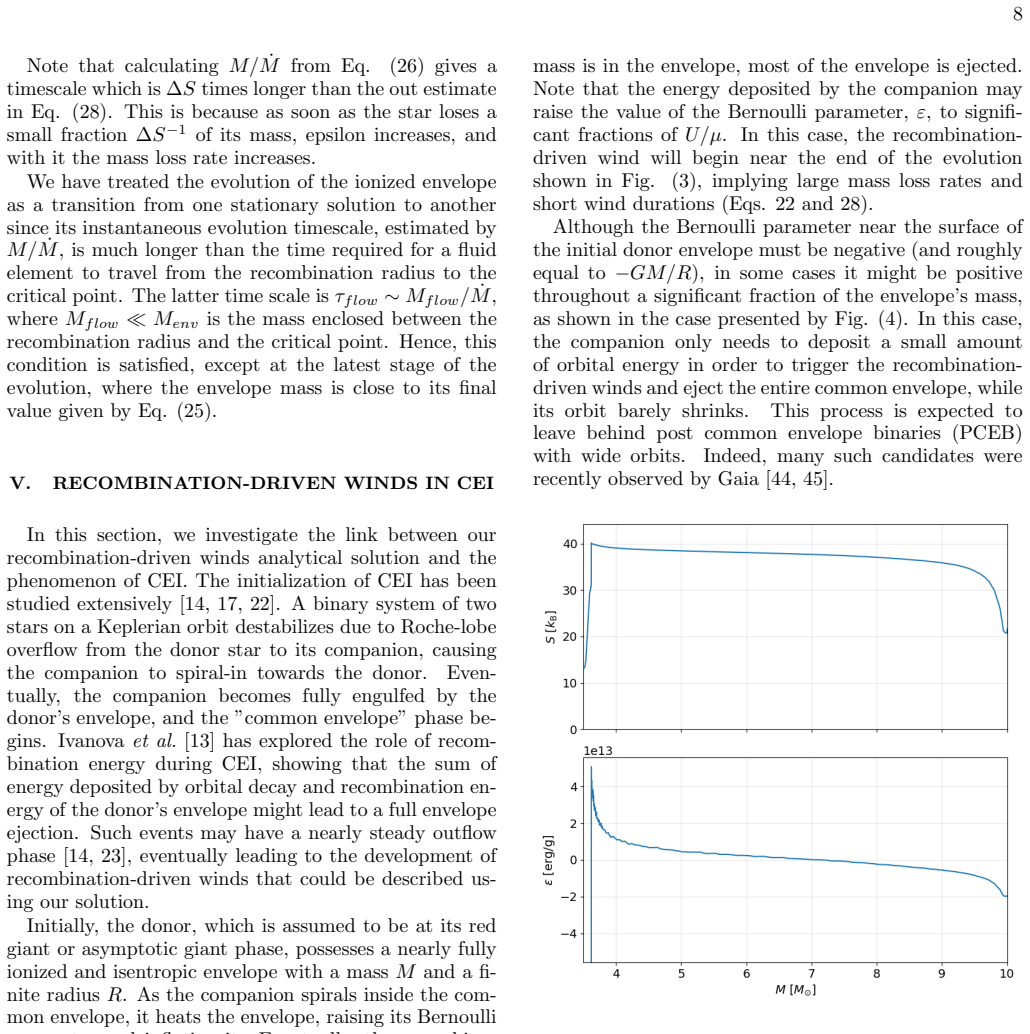
We present an analytical stationary isentropic solution of the spherically symmetric Euler equations in the gravitational field of a star using an equation of state of ionizable monatomic gas. The solution consists of a fully ionized hydrostatic inner region, followed by a thick hydrostatic recombination region where the density decreases by orders of magnitude, the radius increases by about an order of magnitude and the temperature decreases by a factor of two. Within this recombination region, a large portion of the recombination energy is used for lifting the gas subsonically. This region ends at a critical point, located roughly at $10-100~\rm{AU}$, where the gas is mostly recombined, beyond which it flows supersonically as a wind. We find the position and the quantities of the gas at the critical point and derive the mass-loss rate of the solution. We apply our solution to evolved stars, with a compact core surrounded by a high entropy envelope. We derive the mass-loss rate as a function of time. As the star is losing mass, it goes through a sequence of our solutions, in a runaway manner which ends once most of the high entropy envelope is lost. The recombination-driven winds are initiated once the stars expands to a radius of about $1~\rm{AU}~M/M_\odot$ and are terminated on a timescale of $10^1-10^4~\rm{years}$. We discuss the implications for common envelope evolution.
Editorial analysis
A structured set of objections, weighed in public.
Referee Report
Summary. The paper presents an analytical stationary isentropic solution of the spherically symmetric Euler equations in a stellar gravitational field, employing an equation of state for an ionizable monatomic gas. The solution structure consists of a fully ionized hydrostatic inner region, a thick recombination region (density drop by orders of magnitude, radius increase by ~10x, temperature drop by factor ~2) in which recombination energy performs subsonic lifting work, terminating at a critical point (10-100 AU, mostly recombined gas) beyond which the flow is supersonic. The mass-loss rate is derived from conditions at the critical point. Applied to evolved stars with compact cores and high-entropy envelopes, the model yields a time-dependent mass-loss rate that drives runaway envelope loss on 10^1-10^4 yr timescales once the stellar radius reaches ~1 AU (M/M_⊙), with implications for common-envelope evolution.
Significance. If the central assumptions hold, the work supplies a parameter-free analytical transonic wind solution and an explicit sequence of solutions tracking envelope loss, which are strengths for modeling recombination-driven mass loss without fitted parameters. The derivation of critical-point location and mass-loss rate from the Euler equations plus the ionizable EOS provides a falsifiable framework that could be tested against stellar evolution calculations.
major comments (2)
- [Abstract] Abstract (paragraph on solution structure): the claim that a large portion of recombination energy is used for subsonic lifting (maintaining isentropy) is load-bearing for the transonic solution, yet no auxiliary estimate is provided showing that radiative losses remain negligible compared to the flow timescale across the recombination zone (where density drops by orders of magnitude); without this, the sound-speed profile and critical-point location at 10-100 AU cannot be guaranteed.
- [Abstract] Abstract (application to evolved stars): the runaway mass-loss sequence ending when most of the high-entropy envelope is lost assumes the stationary isentropic solutions can be sequenced in time without violating the hydrostatic inner-region or recombination-region structure; the transition between successive solutions requires explicit justification that the critical-point conditions remain consistent as the envelope mass decreases.
minor comments (1)
- Notation for the ionizable monatomic EOS and the definition of the critical point could be stated more explicitly to allow direct reproduction of the mass-loss rate formula.
Simulated Author's Rebuttal
We thank the referee for their insightful comments. We address each major comment below, providing clarifications and indicating where revisions will be made to strengthen the manuscript.
read point-by-point responses
-
Referee: [Abstract] Abstract (paragraph on solution structure): the claim that a large portion of recombination energy is used for subsonic lifting (maintaining isentropy) is load-bearing for the transonic solution, yet no auxiliary estimate is provided showing that radiative losses remain negligible compared to the flow timescale across the recombination zone (where density drops by orders of magnitude); without this, the sound-speed profile and critical-point location at 10-100 AU cannot be guaranteed.
Authors: The isentropic nature of the solution is an assumption that enables the analytical treatment, implying that radiative losses are negligible on the flow timescale. We recognize that an explicit estimate would bolster this assumption. In the revised manuscript, we will include an order-of-magnitude calculation comparing the radiative cooling timescale to the flow timescale through the recombination region, using typical densities and temperatures from the solution. This will confirm that cooling is slow enough to maintain isentropy, thereby supporting the sound-speed profile and critical point location. revision: yes
-
Referee: [Abstract] Abstract (application to evolved stars): the runaway mass-loss sequence ending when most of the high-entropy envelope is lost assumes the stationary isentropic solutions can be sequenced in time without violating the hydrostatic inner-region or recombination-region structure; the transition between successive solutions requires explicit justification that the critical-point conditions remain consistent as the envelope mass decreases.
Authors: The time-dependent mass-loss rate is obtained by applying the stationary solution at successive stages of envelope mass loss. Each stationary solution is valid for a given core mass, envelope mass, and entropy. As mass is lost on timescales of 10^1-10^4 years, which are much longer than the dynamical timescales at the critical point (sound crossing time ~ years or less at 10-100 AU), the structure can adjust quasi-statically to the next solution. We will add a paragraph in the revised manuscript explicitly discussing this timescale separation to justify the sequencing and consistency of the critical-point conditions. revision: yes
Circularity Check
No significant circularity; derivation is self-contained from Euler equations and EOS
full rationale
The paper derives its transonic solution directly from the spherically symmetric Euler equations under the isentropic assumption together with the ionizable monatomic gas equation of state. The critical point location, state variables there, and resulting mass-loss rate follow from solving those equations for the described piecewise structure (hydrostatic ionized core, thick recombination zone, supersonic wind). No parameters are fitted to data and then relabeled as predictions, no self-citations are invoked as load-bearing uniqueness theorems, and no ansatz is smuggled in via prior work. The mass-loss rate expression is obtained by construction from the critical-point conditions rather than being imposed. The derivation therefore remains independent of its own outputs.
Axiom & Free-Parameter Ledger
axioms (2)
- domain assumption Flow is stationary, isentropic, and spherically symmetric
- domain assumption Recombination energy primarily lifts gas subsonically within the thick hydrostatic region
Reference graph
Works this paper leans on
-
[1]
of recombination-driven winds. In§IV, we develop the evolution of a polytropic stellar envelope made of a single-level ionized gas, and show that the recombination- driven winds lead to mass runaway, which is terminated only when the envelope’s mass is comparable to that of the stellar core. We evaluate the final envelope mass, and the time from the initi...
-
[2]
E. N. Parker, Dynamics of the interplanetary gas and magnetic fields, The Astrophysical Journal128, 664 (1958)
1958
-
[3]
E. N. Parker, Dynamical theory of the solar wind, Space Science Reviews4, 666 (1965)
1965
-
[4]
E. N. Parker,Present developments in theory of the solar wind, Invited review / NASA Technical Report 19730002046 (NASA Ames Research Center, 1972)
1972
-
[5]
T. E. Holzer, The solar wind and related astrophysi- cal phenomena, inSolar System Plasma Physics, Vol. 1, edited by E. N. Parker, C. F. Kennel, and L. J. Lanzerotti (North-Holland, Amsterdam, The Netherlands, 1979) pp. 101–176
1979
-
[6]
R. Keppens and J. P. Goedbloed, Numerical simulations of stellar winds: polytropic models (1999), arXiv:astro- ph/9901380 [astro-ph]
arXiv 1999
-
[7]
B. K. Shivamoggi, D. Rollins, and L. Pohl, Parker’s so- lar wind model for a polytropic gas, Entropy23, 1497 (2021)
2021
-
[8]
B. K. Shivamoggi and L. Pohl, Polytropic gas effects in parker’s solar wind model and coronal hole flows (2024), arXiv:2407.06122 [astro-ph.SR]
arXiv 2024
-
[9]
R. C. Newman and W. I. Axford, Recombination fronts in stellar-wind flows, The Astrophysical Journal151, 1145 (1968)
1968
-
[10]
Waldron, Recombination stellar wind model for the coronae of early-type stars, ApJ282(1984)
W. Waldron, Recombination stellar wind model for the coronae of early-type stars, ApJ282(1984)
1984
-
[11]
R. R. Williams and J. E. Dyson, Breaking the sound barrier in recombination fronts, Monthly Notices of the Royal Astronomical Society279, 987–992 (1996)
1996
-
[12]
Quataert, R
E. Quataert, R. Fern´ andez, D. Kasen, H. Klion, and B. Paxton, Super-eddington stellar winds driven by near- surface energy deposition, Monthly Notices of the Royal Astronomical Society458, 1214–1233 (2016)
2016
-
[13]
T. A. Reichardt, O. De Marco, R. Iaconi, L. Chamandy, and D. J. Price, The impact of recombination energy on simulations of the common-envelope binary interaction, Monthly Notices of the Royal Astronomical Society494, 5333–5349 (2020)
2020
-
[14]
Ivanova, S
N. Ivanova, S. Justham, and P. Podsiadlowski, On the role of recombination in common-envelope ejections, Monthly Notices of the Royal Astronomical Society447, 2181–2197 (2015)
2015
-
[15]
J. L. A. Nandez and N. Ivanova, Common envelope events with low-mass giants: understanding the energy budget, Monthly Notices of the Royal Astronomical Society460, 3992–4002 (2016)
2016
-
[16]
J. L. A. Nandez, N. Ivanova, and J. C. Lombardi, Re- combination energy in double white dwarf formation, Monthly Notices of the Royal Astronomical Society: Let- ters450, L39–L43 (2015)
2015
-
[17]
Ivanova and J
N. Ivanova and J. L. Nandez, Common envelope events with low-mass giants: understanding the transition to the slow spiral-in, Monthly Notices of the Royal Astro- nomical Society462, 362 (2016)
2016
-
[18]
Paczynski, Common envelope binaries, Symposium - International Astronomical Union73, 75–80 (1976)
B. Paczynski, Common envelope binaries, Symposium - International Astronomical Union73, 75–80 (1976)
1976
-
[19]
R. F. Webbink, Double white dwarfs as progenitors of r coronae borealis stars and type i supernovae, Astrophys. J.277, 355 (1984)
1984
-
[20]
Livio and N
M. Livio and N. Soker, The common envelope phase in the evolution of binary stars, The Astrophysical Journal 329, 764 (1988)
1988
-
[21]
De Marco, J.-C
O. De Marco, J.-C. Passy, M. Moe, F. Herwig, M.- M. Mac Low, and B. Paxton, On the alpha formal- ism for the common envelope interaction, Monthly Notices of the Royal Astronomical Society411, 2277 (2011), https://academic.oup.com/mnras/article- pdf/411/4/2277/3046202/mnras0411-2277.pdf
2011
-
[22]
Ivanova, S
N. Ivanova, S. Justham, and P. Ricker,Common Enve- lope Evolution, 2514-3433 (IOP Publishing, 2020)
2020
-
[23]
2013, A&A Rv, 21, 59, doi: 10.1007/s00159-013-0059-2
N. Ivanova, S. Justham, X. Chen, O. De Marco, C. L. Fryer, E. Gaburov, H. Ge, E. Glebbeek, Z. Han, X.-D. Li, G. Lu, T. Marsh, P. Podsiadlowski, A. Potter, N. Soker, R. Taam, T. M. Tauris, E. P. J. van den Heuvel, and R. F. Webbink, Common envelope evolution: where we stand and how we can move forward, The Astronomy and Astrophysics Review21, 10.1007/s0015...
-
[24]
Ivanova, Common envelope: progress and transients, Proceedings of the International Astronomical Union12, 199–206 (2016)
N. Ivanova, Common envelope: progress and transients, Proceedings of the International Astronomical Union12, 199–206 (2016)
2016
-
[25]
P. M. Ricker and R. E. Taam, The interaction of stellar objects within a common envelope, The Astrophysical Journal672, L41–L44 (2007)
2007
-
[26]
M. Y. M. Lau, R. Hirai, M. Gonz´ alez-Bol´ ıvar, D. J. Price, O. DeMarco, and I. Mandel, Common envelopes in mas- sive stars: towards the role of radiation pressure and re- combination energy in ejecting red supergiant envelopes, Monthly Notices of the Royal Astronomical Society512, 5462–5480 (2022)
2022
-
[27]
M. Y. M. Lau, R. Hirai, D. J. Price, and I. Mandel, Com- mon envelopes in massive stars ii: The distinct roles of hydrogen and helium recombination, Monthly Notices of the Royal Astronomical Society516, 4669–4678 (2022)
2022
-
[28]
M., Hirai, Ryosuke, Price, Daniel J., Man- del, Ilya, and Bate, Matthew R., Common envelopes in massive stars - iii
Lau, Mike Y. M., Hirai, Ryosuke, Price, Daniel J., Man- del, Ilya, and Bate, Matthew R., Common envelopes in massive stars - iii. the obstructive role of radiation trans- port in envelope ejection, A&A699, A274 (2025)
2025
-
[29]
F. K. Roepke and O. D. Marco, Simulations of common-envelope evolution in binary stellar systems: physical models and numerical techniques (2022), arXiv:2212.07308 [astro-ph.SR]
arXiv 2022
-
[30]
Nelemans and C
G. Nelemans and C. A. Tout, Reconstructing the evolution of white dwarf binaries: further evidence for an alternative algorithm for the outcome of the common-envelope phase in close binaries, Monthly Notices of the Royal Astronomical Society356, 753 (2005), https://academic.oup.com/mnras/article- pdf/356/2/753/3980301/356-2-753.pdf
2005
-
[31]
Di Stefano, M
R. Di Stefano, M. U. Kruckow, Y. Gao, P. G. Neunteufel, and C. Kobayashi, Scatter: A new common envelope for- malism, The Astrophysical Journal944, 87 (2023)
2023
-
[32]
Sabach, S
E. Sabach, S. Hillel, R. Schreier, and N. Soker, Energy transport by convection in the common envelope evolu- tion, Monthly Notices of the Royal Astronomical Society 472, 4361–4367 (2017)
2017
-
[33]
L. Chamandy, J. Carroll-Nellenback, E. G. Blackman, A. Frank, Y. Tu, B. Liu, Y. Zou, and J. Nordhaus, How negative feedback and the ambient environment limit the influence of recombination in common envelope evolution (2024), arXiv:2304.14840 [astro-ph.SR]. 12
arXiv 2024
-
[34]
Grichener, E
A. Grichener, E. Sabach, and N. Soker, The limited role of recombination energy in common envelope removal, Monthly Notices of the Royal Astronomical Society478, 1818–1824 (2018)
2018
-
[35]
Soker, A
N. Soker, A. Grichener, and E. Sabach, Radiating the hydrogen recombination energy during common envelope evolution, The Astrophysical Journal Letters863, L14 (2018)
2018
-
[36]
Ivanova, On the use of hydrogen recombination en- ergy during common envelope events, The Astrophysical Journal Letters858, L24 (2018)
N. Ivanova, On the use of hydrogen recombination en- ergy during common envelope events, The Astrophysical Journal Letters858, L24 (2018)
2018
-
[37]
Z. Chen and N. Ivanova, Bridging the gap between lu- minous red novae and common envelope evolution: the role of recombination energy and radiation force (2024), arXiv:2402.05686 [astro-ph.SR]
arXiv 2024
-
[38]
Kirilov, D
A. Kirilov, D. Calder´ on, O. Pejcha, and P. C. Duffell, Two-dimensional radiation-hydrodynamic simulations of luminous red novae, The Astrophysical Journal Letters 994, L41 (2025)
2025
-
[39]
M. N. Saha, Liii. ionization in the solar chromosphere, Philosophical Magazine 6,40, 472 (1920)
1920
-
[40]
M. N. Saha, On a physical theory of stellar spectra, Pro- ceedings of the Royal Society A: Mathematical, Physical and Engineering Sciences99, 135 (1921)
1921
-
[41]
A. Corli and F. Asakura, The system of ionized gas dy- namics (2017), arXiv:1702.05881 [math.AP]
Pith/arXiv arXiv 2017
-
[42]
Chandrasekhar,An Introduction to the Study of Stel- lar Structure(University of Chicago Press, Chicago, IL, 1939)
S. Chandrasekhar,An Introduction to the Study of Stel- lar Structure(University of Chicago Press, Chicago, IL, 1939)
1939
-
[43]
Kippenhahn and A
R. Kippenhahn and A. Weigert,Stellar Structure and Evolution, 2nd ed. (Springer-Verlag, Berlin Heidelberg,
-
[44]
see Chapter 19 for polytropic envelopes and mass– radius relations
-
[45]
P. A. Lectures,Polytropes(2025)
2025
-
[46]
Yamaguchi, K
N. Yamaguchi, K. El-Badry, N. R. Rees, S. Shahaf, T. Mazeh, and R. Andrae, Wide post-common envelope binaries from gaia: Orbit validation and formation mod- els, Publications of the Astronomical Society of the Pa- cific136, 084202 (2024)
2024
-
[47]
C. Shariat and K. El-Badry, A global view of post- interaction white dwarf-main sequence binaries (2026), arXiv:2601.00439 [astro-ph.SR]
arXiv 2026
-
[48]
A. S. Jermyn, E. B. Bauer, J. Schwab, R. Farmer, W. H. Ball, E. P. Bellinger, A. Dotter, M. Joyce, P. Marchant, J. S. G. Mombarg, W. M. Wolf, T. L. Sunny Wong, G. C. Cinquegrana, E. Farrell, R. Smolec, A. Thoul, M. Cantiello, F. Herwig, O. Toloza, L. Bildsten, R. H. D. Townsend, and F. X. Timmes, Modules for experiments in stellar astrophysics (mesa): Tim...
2023
-
[49]
E. Yang and E. Quataert, Steady-state stellar winds driven by recombination (2026), arXiv:2606.19422 [astro- ph.SR]
Pith/arXiv arXiv 2026
discussion (0)
Sign in with ORCID, Apple, or X to comment. Anyone can read and Pith papers without signing in.