Quasi-Bayes empirical Bayes estimation of sums of random variables
Pith reviewed 2026-06-26 13:18 UTC · model grok-4.3
The pith
Quasi-Bayes empirical Bayes uses Newton's algorithm to estimate sums of random variables under mixture models.
A machine-rendered reading of the paper's core claim, the machinery that carries it, and where it could break.
Core claim
The quasi-Bayes empirical Bayes methodology addresses limitations through recursive estimation of the mixing distribution based on Newton's algorithm, yielding a computationally efficient plug-in estimate applicable to a broad class of utility functions with asymptotic credible intervals, and establishes large sample guarantees via merging with Bayes estimates and consistency under a correctly specified frequentist model.
What carries the argument
Recursive estimation of the mixing distribution based on Newton's algorithm, which produces the plug-in estimate for the target sum.
If this is right
- The method yields computationally efficient and scalable plug-in estimates for the target sums.
- It applies to a broad class of utility functions beyond limited nonparametric cases.
- Asymptotic credible intervals follow from a Gaussian central limit theorem.
- Quasi-Bayes estimates merge with Bayes estimates in large samples.
- Consistency holds under a correctly specified frequentist model.
Where Pith is reading between the lines
- The recursive updates could support online estimation in streaming data applications.
- The approach might extend to other latent variable problems in mixture models such as prediction tasks.
- Trade-offs between this method and fully nonparametric Bayesian alternatives could be examined in terms of speed and accuracy.
- The asymptotic merging property suggests possible use in settings where full Bayes computation is prohibitive.
Load-bearing premise
The frequentist model is correctly specified for the consistency guarantees to hold.
What would settle it
A simulation where data comes from a misspecified mixture model and the quasi-Bayes estimates do not converge to the true sum values as sample size increases would disprove the consistency result.
Figures
read the original abstract
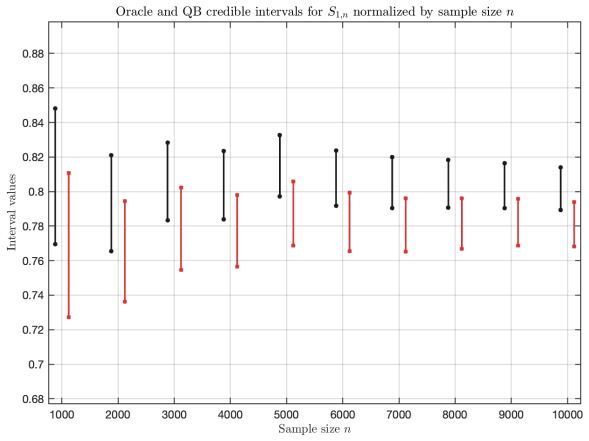
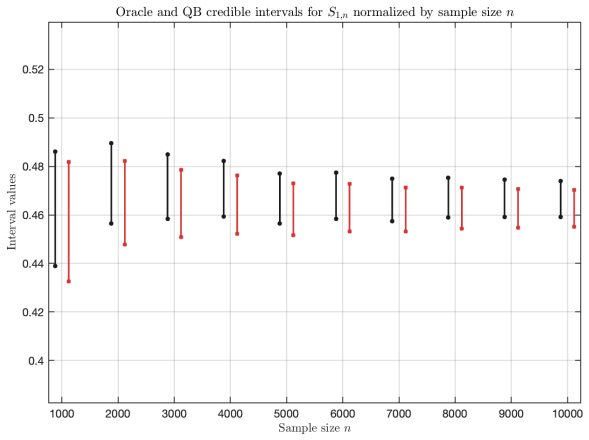
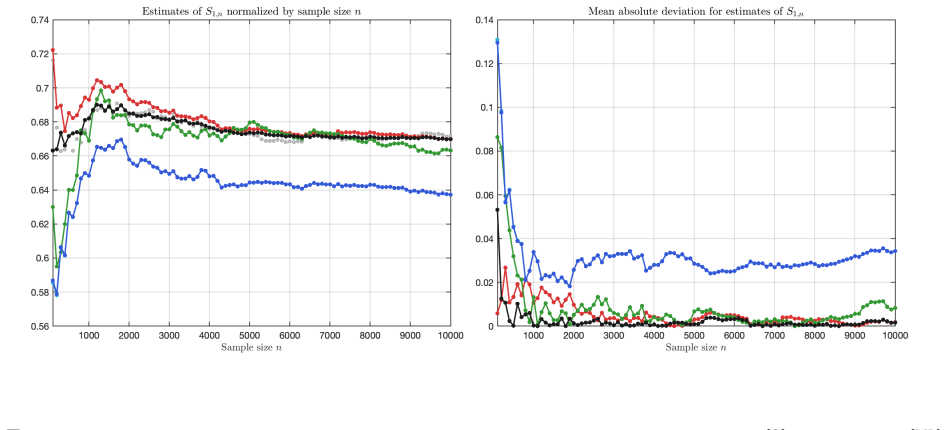
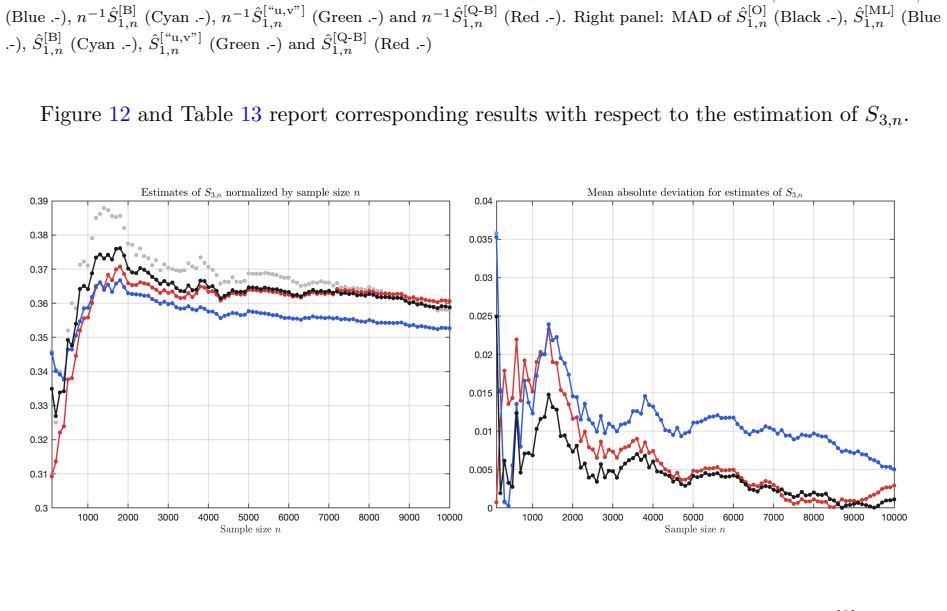
The estimation of sums of functions of observable and unobservable variables is a long-standing problem in statistics with applications across many domains. Empirical Bayes methods provide a natural framework for this task under mixture models, but existing approaches often rely on restrictive parametric assumptions or apply only to limited classes of functionals in nonparametric settings. We propose a nonparametric methodology, referred to as quasi-Bayes empirical Bayes, that addresses these limitations through a recursive estimation of the mixing distribution based on Newton's algorithm. The resulting plug-in estimate of the target sum is computationally efficient, scalable, and applicable to a broad class of utility functions, while enabling uncertainty quantification via asymptotic credible intervals derived from a Gaussian central limit theorem. We establish large sample asymptotic theoretical guarantees by proving a merging between the quasi-Bayes and Bayes estimates and by showing consistency under a correctly specified frequentist model. Synthetic-data and real-data analyses demonstrate the practical accuracy and stability of the method, with performance comparable to, and in some cases better than, existing empirical Bayes procedures.
Editorial analysis
A structured set of objections, weighed in public.
Referee Report
Summary. The manuscript proposes a quasi-Bayes empirical Bayes methodology for estimating sums of functions of observable and unobservable variables under mixture models. It employs recursive estimation of the mixing distribution via Newton's algorithm to obtain a computationally efficient plug-in estimator applicable to a broad class of utility functions. The approach supplies asymptotic credible intervals derived from a Gaussian central limit theorem and establishes large-sample guarantees via a merging result between the quasi-Bayes and Bayes estimates together with consistency under a correctly specified frequentist model. Performance is illustrated through synthetic-data and real-data experiments.
Significance. If the stated asymptotic results hold, the contribution supplies a scalable nonparametric procedure for a practically relevant class of functionals that avoids restrictive parametric assumptions while furnishing built-in uncertainty quantification. The merging property with Bayes estimates and the explicit consistency statement under correct specification would constitute substantive theoretical advances in empirical Bayes methodology for sums involving latent variables.
minor comments (2)
- [Abstract] Abstract: the phrase 'broad class of utility functions' is repeated without a precise characterization; a short sentence listing the functional forms covered (e.g., indicators, linear, or bounded continuous) would clarify the scope.
- The description of Newton's algorithm for recursive mixing-distribution estimation would benefit from an explicit statement of the update rule and the stopping criterion used in the implementation.
Simulated Author's Rebuttal
We thank the referee for the positive summary, significance assessment, and recommendation of minor revision. The referee's description accurately reflects the paper's contributions on quasi-Bayes empirical Bayes estimation for sums under mixture models, including the recursive mixing distribution estimation, asymptotic guarantees, and uncertainty quantification.
Circularity Check
No significant circularity detected
full rationale
The paper proposes a nonparametric quasi-Bayes empirical Bayes estimator via Newton's algorithm recursion on the mixing distribution, with plug-in estimates for sums of functionals and asymptotic credible intervals from a Gaussian CLT. Large-sample guarantees are established by proving merging with Bayes estimates plus consistency under a correctly specified frequentist model. These are standard asymptotic arguments that do not reduce by construction to fitted parameters, self-definitions, or self-citation chains. No load-bearing step in the abstract or described claims exhibits any of the enumerated circularity patterns; the derivation is self-contained against external benchmarks.
Axiom & Free-Parameter Ledger
Reference graph
Works this paper leans on
-
[1]
Battiston, M. and Cappello, L. (2025). New (and old) predictive schemes with a.c.i.d. sequences. Preprint arXiv:2507.21874
-
[2]
and Pannekoek, J
Bethlehem, J.G., Keller, W.J. and Pannekoek, J. (1990). Disclosure control of microdata. J. Am. Statist. Assoc. 85 38--45
1990
-
[3]
Bissiri, P.G., Holmes, C.C., and Walker, S.G. (2007). A general framework for updating belief distributions. J. R. Statist. Soc. B 78, 1103--1130
2007
-
[4]
and Ritov, Y
Brown, L.D., Greenshtein, E. and Ritov, Y. (2013). The Poisson compound decision problem revisited. J. Am. Statist. Assoc. 108, 741--749
2013
-
[5]
and Fitzpatrick, M
Bunge, J. and Fitzpatrick, M. (1993) Estimating the number of species: a review. J. Am. Statist. Assoc. 88, 364-373
1993
-
[6]
Universal priors: solving empirical Bayes via Bayesian inference and pretraining
Cannella, N., Teh, A., Han, Y. and Polyanskiy, Y. (2026) Universal priors: solving empirical Bayes via Bayesian inference and pretraining. Preprint arXiv:2602.15136
work page internal anchor Pith review Pith/arXiv arXiv 2026
-
[7]
and Lindley, D.V
Deely, J.J. and Lindley, D.V. (1981). Bayes empirical Bayes. J. Am. Statist. Assoc. 76, 833--841
1981
-
[8]
Efron, B. (2014). Two modeling strategies for empirical Bayes estimation. Statist. Sci. 29, 285--301
2014
-
[9]
Efron, B. (2019). Bayes, oracle Bayes and empirical Bayes. Statist. Sci. 34, 177--201
2019
-
[10]
Efron. B. and Hastie, T. (2021). Computer age statistical inference: algorithms, evidence, and data science. Cambridge University Press
2021
-
[11]
and Thisted, R
Efron, B. and Thisted, R. (1976). Estimating the number of unseen species: How many words did Shakespeare know? Biometrika 63, 435--447
1976
-
[12]
Quasi-Bayes empirical Bayes: a sequential approach to the Poisson compound decision problem
Favaro, S. and Fortini, S. (2024). Quasi-Bayes empirical Bayes: a sequential approach to the Poisson compound decision problem. Preprint arXiv:2411.07651
work page internal anchor Pith review Pith/arXiv arXiv 2024
-
[13]
and Teh, Y.W
Favaro, S. and Teh, Y.W. (2013). MCMC for normalized random measure mixture models. Statist. Sci. 28, 335--359
2013
-
[14]
Ferguson, T.S. (1973). A Bayesian analysis of some nonparametric problems. Ann. Statist. 1, 209--230
1973
-
[15]
and Walker, S
Fong, E., Holmes, C. and Walker, S. G. (2023). Martingale posterior distributions. J. R. Statist. Soc. B 85, 1357--1391
2023
-
[16]
and Petrone, S
Fortini, S. and Petrone, S. (2020). Quasi-Bayesian properties of a procedure for sequential learning in mixture models. J. R. Statist. Soc. B 82, 1087--1114
2020
-
[17]
and Petrone, S
Fortini, S. and Petrone, S. (2025). Exchangeability, Prediction and Predictive Modeling in Bayesian Statistics. Statist. Sci. 40, 40--67
2025
-
[18]
Good, I.J. (1953). The population frequencies of species and the estimation of population parameters. Biometrika 40, 237-264
1953
-
[19]
and Toulmin, G.H
Good, I.J. and Toulmin, G.H. (1956). The number of new species, and the increase in population coverage, when a sample is increased. Biometrika 43, 45--63
1956
-
[20]
and Walker, S.G
Hahn, P.R., Martin, R. and Walker, S.G. (2018). On recursive Bayesian predictive distributions. J. Am. Statist. Assoc. 113, 1085--1093
2018
-
[21]
Ignatiadis, N. and Kankanala, S. (2026). Compound decisions and empirical Bayes via Bayesian nonparametrics. Preprint arXiv:2602.20115
-
[22]
and Wu, Y
Jana, S., Polyanskiy, Y. and Wu, Y. (2025). Optimal empirical Bayes estimation for the Poisson model via minimum-distance methods. Inf. Inference 14, 1--42
2025
-
[23]
Knoblauch, J., Jewson, J., and Damoulas, T. (2022). An optimization-centric view on Bayes’ rule: reviewing and generalizing variational inference. J. Mach. Learn. Res. 23, 1--109
2022
-
[24]
Lindsay, B.G. (1995). Mixture models: theory, geometry and applications. NSF-CBMS Regional Conference Series in Probability and Statistics
1995
-
[25]
Lo, A.Y. (1984). On a class of Bayesian nonparametric estimates. I. Density estimates Ann. Statist. 12, 351--357
1984
-
[26]
and Lindsay, B.G
Mao, C.X. and Lindsay, B.G. (2004). A Poisson model for the coverage problem with a genomic application. Biometrika 89, 669--682
2004
-
[27]
Martin, R. (2012). Convergence rate for predictive recursion estimation of finite mixtures. Stat. Probab. Lett. 82, 378--384
2012
-
[28]
and Ghosh, J.K
Martin, R. and Ghosh, J.K. (2008). Stochastic approximation and Newton’s estimate of a mixing distribution. Statist. Sci. 23, 365--382
2008
-
[29]
and Tokdar, S.T
Martin, R. and Tokdar, S.T. (2009). Asymptotic properties of predictive recursion: robustness and rate of convergence. Electron. J. Stat. 3, 1455--1472
2009
-
[30]
and Zhang, Y
Newton, M.A., Quintana, F.A. and Zhang, Y. (1998). Nonparametric Bayes methods using predictive updating. In Practical Nonparametric and Semiparametric Bayesian Statistics, Springer
1998
-
[31]
Robbins, H. (1951). Asymptotically subminimax solutions of compound decision problems. In Proceedings of the Second Berkeley Symposium 2, 131--148
1951
-
[32]
Robbins, H. (1956). An empirical Bayes approach to statistics. In Proc. Third Berkeley Symp. Math. Statist. Probab. 3, 157--164
1956
-
[33]
Robbins, H. (1977). Prediction and estimation for the compound Poisson distribution. Proc. Natl. Acad. Sci. U.S.A. 74 , 2670--2671
1977
-
[34]
Robbins, H. (1988). The u,\,v method of estimation. In Statistical Decision Theory and Related Topics IV. Springer, New York
1988
-
[35]
and Zhang, C.-H
Robbins, H. and Zhang, C.-H. (1988). Estimating a treatment effect under biased sampling. Proc. Natl. Acad. Sci. U.S.A. 85, 3670--3672
1988
-
[36]
and Zhang, C.-H
Robbins, H. and Zhang, C.-H. (1989). Estimating the superiority of a drug to a placebo when all and only those patients at risk are treated with the drug. Proc. Natl. Acad. Sci. U.S.A. 86, 3003--3005
1989
-
[37]
and Zhang, C.-H
Robbins, H. and Zhang, C.-H. (1991). Estimating a multiplicative treatment effect under biased allocation. Biometrika 78, 349--354
1991
-
[38]
and Zhang, C.-H
Robbins, H. and Zhang, C.-H. (2000). Efficiency of the u,\,v method of estimation. Proc. Natl. Acad. Sci. U.S.A. 97, 12976--12979
2000
-
[39]
M., and de Montjoye, Y
Rocher, L., Hendrickx, J. M., and de Montjoye, Y. A. (2019). Estimating the success of re-identifications in incomplete datasets using generative models. Nat. Commun. 10, 3069
2019
- [40]
-
[41]
Skinner, and Elliot, M.J. (2002). A measure of disclosure risk for microdata. J. R. Statist. Soc. B 64, 855--867
2002
-
[42]
and Makov, U.E
Smith, A.F.M. and Makov, U.E. (1978). A quasi-Bayes sequential procedure for mixtures. J. R. Statist. Soc. B 40, 106--112
1978
-
[43]
and West, M
Tebaldi, C. and West, M. (1998). Bayesian inference on network traffic using link count data. J. Amer. Statist. Assoc. 93, 557--573
1998
-
[44]
Vardi, Y. (1996). Network tomography: Estimating source-destination traffic intensities from link data. J. Amer. Statist. Assoc. 91, 365--377
1996
-
[45]
Zhang, C.-H. (2005). Estimation of sums of random variables: examples and information bounds. Ann. Statist. 33, 2022--2041
2005
-
[46]
Stochastic approximation and its applications
Chen, H.F (2002). Stochastic approximation and its applications. Springer New York, NY
2002
discussion (0)
Sign in with ORCID, Apple, or X to comment. Anyone can read and Pith papers without signing in.