The efficiency per free-fall time as a ratio of the Star Formation Rate to the gas-infall rate in collapsing cores: dependence on the core definition, accretion, and radial structure
Pith reviewed 2026-06-26 11:50 UTC · model grok-4.3
The pith
The efficiency per free-fall time in collapsing cores depends sensitively on core definition and external gas supply.
A machine-rendered reading of the paper's core claim, the machinery that carries it, and where it could break.
Core claim
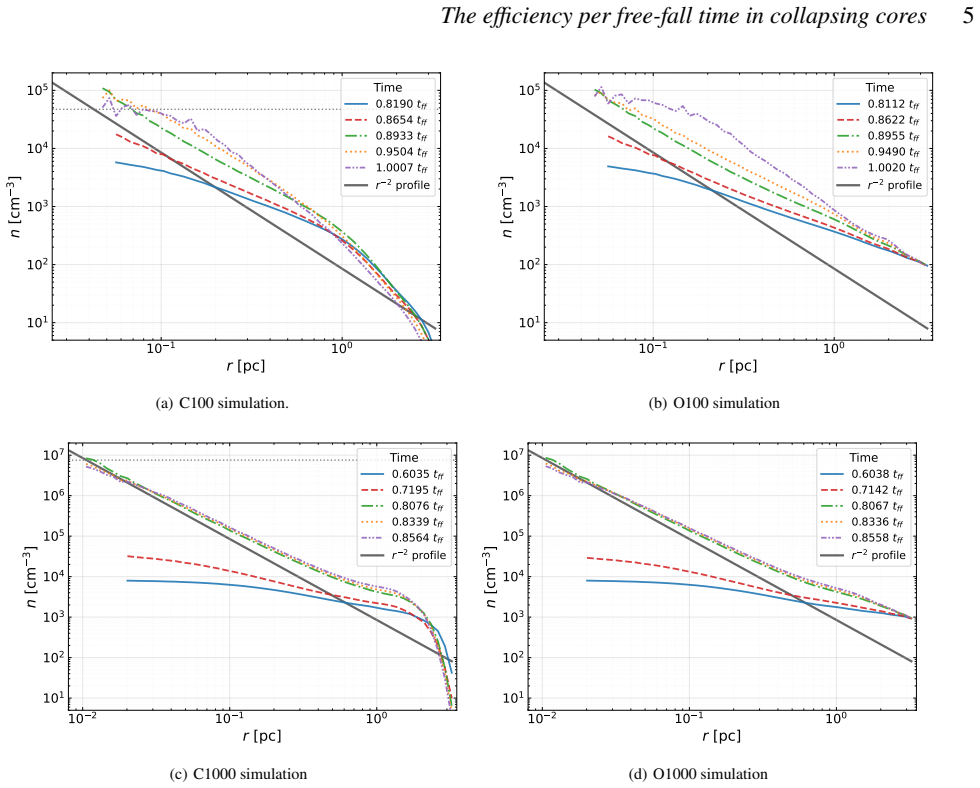
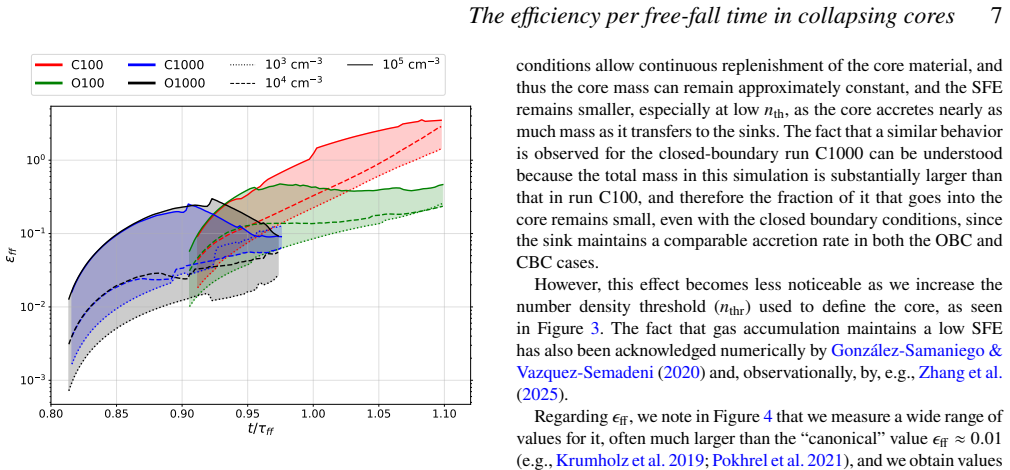
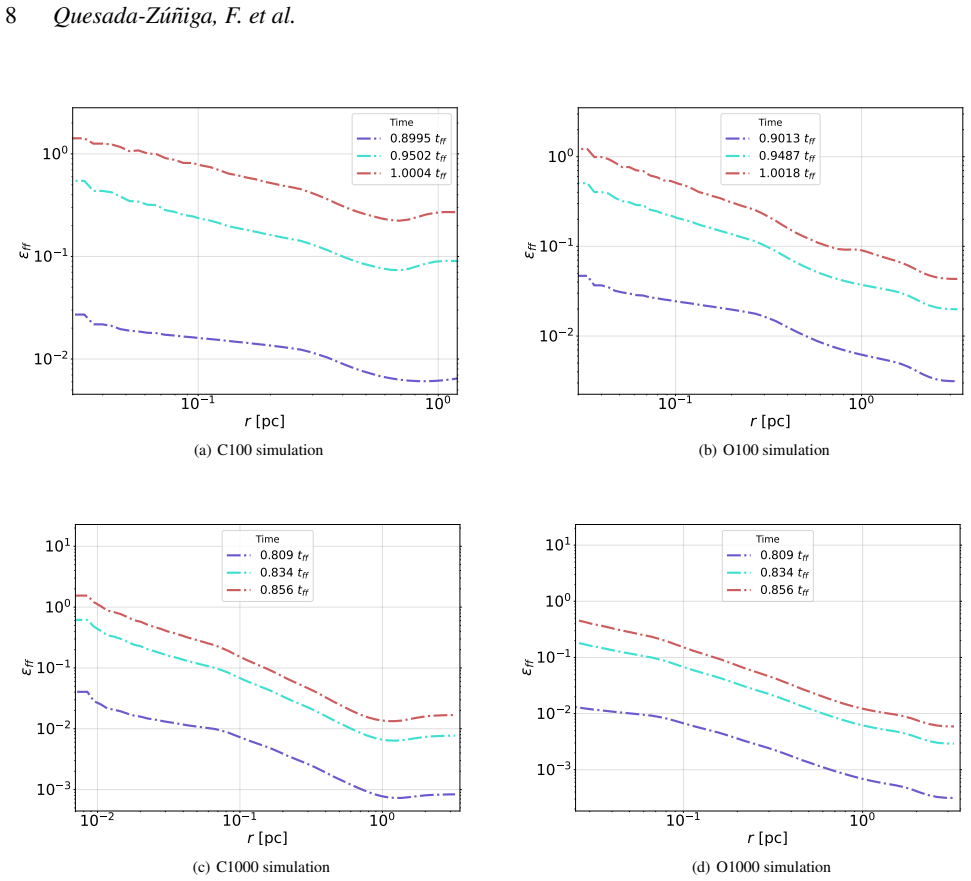
In simulations that begin with a central Gaussian overdensity and evolve toward a density profile n proportional to r to the minus two, a sink forms at the center. After sink formation the efficiency per free-fall time rises and then stays relatively stable while accretion continues to replenish core mass, but increases once the reservoir is exhausted. The value is higher in low-mass cores because the larger infall rates onto high-mass cores offset their higher star formation rates. Both the boundary conditions and the density threshold used to define the core alter the inferred efficiency.
What carries the argument
The ratio defined as average star formation rate divided by (core mass divided by free-fall time), where core mass is the gas mass above a chosen density threshold.
If this is right
- After a sink particle forms, the efficiency per free-fall time becomes stable during ongoing accretion but rises sharply once the gas reservoir is depleted.
- Low-density cores are more sensitive to boundary conditions than high-density cores because they have smaller mass reservoirs.
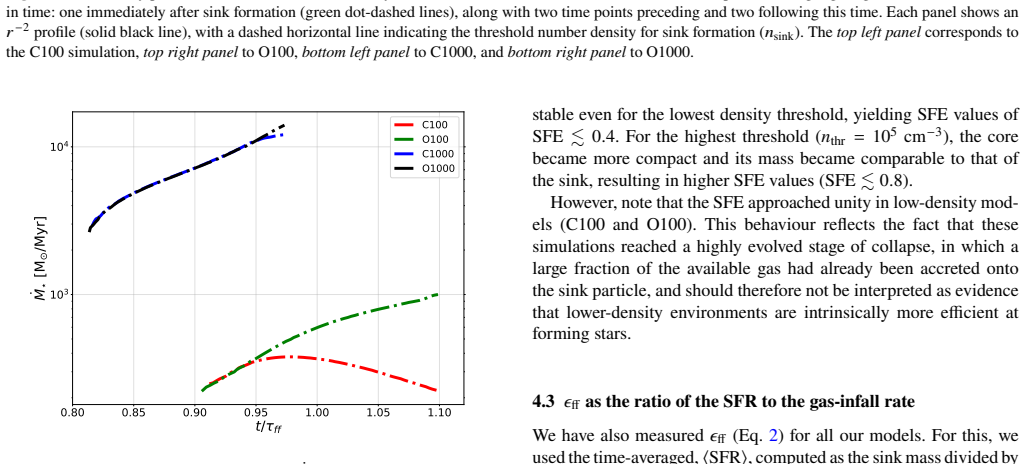
- The efficiency per free-fall time ends up higher in low-mass cores than in high-mass cores because higher infall rates onto the latter compensate for their higher star formation rates.
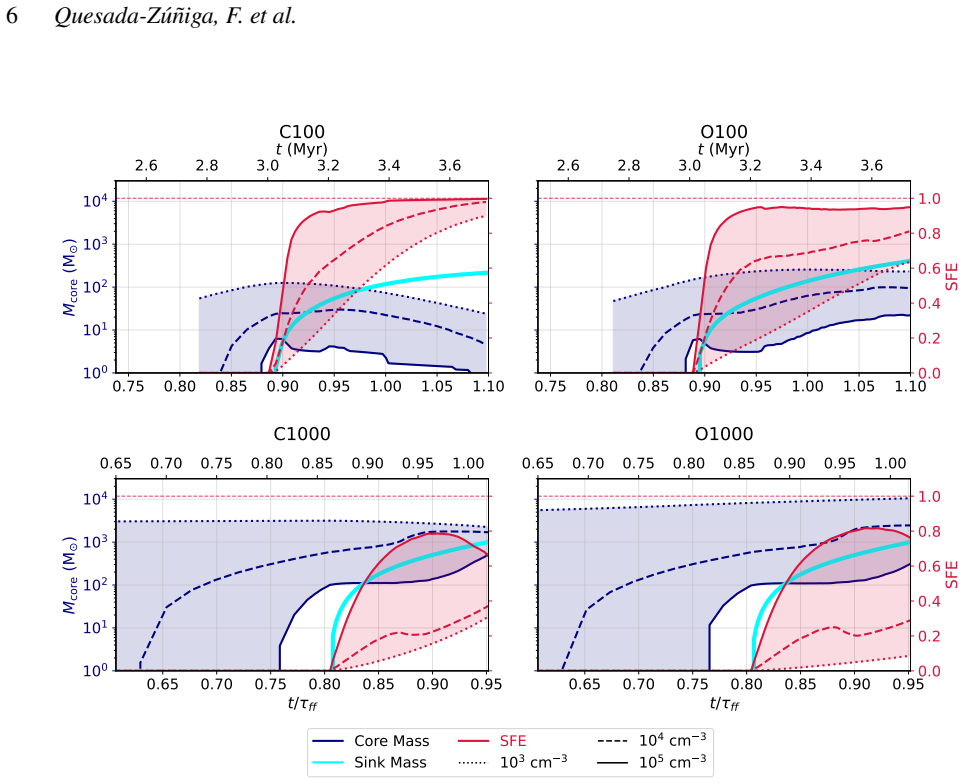
- Changing the density threshold that defines the core directly changes the measured core mass and therefore the inferred efficiency.
Where Pith is reading between the lines
- Observed differences in efficiency per free-fall time between cores could partly reflect differences in how the cores are bounded or supplied rather than differences in intrinsic star formation physics.
- The power-law radial structure that develops during collapse directly sets the infall rate entering the efficiency calculation, so any process that alters that structure would change the measured value.
Load-bearing premise
That defining the core as all gas above a density threshold in simplified isolated simulations with Gaussian initial overdensity captures the physics needed to measure the efficiency in real molecular cloud cores.
What would settle it
Measuring the efficiency in a set of simulations that vary only the density threshold while keeping all other parameters fixed and checking whether the predicted change in the ratio matches the change seen when the same threshold variation is applied to observed core samples with independent accretion-rate estimates.
Figures
read the original abstract
A parameter used to characterise star formation activity in MCs is the efficiency per free-fall time, $\epsilon_{\rm ff}$, although commonly referred to as an efficiency, it is formally the ratio between the star formation rate (SFR) and the gas-infall rate. Here we numerically study the collapse of cores and define $\epsilon_{\rm ff}\equiv\langle\dot{M}_\star\rangle/(M_{\rm core}/\tau_{\rm ff})$, where $\langle\dot{M}_\star\rangle$ is the average SFR, $M_{\rm core}$ is the gas mass within the core (as the gas cells above a density threshold), and $\tau_{\rm ff}$ is the free-fall time of the core gas. We perform simplified numerical experiments of the gravitational collapse of an isolated core, varying the initial mean number density ($n_0=100$ and $1000~\rm cm^{-3}$) and adopting closed/open BCs to (dis)allow fresh gas accretion into the domain. The simulations start with a slight central Gaussian overdensity that evolved into a power-law profile, $n\propto r^{-p}$ with $p\to2$. As the collapse proceeds, a sink particle forms in the center of the core. We find that both the BCs and the adopted core definition modify the measured core properties and, consequently, the inferred $\epsilon_{\rm ff}$. Low-density models have less mass available, and their accretion histories are therefore much more sensitive to the choice of BCs, while high-density runs, with their larger mass reservoirs, maintain similar accretion histories regardless of the BCs. In all models, after sink formation, $\epsilon_{\rm ff}$ rises and then remains relatively stable while accretion continues to replenish the core's mass, but increases once the gas reservoir is exhausted. Somewhat counterintuitively, $\epsilon_{\rm ff}$ is higher in the low-mass cores, since the larger gas infall rates onto the high-mass cores compensate for their higher SFR. We conclude that the inferred $\epsilon_{\rm ff}$ depends sensitively on both the adopted core definition and external mass supply
Editorial analysis
A structured set of objections, weighed in public.
Referee Report
Summary. The manuscript reports controlled numerical experiments on the gravitational collapse of isolated cores initialized with a central Gaussian overdensity that evolves to a power-law density profile. It defines ε_ff ≡ ⟨Ṁ⋆⟩ / (M_core / τ_ff), where M_core is the mass of gas cells above a chosen density threshold, and examines how the measured ε_ff responds to initial mean density (n0 = 100 or 1000 cm^{-3}), closed versus open boundary conditions, and the density threshold adopted for the core. The central result is that ε_ff depends sensitively on both the core definition and the presence of external mass supply, with higher values found in lower-mass cores because their lower infall rates are not offset by proportionally lower SFRs.
Significance. If the reported sensitivities hold, the work supplies a concrete, internally consistent demonstration that ε_ff inferred from simulations is not robust to standard modeling choices. This is useful for the field because it supplies a controlled test of how core definition and mass reservoir affect the ratio of SFR to gas-infall rate, directly addressing a quantity widely used to compare simulations and observations. The use of clearly defined, reproducible numerical setups with no free parameters fitted to data is a methodological strength.
major comments (2)
- [Abstract / Results] Abstract and results section: the claim that ε_ff is higher in low-mass cores because 'larger gas infall rates onto the high-mass cores compensate for their higher SFR' is the key counter-intuitive result; however, the manuscript does not report the actual numerical values of ⟨Ṁ⋆⟩, M_core, and τ_ff (or their ratios) for the different n0 and BC cases, making it impossible to verify the magnitude of the compensation or to judge whether the difference is statistically significant given the sink-particle accretion implementation.
- [Methods] Methods: the core is defined as all gas cells above a chosen density threshold, yet the specific threshold values, the resulting M_core(threshold) curves, and the time evolution of the enclosed mass are not tabulated or plotted; without these data the statement that 'both the BCs and the adopted core definition modify the measured core properties' cannot be assessed quantitatively.
minor comments (2)
- [Results] The evolution of the density profile to n ∝ r^{-p} with p → 2 is stated but not illustrated; a figure showing radial profiles at several times before and after sink formation would clarify how the power-law index is measured and whether it is the same across the n0 and BC runs.
- [Abstract / Methods] Notation: the symbol ⟨Ṁ⋆⟩ is introduced as an average SFR, but the time window over which the average is taken (e.g., from sink formation to a fixed multiple of τ_ff) is not stated explicitly.
Simulated Author's Rebuttal
We thank the referee for the constructive review and recommendation of minor revision. We address each major comment below.
read point-by-point responses
-
Referee: [Abstract / Results] Abstract and results section: the claim that ε_ff is higher in low-mass cores because 'larger gas infall rates onto the high-mass cores compensate for their higher SFR' is the key counter-intuitive result; however, the manuscript does not report the actual numerical values of ⟨Ṁ⋆⟩, M_core, and τ_ff (or their ratios) for the different n0 and BC cases, making it impossible to verify the magnitude of the compensation or to judge whether the difference is statistically significant given the sink-particle accretion implementation.
Authors: We agree that explicit numerical values are needed to substantiate the compensation claim. The revised manuscript will add a table reporting the time-averaged ⟨Ṁ⋆⟩, M_core, τ_ff and resulting ε_ff (with standard deviations) for every n0–BC combination. This will permit direct verification of the magnitude of the effect and assessment of its robustness given the sink implementation. revision: yes
-
Referee: [Methods] Methods: the core is defined as all gas cells above a chosen density threshold, yet the specific threshold values, the resulting M_core(threshold) curves, and the time evolution of the enclosed mass are not tabulated or plotted; without these data the statement that 'both the BCs and the adopted core definition modify the measured core properties' cannot be assessed quantitatively.
Authors: We acknowledge that quantitative support for the sensitivity to core definition is currently insufficient. The revision will include (i) explicit statement of the density thresholds used in each model and (ii) a new figure displaying M_core versus threshold at representative times together with the time evolution of enclosed mass for the adopted thresholds under both boundary conditions. revision: yes
Circularity Check
No significant circularity
full rationale
The paper performs numerical hydrodynamical experiments of isolated core collapse under varying initial densities and boundary conditions, then directly computes ε_ff from the simulation outputs using the explicit definition ε_ff ≡ ⟨Ṁ_star⟩ / (M_core / τ_ff), where all quantities are measured quantities extracted from the runs. The reported sensitivity of ε_ff to core density-threshold definition and to open/closed boundaries follows immediately from those measurements; no parameter is fitted to data and then re-labeled as a prediction, no uniqueness theorem or ansatz is imported via self-citation, and the central claim is scoped to the internal behavior of the chosen numerical setups rather than asserted as an external physical law. The derivation chain is therefore self-contained and does not reduce to its inputs by construction.
Axiom & Free-Parameter Ledger
axioms (2)
- domain assumption Gravitational collapse of an isolated core can be modeled with standard hydrodynamics and a sink particle for the central star.
- domain assumption Free-fall time τ_ff is computed from the mean density of gas cells above the chosen threshold.
Reference graph
Works this paper leans on
-
[1]
, title =
Gong, Hao and Ostriker, Eve C. , title =. The Astrophysical Journal , year =
-
[2]
and Kim, Chang-Goo and others , title =
Mao, Saoli and Ostriker, Eve C. and Kim, Chang-Goo and others , title =. The Astrophysical Journal , year =
-
[3]
yt: A Multi-code Analysis Toolkit for Astrophysical Simulation Data. The Astrophysical Journal Supplement Series , archivePrefix = "arXiv", eprint =. doi:10.1088/0067-0049/192/1/9 , adsurl =
-
[4]
, year = 2026, month = jan, volume =
Comparing the Mgas-Nyso Relation inside a Giant Molecular Cloud. , year = 2026, month = jan, volume =. doi:xxx , adsurl =
2026
-
[5]
Probability distribution function of integrated intensity for dense molecular gas tracers
ATOMS: ALMA Three-millimeter Observations of massive Star-forming regions - XX. Probability distribution function of integrated intensity for dense molecular gas tracers. , keywords =. doi:10.1093/mnras/staf176 , archivePrefix =. 2501.16682 , primaryClass =
-
[6]
N2H+ depletion in the massive protostellar cluster AFGL 5142
N _ 2 H ^ + depletion in the massive protostellar cluster AFGL 5142. , keywords =. doi:10.1051/0004-6361/201014152 , archivePrefix =. 1009.2333 , primaryClass =
work page internal anchor Pith review Pith/arXiv arXiv doi:10.1051/0004-6361/201014152
-
[7]
Properties of dense cores in clustered massive star-forming regions at high angular resolution
Properties of dense cores in clustered massive star-forming regions at high angular resolution. , keywords =. doi:10.1093/mnras/stt679 , archivePrefix =. 1304.5136 , primaryClass =
work page internal anchor Pith review Pith/arXiv arXiv doi:10.1093/mnras/stt679
-
[8]
The Critical Density and the Effective Excitation Density of Commonly Observed Molecular Dense Gas Tracers. , keywords =. doi:10.1086/680342 , archivePrefix =. 1501.01629 , primaryClass =
work page internal anchor Pith review Pith/arXiv arXiv doi:10.1086/680342
-
[9]
The ALMA Survey of Star Formation and Evolution in Massive Protoclusters with Blue Profiles (ASSEMBLE): Core Growth, Cluster Contraction, and Primordial Mass Segregation. , keywords =. doi:10.3847/1538-4365/acfee5 , archivePrefix =. 2309.14684 , primaryClass =
-
[10]
The effect of photoionizing feedback on the shaping of hierarchically-forming stellar clusters. , keywords =. doi:10.1093/mnras/staa2921 , archivePrefix =. 2003.12711 , primaryClass =
-
[11]
and Bernard, Jean-Philippe and Chu, You-Hua and Fukui, Yasuo and Gruendl, Robert A
Wong, Tony and Hughes, Annie and Ott, Jürgen and Muller, Erik and Pineda, Jorge L. and Bernard, Jean-Philippe and Chu, You-Hua and Fukui, Yasuo and Gruendl, Robert A. and Henkel, Christian and Kawamura, Akiko and Klein, Ulrich and Looney, Leslie W. and Maddison, Sarah and Mizuno, Yoji and Paradis, Deborah and Seale, Jonathan and , Daniel E. Welty , title ...
-
[12]
The Star Formation Rate of Supersonic MHD Turbulence
The Star Formation Rate of Supersonic Magnetohydrodynamic Turbulence. , keywords =. doi:10.1088/0004-637X/730/1/40 , archivePrefix =. 0907.0248 , primaryClass =
work page internal anchor Pith review Pith/arXiv arXiv doi:10.1088/0004-637x/730/1/40
-
[13]
Analytical star formation rate from gravoturbulent fragmentation
Analytical Star Formation Rate from Gravoturbulent Fragmentation. , keywords =. doi:10.1088/2041-8205/743/2/L29 , archivePrefix =. 1110.0033 , primaryClass =
work page internal anchor Pith review Pith/arXiv arXiv doi:10.1088/2041-8205/743/2/l29 2041
-
[14]
Stellar feedback in the star formation-gas density relation: Comparison between simulations and observations. , keywords =. doi:10.1051/0004-6361/202347527 , archivePrefix =. 2311.18522 , primaryClass =
-
[15]
FLASH: An Adaptive Mesh Hydrodynamics Code for Modeling Astrophysical Thermonuclear Flashes. , keywords =. doi:10.1086/317361 , adsurl =
-
[16]
Physica Scripta Volume T , year = 2008, month = dec, volume =
Introduction to FLASH 3.0, with application to supersonic turbulence. Physica Scripta Volume T , year = 2008, month = dec, volume =. doi:10.1088/0031-8949/2008/T132/014046 , adsurl =
-
[18]
Gravity or turbulence? VII. The Schmidt Kennicutt law, the star formation efficiency, and the mass density of clusters from gravitational collapse rather than turbulent support. , keywords =. doi:10.1093/mnras/staf1123 , archivePrefix =. 2409.11588 , primaryClass =
-
[19]
The physics behind the Kennicutt-Schmidt relation
Gravity or turbulence? - VI. The physics behind the Kennicutt-Schmidt relation. , keywords =. doi:10.1093/mnras/stae2036 , archivePrefix =. 2408.13636 , primaryClass =
-
[20]
, year = 1986, month = nov, volume =
Relationships Between Dense Cores and Young Stars. , year = 1986, month = nov, volume =. doi:10.1086/131882 , adsurl =
-
[21]
Star formation in molecular clouds - Observation and theory. , keywords =. doi:10.1146/annurev.aa.25.090187.000323 , adsurl =
-
[22]
2006 , eprint=
An Observational Perspective of Low-Mass Dense Cores I: Internal Physical and Chemical Properties , author=. 2006 , eprint=
2006
-
[23]
The Nature of the Dense Core Population in the Pipe Nebula: A Survey of NH _ 3 , CCS, and HC _ 5 N Molecular Line Emission. , keywords =. doi:10.1086/522889 , archivePrefix =. 0708.3660 , primaryClass =
work page internal anchor Pith review Pith/arXiv arXiv doi:10.1086/522889
-
[24]
Simultaneous Evolution of the Virial Parameter and Star Formation Rate in Molecular Clumps Undergoing Global Hierarchical Collapse. , keywords =. doi:10.3847/1538-4357/abb8d4 , archivePrefix =. 2002.01594 , primaryClass =
-
[25]
Filaments in Simulations of Molecular Cloud Formation
Filaments in Simulations of Molecular Cloud Formation. , keywords =. doi:10.1088/0004-637X/791/2/124 , archivePrefix =. 1308.6298 , primaryClass =
work page internal anchor Pith review Pith/arXiv arXiv doi:10.1088/0004-637x/791/2/124
-
[26]
Scale-free gravitational collapse as the origin of r ^ -2 density profile - a possible role of turbulence in regulating gravitational collapse. , keywords =. doi:10.1093/mnras/sty657 , archivePrefix =. 1803.03273 , primaryClass =
work page internal anchor Pith review Pith/arXiv arXiv doi:10.1093/mnras/sty657
-
[27]
A compilation of interstellar gas properties. , keywords =. doi:10.1086/156500 , adsurl =
-
[28]
The Neutral Atomic Phases of the Interstellar Medium. , keywords =. doi:10.1086/175510 , adsurl =
-
[30]
Control of star formation by supersonic turbulence
Control of star formation by supersonic turbulence. Reviews of Modern Physics , keywords =. doi:10.1103/RevModPhys.76.125 , archivePrefix =. astro-ph/0301093 , primaryClass =
work page internal anchor Pith review Pith/arXiv arXiv doi:10.1103/revmodphys.76.125
-
[31]
Inefficient star formation through turbulence, magnetic fields and feedback. , keywords =. doi:10.1093/mnras/stv941 , adsurl =
-
[32]
Star Formation Efficiency and Dispersal of Giant Molecular Clouds with UV Radiation Feedback: Dependence on Gravitational Boundedness and Magnetic Fields. , keywords =. doi:10.3847/1538-4357/abe934 , adsurl =
-
[33]
A Simple Law of Star Formation
A Simple Law of Star Formation. , keywords =. doi:10.1088/2041-8205/759/2/L27 , archivePrefix =. 1208.3758 , primaryClass =
work page internal anchor Pith review Pith/arXiv arXiv doi:10.1088/2041-8205/759/2/l27 2041
-
[34]
Disentangling the independently controllable factors of variation by interacting with the world
Embedded Clusters in Molecular Clouds. , keywords =. doi:10.1146/annurev.astro.41.011802.094844 , archivePrefix =. astro-ph/0301540 , primaryClass =
work page internal anchor Pith review Pith/arXiv arXiv doi:10.1146/annurev.astro.41.011802.094844
-
[35]
Molecular Clouds and Star Formation in the Inner Galaxy: A Comparison of CO, H ii, and Far-Infrared Surveys. , keywords =. doi:10.1086/163909 , adsurl =
-
[36]
The Edges of Molecular Clouds: Fractal Boundaries and Density Structure. , keywords =. doi:10.1086/170419 , adsurl =
-
[37]
Star Clusters Across Cosmic Time. , keywords =. doi:10.1146/annurev-astro-091918-104430 , archivePrefix =. 1812.01615 , primaryClass =
-
[38]
ApJ , archivePrefix = "arXiv", eprint =
On the Star Formation Rates in Molecular Clouds. ApJ , archivePrefix = "arXiv", eprint =. doi:10.1088/0004-637X/724/1/687 , adsurl =
-
[39]
The Formation of Stars
-
[40]
Fragmentation of Massive Dense Cores Down to < -0.5ex 1000 AU: Relation between Fragmentation and Density Structure. , keywords =. doi:10.1088/0004-637X/785/1/42 , archivePrefix =. 1401.8292 , primaryClass =
work page internal anchor Pith review Pith/arXiv arXiv doi:10.1088/0004-637x/785/1/42
-
[41]
The Single-cloud Star Formation Relation. , keywords =. doi:10.3847/2041-8213/abf564 , archivePrefix =. 2104.04551 , primaryClass =
-
[42]
and Olson, K
Fryxell, B. and Olson, K. and Ricker, P. and Timmes, F. X. and Zingale, M. and Lamb, D. Q. and MacNeice, P. and Rosner, R. and Truran, J. W. and Tufo, H. , title =. 2000 , url =
2000
-
[43]
Dyas Utomo and Jiayi Sun and Adam K. Leroy and J. M. Diederik Kruijssen and Eva Schinnerer and Andreas Schruba and Frank Bigiel and Guillermo A. Blanc and M. Star Formation Efficiency per Free-fall Time in nearby Galaxies , journal =. doi:10.3847/2041-8213/aacf8f , url =
-
[44]
Tree-based solvers for adaptive mesh refinement code FLASH - II: radiation transport module TreeRay. , keywords =. doi:10.1093/mnras/stab1482 , archivePrefix =. 2105.09644 , primaryClass =
-
[45]
Mit 5 Textabbildungen
\"U ber die Verdichtung von H I-Gebieten. Mit 5 Textabbildungen. , year = 1955, month = jan, volume =
1955
-
[46]
, year = 1956, month = jan, volume =
Boyle's Law and gravitational instability. , year = 1956, month = jan, volume =. doi:10.1093/mnras/116.3.351 , adsurl =
-
[47]
XIV.0 Scientific Meeting (virtual) of the Spanish Astronomical Society , year = 2020, month = jul, eid =
Fragmentation of molecular clouds: the role of magnetic field. XIV.0 Scientific Meeting (virtual) of the Spanish Astronomical Society , year = 2020, month = jul, eid =
2020
-
[48]
The Interstellar Environment of our Galaxy
The interstellar environment of our galaxy. Reviews of Modern Physics , keywords =. doi:10.1103/RevModPhys.73.1031 , archivePrefix =. astro-ph/0106359 , primaryClass =
work page internal anchor Pith review Pith/arXiv arXiv doi:10.1103/revmodphys.73.1031
-
[49]
The Structure and Evolution of Molecular Clouds: from Clumps to Cores to the IMF
The Structure and Evolution of Molecular Clouds: from Clumps to Cores to the IMF. Protostars and Planets IV , year = 2000, editor =. doi:10.48550/arXiv.astro-ph/9902246 , archivePrefix =. astro-ph/9902246 , primaryClass =
work page internal anchor Pith review Pith/arXiv arXiv doi:10.48550/arxiv.astro-ph/9902246 2000
-
[50]
A robust numerical scheme for highly compressible magnetohydrodynamics: Nonlinear stability, implementation and tests. Journal of Computational Physics , keywords =. doi:10.1016/j.jcp.2011.01.026 , archivePrefix =. 1101.3007 , primaryClass =
work page internal anchor Pith review Pith/arXiv arXiv doi:10.1016/j.jcp.2011.01.026 2011
-
[51]
Towards the ultimate conservative difference scheme III
Bram. Towards the ultimate conservative difference scheme III. Upstream-centered finite-difference schemes for ideal compressible flow , journal =. 1977 , issn =. doi:https://doi.org/10.1016/0021-9991(77)90094-8 , url =
-
[52]
Riemann Solvers and Numerical Methods for Fluid Dynamics: A Practical Introduction , journal =
Toro, Eleuterio , year =. Riemann Solvers and Numerical Methods for Fluid Dynamics: A Practical Introduction , journal =
-
[53]
Journal of Computational Physics , year = 2009, month = dec, volume =
A positive MUSCL-Hancock scheme for ideal magnetohydrodynamics. Journal of Computational Physics , year = 2009, month = dec, volume =. doi:10.1016/j.jcp.2009.08.020 , adsurl =
-
[54]
Towards a comprehensive scenario
Global hierarchical collapse in molecular clouds. Towards a comprehensive scenario. , keywords =. doi:10.1093/mnras/stz2736 , archivePrefix =. 1903.11247 , primaryClass =
-
[55]
From Filamentary Networks to Dense Cores in Molecular Clouds: Toward a New Paradigm for Star Formation. Protostars and Planets VI , year = 2014, editor =. doi:10.2458/azu_uapress_9780816531240-ch002 , archivePrefix =. 1312.6232 , primaryClass =
work page internal anchor Pith review Pith/arXiv arXiv doi:10.2458/azu_uapress_9780816531240-ch002 2014
-
[56]
Physics of the Interstellar and Intergalactic Medium
-
[57]
1999 , publisher=
Introducción a la Física del Medio Interestelar , author=. 1999 , publisher=
1999
-
[58]
1980 , publisher=
Physics of the Interstellar Medium , author=. 1980 , publisher=
1980
-
[59]
2012 , publisher=
Finite Element Methods for Navier-Stokes Equations: Theory and Algorithms , author=. 2012 , publisher=
2012
-
[60]
2003 , publisher=
Fluid Mechanics , author=. 2003 , publisher=
2003
-
[61]
Batchelor, G. K. , year=. An Introduction to Fluid Dynamics , DOI=
-
[62]
The Stability of a Spherical Nebula. Philosophical Transactions of the Royal Society of London Series A , year = 1902, month = jan, volume =. doi:10.1098/rsta.1902.0012 , adsurl =
-
[63]
Chapter 8 - Boundary Conditions , editor =
Jiri Blazek , keywords =. Chapter 8 - Boundary Conditions , editor =. Computational Fluid Dynamics: Principles and Applications (Third Edition) , publisher =. 2015 , isbn =. doi:https://doi.org/10.1016/B978-0-08-099995-1.00008-7 , url =
-
[64]
2001 , publisher=
Computational Methods for Fluid Dynamics , author=. 2001 , publisher=
2001
-
[65]
Monthly Notices of the Royal Astronomical Society , volume =
Wünsch, R and Walch, S and Dinnbier, F and Whitworth, A , title = ". Monthly Notices of the Royal Astronomical Society , volume =. 2018 , month =. doi:10.1093/mnras/sty015 , url =
-
[66]
John K. Salmon and Michael S. Warren , abstract =. Skeletons from the Treecode Closet , journal =. 1994 , issn =. doi:https://doi.org/10.1006/jcph.1994.1050 , url =
-
[67]
The cosmological simulation code GADGET-2. , keywords =. doi:10.1111/j.1365-2966.2005.09655.x , archivePrefix =. astro-ph/0505010 , primaryClass =
-
[68]
A hierarchical O(N log N) force-calculation algorithm. , keywords =. doi:10.1038/324446a0 , adsurl =
-
[69]
A Solution-Adaptive Upwind Scheme for Ideal Magnetohydrodynamics. Journal of Computational Physics , year = 1999, month = sep, volume =. doi:10.1006/jcph.1999.6299 , adsurl =
-
[70]
Journal of Computational Physics , volume=
An 8-wave MHD solver using Godunov-type algorithms , author=. Journal of Computational Physics , volume=. 1984 , publisher=
1984
-
[71]
Anshu Dubey and Katie Antypas and Murali K. Ganapathy and Lynn B. Reid and Katherine Riley and Dan Sheeler and Andrew Siegel and Klaus Weide , title =. doi:10.1016/j.parco.2009.08.001 , url =
-
[72]
Journal of Computational Physics , keywords =
The Piecewise Parabolic Method (PPM) for Gas-Dynamical Simulations. Journal of Computational Physics , keywords =. doi:10.1016/0021-9991(84)90143-8 , adsurl =
-
[73]
Paul C. Clark and Simon C. O. Glover and Ralf S. Klessen , title =. doi:10.1111/j.1365-2966.2011.20087.x , url =
-
[74]
Principles of Astrophysical Fluid Dynamics , DOI=
Clarke, Cathie and Carswell, Bob , year=. Principles of Astrophysical Fluid Dynamics , DOI=
-
[75]
Modeling Collapse and Accretion in Turbulent Gas Clouds: Implementation and Comparison of Sink Particles in AMR and SPH. , keywords =. doi:10.1088/0004-637X/713/1/269 , archivePrefix =. 1001.4456 , primaryClass =
work page internal anchor Pith review Pith/arXiv arXiv doi:10.1088/0004-637x/713/1/269
-
[76]
The Jeans Condition: A New Constraint on Spatial Resolution in Simulations of Isothermal Self-gravitational Hydrodynamics. , keywords =. doi:10.1086/310975 , adsurl =
-
[77]
Ammonia in Infrared Dark Clouds
Ammonia in infrared dark clouds. , keywords =. doi:10.1051/0004-6361:20054128 , archivePrefix =. astro-ph/0601078 , primaryClass =
work page internal anchor Pith review Pith/arXiv arXiv doi:10.1051/0004-6361:20054128
-
[78]
The Milky Way as a Star Formation Engine
The Milky Way as a Star Formation Engine. Protostars and Planets VI , year = 2014, editor =. doi:10.2458/azu_uapress_9780816531240-ch006 , archivePrefix =. 1402.6196 , primaryClass =
work page internal anchor Pith review Pith/arXiv arXiv doi:10.2458/azu_uapress_9780816531240-ch006 2014
-
[79]
The Life and Times of Giant Molecular Clouds. arXiv e-prints , keywords =. doi:10.48550/arXiv.2203.09570 , archivePrefix =. 2203.09570 , primaryClass =
-
[80]
On The Nature of Variations in the Measured Star Formation Efficiency of Molecular Clouds
On the nature of variations in the measured star formation efficiency of molecular clouds. , keywords =. doi:10.1093/mnras/stz1758 , archivePrefix =. 1809.08348 , primaryClass =
work page internal anchor Pith review Pith/arXiv arXiv doi:10.1093/mnras/stz1758
-
[81]
The Exciting Lives of Giant Molecular Clouds
The exciting lives of giant molecular clouds. , keywords =. doi:10.1093/mnras/stt508 , archivePrefix =. 1303.4995 , primaryClass =
work page internal anchor Pith review Pith/arXiv arXiv doi:10.1093/mnras/stt508
-
[82]
Gilberto C G. Density profile evolution during prestellar core collapse: collapse starts at the large scale , journal =. doi:10.1093/mnras/stab394 , url =
discussion (0)
Sign in with ORCID, Apple, or X to comment. Anyone can read and Pith papers without signing in.