Ordering Stochastic Block Models via prior transitivity
Pith reviewed 2026-06-26 11:30 UTC · model grok-4.3
The pith
The Transitive Stochastic Block Model imposes order on directed network blocks by placing transitivity-inducing priors on directional imbalance rather than interaction volume.
A machine-rendered reading of the paper's core claim, the machinery that carries it, and where it could break.
Core claim
The central claim is that order-restricted priors applied to the direction component of a stochastic block model yield a coherent probabilistic representation of hierarchical block structure in directed networks; the resulting TSBM improves out-of-sample prediction and partition quality relative to unconstrained block models whenever the observed directional imbalances are consistent with transitivity, while the same construction supplies a direct diagnostic for when that consistency fails.
What carries the argument
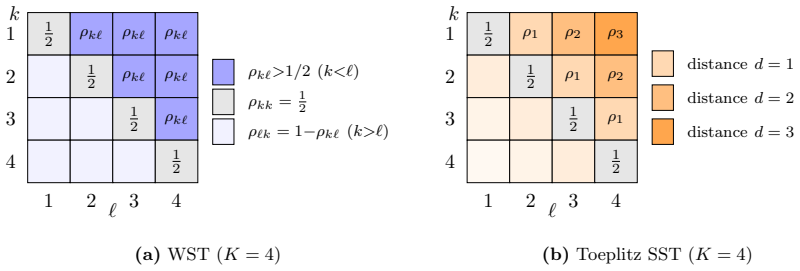
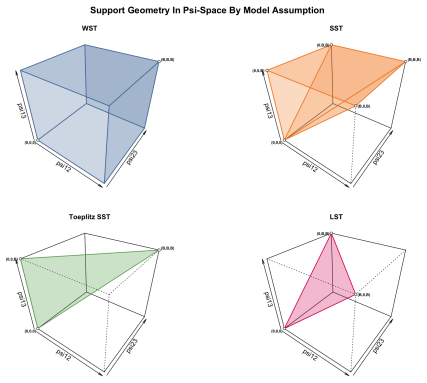
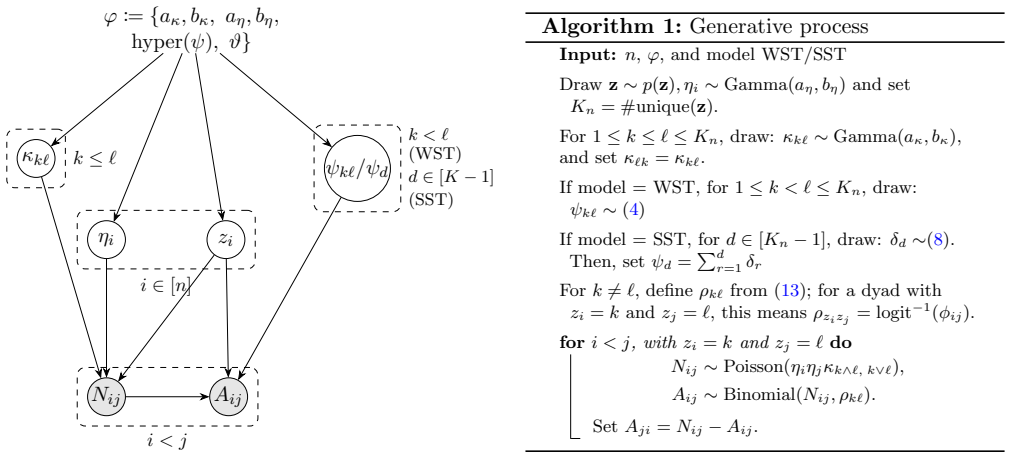
The Transitive Stochastic Block Model (TSBM), which factors each directed edge into a volume parameter and a direction probability that is constrained by either weak-stochastic-transitivity or Toeplitz strong-stochastic-transitivity priors, together with an age-ordered partition prior that breaks label exchangeability.
If this is right
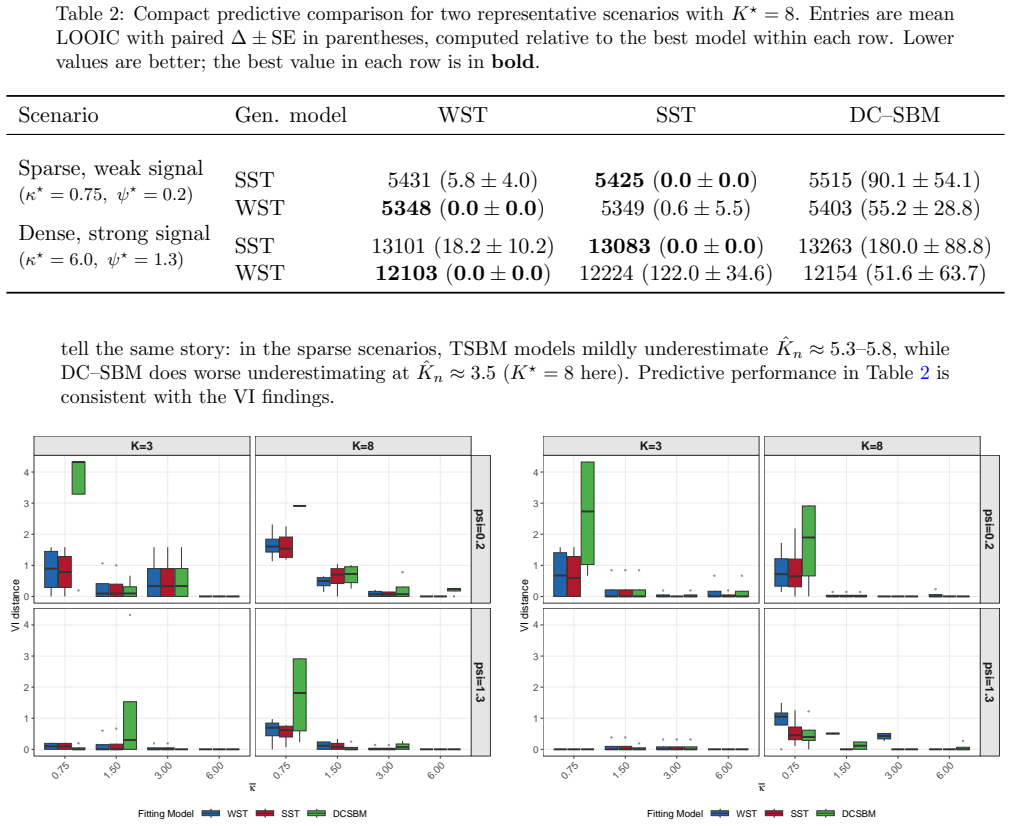
- Order-constrained priors raise predictive accuracy and block recovery, especially when networks are sparse.
- The age-ordered partition prior allows the number of blocks to be inferred jointly with their rank order.
- The model distinguishes cases in which transitive block structure improves fit from cases in which it harms fit.
- Posterior inference remains feasible through a standard Gibbs sampler that uses Pólya-Gamma augmentation.
- Partitions recovered under the model display visibly clearer ordered structure on empirical directed networks.
Where Pith is reading between the lines
- The volume-direction split could be reused in other directed network models that currently treat edge weight and orientation jointly.
- Comparing the weak and strong transitivity versions on the same data supplies a direct test of whether rank separation alone explains observed imbalances.
- The framework supplies a natural null model against which to measure the strength of non-transitive patterns such as rock-paper-scissors motifs.
- Because the ordering is learned from the data rather than imposed externally, the same sampler could be applied to networks whose hierarchy is only partially known.
Load-bearing premise
Directional imbalances between blocks obey a transitive ordering without cycles.
What would settle it
A directed network in which the inferred blocks exhibit cyclic dominance (A beats B, B beats C, C beats A) at rates that the model assigns near-zero probability would falsify the ordering benefit.
Figures
read the original abstract
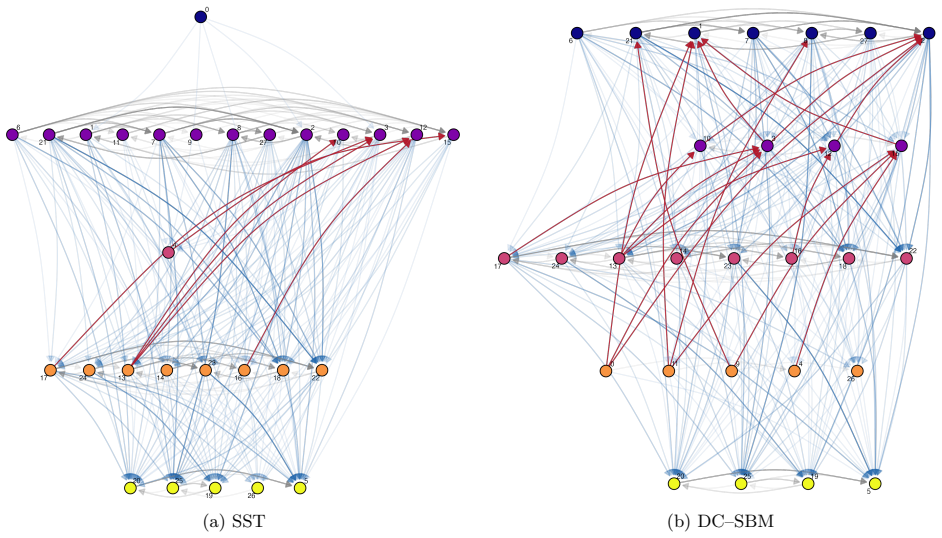
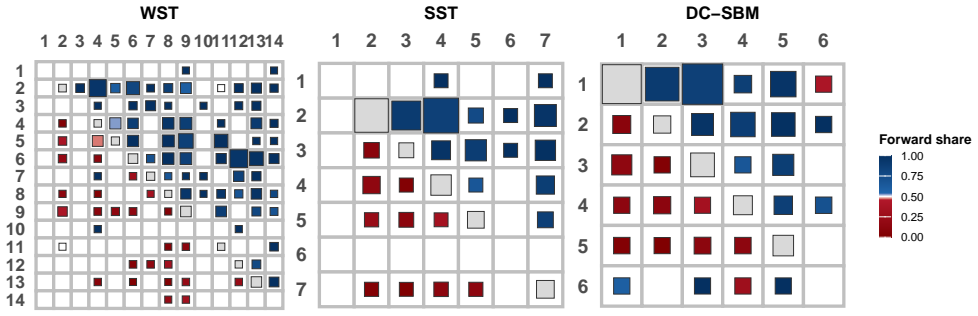
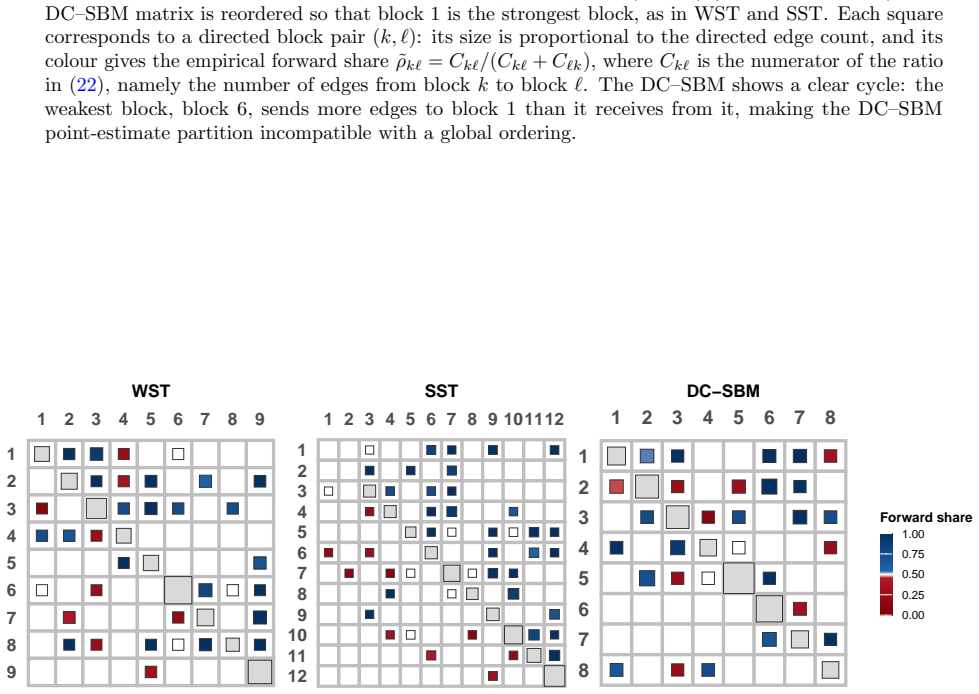
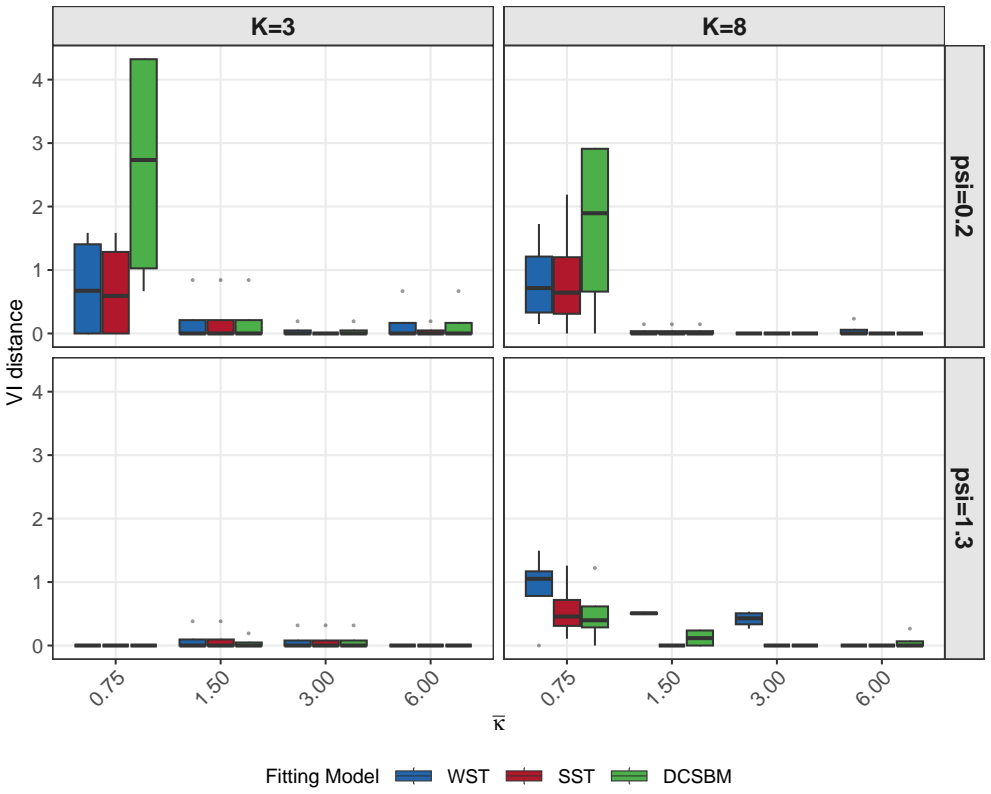
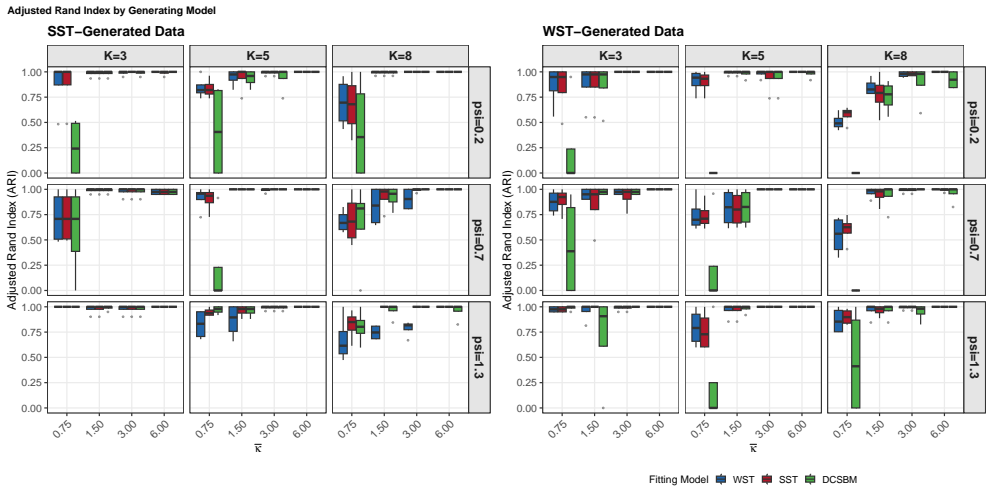
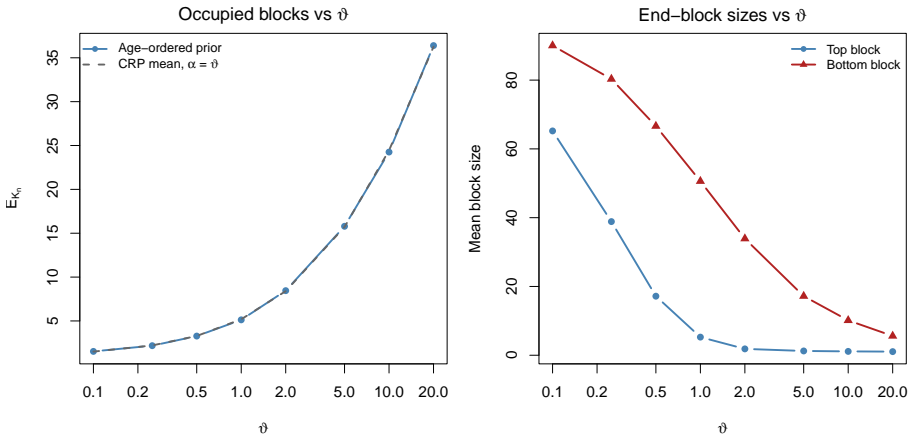
In directed networks, nodes may form groups with similar interaction patterns, while these groups may themselves follow an ordered structure. Existing methods typically treat these features separately, either clustering nodes without enforcing a coherent block order, or ranking individual nodes without allowing for structurally equivalent groups. We introduce the Transitive Stochastic Block Model (TSBM), a Bayesian model for directed weighted networks that uses transitivity-inducing priors to infer ordered blocks. The model separates the total volume of interaction between two nodes from the direction of interaction conditional on interaction occurring, so that hierarchy is imposed on directional imbalance rather than interaction frequency. We consider two order-restricted specifications: a flexible weak-stochastic-transitivity version, which excludes cyclic dominance patterns while allowing heterogeneous block-pair strengths, and a Toeplitz strong-stochastic-transitivity version, in which directional advantage increases with rank separation. Posterior inference is performed through a Gibbs sampler using P\'olya-Gamma data augmentation. Since ordered block labels are not exchangeable, we introduce an age-ordered partition prior to infer the number of blocks jointly with node allocation. Simulation studies show that order-constrained priors improve prediction and partition recovery, especially in sparse networks. Across six empirical directed networks, the TSBM improves predictive performance in four cases and yields partitions with clearer ordered structure. The results also identify cases, such as nearly deterministic dominance networks or non-transitive citation networks, where imposing ordered blocks can harm prediction. The TSBM therefore provides a probabilistic framework for estimating ordered groups and assessing when a transitive block structure is supported by the data.
Editorial analysis
A structured set of objections, weighed in public.
Referee Report
Summary. The paper introduces the Transitive Stochastic Block Model (TSBM) for directed weighted networks. It separates interaction volume from conditional direction and imposes transitivity-inducing priors (weak stochastic transitivity or Toeplitz strong stochastic transitivity) on the direction component to infer ordered blocks. Posterior inference uses a Gibbs sampler with Pólya-Gamma augmentation together with an age-ordered partition prior that jointly infers the number of blocks. Simulation studies report improved prediction and partition recovery (especially in sparse networks). On six empirical directed networks the TSBM improves predictive performance in four cases and produces partitions with clearer ordered structure, while explicitly identifying degradation on nearly deterministic dominance networks and non-transitive citation networks.
Significance. If the reported gains hold, the TSBM supplies a coherent Bayesian framework that bridges clustering and ranking by allowing the data to indicate when a transitive block ordering is supported. The separation of volume and direction, the two order-restricted specifications, the age-ordered prior, and the explicit counter-examples where the model harms performance are all positive features. The skeptic's concern that the transitivity premise is load-bearing is mitigated by the manuscript's own identification of settings in which the prior conflicts with the likelihood and harms prediction.
major comments (1)
- [Abstract] Abstract: the headline claim that order-constrained priors improve prediction rests on the data satisfying the transitivity premise. While the abstract correctly flags degradation on non-transitive citation networks, a concrete diagnostic (e.g., a posterior predictive check or a model-comparison statistic) for deciding when the TSBM should be preferred to an unconstrained SBM would make the practical recommendation load-bearing rather than post-hoc.
minor comments (1)
- Notation for the two transitivity specifications (weak vs. Toeplitz strong) and for the age-ordered partition prior should be introduced with explicit equations in the model section so that the Gibbs sampler steps can be verified without ambiguity.
Simulated Author's Rebuttal
We thank the referee for the positive evaluation and the constructive suggestion regarding practical model selection. We address the comment below and will incorporate revisions to strengthen the guidance on when the TSBM is appropriate.
read point-by-point responses
-
Referee: [Abstract] Abstract: the headline claim that order-constrained priors improve prediction rests on the data satisfying the transitivity premise. While the abstract correctly flags degradation on non-transitive citation networks, a concrete diagnostic (e.g., a posterior predictive check or a model-comparison statistic) for deciding when the TSBM should be preferred to an unconstrained SBM would make the practical recommendation load-bearing rather than post-hoc.
Authors: We agree that an explicit, pre-specified diagnostic would make the recommendation more actionable. The current manuscript already reports out-of-sample predictive performance (log predictive density) as the primary basis for comparing TSBM variants against the unconstrained SBM, and explicitly identifies the two empirical networks where the order constraint degrades performance. In the revision we will add a dedicated subsection on model comparison that formalizes this comparison via (i) posterior predictive checks for transitivity violations (e.g., frequency of observed cycles relative to posterior predictive replicates) and (ii) WAIC computed from the Pólya-Gamma-augmented MCMC output. These quantities will be reported alongside the predictive scores in both the simulation and empirical sections, and the abstract will be updated to reference the availability of these diagnostics. This change directly addresses the concern while remaining within the scope of the existing computational framework. revision: yes
Circularity Check
No significant circularity; performance claims rest on external simulation and data validation
full rationale
The TSBM defines new transitivity-inducing priors (weak or Toeplitz strong stochastic transitivity) on directional imbalance after separating volume from conditional direction, then uses an age-ordered partition prior and Pólya-Gamma Gibbs sampler for inference. Simulation and empirical results (improved prediction in four of six networks) are obtained by applying the model to held-out data and comparing against baselines; these are not reductions by the paper's own equations to quantities already fitted inside the model. The abstract explicitly flags degradation on non-transitive networks, confirming the framework does not force its own success by construction. No self-citation load-bearing steps, fitted-input-called-prediction patterns, or ansatz smuggling appear in the derivation chain.
Axiom & Free-Parameter Ledger
axioms (1)
- domain assumption Directional imbalance between blocks obeys weak or strong stochastic transitivity.
invented entities (1)
-
Transitive Stochastic Block Model (TSBM)
no independent evidence
Reference graph
Works this paper leans on
-
[1]
Advances in Applied Probability , year =
The ages of alleles and a coalescent , author =. Advances in Applied Probability , year =. doi:10.2307/1427237 , number =
-
[2]
Advances in Applied Probability , year =
Consistent ordered sampling distributions: characterization and convergence , author =. Advances in Applied Probability , year =. doi:10.2307/1427746 , number =
-
[3]
Regenerative composition structures , url =
Gnedin, Alexander and Pitman, Jim , doi =. Regenerative composition structures , url =
-
[4]
2025 , eprint =
Bayesian nonparametric community detection in assortative stochastic block models , author =. 2025 , eprint =
2025
-
[5]
Journal of Computational and Graphical Statistics , author =
A split-merge. Journal of Computational and Graphical Statistics , author =. 2004 , pages =. doi:10.1198/1061860043001 , number =
-
[6]
Computational Statistics & Data Analysis , author =
The. Computational Statistics & Data Analysis , author =. 2007 , pages =. doi:10.1016/j.csda.2007.01.024 , language =
-
[7]
Improved criteria for clustering based on the posterior similarity matrix , volume =. Bayesian Analysis , author =. doi:10.1214/09-BA414 , number =
-
[8]
Journal of Computational and Graphical Statistics , author =
Dependent. Journal of Computational and Graphical Statistics , author =. 2022 , pages =. doi:10.1080/10618600.2021.1987255 , language =
-
[9]
Bayesian. Bayesian Analysis , author =. doi:10.1214/24-BA1415 , number =
-
[10]
Journal of Computational and Graphical Statistics , author =
An. Journal of Computational and Graphical Statistics , author =. 2010 , pages =. doi:10.1198/jcgs.2010.09008 , language =
-
[11]
Proceedings of the 21st National Conference on Artificial Intelligence (AAAI) , volume=
Learning systems of concepts with an infinite relational model , author=. Proceedings of the 21st National Conference on Artificial Intelligence (AAAI) , volume=
-
[12]
Journal of the Royal Statistical Society Series B: Statistical Methodology , author =
Dealing. Journal of the Royal Statistical Society Series B: Statistical Methodology , author =. 2000 , pages =. doi:10.1111/1467-9868.00265 , abstract =
-
[13]
Educational and Psychological Measurement , author =
A. Educational and Psychological Measurement , author =. 2021 , pages =. doi:10.1177/0013164420970614 , abstract =
-
[14]
Gaucher, Solenne and Klopp, Olga , year =. Maximum. doi:10.48550/ARXIV.1902.10605 , abstract =
-
[15]
The Annals of Applied Statistics , author =
Uncovering latent structure in valued graphs:. The Annals of Applied Statistics , author =. doi:10.1214/10-AOAS361 , number =
-
[16]
Conjugate. Biometrika , author =. 2019 , pages =. doi:10.1093/biomet/asz034 , abstract =
-
[17]
Journal of the American Statistical Association , author =
Bayesian. Journal of the American Statistical Association , author =. 1993 , pages =. doi:10.1080/01621459.1993.10476321 , language =
-
[18]
Bayesian. Bayesian Analysis , author =. doi:10.1214/17-BA1073 , number =
-
[19]
Statistics and Computing , author =
Optimal. Statistics and Computing , author =. 2018 , pages =. doi:10.1007/s11222-017-9786-y , number =
-
[20]
Pitman, Jim , year =. Combinatorial. doi:10.1007/b11601500 , language =
-
[21]
The Annals of Applied Probability , author =
Conditional formulae for. The Annals of Applied Probability , author =. doi:10.1214/12-AAP843 , number =
-
[22]
Methodology and Computing in Applied Probability , author =
On a. Methodology and Computing in Applied Probability , author =. 2012 , pages =. doi:10.1007/s11009-010-9202-y , language =
-
[23]
PLOS ONE , volume =
Contact Patterns in a High School: A Comparison between Data Collected Using Wearable Sensors, Contact Diaries and Friendship Surveys , author =. PLOS ONE , volume =
-
[24]
Matrilineal rank Inheritance varies with absolute rank in Japanese macaques , author =
-
[25]
Joram Soch and The Book of Statistical Proofs and Karahan Sarıtaş and Maja and Pietro Monticone and Thomas J. Faulkenberry and Osvaldo A Martin and Alex Kipnis and Salvador Balkus and lfkdlfdlk and Carsten Allefeld and Heiner Atze and Adam Knapp and Ciarán D. McInerney and Lo4ding00 and Valeriu Ohan and amvosk and maxgrozo , month = jan, year =. doi:10.52...
-
[26]
A new parametrization of the Gnedin-Fisher species sampling model
Cerquetti, Annalisa , year =. A new parametrization of the. doi:10.48550/ARXIV.1008.2285 , abstract =
work page internal anchor Pith review Pith/arXiv arXiv doi:10.48550/arxiv.1008.2285
-
[27]
The Annals of Applied Probability , author =
Bayesian nonparametric estimators derived from conditional. The Annals of Applied Probability , author =. doi:10.1214/07-AAP495 , number =
-
[28]
Journal of the Royal Statistical Society Series B: Statistical Methodology , author =
Bayesian. Journal of the Royal Statistical Society Series B: Statistical Methodology , author =. 2009 , pages =. doi:10.1111/j.1467-9868.2009.00717.x , abstract =
-
[29]
A. Biometrics , author =. 2012 , pages =. doi:10.1111/j.1541-0420.2012.01793.x , abstract =
-
[30]
Bayesian cluster analysis , volume =. Biometrika , author =. 1978 , pages =. doi:10.1093/biomet/65.1.31 , language =
-
[31]
Charalambides, Charalambos A. , month = apr, year =. Combinatorial. doi:10.1002/0471733180 , language =
-
[32]
Discrete Mathematics , author =
Generalized. Discrete Mathematics , author =. 1996 , pages =. doi:10.1016/0012-365X(95)00112-A , language =
-
[33]
Electronic Communications in Probability , author =
A. Electronic Communications in Probability , author =. 2010 , pages =. doi:10.1214/ECP.v15-1532 , number =
-
[34]
Journal of Mathematical Sciences , author =
Exchangeable. Journal of Mathematical Sciences , author =. 2006 , pages =. doi:10.1007/s10958-006-0335-z , language =
-
[35]
2025 , eprint =
Santi, Lapo and Friel, Nial , title =. 2025 , eprint =
2025
-
[36]
2021 IEEE International Symposium on Information Theory (ISIT) , pages =
Hsiao, Chen-Hao and Wang, I-Hsiang , title =. 2021 IEEE International Symposium on Information Theory (ISIT) , pages =. 2021 , publisher =
2021
-
[37]
and Leinhardt, Samuel , title =
Holland, Paul W. and Leinhardt, Samuel , title =. Journal of the American Statistical Association , volume =. 1981 , doi =
1981
-
[38]
and Wasserman, Stanley S
Fienberg, Stephen E. and Wasserman, Stanley S. , title =. Sociological Methodology 1981 , editor =
1981
-
[39]
and Wong, George Y
Wang, Yuchung J. and Wong, George Y. , title =. Journal of the American Statistical Association , volume =. 1987 , doi =
1987
-
[40]
Tournament Solutions and Majority Voting , series =
Laslier, Jean-Fran. Tournament Solutions and Majority Voting , series =. 1997 , doi =
1997
-
[41]
Handbook of Computational Social Choice , editor =
Brandt, Felix and Brill, Markus and Harrenstein, Paul , title =. Handbook of Computational Social Choice , editor =. 2016 , doi =
2016
-
[42]
, title =
Hass, Christine C. , title =. Journal of Zoology , volume =. 1991 , doi =
1991
-
[43]
and DeCasien, Alex R
Strauss, Eli D. and DeCasien, Alex R. and Galindo, Gabriela and Hobson, Elizabeth A. and Shizuka, Daizaburo and Curley, James P. , title =. Philosophical Transactions of the Royal Society B: Biological Sciences , volume =. 2022 , doi =
2022
-
[44]
Journal of Machine Learning Research , volume =
Bengio, Yoshua and Grandvalet, Yves , title =. Journal of Machine Learning Research , volume =
-
[45]
Statistics and Computing , volume =
Vehtari, Aki and Gelman, Andrew and Gabry, Jonah , title =. Statistics and Computing , volume =. 2017 , doi =
2017
-
[46]
, title =
Elo, Arpad E. , title =. 1978 , isbn =
1978
-
[47]
2025 , eprint =
Grazian, Clara , title =. 2025 , eprint =
2025
-
[48]
and Titterington, D
Celeux, Gilles and Forbes, Florence and Robert, Christian P. and Titterington, D. M. , title =. Bayesian Analysis , year =
-
[49]
, title =
MacEachern, Steven N. , title =. ASA Proceedings of the Section on Bayesian Statistical Science , publisher =
-
[50]
and Steel, Mark F
Griffin, Jim E. and Steel, Mark F. J. , title =. Journal of the American Statistical Association , year =
-
[51]
Quintana, Fernando A. and M. The Dependent Dirichlet Process and Related Models , journal =. 2022 , volume =
2022
-
[52]
Bayesian Dependent Mixture Models: A Predictive Comparison and Survey , journal =
Wade, Sara and In. Bayesian Dependent Mixture Models: A Predictive Comparison and Survey , journal =. 2025 , volume =
2025
-
[53]
, title =
Park, Ju-Hyun and Dunson, David B. , title =. Statistica Sinica , year =
-
[54]
A Product Partition Model with Regression on Covariates , journal =
M. A Product Partition Model with Regression on Covariates , journal =. 2011 , volume =
2011
-
[55]
and Frazier, Peter I
Blei, David M. and Frazier, Peter I. , title =. Journal of Machine Learning Research , year =
-
[56]
and Quintana, Fernando A
Page, Garritt L. and Quintana, Fernando A. , title =. Bayesian Analysis , year =
-
[57]
and Day, Ryan and Tsai, Jerry W
Dahl, David B. and Day, Ryan and Tsai, Jerry W. , title =. Journal of the American Statistical Association , year =
-
[58]
Biometrics , year =
Argiento, Raffaele and Corradin, Riccardo and Guglielmi, Alessandra and Lanzarone, Ettore , title =. Biometrics , year =
-
[59]
and Quintana, Fernando A
Paganin, Sally and Page, Garritt L. and Quintana, Fernando A. , title =. Electronic Journal of Statistics , year =
-
[60]
Assessing a Mixture Model for Clustering with the Integrated Completed Likelihood , journal =
Biernacki, Christophe and Celeux, Gilles and Govaert, G. Assessing a Mixture Model for Clustering with the Integrated Completed Likelihood , journal =. 2000 , volume =
2000
-
[61]
The Annals of Statistics , year =
Nobile, Agostino , title =. The Annals of Statistics , year =
-
[62]
, title =
Richardson, Sylvia and Green, Peter J. , title =. Journal of the Royal Statistical Society: Series B (Methodological) , year =
-
[63]
, title =
Jain, Sonia and Neal, Radford M. , title =. Journal of Computational and Graphical Statistics , year =
-
[64]
and Harrison, Matthew T
Miller, Jeffrey W. and Harrison, Matthew T. , title =. Journal of the American Statistical Association , year =
-
[65]
Generalized Mixtures of Finite Mixtures and Telescoping Sampling , journal =
Fr. Generalized Mixtures of Finite Mixtures and Telescoping Sampling , journal =. 2021 , volume =
2021
-
[66]
Probability Theory and Related Fields , year =
Pitman, Jim , title =. Probability Theory and Related Fields , year =
-
[67]
, title =
Ferguson, Thomas S. , title =. The Annals of Statistics , year =
-
[68]
, title =
Antoniak, Charles E. , title =. The Annals of Statistics , year =
-
[69]
Journal of Mathematical Sciences , year =
Gnedin, Alexander and Pitman, Jim , title =. Journal of Mathematical Sciences , year =
-
[70]
, title =
Hartigan, John A. , title =. Communications in Statistics -- Theory and Methods , year =
-
[71]
, title =
Barry, Daniel and Hartigan, John A. , title =. The Annals of Statistics , year =
-
[72]
Cluster Analysis, Model Selection, and Prior Distributions on Models , journal =
Casella, George and Moreno, El. Cluster Analysis, Model Selection, and Prior Distributions on Models , journal =. 2014 , volume =
2014
-
[73]
2025 , eprint =
Advances in Bayesian random partition models: A comprehensive review , author =. 2025 , eprint =
2025
-
[74]
Are Gibbs-Type Priors the Most Natural Generalization of the Dirichlet Process? , journal =
De Blasi, Pierpaolo and Favaro, Stefano and Lijoi, Antonio and Mena, Rams. Are Gibbs-Type Priors the Most Natural Generalization of the Dirichlet Process? , journal =. 2015 , volume =
2015
-
[75]
Page, Lawrence and Brin, Sergey and Motwani, Rajeev and Winograd, Terry , title =
-
[76]
and Moore, Cristopher , title =
De Bacco, Caterina and Larremore, Daniel B. and Moore, Cristopher , title =. Science Advances , year =
-
[77]
Ryan, Matthew , title =
-
[78]
The American Mathematical Monthly , volume =
Harary, Frank and Leo Moser , title =. The American Mathematical Monthly , volume =. 1966 , pages =
1966
-
[79]
Communications Physics , volume =
Morel-Balbi, Sebastian and Kirkley, Alec , title =. Communications Physics , volume =. 2026 , doi =
2026
-
[80]
Journal of the Royal Society Interface , author =
The network motif architecture of dominance hierarchies , volume =. Journal of the Royal Society Interface , author =. 2015 , pages =. doi:10.1098/rsif.2015.0080 , number =
discussion (0)
Sign in with ORCID, Apple, or X to comment. Anyone can read and Pith papers without signing in.