Cumulative Natural Direct and Indirect Effects for Causal Mediation Analysis
Pith reviewed 2026-06-26 11:25 UTC · model grok-4.3
The pith
Cumulative natural direct and indirect effects decompose total effects while preserving skew-symmetry and additivity for continuous treatments.
A machine-rendered reading of the paper's core claim, the machinery that carries it, and where it could break.
Core claim
We introduce the cumulative natural direct effect (CNDE) and cumulative natural indirect effect (CNIE) for continuous treatments by decomposing the local causal effect E[∂_x Y_x] into local direct and indirect effects. These measures satisfy a decomposition of the total effect that is skew-symmetric and additive. We extend the framework to ordinal treatments with discrete analogues that preserve these properties. Identification results are established under standard causal assumptions.
What carries the argument
Cumulative natural direct and indirect effects, obtained by integrating local direct and indirect effects derived from the derivative of the outcome with respect to the treatment.
If this is right
- The total effect decomposes additively into CNDE and CNIE without sign or ordering paradoxes.
- The decomposition remains valid when treatment is reversed, satisfying skew-symmetry.
- Discrete cumulative effects defined over ordered treatment levels inherit the same decomposition properties.
- Standard identification formulas apply directly to the new measures under the usual no-confounding conditions.
Where Pith is reading between the lines
- The construction could be applied to other continuous-treatment effect decompositions where symmetry properties are required.
- In settings with treatment-mediator interactions, the cumulative measures may produce more stable policy interpretations than conventional natural effects.
- Extensions to time-varying treatments might follow by replacing the derivative with an appropriate infinitesimal operator.
Load-bearing premise
Identification of the cumulative effects from observed data requires the standard assumptions of consistency, positivity, and no unmeasured confounding for the treatment-mediator, treatment-outcome, and mediator-outcome relations.
What would settle it
A numerical example or dataset in which the sum of the estimated CNDE and CNIE differs from the total effect, or in which reversing the treatment direction fails to produce the negative of the original decomposition, would falsify the claimed preservation of additivity and skew-symmetry.
Figures
read the original abstract
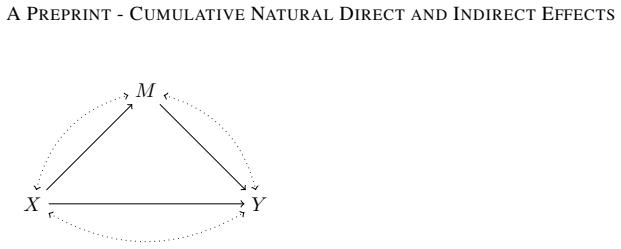
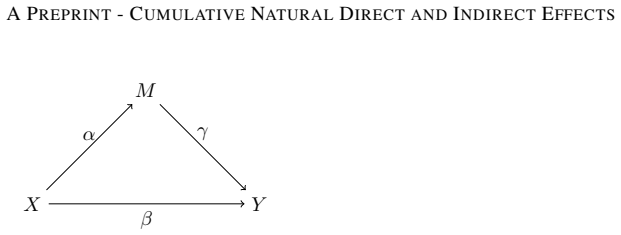
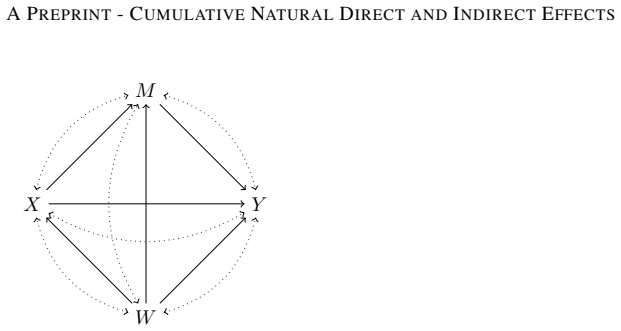
Causal mediation analysis provides a fundamental framework for quantifying the contributions of different pathways from a treatment $X$ to an outcome $Y$ through a mediator. The natural direct and indirect effects (NDE and NIE) are widely used to decompose the total effect. In this paper, we observe that NDE and NIE can give rise to paradoxical interpretations due to their failure to satisfy two desirable properties of interpretable causal effects: skew-symmetry and additivity. To address these limitations, we introduce new measures of direct and indirect effects for continuous treatments, termed the cumulative natural direct and indirect effects (CNDE and CNIE), constructed by decomposing local causal effects $\mathbb{E}[\partial_xY_{x}]$ into local direct and indirect effects. CNDE and CNIE yield a decomposition of the total effect that preserves both skew-symmetry and additivity. We further extend this framework to ordinal treatments by defining discrete analogues of the cumulative effects over ordered treatment levels that preserve these structural properties. We establish decomposition and identification results for the proposed measures under standard causal assumptions. We illustrate their behavior, in comparison with NDE and NIE, using canonical linear mediation models with interaction and a real-world dataset.
Editorial analysis
A structured set of objections, weighed in public.
Referee Report
Summary. The paper introduces cumulative natural direct and indirect effects (CNDE and CNIE) for continuous treatments in causal mediation analysis. These are constructed by first decomposing the local total effect E[∂_x Y_x] into local direct and indirect components and then integrating to obtain cumulative versions. The authors claim that CNDE and CNIE provide a decomposition of the total effect that satisfies skew-symmetry and additivity (unlike standard NDE/NIE), establish decomposition and identification results under standard causal assumptions, extend the framework to ordinal treatments via discrete analogues, and illustrate the measures in linear mediation models with interaction and on a real dataset.
Significance. If the decomposition, identification, and algebraic properties hold, the proposed measures would supply a coherent alternative for mediation analysis with continuous or ordinal treatments that avoids certain paradoxical interpretations arising from failures of skew-symmetry and additivity. The explicit construction from local effects, the extension to ordered discrete treatments, and the comparison with existing linear-model results constitute a targeted methodological contribution in causal inference.
major comments (3)
- [§3] §3 (definition of CNDE/CNIE): the construction decomposes and integrates E[∂_x Y_x], which presupposes that the potential-outcome map x ↦ Y_x is differentiable (at least almost everywhere). The identification results later invoke only the standard quartet of consistency, positivity, and no unmeasured confounding for the three relations; none of these conditions entails differentiability or even continuity of Y_x. Consequently the claimed skew-symmetry and additivity hold only conditionally on an extra regularity assumption not listed among the “standard causal assumptions.”
- [§4] §4 (identification and decomposition theorems): the paper states that decomposition and identification results are established, yet the provided text does not display the explicit integral expressions for CNDE and CNIE nor the step-by-step verification that integration preserves skew-symmetry and additivity for arbitrary (sufficiently regular) response surfaces. Without these derivations the central claim that the cumulative effects “yield a decomposition … that preserves both skew-symmetry and additivity” cannot be fully assessed.
- [§5] §5 (linear-model illustration): the comparison with NDE/NIE is performed only inside canonical linear models with interaction. It remains unclear whether the reported numerical differences between CNDE/CNIE and NDE/NIE persist, or reverse, under non-linear data-generating processes that still satisfy the differentiability requirement.
minor comments (2)
- [§3] Notation for the local total effect E[∂_x Y_x] is introduced without an explicit statement of the measure with respect to which the derivative is taken or the domain on which it is assumed to exist.
- [Abstract] The abstract refers to “canonical linear mediation models with interaction” but does not specify the precise interaction term; the main text should state the model equation explicitly before presenting numerical results.
Simulated Author's Rebuttal
We thank the referee for the detailed and constructive comments. We address each major comment below and indicate the corresponding revisions.
read point-by-point responses
-
Referee: [§3] §3 (definition of CNDE/CNIE): the construction decomposes and integrates E[∂_x Y_x], which presupposes that the potential-outcome map x ↦ Y_x is differentiable (at least almost everywhere). The identification results later invoke only the standard quartet of consistency, positivity, and no unmeasured confounding for the three relations; none of these conditions entails differentiability or even continuity of Y_x. Consequently the claimed skew-symmetry and additivity hold only conditionally on an extra regularity assumption not listed among the “standard causal assumptions.”
Authors: We agree that the definition of the local effects and their integration requires differentiability of the potential-outcome map (at least almost everywhere). The identification results rely on the standard assumptions, but the construction of CNDE and CNIE additionally presupposes this regularity condition. We will explicitly add differentiability (a.e.) to the list of assumptions in the revised manuscript and clarify that skew-symmetry and additivity hold under the standard causal assumptions together with this regularity condition. revision: yes
-
Referee: [§4] §4 (identification and decomposition theorems): the paper states that decomposition and identification results are established, yet the provided text does not display the explicit integral expressions for CNDE and CNIE nor the step-by-step verification that integration preserves skew-symmetry and additivity for arbitrary (sufficiently regular) response surfaces. Without these derivations the central claim that the cumulative effects “yield a decomposition … that preserves both skew-symmetry and additivity” cannot be fully assessed.
Authors: We will insert the explicit integral expressions for CNDE and CNIE in §4. We will also add a step-by-step verification showing that, for sufficiently regular response surfaces, the integration operation preserves skew-symmetry and additivity. These additions will make the central claim fully verifiable from the text. revision: yes
-
Referee: [§5] §5 (linear-model illustration): the comparison with NDE/NIE is performed only inside canonical linear models with interaction. It remains unclear whether the reported numerical differences between CNDE/CNIE and NDE/NIE persist, or reverse, under non-linear data-generating processes that still satisfy the differentiability requirement.
Authors: The linear-model section is intended as an illustration in a setting where NDE/NIE are commonly studied and where their failure of skew-symmetry and additivity is transparent. The algebraic properties of CNDE/CNIE are established generally under the stated assumptions and do not rely on linearity. We will add a clarifying sentence noting that the magnitude and direction of numerical differences are model-dependent and that the linear case is chosen to highlight the interpretative advantage of the new measures. A full exploration of non-linear DGPs is left for future work, as it would require specifying particular non-linear surfaces while preserving differentiability. revision: partial
Circularity Check
No significant circularity; derivation self-contained via explicit construction
full rationale
The paper defines CNDE and CNIE explicitly by decomposing and integrating the local effect E[∂_x Y_x] into direct and indirect components, with skew-symmetry and additivity following immediately from the integral properties and the definition itself. Identification and decomposition results are stated to hold under the standard quartet of consistency/positivity/no-unmeasured-confounding assumptions, without any reduction to fitted parameters, self-citations, or prior uniqueness theorems. No load-bearing step equates a claimed result to its own inputs by construction; the measures are new objects introduced to satisfy the listed properties, and the derivation chain remains independent of the target conclusions.
Axiom & Free-Parameter Ledger
axioms (1)
- domain assumption Standard causal assumptions: consistency, positivity, and no unmeasured confounding for the relevant relationships.
invented entities (2)
-
Cumulative natural direct effect (CNDE)
no independent evidence
-
Cumulative natural indirect effect (CNIE)
no independent evidence
Reference graph
Works this paper leans on
-
[1]
Wong, Wing Hung , title =
-
[2]
Engle , journal =
Robert F. Engle , journal =. Autoregressive Conditional Heteroscedasticity with Estimates of the Variance of United Kingdom Inflation , urldate =
-
[3]
Randomization Inference for Treatment Effect Variation , publisher =
Ding, Peng and Feller, Avi and Miratrix, Luke , keywords =. Randomization Inference for Treatment Effect Variation , publisher =. 2014 , copyright =
2014
-
[4]
D. R. Cox , journal =. Interaction , urldate =
-
[5]
Gujarati , author=
Basic econometrics/Damodar N. Gujarati , author=
-
[6]
International Journal of Mathematics Trends and Technology (IJMTT) , volume=
On the calculus of Dirac delta function with some applications , author=. International Journal of Mathematics Trends and Technology (IJMTT) , volume=
-
[7]
, journal =
Grimstad, Bjarne and Knudsen, Brage R. , journal =. Mathematical programming formulations for piecewise polynomial functions , volume =
-
[8]
and Pedregal, Diego J
Young, Peter C. and Pedregal, Diego J. and Tych, Wlodek , journal =. Dynamic harmonic regression , volume =
-
[9]
Probability Theory and Statistical Inference: Econometric Modeling with Observational Data , year =
Spanos, Aris , publisher =. Probability Theory and Statistical Inference: Econometric Modeling with Observational Data , year =
-
[10]
Inferring Cause and Effect in the Presence of Heteroscedastic Noise , volume =
Xu, Sascha and Mian, Osman A and Marx, Alexander and Vreeken, Jilles , booktitle =. Inferring Cause and Effect in the Presence of Heteroscedastic Noise , volume =
-
[11]
T. S. Breusch and A. R. Pagan , journal =. A Simple Test for Heteroscedasticity and Random Coefficient Variation , urldate =
-
[12]
J. B. Diaz and F. T. Metcalf , journal =. On Iteration Procedures for Equations of the First Kind, Ax = y, and Picard's Criterion for the Existence of a Solution , urldate =
-
[13]
1910 , journal=
Sur un th. 1910 , journal=
1910
-
[14]
Integral equations of the first kind, inverse problems and regularization: a crash course , volume =
C W Groetsch, , journal =. Integral equations of the first kind, inverse problems and regularization: a crash course , volume =
-
[15]
An Introduction to Partial Differential Equations , year =
Pinchover, Yehuda and Rubinstein, Jacob , publisher =. An Introduction to Partial Differential Equations , year =
-
[16]
Calculus of variations / J
Jost, J. Calculus of variations / J
-
[17]
Imbens , journal =
Guido W. Imbens , journal =. Instrumental Variables: An Econometrician's Perspective , urldate =
-
[18]
1926 , publisher=
An introduction to the study of integral equations , author=. 1926 , publisher=
1926
-
[19]
Fuller , journal =
Yasuo Amemiya and Wayne A. Fuller , journal =
-
[20]
Journal of Mathematical Analysis and Applications , volume=
On compact operators , author=. Journal of Mathematical Analysis and Applications , volume=
-
[21]
McCormick , title =
Chunxiao Li and Cynthia Rudin and Tyler H. McCormick , title =. Journal of Machine Learning Research , year =
-
[22]
Testing Additive Separability of Error Term in Nonparametric Structural Models , volume =
Liangjun Su and Yundong Tu and Aman Ullah , journal =. Testing Additive Separability of Error Term in Nonparametric Structural Models , volume =
-
[23]
Baum and Mark E
Christopher F. Baum and Mark E. Schaffer and Steven Stillman , journal =. Instrumental Variables and GMM: Estimation and Testing , volume =
-
[24]
Large Sample Properties of Generalized Method of Moments Estimators , urldate =
Lars Peter Hansen , journal =. Large Sample Properties of Generalized Method of Moments Estimators , urldate =
-
[25]
Angrist and Guido W
Joshua D. Angrist and Guido W. Imbens , journal =. Two-Stage Least Squares Estimation of Average Causal Effects in Models with Variable Treatment Intensity , volume =
-
[26]
The nonlinear two-stage least-squares estimator , volume =
Takeshi Amemiya , journal =. The nonlinear two-stage least-squares estimator , volume =
-
[27]
Statistica Sinica , volume=
AN EQUATION FOR THE IDENTIFICATION OF AVERAGE CAUSAL EFFECT IN NONLINEAR MODELS , author=. Statistica Sinica , volume=
-
[28]
2015 , publisher=
Numerical analysis , author=. 2015 , publisher=
2015
-
[29]
2009 , publisher=
Measurement error models , author=. 2009 , publisher=
2009
-
[30]
Errors-in-variables methods in system identification , volume =
Torsten S. Errors-in-variables methods in system identification , volume =. Automatica , number =
-
[31]
Pattern Recognition and Machine Learning , year =
Bishop, Christopher , month =. Pattern Recognition and Machine Learning , year =
-
[32]
Earnings, Schooling, and Ability Revisited
Card, David. Earnings, Schooling, and Ability Revisited. 1994
1994
-
[33]
and Newey, Whitney K
Hausman, Jerry A. and Newey, Whitney K. and Woutersen, Tiemen and Chao, John C. and Swanson, Norman R. , journal =. Instrumental variable estimation with heteroskedasticity and many instruments , volume =
-
[34]
Newey and James L
Whitney K. Newey and James L. Powell , journal =. Instrumental Variable Estimation of Nonparametric Models , urldate =
-
[35]
2017 , institution=
Individual counterfactuals with multidimensional unobserved heterogeneity , author=. 2017 , institution=
2017
-
[36]
Matzkin , journal =
Rosa L. Matzkin , journal =. On independence conditions in nonseparable models: Observable and unobservable instruments , volume =
-
[37]
Nonlinear causal discovery with additive noise models , volume =
Hoyer, Patrik and Janzing, Dominik and Mooij, Joris M and Peters, Jonas and Sch\". Nonlinear causal discovery with additive noise models , volume =. Advances in Neural Information Processing Systems , editor =
-
[38]
and Rubin, Donald B
Imbens, Guido W. and Rubin, Donald B. , year=. Causal Inference for Statistics, Social, and Biomedical Sciences: An Introduction , publisher=
-
[39]
Health Service Research Methodology: A Focus on AIDS , publisher=
James Robins , title =. Health Service Research Methodology: A Focus on AIDS , publisher=
-
[40]
2009 , edition =
Judea Pearl , title =. 2009 , edition =
2009
-
[41]
Methods of mathematical physics , volume=
Lagrange’s interpolation formula , author=. Methods of mathematical physics , volume=. 1988 , publisher=
1988
-
[42]
Morgan , journal =
Luke Keele and Jason W. Morgan , journal =. HOW STRONG IS STRONG ENOUGH? STRENGTHENING INSTRUMENTS THROUGH MATCHING AND WEAK INSTRUMENT TESTS , urldate =
-
[43]
Trace Class Operators and Lidskii’s Theorem , author=
-
[44]
Unobserved Ability, Efficiency Wages, and Interindustry Wage Differentials , urldate =
McKinley Blackburn and David Neumark , journal =. Unobserved Ability, Efficiency Wages, and Interindustry Wage Differentials , urldate =
-
[45]
, author=
A method of successive approximations for Fredholm integral equations of the first kind. , author=. Uspeki mat Nauk , volume=
-
[46]
, publisher =
Muscat, J. , publisher =. Functional Analysis: An Introduction to Metric Spaces, Hilbert Spaces, and Banach Algebras , year =
-
[47]
Linear regression , pages=
Multiple linear regression , author=. Linear regression , pages=. 2017 , publisher=
2017
-
[48]
Journal of the American Statistical Association , year=
Two-Stage Least Squares Estimation of Average Causal Effects in Models with Variable Treatment Intensity , author=. Journal of the American Statistical Association , year=
-
[49]
Stock , booktitle =
J.H. Stock , booktitle =. Instrumental Variables in Statistics and Econometrics , year =
-
[50]
Kernel Instrumental Variable Regression , volume =
Singh, Rahul and Sahani, Maneesh and Gretton, Arthur , booktitle =. Kernel Instrumental Variable Regression , volume =
-
[51]
Terza and Anirban Basu and Paul J
Joseph V. Terza and Anirban Basu and Paul J. Rathouz , journal =. Two-stage residual inclusion estimation: Addressing endogeneity in health econometric modeling , volume =
-
[52]
and Tibshirani, R
Hastie, T. and Tibshirani, R. and Friedman, J. , publisher =. The Elements of Statistical Learning: Data Mining, Inference, and Prediction, Second Edition , year =
-
[53]
, journal =
Thorndike, Robert L. , journal =. Who belongs in the family? , volume =
-
[54]
2011 , institution=
Continuous Treatments , author=. 2011 , institution=
2011
-
[55]
Wooldridge , title=
Jeffrey M. Wooldridge , title=
-
[56]
Nguyen Viet, Cuong , title=
-
[57]
Bounds on Treatment Effects from Studies with Imperfect Compliance , volume =
Alexander Balke and Judea Pearl , journal =. Bounds on Treatment Effects from Studies with Imperfect Compliance , volume =
-
[58]
arXiv: Methodology , year=
Regression with genuinely functional errors-in-covariates , author=. arXiv: Methodology , year=
-
[59]
Functional Linear Regression: Dependence and Error Contamination , volume =
Cheng Chen and Shaojun Guo and Xinghao Qiao , journal =. Functional Linear Regression: Dependence and Error Contamination , volume =
-
[60]
2010 , publisher=
Econometric analysis of cross section and panel data , author=. 2010 , publisher=
2010
-
[61]
Efficient Estimation of Conditional Variance Functions in Stochastic Regression , urldate =
Jianqing Fan and Qiwei Yao , journal =. Efficient Estimation of Conditional Variance Functions in Stochastic Regression , urldate =
-
[62]
and Berger, R.L
Casella, G. and Berger, R.L. , publisher =. Statistical Inference , year =
-
[63]
, publisher =
Greene, W.H. , publisher =. Econometric Analysis , year =
-
[64]
An introduction to causal inference
Pearl, Judea , journal =. An introduction to causal inference. , volume =
-
[65]
Asymptotic normality of support vector machine variants and other regularized kernel methods , volume =
Robert Hable , journal =. Asymptotic normality of support vector machine variants and other regularized kernel methods , volume =
-
[66]
Asymptotic normality and confidence intervals for derivatives of 2-layers neural network in the random features model , volume =
Shen, Yiwei and Bellec, Pierre C , booktitle =. Asymptotic normality and confidence intervals for derivatives of 2-layers neural network in the random features model , volume =
-
[67]
, publisher =
DiBenedetto, E. , publisher =. Real Analysis , year =
-
[68]
Tchetgen Tchetgen and David E
Mohammad Taha Bahadori and Eric J. Tchetgen Tchetgen and David E. Heckerman , title =. 2022 , booktitle =
2022
-
[69]
Program Heterogeneity and Propensity Score Matching: An Application to the Evaluation of Active Labor Market Policies , urldate =
Michael Lechner , journal =. Program Heterogeneity and Propensity Score Matching: An Application to the Evaluation of Active Labor Market Policies , urldate =
-
[70]
J. A. Hausman , journal =. Specification Tests in Econometrics , urldate =
-
[71]
Algebraic Geometry and Statistical Learning Theory , DOI=
Watanabe, Sumio , year=. Algebraic Geometry and Statistical Learning Theory , DOI=
-
[72]
War and Wages , volume =
Dylan S Small and Paul R Rosenbaum , journal =. War and Wages , volume =
-
[73]
Ridge: a computer program for calculating ridge regression estimates , author=
-
[74]
Identification and inference for econometric models: Essays in honor of Thomas Rothenberg , pages=
Unobserved heterogeneity and estimation of average partial effects , author=. Identification and inference for econometric models: Essays in honor of Thomas Rothenberg , pages=
-
[75]
IRREGULAR
Bryan S. Graham and James L. Powell , journal =. IDENTIFICATION AND ESTIMATION OF AVERAGE PARTIAL EFFECTS IN "IRREGULAR" CORRELATED RANDOM COEFFICIENT PANEL DATA MODELS , urldate =
-
[76]
and Keueger, Alan B
Angrist, Joshua D. and Keueger, Alan B. , journal =
-
[77]
Job Market Signaling , urldate =
Michael Spence , journal =. Job Market Signaling , urldate =
-
[78]
Econometric evaluation of labour market policies , pages=
Identification and estimation of causal effects of multiple treatments under the conditional independence assumption , author=. Econometric evaluation of labour market policies , pages=. 2001 , publisher=
2001
-
[79]
The Case against Education: Why the Education System Is a Waste of Time and Money , urldate =
Bryan Caplan , publisher =. The Case against Education: Why the Education System Is a Waste of Time and Money , urldate =
-
[80]
Estimation and Inference of Heterogeneous Treatment Effects using Random Forests , volume =
Stefan Wager and Susan Athey , journal =. Estimation and Inference of Heterogeneous Treatment Effects using Random Forests , volume =
discussion (0)
Sign in with ORCID, Apple, or X to comment. Anyone can read and Pith papers without signing in.