On k-limited domination: complexity and Cartesian products
Pith reviewed 2026-06-26 10:20 UTC · model grok-4.3
The pith
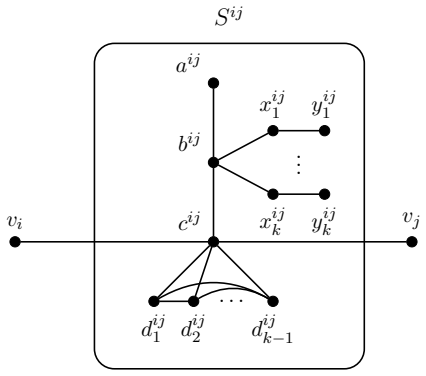
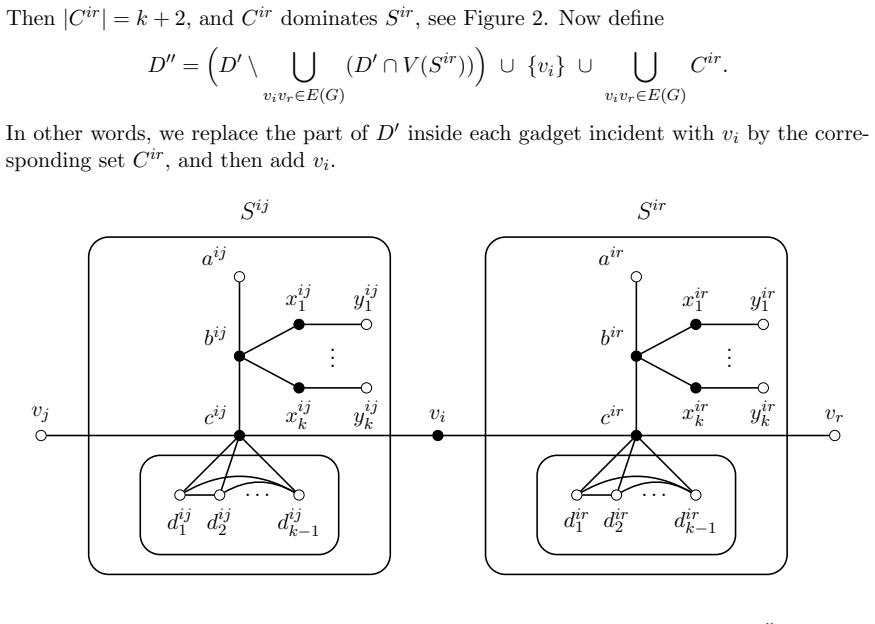
For every fixed integer k at least 2, deciding whether a graph has a k-limited dominating set of size at most ell is NP-complete.
A machine-rendered reading of the paper's core claim, the machinery that carries it, and where it could break.
Core claim
A dominating set is called k-limited if every vertex in the set has at most k neighbors outside it. The minimum cardinality of a k-limited dominating set is the k-limited domination number, denoted by gamma_k^L(G). We prove that, for every fixed integer k greater than or equal to 2, deciding whether a graph admits a k-limited dominating set of size at most ell is NP-complete. In addition, we establish general lower and upper bounds for gamma_k^L(G square H), show that both are sharp, and derive exact values for several natural families of graph products.
What carries the argument
The k-limited dominating set, which requires both that the set dominates the graph and that each member has at most k neighbors outside the set.
If this is right
- The decision problem cannot be solved in polynomial time unless P equals NP.
- The lower and upper bounds on gamma_k^L(G square H) are attained for some pairs of graphs.
- Exact values of the k-limited domination number hold for rook graphs, Cartesian products of k-coronas, certain grid graphs, and several cases of prisms and hypercubes.
Where Pith is reading between the lines
- The NP-completeness result suggests that similar hardness may hold for related limited-domination parameters or for other graph operations beyond Cartesian products.
- Exact formulas for specific product families could be used to test conjectures about domination numbers in larger grid-like or network graphs.
- The verification procedure being polynomial supports the claim that the problem is in NP, but leaves open whether the hardness proof technique extends to weighted or directed variants.
Load-bearing premise
A proposed k-limited dominating set can be verified in polynomial time by checking both the domination condition and the at-most-k external neighbors condition for each vertex in the set.
What would settle it
A polynomial-time algorithm that correctly decides the existence of a k-limited dominating set of size at most ell for some fixed k at least 2 would falsify the NP-completeness claim.
Figures
read the original abstract
A dominating set is called $k$-limited if every vertex in the set has at most $k$ neighbors outside it. The minimum cardinality of a $k$-limited dominating set is the $k$-limited domination number, denoted by $\gamma_k^{\mathrm{L}}(G)$. We prove that, for every fixed integer $k\ge 2$, deciding whether a graph admits a $k$-limited dominating set of size at most $\ell$ is $\mathsf{NP}$-complete. In addition, a systematic study of $k$-limited domination in Cartesian products is initiated. In particular, we establish general lower and upper bounds for $\gamma_k^{\mathrm{L}}(G\square H)$, show that both are sharp, and derive exact values for several natural families of graph products. Among others, we obtain exact results for rook graphs, Cartesian products of $k$-coronas, certain grid graphs, and several cases involving prisms and hypercubes.
Editorial analysis
A structured set of objections, weighed in public.
Referee Report
Summary. The paper proves that deciding the existence of a k-limited dominating set of size at most ℓ is NP-complete for every fixed k ≥ 2. It also initiates the study of the k-limited domination number γ_k^L(G) in Cartesian products G□H by establishing general lower and upper bounds (shown to be sharp) and deriving exact values for families including rook graphs, k-coronas, certain grids, prisms, and hypercubes.
Significance. The NP-completeness result strengthens the known hardness landscape for domination variants. The product-graph results are useful because they supply both general bounds with matching constructions and exact values on concrete families; the explicit sharpness proofs and exact derivations for multiple natural products constitute a solid starting point for further work on limited domination parameters.
minor comments (3)
- The definition of a k-limited dominating set (every vertex in the set has at most k neighbors outside the set) should be stated explicitly in the introduction before the complexity result is announced.
- In the Cartesian-product section, the general lower and upper bounds should be accompanied by a short table or list of the families for which equality is attained, to improve readability.
- Notation: ensure that the symbol ℓ is introduced as the size bound in the decision problem statement and is used consistently in the NP-completeness theorem.
Simulated Author's Rebuttal
We thank the referee for the positive summary and significance assessment of the manuscript. The recommendation of minor revision is noted. No specific major comments appear in the report.
Circularity Check
No significant circularity
full rationale
The paper's central results consist of a direct NP-completeness proof (via explicit reduction for the decision problem) and independent derivations of lower/upper bounds plus exact values for Cartesian products of graphs. Membership in NP follows from a standard polynomial-time verification procedure on a certificate set S that checks domination and the k-neighbor limit via adjacency traversal; this verification is external to any fitted parameters or prior self-citations. No equations, ansatzes, or uniqueness claims reduce by construction to the paper's own inputs, and no load-bearing premise rests solely on overlapping-author citations. The derivation chain is therefore self-contained against external graph-theoretic benchmarks.
Axiom & Free-Parameter Ledger
axioms (2)
- standard math Graphs are finite, simple, and undirected.
- standard math The Cartesian product G□H has vertex set V(G)×V(H) and edges between (u,v) and (u',v') when either u=u' and v~v' or v=v' and u~u'.
Reference graph
Works this paper leans on
-
[1]
J. Azarija, M. A. Henning, S. Klavˇ zar, (Total) Domination in Prisms Electron. J. Comb., 24(1), 2017, #P1.19.https://doi.org/10.37236/6288
-
[2]
Boˇ zovi´ c, G
D. Boˇ zovi´ c, G. Radi´ c,ˇZ. Kovijani´ c-Vuki´ cevi´ c, A. Tepeh, Onk-limited domination in graphs, submitted
-
[3]
B. Breˇ sar, P. Dorbec, W. Goddard, B. L. Hartnell, M. A. Henning, S. Klavˇ zar, D. F. Rall, Vizing’s conjecture: a survey and recent results, J. Graph Theory 69 (2012) 46–76.https://doi.org/10.1002/jgt.20565
-
[4]
M. Chellali, T. W. Haynes, S. T. Hedetniemi, A. McRae, [1,2]-sets in graphs, Discrete Appl. Math. 161 (2013) 2885–2893.https://doi.org/10.1016/j.dam.2013.06.012
-
[5]
Three-level parallel J-Jacobi algorithms for Hermitian matrices
R. Erveˇ s, A. Tepeh, Induced cycles vertex number and (1,2)-domination in cubic graphs,Appl. Math. Comput.510(2025), 129700,https://doi.org/10.1016/j.amc. 2025.129700
-
[6]
M. H. Fakhran, A. A. Gorzin, M. A. Henning, A. Jafari and R. Touserkani, On (1,2)- domination in cubic graphs,Discrete Math.344(2021) 112546,https://doi.org/10. 1016/j.disc.2021.112546
arXiv 2021
-
[7]
O. Favaron, M. A. Henning, J. Puech, D. Rautenbach, On domination and annihilation in graphs with claw-free blocks, Discrete Math. 231 (2001) 143–151.https://doi.org/ 10.1016/S0012-365X(00)00313-7
-
[8]
J. F. Fink, M. S. Jacobson,n-domination in graphs, in: Y. Alavi, G. Chartrand, O. R. Oellermann, A. J. Schwenk (Eds.), Graph Theory with Applications to Algo- rithms and Computer Science, Wiley, New York, 1985, pp. 283–300
1985
-
[9]
M. R. Garey, D. S. Johnson, Computers and Intractability; A Guide to the Theory of NP-Completeness, W. H. Freeman & Co., New York, 1979.https://doi.org/10. 1137/1024022
1979
-
[10]
W. Goddard, M. A. Henning, A note on domination and total domination in prisms, J. Comb. Optim. 35 (2018) 14–20.https://doi.org/10.1007/s10878-017-0150-0
-
[11]
F. Harary, M. Livingston, Independent domination in hypercubes, Appl. Math. Lett. 6 (1993) 27–28.https://doi.org/10.1016/0893-9659(93)90027-K
-
[12]
T. W. Haynes, S. T. Hedetniemi, M. A. Henning (Eds.), Topics in Domination in Graphs, Developments in Mathematics, Vol. 64, Springer, Cham, 2020.https://doi. org/10.1007/978-3-030-51117-3
-
[13]
T. W. Haynes, S. T. Hedetniemi, M. A. Henning (Eds.), Structures of Domination in Graphs, Developments in Mathematics, Vol. 66, Springer, Cham, 2021.https: //doi.org/10.1007/978-3-030-58892-2 17
-
[14]
T. W. Haynes, S. T. Hedetniemi, M. A. Henning, Domination in Graphs: Core Con- cepts, Series: Springer Monographs in Mathematics, Springer, Cham, 2023.https: //doi.org/10.1007/978-3-031-09496-5
-
[15]
N. Ghareghani, I. Peterin, P. Sharifani, [1, k]-domination number of lexicographic prod- ucts of graphs, Bull. Malays. Math. Sci. Soc. 44 (2021) 375–392.https://doi.org/ 10.1007/s40840-020-00957-0
-
[16]
Radi´ c, G
G. Radi´ c, G. Radi´ c, A. Tepeh, (1,2)-domination of Flower snarks, submitted
-
[17]
Tepeh, Total domination in generalized prisms and a new domination invariant, Discuss
A. Tepeh, Total domination in generalized prisms and a new domination invariant, Discuss. Math. Graph Theory 41 (2021) 1165–1178.https://api.semanticscholar. org/CorpusID:209476345
2021
-
[18]
G. J. M. van Wee, Improved sphere bounds on the covering radius of codes. IEEE Trans. Inform. Theory 34 (1988) 237–245.https://doi.org/10.1109/18.2632
-
[19]
Y.-S. Wu, J.-Y. Chen, Improved lower bounds on the domination number of hypercubes and binary codes with covering radius one, Discrete Math. 347 (2024) 113752.https: //doi.org/10.1016/j.disc.2023.113752 18
discussion (0)
Sign in with ORCID, Apple, or X to comment. Anyone can read and Pith papers without signing in.