Tearing Instability in Gyrotropic MHD: Effects of Equilibrium Pressure Anisotropy
Pith reviewed 2026-06-26 09:39 UTC · model grok-4.3
The pith
Pressure anisotropy in gyrotropic MHD changes the tearing growth rate prefactor in a Harris sheet while the Lundquist-number exponent stays -1/2.
A machine-rendered reading of the paper's core claim, the machinery that carries it, and where it could break.
Core claim
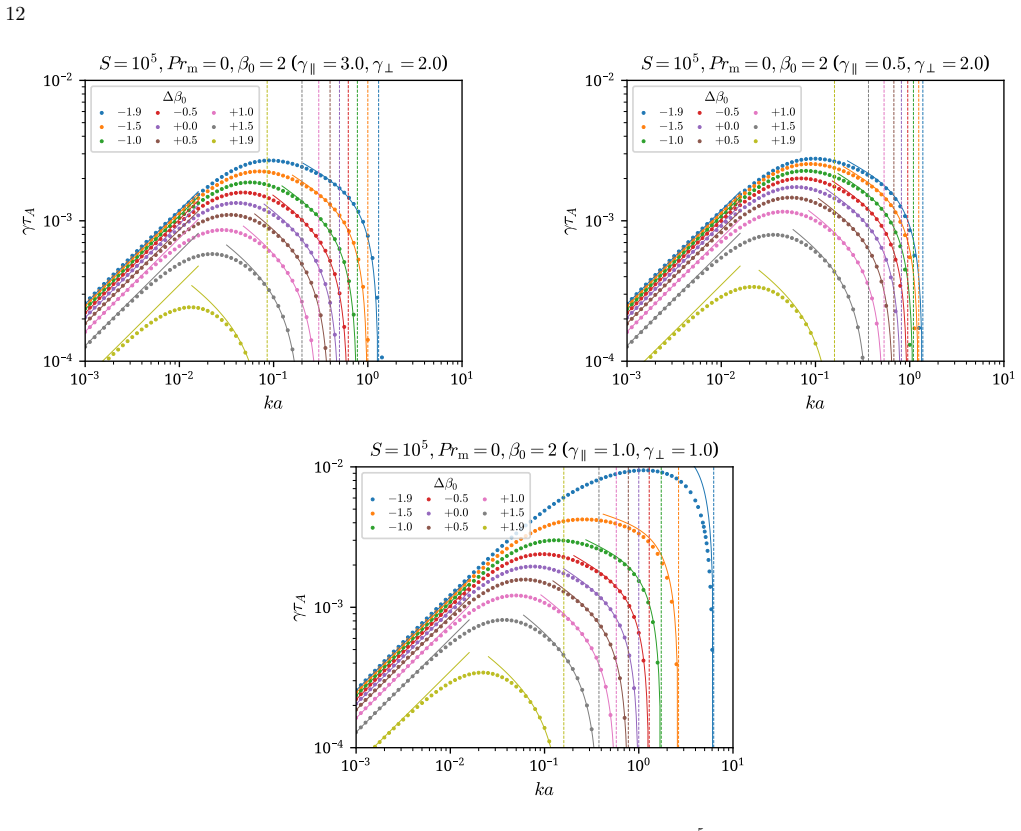
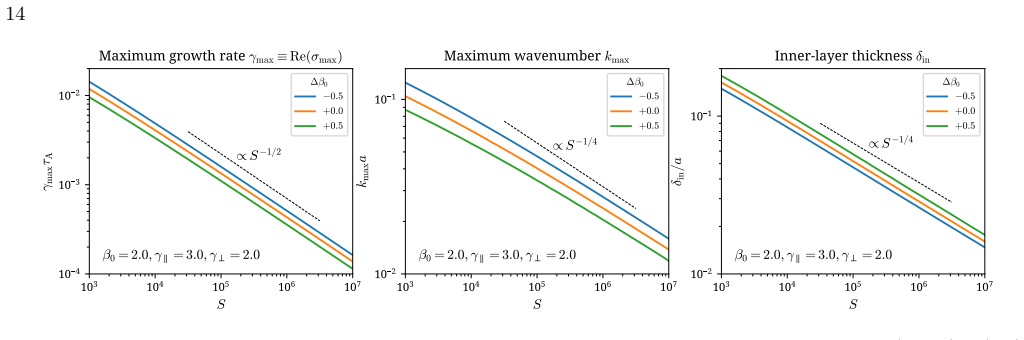
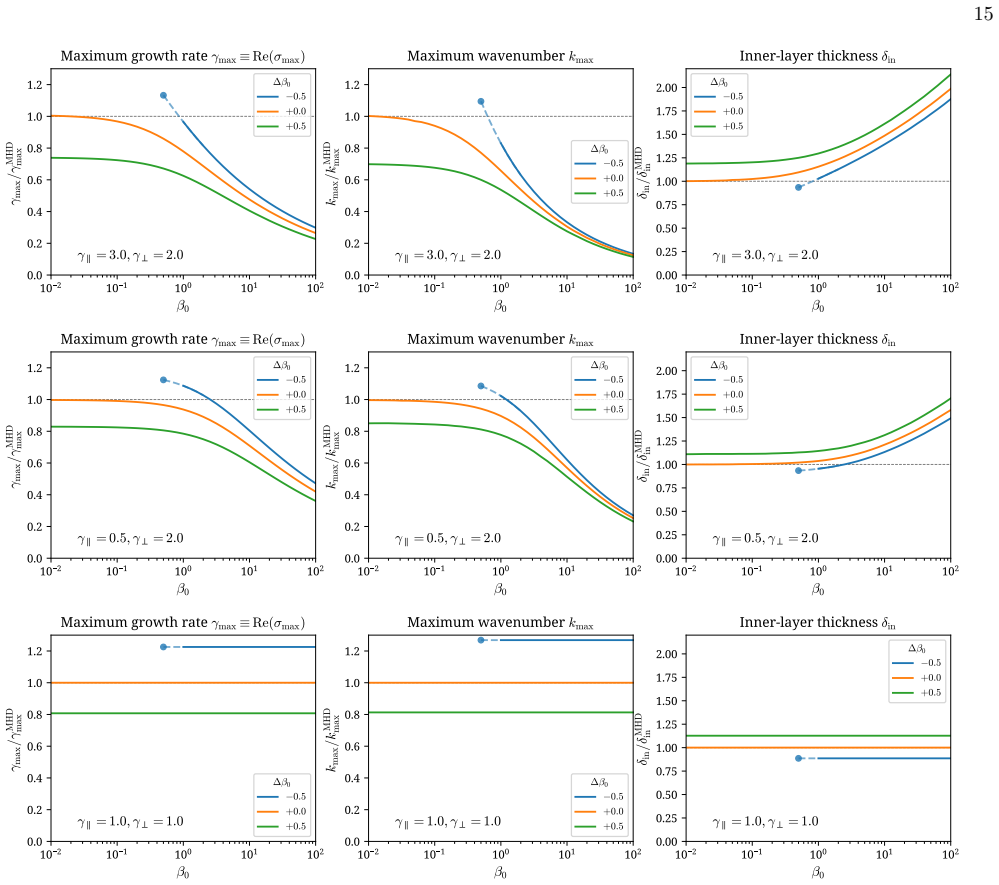
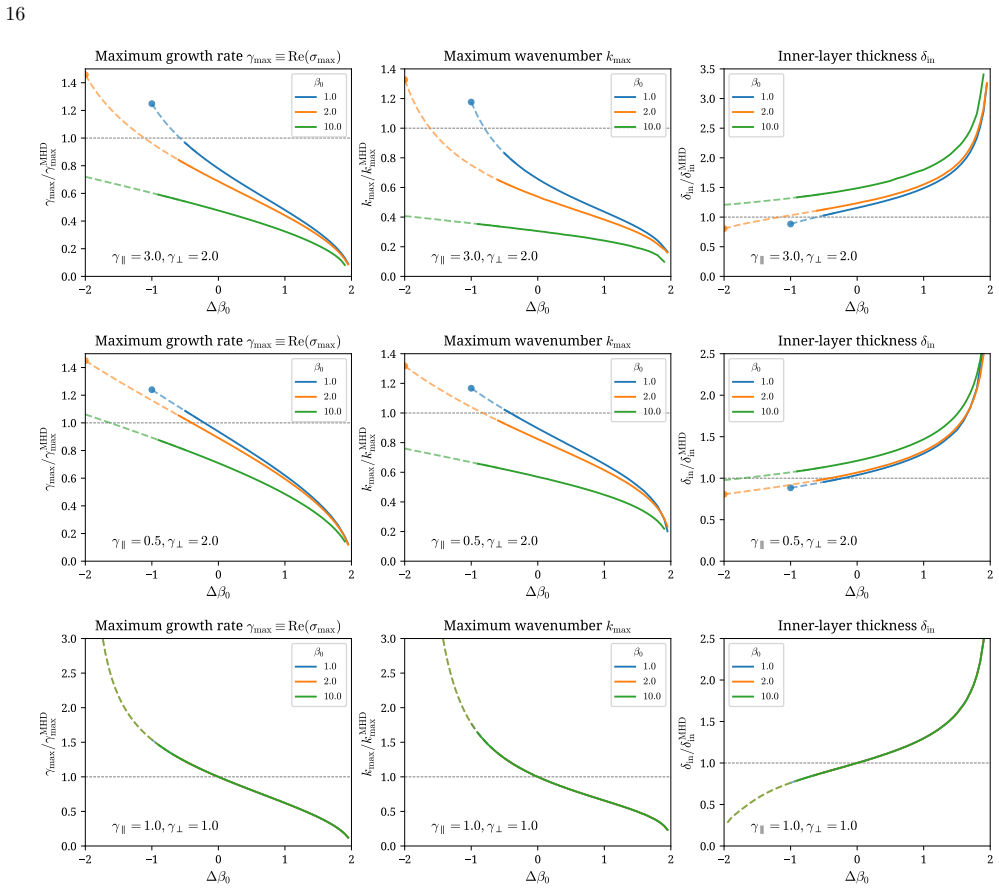
In the ideal outer region anisotropy changes the far-field decay rate, Δ', and the upper wavenumber cutoff α_c = sqrt(A/R0) with A = 1 - Δβ0/2 and R0 = 1 + ½[(γ∥ + γ⊥ - 2)β0 + γ∥ Δβ0]. In the resistive inner layer anisotropy enters the leading momentum balance through A. Modified FKR and Coppi branches are derived; matching them at crossover gives γ_max τ_A ∼ A^{1/2} R0^{-1/4} S^{-1/2}. Positive Δβ0 generally suppresses tearing and broadens the inner layer; negative Δβ0 enhances growth and shifts the fastest mode to larger wavenumber. PSECAS eigenvalue calculations support the Coppi branch and are consistent with the FKR branch when a fitted finite-wavelength Δ' is used.
What carries the argument
The gyrotropic-MHD closure applied to the force-free Harris sheet, with derived scalars A and R0 that enter both the outer-region matching condition and the inner-layer momentum balance.
If this is right
- The Lundquist-number exponent in the maximum growth rate remains -1/2.
- The prefactor of the growth rate depends explicitly on equilibrium anisotropy Δβ0, plasma beta β0, and the gyrotropic closure coefficients.
- Positive Δβ0 suppresses the instability and broadens the inner resistive layer.
- Negative Δβ0 enhances the growth rate and moves the fastest-growing mode to higher wavenumber.
- Eigenvalue calculations confirm the analytic branches when a finite-wavelength approximation for Δ' is adopted.
Where Pith is reading between the lines
- In astrophysical current sheets where pressure anisotropy can be measured, the reconnection rate mediated by tearing may be rescaled from the isotropic case using the derived prefactor.
- The same A and R0 factors could be inserted into nonlinear tearing or plasmoid-mediated reconnection models to estimate how anisotropy shifts the transition to the plasmoid regime.
- Kinetic or hybrid simulations initialized with the same β0 and Δβ0 could test whether the fluid prediction survives when finite-Larmor-radius effects are restored.
Load-bearing premise
The gyrotropic closure that defines R0 through the coefficients γ∥ and γ⊥ together with the assumption that the equilibrium remains a force-free Harris sheet with prescribed β0 and Δβ0.
What would settle it
A direct numerical solution or simulation of the linearized gyrotropic-MHD equations for a Harris sheet at several values of S and Δβ0 that either reproduces or deviates from the predicted scaling γ_max ∼ A^{1/2} R0^{-1/4} S^{-1/2}.
Figures
read the original abstract
Weakly collisional plasmas are widespread in astrophysics and can sustain pressure anisotropy, yet most analytical tearing-mode scalings assume an isotropic equilibrium. We develop a linear theory of resistive tearing in nonideal gyrotropic MHD for a force-free Harris current sheet characterized by perpendicular plasma beta $\beta_0$ and parallel-minus-perpendicular beta difference $\Delta\beta_0$. In the ideal outer region, anisotropy changes the far-field decay rate, the matching parameter $\Delta'$, and the upper wavenumber cutoff for localized tearing, $\alpha\equiv ka<\alpha_c=\sqrt{\mathcal{A}/\mathcal{R}_0}$, with $\mathcal{A}=1-\Delta\beta_0/2$ and $\mathcal{R}_0=1+\frac{1}{2}[(\gamma_\parallel+\gamma_\perp-2)\beta_0+\gamma_\parallel\Delta\beta_0]$. In the resistive inner layer, anisotropy enters the leading momentum balance through $\mathcal{A}$. We derive modified FKR and Coppi branches and, by matching them at their crossover wavenumber, obtain $\gamma_{\max}\tau_A\sim\mathcal{A}^{1/2}\mathcal{R}_0^{-1/4}S^{-1/2}$. Thus the classical Lundquist-number exponent is retained, while the prefactor depends on the equilibrium anisotropy, plasma beta, and gyrotropic closure. PSECAS eigenvalue calculations support the Coppi branch and are consistent with the FKR branch when a fitted finite-wavelength approximation for $\Delta'$ is used. Within the localized-mode and pressure-positive domain, positive $\Delta\beta_0$ generally suppresses tearing and broadens the inner layer, whereas negative $\Delta\beta_0$ enhances growth and shifts the fastest mode to larger wavenumber. This work identifies how prescribed equilibrium pressure anisotropy modifies both ideal outer matching and resistive inner-layer dynamics in the gyrotropic-MHD regime.
Editorial analysis
A structured set of objections, weighed in public.
Referee Report
Summary. The paper develops a linear resistive tearing theory in nonideal gyrotropic MHD for a force-free Harris sheet with uniform perpendicular beta β₀ and anisotropy Δβ₀. Anisotropy modifies the ideal outer-region decay rate, the matching parameter Δ', and the cutoff α_c = √(A/R₀) with A = 1 - Δβ₀/2 and R₀ defined from γ∥, γ⊥, β₀, Δβ₀. In the inner layer, anisotropy enters the momentum balance through A. Modified FKR and Coppi branches are derived; matching at their crossover yields γ_max τ_A ∼ A^{1/2} R₀^{-1/4} S^{-1/2}, preserving the classical Lundquist exponent while making the prefactor depend on anisotropy. PSECAS eigenvalue runs are stated to support the Coppi branch and the FKR branch with a fitted Δ' approximation. Positive Δβ₀ suppresses tearing; negative enhances it.
Significance. If the equilibrium assumption holds, the result shows that pressure anisotropy alters the growth-rate prefactor and the domain of unstable wavenumbers without changing the S^{-1/2} scaling. This is relevant for tearing in weakly collisional astrophysical and space plasmas. The analytic matching procedure and the reported consistency with eigenvalue computations are positive features.
major comments (2)
- [Abstract and §2 (equilibrium)] Abstract and equilibrium setup: the claim that the standard force-free Harris sheet B_y = B_0 tanh(x/a) with spatially constant β₀ and Δβ₀ is an exact equilibrium of gyrotropic MHD is not verified. The static force balance J × B = ∇ · P with P = p_⊥ I + (p_∥ − p_⊥) b b generally yields a nonzero residual for constant Δβ₀ unless the pressures vary spatially or γ∥, γ⊥ are specially chosen. Because A and R₀ are constructed directly from these parameters, any inconsistency propagates into the outer decay rate, Δ', α_c, and the inner-layer balance, undermining the derived scaling.
- [§3 and §4] §3 (outer region) and §4 (inner layer): the modified Δ' and the factor A in the momentum equation are obtained under the assumption that the equilibrium profile remains exactly the isotropic Harris sheet. If the equilibrium condition is not satisfied, the outer-region solution for the vector potential and the inner-layer normalization both require re-derivation; the crossover matching that produces the A^{1/2} R₀^{-1/4} prefactor would then change.
minor comments (2)
- [Abstract and §2] The definitions of γ∥ and γ⊥ (gyrotropic closure coefficients) are used to construct R₀ but their explicit values or ranges are not tabulated; a short table or explicit expressions would improve reproducibility.
- [§5 (numerics)] The statement that PSECAS runs are 'consistent with the FKR branch when a fitted finite-wavelength approximation for Δ' is used' should specify the fitting procedure and the wavenumber range over which the fit is applied.
Simulated Author's Rebuttal
We thank the referee for their careful reading and for highlighting an important point regarding the equilibrium setup. We address the major comments point by point below.
read point-by-point responses
-
Referee: Abstract and §2 (equilibrium)] Abstract and equilibrium setup: the claim that the standard force-free Harris sheet B_y = B_0 tanh(x/a) with spatially constant β₀ and Δβ₀ is an exact equilibrium of gyrotropic MHD is not verified. The static force balance J × B = ∇ · P with P = p_⊥ I + (p_∥ − p_⊥) b b generally yields a nonzero residual for constant Δβ₀ unless the pressures vary spatially or γ∥, γ⊥ are specially chosen. Because A and R₀ are constructed directly from these parameters, any inconsistency propagates into the outer decay rate, Δ', α_c, and the inner-layer balance, undermining the derived scaling.
Authors: We acknowledge that the manuscript states the Harris sheet with uniform β₀ and Δβ₀ as an exact equilibrium without providing an explicit verification of J × B = ∇ · P under the gyrotropic pressure tensor. This is a valid concern. In the revised manuscript we will add a dedicated subsection in §2 that substitutes the assumed profiles into the force-balance equation and derives the necessary conditions on the gyrotropic parameters (or notes any required spatial variation in pressures) for the residual to vanish. If the standard profile is only approximate, we will either adjust the equilibrium or clearly flag the approximation and its effect on A and R₀. revision: yes
-
Referee: [§3 and §4] §3 (outer region) and §4 (inner layer): the modified Δ' and the factor A in the momentum equation are obtained under the assumption that the equilibrium profile remains exactly the isotropic Harris sheet. If the equilibrium condition is not satisfied, the outer-region solution for the vector potential and the inner-layer normalization both require re-derivation; the crossover matching that produces the A^{1/2} R₀^{-1/4} prefactor would then change.
Authors: We agree that the outer-region solution, Δ', α_c, and the inner-layer momentum balance all presuppose the equilibrium profile. Once the equilibrium verification in §2 is complete, we will re-derive the outer decay rate and Δ' if the profile must be modified, and we will update the inner-layer normalization and the FKR–Coppi crossover matching accordingly. The revised scaling will be presented with the corrected equilibrium. revision: yes
Circularity Check
No significant circularity; derivation is self-contained analytic matching
full rationale
The paper assumes a prescribed force-free Harris sheet equilibrium with uniform β0 and Δβ0, inserts the gyrotropic parameters into the outer-region decay rate (yielding α_c = sqrt(A/R0) with A and R0 defined from γ∥, γ⊥, β0, Δβ0) and inner-layer momentum balance (through A), then performs standard FKR/Coppi matching to obtain the scaling γ_max τ_A ∼ A^{1/2} R_0^{-1/4} S^{-1/2}. This is a derived result from the modified equations, not a re-statement of the inputs by construction. No load-bearing self-citations appear; PSECAS eigenvalue checks are presented as external numerical support. Any question of whether the chosen equilibrium exactly satisfies J × B = ∇ · P for constant Δβ0 is a modeling assumption, not a circular reduction in the derivation chain.
Axiom & Free-Parameter Ledger
axioms (2)
- domain assumption Gyrotropic MHD closure with coefficients γ∥ and γ⊥ is applicable to the weakly collisional regime
- domain assumption The equilibrium is a force-free Harris current sheet with uniform β0 and Δβ0
Reference graph
Works this paper leans on
-
[1]
Alt, A., & Kunz, M. W. 2019, Journal of Plasma Physics, 85, 175850102, doi: 10.1017/S0022377819000084
-
[2]
2019, MNRAS, 485, 908, doi: 10.1093/mnras/stz379
Berlok, T., & Pfrommer, C. 2019, MNRAS, 485, 908, doi: 10.1093/mnras/stz379
-
[3]
Boldyrev, S., & Loureiro, N. F. 2018, in Journal of Physics Conference Series, Vol. 1100, Journal of Physics Conference Series (IOP), 012003, doi: 10.1088/1742-6596/1100/1/012003
-
[4]
Chen, J., & Palmadesso, P. J. 1984, The Physics of Fluids, 27, 1198, doi: 10.1063/1.864727
-
[5]
Chew, G. F., Goldberger, M. L., & Low, F. E. 1956, Proceedings of the Royal Society of London Series A, 236, 112, doi: 10.1098/rspa.1956.0116
-
[6]
2002, Geophysical Research Letters, 29, 62, doi: 10.1029/2002GL014720 —
Chiou, S.-W., & Hau, L.-N. 2002, Geophysical Research Letters, 29, 62, doi: 10.1029/2002GL014720 —. 2003, Physics of Plasmas, 10, 3813, doi: 10.1063/1.1606682
-
[7]
1976, Soviet Journal of Plasma Physics, 2, 533
Rutherford, P. 1976, Soviet Journal of Plasma Physics, 2, 533
1976
-
[8]
Interpretable Machine Learning for Science with PySR and SymbolicRegression.jl
Cranmer, M. 2023, arXiv e-prints, arXiv:2305.01582, doi: 10.48550/arXiv.2305.01582
work page internal anchor Pith review Pith/arXiv arXiv doi:10.48550/arxiv.2305.01582 2023
-
[9]
L., Kowal, G., & Falceta-Gon¸ calves, D
Ferreira-Santos, G. L., Kowal, G., & Falceta-Gon¸ calves, D. A. 2025, ApJ, 993, 74, doi: 10.3847/1538-4357/ae046e
-
[10]
P., Killeen, J., & Rosenbluth, M
Furth, H. P., Killeen, J., & Rosenbluth, M. N. 1963, Physics of Fluids, 6, 459, doi: 10.1063/1.1706761
-
[11]
2002, Physics of Plasmas, 9, 2455, doi: 10.1063/1.1476002
Hau, L.-N. 2002, Physics of Plasmas, 9, 2455, doi: 10.1063/1.1476002
-
[12]
Loureiro, N. F., & Uzdensky, D. A. 2016, Plasma Physics and Controlled Fusion, 58, 014021, doi: 10.1088/0741-3335/58/1/014021
-
[13]
Matteini, L., Landi, S., Velli, M., & Matthaeus, W. H. 2013, ApJ, 763, 142, doi: 10.1088/0004-637X/763/2/142 OpenAI. 2026, Codex, https://openai.com/codex/
-
[14]
2014, ApJL, 780, L19, doi: 10.1088/2041-8205/780/2/L19
Pucci, F., & Velli, M. 2014, ApJL, 780, L19, doi: 10.1088/2041-8205/780/2/L19
-
[15]
B., Karimabadi, H., & Daughton, W
Quest, K. B., Karimabadi, H., & Daughton, W. 2010, Physics of Plasmas, 17, 022107, doi: 10.1063/1.3309731
-
[16]
Uzdensky, D. A., & Loureiro, N. F. 2016, Physical Review Letters, 116, 105003, doi: 10.1103/PhysRevLett.116.105003
-
[17]
Winarto, H. W., & Kunz, M. W. 2022, Journal of Plasma Physics, 88, 905880210, doi: 10.1017/S0022377822000150
discussion (0)
Sign in with ORCID, Apple, or X to comment. Anyone can read and Pith papers without signing in.