Upstream reciprocity versus downstream reciprocity: Catalyzing cooperation
Pith reviewed 2026-06-26 09:30 UTC · model grok-4.3
The pith
An optimal network degree maximizes upstream reciprocity across update rules in structured populations.
A machine-rendered reading of the paper's core claim, the machinery that carries it, and where it could break.
Core claim
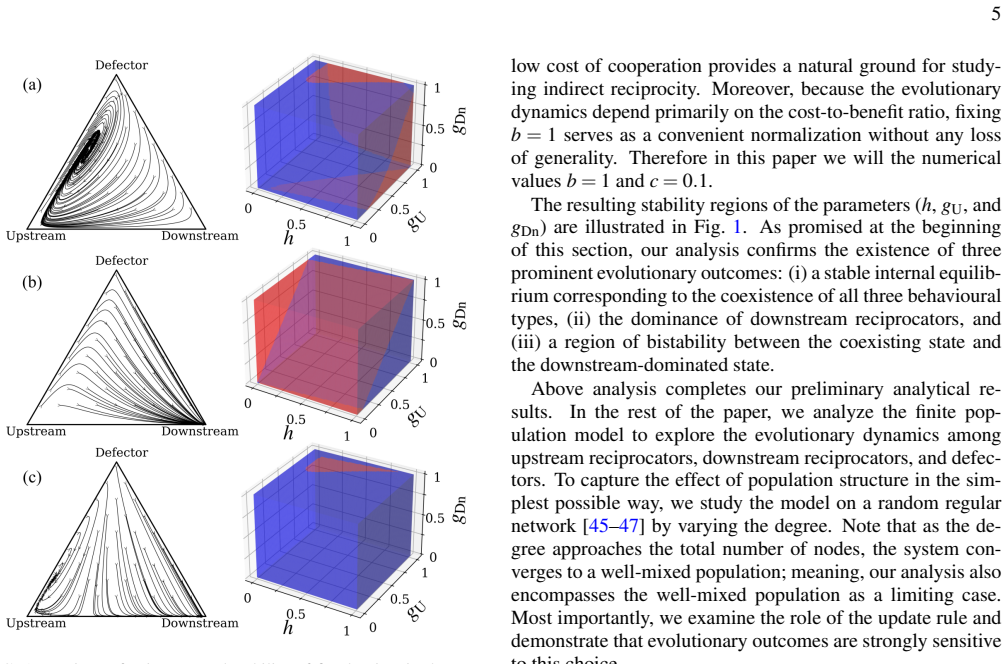
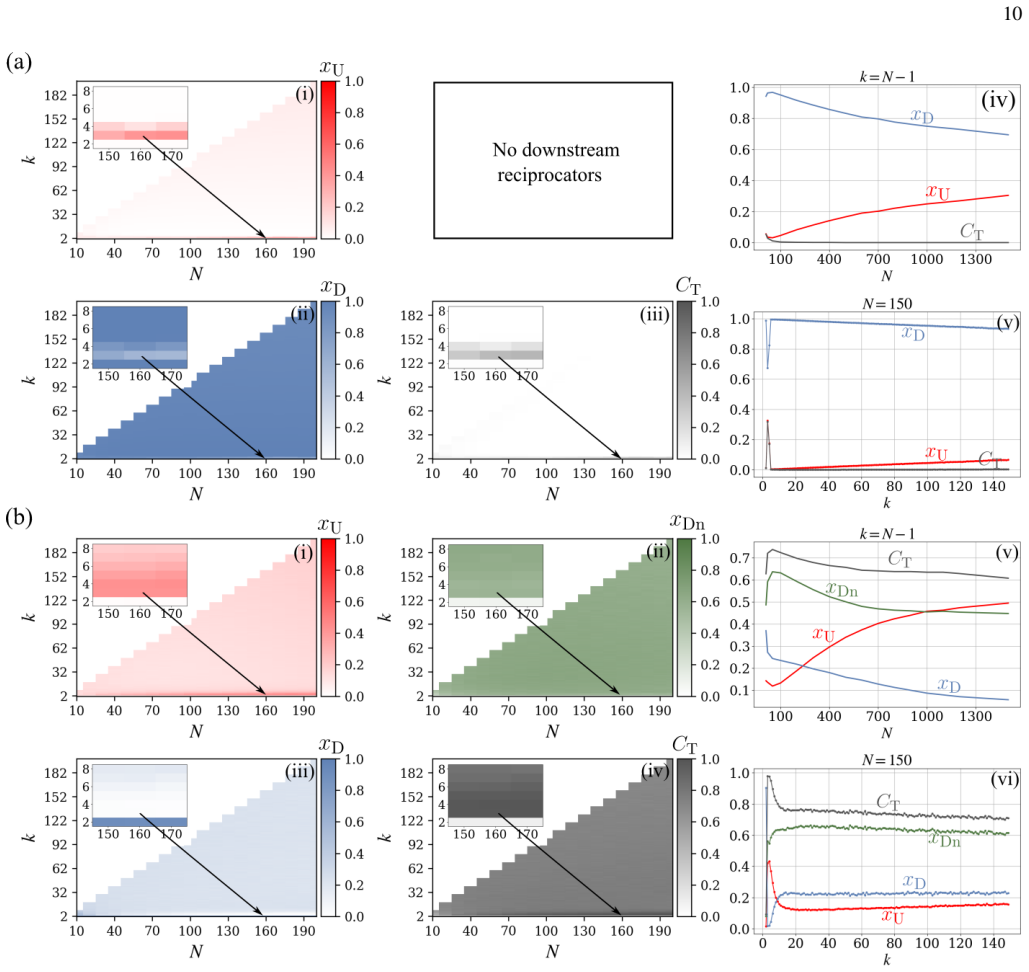
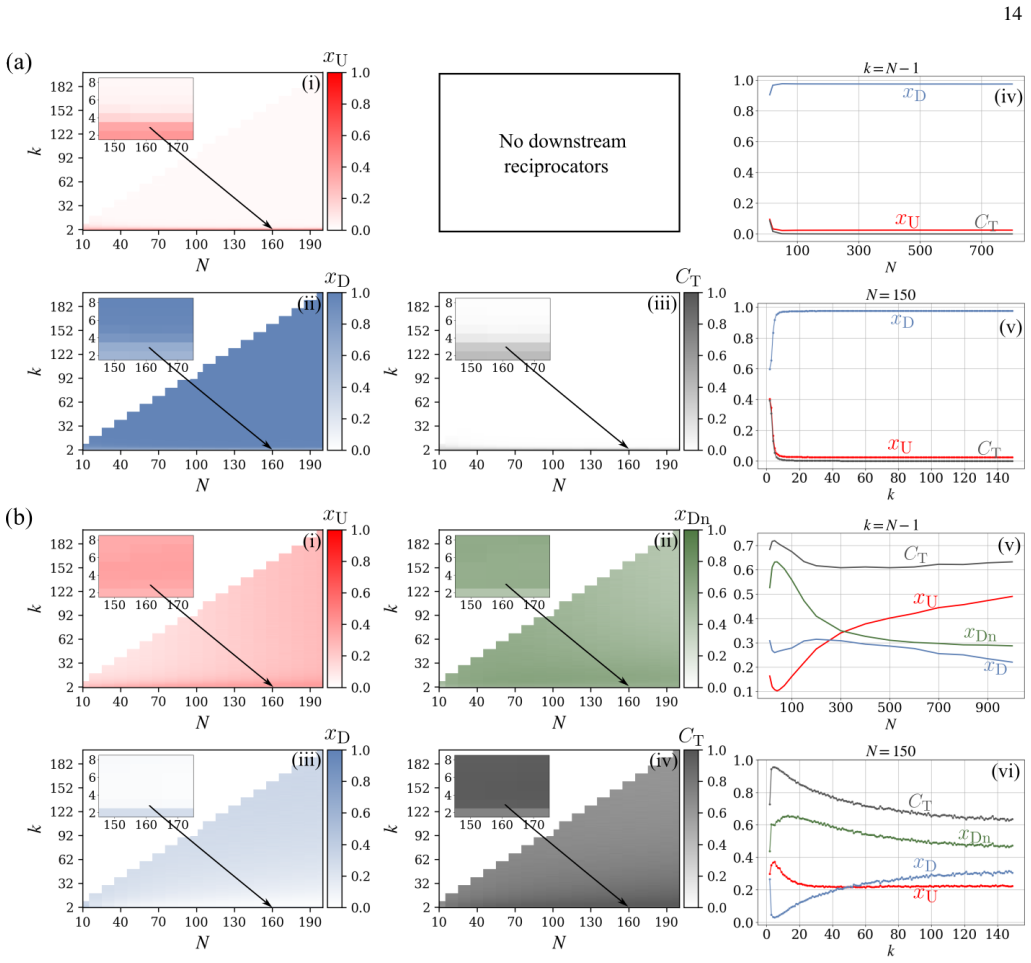
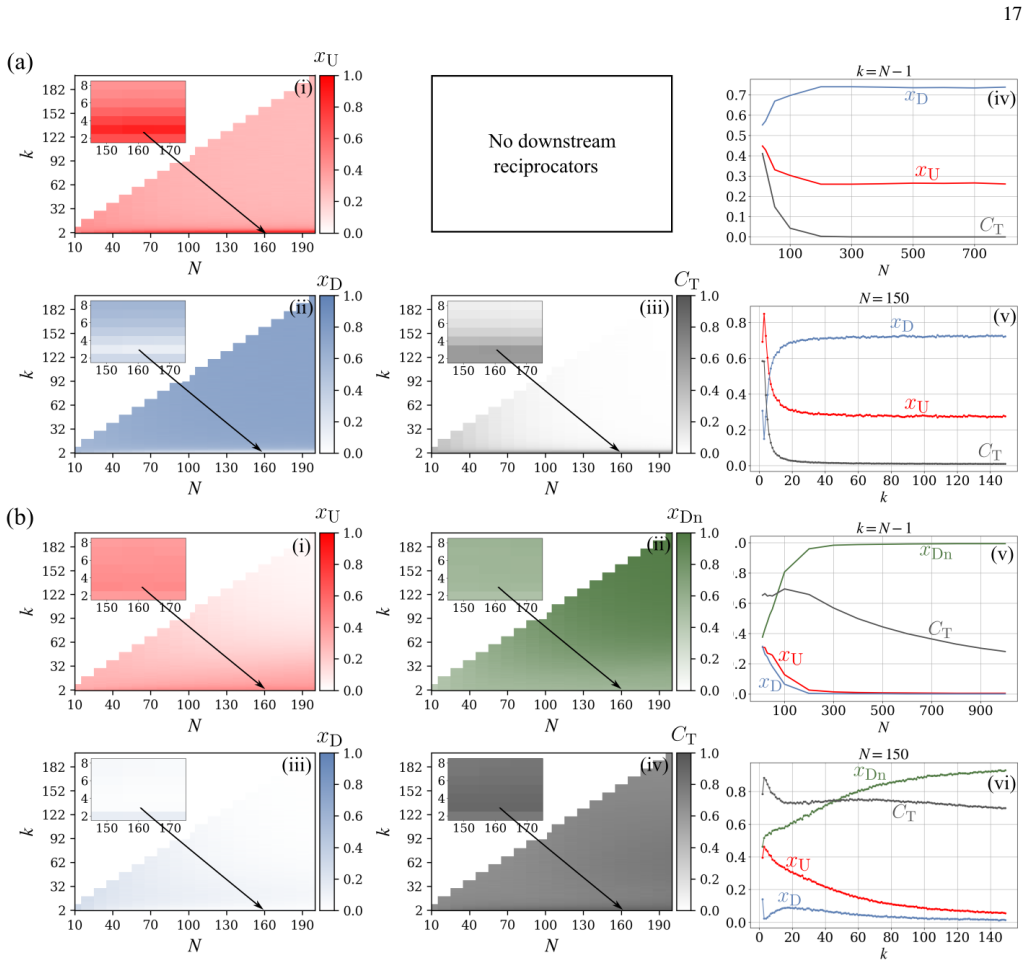
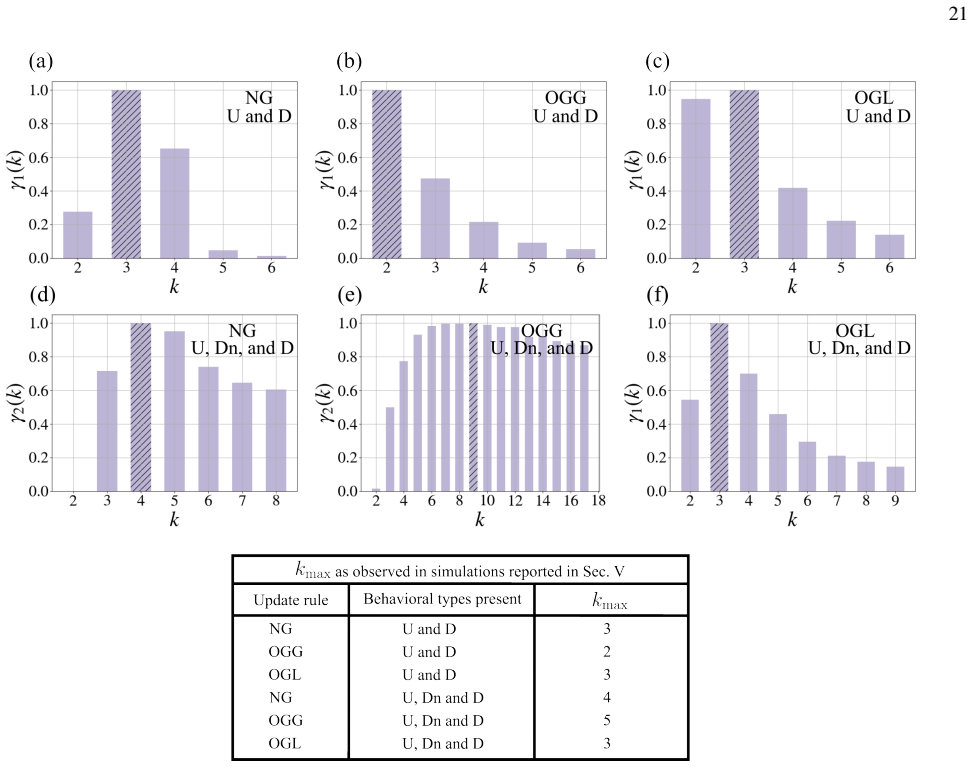
In agent-based models of indirect reciprocity on networks, where agents are purely defectors, upstream reciprocators, or downstream reciprocators and update via global or local mechanisms, upstream reciprocity reaches a maximum at an optimal average degree. This optimum reflects a structural tug-of-war between the formation of cooperative clusters and exposure to defectors, and it remains stable across all tested update rules and population sizes. Downstream reciprocity can promote or inhibit upstream reciprocity depending on the mechanism but exerts a net positive influence on cooperation.
What carries the argument
The optimal network degree, which balances cooperative clustering against defector exposure in the evolutionary dynamics of the three fixed behavioral types.
If this is right
- Downstream reciprocity either fosters or inhibits upstream reciprocity according to whether updates are global or local.
- The net contribution of downstream reciprocity to total cooperation stays positive under all explored conditions.
- Behavioral coexistence emerges under some update rules while downstream reciprocators dominate under others.
- The optimal degree for upstream reciprocity is insensitive to the specific evolutionary update rule or population size.
Where Pith is reading between the lines
- Network structure in real groups might be adjustable to favor indirect reciprocity by hitting the intermediate degree range.
- Models allowing individuals to switch between upstream and downstream strategies over time could test whether the optimum survives.
- The global-local distinction maps onto differences in information access that appear in human social networks of varying density.
- The tug-of-war mechanism might generalize to other forms of conditional cooperation on graphs beyond reciprocity.
Load-bearing premise
Individuals are locked into one of three pure behavioral types with no mixed strategies inside an agent, and the only key difference among simulations is global versus local updating of experiences and reputations.
What would settle it
Simulations with the same setup but much larger populations or additional update mechanisms showing no peak in upstream reciprocity at any network degree would falsify the claimed robustness of the optimum.
Figures
read the original abstract
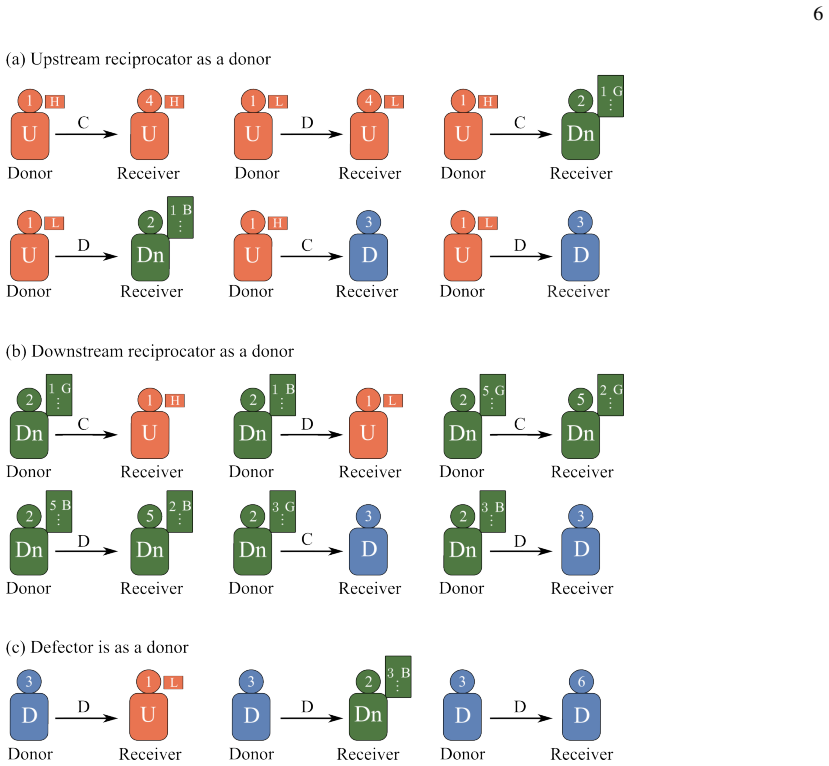
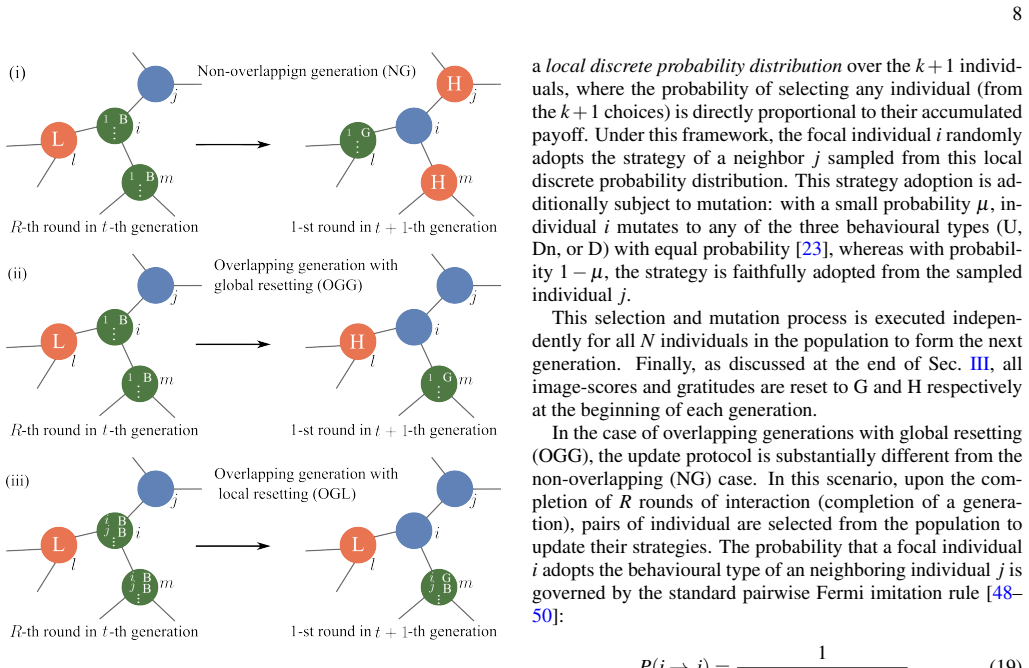
Why would anyone help a stranger, knowing they may never meet again? Indirect reciprocity offers one of the most compelling evolutionary answers, yet its two canonical forms -- upstream reciprocity (experience-based), and downstream reciprocity (reputation-based) -- have been studied mostly in isolation. Their joint dynamics in finite and structured populations remain largely unexplored. Here, we fill this gap using agent-based simulations in which an agent is behaviourally either defector, upstream reciprocator, or downstream reciprocator, and the agents' population state is temporally updated using different evolutionary update mechanisms. We show that update mechanism plays a surprisingly decisive role in shaping the fate of downstream and especially upstream reciprocators. Whether agents' experiences and reputations are updated globally or locally can shift outcomes from rich behavioural coexistence to the dominance of downstream reciprocators alone. Intriguingly, we uncover a robust structural feature that persists across all the explored update rules and population sizes: an optimal network degree at which upstream reciprocity is maximized, reflecting a fundamental tug-of-war between cooperative clustering and exposure to defectors. Our results highlight that while downstream reciprocity can either foster or inhibit upstream reciprocity depending on the update mechanism, its net effect on cooperation remains largely positive.
Editorial analysis
A structured set of objections, weighed in public.
Referee Report
Summary. The manuscript uses agent-based simulations to study the joint evolution of upstream reciprocity (experience-based) and downstream reciprocity (reputation-based) alongside defection in finite structured populations. Agents are assigned one of three fixed pure strategies (D, UR, DR) whose frequencies evolve under different update rules; the key result is that update mechanism (global vs. local) strongly affects strategy coexistence, while an optimal network degree that maximizes upstream reciprocity persists across all tested update rules and population sizes, interpreted as a tug-of-war between clustering and defector exposure. Downstream reciprocity is reported to exert a net positive effect on overall cooperation.
Significance. If the central structural finding survives relaxation of the fixed-strategy assumption, the work would usefully extend indirect-reciprocity theory into structured populations by showing how local vs. global information updates and network degree jointly shape behavioral coexistence. The simulation framework itself is a strength, but the absence of analytical benchmarks or robustness checks against evolving/mixed strategies limits the generality of the reported optimum.
major comments (2)
- [Model] Model section (agent behavioral types): each agent is locked into one of three pure strategies (D, UR, or DR) with no intra-individual evolution, mutation between rules, or mixed-strategy parameters. The reported tug-of-war and optimal-degree peak for upstream reciprocity are therefore generated by construction under this discrete, non-evolving strategy set; the manuscript provides no test of whether the peak survives even modest within-agent adaptation or continuous reciprocity parameters.
- [Results] Results (optimal-degree claim): the persistence of an optimal network degree is asserted across update rules and population sizes, yet no quantitative details are supplied on how the peak location or height was identified (e.g., fitting procedure, confidence intervals, or sensitivity to the precise definition of “upstream reciprocity frequency”).
minor comments (2)
- [Abstract] Abstract and Methods: simulation outcomes are summarized without reporting parameter values, number of replicates, statistical tests, error bars, or any comparison to analytical predictions.
- [Model] Notation: the distinction between global and local update of experiences versus reputations is central but introduced without an explicit equation or pseudocode block that would allow exact reproduction.
Simulated Author's Rebuttal
We thank the referee for their constructive comments. We address each major comment below, indicating planned revisions where appropriate.
read point-by-point responses
-
Referee: Model section (agent behavioral types): each agent is locked into one of three pure strategies (D, UR, or DR) with no intra-individual evolution, mutation between rules, or mixed-strategy parameters. The reported tug-of-war and optimal-degree peak for upstream reciprocity are therefore generated by construction under this discrete, non-evolving strategy set; the manuscript provides no test of whether the peak survives even modest within-agent adaptation or continuous reciprocity parameters.
Authors: Our model is designed to compare the evolutionary dynamics of three fixed pure strategies, a standard approach in evolutionary game theory that isolates the effects of distinct behavioral rules without intra-individual mixing. The tug-of-war and optimal-degree result arise directly from the interactions among these types on networks under varying update rules. We acknowledge that testing robustness under mixed or evolving strategies would be valuable but lies beyond the current scope; we will add an explicit discussion of this limitation in the revised manuscript. revision: partial
-
Referee: Results (optimal-degree claim): the persistence of an optimal network degree is asserted across update rules and population sizes, yet no quantitative details are supplied on how the peak location or height was identified (e.g., fitting procedure, confidence intervals, or sensitivity to the precise definition of “upstream reciprocity frequency”).
Authors: We agree that additional quantitative details would improve clarity. In the revised manuscript we will describe the peak identification procedure (maximum average upstream-reciprocator frequency across replicates), report variability across runs, and include a brief sensitivity analysis with respect to the frequency definition. revision: yes
Circularity Check
No circularity: simulation exploration with independent outcomes
full rationale
The paper performs agent-based simulations of evolutionary dynamics on networks with three fixed pure strategies (defector, upstream reciprocator, downstream reciprocator) under varying update rules and population structures. The central result—an optimal network degree maximizing upstream reciprocity—is reported as an emergent feature observed consistently across simulations, not derived by algebraic reduction, parameter fitting renamed as prediction, or self-citation chains. No equations are presented that equate outputs to inputs by construction, and the model assumptions (discrete strategy types, global/local updates) are stated explicitly as modeling choices rather than smuggled via prior self-citations. The work is self-contained as numerical exploration; results do not reduce to the inputs by definition.
Axiom & Free-Parameter Ledger
free parameters (3)
- network degree
- population size
- update rule parameters
axioms (2)
- domain assumption Each agent is fixed as one of three pure behavioral types: defector, upstream reciprocator, or downstream reciprocator.
- domain assumption Evolutionary dynamics are governed by the chosen update mechanisms for experiences and reputations.
Reference graph
Works this paper leans on
-
[1]
Clutton-Brock, Cooperation between non-kin in animal soci- eties, Nature462, 51–57 (2009)
T. Clutton-Brock, Cooperation between non-kin in animal soci- eties, Nature462, 51–57 (2009)
2009
-
[2]
M. A. Nowak, Five rules for the evolution of cooperation, Sci- ence314, 1560 (2006)
2006
-
[3]
M. A. Dufwenberg, U. Gneezy, W. Güth, and E. van Damme, Direct versus indirect reciprocity : An experiment (2001)
2001
-
[4]
M. Y . Bartlett and D. DeSteno, Gratitude and prosocial be- havior: Helping when it costs you, Psychological Science17, 319–325 (2006)
2006
-
[5]
K. Gray, A. F. Ward, and M. I. Norton, Paying it forward: Gen- eralized reciprocity and the limits of generosity., Journal of Ex- perimental Psychology: General143, 247–254 (2014)
2014
-
[6]
van Apeldoorn and A
J. van Apeldoorn and A. Schram, Indirect reciprocity; a field experiment, PLOS ONE11, e0152076 (2016)
2016
-
[7]
Y . Horita, M. Takezawa, T. Kinjo, Y . Nakawake, and N. Ma- suda, Transient nature of cooperation by pay-it-forward reci- procity, Scientific Reports6, 10.1038/srep19471 (2016)
-
[8]
Schnedler, The broken chain: Evidence against emotionally driven upstream indirect reciprocity, Games and Economic Be- havior136, 542–558 (2022)
W. Schnedler, The broken chain: Evidence against emotionally driven upstream indirect reciprocity, Games and Economic Be- havior136, 542–558 (2022). 22
2022
-
[9]
Obayashi, M
S. Obayashi, M. Inaba, T. Ohdaira, and T. Kiyonari, It’s my turn: empirical evidence of upstream indirect reciprocity in so- ciety through a quasi-experimental approach, Journal of Com- putational Social Science6, 1055–1079 (2023)
2023
-
[10]
Watanabe, M
T. Watanabe, M. Takezawa, Y . Nakawake, A. Kunimatsu, H. Yamasue, M. Nakamura, Y . Miyashita, and N. Masuda, Two distinct neural mechanisms underlying indirect reciprocity, Pro- ceedings of the National Academy of Sciences111, 3990–3995 (2014)
2014
-
[11]
Swakman, L
V . Swakman, L. Molleman, A. Ule, and M. Egas, Reputation- based cooperation: empirical evidence for behavioral strategies, Evolution and Human Behavior37, 230–235 (2016)
2016
-
[12]
Eriksson and C
T. Eriksson and C. Ferreira, Who pays it forward the most? ex- amining organizational citizenship behavior in the workplace, Journal of Theoretical Social Psychology5, 215–228 (2021)
2021
-
[13]
Gaudeul, C
A. Gaudeul, C. Keser, and S. Müller, The evolution of morals under indirect reciprocity, Games and Economic Behavior126, 251–277 (2021)
2021
-
[14]
Rutte and M
C. Rutte and M. Taborsky, Generalized reciprocity in rats, PLoS Biology5, e196 (2007)
2007
-
[15]
Bshary, A
R. Bshary, A. Hohner, K. A. el Djoudi, and H. Fricke, Interspe- cific communicative and coordinated hunting between groupers and giant moray eels in the red sea, PLOS Biology4, e431 (2006)
2006
-
[16]
Majolo, G
B. Majolo, G. Schino, and F. Aureli, The relative prevalence of direct, indirect and generalized reciprocity in macaque groom- ing exchanges, Animal Behaviour83, 763–771 (2012)
2012
-
[17]
Y . I. Russell, J. Call, and R. I. Dunbar, Image scoring in great apes, Behavioural Processes78, 108–111 (2008)
2008
-
[18]
M. A. Nowak and K. Sigmund, Evolution of indirect reci- procity, Nature437, 1291 (2005)
2005
-
[19]
Boyd and P
R. Boyd and P. J. Richerson, The evolution of reciprocity in sizable groups, Journal of Theoretical Biology132, 337–356 (1988)
1988
-
[20]
Boyd and P
R. Boyd and P. J. Richerson, The evolution of indirect reci- procity, Social Networks11, 213–236 (1989)
1989
-
[21]
M. A. Nowak and S. Roch, Upstream reciprocity and the evolu- tion of gratitude, Proceedings of the Royal Society B: Biologi- cal Sciences274, 605–610 (2006)
2006
-
[22]
Iwagami and N
A. Iwagami and N. Masuda, Upstream reciprocity in heteroge- neous networks, Journal of Theoretical Biology265, 297–305 (2010)
2010
-
[23]
M. A. Nowak and K. Sigmund, Evolution of indirect reciprocity by image scoring, Nature393, 573–577 (1998)
1998
-
[24]
M. A. Nowak and K. Sigmund, The dynamics of indirect reci- procity, Journal of Theoretical Biology194, 561–574 (1998)
1998
-
[25]
Ohtsuki and Y
H. Ohtsuki and Y . Iwasa, How should we define good- ness?—reputation dynamics in indirect reciprocity, Journal of Theoretical Biology231, 107–120 (2004)
2004
-
[26]
Hilbe, L
C. Hilbe, L. Schmid, J. Tkadlec, K. Chatterjee, and M. A. Nowak, Indirect reciprocity with private, noisy, and incomplete information, Proceedings of the National Academy of Sciences 115, 12241–12246 (2018)
2018
-
[27]
F. P. Santos, F. C. Santos, and J. M. Pacheco, Social norm com- plexity and past reputations in the evolution of cooperation, Na- ture555, 242–245 (2018)
2018
-
[28]
Raub and J
W. Raub and J. Weesie, Reputation and efficiency in social in- teractions: An example of network effects, American Journal of Sociology96, 626–654 (1990)
1990
-
[29]
Pollock and L
G. Pollock and L. A. Dugatkin, Reciprocity and the emer- gence of reputation, Journal of Theoretical Biology159, 25–37 (1992)
1992
-
[30]
Ohtsuki and Y
H. Ohtsuki and Y . Iwasa, The leading eight: Social norms that can maintain cooperation by indirect reciprocity, Journal of Theoretical Biology239, 435–444 (2006)
2006
-
[31]
Schmid, K
L. Schmid, K. Chatterjee, C. Hilbe, and M. A. Nowak, A uni- fied framework of direct and indirect reciprocity, Nature Human Behaviour5, 1292–1302 (2021)
2021
-
[32]
Pfeiffer, C
T. Pfeiffer, C. Rutte, T. Killingback, M. Taborsky, and S. Bon- hoeffer, Evolution of cooperation by generalized reciprocity, Proceedings of the Royal Society B: Biological Sciences272, 1115–1120 (2005)
2005
-
[33]
Okada, A review of theoretical studies on indirect reciprocity, Games11, 27 (2020)
I. Okada, A review of theoretical studies on indirect reciprocity, Games11, 27 (2020)
2020
-
[34]
Sigmund,The Calculus of Selfishness(Princeton University Press, Princeton, NJ, 2010)
K. Sigmund,The Calculus of Selfishness(Princeton University Press, Princeton, NJ, 2010)
2010
-
[35]
W. E. Baker and N. Bulkley, Paying it forward vs. rewarding reputation: Mechanisms of generalized reciprocity, Organiza- tion Science25, 1493–1510 (2014)
2014
-
[36]
Stanca, Measuring indirect reciprocity: Whose back do we scratch?, Journal of Economic Psychology30, 190–202 (2009)
L. Stanca, Measuring indirect reciprocity: Whose back do we scratch?, Journal of Economic Psychology30, 190–202 (2009)
2009
-
[37]
Simpson, A
B. Simpson, A. Harrell, D. Melamed, N. Heiserman, and D. V . Negraia, The roots of reciprocity: Gratitude and reputation in generalized exchange systems, American Sociological Review 83, 88–110 (2017)
2017
-
[38]
Sasaki, S
T. Sasaki, S. Uchida, I. Okada, and H. Yamamoto, The evolu- tion of cooperation and diversity under integrated indirect reci- procity, Games15, 15 (2024)
2024
-
[39]
T. Sasaki, S. Uchida, I. Okada, H. Yamamoto, and Y . Nakai, Integrating upstream and downstream reciprocity stabilizes cooperator-defector coexistence in others-only pub- lic goods games, Frontiers in Behavioral Economics4, 10.3389/frbhe.2025.1697570 (2026)
-
[40]
S. L. Chang, M. Piraveenan, P. Pattison, and M. Prokopenko, Game theoretic modelling of infectious disease dynamics and intervention methods: a review, Journal of Biological Dynamics 14, 57–89 (2020)
2020
-
[41]
Hofbauer and K
J. Hofbauer and K. Sigmund,Evolutionary Games and Popula- tion Dynamics(Cambridge University Press, Cambridge, UK, 1998)
1998
-
[42]
M. A. Nowak,Evolutionary Dynamics: Exploring the Equa- tions of Life(Harvard University Press, Cambridge, MA, 2006)
2006
-
[43]
Mukhopadhyay and S
A. Mukhopadhyay and S. Chakraborty, Replicator equations in- duced by microscopic processes in nonoverlapping population playing bimatrix games, Chaos31, 023123 (2021)
2021
-
[44]
Wolfram Research, Mathematica, version 13.0 (2024), cham- paign, IL
I. Wolfram Research, Mathematica, version 13.0 (2024), cham- paign, IL
2024
-
[45]
Lieberman, C
E. Lieberman, C. Hauert, and M. A. Nowak, Evolutionary dy- namics on graphs, Nature433, 312–316 (2005)
2005
-
[46]
M. E. J. Newman, The structure and function of complex net- works, SIAM Review45, 167–256 (2003)
2003
-
[47]
Barabási,Network Science(Cambridge University Press, Cambridge, 2016)
A.-L. Barabási,Network Science(Cambridge University Press, Cambridge, 2016)
2016
-
[48]
Szabó and G
G. Szabó and G. Fáth, Evolutionary games on graphs, Physics Reports446, 97 (2007)
2007
-
[49]
L. E. Blume, The statistical mechanics of strategic interaction, Games and Economic Behavior5, 387 (1993)
1993
-
[50]
Stochastic dynamics of invasion and fixation
A. Traulsen, M. A. Nowak, and J. M. Pacheco, Stochastic dynamics of invasion and fixation, Physical Review E74, 10.1103/physreve.74.011909 (2006)
-
[51]
L. A. Bach, D. J. T. Sumpter, J. Alsner, and V . Loeschcke, Spa- tial evolutionary games of interaction among generic cancer cells, Computational and Mathematical Methods in Medicine 5, 47–58 (2003)
2003
-
[52]
A. ´Swierniak and M. Krze ´slak, Cancer heterogeneity and multilayer spatial evolutionary games, Biology Direct11, 10.1186/s13062-016-0156-z (2016)
-
[53]
M. G. Zimmermann, V . M. Eguíluz, and M. San Miguel, 23 Coevolution of dynamical states and interactions in dynamic networks, Physical Review E69, 10.1103/physreve.69.065102 (2004)
-
[54]
J. M. Pacheco, A. Traulsen, and M. A. Nowak, Coevolu- tion of strategy and structure in complex networks with dy- namical linking, Physical Review Letters97, 10.1103/phys- revlett.97.258103 (2006)
-
[55]
Broom, C
M. Broom, C. Cannings, and G. T. Vickers, Multi-player matrix games, Bulletin of Mathematical Biology59, 931 (1997)
1997
-
[56]
V . Kumar Dubey, S. Chakraborty, A. Patra, and S. Chakraborty, Evolutionarily stable strategy in asymmetric games: Dynamical and information-theoretical perspectives, Chaos: An Interdis- ciplinary Journal of Nonlinear Science36, 10.1063/5.0297611 (2026)
-
[57]
Patra, V
A. Patra, V . K. Dubey, and S. Chakraborty, Coexistence of coor- dination and anticoordination in nonlinear public goods game, Journal of Physics: Complexity3, 045006 (2022)
2022
-
[58]
Barabási,Network Science(Cambridge University Press, 2016)
A.-L. Barabási,Network Science(Cambridge University Press, 2016)
2016
-
[59]
E. F. Moore, The shortest path through a maze, inProceed- ings of the International Symposium on the Theory of Switching (Harvard University Press, 1959) pp. 285–292
1959
discussion (0)
Sign in with ORCID, Apple, or X to comment. Anyone can read and Pith papers without signing in.