Supporting Tutors in the Gig Economy with Automated Feedback: A Case Study on Ringle
Pith reviewed 2026-06-26 09:50 UTC · model grok-4.3
The pith
Tutors on online gig platforms view automated feedback more negatively than learner feedback yet use it to monitor performance and platform expectations.
A machine-rendered reading of the paper's core claim, the machinery that carries it, and where it could break.
Core claim
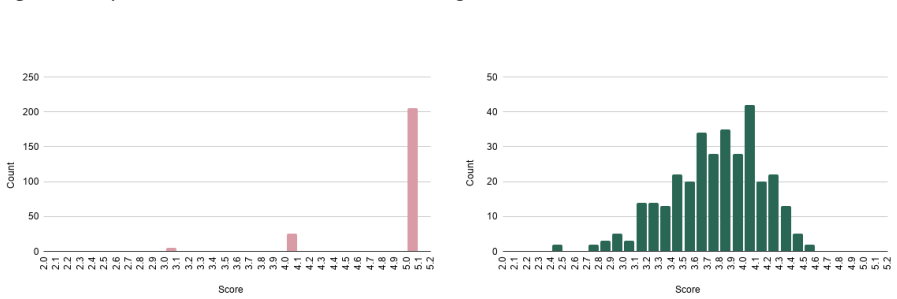
Tutors perceived automated feedback more negatively than learner feedback, yet they found it useful for self-monitoring and understanding platform expectations, though discrepancies between them often caused confusion.
What carries the argument
The research probe deployed on Ringle that analyzes lesson transcripts and delivers automated feedback to tutors, serving as the intervention whose reception is measured through post-deployment surveys.
If this is right
- Feedback systems on gig-education platforms can incorporate automated analysis to help tutors align with platform standards.
- Discrepancies between automated and human feedback sources must be minimized to prevent tutor confusion.
- Automated feedback provides a scalable way for platforms to monitor tutor quality beyond relying solely on learner ratings.
- Design of such systems should prioritize clarity so tutors can act on the feedback without mixed signals.
Where Pith is reading between the lines
- Platforms could experiment with hybrid feedback that flags where automated and learner scores diverge and explains the difference.
- The same probe approach might be adapted to other gig-work domains where performance feedback is currently only human-generated.
- Longer deployments could test whether repeated exposure to automated feedback shifts tutor attitudes from negative toward neutral or positive.
Load-bearing premise
The 36 tutors' survey answers reflect their actual views of the automated feedback rather than reactions shaped by knowing they were part of a research deployment.
What would settle it
A controlled comparison in which the same tutors receive both automated and learner feedback on identical lessons without knowing the source and report their perceptions in a follow-up survey.
Figures


read the original abstract
The rise of online tutoring platforms in the gig economy has made education more scalable, flexible, and on-demand. These platforms rely on learner evaluations as the primary feedback for tutors and platforms. However, such feedback offers limited guidance for tutors' improvement and makes it difficult to monitor tutor quality at scale. To this end, we explored AI-powered automated feedback and how tutors perceive and respond to it. We deployed a research probe on Ringle, a popular online English tutoring platform, that analyzed tutors' lessons and provided automated feedback. We then surveyed 36 tutors about their experience. Our findings reveal that while tutors perceived automated feedback more negatively than learner feedback, they found it useful for self-monitoring and understanding platform expectations, though discrepancies between them often caused confusion. Based on these insights, we propose design considerations for feedback systems for online educational gig platforms.
Editorial analysis
A structured set of objections, weighed in public.
Referee Report
Summary. The paper reports a case study deploying an AI research probe on the Ringle online English tutoring platform to generate automated feedback on tutors' lessons. A survey of 36 tutors found that automated feedback was perceived more negatively than learner feedback, yet was seen as useful for self-monitoring and clarifying platform expectations, while discrepancies between the two sources often produced confusion. The authors distill design considerations for feedback systems on gig-economy educational platforms.
Significance. If the survey findings are robust, the work supplies timely empirical insight into how tutors in scalable, on-demand tutoring platforms experience automated versus human feedback. This can inform HCI design for quality-monitoring tools that balance tutor support with platform oversight. The study is exploratory and platform-specific, so its primary value lies in surfacing concrete perception patterns rather than in broad generalization.
major comments (1)
- [Survey and Findings (implied from abstract and methods description)] The central comparative claims rest on a single post-deployment survey of 36 tutors. The manuscript provides no quantitative validation of the automated feedback's accuracy, no pre/post measures, no control condition, and no analysis of response bias, social-desirability effects, or non-response. Because the evidentiary base is this convenience sample alone, systematic distortion in tutor self-reports directly undermines the headline finding that automated feedback was viewed more negatively yet remained useful for self-monitoring.
minor comments (1)
- [Abstract] The abstract states the sample size but does not mention the absence of validation or bias checks; adding one sentence on these limitations would improve transparency.
Simulated Author's Rebuttal
We thank the referee for the detailed review and constructive critique of our exploratory case study. We address the major comment on the survey methodology and evidentiary base below, and will revise the manuscript to better frame its scope and limitations.
read point-by-point responses
-
Referee: The central comparative claims rest on a single post-deployment survey of 36 tutors. The manuscript provides no quantitative validation of the automated feedback's accuracy, no pre/post measures, no control condition, and no analysis of response bias, social-desirability effects, or non-response. Because the evidentiary base is this convenience sample alone, systematic distortion in tutor self-reports directly undermines the headline finding that automated feedback was viewed more negatively yet remained useful for self-monitoring.
Authors: Our work is positioned as an exploratory case study of tutor perceptions in a real-world gig-economy deployment, not as a controlled experiment or technical evaluation of AI accuracy. The comparative claims concern subjective perceptions of negativity, usefulness for self-monitoring, and confusion from discrepancies, which are appropriately captured through post-deployment self-reports from the 36 tutors who used the probe. We agree that the absence of pre/post measures, control conditions, quantitative accuracy validation, and formal bias or non-response analysis constitutes a limitation of the convenience sample; these elements were outside the study's scope. We will revise the manuscript to add a dedicated limitations subsection that explicitly discusses these issues, potential social-desirability effects, and the platform-specific nature of the findings, thereby tempering claims and clarifying the contribution as surfacing concrete perception patterns rather than robust causal or generalizable results. revision: yes
Circularity Check
No circularity; empirical survey findings are self-contained
full rationale
The paper reports results from a deployed research probe followed by a survey of 36 tutors on Ringle. No equations, fitted parameters, predictions, or derivation chains exist. All claims are direct descriptions of collected survey responses; the evidentiary basis does not reduce to any self-referential construction or self-citation load-bearing step. This is a standard empirical case study with no mathematical or definitional circularity.
Axiom & Free-Parameter Ledger
axioms (1)
- domain assumption Tutors' survey responses reflect their genuine perceptions of the feedback systems.
Reference graph
Works this paper leans on
-
[1]
Qualitative research in psychology , volume=
Using thematic analysis in psychology , author=. Qualitative research in psychology , volume=. 2006 , publisher=
2006
-
[2]
2015 , publisher=
Teaching by principles: An interactive approach to language pedagogy , author=. 2015 , publisher=
2015
-
[3]
Asia Pacific Education Review , volume=
The characteristics of effective English teachers as perceived by high school teachers and students in Korea , author=. Asia Pacific Education Review , volume=. 2006 , publisher=
2006
-
[4]
2008 , publisher=
Characteristics of effective teachers: Perceptions of the English teachers , author=. 2008 , publisher=
2008
-
[5]
Proceedings of the CHI Conference on Human Factors in Computing Systems , articleno =
Hernandez, Rie Helene (Lindy) and Song, Qiurong and Kou, Yubo and Gui, Xinning , title =. Proceedings of the CHI Conference on Human Factors in Computing Systems , articleno =. 2024 , isbn =. doi:10.1145/3613904.3642151 , abstract =
-
[6]
Assessment of Teacher Reactions to a Standards-Based Teacher Evaluation System: A Pilot Study* , volume =
Milanowski, Anthony and Heneman, Herbert , year =. Assessment of Teacher Reactions to a Standards-Based Teacher Evaluation System: A Pilot Study* , volume =. Journal of Personnel Evaluation in Education , doi =
-
[7]
International Journal of Artificial Intelligence in Education , volume=
High School English Teachers Reflect on Their Talk: A Study of Response to Automated Feedback with the Teacher Talk Tool , author=. International Journal of Artificial Intelligence in Education , volume=. 2025 , publisher=
2025
-
[8]
Administrative Science Quarterly , volume=
The invisible cage: Workers’ reactivity to opaque algorithmic evaluations , author=. Administrative Science Quarterly , volume=. 2021 , publisher=
2021
-
[9]
Asia Pacific Education Review , volume=
Private tutoring through the internet: Globalization and offshoring , author=. Asia Pacific Education Review , volume=. 2010 , publisher=
2010
-
[10]
Olga Kozar and Naomi Sweller , keywords =. An exploratory study of demographics, goals and expectations of private online language learners in Russia , journal =. 2014 , issn =. doi:https://doi.org/10.1016/j.system.2014.04.005 , url =
-
[11]
2017 , publisher=
Internationalisation, higher education and the growing demand for English: An investigation into the English medium of instruction (EMI) movement in China and Japan , author=. 2017 , publisher=
2017
-
[12]
, author=
Globalization, English language policy, and teacher agency: Focus on Asia. , author=. International Education Journal: Comparative Perspectives , volume=. 2016 , publisher=
2016
-
[13]
Computer Supported Cooperative Work (CSCW) , volume=
Rating working conditions on digital labor platforms , author=. Computer Supported Cooperative Work (CSCW) , volume=. 2019 , publisher=
2019
-
[14]
Proceedings of the 2018 CHI Conference on Human Factors in Computing Systems , pages=
More stars or more reviews? , author=. Proceedings of the 2018 CHI Conference on Human Factors in Computing Systems , pages=
2018
-
[15]
Annual review of economics , volume=
Reputation and feedback systems in online platform markets , author=. Annual review of economics , volume=. 2016 , publisher=
2016
-
[16]
Advances in group processes , volume=
The production of trust in online markets , author=. Advances in group processes , volume=
-
[17]
Proceedings of the ACM on Human-Computer Interaction , volume=
The perpetual work life of crowdworkers: How tooling practices increase fragmentation in crowdwork , author=. Proceedings of the ACM on Human-Computer Interaction , volume=. 2019 , publisher=
2019
-
[18]
International Journal of Comparative Labour Law and Industrial Relations , volume=
The end of the subordinate worker? The on-demand economy, the gig economy, and the need for protection for crowdworkers , author=. International Journal of Comparative Labour Law and Industrial Relations , volume=
-
[19]
Human Performance , volume=
Reactions to employee performance monitoring: Framework, review, and research directions , author=. Human Performance , volume=. 2000 , publisher=
2000
-
[20]
Journal of Management , volume=
EPM 20/20: A review, framework, and research agenda for electronic performance monitoring , author=. Journal of Management , volume=. 2020 , publisher=
2020
-
[21]
Proceedings of the 2022 CHI Conference on Human Factors in Computing Systems , pages=
Privacy, surveillance, and power in the gig economy , author=. Proceedings of the 2022 CHI Conference on Human Factors in Computing Systems , pages=
2022
-
[22]
Organization Studies , volume=
Algorithmic surveillance in the gig economy: The organization of work through Lefebvrian conceived space , author=. Organization Studies , volume=. 2021 , publisher=
2021
-
[23]
Proceedings of the CHI Conference on Human Factors in Computing Systems , articleno =
Do, Kimberly and De Los Santos, Maya and Muller, Michael and Savage, Saiph , title =. Proceedings of the CHI Conference on Human Factors in Computing Systems , articleno =. 2024 , isbn =. doi:10.1145/3613904.3642614 , abstract =
-
[24]
2018 , eprint=
Laying the Groundwork for a Worker-Centric Peer Economy , author=. 2018 , eprint=
2018
-
[25]
Discourse: Studies in the Cultural Politics of Education , volume=
‘The most popular star-tutor of English’: Discursive construction of tutor identities in shadow education , author=. Discourse: Studies in the Cultural Politics of Education , volume=. 2020 , publisher=
2020
-
[26]
Discourse: Studies in the cultural politics of education , volume=
Discursive practices of private online tutoring websites in Russia , author=. Discourse: Studies in the cultural politics of education , volume=. 2015 , publisher=
2015
-
[27]
Language Teaching Research , volume=
Secondary school students’ enjoyment of English private tutoring: An L2 motivational self perspective , author=. Language Teaching Research , volume=. 2023 , publisher=
2023
-
[28]
Xia, Meng and Zhao, Yankun and Erol, Mehmet Hamza and Hong, Jihyeong and Kim, Juho , title =. 2022 , isbn =. doi:10.1145/3506860.3506883 , booktitle =
-
[29]
Proceedings of the Ninth ACM Conference on Learning@ Scale , pages=
RLens: A Computer-aided Visualization System for Supporting Reflection on Language Learning under Distributed Tutorship , author=. Proceedings of the Ninth ACM Conference on Learning@ Scale , pages=
-
[30]
Human Resource Management , volume=
Creation of the algorithmic management questionnaire: A six-phase scale development process , author=. Human Resource Management , volume=. 2024 , publisher=
2024
-
[31]
Journal of Organizational Behavior , year=
Algorithmic management in the gig economy: A systematic review and research integration , author=. Journal of Organizational Behavior , year=
-
[32]
Proceedings of the 33rd annual ACM conference on human factors in computing systems , pages=
Working with machines: The impact of algorithmic and data-driven management on human workers , author=. Proceedings of the 33rd annual ACM conference on human factors in computing systems , pages=
-
[33]
Journal of Organizational Behavior , year=
Perceived algorithmic evaluation and app-workers' service performance: The roles of flow experience and challenges of gig work , author=. Journal of Organizational Behavior , year=
-
[34]
Long Range Planning , volume=
Responding to inconsistent performance feedback on multiple goals: the contingency role of decision maker's status in introducing changes , author=. Long Range Planning , volume=. 2023 , publisher=
2023
-
[35]
More like a friend than a teacher
“More like a friend than a teacher”: ideal teachers and the gig economy for online language learning , author=. Computer Assisted Language Learning , volume=. 2023 , publisher=
2023
-
[36]
Comparative labor law and policy journal , volume=
The rise of the ‘just-in-time workforce’: on-demand work, crowd work and labour protection in the ‘gig-economy’ , author=. Comparative labor law and policy journal , volume=. 2016 , publisher=
2016
-
[37]
Imi Konnect , volume=
Future of gig economy: opportunities and challenges , author=. Imi Konnect , volume=
-
[38]
arXiv preprint arXiv:2201.09787 , year=
Using computational grounded theory to understand tutors' experiences in the gig economy , author=. arXiv preprint arXiv:2201.09787 , year=
-
[39]
On Students' (Mis)judgments of Learning and Teaching Effectiveness , journal =. 2020 , issn =. doi:https://doi.org/10.1016/j.jarmac.2019.12.009 , author =
-
[40]
, author=
Why and how you should read student evaluations of teaching. , author=. 2020 , publisher=
2020
-
[41]
Studies in Higher Education , volume=
Measuring what matters: the positioning of students in feedback processes within national student satisfaction surveys , author=. Studies in Higher Education , volume=. 2022 , publisher=
2022
-
[42]
2000 , publisher=
Teacher Evaluation to Enhance Professional Practice , author=. 2000 , publisher=
2000
-
[43]
2000 , publisher=
Teacher evaluation: A comprehensive guide to new directions and practices , author=. 2000 , publisher=
2000
-
[44]
arXiv preprint arXiv:2105.07949 , year=
Using transformers to provide teachers with personalized feedback on their classroom discourse: The TalkMoves application , author=. arXiv preprint arXiv:2105.07949 , year=
-
[45]
Teaching and Teacher Education , volume=
Promoting rich discussions in mathematics classrooms: Using personalized, automated feedback to support reflection and instructional change , author=. Teaching and Teacher Education , volume=. 2022 , publisher=
2022
-
[46]
Educational technology research and development , pages=
Automated feedback on discourse moves: teachers’ perceived utility of a professional learning tool , author=. Educational technology research and development , pages=. 2024 , publisher=
2024
-
[47]
Proceedings of the 2020 chi conference on human factors in computing systems , pages=
Toward automated feedback on teacher discourse to enhance teacher learning , author=. Proceedings of the 2020 chi conference on human factors in computing systems , pages=
2020
-
[48]
2015 , institution=
The limits of reputation in platform markets: An empirical analysis and field experiment , author=. 2015 , institution=
2015
-
[49]
Work, Employment and Society , volume =
Alex J Wood and Mark Graham and Vili Lehdonvirta and Isis Hjorth , title =. Work, Employment and Society , volume =. 2019 , doi =
2019
-
[50]
Cogent Education , volume=
How important is teacher training? Untrained community tutors and professional teachers motivation and success in online second language teaching (SLT) and implications for future online SLT , author=. Cogent Education , volume=. 2023 , publisher=
2023
-
[51]
Administrative Sciences , volume=
Systematic Literature Review on Gig Economy: Power Dynamics, Worker Autonomy, and the Role of Social Networks , author=. Administrative Sciences , volume=. 2024 , publisher=
2024
-
[52]
Multisource feedback: Lessons learned and implications for practice , author=. Human Resource Management: Published in Cooperation with the School of Business Administration, The University of Michigan and in alliance with the Society of Human Resources Management , volume=. 2007 , publisher=
2007
-
[53]
The handbook of multisource feedback: The comprehensive resource for designing and implementing MSF processes , pages=
The great debate: Should multisource feedback be used for administration or development only , author=. The handbook of multisource feedback: The comprehensive resource for designing and implementing MSF processes , pages=. 2001 , publisher=
2001
-
[54]
360 ^ Feedback: Accuracy, Reactions, and Perceptions of Usefulness , volume =
Brett, Joan and Atwater, Leanne , year =. 360 ^ Feedback: Accuracy, Reactions, and Perceptions of Usefulness , volume =. Journal of Applied Psychology , doi =
-
[55]
The Leadership Quarterly , volume=
Reactions of leaders to 360-degree feedback from subordinates and peers , author=. The Leadership Quarterly , volume=. 1998 , publisher=
1998
-
[56]
Journal of Industrial Relations , volume=
Labor control in the gig economy: Evidence from Uber in China , author=. Journal of Industrial Relations , volume=. 2019 , publisher=
2019
-
[57]
Human relations , volume=
Labour process theory and the gig economy , author=. Human relations , volume=. 2019 , publisher=
2019
-
[58]
Proceedings of the Eleventh ACM Conference on Learning@ Scale , pages=
Using Large Language Models To Diagnose Math Problem-solving Skills At Scale , author=. Proceedings of the Eleventh ACM Conference on Learning@ Scale , pages=
-
[59]
Proceedings of the Tenth ACM Conference on Learning@ Scale , pages=
RECIPE: How to integrate ChatGPT into EFL writing education , author=. Proceedings of the Tenth ACM Conference on Learning@ Scale , pages=
-
[60]
Proceedings of The Web Conference 2020 , pages=
Reputation agent: Prompting fair reviews in gig markets , author=. Proceedings of The Web Conference 2020 , pages=
2020
-
[61]
2021 , publisher=
Being the Boss: Gig Workers' Value of Flexible Work , author=. 2021 , publisher=
2021
-
[62]
Computers in Human Behavior , volume=
Too much light blinds: The transparency-resistance paradox in algorithmic management , author=. Computers in Human Behavior , volume=. 2024 , publisher=
2024
-
[63]
Acm Sigcas Computers and Society , volume=
Big data and algorithmic decision-making: can transparency restore accountability? , author=. Acm Sigcas Computers and Society , volume=. 2017 , publisher=
2017
-
[64]
Journal of Career Assessment , volume=
A short version of the occupational self-efficacy scale: Structural and construct validity across five countries , author=. Journal of Career Assessment , volume=. 2008 , publisher=
2008
-
[65]
, author=
Work Extrinsic and Intrinsic Motivation Scale: Its value for organizational psychology research. , author=. Canadian Journal of Behavioural Science/Revue canadienne des sciences du comportement , volume=. 2009 , publisher=
2009
-
[66]
Applied psychology , volume=
Work motivation and performance: A social identity perspective , author=. Applied psychology , volume=. 2000 , publisher=
2000
-
[67]
SA Journal of Industrial Psychology , volume=
Work-based identity and work engagement as potential antecedents of task performance and turnover intention: Unravelling a complex relationship , author=. SA Journal of Industrial Psychology , volume=. 2012 , publisher=
2012
-
[68]
Luxembourg: Publications Office of the European Union , year=
Platform workers in Europe , author=. Luxembourg: Publications Office of the European Union , year=
-
[69]
arXiv preprint arXiv:2202.08479 , year=
On the evaluation metrics for paraphrase generation , author=. arXiv preprint arXiv:2202.08479 , year=
-
[70]
Language Models are Few-Shot Learners , volume =
Brown, Tom and Mann, Benjamin and Ryder, Nick and Subbiah, Melanie and Kaplan, Jared D and Dhariwal, Prafulla and Neelakantan, Arvind and Shyam, Pranav and Sastry, Girish and Askell, Amanda and Agarwal, Sandhini and Herbert-Voss, Ariel and Krueger, Gretchen and Henighan, Tom and Child, Rewon and Ramesh, Aditya and Ziegler, Daniel and Wu, Jeffrey and Winte...
-
[71]
Ringle Tutor: Online Language Tutoring Platform , year =
-
[72]
Australian Journal of Teacher Education (Online) , volume=
Teacher identity in the early career phase: Trajectories that explain and influence development , author=. Australian Journal of Teacher Education (Online) , volume=
-
[73]
Proceedings of the Tenth ACM Conference on Learning @ Scale , pages =
Demszky, Dorottya and Liu, Jing , title =. Proceedings of the Tenth ACM Conference on Learning @ Scale , pages =. 2023 , isbn =. doi:10.1145/3573051.3593379 , abstract =
-
[74]
Proceedings of the Tenth ACM Conference on Learning@ Scale , pages=
High-resolution course feedback: Timely feedback mechanism for instructors , author=. Proceedings of the Tenth ACM Conference on Learning@ Scale , pages=
-
[75]
Studies in second language acquisition , volume=
Corrective feedback and learner uptake: Negotiation of form in communicative classrooms , author=. Studies in second language acquisition , volume=. 1997 , publisher=
1997
-
[76]
Park, Kunwoo and Cha, Meeyoung and Rhim, Eunhee , title =. 2018 , isbn =. doi:10.1145/3184558.3186579 , booktitle =
-
[77]
International Conference on Artificial Intelligence in Education , pages=
From Noisy Classroom Transcripts to Actionable Feedback: Fine-Tuning GPT-4o to Detect Teachers’ Opportunities to Respond , author=. International Conference on Artificial Intelligence in Education , pages=. 2025 , organization=
2025
-
[78]
International Conference on Artificial Intelligence in Education , pages=
Improving the validity of automatically generated feedback via reinforcement learning , author=. International Conference on Artificial Intelligence in Education , pages=. 2024 , organization=
2024
discussion (0)
Sign in with ORCID, Apple, or X to comment. Anyone can read and Pith papers without signing in.