Design and Development of a Neuromorphic Silicon Suite: PVT Sensing, Stochastic LIF Inference, On-Chip STDP Learning, and Crossbar Programming
Pith reviewed 2026-06-26 09:20 UTC · model grok-4.3
The pith
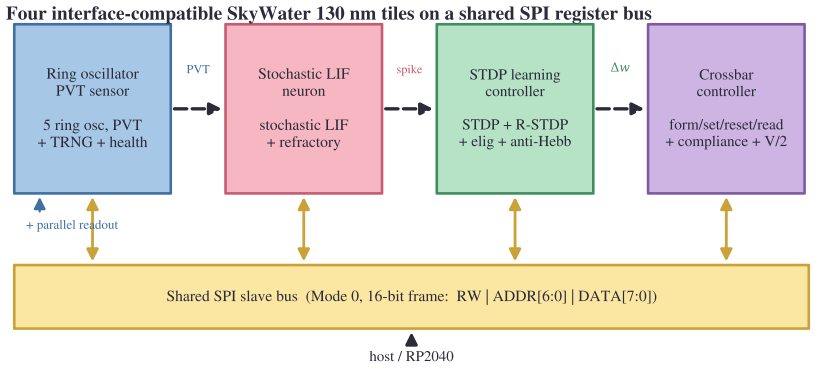
Four digital IP blocks for neuromorphic edge hardware share one SPI register interface and one verification flow.
A machine-rendered reading of the paper's core claim, the machinery that carries it, and where it could break.
Core claim
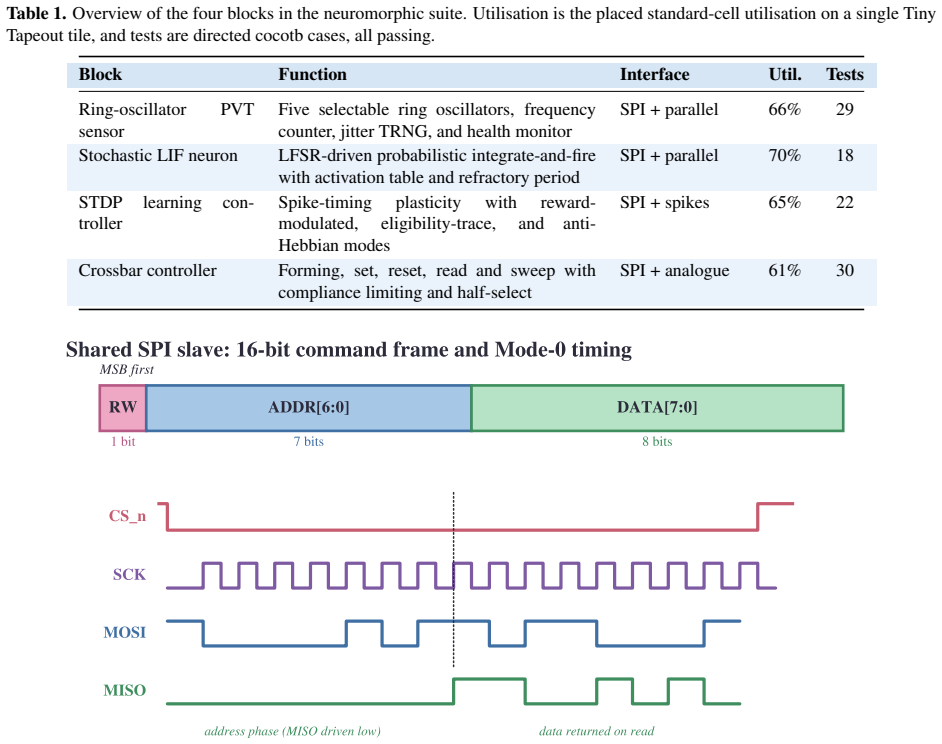
The paper establishes that a coherent, openly released set of four interface-compatible digital IP blocks can be built on the SkyWater 130 nm process: a PVT sensor built from selectable ring oscillators that also supplies a jitter-based true-random-number generator, a stochastic LIF neuron with configurable LFSR and activation table, an on-chip STDP controller with programmable curve and reward-modulated modes, and a memristive-crossbar controller supporting forming, set, reset, read and automated sweeps. The blocks share a common SPI register file, each fits in one tile, passes 99 cocotb tests, meets timing at 50 MHz, and draws 0.64 to 0.70 mW in post-synthesis estimates, with all results o
What carries the argument
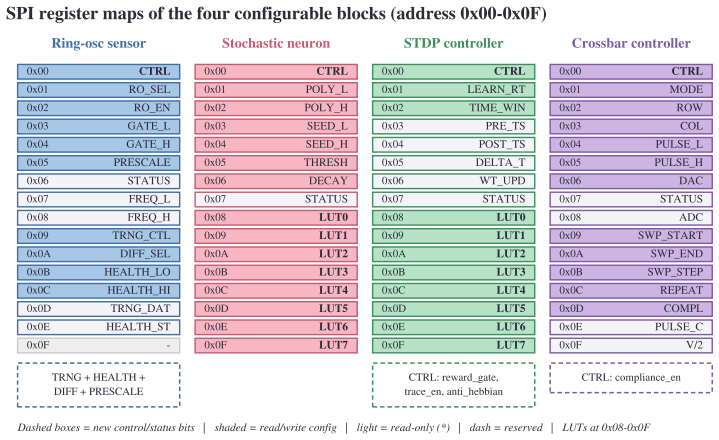
The common SPI register file that unifies the four blocks and enables a single verification flow across sensing, stochastic inference, local learning and crossbar programming.
If this is right
- Designers can drop any combination of the four blocks into a larger neuromorphic ASIC without redesigning the control interface.
- The shared register file allows a single software driver to configure sensing, neuron behavior, plasticity rules and crossbar operations.
- The open standard-cell flow and 99 passing cocotb tests provide a reusable verification template for similar mixed neuromorphic-digital designs.
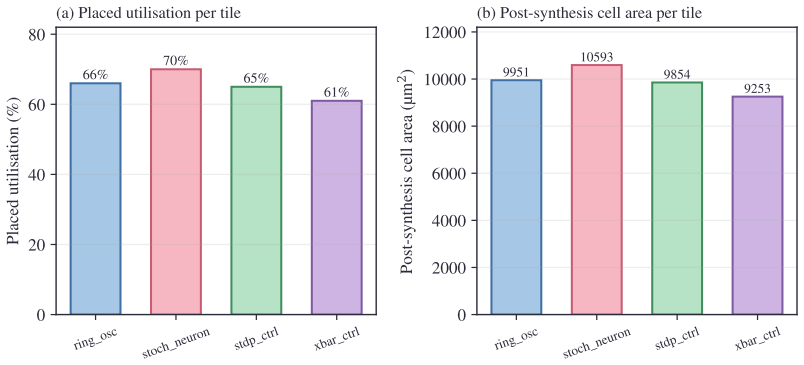
- Each block maps to roughly 9-11 thousand square micrometres and 61-70 percent tile utilisation, giving predictable area budgets for larger arrays.
Where Pith is reading between the lines
- The unified interface could shorten the time needed to prototype hybrid digital-analogue neuromorphic systems that combine these functions with emerging memory.
- Releasing the blocks openly may encourage community reuse and incremental improvement of the STDP modes or crossbar controller without starting from scratch.
- Because the PVT sensor also supplies random numbers, future chips could use the same silicon area for both calibration and stochastic computation without extra hardware.
Load-bearing premise
The post-synthesis simulation and timing analysis will match the behavior of the designs once they are fabricated in silicon.
What would settle it
Fabricate the submitted Tiny Tapeout chip and confirm that each of the four blocks operates at 50 MHz with positive setup and hold margin while consuming power within the reported 0.64-0.70 mW range under the default activity assumption.
Figures
read the original abstract
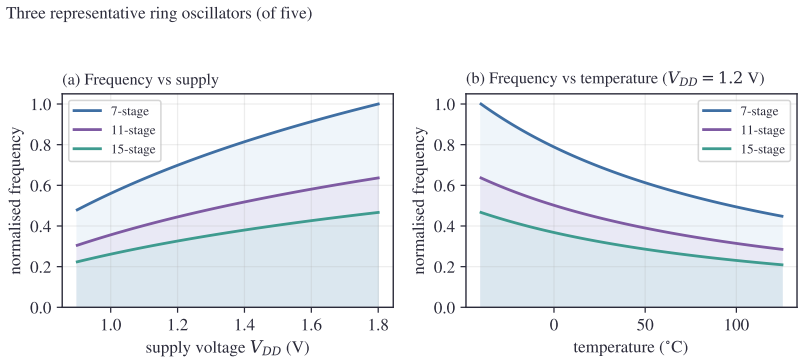
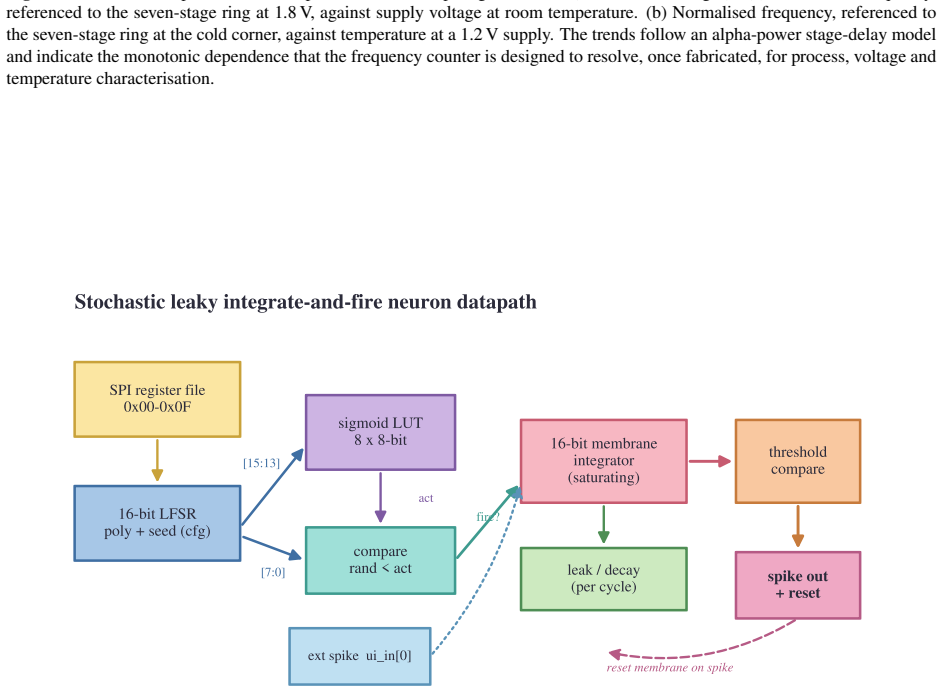
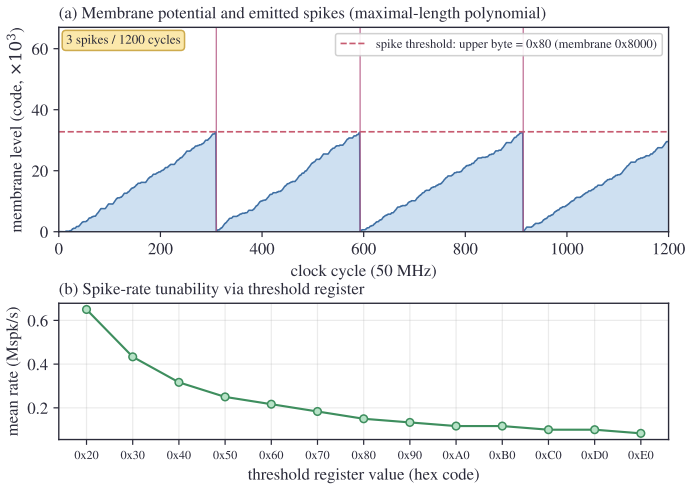
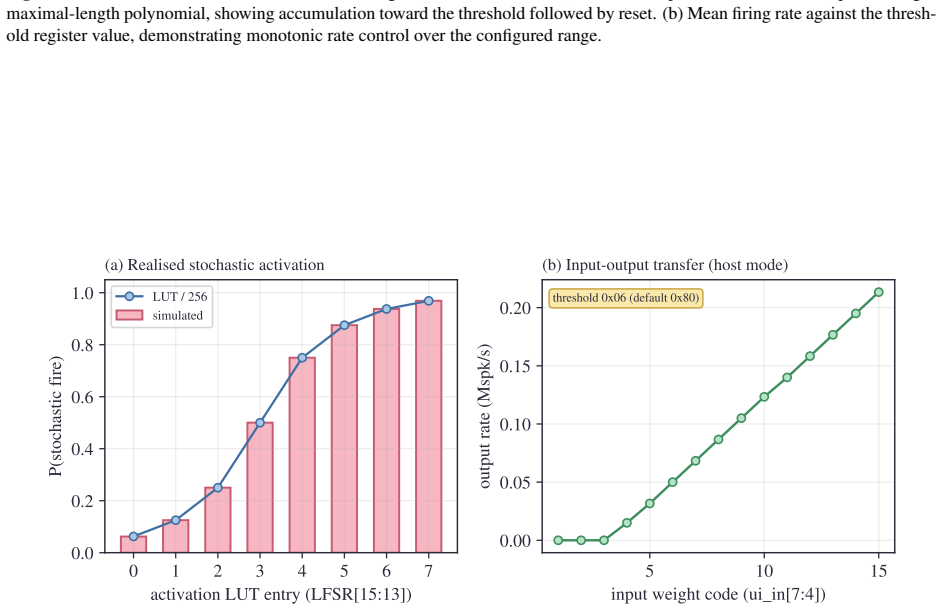
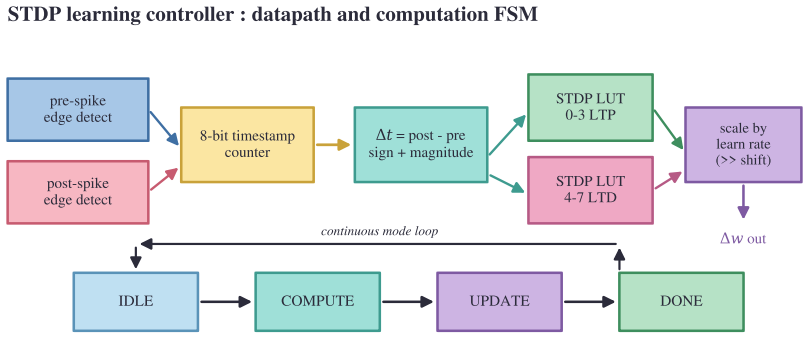
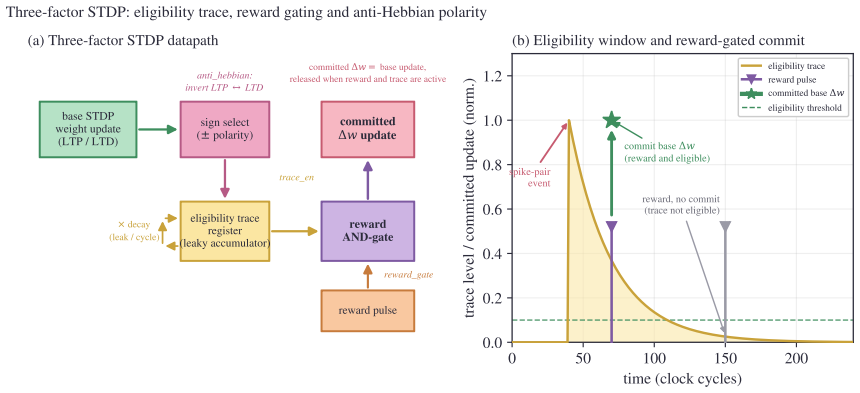
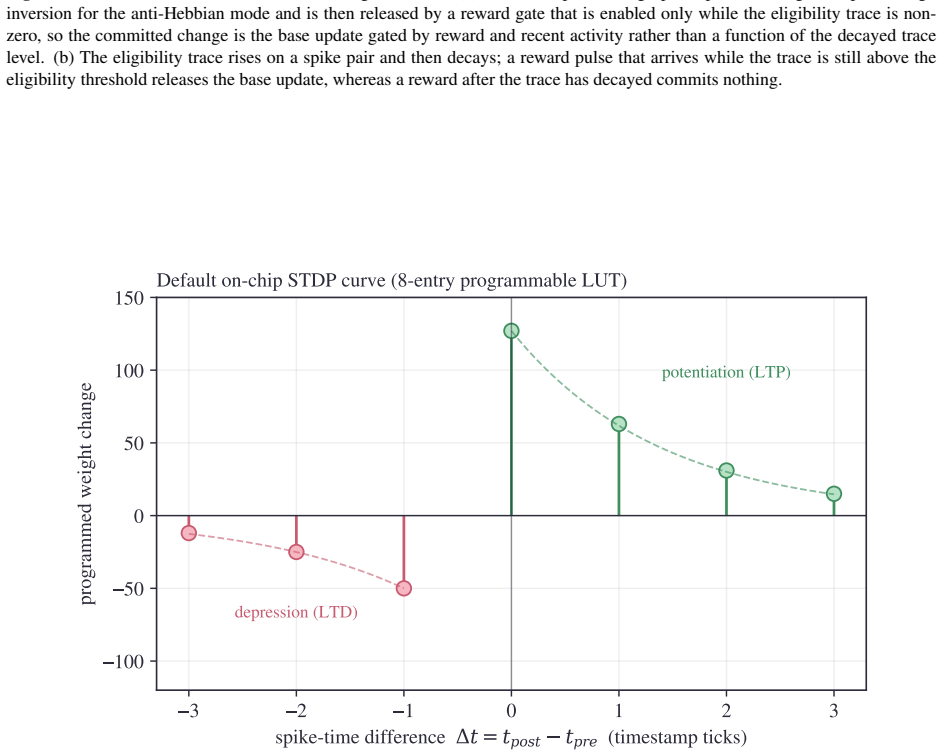
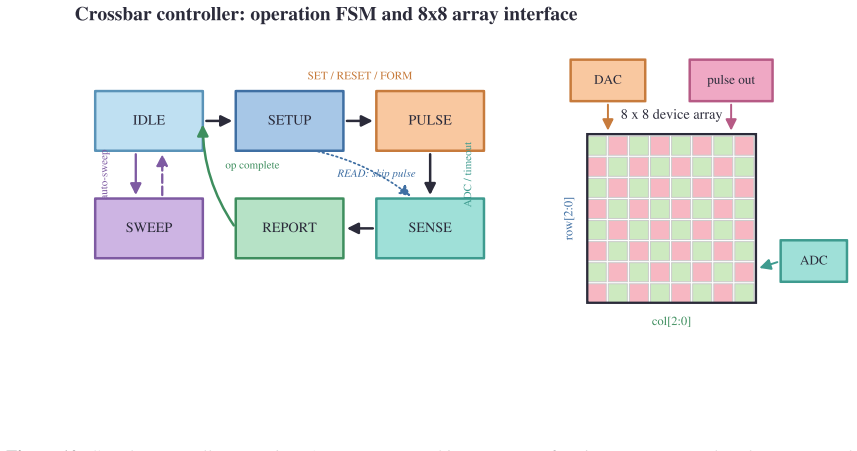
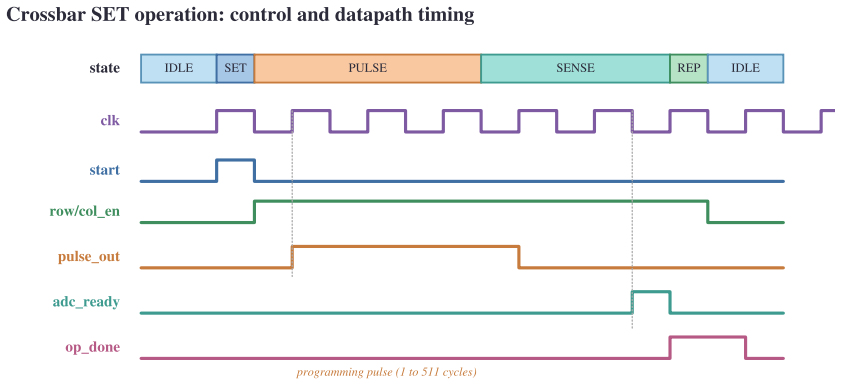
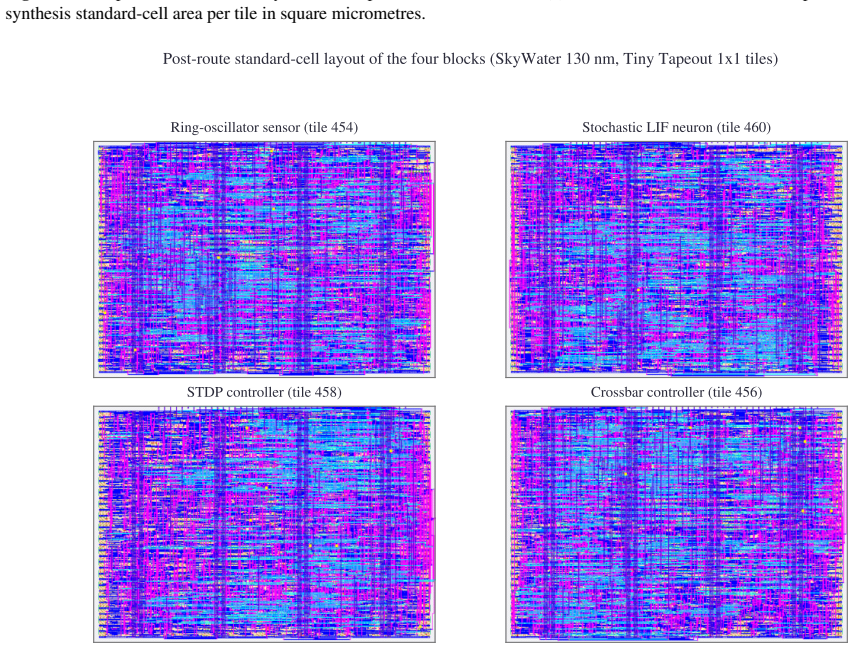
Edge neuromorphic systems need compact, configurable hardware that combines probabilistic inference, local learning, and an interface to emerging analogue memory. We present four interface-compatible digital IP blocks implemented as standard-cell CMOS on the SkyWater 130 nm process: a process, voltage and temperature (PVT) sensor built from five selectable ring oscillators that also provides a jitter-based true-random-number generator and a frequency-bounds health monitor; a stochastic leaky integrate-and-fire (LIF) neuron with a configurable LFSR, a programmable activation table, and a refractory period; an on-chip spike-timing-dependent plasticity (STDP) controller with a programmable curve and reward-modulated, eligibility-trace, and anti-Hebbian modes; and a memristive-crossbar controller supporting forming, set, reset, read, and automated current-voltage sweep with current-compliance limiting and half-select biasing. All four blocks share a common serial peripheral interface (SPI) register file; the sensor also exposes a parallel readout. Each occupies a single tile at a 50 MHz target. The suite was verified with 99 cocotb tests at register-transfer and gate level (all passing) and taken through an open standard-cell flow, then submitted for tapeout via the Tiny Tapeout shared-silicon programme. Mapped to the open cell library, each block occupies a post-synthesis cell area of 9.3 to 10.6 thousand square micrometres, places at 61 to 70 per cent tile utilisation, meets the 50 MHz constraint with positive setup and hold margin after clock-tree synthesis, and draws an estimated 0.64 to 0.70 mW under a default switching-activity assumption. The contribution is a coherent, openly released set of building blocks unified by one register interface and one verification flow. All results are from simulation and the implementation flow; no fabricated silicon is reported.
Editorial analysis
A structured set of objections, weighed in public.
Referee Report
Summary. The manuscript describes the design of four interface-compatible digital IP blocks in SkyWater 130 nm CMOS for neuromorphic edge systems: a PVT sensor incorporating a jitter-based TRNG and health monitor, a stochastic LIF neuron with configurable LFSR and activation table, an STDP controller supporting programmable curves and multiple modes, and a memristive crossbar programmer with forming/set/reset/read and sweep capabilities. All blocks share a common SPI register file (with parallel readout on the sensor), were verified via 99 passing cocotb tests at RTL and gate level, meet a 50 MHz target with positive timing margins after CTS, occupy 9.3–10.6 kµm² post-synthesis at 61–70% utilization, and were submitted for tapeout via Tiny Tapeout. Power is estimated at 0.64–0.70 mW under default switching activity. The stated contribution is a coherent, openly released set of blocks unified by one register interface and verification flow; all results are from simulation and the implementation flow with no fabricated silicon reported.
Significance. If the post-synthesis behavior holds, the work supplies openly released, interface-unified digital building blocks that integrate sensing, stochastic inference, on-chip learning, and crossbar control—elements useful for constructing compact neuromorphic systems. The comprehensive cocotb verification suite, open standard-cell flow, and tapeout submission provide concrete reproducibility assets that strengthen the engineering contribution.
minor comments (2)
- [Abstract] Abstract and §4 (results): the power figures rely on a default switching-activity assumption; adding a short sentence on the range under varied activity factors would clarify the estimate's robustness without altering the central claims.
- The manuscript would benefit from a consolidated table (perhaps in §4) listing area, utilization, timing slack, and estimated power for all four blocks side-by-side to facilitate direct comparison.
Simulated Author's Rebuttal
We thank the referee for the constructive summary and the recommendation of minor revision. The report accurately captures the scope of the work as four interface-compatible digital IP blocks verified entirely through simulation and the open implementation flow, with submission to Tiny Tapeout but no post-fabrication silicon measurements yet available. We address the report below.
Circularity Check
No significant circularity identified
full rationale
The paper is an engineering design description of four digital IP blocks (PVT sensor/TRNG, stochastic LIF, STDP controller, crossbar programmer) sharing an SPI register file. All claims rest on explicit RTL/gate-level simulation, 99 passing cocotb tests, post-synthesis area/timing numbers from the SkyWater 130 nm open flow, and the statement that no fabricated silicon results are reported. There are no equations, fitted parameters, predictions, or derivation steps that reduce to inputs by construction, and no load-bearing self-citations. The central contribution (existence and compatibility of the blocks under the stated verification flow) is therefore self-contained and externally falsifiable via the open release.
Axiom & Free-Parameter Ledger
Reference graph
Works this paper leans on
-
[1]
Loihi: A neuromorphic manycore processor with on-chip learning.IEEE Micro, 38:82-99, 2018
Mike Davies, Narayan Srinivasa, Tsung-Han Lin, Gautham Chinya, Yongqiang Cao, Sri Harsha Choday, Andreas Wild, and Hong Wang. Loihi: A neuromorphic manycore processor with on-chip learning.IEEE Micro, 38:82-99, 2018. doi: 10.1109/mm.2018.112130359
-
[2]
Phu Nguyen Phan Hai, Khang Pham Lo Hoang, Cam Doan Ngoc, Bao Bui Quoc, and Trang Hoang. A neuromorphic approach to ddos detection: Hardware accelerator for integer-quantized spiking neural networks.IEEE Access, 14:81824-81839, 2026. doi: 10.1109/access.2 026.3694606
-
[3]
Artificial spiking neuron architectures: Devices and circuits for neuromorphic computing
Mudasir Ahmad Khanday and Farooq Ahmad Khanday. Artificial spiking neuron architectures: Devices and circuits for neuromorphic computing. InEnergy-Efficient Devices and Circuits for Neuromorphic Computing, pages 29-48. 2026. doi: 10.1016/b978-0-443-29981-0 .00003-3
-
[4]
Hardware-aware fine-tuning of spiking q-networks on the spinnaker2 neuromorphic platform
Sirine Arfa, Bernhard V ogginger, and Christian Mayr. Hardware-aware fine-tuning of spiking q-networks on the spinnaker2 neuromorphic platform. In2025 International Conference on Neuromorphic Systems (ICONS), pages 74-81, 2025. doi: 10.1109/icons69015.2025.00021
-
[5]
Unsupervised classification of spike patterns with the loihi neuromorphic processor
Ryoga Matsuo, Ahmed Elgaradiny, and Federico Corradi. Unsupervised classification of spike patterns with the loihi neuromorphic processor. Electronics, 13:3203, 2024. doi: 10.3390/electronics13163203
-
[6]
Soukaina El Maachi, Abdellah Chehri, and Rachid Saadane. Efficient hardware acceleration of spiking neural networks using fpga: Towards real-time edge neuromorphic computing. In2024 IEEE 99th Vehicular Technology Conference (VTC2024-Spring), pages 1-5, 2024. doi: 10.1109/vtc2024-spring62846.2024.10683049
work page doi:10.1109/vtc2024-spring62846.2024.10683049 2024
-
[7]
K. Venkateswara Reddy and N. Balaji. Efficient hardware implementation of spiking neural networks using nonstandard finite difference scheme for leaky integrate and fire neuron model.Journal of Circuits, Systems and Computers, 34, 2024. doi: 10.1142/s0218126625500380
-
[8]
Shivani Sharma and Darshika G. Perera. High-level synthesis-based fpga hardware accelerator for generalized hebbian learning algorithm for neuromorphic computing.Electronics, 15:1725, 2026. doi: 10.3390/electronics15081725
-
[9]
Design of an efficient parallel random number generator using a single lfsr for stochastic computing
Donghui Lee, Hyoju Seo, and Yongtae Kim. Design of an efficient parallel random number generator using a single lfsr for stochastic computing. In2024 International Conference on Artificial Intelligence in Information and Communication (ICAIIC), pages 775-777, 2024. doi: 10.1109/icaiic60209.2024.10463230
-
[10]
Shrivastava
Murchana Saikia and Bhawna P. Shrivastava. Adaptive reconfigurable lfsr: Dynamic tapping and reseeding for enhanced pseudo random number generation. In2024 IEEE International Students Conference on Electrical, Electronics and Computer Science (SCEECS), pages 1-6,
-
[11]
doi: 10.1109/sceecs61402.2024.10482241
work page internal anchor Pith review Pith/arXiv arXiv doi:10.1109/sceecs61402.2024.10482241 2024
-
[12]
High-entropy lfsr-based random number generator (rng) for hardware security
Sonia Akter, Shelby Williams, Prosen Kirtonia, Kasem Khalil, and Magdy Bayoumi. High-entropy lfsr-based random number generator (rng) for hardware security. In2025 IEEE 38th International System-on-Chip Conference (SOCC), pages 1-6, 2025. doi: 10.1109/socc6612 6.2025.11235484
-
[13]
Hesham Mostafa, Federico Corradi, Fabio Stefanini, and Giacomo Indiveri. A hybrid analog/digital spike-timing dependent plasticity learn- ing circuit for neuromorphic vlsi multi-neuron architectures. In2014 IEEE International Symposium on Circuits and Systems (ISCAS), pages 854-857, 2014. doi: 10.1109/iscas.2014.6865270
-
[14]
Salah Daddinounou and Elena-Ioana Vatajelu. Bi-sigmoid spike-timing dependent plasticity learning rule for magnetic tunnel junction-based snn.Frontiers in Neuroscience, 18, 2024. doi: 10.3389/fnins.2024.1387339
-
[15]
J. O. Castro, B. Buyatti, D. Mercado, A. Di Donato, M. Quintero, and M. Tortarolo. Spike-timing-dependent-plasticity learning in a planar magnetic domain wall artificial synapse.Journal of Physics D: Applied Physics, 58:125002, 2025. doi: 10.1088/1361-6463/adab01
-
[16]
Sangwook Youn, Hwiho Hwang, and Hyungjin Kim. Ferroelectric tunnel junction memristor crossbar array with annealing optimization for in-memory computing.Advanced Intelligent Systems, 8, 2025. doi: 10.1002/aisy.202500817
-
[17]
Muhammad Naqi, Taehwan Kim, Yongin Cho, Pavan Pujar, Jongsun Park, and Sunkook Kim. Large scale integrated igzo crossbar memristor array based artificial neural architecture for scalable in-memory computing.Materials Today Nano, 25:100441, 2024. doi: 10.1016/j.mtna no.2023.100441
-
[18]
Specification of generic memristor-based crossbar architectures for in-memory computing
Benjamin Seiler and Dietmar Fey. Specification of generic memristor-based crossbar architectures for in-memory computing. In2025 14th International Conference on Modern Circuits and Systems Technologies (MOCAST), pages 1-4, 2025. doi: 10.1109/mocast65744.2025.110 83925
-
[19]
Accurate mapping of rnns on neuromorphic hardware with adaptive spiking neurons
Gauthier Boeshertz, Giacomo Indiveri, Manu Nair, and Alpha Renner. Accurate mapping of rnns on neuromorphic hardware with adaptive spiking neurons. In2024 International Conference on Neuromorphic Systems (ICONS), pages 376-380, 2024. doi: 10.1109/icons62911.202 4.00064
-
[20]
Sushma Srivastava and S. S. Rathod. Silicon neuron-analog cmos vlsi implementation and analysis at 180nm. In2016 3rd International Conference on Devices, Circuits and Systems (ICDCS), pages 28-32, 2016. doi: 10.1109/icdcsyst.2016.7570617
-
[21]
Bifurcation phenomena observed from two-variable spiking neuron integrated circuit
Takemori Orima, Yoshihiko Horio, Satoshi Moriya, and Shigeo Sato. Bifurcation phenomena observed from two-variable spiking neuron integrated circuit. In2024 IEEE International Symposium on Circuits and Systems (ISCAS), pages 1-5, 2024. doi: 10.1109/iscas58744.202 4.10558075
-
[22]
Priyanka, Sangeeta Singh, and Meena Panchore. Emulation of neuro-mimetic dynamics via gasb/si heterojunction v-dgtfet leaky-integrate- fire silicon neuron.Micro and Nanostructures, 185:207709, 2024. doi: 10.1016/j.micrna.2023.207709
-
[23]
Harshitha Gangu, Aakash Deshpande, Ranie S. Jeyakumar, Sahil Rakesh Wani, Abhishek Ajit Kadam, Udayan Ganguly, Laxmeesha Somappa, and Veeresh Deshpande. 3d monolithic integrated indium tin oxide-silicon hybrid leaky integrate and fire neuron. In2026 IEEE International Symposium on Circuits and Systems (ISCAS), pages 2128-2132, 2026. doi: 10.1109/iscas6621...
-
[24]
Loan, Neelofer Afzal, and Hend I
Mohd Faizan, Sajad A. Loan, Neelofer Afzal, and Hend I. Alkhammash. A partial-ground-plane based silicon on insulator transistor for energy-efficient leaky integrate-and-fire neuron realizations and applications.IEEE Transactions on Nanotechnology, 24:564-573, 2025. doi: 10.1109/tnano.2025.3632531
-
[25]
Design of a low power leaky integrate-and-fire neuron circuit using a memristor emulator
Amel Neifar, Imen Barraj, and Mohamed Masmoudi. Design of a low power leaky integrate-and-fire neuron circuit using a memristor emulator. In2025 37th International Conference on Microelectronics (ICM), pages 1-5, 2025. doi: 10.1109/icm66518.2025.11322462
-
[26]
Dean Brand, Domenica Dibenedetto, and Francesco Petruccione. Canonical quantization of a memristive leaky integrate-and-fire neuron circuit.Physical Review Research, 8, 2026. doi: 10.1103/y61v-2bxf
-
[27]
Exploring neuronal leakage for spiking neural networks on event-driven hardware
Jann Krausse, Sven Nitzsche, Brian Pachideh, Carmen Weigelt, Klaus Knobloch, and Juergen Becker. Exploring neuronal leakage for spiking neural networks on event-driven hardware. In2024 International Conference on Neuromorphic Systems (ICONS), pages 140-147, 2024. doi: 10.1109/icons62911.2024.00028
-
[28]
A comparison for probabilistic spiking neuron model and spiking integrate-and-fire neuron model
Xiuqing Wang, Zeng-Guang Hou, Hui Zeng, Min Tan, and Yongji Wang. A comparison for probabilistic spiking neuron model and spiking integrate-and-fire neuron model. InProceedings of the 33rd Chinese Control Conference (CCC), pages 5059-5064, 2014. doi: 10.1109/chic c.2014.6895800. 18
-
[29]
Shuichi Ichikawa. Random number generation from image data and lfsr.IEEJ Transactions on Industry Applications, 145:192-199, 2025. doi: 10.1541/ieejias.145.192
-
[30]
Andrew S. Cassidy, Paul Merolla, John V . Arthur, Steve K. Esser, Bryan Jackson, Rodrigo Alvarez-Icaza, Pallab Datta, Jun Sawada, Theodore M. Wong, Vitaly Feldman, Arnon Amir, Daniel Ben-Dayan Rubin, Filipp Akopyan, Emmett McQuinn, William P. Risk, and Dharmendra S. Modha. Cognitive computing building block: A versatile and efficient digital neuron model ...
-
[31]
Jiho Kim, Kaeun Lim, and Youngmin Kim. Hardware-efficient stochastic computing-based neural networks with snn-isomorphic lif activa- tion.Electronics, 15:768, 2026. doi: 10.3390/electronics15040768
-
[32]
Guo-qiang Bi and Mu-ming Poo. Synaptic modifications in cultured hippocampal neurons: Dependence on spike timing, synaptic strength, and postsynaptic cell type.The Journal of Neuroscience, 18:10464-10472, 1998. doi: 10.1523/jneurosci.18-24-10464.1998
-
[33]
Md Mahmudul Kabir Peyal, Sumedha Gandharava, and Kurtis D. Cantley. Demonstrating spike-timing-dependent plasticity learning with electrochemical fets. In2025 IEEE Workshop on Microelectronics and Electron Devices (WMED), pages 1-4, 2025. doi: 10.1109/wmed65 750.2025.11026983
-
[34]
E. M. Izhikevich. Solving the distal reward problem through linkage of stdp and dopamine signaling.Cerebral Cortex, 17:2443-2452, 2007. doi: 10.1093/cercor/bhl152
-
[35]
Razvan V . Florian. Reinforcement learning through modulation of spike-timing-dependent synaptic plasticity.Neural Computation, 19: 1468-1502, 2007. doi: 10.1162/neco.2007.19.6.1468
-
[36]
Robert Legenstein, Dejan Pecevski, and Wolfgang Maass. A learning theory for reward-modulated spike-timing-dependent plasticity with application to biofeedback.PLoS Computational Biology, 4:e1000180, 2008. doi: 10.1371/journal.pcbi.1000180
-
[37]
Nicolas Fremaux and Wulfram Gerstner. Neuromodulated spike-timing-dependent plasticity, and theory of three-factor learning rules.Fron- tiers in Neural Circuits, 9:85, 2016. doi: 10.3389/fncir.2015.00085
-
[38]
Quintana, Fernando Perez-Pena, and Pedro L
Fernando M. Quintana, Fernando Perez-Pena, and Pedro L. Galindo. Bio-plausible digital implementation of a reward modulated stdp synapse.Neural Computing and Applications, 34:15649-15660, 2022. doi: 10.1007/s00521-022-07220-6
-
[39]
Reservoir computing with a random memristor crossbar array.Nanotechnology, 35:415205, 2024
Xinxin Wang and Huanglong Li. Reservoir computing with a random memristor crossbar array.Nanotechnology, 35:415205, 2024. doi: 10.1088/1361-6528/ad61ee
-
[40]
Sangyeob Kim, Sangjin Kim, Soyeon Um, Kwantae Kim, and Hoi-Jun Yoo. Neuro-cim: A 310.4 tops/w neuromorphic computing-in- memory processor with low wl/bl activity and digital-analog mixed-mode neuron firing. In2022 IEEE Symposium on VLSI Technology and Circuits, pages 38-39, 2022. doi: 10.1109/vlsitechnologyandcir46769.2022.9830276
work page doi:10.1109/vlsitechnologyandcir46769.2022.9830276 2022
-
[41]
W. Hokenmaier, R. Jurasek, E. McNeil, and Darin Daudelin. A hebbian learning based spiking neuromorphic hardware accelerator with reram. In2025 IEEE 34th Microelectronics Design and Test Symposium (MDTS), pages 1-5, 2025. doi: 10.1109/mdts64924.2025.11177094
-
[42]
Abu Sayed Chowdhury and Orchi Hassan
Md. Abu Sayed Chowdhury and Orchi Hassan. In-memory boolean logic computation in binary neural network inspired memristor crossbar array. In2026 10th IEEE Electron Devices Technology and Manufacturing Conference (EDTM), pages 1-3, 2026. doi: 10.1109/edtm65772. 2026.11497945
-
[43]
Hassan, Hai Helen Li, and Yiran Chen
Amr M. Hassan, Hai Helen Li, and Yiran Chen. Hardware implementation of echo state networks using memristor double crossbar arrays. In2017 International Joint Conference on Neural Networks (IJCNN), pages 2171-2177, 2017. doi: 10.1109/ijcnn.2017.7966118
-
[44]
Chris Yakopcic, Md Zahangir Alom, and Tarek M. Taha. Memristor crossbar deep network implementation based on a convolutional neural network. In2016 International Joint Conference on Neural Networks (IJCNN), pages 963-970, 2016. doi: 10.1109/ijcnn.2016.7727302
-
[45]
Fabien Alibart, Ligang Gao, Brian D. Hoskins, and Dmitri B. Strukov. High precision tuning of state for memristive devices by adaptable variation-tolerant algorithm.Nanotechnology, 23:075201, 2012. doi: 10.1088/0957-4484/23/7/075201
-
[46]
Yuval Cassuto, Shahar Kvatinsky, and Eitan Yaakobi. Information-theoretic sneak-path mitigation in memristor crossbar arrays.IEEE Transactions on Information Theory, 62:4801-4813, 2016. doi: 10.1109/tit.2016.2594798
-
[47]
Bisweswar Santra, Gangadhar Das, Giuliana Aquilanti, and Aloke Kanjilal. Resistive switching and synaptic characteristics in zno@beta-sic composite-based rram for neuromorphic computing.Journal of Applied Physics, 137, 2025. doi: 10.1063/5.0246384
-
[48]
Usman Isyaku Bature, Haider Abbas, Ali Alzahrani, Arshid Nisar, Faisal Bashir, and Furqan Zahoor. Analysis of resistive switch- ing properties in tio2-based rram device for neuromorphic computing applications.Applied Materials Today, 47:102916, 2025. doi: 10.1016/j.apmt.2025.102916
-
[49]
Udumu Mounika Reddy, Deepak K, Ashish Varade, P. Anjaneyulu, Shobith M. Shanbogh, and R. S. Vishwanath. Chromium cyanurate- based robust resistive switching device emulating synaptic plasticity for neuromorphic application.Synthetic Metals, 319:118161, 2026. doi: 10.1016/j.synthmet.2026.118161
-
[50]
Integrated selector-based resistive random-access memory (rram) and memristors
Shaibal Mukherjee. Integrated selector-based resistive random-access memory (rram) and memristors. InResistive Switching Systems for In-Memory Computation and Artificial Intelligence. 2026. doi: 10.1088/978-0-7503-6169-9ch2
-
[51]
Hyojung Kim. Halide perovskite memristor crossbar arrays for low voltage in memory computing.Advanced Materials Interfaces, 12, 2025. doi: 10.1002/admi.202500729
-
[52]
Building openlane: A 130nm openroad-based tapeout-proven flow
Mohamed Shalan and Tim Edwards. Building openlane: A 130nm openroad-based tapeout-proven flow. InProceedings of the 39th Interna- tional Conference on Computer-Aided Design (ICCAD), pages 1-6, 2020. doi: 10.1145/3400302.3415735
-
[53]
Design and implementation of integrated circuits using open source tools and sky130 free pdk
Krzysztof Herman, Mauricio Montanares, and Jorge Marin. Design and implementation of integrated circuits using open source tools and sky130 free pdk. In2023 30th International Conference on Mixed Design of Integrated Circuits and System (MIXDES), pages 105-110,
-
[54]
doi: 10.23919/mixdes58562.2023.10203216
-
[55]
Md Shyeem Rahman, Shabbir Hoshen Suvo, Zohara Kamal, and Touhidur Rahman. Standard cell library characterization flow using open source tools with google and skywater 130nm pdk. In2024 6th International Conference on Electrical Engineering and Information and Communication Technology (ICEEICT), pages 1175-1180, 2024. doi: 10.1109/iceeict62016.2024.10534506
-
[56]
Md Shyeem Rahman, Shabbir Hoshen Suvo, and Touhidur Rahman. Timing and power characterization of standard cell with google and skywater 130nm pdk using open-source tools. In2024 12th International Conference on Internet of Everything, Microwave, Embedded, Communication and Networks (IEMECON), pages 1-5, 2024. doi: 10.1109/iemecon62401.2024.10846687
-
[57]
Om Bhatt, Darshana Sankhe, and Avinash More. Exploring sram layout using open-source tools: A case study with skywater 130nm pdk, magic, xschem, ngspice, and openram. In2025 10th International Conference on Signal Processing and Communication (ICSC), pages 820-826, 2025. doi: 10.1109/icsc64553.2025.10968602
-
[58]
Mauricio Montanares, V . H. Arzate Palma, Kevin G. McCarthy, and Gerardo Molina Salgado. Open-source 4 k cmos calibration: Integrating icemos and sky130 pdk. In2025 IFIP/IEEE 33rd International Conference on Very Large Scale Integration (VLSI-SoC), pages 1-5, 2025. doi: 10.1109/vlsi-soc64688.2025.11421773. 19
-
[59]
Uriel Jaramillo-Toral, Susana Ortega-Cisneros, Emilio Isaac Baungarten-Leon, Erick Jaramillo-Toral, and Hector Emmanuel Munoz Zapata. Analog blocks for 8-bit sar adc: Rail-to-rail comparator and two-stage operational amplifier designed with open-source tools and sky130 pdk. In2025 IEEE Asia Pacific Conference on Circuits and Systems (APCCAS), pages 1-5, 2...
-
[60]
Farhad Modaresi, Matthew Guthaus, and Jason K. Eshraghian. Openspike: An openram snn accelerator. In2023 IEEE International Symposium on Circuits and Systems (ISCAS), pages 1-5, 2023. doi: 10.1109/iscas46773.2023.10182182
-
[61]
Charlotte Frenkel, Martin Lefebvre, Jean-Didier Legat, and David Bol. A 0.086-mm2 12.7-pj/sop 64k-synapse 256-neuron online-learning digital spiking neuromorphic processor in 28nm cmos.IEEE Transactions on Biomedical Circuits and Systems, 13:145-158, 2019. doi: 10.1109/tbcas.2018.2880425
-
[62]
Charlotte Frenkel and Giacomo Indiveri. Reckon: A 28nm sub-mm2 task-agnostic spiking recurrent neural network processor enabling on-chip learning over second-long timescales. In2022 IEEE International Solid-State Circuits Conference (ISSCC), pages 1-3, 2022. doi: 10.1109/isscc42614.2022.9731734
-
[63]
Neurocorex: An open-source fpga-based spiking neural network emulator with on-chip learning, 2025
Ashish Gautam, Prasanna Date, Shruti Kulkarni, Robert Patton, and Thomas Potok. Neurocorex: An open-source fpga-based spiking neural network emulator with on-chip learning, 2025. arXiv:2506.14138
arXiv 2025
-
[64]
A 95nw ring oscillator-based temperature sensor for rfid tags in 0.13 um cmos
Sunghyun Park, Changwook Min, and SeongHwan Cho. A 95nw ring oscillator-based temperature sensor for rfid tags in 0.13 um cmos. In 2009 IEEE International Symposium on Circuits and Systems (ISCAS), pages 1153-1156, 2009. doi: 10.1109/iscas.2009.5117965
-
[65]
A ring oscillator-based temperature sensor for u-healthcare in 0.13 um cmos
Sung-Sik Woo, Jung-Hyup Lee, and SeongHwan Cho. A ring oscillator-based temperature sensor for u-healthcare in 0.13 um cmos. In2009 International SoC Design Conference (ISOCC), pages 548-551, 2009. doi: 10.1109/socdc.2009.5423820
-
[66]
A compact cmos ring oscillator with temperature and supply compensation for sensor applications
Yanmei Wang, Pak Kwong Chan, and King Ho Li. A compact cmos ring oscillator with temperature and supply compensation for sensor applications. In2014 IEEE Computer Society Annual Symposium on VLSI (ISVLSI), pages 267-272, 2014. doi: 10.1109/isvlsi.2014.15
-
[67]
Cmos design of 5-stage ring oscillator as temperature sensor
Deepak Rasaily, Rajesh Mehra, and Uday Rai. Cmos design of 5-stage ring oscillator as temperature sensor. In2016 International Conference on Electrical, Electronics, and Optimization Techniques (ICEEOT), pages 2371-2375, 2016. doi: 10.1109/iceeot.2016.7755119
-
[68]
Cmos oscillator having stable frequency with process, temperature and voltage variation
Vikas Rana. Cmos oscillator having stable frequency with process, temperature and voltage variation. In2018 31st International Conference on VLSI Design (VLSID), pages 181-185, 2018. doi: 10.1109/vlsid.2018.59
-
[69]
Berk Sunar, William J. Martin, and Douglas R. Stinson. A provably secure true random number generator with built-in tolerance to active attacks.IEEE Transactions on Computers, 56:109-119, 2007. doi: 10.1109/tc.2007.250627
-
[70]
Tae-Hyoung Kim, Randy Persaud, and Chris H. Kim. Silicon odometer: An on-chip reliability monitor for measuring frequency degradation of digital circuits.IEEE Journal of Solid-State Circuits, 43:874-880, 2008. doi: 10.1109/jssc.2008.917502. 20
discussion (0)
Sign in with ORCID, Apple, or X to comment. Anyone can read and Pith papers without signing in.