Non-normal weakly nonlinear analysis: asymptotic consistency and non-universality
Pith reviewed 2026-06-26 07:18 UTC · model grok-4.3
The pith
A weakly nonlinear theory for non-normal flows under forcing yields asymptotically consistent but non-universal amplitude equations that track subcritical transitions.
A machine-rendered reading of the paper's core claim, the machinery that carries it, and where it could break.
Core claim
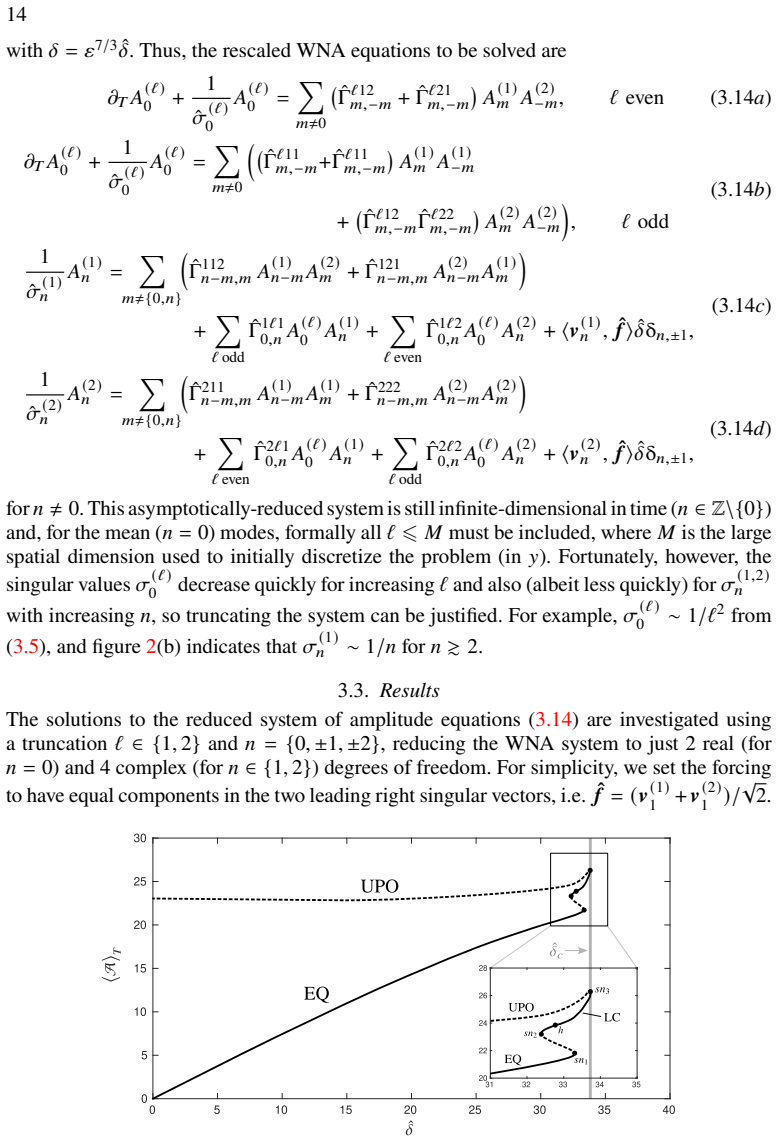
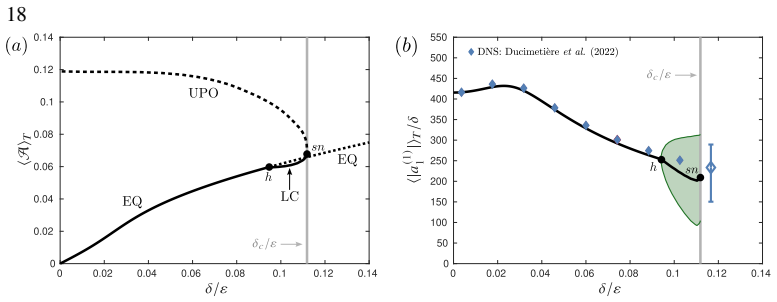
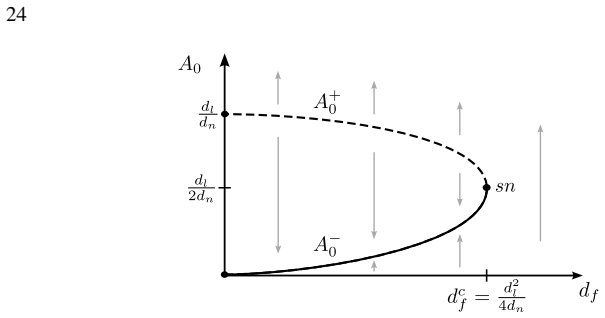
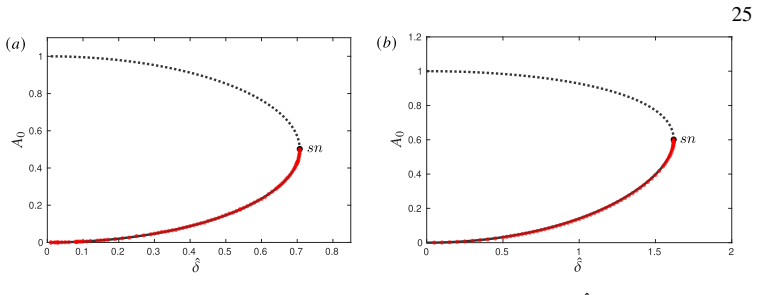
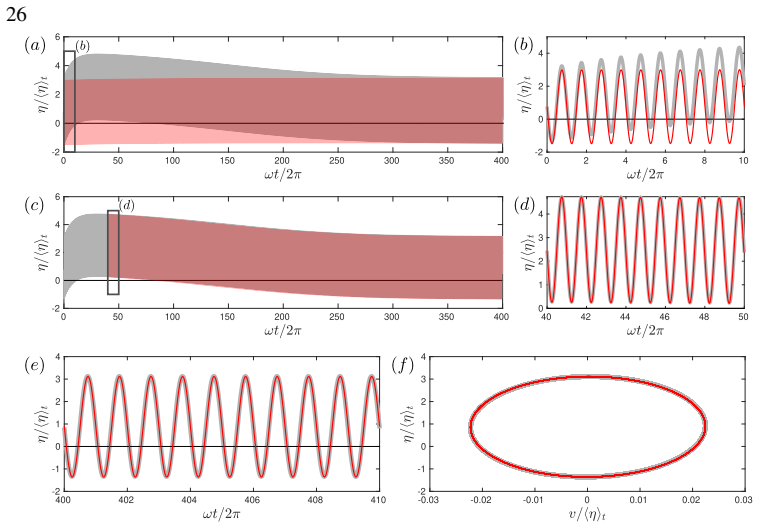
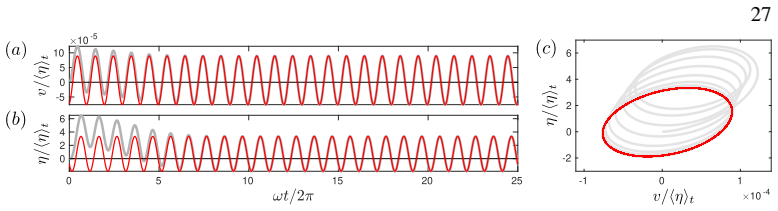
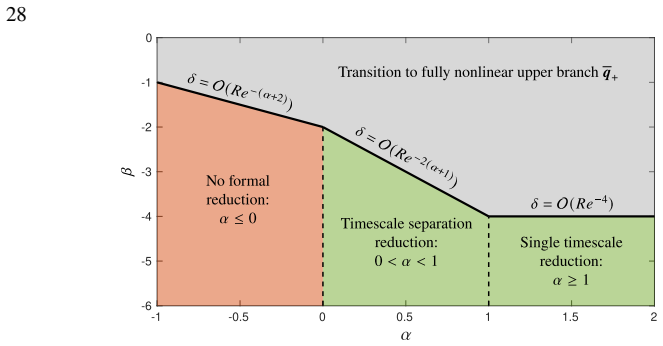
Following the definition of ε as the reciprocal of maximum linear amplification, the analysis ensures asymptotic consistency by adapting to the underlying structure, resulting in amplitude equations that, unlike classical ones near bifurcations, are non-universal and can involve multi-modal, multi-frequency responses at leading order. These equations capture stable nonlinear states emerging from laminar flow, their bifurcations, and collision with the basin boundary as forcing increases, thus describing subcritical transitions driven by forcing and initial conditions.
What carries the argument
The adaptive expansion framework that uses ε (reciprocal of maximum linear amplification) as the small parameter and reorganizes the perturbation hierarchy to match the non-normal structure of the linear operator.
If this is right
- The reduced equations describe stable nonlinear states that emerge from the laminar flow as forcing amplitude grows.
- Subsequent bifurcations of these states are captured by the amplitude equations.
- The equations predict the collision of these states with the boundary of their basin of attraction.
- Critical parameters can be identified beyond which no stable weakly nonlinear state exists.
- Subcritical transitions driven by forcing and varied initial conditions can be analyzed within the reduced system.
Where Pith is reading between the lines
- The same adaptive construction could be applied to other non-normal flows whose maximum transient growth is known to increase without bound.
- Because the amplitude equations are regime-specific, transition thresholds extracted from them will generally differ between systems even when the linear non-normality appears similar.
- The framework supplies a concrete route to test whether observed transition in a given experiment occurs through the weakly nonlinear states it identifies.
Load-bearing premise
A limit in which the maximum linear amplification becomes arbitrarily large can be identified while the underlying linear and nonlinear operators retain their structure.
What would settle it
Direct numerical simulations of the harmonically forced channel flow at successively larger forcing amplitudes that either reproduce or contradict the nonlinear states, bifurcation sequence, and critical forcing values predicted by the derived amplitude equations.
Figures
read the original abstract
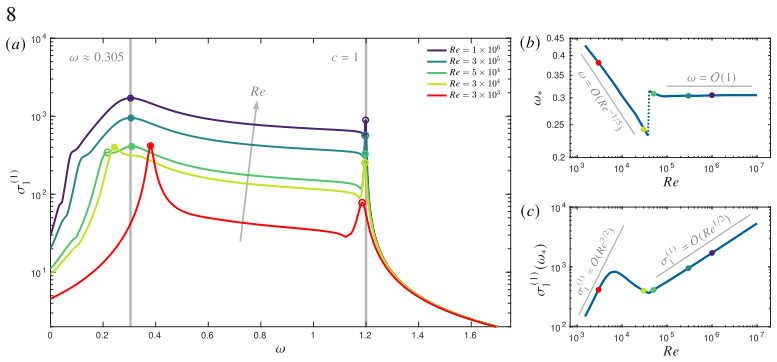
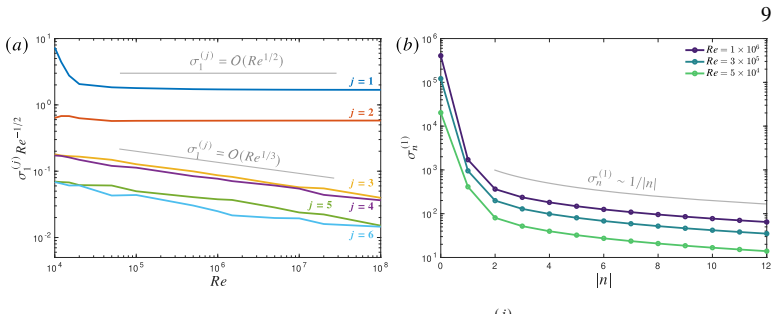
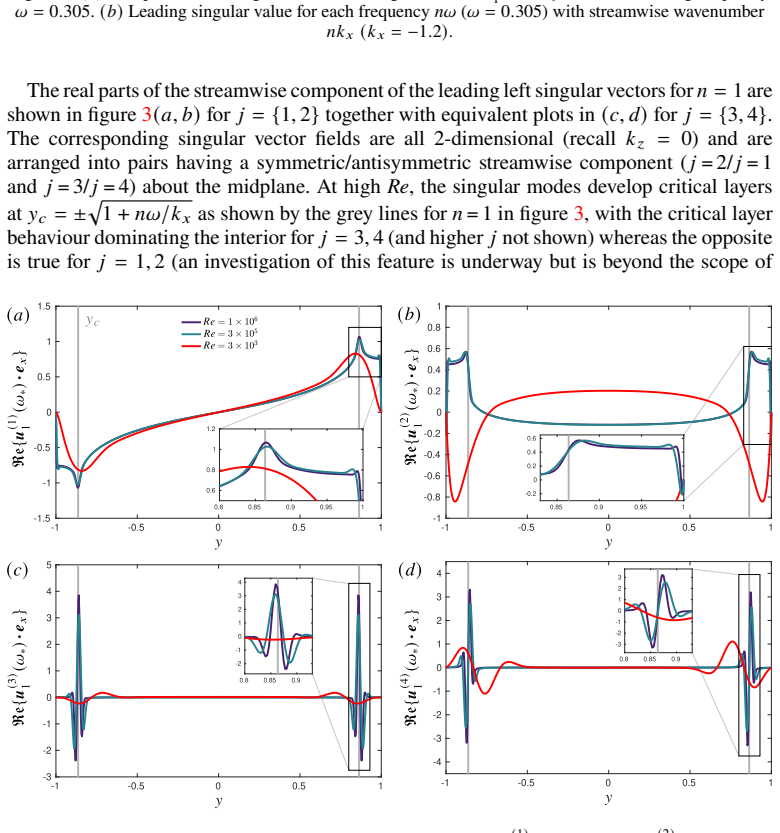
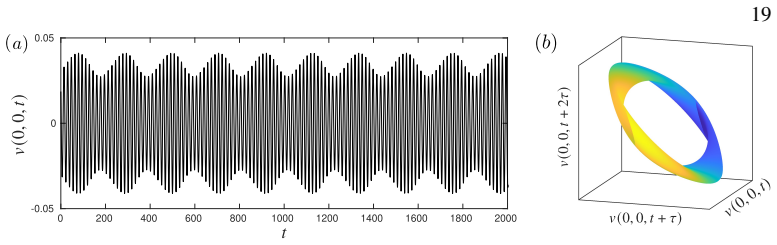
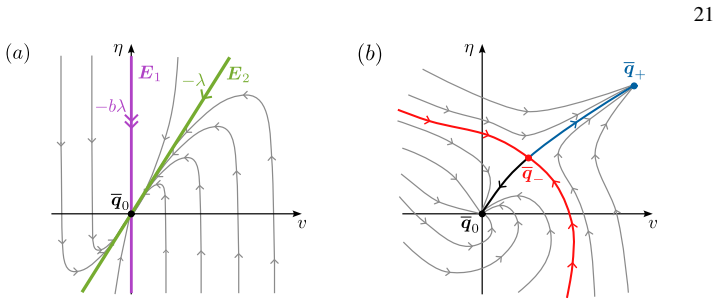
Non-normality can induce large transient growth in linearly stable systems. Determining whether this growth triggers a transition in the underlying nonlinear system, however, requires understanding the interaction between non-normality and nonlinearity. Here, we develop a weakly nonlinear theory for linearly-stable, non-normal systems subject to harmonic forcing, enabling a systematic analysis of this interaction. Following Ducimeti\`ere et al. (J. Fluid Mech., vol. 947, 2022, A43), we define a formal small parameter $\varepsilon$ as the reciprocal of the system's maximum linear amplification. However, we ensure asymptotic consistency by providing a framework that naturally adapts to the underlying structure of the system. The approach is applied to a harmonically forced channel flow and to a two-dimensional model mimicking the structure of the Orr-Sommerfeld-Squire equations. Unlike classical weakly nonlinear analysis near bifurcation points, the resulting amplitude equations are non-universal. In fact, a single linear mode amplified by the non-normality can nonlinearly excite a multi-modal and multi-frequency response at leading-order, which is system- or even regime-specific. Nevertheless, the method yields asymptotically consistent amplitude equations that capture this complexity provided a limit in which $\varepsilon\rightarrow0$ can be identified. As the forcing amplitude increases, the reduced equations capture stable nonlinear states emerging from the laminar flow, their subsequent bifurcations, and their eventual collision with the boundary of their basin of attraction. Thus, the amplitude equations can capture subcritical transitions driven by forcing and varied initial conditions and enable the identification of critical parameters beyond which no stable weakly nonlinear state exists.
Editorial analysis
A structured set of objections, weighed in public.
Referee Report
Summary. The manuscript develops a weakly nonlinear analysis for linearly stable non-normal systems under harmonic forcing. Defining ε as the reciprocal of maximum linear amplification, it introduces an adaptive framework to derive asymptotically consistent (but non-universal) amplitude equations. These equations allow a single amplified linear mode to excite multi-modal, multi-frequency responses at leading order. Applications to harmonically forced channel flow and a 2D Orr-Sommerfeld-Squire-like model show the reduced equations capturing stable nonlinear states emerging from laminar flow, their bifurcations, and collision with basin boundaries, thereby addressing subcritical transitions driven by forcing and initial conditions.
Significance. If the central claims hold, the work supplies a systematic tool for analyzing non-normality-nonlinearity interactions in forced flows where classical bifurcation-based weakly nonlinear analysis does not apply. The explicit qualification that results are non-universal and require case-by-case identification of the ε→0 limit, together with the adaptive construction, constitutes a substantive advance over prior approaches such as Ducimeti`ere et al. (2022).
major comments (1)
- [Abstract] Abstract and introduction: the central claim that the framework 'yields asymptotically consistent amplitude equations' is explicitly conditioned on identifying a limit ε→0 for each system. No general procedure, error bound, or robustness test for this identification is supplied, yet the applications to channel flow and the 2D model rest on it; this identification step is therefore load-bearing and requires explicit demonstration.
minor comments (1)
- Notation for the adaptive scaling and the precise definition of the maximum linear amplification should be introduced with an equation number in the main text rather than left implicit from the abstract.
Simulated Author's Rebuttal
We thank the referee for their detailed and constructive report. We address the single major comment below, agreeing that the ε→0 identification step merits clearer exposition.
read point-by-point responses
-
Referee: [Abstract] Abstract and introduction: the central claim that the framework 'yields asymptotically consistent amplitude equations' is explicitly conditioned on identifying a limit ε→0 for each system. No general procedure, error bound, or robustness test for this identification is supplied, yet the applications to channel flow and the 2D model rest on it; this identification step is therefore load-bearing and requires explicit demonstration.
Authors: We agree that the identification of the appropriate ε→0 limit is load-bearing and system-specific, consistent with the non-universal character of the amplitude equations. In the submitted manuscript this identification is performed explicitly for each application via linear resolvent analysis combined with asymptotic term balancing (detailed in §§3.2 and 4.2). To address the referee’s concern we will revise the abstract and introduction to state the identification procedure more explicitly, add a short subsection summarizing the steps and numerical checks used to confirm the limit, and include residual estimates that serve as practical error indicators. Because the framework is deliberately adaptive rather than universal, a single general algorithm is not supplied; however, the case-by-case verification will now be documented more transparently. revision: yes
Circularity Check
No significant circularity identified
full rationale
The derivation defines ε explicitly as the reciprocal of maximum linear amplification and conditions all claims on the existence of a limit ε→0 that can be identified for the given system; the adaptive framework is presented as the mechanism that enforces consistency without reducing to a tautology or fitted input. The amplitude equations are explicitly described as non-universal and regime-specific, with no steps that rename a prediction as a fit, import uniqueness via self-citation, or smuggle an ansatz through prior work by the same authors. The citation to Ducimeti`ere et al. is external and does not carry the central consistency argument. The chain remains self-contained once the stated limit identification is granted.
Axiom & Free-Parameter Ledger
axioms (1)
- domain assumption A formal small parameter ε defined as the reciprocal of the system's maximum linear amplification exists and permits an asymptotic expansion that adapts to system structure.
Reference graph
Works this paper leans on
-
[1]
Science , volume=
Hydrodynamic stability without eigenvalues , author=. Science , volume=. 1993 , publisher=
1993
-
[2]
Baggett, J. S. and Driscoll, T. A. and Trefethen, L. N. , title =. Phys. Fluids , volume =. 1995 , month =
1995
-
[3]
Physics of Fluids , volume=
Low-dimensional models of subcritical transition to turbulence , author=. Physics of Fluids , volume=. 1997 , publisher=
1997
-
[4]
Input-output inspired method for permissible perturbation amplitude of transitional wall-bounded shear flows , author=. Phys. Rev. E , volume=. 2020 , publisher=
2020
-
[5]
Paul Becherer and Alexander N. Morozov and Wim. Probing a subcritical instability with an amplitude expansion: An exploration of how far one can get , journal =. 2009 , issn =. doi:https://doi.org/10.1016/j.physd.2009.03.009 , url =
-
[6]
Finite amplitude cellular convection , volume=. J. Fluid Mech. , author=. 1958 , pages=. doi:10.1017/S0022112058000410 , number=
-
[7]
On the problem of turbulence , author=. Dokl. Akad. Nauk USSR , volume=
-
[8]
On the non-linear mechanics of hydrodynamic stability , author=. J. Fluid Mech. , volume=. 1958 , publisher=
1958
-
[9]
Stuart, J. T. , journal=. On the non-linear mechanics of wave disturbances in stable and unstable parallel flows. 1960 , publisher=
1960
-
[10]
On the non-linear mechanics of wave disturbances in stable and unstable parallel flows
Watson, J , journal=. On the non-linear mechanics of wave disturbances in stable and unstable parallel flows. 1960 , publisher=
1960
-
[11]
R. R. Kerswell , title =. Nonlinearity , year =
-
[12]
and Schneider, T.M
Eckhardt, B. and Schneider, T.M. and Hof, B. and Westerweel, J. , title =. Ann. Rev. Fluid Mech. , year =
-
[13]
and Uhlmann, M
Kawahara, G. and Uhlmann, M. and van Veen, L. , title =. Annu. Rev. Fluid Mech. , year =
-
[14]
Physica A , volume=
Transition to turbulence in shear flows , author=. Physica A , volume=. 2018 , publisher=
2018
-
[15]
Transition to Turbulence in Pipe Flow
Avila, Marc and Barkley, Dwight and Hof, Björn. Transition to Turbulence in Pipe Flow. Annu. Rev. Fluid Mech. 2023. doi:https://doi.org/10.1146/annurev-fluid-120720-025957
-
[16]
Journal of Fluid Mechanics , volume=
Theoretical perspective on the route to turbulence in a pipe , author=. Journal of Fluid Mechanics , volume=. 2016 , publisher=
2016
-
[17]
1916 , publisher=
Rayleigh, Lord , journal=. 1916 , publisher=
1916
-
[18]
Hydrodynamic and hydromagnetic stability , author=. Int. Ser. Monogr. on Phys. , year=
-
[19]
Stability of a viscous liquid contained between two rotating cylinders , author=
VIII. Stability of a viscous liquid contained between two rotating cylinders , author=. Philosophical Transactions of the Royal Society of London. Series A, Containing Papers of a Mathematical or Physical Character , volume=. 1923 , publisher=
1923
-
[20]
2012 , publisher=
The Couette-Taylor Problem , author=. 2012 , publisher=
2012
-
[21]
2020 , publisher=
Spectra and pseudospectra: the behavior of nonnormal matrices and operators , author=. 2020 , publisher=
2020
-
[22]
Global instabilities in spatially developing flows: N on-Normality and Nonlinearity
Chomaz, Jean-Marc. Global instabilities in spatially developing flows: N on-Normality and Nonlinearity. Annual Review of Fluid Mechanics. 2005. doi:https://doi.org/10.1146/annurev.fluid.37.061903.175810
-
[23]
Nonmodal stability theory , author=. Annu. Rev. Fluid Mech. , volume=. 2007 , publisher=
2007
-
[24]
Journal of Fluid Mechanics , volume=
A critical-layer framework for turbulent pipe flow , author=. Journal of Fluid Mechanics , volume=. 2010 , publisher=
2010
-
[25]
SIAM review , volume=
Pseudospectra of linear operators , author=. SIAM review , volume=. 1997 , publisher=
1997
-
[26]
Reviews of modern physics , volume=
Pattern formation outside of equilibrium , author=. Reviews of modern physics , volume=. 1993 , publisher=
1993
-
[27]
Nonlinear standing waves in Couette-Taylor flow , author =. Phys. Rev. A , volume =. 1989 , month =. doi:10.1103/PhysRevA.39.3734 , url =
-
[28]
Journal of Fluid Mechanics , author=
Non-stationary finite amplitude convection , volume=. Journal of Fluid Mechanics , author=. 1967 , pages=. doi:10.1017/S0022112067002034 , number=
-
[29]
Reports on Progress in Physics , volume=
Non-linear properties of thermal convection , author=. Reports on Progress in Physics , volume=. 1978 , publisher=
1978
-
[30]
Hof , title =
B. Hof , title =. Nat. Rev. Phys. , volume =
-
[31]
Itano and S
T. Itano and S. Toh , title =. J. Phys. Soc. Jpn. , year =
-
[32]
and Yorke, J.A
Skufca, J.D. and Yorke, J.A. and Eckhardt, B. , title =. Phys. Rev. Lett. , year =
-
[33]
T. M. Schneider and B. Eckhardt and J. A. Yorke , title =. Phys. Rev. Lett. , year =
-
[34]
Weak nonlinearity for strong non-normality , author=. J. Fluid Mech. , volume=. 2022 , publisher=
2022
-
[35]
Ducimeti\`ere, Y. and Boujo, E. and Gallaire, F. , year=. Weakly nonlinear evolution of stochastically driven non-normal systems , volume=. doi:10.1017/jfm.2022.902 , journal=
-
[36]
Ducimetière, Y. and Gallaire, F. , year=. A weakly nonlinear amplitude equation approach to the bypass transition in the two-dimensional Lamb–Oseen vortex , volume=. doi:10.1017/jfm.2023.856 , journal=
-
[37]
Nonmodal amplitude equations , author =. Phys. Rev. E , volume =. 2025 , month =. doi:10.1103/pvn5-twfj , url =
-
[38]
Atmospheric Turbulence and Radio Waves Propagation, Proc
The interaction of turbulence with strong wind shear , author=. Atmospheric Turbulence and Radio Waves Propagation, Proc. Intern. Collq. Moscow, 1965 , pages=. 1965 , publisher=
1965
-
[39]
The Physics of Fluids , volume=
Stability of linear flow , author=. The Physics of Fluids , volume=. 1975 , publisher=
1975
-
[40]
Journal of Fluid Mechanics , volume=
A note on an algebraic instability of inviscid parallel shear flows , author=. Journal of Fluid Mechanics , volume=. 1980 , publisher=
1980
-
[41]
The lift-up effect: The linear mechanism behind transition and turbulence in shear flows , journal =. 2014 , note =. doi:https://doi.org/10.1016/j.euromechflu.2014.03.005 , url =
-
[42]
Orr , journal =
William M'F. Orr , journal =. The Stability or Instability of the Steady Motions of a Perfect Liquid and of a Viscous Liquid. Part II: A Viscous Liquid , urldate =
-
[43]
Farrell, B. F. , title =. Phys. Fluids , volume =. 1988 , month =. doi:10.1063/1.866609 , url =
-
[44]
Orr mechanism in transition of parallel shear flow , author =. Phys. Rev. Fluids , volume =. 2021 , month =
2021
-
[45]
and Nikolaidis, Marios-Andreas and Karp, Michael , year=
Lozano-Durán, Adrián and Constantinou, Navid C. and Nikolaidis, Marios-Andreas and Karp, Michael , year=. Cause-and-effect of linear mechanisms sustaining wall turbulence , volume=. doi:10.1017/jfm.2020.902 , journal=
-
[46]
Markeviciute, Vilda K. and Kerswell, Rich R. , year=. Threshold transient growth as a criterion for turbulent mean profiles , volume=. doi:10.1017/jfm.2024.671 , journal=
-
[47]
arXiv preprint arXiv:2503.05611 , year=
Transient Growth in Streaky Unbounded Shear Flow: A symbiosis of Orr and Push-over mechanisms , author=. arXiv preprint arXiv:2503.05611 , year=
-
[48]
Chaos transition despite linear stability , author =. Phys. Rev. E , volume =. 1994 , month =. doi:10.1103/PhysRevE.50.3705 , url =
-
[49]
Nonlinear normality versus non-normal linearity , author=
Transition in shear flows. Nonlinear normality versus non-normal linearity , author=. Physics of Fluids , volume=. 1995 , publisher=
1995
-
[50]
Krasnov, D. and Zikanov, O. and Rossi, M. and Boeck, T. , year=. Optimal linear growth in magnetohydrodynamic duct flow , volume=. doi:10.1017/S0022112010000273 , journal=
-
[51]
Nonmodal Growth of the Magnetorotational Instability , author =. Phys. Rev. Lett. , volume =. 2014 , month =. doi:10.1103/PhysRevLett.113.025006 , url =
-
[52]
The non-modal onset of the tearing instability , volume=. J. Plasma Phys. , author=. 2018 , pages=. doi:10.1017/S0022377818001009 , number=
-
[53]
arXiv preprint arXiv:2510.03141 , year=
Nonmodal growth and optimal perturbations in magnetohydrodynamic shear flows , author=. arXiv preprint arXiv:2510.03141 , year=
-
[54]
Nonmodal growth and optimal perturbations in magnetohydrodynamic shear flows , author=. Phys. Rev. E , volume=. 2026 , publisher=
2026
-
[55]
Kaminski, A. K. and Caulfield, C. P. and Taylor, J. R. , year=. Transient growth in strongly stratified shear layers , volume=. doi:10.1017/jfm.2014.552 , journal=
-
[56]
Kaminski, A. K. and Caulfield, C. P. and Taylor, J. R. , year=. Nonlinear evolution of linear optimal perturbations of strongly stratified shear layers , volume=. doi:10.1017/jfm.2017.396 , journal=
-
[57]
Garnaud, X. and Lesshafft, L. and Schmid, P. J. and Huerre, P. , title =. Physics of Fluids , volume =. 2013 , month =. doi:10.1063/1.4801751 , url =
-
[58]
The preferred mode of incompressible jets: lin ear frequency response analysis
Garnaud, X. and Lesshafft, L. and Schmid, P. J. and Huerre, P. , year=. The preferred mode of incompressible jets: linear frequency response analysis , volume=. doi:10.1017/jfm.2012.540 , journal=
-
[59]
Pickering, Ethan and Rigas, Georgios and Nogueira, Petrônio A. S. and Cavalieri, André V. G. and Schmidt, Oliver T. and Colonius, Tim , year=. Lift-up, Kelvin–Helmholtz and Orr mechanisms in turbulent jets , volume=. doi:10.1017/jfm.2020.301 , journal=
-
[60]
Stability and optimal forcing analysis of a wind turbine wake: Comparison with POD , journal =
Giovanni. Stability and optimal forcing analysis of a wind turbine wake: Comparison with POD , journal =. 2022 , issn =. doi:https://doi.org/10.1016/j.renene.2021.09.025 , url =
-
[61]
and Wan, Minping , title =
Feng, Dachuan and Gupta, Vikrant and Li, Larry K.B. and Wan, Minping , title =. Physics of Fluids , volume =. 2024 , month =
2024
-
[62]
Self-consistent model for active control of wind turbine wakes , volume=
Li, Zhaobin and Yang, Xiaolei , year=. Self-consistent model for active control of wind turbine wakes , volume=. doi:10.1017/jfm.2025.10263 , journal=
-
[63]
Camporeale, E. and Burgess, D. and Passot, T. , title =. Phys. Plasmas , volume =. 2009 , month =. doi:10.1063/1.3094759 , url =
-
[64]
Linear Technique to Understand Non-Normal Turbulence Applied to a Magnetized Plasma , author =. Phys. Rev. Lett. , volume =. 2014 , month =. doi:10.1103/PhysRevLett.113.025003 , url =
-
[65]
Generalized universal instability: transient linear amplification and subcritical turbulence , volume=. J. Plasma Phys. , author=. 2015 , pages=. doi:10.1017/S0022377815000495 , number=
-
[66]
Friedman, B. and Carter, T. A. , title =. Phys. Plasmas , volume =. 2015 , month =. doi:10.1063/1.4905863 , url =
-
[67]
Non-normality, reactivity, and intrinsic stochasticity in neural dynamics: a non-equilibrium potential approach , author=. J. Stat. Mech.: Theory Exp. , volume=. 2018 , publisher=
2018
-
[68]
Non-normal amplification of stochastic quasicycles , author=. Phys. Rev. E , volume=. 2018 , publisher=
2018
-
[69]
Predicting transient amplification in perturbed ecological systems , author=. J. Appl. Ecol. , pages=. 2007 , publisher=
2007
-
[70]
Non-normal interactions create socio-economic bubbles , author=. Commun. Phys. , volume=. 2023 , publisher=
2023
-
[71]
Structure and dynamical behavior of non-normal networks , author=. Sci. Adv. , volume=. 2018 , publisher=
2018
-
[72]
Patterns of non-normality in networked systems , author=. J. Theor. Biol. , volume=. 2019 , publisher=
2019
-
[73]
Nicoletti, S. and Fanelli, D. and Zagli, N. and Asllani, M. and Battistelli, G. and Carletti, T. and Chisci, L. and Innocenti, G. and Livi, R. , title =. Chaos , volume =. 2019 , month =. doi:10.1063/1.5099538 , url =
-
[74]
Proceedings of the Royal Society A: Mathematical, Physical and Engineering Sciences , volume=
Bifurcations with imperfect SO (2) symmetry and pinning of rotating waves , author=. Proceedings of the Royal Society A: Mathematical, Physical and Engineering Sciences , volume=. 2013 , publisher=
2013
-
[75]
Dedalus: A flexible framework for numerical simulations with spectral methods. Phys. Rev. Res. , year = 2020, volume =
2020
-
[76]
arXiv preprint arXiv:2506.14792 , year=
Fast automated adjoints for spectral PDE solvers , author=. arXiv preprint arXiv:2506.14792 , year=
-
[77]
Skene, C. S. and Burns, K. J. , journal=. Fast automated adjoints for spectral. 2026 , publisher=
2026
-
[78]
1983 , publisher=
Nonlinear Oscillations, Dynamical Systems and Bifurcations of Vector Fields , author=. 1983 , publisher=
1983
-
[79]
1980 , publisher=
Elementary Stability and Bifurcation Theory , author=. 1980 , publisher=
1980
-
[80]
Introduction to Bifurcation Theory , author=. Rev. Mod. Phys. , volume=
discussion (0)
Sign in with ORCID, Apple, or X to comment. Anyone can read and Pith papers without signing in.