REVIEW 1 major objections 2 minor 61 references
Multi-objective Bayesian optimisation of a double-layer target for quasi-monoenergetic TNSA protons
T0 review · 1 major / 2 minor · reviewed 2026-06-26 · grok-4.3
Pith's one-line read Bayesian optimization locates double-layer target parameters for 64-71 MeV quasi-monoenergetic TNSA protons.
desk verdict 2D Bayesian optimization on 80 EPOCH runs locates 64-71 MeV Pareto points for the double-layer target, but the single 3D verification drops the peak to 34 MeV with earlier sheath decay, so the reported optima may not translate. read the letter →
The pith
A machine-rendered reading of the paper's core claim, the machinery that carries it, and where it could break.
The reading
What carries the argument
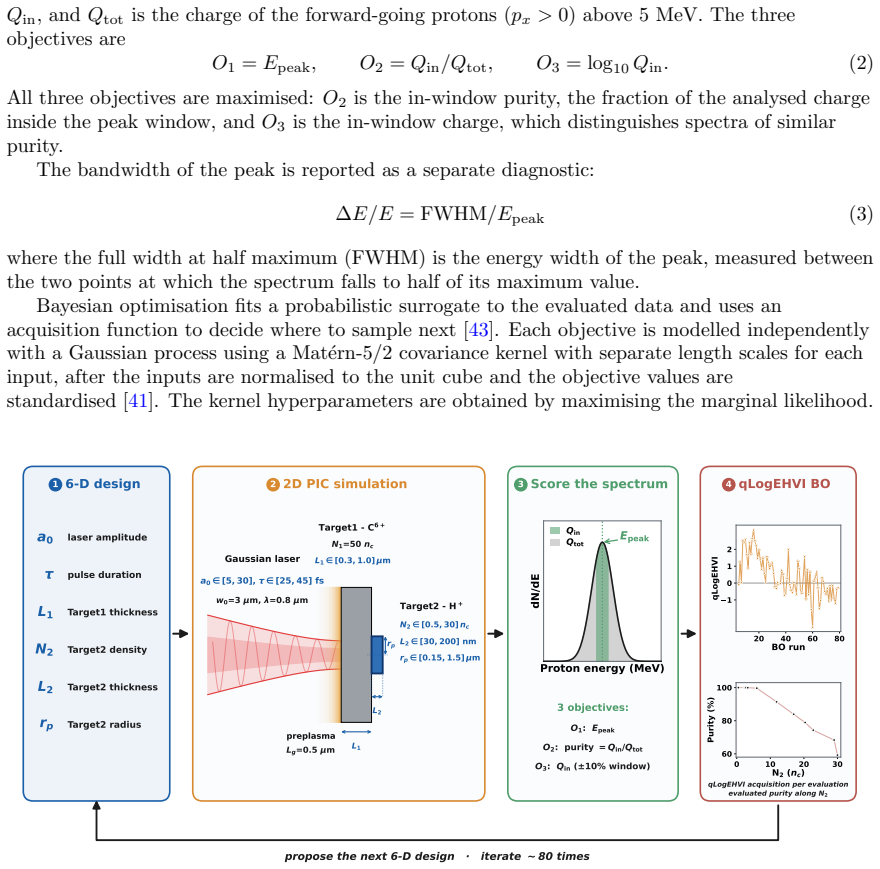
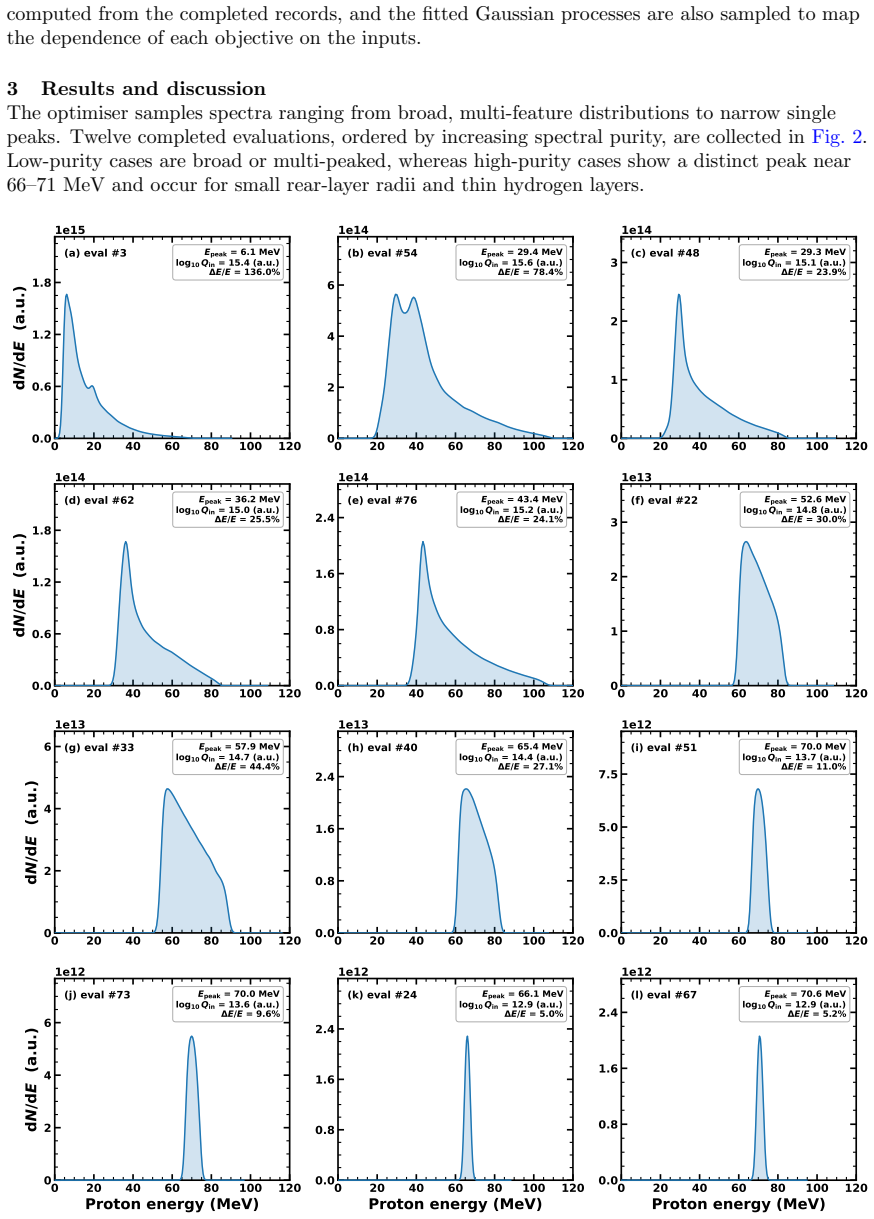
Multi-objective Bayesian optimisation that scores each spectrum on three quantities: peak energy, charge fraction inside a ±10 percent window, and charge inside that window.
What would settle it
Fabricating a target with the reported optimal parameters and measuring its proton spectrum in a real laser experiment would show whether the 64-71 MeV quasi-monoenergetic peak appears at the energies predicted by the two-dimensional runs.
Extended reading notes
Core claim
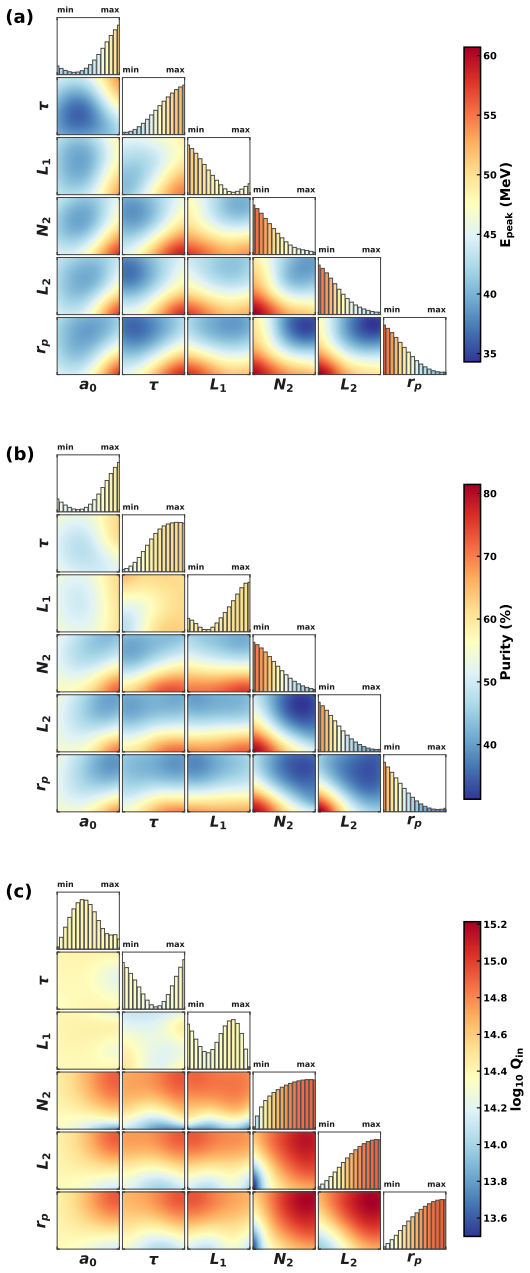
Multi-objective Bayesian optimisation of laser amplitude, pulse duration, carbon-layer thickness, hydrogen-layer density, thickness and radius identifies Pareto-optimal double-layer targets that deliver proton peak energies of 64-71 MeV in two-dimensional simulations; a three-dimensional run of an intermediate-density member of this set yields a lower peak of 34.1 MeV but preserves the quasi-monoenergetic feature with relative bandwidth narrowed to 7 percent.
Load-bearing premise
Two-dimensional simulations with the chosen scoring functions are sufficient to identify the physically relevant optima even though three-dimensional verification produces substantially lower peak energy.
Editorial extensions
If this is right
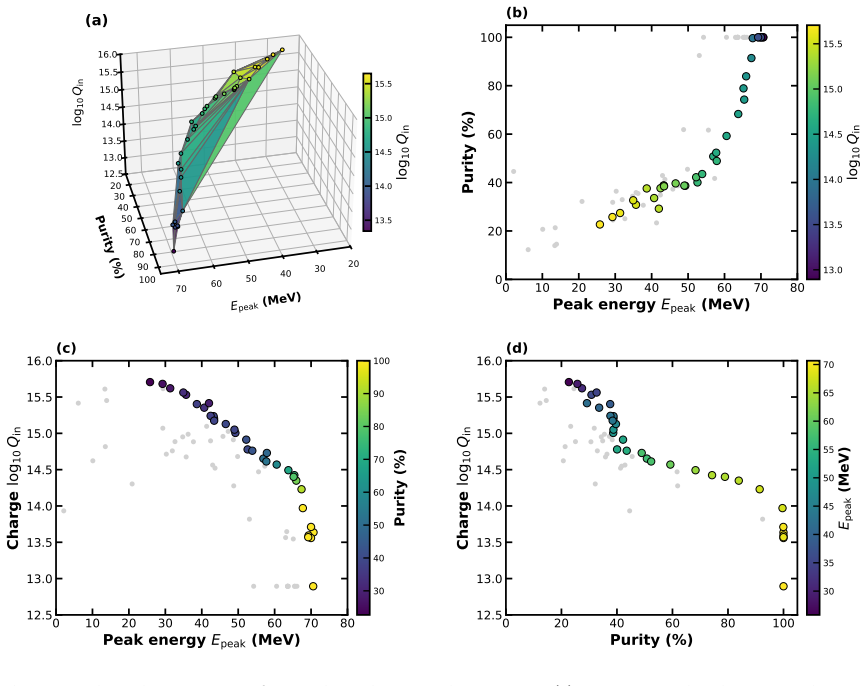
- Increasing hydrogen-layer density along the optimal branch raises in-window charge while widening bandwidth.
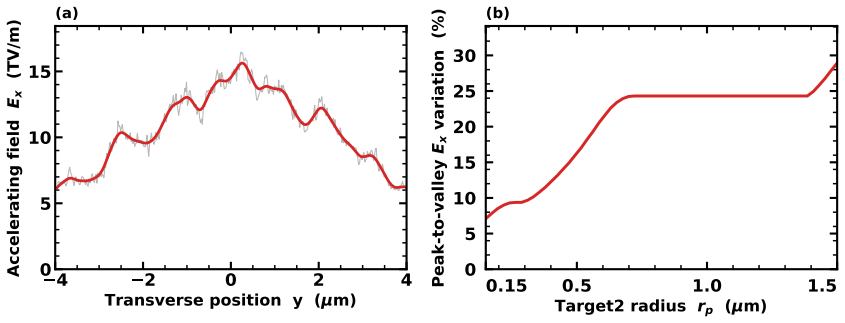
- The small rear-layer radius keeps the proton source inside the flat central region of the transverse sheath field.
- Three-dimensional effects reduce peak energy yet narrow the relative bandwidth compared with the two-dimensional result.
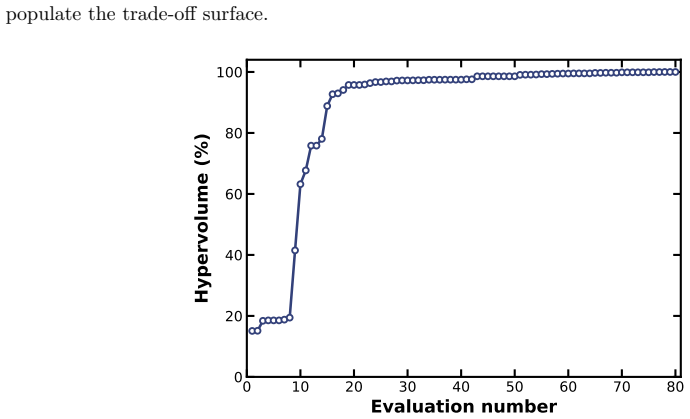
- The optimisation campaign maps explicit trade-offs among peak energy, charge fraction and total charge without exhaustive sampling.
Reading between the lines
- The same optimisation workflow could be applied to other target geometries or acceleration mechanisms to locate high-quality operating points.
- Experimental campaigns at facilities with comparable laser parameters could test whether the identified settings produce the predicted spectra.
- Incorporating additional objectives such as beam divergence or emittance into the scoring would refine the Pareto front for practical applications.
Editorial analysis
A structured set of objections, weighed in public.
Referee Report
Summary. The manuscript reports a six-parameter multi-objective Bayesian optimization of a carbon-hydrogen double-layer target for TNSA proton acceleration, based on 80 two-dimensional EPOCH PIC simulations. Each spectrum is scored on peak energy, charge fraction within a ±10% window, and absolute charge in the window. The Pareto set clusters near a0=30, τ=45 fs, L1=0.3 μm, L2=30 nm, rp=0.15 μm (with varying N2), producing 2D peak energies of 64–71 MeV. A single 3D verification at N2=11.85 nc yields E_peak=34.1 MeV and ΔE/E=7.0% while retaining a quasi-monoenergetic feature, attributed to earlier sheath decay.
Significance. If the identified parameter branch remains optimal once three-dimensional effects are fully accounted for, the work would supply concrete guidance for experimental TNSA designs aiming at higher-energy quasi-monoenergetic protons. The multi-objective Bayesian approach and the observation that a small rear-layer radius keeps protons in the uniform central sheath region constitute potentially useful methodological and physical insights for laser-plasma acceleration.
major comments (1)
- [3D verification paragraph] The 3D verification paragraph (and corresponding abstract statement): the single 3D run at N2=11.85 nc produces E_peak=34.1 MeV (roughly half the 2D value of 67.4 MeV) together with earlier rear-sheath decay and proton saturation. Because TNSA sheath evolution, transverse uniformity, and acceleration time are known to differ systematically between 2D and 3D, the Pareto-optimal branch located in 2D is not guaranteed to remain optimal in 3D; the retention of a narrower quasi-monoenergetic peak does not establish that the reported parameters maximize the three scoring functions under physically relevant conditions.
minor comments (2)
- No convergence diagnostics, grid-resolution studies, or uncertainty quantification on the optimized parameters or scoring functions are provided, which would strengthen in the 80-run campaign.
- The manuscript would benefit from an explicit statement of the limitations of 2D optimization for TNSA and a clearer discussion of how the reported 2D Pareto front should be interpreted for experimental planning.
Simulated Author's Rebuttal
We thank the referee for highlighting the limitations in interpreting the single 3D verification run. We address the comment below and will revise the manuscript accordingly to avoid any implication of 3D optimality.
read point-by-point responses
-
Referee: The 3D verification paragraph (and corresponding abstract statement): the single 3D run at N2=11.85 nc produces E_peak=34.1 MeV (roughly half the 2D value of 67.4 MeV) together with earlier rear-sheath decay and proton saturation. Because TNSA sheath evolution, transverse uniformity, and acceleration time are known to differ systematically between 2D and 3D, the Pareto-optimal branch located in 2D is not guaranteed to remain optimal in 3D; the retention of a narrower quasi-monoenergetic peak does not establish that the reported parameters maximize the three scoring functions under physically relevant conditions.
Authors: We agree with the referee that a single 3D simulation does not demonstrate optimality of the identified parameter branch under 3D conditions, nor does it establish that these parameters maximize the three objective functions in 3D. The 2D campaign was performed due to the prohibitive computational cost of a comparable 3D multi-objective optimization. The 3D run was included solely to test whether the quasi-monoenergetic spectral feature survives the transition to 3D geometry, which it does. We will revise both the abstract and the 3D verification paragraph to state explicitly that the multi-objective optimization and Pareto front were obtained in 2D, that the 3D case provides verification of feature retention (with the observed reduction in peak energy and bandwidth), and that full confirmation of optimality in 3D would require additional 3D simulations. These changes will be made in the revised manuscript. revision: yes
Circularity Check
No circularity: all reported quantities are direct EPOCH simulation outputs with no self-referential derivations or fitted inputs renamed as predictions.
full rationale
The paper performs 80 two-dimensional EPOCH particle-in-cell runs, scores each spectrum by three explicit functions (peak energy, charge fraction in ±10% window, charge in window), and reports the resulting Pareto front and one 3D verification run. Peak energies (64–71 MeV in 2D, 34.1 MeV in 3D), bandwidths, and charge values are raw simulation outputs; none are obtained by solving equations that embed the target quantities or by fitting parameters to a subset and then relabeling the fit as a prediction. No self-citations appear in the provided text as load-bearing premises, no uniqueness theorems are invoked, and no ansatz is smuggled via prior work. The derivation chain is therefore self-contained against external benchmarks (the EPOCH code itself).
Assumptions & free parameters
assumptions (1)
- domain assumption EPOCH particle-in-cell code accurately models the sheath-field evolution and proton acceleration in both 2D and 3D geometries for the chosen target parameters
Cite this review
Pith. "Pith review of Multi-objective Bayesian optimisation of a double-layer target for quasi-monoenergetic TNSA protons." pith.science (2026). https://pith.science/paper/EP3ALSIN
@misc{pith2026260623224,
  author       = {Pith},
  title        = {Pith review of: Multi-objective Bayesian optimisation of a double-layer target for quasi-monoenergetic TNSA protons},
  year         = {2026},
  howpublished = {\url{https://pith.science/paper/EP3ALSIN}},
  note         = {Machine review of arXiv:2606.23224}
}
abstract
We carry out a six-parameter multi-objective Bayesian optimisation of a carbon--hydrogen double-layer target for target-normal-sheath proton acceleration. The campaign consists of 80 two-dimensional EPOCH simulations with the laser amplitude $a_0$, pulse duration $\tau$, carbon-layer thickness $L_1$, hydrogen-layer density $N_2$, hydrogen-layer thickness $L_2$ and hydrogen-layer radius $r_p$ as input variables. Each final proton spectrum is scored by the peak energy, the charge fraction inside a $\pm10\%$ peak-energy window and the charge in that window. Among the Pareto-set evaluations, the cases with peak energies between 64 and 71 MeV occur near $a_0=30$, $\tau=45$ fs, $L_1=0.3\,\mu{\rm m}$, $L_2=30$ nm and $r_p=0.15\,\mu{\rm m}$. Along this branch, increasing $N_2$ raises the in-window charge and increases the bandwidth. The small rear-layer radius keeps the proton source within the flat central region of the transverse sheath field, where the accelerating field is nearly uniform. A 3D calculation is performed for the intermediate-density case $N_2=11.85\,n_c$, which balances bandwidth and in-window charge along this branch. The corresponding 2D spectrum has $E_{\rm peak}=67.4$ MeV and $\Delta E/E=18.8\%$, whereas the 3D spectrum has $E_{\rm peak}=34.1$ MeV and $\Delta E/E=7.0\%$. The lower 3D peak energy and narrower bandwidth are associated with an earlier decay of the rear-sheath field and an earlier saturation of the proton peak energy, and the quasi-monoenergetic peak is retained in 3D.
Figures
Figures from the paper (4 more)

Reference graph
Works this paper leans on
-
[1]
R. A. Snavely, M. H. Key, S. P. Hatchett, T. E. Cowan, M. Roth, T. W. Phillips, M. A. Stoyer, E. A. Henry, T. C. Sangster, M. S. Singh, S. C. Wilks, A. MacKinnon, A. Offenberger, D. M. Pennington, K. Yasuike, A. B. Langdon, B. F. Lasinski, J. Johnson, M. D. Perry, and E. M. Campbell. Intense high-energy proton beams from petawatt-laser irradiation of soli...
2000
-
[2]
Hatchett, Curtis G
Stephen P. Hatchett, Curtis G. Brown, Thomas E. Cowan, Eugene A. Henry, Joy S. Johnson, Michael H. Key, Jeffrey A. Koch, A. Bruce Langdon, Barbara F. Lasinski, Richard W. Lee, Andrew J. Mackinnon, Deanna M. Pennington, Michael D. Perry, Thomas W. Phillips, Markus Roth, T. Craig Sangster, Mike S. Singh, Richard A. Snavely, Mark A. Stoyer, Scott C. Wilks, a...
-
[3]
Borghesi, D
M. Borghesi, D. H. Campbell, A. Schiavi, M. G. Haines, O. Willi, A. J. MacKinnon, P. Patel, L. A. Gizzi, M. Galimberti, R. J. Clarke, F. Pegoraro, H. Ruhl, and S. Bulanov. Electric field detection in laser-plasma interaction experiments via the proton imaging technique.Physics of Plasmas, 9(5):2214–2220, 2002
2002
-
[4]
Patel, A
P. Patel, A. Mackinnon, M. Key, T. Cowan, M. Foord, M. Allen, D. Price, H. Ruhl, P. Springer, and R. Stephens. Isochoric heating of solid-density matter with an ultrafast proton beam.Physical Review Letters, 91(12):125004, 2003
2003
-
[5]
M. Roth, T. E. Cowan, M. H. Key, S. P. Hatchett, C. Brown, W. Fountain, J. Johnson, D. M. Pennington, R. A. Snavely, S. C. Wilks, K. Yasuike, H. Ruhl, F. Pegoraro, S. V. Bulanov, E. M. Campbell, M. D. Perry, and H. Powell. Fast ignition by intense laser-accelerated proton beams.Physical Review Letters, 86(3):436–439, 2001
2001
-
[6]
S. V. Bulanov and V. S. Khoroshkov. Feasibility of using laser ion accelerators in proton therapy.Plasma Physics Reports, 28(5):453–456, 2002
2002
-
[7]
What will it take for laser driven proton accelerators to be applied to tumor therapy?Physical Review Special Topics - Accelerators and Beams, 10(9):094801, 2007
Ute Linz and Jose Alonso. What will it take for laser driven proton accelerators to be applied to tumor therapy?Physical Review Special Topics - Accelerators and Beams, 10(9):094801, 2007. 10
2007
-
[8]
K. Zeil, M. Baumann, E. Beyreuther, T. Burris-Mog, T. E. Cowan, W. Enghardt, L. Karsch, S. D. Kraft, L. Laschinsky, J. Metzkes, D. Naumburger, M. Oppelt, C. Richter, R. Sauerbrey, M. Sch¨ urer, U. Schramm, and J. Pawelke. Dose-controlled irradiation of cancer cells with laser-accelerated proton pulses.Applied Physics B, 110(4):437–444, 2013
2013
Show all 61 references
-
[9]
Flash radiotherapy: A promising new method for radiotherapy (review).Oncology Letters, 24(6):419, 2022
Yinghao Lv, Yue Lv, Zhen Wang, Tian Lan, Xuping Feng, Hao Chen, Jiang Zhu, Xiao Ma, Jinpeng Du, Guimin Hou, Wenwei Liao, Kefei Yuan, and Hong Wu. Flash radiotherapy: A promising new method for radiotherapy (review).Oncology Letters, 24(6):419, 2022
2022
-
[10]
Florian Kroll, Florian-Emanuel Brack, Constantin Bernert, Stefan Bock, Elisabeth Bodenstein, Kerstin Br¨ uchner, Thomas E. Cowan, Lennart Gaus, Ren´ e Gebhardt, Uwe Helbig, Leonhard Karsch, Thomas Kluge, Stephan Kraft, Mechthild Krause, Elisabeth Lessmann, Umar Masood, Sebasti...
2022
-
[11]
International Atomic Energy Agency, Vienna, 2005
International Atomic Energy Agency.Radiation Oncology Physics: A Handbook for Teachers and Students. International Atomic Energy Agency, Vienna, 2005
2005
-
[12]
Cowan, Leonhard Karsch, Stephan Kraft, Leoni A
Florian-Emanuel Brack, Florian Kroll, Lennart Gaus, Constantin Bernert, Elke Beyreuther, Thomas E. Cowan, Leonhard Karsch, Stephan Kraft, Leoni A. Kunz-Schughart, Elisabeth Lessmann, Josefine Metzkes-Ng, Lieselotte Obst-Huebl, J¨ org Pawelke, Martin Rehwald, Hans-Peter Schlenv...
2020
-
[13]
Hegelich, S
M. Hegelich, S. Karsch, G. Pretzler, D. Habs, K. Witte, W. Guenther, M. Allen, A. Blazevic, J. Fuchs, J. C. Gauthier, M. Geissel, P. Audebert, T. Cowan, and M. Roth. Mev ion jets from short-pulse-laser interaction with thin foils.Physical Review Letters, 89(8):085002, 2002
2002
-
[14]
Schwoerer, S
H. Schwoerer, S. Pfotenhauer, O. J¨ ackel, K.-U. Amthor, B. Liesfeld, W. Ziegler, R. Sauerbrey, K. W. D. Ledingham, and T. Esirkepov. Laser-plasma acceleration of quasi-monoenergetic protons from microstructured targets.Nature, 439(7075):445–448, 2006
2006
-
[15]
Fonseca, Luis O
Dan Haberberger, Sergei Tochitsky, Frederico Fiuza, Chao Gong, Ricardo A. Fonseca, Luis O. Silva, Warren B. Mori, and Chan Joshi. Collisionless shocks in laser-produced plasma generate monoenergetic high-energy proton beams.Nature Physics, 8(1):95–99, 2012
2012
-
[16]
Pirozhkov
Hiroyuki Daido, Mamiko Nishiuchi, and Alexander S. Pirozhkov. Review of laser-driven ion sources and their applications.Reports on Progress in Physics, 75(5):056401, 2012
2012
-
[17]
Ion acceleration by superintense laser-plasma interaction.Reviews of Modern Physics, 85(2):751–793, 2013
Andrea Macchi, Marco Borghesi, and Matteo Passoni. Ion acceleration by superintense laser-plasma interaction.Reviews of Modern Physics, 85(2):751–793, 2013
2013
-
[18]
Esirkepov, M
T. Esirkepov, M. Borghesi, S. V. Bulanov, G. Mourou, and T. Tajima. Highly efficient relativistic-ion generation in the laser-piston regime.Physical Review Letters, 92(17):175003, 2004
2004
-
[19]
Fiuza, A
F. Fiuza, A. Stockem, E. Boella, R. A. Fonseca, L. O. Silva, D. Haberberger, S. Tochitsky, C. Gong, W. B. Mori, and C. Joshi. Laser-driven shock acceleration of monoenergetic ion beams.Physical Review Letters, 109(21):215001, 2012
2012
-
[20]
L. Yin, B. J. Albright, B. M. Hegelich, K. J. Bowers, K. A. Flippo, T. J. T. Kwan, and J. C. Fern´ andez. Monoenergetic and gev ion acceleration from the laser breakout afterburner using ultrathin targets.Physics of Plasmas, 14(5):056706, 2007
2007
-
[21]
Bulanov, Timur Zh
Tatsufumi Nakamura, Sergei V. Bulanov, Timur Zh. Esirkepov, and Masaki Kando. High-energy ions from near-critical density plasmas via magnetic vortex acceleration.Physical Review Letters, 105(13):135002, 2010
2010
-
[22]
S. C. Wilks, A. B. Langdon, T. E. Cowan, M. Roth, M. Singh, S. Hatchett, M. H. Key, D. Pennington, A. MacKinnon, and R. A. Snavely. Energetic proton generation in ultra-intense laser-solid interactions.Physics of Plasmas, 8(2):542–549, 2001
2001
-
[23]
P. Mora. Plasma expansion into a vacuum.Physical Review Letters, 90(18):185002, 2003. 11
2003
-
[24]
Target normal sheath acceleration: Theory, comparison with experiments and future perspectives.New Journal of Physics, 12(4):045012, 2010
Matteo Passoni, Luca Bertagna, and Alessandro Zani. Target normal sheath acceleration: Theory, comparison with experiments and future perspectives.New Journal of Physics, 12(4):045012, 2010
2010
-
[25]
Multiphoton 3d lithography.Nature Reviews Methods Primers, 5:15, 2025
Edvinas Skliutas, Greta Merkininkaite, Shoji Maruo, Wenxin Zhang, Wenyuan Chen, Weiting Deng, Julia Greer, Georg von Freymann, and Mangirdas Malinauskas. Multiphoton 3d lithography.Nature Reviews Methods Primers, 5:15, 2025
2025
-
[26]
Liang Yang, Frederik Mayer, Uwe H. F. Bunz, Eva Blasco, and Martin Wegener. Multi-material multi-photon 3d laser micro- and nanoprinting.Light: Advanced Manufacturing, 2:1, 2021
2021
-
[27]
Robinson, Pulickel M
Xiewen Wen, Boyu Zhang, Weipeng Wang, Fan Ye, Shuai Yue, Hua Guo, Guanhui Gao, Yushun Zhao, Qiyi Fang, Christine Nguyen, Xiang Zhang, Jiming Bao, Jacob T. Robinson, Pulickel M. Ajayan, and Jun Lou. 3d-printed silica with nanoscale resolution.Nature Materials, 20(11):1506–1511, 2021
2021
-
[28]
P. Mora. Thin-foil expansion into a vacuum.Physical Review E, 72(5):056401, 2005
2005
-
[29]
Fuchs, P
J. Fuchs, P. Antici, E. d’Humi` eres, E. Lefebvre, M. Borghesi, E. Brambrink, C. A. Cecchetti, M. Kaluza, V. Malka, M. Manclossi, S. Meyroneinc, P. Mora, J. Schreiber, T. Toncian, H. P´ epin, and P. Audebert. Laser-driven proton scaling laws and new paths towards energy increa...
2006
-
[30]
Robson, P
L. Robson, P. T. Simpson, R. J. Clarke, K. W. D. Ledingham, F. Lindau, O. Lundh, T. McCanny, P. Mora, D. Neely, C.-G. Wahlstr¨ om, M. Zepf, and P. McKenna. Scaling of proton acceleration driven by petawatt-laser-plasma interactions.Nature Physics, 3(1):58–62, 2007
2007
-
[31]
Wagner, O
F. Wagner, O. Deppert, C. Brabetz, P. Fiala, A. Kleinschmidt, P. Poth, V. A. Schanz, A. Tebartz, B. Zielbauer, M. Roth, T. St¨ ohlker, and V. Bagnoud. Maximum proton energy above 85 mev from the relativistic interaction of laser pulses with micrometer thick ch 2 targets.Physic...
2016
-
[32]
Higginson, R
A. Higginson, R. J. Gray, M. King, R. J. Dance, S. D. R. Williamson, N. M. H. Butler, R. Wilson, R. Capdessus, C. Armstrong, J. S. Green, S. J. Hawkes, P. Martin, W. Q. Wei, S. R. Mirfayzi, X. H. Yuan, S. Kar, M. Borghesi, R. J. Clarke, D. Neely, and P. McKenna. Near-100 mev p...
2018
-
[33]
Malte Kaluza, J¨ org Schreiber, Markus I. K. Santala, Georg D. Tsakiris, Klaus Eidmann, J¨ urgen Meyer-ter Vehn, and Klaus J. Witte. Influence of the laser prepulse on proton acceleration in thin-foil experiments.Physical Review Letters, 93(4):045003, 2004
2004
-
[34]
Laser ion acceleration using a solid target coupled with a low-density layer.Physical Review E, 85(3):036405, 2012
Andrea Sgattoni, Pasquale Londrillo, Andrea Macchi, and Matteo Passoni. Laser ion acceleration using a solid target coupled with a low-density layer.Physical Review E, 85(3):036405, 2012
2012
-
[35]
Passoni, A
M. Passoni, A. Sgattoni, I. Prencipe, L. Fedeli, D. Dellasega, L. Cialfi, Il Woo Choi, I Jong Kim, K. A. Janulewicz, Hwang Woon Lee, Jae Hee Sung, Seong Ku Lee, and Chang Hee Nam. Toward high-energy laser-driven ion beams: Nanostructured double-layer targets.Physical Review Ac...
2016
-
[36]
J. H. Bin, W. J. Ma, H. Y. Wang, M. J. V. Streeter, C. Kreuzer, D. Kiefer, M. Yeung, S. Cousens, P. S. Foster, B. Dromey, X. Q. Yan, R. Ramis, J. Meyer-ter Vehn, M. Zepf, and J. Schreiber. Ion acceleration using relativistic pulse shaping in near-critical-density plasmas. Phys...
2015
-
[37]
T. Zh. Esirkepov, S. V. Bulanov, K. Nishihara, T. Tajima, F. Pegoraro, V. S. Khoroshkov, K. Mima, H. Daido, Y. Kato, Y. Kitagawa, K. Nagai, and S. Sakabe. Proposed double-layer target for the generation of high-quality laser-accelerated ion beams.Physical Review Letters, 89(17...
2002
-
[38]
Neely, P
D. Neely, P. Foster, A. Robinson, F. Lindau, O. Lundh, A. Persson, C.-G. Wahlstr¨ om, and P. McKenna. Enhanced proton beams from ultrathin targets driven by high contrast laser pulses.Applied Physics Letters, 89(2):021502, 2006. 12
2006
-
[39]
McKenna, D
P. McKenna, D. C. Carroll, O. Lundh, F. N¨ urnberg, K. Markey, S. Bandyopadhyay, D. Batani, R. G. Evans, R. Jafer, S. Kar, D. Neely, D. Pepler, M. N. Quinn, R. Redaelli, M. Roth, C.-G. Wahlstr¨ om, X. H. Yuan, and M. Zepf. Effects of front surface plasma expansion on proton ac...
2008
-
[40]
Jones, Matthias Schonlau, and William J
Donald R. Jones, Matthias Schonlau, and William J. Welch. Efficient global optimization of expensive black-box functions.Journal of Global Optimization, 13(4):455–492, 1998
1998
-
[41]
Carl Edward Rasmussen and Christopher K. I. Williams.Gaussian Processes for Machine Learning. MIT Press, Cambridge, MA, 2006
2006
-
[42]
Jasper Snoek, Hugo Larochelle, and Ryan P. Adams. Practical bayesian optimization of machine learning algorithms. InAdvances in Neural Information Processing Systems, volume 25, pages 2951–2959, 2012
2012
-
[43]
Adams, and Nando de Freitas
Bobak Shahriari, Kevin Swersky, Ziyu Wang, Ryan P. Adams, and Nando de Freitas. Taking the human out of the loop: A review of bayesian optimization.Proceedings of the IEEE, 104(1):148–175, 2016
2016
-
[44]
Kakade, and Matthias Seeger
Niranjan Srinivas, Andreas Krause, Sham M. Kakade, and Matthias Seeger. Gaussian process optimization in the bandit setting: No regret and experimental design. InProceedings of the 27th International Conference on Machine Learning, pages 1015–1022, 2010
2010
-
[45]
R. J. Shalloo, S. J. D. Dann, J.-N. Gruse, C. I. D. Underwood, A. F. Antoine, C. Arran, M. Backhouse, C. D. Baird, M. D. Balcazar, N. Bourgeois, J. A. Cardarelli, P. Hatfield, J. Kang, K. Krushelnick, S. P. D. Mangles, C. D. Murphy, N. Lu, J. Osterhoff, K. P˜ oder, P. P. Rajee...
2020
-
[46]
S¨ oren Jalas, Manuel Kirchen, Philipp Messner, Paul Winkler, Lars H¨ ubner, Julian Dirkwinkel, Matthias Schnepp, R´ emi Lehe, and Andreas R. Maier. Bayesian optimization of a laser-plasma accelerator.Physical Review Letters, 126(10):104801, 2021
2021
-
[47]
Smith, Chris Orban, John T
Joseph R. Smith, Chris Orban, John T. Morrison, Kevin M. George, Gregory K. Ngirmang, Enam A. Chowdhury, and W. Mel Roquemore. Optimizing laser-plasma interactions for ion acceleration using particle-in-cell simulations and evolutionary algorithms.New Journal of Physics, 22(10...
2020
-
[48]
E. J. Dolier, M. King, R. Wilson, R. J. Gray, and P. McKenna. Multi-parameter bayesian optimisation of laser-driven ion acceleration in particle-in-cell simulations.New Journal of Physics, 24(7):073025, 2022
2022
-
[49]
Loughran, M
B. Loughran, M. J. V. Streeter, H. Ahmed, S. Astbury, M. Balcazar, M. Borghesi, N. Bourgeois, et al. Automated control and optimization of laser-driven ion acceleration.High Power Laser Science and Engineering, 11:e35, 2023
2023
-
[50]
Bayesian optimization of double-pulse temporal shaping for enhanced target-normal-sheath proton acceleration under fixed laser energy.arXiv preprint arXiv:2606.15687, 2026
Cheng-Qi Zhang, Yang He, Mamat Ali Bake, and Bai-Song Xie. Bayesian optimization of double-pulse temporal shaping for enhanced target-normal-sheath proton acceleration under fixed laser energy.arXiv preprint arXiv:2606.15687, 2026
2026
-
[51]
Multi-objective and multi-fidelity bayesian optimization of laser-plasma acceleration.Physical Review Research, 5(1):013063, 2023
Faran Irshad, Stefan Karsch, and Andreas D¨ opp. Multi-objective and multi-fidelity bayesian optimization of laser-plasma acceleration.Physical Review Research, 5(1):013063, 2023
2023
-
[52]
Foerster, Kilian von Grafenstein, Florian Haberstroh, Elodie Travac, Niklas Weisse, Stefan Karsch, and Andreas D¨ opp
Faran Irshad, Christoph Eberle, Florian M. Foerster, Kilian von Grafenstein, Florian Haberstroh, Elodie Travac, Niklas Weisse, Stefan Karsch, and Andreas D¨ opp. Pareto optimization and tuning of a laser wakefield accelerator.Physical Review Letters, 133(8):085001, 2024
2024
-
[53]
T. D. Arber, K. Bennett, C. S. Brady, A. Lawrence-Douglas, M. G. Ramsay, N. J. Sircombe, P. Gillies, R. G. Evans, H. Schmitz, A. R. Bell, and C. P. Ridgers. Contemporary particle-in-cell approach to laser-plasma modelling.Plasma Physics and Controlled Fusion, 57(11):113001, 2015. 13
2015
-
[54]
Danson, Constantin Haefner, Jake Bromage, et al
Colin N. Danson, Constantin Haefner, Jake Bromage, et al. Petawatt and exawatt class lasers worldwide.High Power Laser Science and Engineering, 7:e54, 2019
2019
-
[55]
Differentiable expected hypervolume improvement for parallel multi-objective bayesian optimization
Samuel Daulton, Maximilian Balandat, and Eytan Bakshy. Differentiable expected hypervolume improvement for parallel multi-objective bayesian optimization. InAdvances in Neural Information Processing Systems, volume 33, pages 9851–9864, 2020
2020
-
[56]
Parallel bayesian optimization of multiple noisy objectives with expected hypervolume improvement
Samuel Daulton, Maximilian Balandat, and Eytan Bakshy. Parallel bayesian optimization of multiple noisy objectives with expected hypervolume improvement. InAdvances in Neural Information Processing Systems, volume 34, pages 2187–2200, 2021
2021
-
[57]
Unexpected improvements to expected improvement for bayesian optimization.arXiv preprint arXiv:2310.20708, 2023
Sebastian Ament, Samuel Daulton, David Eriksson, Maximilian Balandat, and Eytan Bakshy. Unexpected improvements to expected improvement for bayesian optimization.arXiv preprint arXiv:2310.20708, 2023
2023
-
[58]
Jiang, Samuel Daulton, Benjamin Letham, Andrew Gordon Wilson, and Eytan Bakshy
Maximilian Balandat, Brian Karrer, Daniel R. Jiang, Samuel Daulton, Benjamin Letham, Andrew Gordon Wilson, and Eytan Bakshy. BoTorch: A framework for efficient monte-carlo bayesian optimization. InAdvances in Neural Information Processing Systems, volume 33, pages 21524–21538, 2020
2020
-
[59]
Spencer, K
I. Spencer, K. W. D. Ledingham, R. P. Singhal, T. McCanny, P. McKenna, et al. Laser generation of proton beams for the production of short-lived positron emitting radioisotopes. Nuclear Instruments and Methods in Physics Research Section B: Beam Interactions with Materials and...
2001
-
[60]
D. J. Stark, L. Yin, B. J. Albright, and F. Guo. Effects of dimensionality on kinetic simulations of laser-ion acceleration in the transparency regime.Physics of Plasmas, 24(5):053103, 2017
2017
-
[61]
Stefano Sinigardi, Javad Babaei, and Giorgio Turchetti. Tnsa proton maximum energy laws for 2d and 3d pic simulations.Nuclear Instruments and Methods in Physics Research Section A: Accelerators, Spectrometers, Detectors and Associated Equipment, 909:438–440, 2018. 14
2018
Reviewed June 26, 2026 · model on record in the stance chip above.
Discussion (0). Sign in to comment.