Vortex photoelectron holography in strong-field tunneling ionization
Pith reviewed 2026-06-26 06:06 UTC · model grok-4.3
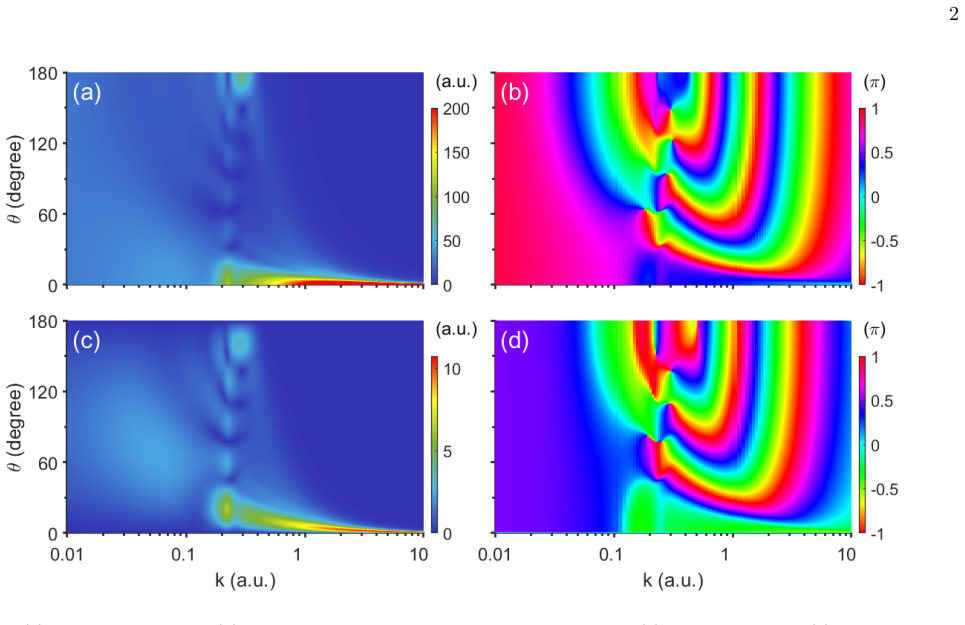
The pith
Vortex photoelectron holography extracts the vortex scattering phase from SFPH fringes in strong-field ionization simulations.
A machine-rendered reading of the paper's core claim, the machinery that carries it, and where it could break.
Core claim
By solving the time-dependent Schrödinger equation, we extract the vortex scattering phase from the SFPH fringes, showing excellent agreement with scattering calculations. Thus, our work provides direct access to the vortex scattering phase, paving the way for applying SFPH to structurally sensitive imaging with phase-engineered photoelectrons.
What carries the argument
Vortex photoelectron holography, the extension of strong-field photoelectron holography that encodes the vortex scattering phase of rescattered electrons in interference fringes.
If this is right
- The vortex scattering phase becomes directly accessible from the fringes.
- Conventional SFPH extends from plane-wave to vortex rescattering.
- SFPH can be applied to structurally sensitive imaging using phase-engineered photoelectrons.
Where Pith is reading between the lines
- The same fringe-extraction approach may generalize to other sources of vortex electrons outside strong-field tunneling.
- Varying the parent-ion potential in simulations would test whether the phase extraction remains clean across different targets.
- If the method holds, it could allow holographic imaging to exploit the additional angular structure carried by the helical phase.
Load-bearing premise
The interference fringes observed in the simulated photoelectron momentum distributions encode the vortex scattering phase in a manner that can be cleanly extracted without dominant contamination from other dynamical phases or from the specific choice of laser parameters and atomic potential.
What would settle it
Extracting a vortex scattering phase from the TDSE-simulated SFPH fringes that fails to match the phase obtained from direct scattering calculations would falsify the central claim.
Figures
read the original abstract
Vortex electrons, characterized by a helical phase front, offer unique advantages for probing material structures. Such electrons can be generated via tunneling ionization in strong laser fields. In this paper, we investigate the rescattering dynamics of vortex photoelectrons by the parent ion. Specifically, we introduce vortex photoelectron holography, extending conventional strong-field photoelectron holography (SFPH) from plane-wave to vortex rescattering. By solving the time-dependent Schr\"{o}dinger equation, we extract the vortex scattering phase from the SFPH fringes, showing excellent agreement with scattering calculations. Thus, our work provides direct access to the vortex scattering phase, paving the way for applying SFPH to structurally sensitive imaging with phase-engineered photoelectrons.
Editorial analysis
A structured set of objections, weighed in public.
Referee Report
Summary. The manuscript introduces vortex photoelectron holography as an extension of conventional strong-field photoelectron holography (SFPH) to vortex rescattering electrons generated by tunneling ionization. By solving the time-dependent Schrödinger equation (TDSE), the authors extract the vortex scattering phase from interference fringes in the simulated photoelectron momentum distributions and report excellent agreement with independent scattering calculations on the same potential.
Significance. If the phase extraction proves robust, the work could open a route to phase-sensitive imaging with vortex photoelectrons. The direct comparison between TDSE simulations and scattering theory is a methodological strength that supports the central claim when quantitative validation is supplied.
major comments (3)
- [Abstract] Abstract: the claim of 'excellent agreement' between TDSE-derived fringes and scattering calculations is unsupported by any quantitative error metrics, R² values, or residual plots; without these the strength of the match cannot be assessed.
- [Method / Results] The procedure for isolating the vortex scattering phase from the SFPH fringes is not described (no mention of fringe fitting, Fourier analysis, or subtraction of other dynamical phases), which is load-bearing for the extraction claim.
- [Results / Discussion] No robustness checks are reported against variations in laser intensity, pulse duration, or atomic potential; such checks are required to confirm that the extracted phase is not contaminated by the specific simulation parameters.
minor comments (2)
- [Introduction] Define the precise meaning of 'vortex scattering phase' (e.g., the azimuthal phase shift or the full complex scattering amplitude) at first use.
- [Figures] Add axis labels, color bars, and momentum-scale bars to all momentum-distribution figures for clarity.
Simulated Author's Rebuttal
We thank the referee for the detailed and constructive report. We address each major comment below and have made revisions to strengthen the quantitative support, clarify the extraction method, and add robustness analysis where feasible.
read point-by-point responses
-
Referee: [Abstract] Abstract: the claim of 'excellent agreement' between TDSE-derived fringes and scattering calculations is unsupported by any quantitative error metrics, R² values, or residual plots; without these the strength of the match cannot be assessed.
Authors: We agree that the abstract claim would be strengthened by quantitative metrics. In the revised manuscript we have added R² values (0.97 for the phase comparison) and a residual plot in the supplementary material, updated the abstract to read 'quantitative agreement (R² = 0.97)' and inserted a short paragraph in the results section describing the error analysis. revision: yes
-
Referee: [Method / Results] The procedure for isolating the vortex scattering phase from the SFPH fringes is not described (no mention of fringe fitting, Fourier analysis, or subtraction of other dynamical phases), which is load-bearing for the extraction claim.
Authors: The original manuscript briefly referenced the extraction in the results but did not provide a full algorithmic description. We have expanded the Methods section with a dedicated subsection that details the Fourier filtering step used to isolate the holographic fringes, the subsequent fitting procedure, and the explicit subtraction of the laser-induced dynamical phase before comparison with the scattering calculation. revision: yes
-
Referee: [Results / Discussion] No robustness checks are reported against variations in laser intensity, pulse duration, or atomic potential; such checks are required to confirm that the extracted phase is not contaminated by the specific simulation parameters.
Authors: We have performed additional TDSE runs at two different intensities (0.8 and 1.2 × 10^14 W/cm²) and two pulse durations (30 fs and 50 fs) and added a new panel showing that the extracted vortex phase deviates by less than 0.15 rad across these cases. For the atomic potential we note that the same model potential is used in both TDSE and scattering calculations, providing an internal consistency check; a short discussion of this point has been inserted. revision: partial
Circularity Check
No significant circularity detected
full rationale
The central claim rests on TDSE simulations producing SFPH fringes from which the vortex scattering phase is extracted and then compared to independent scattering calculations performed on the same atomic potential. This comparison constitutes external validation rather than a reduction to fitted inputs or self-referential definitions. No load-bearing steps reduce by construction to the paper's own outputs, no self-citation chains justify uniqueness theorems, and no ansatz is smuggled via prior work. The derivation chain is self-contained against the stated benchmarks.
Axiom & Free-Parameter Ledger
axioms (1)
- domain assumption The time-dependent Schrödinger equation accurately captures the dynamics of photoelectrons in strong laser fields including rescattering.
invented entities (1)
-
vortex photoelectron
no independent evidence
Reference graph
Works this paper leans on
-
[1]
01 in the following calculations
and set k⊥ = 0. 01 in the following calculations. Using standard methods of scattering theory (ST) [43], we calculated the plane-wave scattering amplitude for the potential (
-
[2]
Fig- ures 1(a) and 1(b) present its absolute value and phase 3 FIG
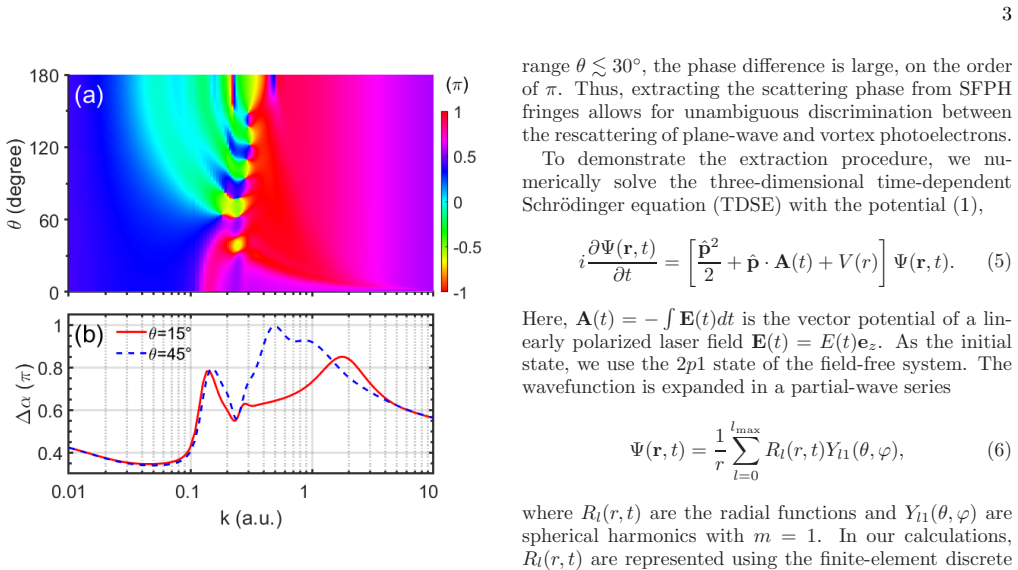
with the screening parameter a = 15. Fig- ures 1(a) and 1(b) present its absolute value and phase 3 FIG. 2. (a) Difference ∆ α between the phases of the plane-wave fk(θ) and vortex fm=1,kθ k (θ) scattering ampli- tudes shown in Fig. 1. (b) Cuts of the scattering phase differ- ence at scattering angles θ = 15 ◦ (red solid line) and θ = 45 ◦ (blue dashed line...
-
[3]
However, near the reso- nance, the phase difference depends strongly on both k and θ
1 ≲ k ≲ 1 dominated by the resonance feature, the phase difference depends only weakly on the scattering angle θ, approaching a constant as k → 0 and mono- tonically decreasing for k ≳ 1. However, near the reso- nance, the phase difference depends strongly on both k and θ. Crucially, at momenta k ∼ 1 of main interest in strong-field physics and within the ne...
-
[4]
1, and duration τ = 75 (corresponding to an intensity of 3
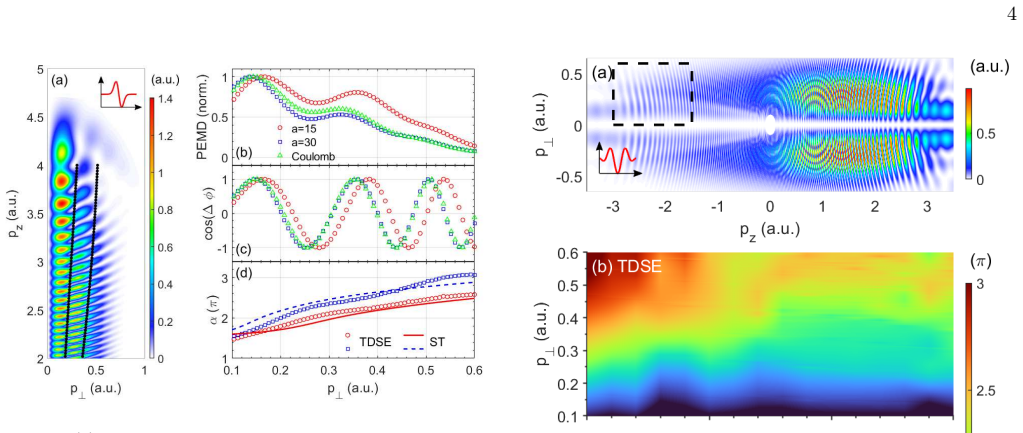
with the screening parameter a = 30, pulse ampli- tude E0 = 0. 1, and duration τ = 75 (corresponding to an intensity of 3 . 5 × 10¹⁴ W/cm2 and a wavelength of λ ≈ 800 nm, respectively) is shown in Fig. 3(a). The inset shows the temporal profile of E(t). The PEMD exhibits two types of interference fringes. The near- horizontal interference structure results...
-
[5]
Given the laser field shape, this term can be readily calculated using classical equations of motion [28, 38]
corresponds to the phase difference between the direct and rescattered photoelectrons, accumulated during propagation in the laser field. Given the laser field shape, this term can be readily calculated using classical equations of motion [28, 38]. The second term, α , is the scattering phase of the photoelectron acquired during rescattering by the parent io...
-
[6]
1 to eliminate the near-horizontal inter- ference
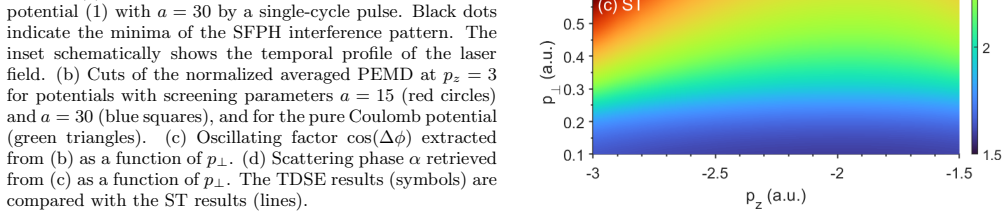
9 ≤ pz ≤ 3. 1 to eliminate the near-horizontal inter- ference. The resulting averaged PEMD at pz = 3, nor- malized to unity at its maximum, is shown in Fig. 3(b). FIG. 4. (a) PEMD for ionization from the 2 p1 state in the potential (1) with a = 15 by a few-cycle pulse. Inset: schematic of the laser field. (b) Phase α of the vortex scat- tering amplitude fm...
2026
-
[7]
Bliokh, I
K. Bliokh, I. Ivanov, G. Guzzinati, L. Clark, R. Van Boxem, A. B´ ech´ e, R. Juchtmans, M. Alonso, P. Schattschneider, F. Nori, and J. Verbeeck, The- ory and applications of free-electron vortex states, Phys. Rep. 690, 1 (2017)
2017
-
[8]
S. M. Lloyd, M. Babiker, G. Thirunavukkarasu, and J. Yuan, Electron vortices: Beams with orbital angular momentum, Rev. Mod. Phys. 89, 035004 (2017)
2017
-
[9]
I. P. Ivanov, Promises and challenges of high-energy vortex states collisions, Prog. Part. Nucl. Phys. 127, 103987 (2022)
2022
-
[10]
Serbo, I
V. Serbo, I. P. Ivanov, S. Fritzsche, D. Seipt, and A. Surzhykov, Scattering of twisted relativistic electron s by atoms, Phys. Rev. A 92, 012705 (2015)
2015
-
[11]
V. P. Kosheleva, V. A. Zaytsev, A. Surzhykov, V. M. Shabaev, and T. St¨ ohlker, Elastic scattering of twisted electrons by an atomic target: Going beyond the born approximation, Phys. Rev. A 98, 022706 (2018)
2018
-
[12]
A. V. Maiorova, S. Fritzsche, R. A. M¨ uller, and A. Surzhykov, Elastic scattering of twisted electrons by diatomic molecules, Phys. Rev. A 98, 042701 (2018)
2018
-
[13]
K. V. Bazarov and O. I. Tolstikhin, Adiabatic the- ory of generation and rescattering of vortex electrons in strong-field ionization by elliptically polarized pulse s, Phys. Rev. A 107, 053114 (2023)
2023
-
[14]
Sheremet, A
N. Sheremet, A. Chaikovskaia, D. Grosman, and D. Karlovets, Influence of the vortex- electron spatial distribution on atomic scattering, Phys. Rev. A 111, 052810 (2025)
2025
-
[15]
Strnat, J
S. Strnat, J. Sommerfeldt, A. K. Sahoo, L. Sharma, and A. Surzhykov, Inelastic scattering of vor- tex electrons beyond the born approximation, J. Phys. B 58, 075201 (2025)
2025
-
[16]
A. L. Harris and S. Fritzsche, A distorted-wave ap- proach to the elastic scattering of twisted electrons, J. Phys. B 58, 095201 (2025)
2025
-
[17]
Uchida and A
M. Uchida and A. Tonomura, Generation of elec- tron beams carrying orbital angular momentum, Nature 464, 737 (2010) . 6
2010
-
[18]
Verbeeck, H
J. Verbeeck, H. Tian, and P. Schattschneider, Pro- duction and application of electron vortex beams, Nature 467, 301 (2010)
2010
-
[19]
Wu and H
H. Wu and H. Yong, Diffractive imaging of transient electronic coherences in molecules with electron vortices , Phys. Rev. Lett. 134, 073001 (2025)
2025
-
[20]
Asenjo-Garcia and F
A. Asenjo-Garcia and F. J. Garc ´ ıa de Abajo, Dichroism in the interaction between vor- tex electron beams, plasmons, and molecules, Phys. Rev. Lett. 113, 066102 (2014)
2014
-
[21]
Edstr¨ om, A
A. Edstr¨ om, A. Lubk, and J. Rusz, Elastic scat- tering of electron vortex beams in magnetic matter, Phys. Rev. Lett. 116, 127203 (2016)
2016
-
[22]
Verbeeck, H
J. Verbeeck, H. Tian, and G. V. Tendeloo, How to manipulate nanoparticles with an electron beam?, Adv. Mater. 25 (2013)
2013
-
[23]
N. L. c. v. c. v. Streshkova, P. Koutensk´ y, and M. Koz´ ak, Electron vortex beams for chirality probing at the nanoscale, Phys. Rev. Appl. 22, 054017 (2024)
2024
-
[24]
T. R. Harvey, J. S. Pierce, J. J. Chess, and B. J. McMorran, Demonstration of electron helical dichroism as a local prob e of chirality (2015), arXiv:1507.01810 [cond-mat.mtrl-sci]
Pith/arXiv arXiv 2015
-
[25]
Kolovertnova, K
V. Kolovertnova, K. V. Bazarov, and O. I. Tolstikhin, Chiral asymmetry in elastic scattering of vortex electrons by molecules, Phys. Rev. A 113, 022801 (2026)
2026
-
[26]
I. I. Pavlov, A. D. Chaikovskaia, and D. V. Karlovets, Generation of vortex electrons by atomic photoioniza- tion, Phys. Rev. A 110, L031101 (2024)
2024
-
[27]
B. K. Das, C. Granados, L. Wang, and M. F. Ciap- pina, Generation of bessel vortex electrons via atomic photoionization, Phys. Rev. A 112, 013114 (2025)
2025
-
[28]
O. I. Tolstikhin and T. Morishita, Strong-field ionization, rescattering, and target structure imaging with vortex electrons, Phys. Rev. A 99, 063415 (2019)
2019
-
[29]
K. V. Bazarov and O. I. Tolstikhin, Generation of vortex electrons in tunneling ionization of polyatomic molecules: Exact results in the zero-range potential model, Phys. Rev. A 110, 033107 (2024)
2024
-
[30]
K. V. Bazarov and O. I. Tolstikhin, Chiral asym- metry in the photoeffect with vortex photoelectrons, Phys. Lett. A 556, 130818 (2025)
2025
-
[31]
K. V. Bazarov and O. I. Tolstikhin, Theory of the photoeffect with vortex photoelectrons, Phys. Rev. A 112, 033111 (2025)
2025
-
[32]
X. B. Planas, A. Ord´ o˜ nez, M. Lewenstein, and A. S. Maxwell, Ultrafast imaging of molec- ular chirality with photoelectron vortices, Phys. Rev. Lett. 129, 233201 (2022)
2022
-
[33]
L. Li, Y. Chen, M. Yu, X. Zhang, Y. Li, Y. Zhou, and P. Lu, Attosecond vortex photoelec- tron holography for probing phase-encoded chirality, Phys. Rev. Lett. 136, 093202 (2026)
2026
-
[34]
Huismans, A
Y. Huismans, A. Rouz´ ee, A. Gijsbertsen, J. H. Jung- mann, A. S. Smolkowska, P. S. W. M. Logman, F. L´ epine, C. Cauchy, S. Zamith, T. Marchenko, J. M. Bakker, G. Berden, B. Redlich, A. F. G. van der Meer, H. G. Muller, W. Vermin, K. J. Schafer, M. Spanner, M. Y. Ivanov, O. Smirnova, D. Bauer, S. V. Popruzhenko, and M. J. J. Vrakking, Time-resolved holog...
2011
-
[35]
Figueira de Morisson Faria and A
C. Figueira de Morisson Faria and A. S. Maxwell, It is all about phases: ultrafast holographic photoelectron imag- ing, Rep. Prog. Phys. 83, 034401 (2020)
2020
-
[36]
Meckel, A
M. Meckel, A. Staudte, S. Patchkovskii, D. M. Vil- leneuve, P. B. Corkum, R. D¨ orner, and M. Span- ner, Signatures of the continuum electron phase in molecular strong-field photoelectron holography, Nat. Phys. 10, 594 (2014)
2014
-
[37]
M.-M. Liu, M. Li, C. Wu, Q. Gong, A. Staudte, and Y. Liu, Phase structure of strong- field tunneling wave packets from molecules, Phys. Rev. Lett. 116, 163004 (2016)
2016
-
[38]
J. Tan, Y. Zhou, M. He, Y. Chen, Q. Ke, J. Liang, X. Zhu, M. Li, and P. Lu, Determination of the ioniza- tion time using attosecond photoelectron interferometry, Phys. Rev. Lett. 121, 253203 (2018)
2018
-
[39]
W. Xie, J. Yan, M. Li, C. Cao, K. Guo, Y. Zhou, and P. Lu, Picometer-resolved photoemission position within the molecule by strong-field photoelectron holography, Phys. Rev. Lett. 127, 263202 (2021)
2021
-
[40]
Porat, G
G. Porat, G. Alon, S. Rozen, O. Pedatzur, M. Kr¨ uger, D. Azoury, A. Natan, G. Orenstein, B. D. Bruner, M. J. J. Vrakking, and N. Dudovich, Attosecond time-resolved photoelectron holography, Nat. Commun. 9, 2805 (2018)
2018
-
[41]
M. Li, H. Xie, W. Cao, S. Luo, J. Tan, Y. Feng, B. Du, W. Zhang, Y. Li, Q. Zhang, P. Lan, Y. Zhou, and P. Lu, Photoelectron holographic interferometry to probe the longitudinal momentum offset at the tunnel exit, Phys. Rev. Lett. 122, 183202 (2019)
2019
-
[42]
M. He, Y. Li, Y. Zhou, M. Li, W. Cao, and P. Lu, Direct visualization of valence electron mo- tion using strong-field photoelectron holography, Phys. Rev. Lett. 120, 133204 (2018)
2018
-
[43]
Liang, Y
J. Liang, Y. Zhou, Y. Liao, W.-C. Jiang, M. Li, and P. Lu, Direct visualization of deforming atomic wavefunction in ultraintense high-frequency laser pulses , Ultrafast Sci. 2022 (2022)
2022
-
[44]
Y. Zhou, O. I. Tolstikhin, and T. Morishita, Near-forward rescattering photoelectron holography in strong-field ion - ization: Extraction of the phase of the scattering ampli- tude, Phys. Rev. Lett. 116, 173001 (2016)
2016
-
[45]
Hasan, P.-H
M. Hasan, P.-H. Tran, J. Gao, V.-H. Hoang, M.- S. Tsai, M.-C. Chen, U. Thumm, C. L. Cocke, C.- D. Lin, A.-T. Le, and M. Han, Strong-field photo- electron interferometry with near-single-cycle yb lasers , Phys. Rev. Lett. 135, 263001 (2025)
2025
-
[46]
Van Boxem, B
R. Van Boxem, B. Partoens, and J. Ver- beeck, Rutherford scattering of electron vortices, Phys. Rev. A 89, 032715 (2014)
2014
-
[47]
Van Boxem, B
R. Van Boxem, B. Partoens, and J. Ver- beeck, Inelastic electron-vortex-beam scattering, Phys. Rev. A 91, 032703 (2015)
2015
-
[48]
I. P. Ivanov, D. Seipt, A. Surzhykov, and S. Fritzsche, Elastic scattering of vortex elec- trons provides direct access to the coulomb phase, Phys. Rev. D 94, 076001 (2016)
2016
-
[49]
Bransden and C
B. Bransden and C. Joachain, Physics of atoms and molecules (2nd ed.) (Prentice Hall, New York, 2003)
2003
-
[50]
O. I. Tolstikhin and T. Morishita, Adiabatic theory of ionization by intense laser pulses: Finite-range poten- tials, Phys. Rev. A 86, 043417 (2012)
2012
-
[51]
T. N. Rescigno and C. W. McCurdy, Numerical grid methods for quantum-mechanical scattering problems, Phys. Rev. A 62, 032706 (2000) . 7
2000
-
[52]
Jiang and X.-Q
W.-C. Jiang and X.-Q. Tian, Efficient split-lanczos propagator for strong-field ionization of atoms, Opt. Express 25, 26832 (2017)
2017
-
[53]
D. G. Arb´ o, J. E. Miraglia, M. S. Gravielle, K. Schiessl, E. Persson, and J. Burgd¨ orfer, Coulomb-volkov approxi- mation for near-threshold ionization by short laser pulses , Phys. Rev. A 77, 013401 (2008)
2008
-
[54]
D. G. Arb´ o, E. Persson, and J. Burgd¨ orfer, Time double- slit interferences in strong-field tunneling ionization, Phys. Rev. A 74, 063407 (2006)
2006
-
[55]
D. G. Arb´ o, K. L. Ishikawa, K. Schiessl, E. Persson, and J. Burgd¨ orfer, Intracycle and intercycle interfer- ences in above-threshold ionization: The time grating, Phys. Rev. A 81, 021403(R) (2010)
2010
-
[56]
Richter, M
M. Richter, M. Kunitski, M. Sch¨ offler, T. Jahnke, L. P. H. Schmidt, M. Li, Y. Liu, and R. D¨ orner, Streaking tem- poral double-slit interference by an orthogonal two-color laser field, Phys. Rev. Lett. 114, 143001 (2015)
2015
-
[57]
C. T. Schmiegelow, J. Schulz, H. Kaufmann, T. Ruster, U. G. Poschinger, and F. Schmidt-Kaler, Transfer of op- tical orbital angular momentum to a bound electron, Nat. Commun. 7, 12998 (2016)
2016
-
[58]
Stopp, M
F. Stopp, M. Verde, M. Katz, M. Drechsler, C. T. Schmiegelow, and F. Schmidt-Kaler, Coherent transfer of transverse optical momentum to the motion of a sin- gle trapped ion, Phys. Rev. Lett. 129, 263603 (2022)
2022
discussion (0)
Sign in with ORCID, Apple, or X to comment. Anyone can read and Pith papers without signing in.