Partial Automation of Verification Condition Proving for Reflex Programs (Draft)
Pith reviewed 2026-06-26 06:36 UTC · model grok-4.3
The pith
Adding annotations, structural invariants, and SMT solvers to the Reflex verification generator automates proof of some conditions.
A machine-rendered reading of the paper's core claim, the machinery that carries it, and where it could break.
Core claim
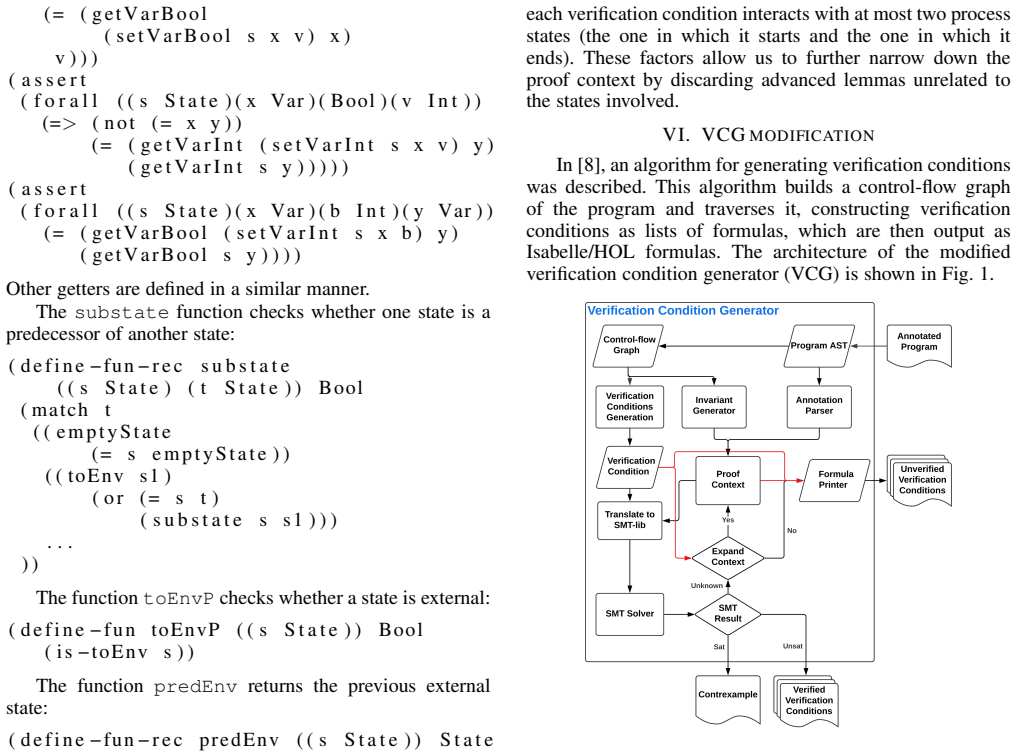
The proposed modifications—an annotation language to describe requirements in a structured form, generation of invariants based on the program structure, and SMT solvers for the preliminary attempt to solve the verification conditions—will automate the proof of some verification conditions generated for Reflex programs.
What carries the argument
The modified verification condition generator that incorporates the annotation language, structure-derived invariants, and SMT solver calls to handle preliminary conditions.
If this is right
- Verification conditions that match the generated invariants or fall within SMT capabilities will be discharged without human input.
- Requirements expressed through the annotation language will be checked against the program structure automatically.
- The overall verification workflow for Reflex programs will require fewer manual proof steps than the prior generator.
- Safety properties of process-oriented control systems become easier to establish at the scale of hundreds of processes.
Where Pith is reading between the lines
- The technique could be tested on open-source Reflex examples to measure the exact fraction of conditions automated.
- Similar structural invariant generation might apply to other process-oriented languages beyond Reflex.
- Integration with existing SMT tools could be extended to handle more complex arithmetic or timing properties common in control systems.
Load-bearing premise
These three modifications will produce a practically useful reduction in the number of verification conditions that still require manual proof for realistic industrial systems.
What would settle it
Apply the modified generator to a Reflex program modeling an industrial system with several hundred processes and count how many verification conditions remain after SMT solving and invariant use; if the remaining count is still too large for manual proof, the claim fails.
Figures
read the original abstract
Process-Oriented Programming is a software development approach that emphasizes the management of control systems through abstractions of processes and their states, enabling these systems to be described in terms of real physical processes. This native description of control is particularly important for industrial systems consisting of hundreds or thousands of processes. For such systems, safety is critical. To ensure the reliability and safety of these systems, formal verification methods must be applied. One such method is deductive verification, which involves formalizing programs and their requirements as logical formulas, known as verification conditions. Proving these conditions confirms that the program meets its requirements. The automatic generation of verification conditions is performed by a specialized software tool called a verification condition generator. We previously proposed a verification condition generator for the Reflex language. However, it generates too many verification conditions, making their manual proof impossible. This paper proposes modifications to the verification condition generator aimed at automating the proof of some of these conditions. These modifications include introducing an annotation language to describe requirements in a structured form, generating invariants based on the program structure, and using SMT solvers for the preliminary attempt to solve the verification conditions.
Editorial analysis
A structured set of objections, weighed in public.
Referee Report
Summary. The manuscript proposes three modifications to an existing verification-condition generator for the Reflex language: (1) an annotation language for expressing requirements in structured form, (2) automatic generation of invariants derived from program structure, and (3) preliminary discharge of verification conditions by SMT solvers. The stated goal is to reduce the volume of conditions that must be proved manually, thereby making deductive verification feasible for industrial systems comprising hundreds or thousands of processes.
Significance. If the proposed techniques can be shown to preserve soundness while automating a non-trivial fraction of verification conditions, the work would address a recognized scalability barrier in the deductive verification of process-oriented control software. The paper correctly identifies the practical problem and situates the proposal relative to prior VC-generation work for Reflex; however, the draft supplies neither a prototype, a worked example, nor any measurement of VC reduction, so the claimed practical benefit remains unassessed.
major comments (2)
- [Abstract] Abstract: the central claim that the three modifications 'will automate the proof of some of these conditions' is asserted without any concrete example, derivation, or preliminary data. A minimal worked example on a small Reflex program, showing which VCs become automatically solvable, is required to substantiate the claim.
- [Proposed modifications (invariant generation)] Description of invariant generation: the manuscript does not specify the syntactic form of the generated invariants, the algorithm that produces them from program structure, or any argument that the invariants are sound with respect to the original Reflex semantics. This omission directly affects whether the proposed automation preserves the correctness of the verification pipeline.
Simulated Author's Rebuttal
We thank the referee for the detailed and constructive report. We agree that the current draft is preliminary and lacks the concrete details and examples needed to substantiate the proposed automation. The revised manuscript will incorporate a minimal worked example and a full specification of the invariant generation technique, including its syntactic form, generation algorithm, and soundness argument.
read point-by-point responses
-
Referee: [Abstract] Abstract: the central claim that the three modifications 'will automate the proof of some of these conditions' is asserted without any concrete example, derivation, or preliminary data. A minimal worked example on a small Reflex program, showing which VCs become automatically solvable, is required to substantiate the claim.
Authors: We agree that the abstract claim requires substantiation. The manuscript is a high-level proposal for modifications to the existing VC generator. In the revision we will add a minimal worked example based on a small Reflex program. The example will show the original VCs, the effect of the annotation language and generated invariants, and which conditions become solvable by the SMT solver. revision: yes
-
Referee: [Proposed modifications (invariant generation)] Description of invariant generation: the manuscript does not specify the syntactic form of the generated invariants, the algorithm that produces them from program structure, or any argument that the invariants are sound with respect to the original Reflex semantics. This omission directly affects whether the proposed automation preserves the correctness of the verification pipeline.
Authors: We acknowledge the omission. The draft focuses on the high-level idea of structure-derived invariants. In the revised version we will define the syntactic form of these invariants, present the algorithm that extracts them from Reflex program structure (process states and transitions), and supply a soundness argument showing that the generated invariants are implied by the original Reflex operational semantics. revision: yes
Circularity Check
High-level design proposal with no derivation, equations, or self-referential reductions
full rationale
The manuscript is a forward-looking proposal for tool modifications (annotation language, structure-based invariants, SMT pre-solving) to an existing VCG. It contains no equations, no fitted parameters, no predictions, and no derivation chain that could reduce to its inputs. The single self-citation to the authors' prior VCG work merely identifies the baseline problem (too many VCs) and is not used to justify any uniqueness theorem or load-bearing claim inside the present paper. All other patterns (self-definitional, fitted-input-as-prediction, ansatz smuggling, renaming) are absent by construction.
Axiom & Free-Parameter Ledger
Reference graph
Works this paper leans on
-
[1]
Hyper-automaton: a model of control algorithms,
V . E. Zyubin, “Hyper-automaton: a model of control algorithms,” in 2007 Siberian Conference on Control and Communications, 2007, pp. 51–57. [Online]. Available: https://doi.org/10.1109/SIBCON.2007. 371297
-
[2]
Reflex language: a practical notation for cyber-physical systems,
V . E. Zyubin, T. V . Liakh, and A. S. Rozov, “Reflex language: a practical notation for cyber-physical systems,”System Informatics, no. 12, pp. 85–104, 2018. [Online]. Available: https://doi.org/10.31144/si.2307-6410.2018.n12.p85-104
-
[3]
Reflex translator,
A. Bastrykina, “Reflex translator,” https://github.com/a-bastrykina/ reflex-translator-diploma, 2020
2020
-
[4]
doi:10.1007/978-3-319-91908-9\ 23
R. H ¨ahnle and M. Huisman, “Deductive software verification: from pen-and-paper proofs to industrial tools,”Computing and Software Science: State of the Art and Perspectives, pp. 345–373, 2019. [Online]. Available: https://doi.org/10.1007/978-3-319-91908-9 18
-
[5]
Hoare logic for java in isabelle/hol,
D. von Oheimb, “Hoare logic for java in isabelle/hol,”Concurrency and Computation: Practice and Experience, vol. 13, no. 13, pp. 1173– 1214, 2001. [Online]. Available: https://doi.org/10.1002/cpe.598
-
[6]
A verification environment for sequential imperative programs in isabelle/hol,
N. Schirmer, “A verification environment for sequential imperative programs in isabelle/hol,” inLogic for Programming, Artificial Intelligence, and Reasoning, F. Baader and A. V oronkov, Eds. Berlin, Heidelberg: Springer Berlin Heidelberg, 2005, pp. 398–414. [Online]. Available: https://doi.org/10.1007/b106931
-
[7]
An operational and axiomatic semantics for non- determinism and sequence points in c,
R. Krebbers, “An operational and axiomatic semantics for non- determinism and sequence points in c,” vol. 49, no. 1, p. 101–112, Jan
-
[8]
Available: https://doi.org/10.1145/2578855.2535878
[Online]. Available: https://doi.org/10.1145/2578855.2535878
-
[9]
Verification condition generator for revised reflex language using isabelle/hol,
A. D. Ishchenko and I. S. Anureev, “Verification condition generator for revised reflex language using isabelle/hol,” in2025 IEEE 26th International Conference of Young Professionals in Electron Devices and Materials (EDM). IEEE, 2025, pp. 1440–1445
2025
-
[10]
Parr,The Definitive ANTLR 4 Reference, 2nd ed
T. Parr,The Definitive ANTLR 4 Reference, 2nd ed. Pragmatic Bookshelf, 2013. [Online]. Available: http://digital.casalini.it/ 9781680505016
2013
-
[11]
Reflex grammar,
A. Ishchenko, “Reflex grammar,” https://github.com/bearhug15/ ReflexVCG/blob/master/src/main/java/su/nsk/iae/reflex/antlr/ NewReflex.g4, 2024
2024
-
[12]
Jml: A notation for detailed design,
G. T. Leavens, A. L. Baker, and C. Ruby, “Jml: A notation for detailed design,” pp. 175–188, 1999
1999
-
[13]
Acsl: Ansi/iso c specification,
P. Baudin, J.-C. Filli ˆatre, C. March ´e, B. Monate, Y . Moy, and V . Prevosto, “Acsl: Ansi/iso c specification,” 2021
2021
-
[14]
Two-step deductive verification of control software using reflex,
I. Anureev, N. Garanina, T. Liakh, A. Rozov, V . Zyubin, and S. Gorlatch, “Two-step deductive verification of control software using reflex,” inInternational Andrei Ershov Memorial Conference on Perspectives of System Informatics. Springer, 2019, pp. 50–63
2019
-
[15]
Satisfiability modulo theories,
C. Barrett and C. Tinelli, “Satisfiability modulo theories,” pp. 305– 343, 2018
2018
-
[16]
Solving sat and sat modulo theories: From an abstract davis–putnam–logemann–loveland procedure to dpll (t),
R. Nieuwenhuis, A. Oliveras, and C. Tinelli, “Solving sat and sat modulo theories: From an abstract davis–putnam–logemann–loveland procedure to dpll (t),”Journal of the ACM (JACM), vol. 53, no. 6, pp. 937–977, 2006
2006
-
[17]
Quantifier instantiation techniques for finite model finding in smt,
A. Reynolds, C. Tinelli, A. Goel, S. Krsti ´c, M. Deters, and C. Barrett, “Quantifier instantiation techniques for finite model finding in smt,” pp. 377–391, 2013
2013
-
[18]
The smt-lib standard: Version 2.0,
C. Barrett, A. Stump, C. Tinelliet al., “The smt-lib standard: Version 2.0,” vol. 13, p. 14, 2010
2010
-
[19]
Z3: An efficient smt solver,
L. De Moura and N. Bjørner, “Z3: An efficient smt solver,” in International conference on Tools and Algorithms for the Construction and Analysis of Systems. Springer, 2008, pp. 337–340
2008
-
[20]
Barrett, C
C. Barrett, C. L. Conway, M. Deters, L. Hadarean, D. Jovanovi ´c, T. King, A. Reynolds, and C. Tinelli, “cvc4,” inInternational Conference on Computer Aided Verification. Springer, 2011, pp. 171–177
2011
-
[21]
cvc5: A versatile and industrial-strength smt solver,
H. Barbosa, C. Barrett, M. Brain, G. Kremer, H. Lachnitt, M. Mann, A. Mohamed, M. Mohamed, A. Niemetz, A. N ¨otzliet al., “cvc5: A versatile and industrial-strength smt solver,” inInternational Conference on Tools and Algorithms for the Construction and Analysis of Systems. Springer, 2022, pp. 415–442
2022
discussion (0)
Sign in with ORCID, Apple, or X to comment. Anyone can read and Pith papers without signing in.