Binary binomial equivalence via hyperplane arrangements
Pith reviewed 2026-06-26 07:42 UTC · model grok-4.3
The pith
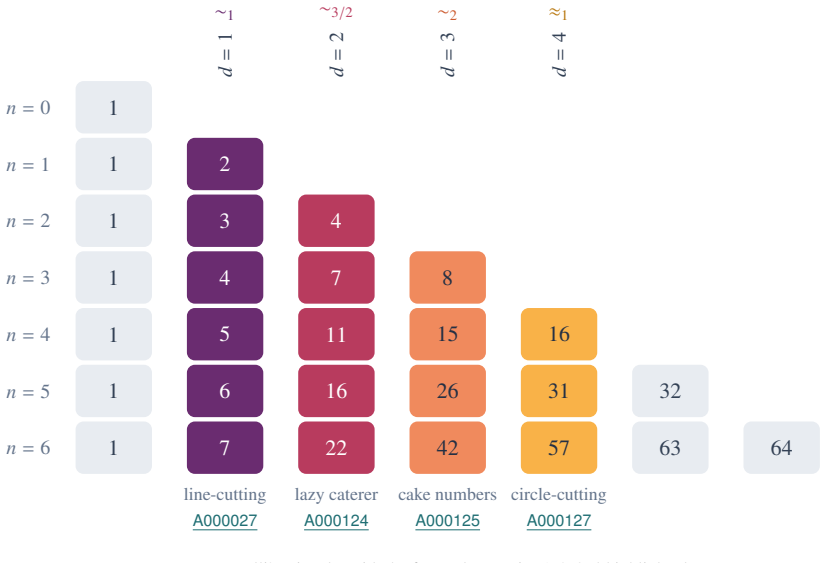
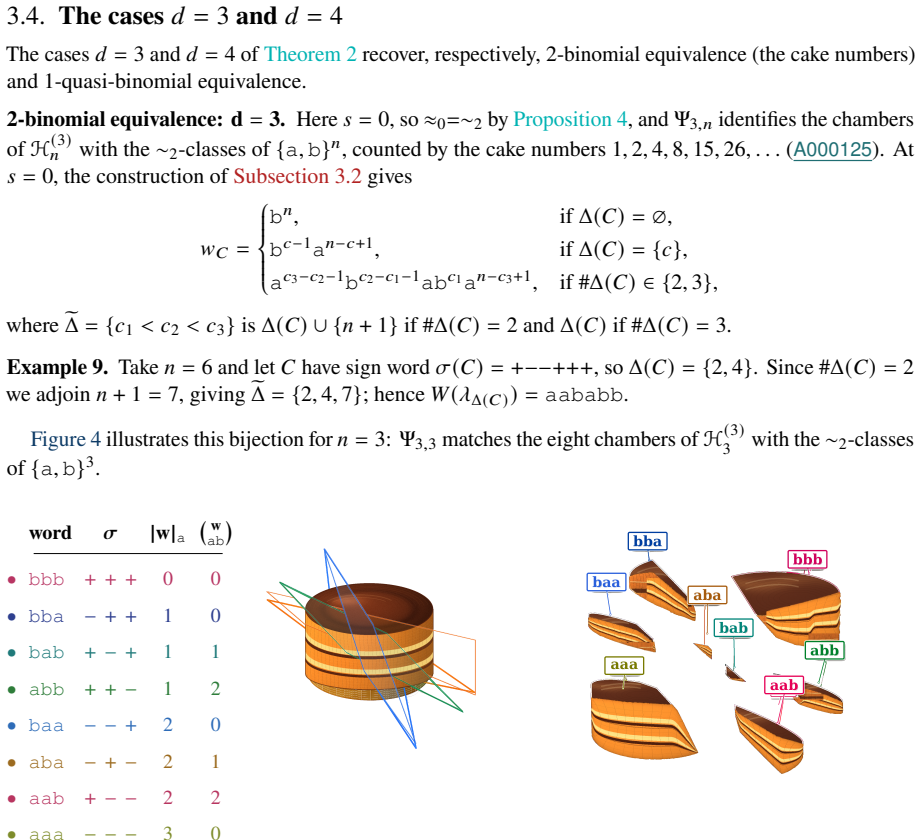
An explicit arrangement of n planes in 3D space has chambers in bijection with the binary 2-binomial equivalence classes of words of length n.
A machine-rendered reading of the paper's core claim, the machinery that carries it, and where it could break.
Core claim
The authors construct an explicit arrangement of n planes in R^3 whose chambers are naturally indexed by the binary 2-binomial equivalence classes of binary words of length n. This arrangement is the three-dimensional case of an infinite family of hyperplane arrangements whose lower-dimensional quotients recover abelian equivalence and an intermediate equivalence, while higher dimensions yield refinements of 2-binomial equivalence. The sizes of the equivalence classes are given by coefficients of suitable Gaussian binomial coefficients.
What carries the argument
The arrangement of n planes in three-dimensional space, with chambers indexed by the equivalence classes.
If this is right
- The full distribution of class sizes for binary 2-binomial equivalence follows from the coefficients of the Gaussian binomial coefficient.
- Stabilization occurs in the number of classes of any fixed cardinality as n grows.
- The same family in higher dimensions realises natural refinements of 2-binomial equivalence.
Where Pith is reading between the lines
- Similar geometric constructions might apply to other word equivalences counted by known sequences.
- The connection to cake numbers suggests possible links to other combinatorial interpretations of those numbers via hyperplane arrangements.
Load-bearing premise
The chambers of the constructed arrangement are in natural bijection with the binary 2-binomial equivalence classes.
What would settle it
Counting the chambers of the explicit n-plane arrangement in 3D and finding a number different from the nth cake number would show the claimed indexing is not bijective.
Figures
read the original abstract
Rigo and Salimov (2015) proved that the number of binary \(2\)-binomial equivalence classes of words of length \(n\) is the \(n^{\text{th}}\) cake number. We give a geometric explanation of this identity by constructing an explicit arrangement of \(n\) planes in three-dimensional space whose chambers are naturally indexed by these equivalence classes. This arrangement is the three-dimensional member of an infinite family of hyperplane arrangements. In dimensions \(1\), \(2\), and \(3\), the corresponding quotients recover abelian equivalence, a natural intermediate equivalence between abelian and \(2\)-binomial equivalence, and binary \(2\)-binomial equivalence itself. In higher dimensions, the same family realises natural refinements of \(2\)-binomial equivalence. We also determine the sizes of the resulting classes. Each size is given by a coefficient of a suitable Gaussian binomial coefficient. This yields the full class-size distribution for binary \(2\)-binomial equivalence and stabilisation results for the number of classes of any fixed cardinality.
Editorial analysis
A structured set of objections, weighed in public.
Referee Report
Summary. Rigo and Salimov (2015) proved that the number of binary 2-binomial equivalence classes of words of length n equals the nth cake number. The manuscript supplies a geometric explanation via an explicit arrangement of n planes in R^3 (Section 3) whose chambers are in bijection with these classes; the bijection is established by a direct combinatorial map verified inductively on n using the recursive structure of both the arrangement and the equivalence. The construction belongs to an infinite family of hyperplane arrangements whose low-dimensional cases recover abelian equivalence, an intermediate equivalence, and 2-binomial equivalence, while higher dimensions yield refinements. Class sizes are expressed as coefficients of Gaussian binomials, yielding the full distribution and stabilization theorems.
Significance. The explicit coordinate definition of the planes together with the inductive bijection supplies a concrete geometric model for the cake-number identity and new enumerative information on class sizes. The family of arrangements and the Gaussian-binomial formulae constitute additional contributions that connect hyperplane-arrangement combinatorics with word equivalences.
minor comments (2)
- §3: the coordinate formulae for the planes are given explicitly, but a short table listing the first few planes for small n would improve readability.
- The induction in the bijectivity argument relies on matching recursive decompositions; a one-sentence reminder of the base case n=1 would help readers.
Simulated Author's Rebuttal
We thank the referee for their positive summary of the manuscript and for recommending acceptance.
Circularity Check
No significant circularity
full rationale
The paper cites an external 2015 result by Rigo and Salimov establishing that the number of binary 2-binomial classes equals the cake number. It then supplies an explicit coordinate definition of n planes in R^3 together with a direct combinatorial bijection (chambers to words) proven by induction on n that equates chamber membership with 2-binomial equivalence. No equation reduces a count or class size to a fitted parameter from the same paper, no load-bearing self-citation appears, and the geometric construction is independent of the prior enumeration. The derivation chain is therefore self-contained against external benchmarks.
Axiom & Free-Parameter Ledger
axioms (2)
- domain assumption The number of binary 2-binomial equivalence classes equals the nth cake number (Rigo-Salimov 2015).
- standard math Chambers of a hyperplane arrangement can be indexed by combinatorial objects when the arrangement is suitably chosen.
Reference graph
Works this paper leans on
-
[1]
G. L. Alexanderson and J. E. Wetzel, Simple partitions of space, Math.\ Mag.\ 51 (1978), no. 4, 220--225
1978
-
[2]
G. E. Andrews, The Theory of Partitions, Encyclopedia of Mathematics and its Applications, vol. 2, Cambridge University Press, Cambridge, 1998; reprint of the 1976 original
1998
-
[3]
Bj\" o rner, M
A. Bj\" o rner, M. Las Vergnas, B. Sturmfels, N. White, and G. M. Ziegler, Oriented Matroids, 2nd ed., Encyclopedia of Mathematics and its Applications, vol. 46, Cambridge University Press, Cambridge, 1999
1999
-
[4]
J. Chrisnata, H. M. Kiah, S. R. Karingula, A. Vardy, E. Yaakobi, and H. Yao, On the number of distinct k -decks: enumeration and bounds, Adv.\ Math.\ Commun.\ 17 (2023), no. 4, 960--978. A preliminary conference version appeared in Proc.\ 19th Int.\ Symp.\ Communications and Information Technologies (ISCIT), IEEE, 2019, pp. 519--524. https://doi.org/10.39...
-
[5]
D. D. Freydenberger, P. Gawrychowski, J. Karhum\" a ki, F. Manea, and W. Rytter, Testing k -binomial equivalence, in Multidisciplinary Creativity: Homage to Gheorghe P a un on his 65th Birthday , Editura Spandugino, Bucharest, 2015, pp. 239--248. https://arxiv.org/abs/1509.00622 arXiv
Pith/arXiv arXiv 2015
-
[6]
Gale, Neighborly and cyclic polytopes, in: V
D. Gale, Neighborly and cyclic polytopes, in: V. L. Klee (ed.), Convexity, Proceedings of Symposia in Pure Mathematics, vol. 7, Amer.\ Math.\ Soc., Providence, RI, 1963, pp. 225--232
1963
-
[7]
D. Gerbner and B. Patk\' o s, Extremal Finite Set Theory, Discrete Mathematics and Its Applications, CRC Press, Boca Raton, FL, 2018. https://doi.org/10.1201/9780429440809 doi
-
[8]
Golafshan and M
M. Golafshan and M. Rigo, Binomial coefficients of multidimensional arrays, in: Combinatorics on Words (WORDS 2025), Lecture Notes in Comput.\ Sci., vol. 15729, Springer, 2025, pp. 139--152
2025
-
[9]
Golafshan and M
M. Golafshan and M. Rigo, Binomial complexity of multidimensional arrays, submitted, 2025
2025
-
[10]
Karlin, Total Positivity, Vol
S. Karlin, Total Positivity, Vol. I, Stanford University Press, Stanford, CA, 1968
1968
-
[11]
J. Karhum\" a ki, S. Puzynina, M. Rao, and M. A. Whiteland, On cardinalities of \(k\)-abelian equivalence classes, Theoret.\ Comput.\ Sci.\ 658 (2017), 190--204. https://doi.org/10.1016/j.tcs.2016.06.010 doi
-
[12]
M. Lejeune, M. Rigo, and M. Rosenfeld, The binomial equivalence classes of finite words, Internat.\ J.\ Algebra Comput.\ 30 (2020), no. 7, 1375--1397. https://doi.org/10.1142/S0218196720500459 doi
-
[13]
Lothaire, Combinatorics on Words, Encyclopedia of Mathematics and its Applications, vol
M. Lothaire, Combinatorics on Words, Encyclopedia of Mathematics and its Applications, vol. 17, Cambridge University Press, Cambridge, 1997. https://doi.org/10.1017/CBO9780511566097 doi
-
[14]
S. Melczer, G. Panova, and R. Pemantle, Counting partitions inside a rectangle, SIAM J.\ Discrete Math.\ 34 (2020), no. 4, 2388--2410. https://doi.org/10.1137/20M1315828 doi
-
[15]
G. Richomme, On some 2 -binomial coefficients of binary words: geometrical interpretation, partitions of integers, and fair words, Theoret.\ Comput.\ Sci.\ 1066 (2026), Paper No. 115732. https://doi.org/10.1016/j.tcs.2025.115732 doi
-
[16]
M. Rigo and P. Salimov, Another generalization of abelian equivalence: binomial complexity of infinite words, Theoret.\ Comput.\ Sci.\ 601 (2015), 47--57. https://doi.org/10.1016/j.tcs.2015.07.025 doi
-
[17]
a fli, Theorie der vielfachen Kontinuit\
L. Schl\" a fli, Theorie der vielfachen Kontinuit\" a t , Denkschr.\ Schweiz.\ Naturforsch.\ Ges.\ 38 (1901), 1--237; reprinted in: Gesammelte Mathematische Abhandlungen, Band I, Birkh\" a user, Basel, 1950
1901
-
[18]
R. P. Stanley, Enumerative Combinatorics, Volume 1, 2nd ed., Cambridge Studies in Advanced Mathematics, vol. 49, Cambridge University Press, Cambridge, 2012
2012
-
[19]
R. P. Stanley, An introduction to hyperplane arrangements, in: Geometric Combinatorics (IAS/Park City Math.\ Ser., vol. 13), Amer.\ Math.\ Soc., Providence, RI, 2007, pp. 389--496
2007
-
[20]
J. Steiner, Einige Gesetze \" u ber die Theilung der Ebene und des Raumes , J.\ Reine Angew.\ Math.\ 1 (1826), 349--364. https://doi.org/10.1515/crll.1826.1.349 doi
-
[21]
T. Zaslavsky, Facing up to arrangements: face-count formulas for partitions of space by hyperplanes, Mem.\ Amer.\ Math.\ Soc.\ 154 (1975), vii+102 pp. https://doi.org/10.1090/memo/0154 doi
discussion (0)
Sign in with ORCID, Apple, or X to comment. Anyone can read and Pith papers without signing in.