Stellar winds of O-type stars traced by high ionization fine-structure emission lines with JWST/MIRI
Pith reviewed 2026-06-26 07:07 UTC · model grok-4.3
The pith
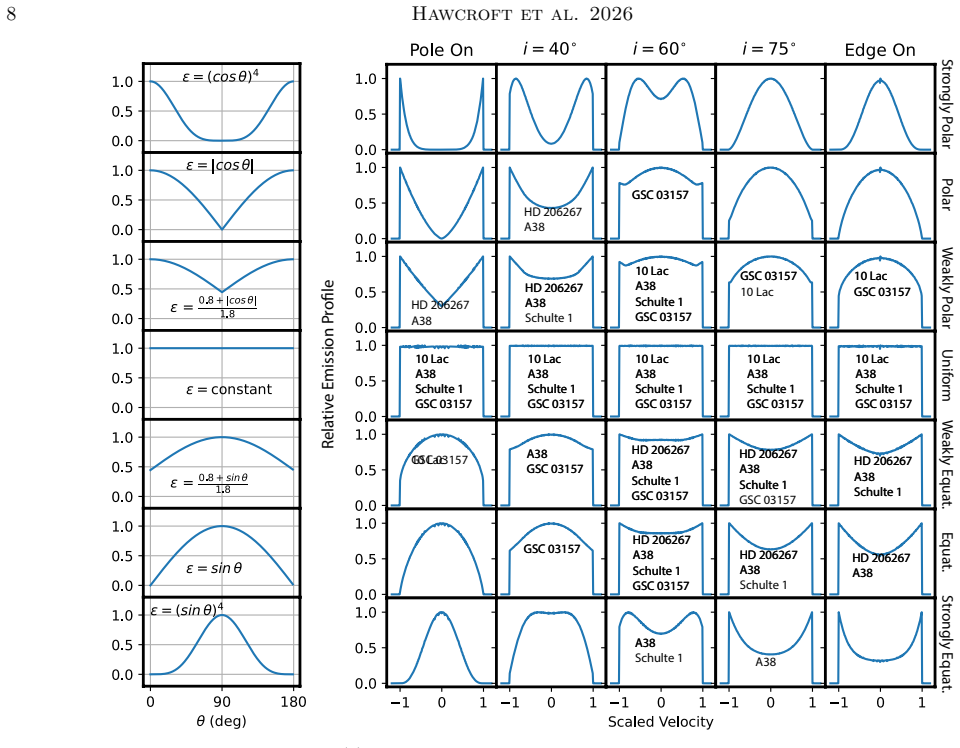
JWST/MIRI observations of [Ne V] lines measure wind speeds in O-type stars.
A machine-rendered reading of the paper's core claim, the machinery that carries it, and where it could break.
Core claim
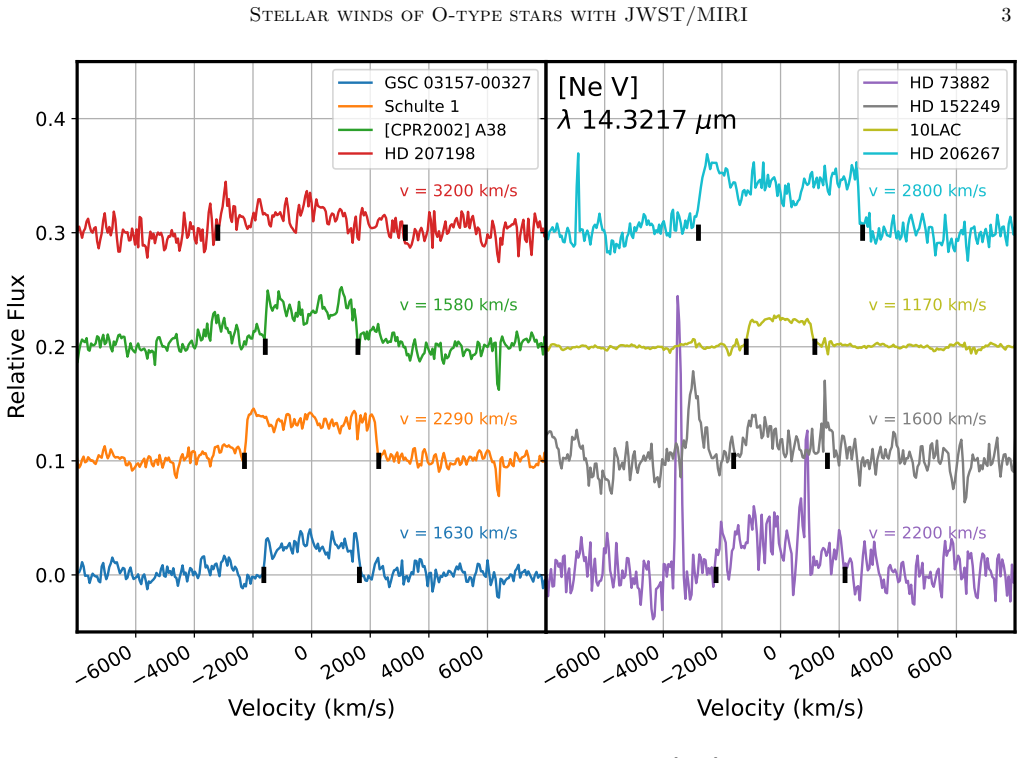
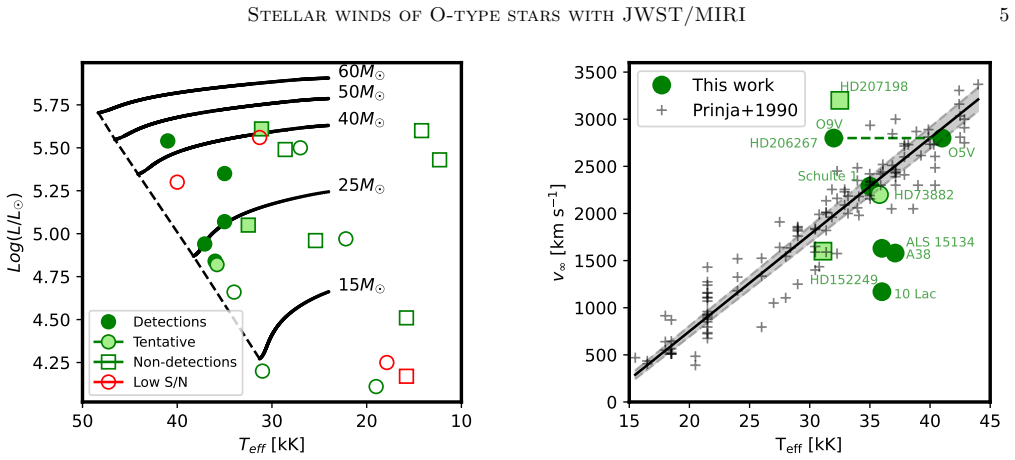
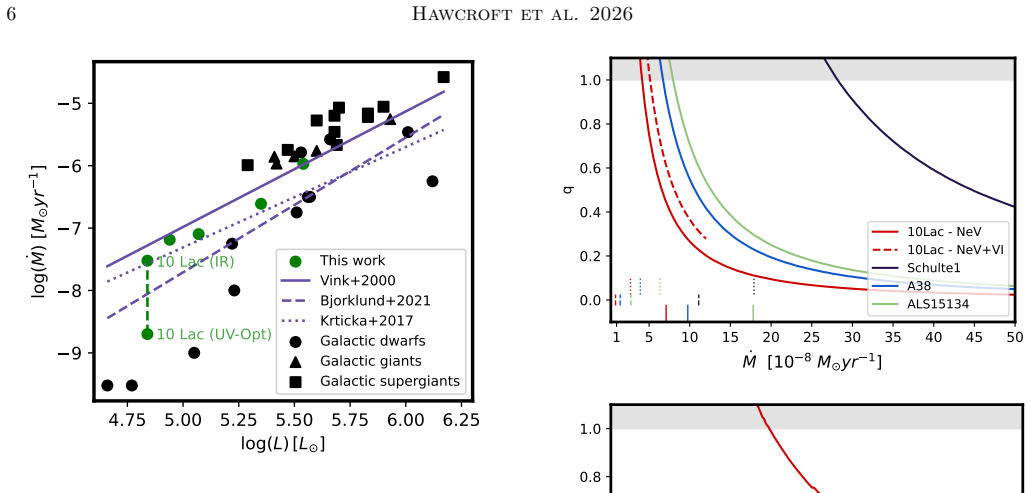
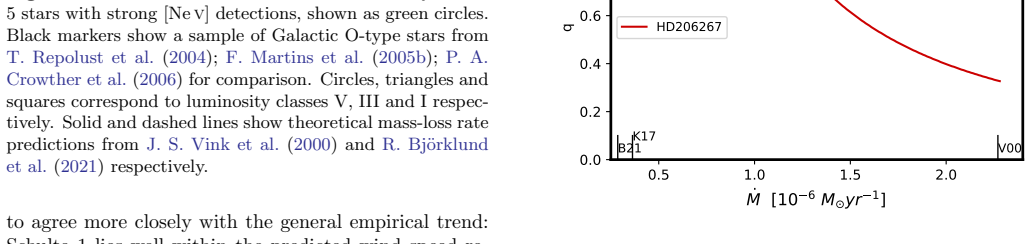
Broad, flat-topped emission in the [Ne V] 14.3 micron fine-structure line is detected in five O-type stars, from which terminal wind speeds are derived that generally agree with empirical trends, though some are surprisingly low, and lower limits on mass-loss rates are estimated. This establishes MIR fine-structure lines as a new probe of stellar winds formed at high ionization and large spatial extent, with frequent incidence in the sample including weak-wind stars.
What carries the argument
The broad, flat-topped profile of the [Ne V] 14.3 micron fine-structure emission line that traces the terminal wind velocity.
If this is right
- Terminal wind speeds can be measured in O-type stars using mid-infrared observations.
- Lower limits on mass-loss rates are obtainable from these lines for stars where other diagnostics fail.
- High ionization lines provide wind information at larger spatial extents than UV or optical lines.
- The method reveals wind emission in the weak-wind regime where it is often undetected otherwise.
Where Pith is reading between the lines
- Similar observations could map the radial structure of winds by comparing lines formed at different distances.
- This may help reconcile differences in mass-loss rate estimates from various wavelength regimes.
- Extending the sample with more JWST data could test if low wind speeds correlate with specific stellar parameters.
Load-bearing premise
The [Ne V] 14.3 micron emission is produced in the stellar wind and its flat-topped shape directly corresponds to the terminal velocity without contamination from other regions.
What would settle it
High-resolution spectra revealing peaked rather than flat-topped [Ne V] line profiles or emission originating outside the wind in the same stars.
Figures
read the original abstract
We investigate the presence of high ionization fine-structure emission lines across a range of 22 OB-type stars observed with JWST-MIRI as part of calibration programmes and the WISCI and MEAD projects. MIR wind emission is detected in 4 late O-dwarfs (O8 V - O9 V), 1 early O-dwarf (O5 V) and there are tentative detections in an additional 3 stars (O8.5 II, O8.5 IV and O9 I). We measure the wind speeds and make estimates of lower limits on the mass-loss rates of 5 O-type stars from broad, flat-topped emission in the fine-structure line of [Ne V] 14.3micron. We find terminal wind speeds that are generally in agreement with empirical trends, but note that in some cases the wind speeds are surprisingly low. We highlight two main takeaways from this sample, which combine to establish an exciting new window into the winds of massive stars. First, a new diagnostic ability is gained from lines formed at much higher ionization, larger spatial extent, and longer wavelengths than typical wind diagnostics. Secondly, there is frequent incidence of MIR emission in O-type stars, even in the 'weak-wind' regime where wind emission is often not detected in the UV and optical.
Editorial analysis
A structured set of objections, weighed in public.
Referee Report
Summary. The manuscript reports JWST/MIRI observations of 22 OB-type stars, detecting high-ionization fine-structure lines including [Ne V] 14.3μm in 5 O-type stars (4 late O-dwarfs, 1 early O-dwarf) with tentative detections in 3 more. Terminal wind speeds are derived from the widths of broad, flat-topped profiles for these 5 stars, generally consistent with empirical trends but with some noted as surprisingly low; lower limits on mass-loss rates are also estimated. The work positions these MIR lines as a new diagnostic for stellar winds at higher ionization and larger spatial scales, emphasizing their frequent incidence even among weak-wind stars.
Significance. If the line-profile interpretation holds, the result would establish a valuable new observational window into massive-star winds using high-ionization fine-structure lines at longer wavelengths, complementing UV/optical diagnostics and potentially constraining mass loss in the weak-wind regime where traditional tracers are often absent. The use of lines formed over larger spatial extents is a clear strength.
major comments (2)
- [line-profile analysis and discussion sections] The central claim that the observed flat-topped [Ne V] 14.3μm profiles directly yield terminal velocities (2 × v_∞) without substantial non-wind contamination is load-bearing for both the velocity measurements and the 'surprisingly low' cases. No quantitative radiative-transfer modeling, multi-epoch verification, or spatial information is supplied to exclude contributions from nebular, circumstellar, or ISM gas (see the line-profile analysis and discussion sections).
- [sample description and conclusions] The claim of 'frequent incidence' of MIR wind emission even in the weak-wind regime rests on a sample drawn from calibration programmes and the WISCI/MEAD projects. Post-selection of stars showing emission is not quantitatively assessed for bias, which directly affects the incidence statement (see the sample description and conclusions).
minor comments (2)
- [methods] Data-reduction steps, line-fitting procedures, and error propagation for the velocity and mass-loss estimates should be expanded with explicit equations or pseudocode for reproducibility.
- [figures] Figure captions for the line profiles would benefit from explicit velocity-scale annotations and direct overlays of the adopted terminal-velocity markers.
Simulated Author's Rebuttal
We thank the referee for the constructive and detailed comments. We address each major point below and indicate the revisions we will make to strengthen the manuscript.
read point-by-point responses
-
Referee: [line-profile analysis and discussion sections] The central claim that the observed flat-topped [Ne V] 14.3μm profiles directly yield terminal velocities (2 × v_∞) without substantial non-wind contamination is load-bearing for both the velocity measurements and the 'surprisingly low' cases. No quantitative radiative-transfer modeling, multi-epoch verification, or spatial information is supplied to exclude contributions from nebular, circumstellar, or ISM gas (see the line-profile analysis and discussion sections).
Authors: We acknowledge that the velocity derivation assumes the flat-topped profiles arise from optically thin wind emission with the full width corresponding to 2 v_∞, without new radiative-transfer calculations in this work. The high ionization stage of [Ne V] makes substantial nebular or ISM contamination improbable, as these environments lack the required ionization. The profile morphology matches expectations from prior wind studies. We will revise the line-profile analysis and discussion sections to add explicit caveats on the assumptions, discuss possible contamination channels with supporting references, and qualify the 'surprisingly low' velocities accordingly. revision: partial
-
Referee: [sample description and conclusions] The claim of 'frequent incidence' of MIR wind emission even in the weak-wind regime rests on a sample drawn from calibration programmes and the WISCI/MEAD projects. Post-selection of stars showing emission is not quantitatively assessed for bias, which directly affects the incidence statement (see the sample description and conclusions).
Authors: The 22 OB stars were observed as part of calibration programmes and the WISCI/MEAD projects; target selection was independent of wind properties or prior emission-line detections. The reported incidence therefore reflects the fraction showing [Ne V] emission within this specific observed sample rather than a post-selected subset. We will revise the sample description to state the selection criteria explicitly and update the conclusions to qualify the incidence statement as applying to the observed sample, while noting the limitations for broader population inferences. revision: yes
Circularity Check
No circularity: direct observational measurements from line profiles compared to external trends.
full rationale
The paper reports direct measurements of terminal wind speeds from the observed widths of flat-topped [Ne V] 14.3 μm emission profiles in JWST/MIRI spectra of O-type stars, with lower limits on mass-loss rates also derived from these detections. These quantities are extracted from the data without any fitting of parameters that are then re-used as predictions of the same quantities. Comparisons are made to independent empirical trends from prior literature (not self-citations). No equations, ansatzes, or uniqueness theorems are invoked that reduce the reported results to the input data by construction. The central claims remain self-contained observational results.
Axiom & Free-Parameter Ledger
Reference graph
Works this paper leans on
-
[1]
Spatially resolved spectroscopy of close massive visual binaries with HST/STIS. I. Seven O-type systems. , keywords =. doi:10.1051/0004-6361/202037730 , archivePrefix =. 2002.12149 , primaryClass =
-
[2]
Spitzer Space Telescope Infrared Spectrograph (IRS) Spectroscopy of the Prototype Wolf-Rayet Star EZ Canis Majoris (HD 50896). , keywords =. doi:10.1086/422878 , adsurl =
-
[3]
Models of forbidden line emission profiles from axisymmetric stellar winds. , keywords =. doi:10.1111/j.1365-2966.2006.10657.x , archivePrefix =. astro-ph/0605259 , primaryClass =
-
[4]
Fundamental parameters of massive stars in multiple systems: The cases of HD 17505A and HD 206267A. , keywords =. doi:10.1051/0004-6361/201732376 , archivePrefix =. 1803.00243 , primaryClass =
-
[5]
The Kiloparsec-scale Kinematics of High-redshift Star-forming Galaxies. , keywords =. doi:10.1088/0004-637X/697/2/2057 , archivePrefix =. 0901.2930 , primaryClass =
-
[6]
doi:10.5281/zenodo.15571377 , version =
JWST Pipeline Notebooks. doi:10.5281/zenodo.15571377 , version =
-
[7]
A First Taste of MEAD (Measuring Extinction and Abundances of Dust). I. Diffuse Milky Way Interstellar Dust Extinction Features in JWST Infrared Spectra. , keywords =. doi:10.3847/1538-3881/ada147 , archivePrefix =. 2412.14378 , primaryClass =
-
[8]
Investigating Silicate, Carbon, and Water in the Diffuse Interstellar Medium: The First Shots from WISCI. , keywords =. doi:10.3847/1538-4357/add73b , archivePrefix =. 2506.20033 , primaryClass =
-
[9]
JWST/MIRI Detection of [Ne V], [Ne VI], and [O IV] Wind Emission in the O9 V Star 10 Lacertae. , keywords =. doi:10.3847/2041-8213/ad91a6 , archivePrefix =. 2410.05469 , primaryClass =
-
[10]
MONOS: Multiplicity Of Northern O-type Spectroscopic systems. II. Orbit review and analysis for 35 single-lined spectroscopic binary systems and candidates. , keywords =. doi:10.1051/0004-6361/202141018 , archivePrefix =. 2106.08865 , primaryClass =
-
[11]
TESS Eclipsing Binary Stars. I. Short-cadence Observations of 4584 Eclipsing Binaries in Sectors 1-26. , keywords =. doi:10.3847/1538-4365/ac324a , archivePrefix =. 2110.13382 , primaryClass =
-
[12]
X-Ray Emission from Massive Stars in Cyg OB2. , keywords =. doi:10.1088/0067-0049/221/1/1 , archivePrefix =. 1401.8098 , primaryClass =
-
[13]
Spectral Classification and Properties of the OVz Stars in the Galactic O Star Spectroscopic Survey (GOSSS). , keywords =. doi:10.3847/0004-6256/152/2/31 , archivePrefix =. 1604.03842 , primaryClass =
-
[14]
The Galactic O-Star Spectroscopic Survey (GOSSS). III. 142 Additional O-type Systems. , keywords =. doi:10.3847/0067-0049/224/1/4 , archivePrefix =. 1602.01336 , primaryClass =
-
[15]
Evidence of multiple star-forming bursts
Spectroscopic characterization of the known O-star population in Cygnus OB2. Evidence of multiple star-forming bursts. , keywords =. doi:10.1051/0004-6361/202039015 , archivePrefix =. 2008.09917 , primaryClass =
-
[16]
Pauldrach, A. W.A. and Hoffmann, T. L. and Lennon, M. , doi =. Astronomy and Astrophysics , keywords =
-
[17]
A Bake-off between CMFGEN and FASTWIND: Modeling the Physical Properties of SMC and LMC O-type Stars. , keywords =. doi:10.1088/0004-637X/768/1/6 , archivePrefix =. 1303.5469 , primaryClass =
-
[18]
Mokiem, M. R. and. Astronomy and Astrophysics , keywords =. doi:10.1051/0004-6361:20053522 , file =
-
[19]
and Owocki, S
Puls, J. and Owocki, S. and Fullerton, A. , file =. Astronomy and astrophysics (Berlin. Print) , keywords =
-
[20]
The Tarantula Massive Binary Monitoring. I. Observational campaign and OB-type spectroscopic binaries. , keywords =. doi:10.1051/0004-6361/201629844 , archivePrefix =. 1610.03500 , primaryClass =
-
[21]
Carneiro, L. P. and Puls, J. and Sundqvist, J. O. and Hoffmann, T. L. , doi =. Astronomy and Astrophysics , keywords =
-
[22]
Oxygen abundance of Vel from [O III] 88 m Herschel/PACS spectroscopy. , keywords =. doi:10.1093/mnras/stae145 , archivePrefix =. 2310.15170 , primaryClass =
-
[23]
Quantitative analysis of WC stars: constraints on neon abundances from ISO-SWS spectroscopy. , keywords =. doi:10.1046/j.1365-8711.2000.03399.x , archivePrefix =. astro-ph/0001228 , primaryClass =
-
[24]
The determination of wind terminal velocities and ionic abundances from infrared fine-structure lines : the WC8 component of gamma Velorum. , keywords =. doi:10.1093/mnras/232.4.821 , adsurl =
-
[25]
The Astrophysical Journal , keywords =. doi:10.1086/430122 , eprint =
-
[26]
Petrov, Blagovest and Vink, Jorick S. and Gr. Astronomy and Astrophysics , keywords =. doi:10.1051/0004-6361/201322754 , eprint =
-
[27]
Astronomy and Astrophysics , keywords =
Gr. Astronomy and Astrophysics , keywords =. doi:10.1051/0004-6361:20020269 , file =
-
[28]
and Castor, John I
Owocki, Stanley P. and Castor, John I. and Rybicki, George B. , doi =. The Astrophysical Journal , keywords =
-
[29]
Fitzpatrick, Edward L. , doi =. Publications of the Astronomical Society of the Pacific , month =. arXiv , arxivId =:9809387 , file =
-
[30]
Sundqvist, J. O. and Puls, J. and Feldmeier, A. , doi =. Astronomy and Astrophysics , keywords =. arXiv , arxivId =:0911.3361 , file =
-
[31]
and Prinja, Raman K
Howarth, Ian D. and Prinja, Raman K. and Massa, Derck , doi =. The Astrophysical Journal , keywords =
-
[32]
Puls, J. and Vink, J. S. and Najarro, F. , doi =. arXiv , arxivId =:0811.0487 , journal =
-
[33]
Sana, H. and de Mink, S. E. and de Koter, A. and Langer, N. and Evans, C. J. and Gieles, M. and Gosset, E. and Izzard, R. G. and Bouquin, J. -B. Le and Schneider, F. R. N. , doi =. arXiv , arxivId =:1207.6397 , journal =
-
[34]
The Astrophysical Journal , keywords =
Haiman, Zoltan and Loeb, Abraham , doi =. The Astrophysical Journal , keywords =. arXiv , arxivId =:9611028 , file =
-
[36]
doi:10.1093/mnras/staa3705 , eprint =
Geen, Sam and Bieri, Rebekka and Rosdahl, Joakim and de Koter, Alex , booktitle =. doi:10.1093/mnras/staa3705 , eprint =
-
[37]
Markova, N. and Puls, J. and Dufton, P. L. and Lennon, D. J. and Evans, C. J. and de Koter, A. and Ramirez-Agudelo, O. H. and Sana, H. and Vink, J. S. , doi =. arXiv , keywords =. arXiv , arxivId =:2001.01451 , file =
arXiv 2001
-
[38]
Lucy, L. B. , doi =. The Astrophysical Journal , month =
-
[39]
Theoretical wind clumping predictions of OB supergiants from line-driven instability simulations across the bi-stability jump. , keywords =. doi:10.1051/0004-6361/201936331 , archivePrefix =. 1910.10475 , primaryClass =
-
[40]
Michael and Danforth, Charles W
Shull, J. Michael and Danforth, Charles W. , doi =. The Astrophysical Journal , month =. arXiv , arxivId =:1907.13148 , issn =
arXiv 1907
-
[41]
doi:10.1007/978-3-7908-1832-1_4 , pages =
Castillo, Oscar and Melin, Patricia , booktitle =. doi:10.1007/978-3-7908-1832-1_4 , pages =
-
[42]
Kennicutt, Robert C. and Evans, Neal J. , booktitle =. doi:10.1146/annurev-astro-081811-125610 , eprint =
-
[43]
Bowman, Judd D. and Rogers, Alan E.E. and Monsalve, Raul A. and Mozdzen, Thomas J. and Mahesh, Nivedita , doi =. Nature , keywords =. arXiv , arxivId =:1810.05912 , file =
-
[44]
and Howarth, Ian D
Walborn, Nolan R. and Howarth, Ian D. , doi =. Publications of the Astronomical Society of the Pacific , keywords =
-
[45]
doi:10.1017/S1743921308020747 , eprint =
Matteucci, Francesca , booktitle =. doi:10.1017/S1743921308020747 , eprint =
-
[46]
, issn =
Hamann, W. , issn =. Astronomy and Astrophysics , keywords =
-
[47]
The IACOB project. I. Rotational velocities in northern Galactic O- and early B-type stars revisited. The impact of other sources of line-broadening. , keywords =. doi:10.1051/0004-6361/201322758 , archivePrefix =. 1311.3360 , primaryClass =
-
[48]
doi:10.1016/j.newast.2013.03.009 , file =
New Astronomy , keywords =. doi:10.1016/j.newast.2013.03.009 , file =
-
[49]
CIGALE: Code Investigating GALaxy Emission
-
[51]
Zaroubi, S. and de Bruyn, A. G. and Harker, G. and Thomas, R. M. and Labropolous, P. and Jeli. Monthly Notices of the Royal Astronomical Society , keywords =. doi:10.1111/j.1365-2966.2012.21500.x , eprint =
-
[52]
Morton, D. C. and Underhill, A. B. , doi =. The Astrophysical Journal Supplement Series , keywords =
-
[54]
Detection of high Lyman continuum leakage from four low-redshift compact star-forming galaxies. , keywords =. doi:10.1093/mnras/stw1205 , archivePrefix =. 1605.05160 , primaryClass =
-
[55]
The redshift evolution of rest-UV spectroscopic properties to z 5. , keywords =. doi:10.1093/mnras/staa355 , archivePrefix =. 1910.04179 , primaryClass =
-
[56]
The Initial Mass Function of Stars: Evidence for Uniformity in Variable Systems. Science , keywords =. doi:10.1126/science.1067524 , archivePrefix =. astro-ph/0201098 , primaryClass =
-
[57]
CHAOS. VIII. Far-ultraviolet Spectra of M101 and the Impact of Wolf Rayet Stars. , keywords =. doi:10.3847/1538-4357/ad5292 , archivePrefix =. 2405.19477 , primaryClass =
-
[58]
CIGALE: a python Code Investigating GALaxy Emission. , keywords =. doi:10.1051/0004-6361/201834156 , archivePrefix =. 1811.03094 , primaryClass =
-
[59]
Code, input physics and web interface
GALEV evolutionary synthesis models - I. Code, input physics and web interface. , keywords =. doi:10.1111/j.1365-2966.2009.14717.x , archivePrefix =. 0903.0378 , primaryClass =
-
[60]
Standard stellar library for evolutionary synthesis. I. Calibration of theoretical spectra. , keywords =. doi:10.1051/aas:1997373 , archivePrefix =. astro-ph/9701019 , primaryClass =
-
[61]
Lyman Continuum leakage from massive leaky starbursts: A different class of emitters?. arXiv e-prints , keywords =. doi:10.48550/arXiv.2410.13254 , archivePrefix =. 2410.13254 , primaryClass =
-
[62]
The Low-redshift Lyman Continuum Survey. I. New, Diverse Local Lyman Continuum Emitters. , keywords =. doi:10.3847/1538-4365/ac5331 , archivePrefix =. 2201.11716 , primaryClass =
-
[63]
and Owocki, S
Dessart, L. and Owocki, S. P. , doi =. Astronomy and Astrophysics , keywords =
-
[64]
Nitrogen line spectroscopy in O-stars. III. The earliest O-stars. , keywords =. doi:10.1051/0004-6361/201218955 , archivePrefix =. 1205.4444 , primaryClass =
-
[65]
Nitrogen line spectroscopy of O-stars. II. Surface nitrogen abundances for O-stars in the Large Magellanic Cloud. , keywords =. doi:10.1051/0004-6361/201117790 , archivePrefix =. 1110.5148 , primaryClass =
-
[66]
doi:10.1051/0004-6361/201117101 , file =
Astronomy and Astrophysics , keywords =. doi:10.1051/0004-6361/201117101 , file =
-
[67]
doi:10.1051/0004-6361/201322390 , eprint =
Astronomy and Astrophysics , keywords =. doi:10.1051/0004-6361/201322390 , eprint =
-
[68]
Turner, Nils H. and ten Brummelaar, Theo A. and Roberts, Lewis C. and Mason, Brian D. and Hartkopf, William I. and Gies, Douglas R. , doi =. AJ , keywords =. arXiv , arxivId =:0805.3162 , file =
-
[69]
Cohen, David H. and Wollman, Emma E. and Leutenegger, Maurice A. and Sundqvist, Jon O. and Fullerton, Alex W. and Zsarǵ, Janos and Owocki, Stanley P. , doi =. Monthly Notices of the Royal Astronomical Society , keywords =. arXiv , arxivId =:1401.7995 , file =
-
[70]
doi:10.1051/0004-6361/201732050 , eprint =
Astronomy and Astrophysics , keywords =. doi:10.1051/0004-6361/201732050 , eprint =
-
[71]
Elmegreen, Bruce G. , booktitle =. doi:10.1017/S1743921312009350 , eprint =
-
[72]
Clark, J. S. and Najarro, F. and Negueruela, I. and Ritchie, B. W. and Gonz. Astronomy and Astrophysics , doi =. arXiv , arxivId =:1811.09444 , issn =
-
[73]
The Messenger , pages =
Bagnulo, S and Jehin, E and Ledoux, C and Cabanac, R and Melo, C and Gilmozzi, R and. The Messenger , pages =
-
[74]
Bouret, J. -C. and Lanz, T. and Hillier, D. J. , doi =. Astronomy and Astrophysics , keywords =. arXiv , arxivId =:0412346 , file =
-
[75]
Tramper, F. and Sana, H. and. Astronomy and Astrophysics , keywords =. doi:10.1051/0004-6361/201424312 , eprint =
-
[76]
Mokiem, M. R. and. Astronomy and Astrophysics , keywords =. doi:10.1051/0004-6361:20064995 , eprint =
-
[77]
and Urbaneja, M
Puls, J. and Urbaneja, M. A. and Venero, R. and Repolust, T. and Springmann, U. and Jokuthy, A. and Mokiem, M. R. , doi =. Astronomy and Astrophysics , keywords =
-
[78]
John and Miller, D
Hillier, D. John and Miller, D. L. , doi =. The Astrophysical Journal , keywords =
-
[79]
Sundqvist, J. O. and Owocki, S. P. and Puls, J. , doi =. Astronomy and Astrophysics , keywords =. arXiv , arxivId =:1710.07780 , file =
-
[80]
and Lanz, T and Hillier, D
Bouret, J.-C. and Lanz, T and Hillier, D. Clumping in Hot-Star Winds , pages =
-
[81]
Keszthelyi, Zsolt and Puls, Joachim and Wade, G. A. , doi =. Astronomy and Astrophysics , keywords =. arXiv , arxivId =:1610.04812 , file =
-
[82]
Sundqvist, J. O. and Bj. arXiv , doi =. arXiv , arxivId =:1910.06586 , issn =
arXiv 1910
-
[83]
and Fullerton,, A
Massa,, D. and Fullerton,, A. W. and Nichols,, J. S. and Owocki,, S. P. and Prinja,, R. K. and St-Louis,, N. and Willis,, A. J. and Altner,, B. and Bolton,, C. T. and Cassinelli,, J. P. and Cohen,, D. and Cooper,, R. G. and Feldmeier,, A. and Gayley,, K. G. and Harries,, T. and Heap,, S. R. and Henriksen,, R. N. and Howarth,, I. D. and Hubeny,, I. and Kam...
discussion (0)
Sign in with ORCID, Apple, or X to comment. Anyone can read and Pith papers without signing in.