An Open-Source LFSR-Based Stochastic Leaky Integrate-and-Fire Neuron in SkyWater 130 nm: Design, Stochastic Characterisation, and Rate Coding
Pith reviewed 2026-06-26 05:34 UTC · model grok-4.3
The pith
A 16-bit configurable LFSR and eight-entry table set Bernoulli firing probabilities in a leaky integrate-and-fire neuron on SkyWater 130 nm CMOS.
A machine-rendered reading of the paper's core claim, the machinery that carries it, and where it could break.
Core claim
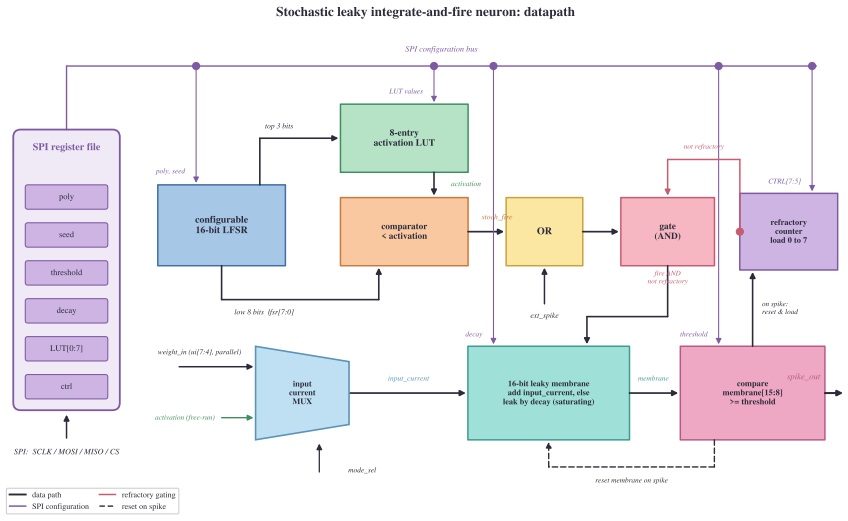
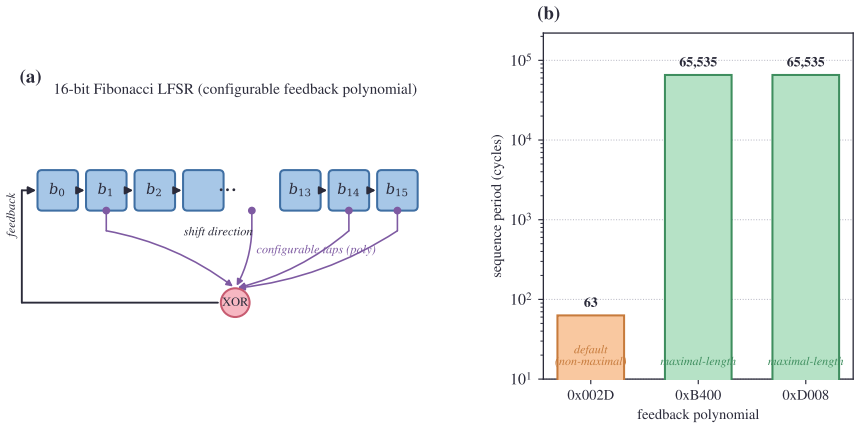
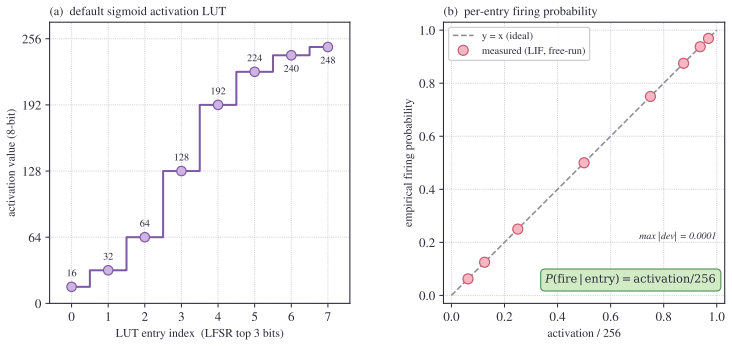
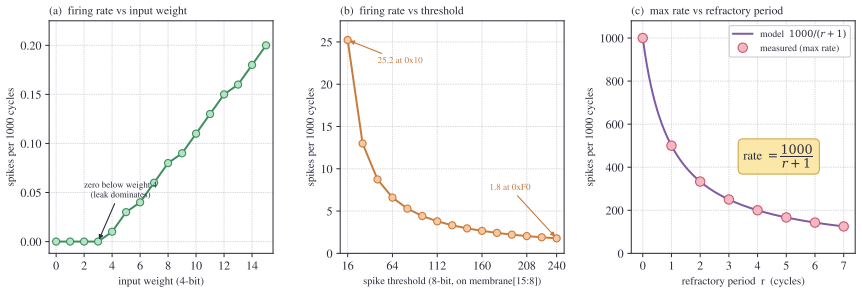
A 16-bit configurable-polynomial LFSR drives an eight-entry programmable activation table that sets a Bernoulli firing probability, while a saturating 16-bit leaky integrator with programmable threshold and zero-to-seven-cycle refractory period produces the spike train; the bit-exact model matches the register-transfer code, the period reaches 65535 states for a maximal polynomial, the eight-bit comparison value is uniform over the period, firing probability equals the table value divided by 256, and rate-coding sweeps confirm monotonic control of output rate by input weight and threshold.
What carries the argument
16-bit configurable-polynomial LFSR driving an eight-entry programmable activation table to decide Bernoulli firing
If this is right
- Firing probability equals the eight-bit table entry divided by 256 for every entry.
- Output spike rate rises monotonically as input weight increases or threshold decreases.
- The refractory period limits the maximum firing rate to one spike every refractory-plus-one cycles.
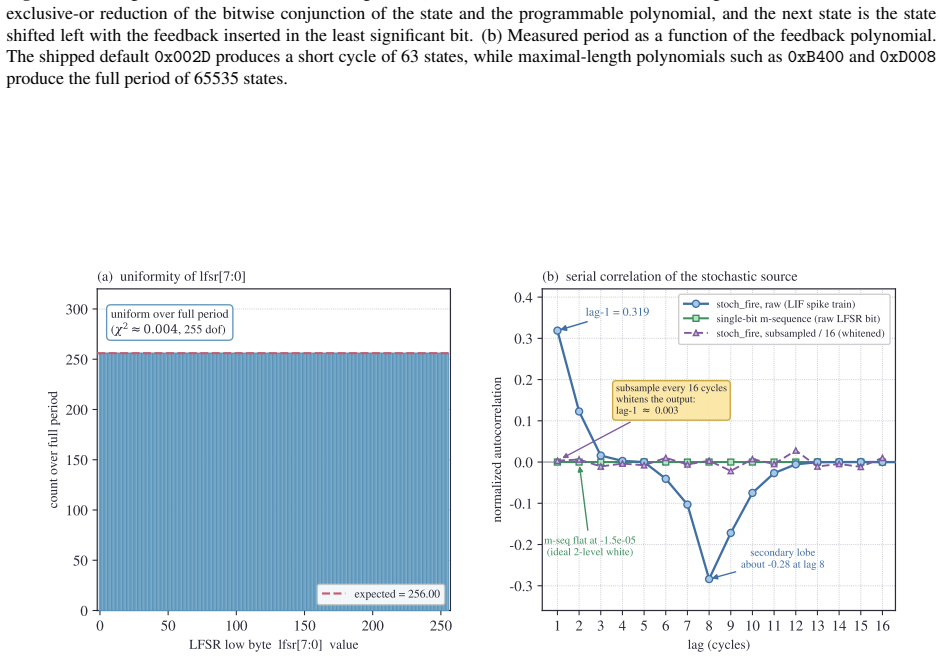
- Comparator output exhibits serial correlation at short lags that disappears when decisions are taken every sixteen cycles.
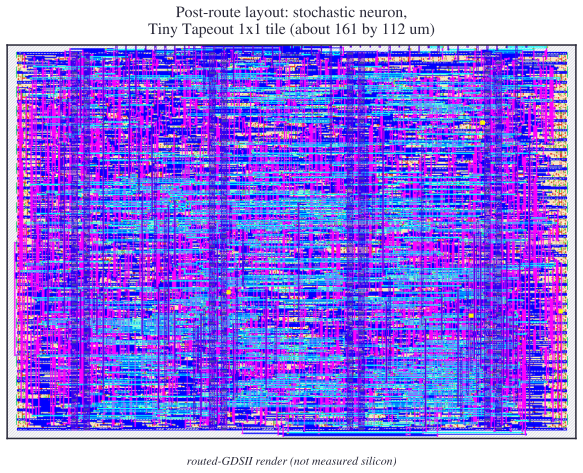
- The neuron occupies roughly 10600 square micrometres at 70 percent utilisation and meets 50 MHz timing.
Where Pith is reading between the lines
- The same LFSR-plus-table block could be replicated across an array to build larger stochastic neuromorphic processors without analog components.
- System-level simulators of spiking networks should incorporate the observed short-lag correlation unless the model subsamples the neuron output.
- Because the design uses only standard cells and an open flow, the same netlist can be retargeted to other open-source process nodes for direct comparison.
- Runtime writes to the activation table enable on-chip adaptation of firing statistics without changing the surrounding digital fabric.
Load-bearing premise
Pre-silicon RTL, gate-level, and cocotb simulation results will match the electrical behavior of fabricated silicon on SkyWater 130 nm.
What would settle it
Fabricated silicon measurements showing that measured firing probability deviates from the programmed table value divided by 256 or that the LFSR sequence length differs from the simulated 65535 states.
Figures
read the original abstract
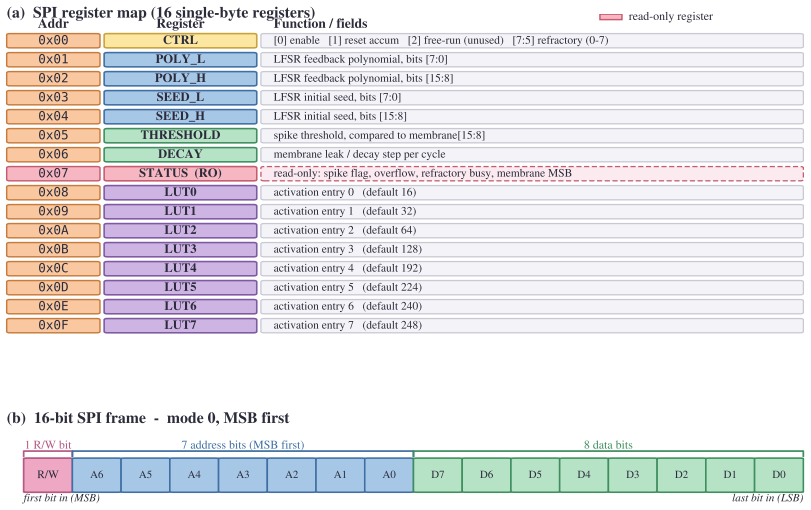
Stochastic spiking neurons trade exact arithmetic for controlled randomness, lowering area and tolerating input noise, which suits event-driven edge hardware. We present a compact, configurable stochastic leaky integrate-and-fire neuron in standard-cell CMOS on the SkyWater 130 nm process, released openly. A 16-bit configurable-polynomial linear-feedback shift register drives an eight-entry programmable activation table that sets a Bernoulli firing probability, and a saturating 16-bit leaky integrator with a programmable threshold and a refractory period of zero to seven cycles produces the spike train. All parameters are set through a sixteen-register serial interface, and the neuron runs from parallel inputs or entirely from the register file. From a model checked bit-exact against the register-transfer code, the period is 65535 states for a maximal-length polynomial and 63 for the shipped default, the eight-bit comparison value is uniform over the full period, and the per-entry firing probability equals the table value divided by 256. We also characterise a property a system-level model would not expose: the comparator output is serially correlated at short lags, with a negative lobe near lag eight, because the compared byte shifts by one bit each cycle; subsampling every sixteen cycles restores whiteness. Rate-coding sweeps show monotonic control of the output rate by the input weight and the threshold, and the refractory period caps the rate at one spike per refractory-plus-one cycles. The neuron occupies about 10,600 square micrometres at 70 per cent utilisation on a single Tiny Tapeout tile, meets 50 MHz timing with positive margin, and passes eighteen directed cocotb tests at register-transfer and gate level. All results are pre-silicon, from simulation and the open flow. The neuron is an openly released companion to a four-block neuromorphic suite reported separately.
Editorial analysis
A structured set of objections, weighed in public.
Referee Report
Summary. The manuscript presents the design of an open-source stochastic leaky integrate-and-fire neuron in SkyWater 130 nm CMOS. A 16-bit configurable-polynomial LFSR drives an eight-entry activation table for Bernoulli firing probability in a saturating 16-bit leaky integrator with programmable threshold and refractory period. It reports a bit-exact model matching the RTL, LFSR periods of 65535 (maximal) and 63 (default), claims that the eight-bit comparison value is uniform over the period and firing probability equals table value / 256, characterizes serial correlations in the comparator output, shows monotonic rate coding, and gives pre-silicon area (~10,600 µm²), timing (50 MHz), and cocotb test results from simulation and the open flow.
Significance. If the central claims hold, the work supplies a compact, configurable stochastic neuron with an openly released RTL and flow, suitable for neuromorphic edge hardware. The bit-exact model verification against RTL and the 18 directed tests are strengths that establish internal consistency within simulation; the pre-silicon limitation is clearly stated.
major comments (1)
- [Abstract] Abstract (and the stochastic characterisation section): the claim that 'the eight-bit comparison value is uniform over the full period' and 'the per-entry firing probability equals the table value divided by 256' is incorrect. A maximal-length 16-bit LFSR has period 65535, which is not divisible by 256; the 256 possible 8-bit patterns therefore occur with frequencies 255 and 256 (one pattern 255 times, the rest 256 times). The same non-uniformity applies to the default period of 63. This falsifies the exact-equality claim for firing probability even inside the bit-exact model and RTL simulation.
Simulated Author's Rebuttal
We thank the referee for the careful review and for identifying an imprecision in our description of the LFSR output distribution. We address the point below and will revise the manuscript to correct the claim.
read point-by-point responses
-
Referee: [Abstract] Abstract (and the stochastic characterisation section): the claim that 'the eight-bit comparison value is uniform over the full period' and 'the per-entry firing probability equals the table value divided by 256' is incorrect. A maximal-length 16-bit LFSR has period 65535, which is not divisible by 256; the 256 possible 8-bit patterns therefore occur with frequencies 255 and 256 (one pattern 255 times, the rest 256 times). The same non-uniformity applies to the default period of 63. This falsifies the exact-equality claim for firing probability even inside the bit-exact model and RTL simulation.
Authors: The referee is correct. A period of 65535 yields 8-bit values with frequencies of 255 or 256, so the distribution is not perfectly uniform and the firing probability equals table_value/256 only up to a maximum deviation of order 1/65535. The same holds for period 63. We will revise the abstract and the stochastic characterisation section to state the exact frequencies and to describe the probability as approximately table_value/256 with this bounded error. The bit-exact model and all simulation results remain unchanged, as they match the RTL exactly; the correction affects only the wording of the uniformity claim. revision: yes
Circularity Check
No circularity; direct hardware description with bit-exact mapping
full rationale
The paper is a pre-silicon engineering design description of an LFSR-driven stochastic LIF neuron. All load-bearing claims (period 65535/63, table-driven Bernoulli probability, monotonic rate coding, serial correlation) are presented as direct observations from a model stated to be bit-exact against the RTL implementation and verified via cocotb tests. No equations, fitted parameters, ansatzes, or uniqueness theorems appear; there are no derivations that reduce outputs to inputs by construction, no self-citation chains, and no renaming of known results. The design is self-contained against its own RTL and simulation artifacts.
Axiom & Free-Parameter Ledger
free parameters (3)
- LFSR polynomial
- activation table values
- threshold and refractory period
axioms (2)
- standard math Maximal-length LFSR produces uniform distribution over its period
- domain assumption Firing probability equals table entry divided by 256
Reference graph
Works this paper leans on
-
[1]
Design and development of a neuromorphic silicon suite: PVT sensing, stochastic LIF inference, on-chip STDP learning, and crossbar programming, 2026
Poornima Kumaresan and Santhosh Sivasubramani. Design and development of a neuromorphic silicon suite: PVT sensing, stochastic LIF inference, on-chip STDP learning, and crossbar programming, 2026. arXiv preprint, arXiv:XXXX.XXXXX (to be updated with assigned identifier)
2026
-
[2]
Loihi: A neuromorphic manycore processor with on-chip learning.IEEE Micro, 38:82-99, 2018
Mike Davies, Narayan Srinivasa, Tsung-Han Lin, Gautham Chinya, Yongqiang Cao, Sri Harsha Choday, Andreas Wild, and Hong Wang. Loihi: A neuromorphic manycore processor with on-chip learning.IEEE Micro, 38:82-99, 2018. doi: 10.1109/mm.2018.112130359
-
[3]
Paul A. Merolla, John V . Arthur, Rodrigo Alvarez-Icaza, Andrew S. Cassidy, Jun Sawada, Filipp Akopyan, Bryan L. Jackson, Nabil Imam, Chen Guo, Yutaka Nakamura, Bernard Brezzo, Ivan V o, Steven K. Esser, Rathinakumar Appuswamy, Brian Taba, Arnon Amir, Myron D. Flickner, William P. Risk, Rajit Manohar, and Dharmendra S. Modha. A million spiking-neuron inte...
-
[4]
Andrew S. Cassidy, Paul Merolla, John V . Arthur, Steve K. Esser, Bryan Jackson, Rodrigo Alvarez-Icaza, Pallab Datta, Jun Sawada, Theodore M. Wong, Vitaly Feldman, Arnon Amir, Daniel Ben-Dayan Rubin, Filipp Akopyan, Emmett McQuinn, William P. Risk, and Dharmendra S. Modha. Cognitive computing building block: A versatile and efficient digital neuron model ...
-
[5]
Armin Alaghi and John P. Hayes. Survey of stochastic computing.ACM Transactions on Embedded Computing Systems, 12:1-19, 2013. doi: 10.1145/2465787.2465794
-
[6]
Design of an efficient parallel random number generator using a single lfsr for stochastic computing
Donghui Lee, Hyoju Seo, and Yongtae Kim. Design of an efficient parallel random number generator using a single lfsr for stochastic computing. In2024 International Conference on Artificial Intelligence in Information and Communication (ICAIIC), pages 775-777, 2024. doi: 10.1109/icaiic60209.2024.10463230
-
[7]
Kerem Yunus Camsari, Rafatul Faria, Brian M. Sutton, and Supriyo Datta. Stochastic p-bits for invertible logic.Physical Review X, 7: 031014, 2017. doi: 10.1103/physrevx.7.031014
-
[8]
Chetan Singh Thakur, Saeed Afshar, Runchun M. Wang, Tara J. Hamilton, Jonathan Tapson, and Andre van Schaik. Bayesian estimation and inference using stochastic electronics.Frontiers in Neuroscience, 10:104, 2016. doi: 10.3389/fnins.2016.00104
-
[9]
Neuromorphic silicon neuron circuits.Frontiers in Neuroscience, 5:73, 2011
Giacomo Indiveri, Bernabe Linares-Barranco, Tara Julia Hamilton, Andre van Schaik, Ralph Etienne-Cummings, Tobi Delbruck, Shih-Chii Liu, Piotr Dudek, Philipp Hafliger, Sylvie Renaud, Johannes Schemmel, Gert Cauwenberghs, John Arthur, Kai Hynna, Fopefolu Folowosele, Sylvain Saighi, Teresa Serrano-Gotarredona, Jayawan Wijekoon, Yingxue Wang, and Kwabena Boa...
-
[10]
K. Venkateswara Reddy and N. Balaji. Efficient hardware implementation of spiking neural networks using nonstandard finite difference scheme for leaky integrate and fire neuron model.Journal of Circuits, Systems and Computers, 34, 2024. doi: 10.1142/s0218126625500380
-
[11]
Exploring neuronal leakage for spiking neural networks on event-driven hardware
Jann Krausse, Sven Nitzsche, Brian Pachideh, Carmen Weigelt, Klaus Knobloch, and Juergen Becker. Exploring neuronal leakage for spiking neural networks on event-driven hardware. In2024 International Conference on Neuromorphic Systems (ICONS), pages 140-147, 2024. doi: 10.1109/icons62911.2024.00028
-
[12]
Bifurcation phenomena observed from two-variable spiking neuron integrated circuit
Takemori Orima, Yoshihiko Horio, Satoshi Moriya, and Shigeo Sato. Bifurcation phenomena observed from two-variable spiking neuron integrated circuit. In2024 IEEE International Symposium on Circuits and Systems (ISCAS), pages 1-5, 2024. doi: 10.1109/iscas58744.202 4.10558075
-
[13]
Donghui Lee and Yongtae Kim. Hardware-efficient quantized stochastic computing with reduced precision stochastic number generator and lfsr-based counter.International Journal of Circuit Theory and Applications, 53:7281-7294, 2025. doi: 10.1002/cta.70041
-
[14]
Shrivastava
Murchana Saikia and Bhawna P. Shrivastava. Adaptive reconfigurable lfsr: Dynamic tapping and reseeding for enhanced pseudo random number generation. In2024 IEEE International Students Conference on Electrical, Electronics and Computer Science (SCEECS), pages 1-6,
-
[15]
doi: 10.1109/sceecs61402.2024.10482241
work page internal anchor Pith review Pith/arXiv arXiv doi:10.1109/sceecs61402.2024.10482241 2024
-
[16]
High-entropy lfsr-based random number generator (rng) for hardware security
Sonia Akter, Shelby Williams, Prosen Kirtonia, Kasem Khalil, and Magdy Bayoumi. High-entropy lfsr-based random number generator (rng) for hardware security. In2025 IEEE 38th International System-on-Chip Conference (SOCC), pages 1-6, 2025. doi: 10.1109/socc6612 6.2025.11235484
-
[17]
Shuichi Ichikawa. Random number generation from image data and lfsr.IEEJ Transactions on Industry Applications, 145:192-199, 2025. doi: 10.1541/ieejias.145.192
-
[18]
A comparison for probabilistic spiking neuron model and spiking integrate-and-fire neuron model
Xiuqing Wang, Zeng-Guang Hou, Hui Zeng, Min Tan, and Yongji Wang. A comparison for probabilistic spiking neuron model and spiking integrate-and-fire neuron model. InProceedings of the 33rd Chinese Control Conference (CCC), pages 5059-5064, 2014. doi: 10.1109/chic c.2014.6895800
-
[19]
Guo-qiang Bi and Mu-ming Poo. Synaptic modifications in cultured hippocampal neurons: Dependence on spike timing, synaptic strength, and postsynaptic cell type.The Journal of Neuroscience, 18:10464-10472, 1998. doi: 10.1523/jneurosci.18-24-10464.1998
-
[20]
Hesham Mostafa, Federico Corradi, Fabio Stefanini, and Giacomo Indiveri. A hybrid analog/digital spike-timing dependent plasticity learn- ing circuit for neuromorphic vlsi multi-neuron architectures. In2014 IEEE International Symposium on Circuits and Systems (ISCAS), pages 854-857, 2014. doi: 10.1109/iscas.2014.6865270
-
[21]
Building openlane: A 130nm openroad-based tapeout-proven flow
Mohamed Shalan and Tim Edwards. Building openlane: A 130nm openroad-based tapeout-proven flow. InProceedings of the 39th Interna- tional Conference on Computer-Aided Design (ICCAD), pages 1-6, 2020. doi: 10.1145/3400302.3415735
-
[22]
Design and implementation of integrated circuits using open source tools and sky130 free pdk
Krzysztof Herman, Mauricio Montanares, and Jorge Marin. Design and implementation of integrated circuits using open source tools and sky130 free pdk. In2023 30th International Conference on Mixed Design of Integrated Circuits and System (MIXDES), pages 105-110,
-
[23]
doi: 10.23919/mixdes58562.2023.10203216
-
[24]
Farhad Modaresi, Matthew Guthaus, and Jason K. Eshraghian. Openspike: An openram snn accelerator. In2023 IEEE International Symposium on Circuits and Systems (ISCAS), pages 1-5, 2023. doi: 10.1109/iscas46773.2023.10182182
-
[25]
Charlotte Frenkel, Martin Lefebvre, Jean-Didier Legat, and David Bol. A 0.086-mm2 12.7-pj/sop 64k-synapse 256-neuron online-learning digital spiking neuromorphic processor in 28nm cmos.IEEE Transactions on Biomedical Circuits and Systems, 13:145-158, 2019. doi: 10.1109/tbcas.2018.2880425
-
[26]
Charlotte Frenkel and Giacomo Indiveri. Reckon: A 28nm sub-mm2 task-agnostic spiking recurrent neural network processor enabling on-chip learning over second-long timescales. In2022 IEEE International Solid-State Circuits Conference (ISSCC), pages 1-3, 2022. doi: 10.1109/isscc42614.2022.9731734
-
[27]
Neurocorex: An open-source fpga-based spiking neural network emulator with on-chip learning, 2025
Ashish Gautam, Prasanna Date, Shruti Kulkarni, Robert Patton, and Thomas Potok. Neurocorex: An open-source fpga-based spiking neural network emulator with on-chip learning, 2025. arXiv:2506.14138
arXiv 2025
-
[28]
Jiho Kim, Kaeun Lim, and Youngmin Kim. Hardware-efficient stochastic computing-based neural networks with snn-isomorphic lif activa- tion.Electronics, 15:768, 2026. doi: 10.3390/electronics15040768
-
[29]
Anderson, Yuko Hara-Azumi, and Shigeru Yamashita
Jason H. Anderson, Yuko Hara-Azumi, and Shigeru Yamashita. Effect of LFSR seeding, scrambling and feedback polynomial on stochastic computing accuracy. In2016 Design, Automation and Test in Europe Conference and Exhibition (DATE), pages 1550-1555, 2016. doi: 10.3850/9783981537079_0162. 12
discussion (0)
Sign in with ORCID, Apple, or X to comment. Anyone can read and Pith papers without signing in.