Probing Nuclear Effects with Transverse Kinematic Imbalance in Muon-neutrino Induced Charged-Current π⁰ Production on Argon with the MicroBooNE Detector
Pith reviewed 2026-06-26 05:44 UTC · model grok-4.3
The pith
Muon-neutrino charged-current pi0 production on argon produces transverse kinematic imbalances that no tested nuclear model reproduces simultaneously.
A machine-rendered reading of the paper's core claim, the machinery that carries it, and where it could break.
Core claim
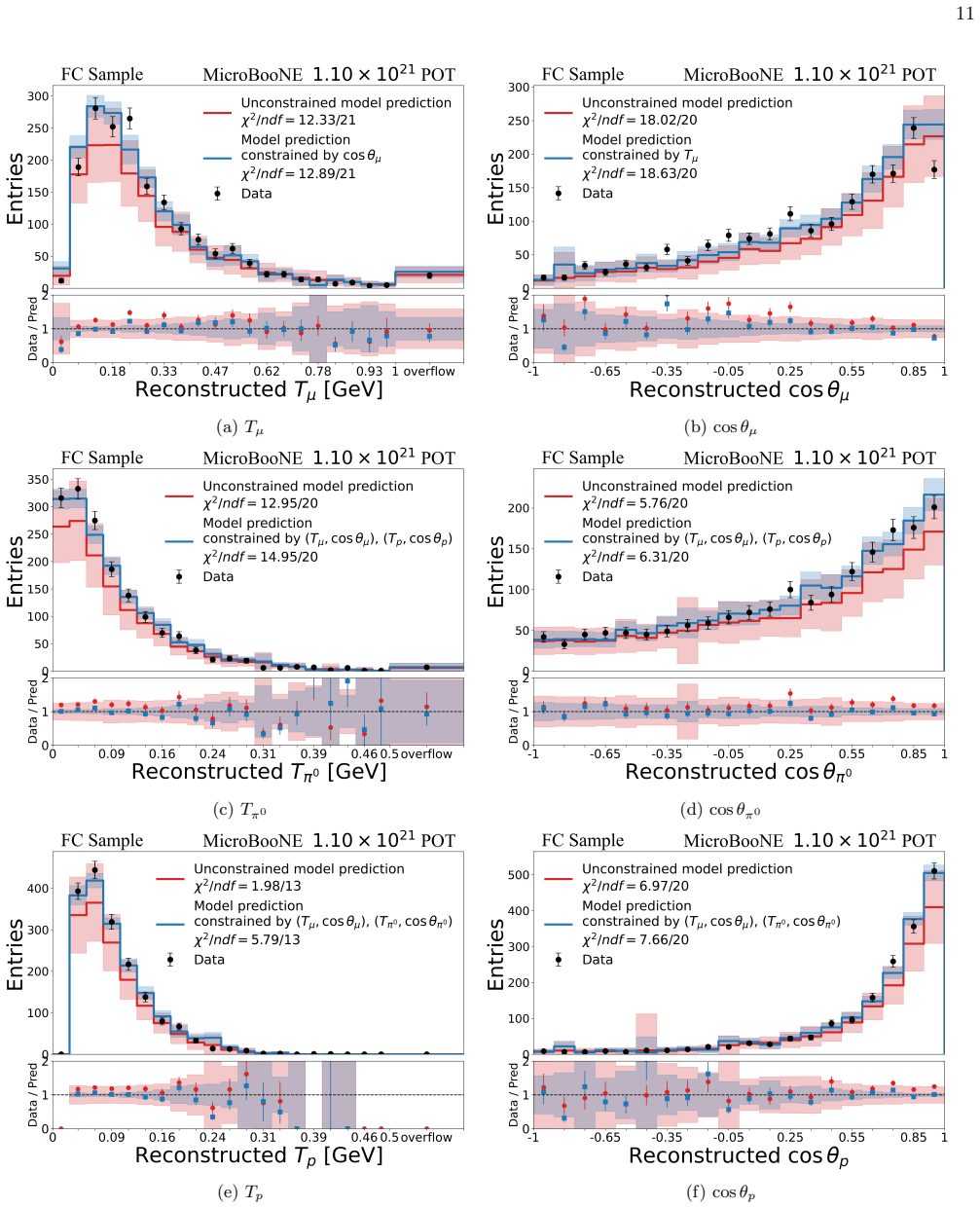
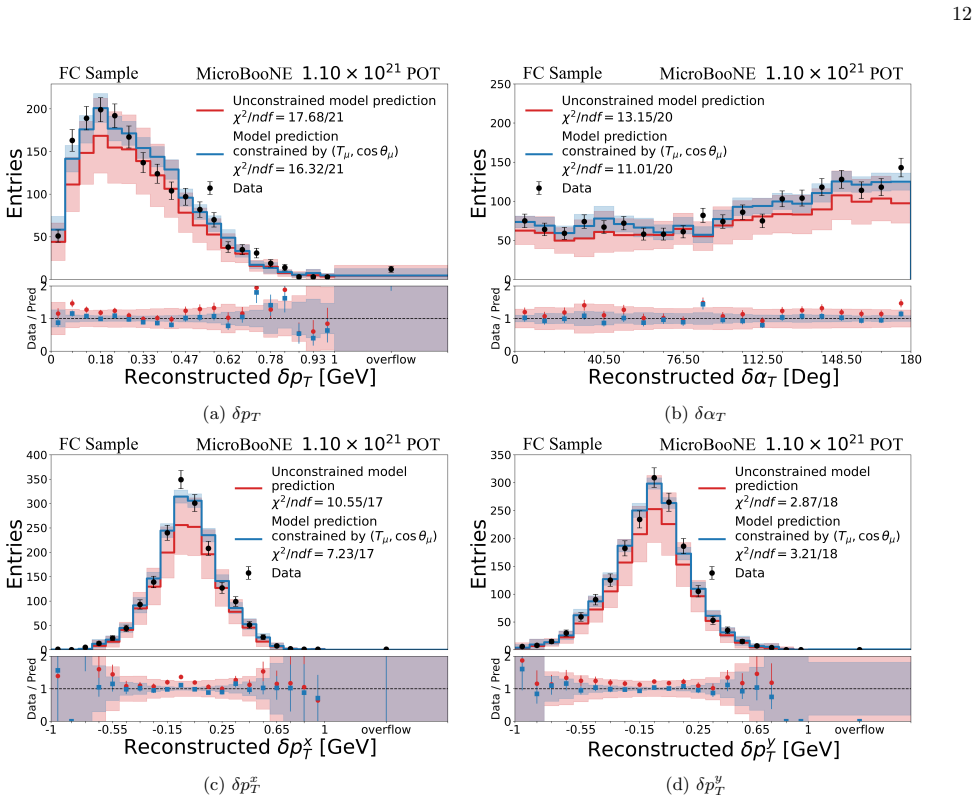
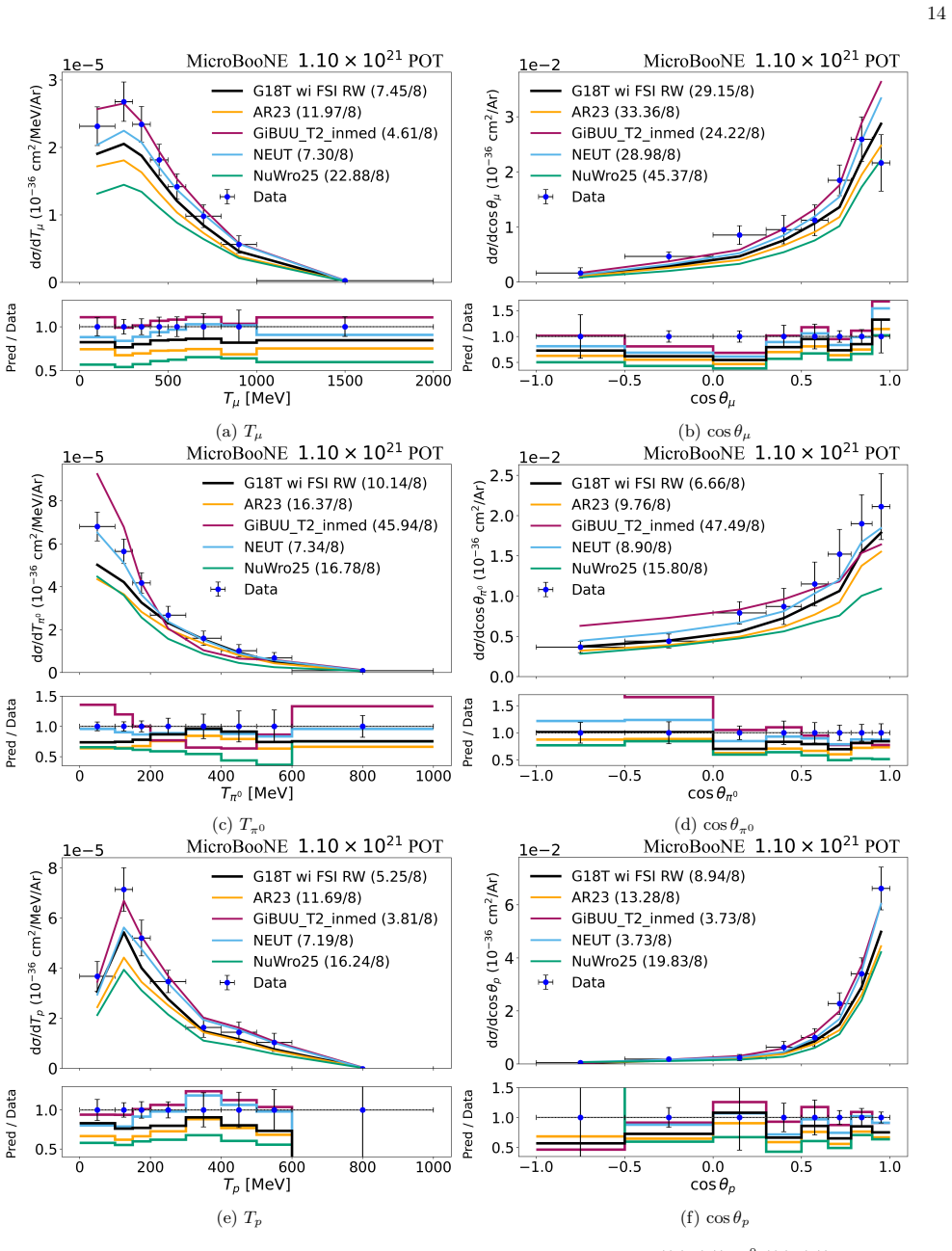
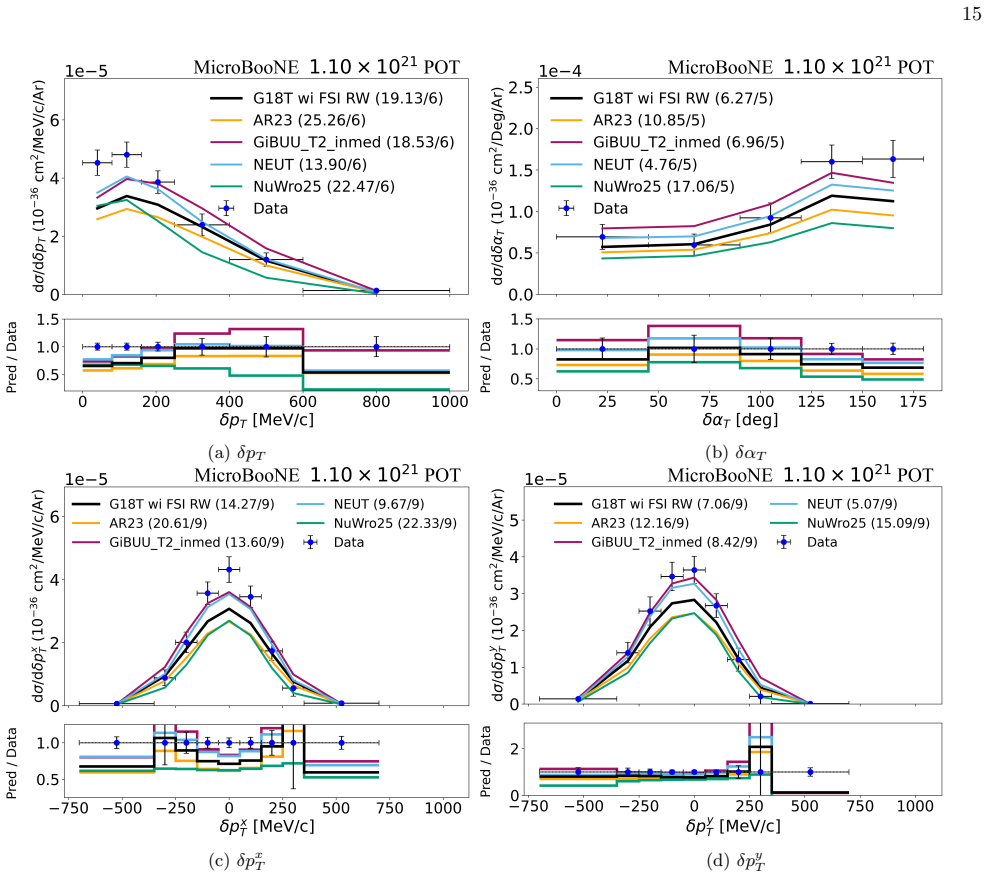
The first measurement of muon neutrino charged-current resonance-like interactions on argon is reported using transverse kinematic imbalance variables constructed from the reconstructed momenta of the muon, leading proton, and neutral pion. These observables probe final-state interactions, and a comprehensive characterization of the pi0-proton final state is given. However, none of the models considered are able to simultaneously reproduce all measured observables.
What carries the argument
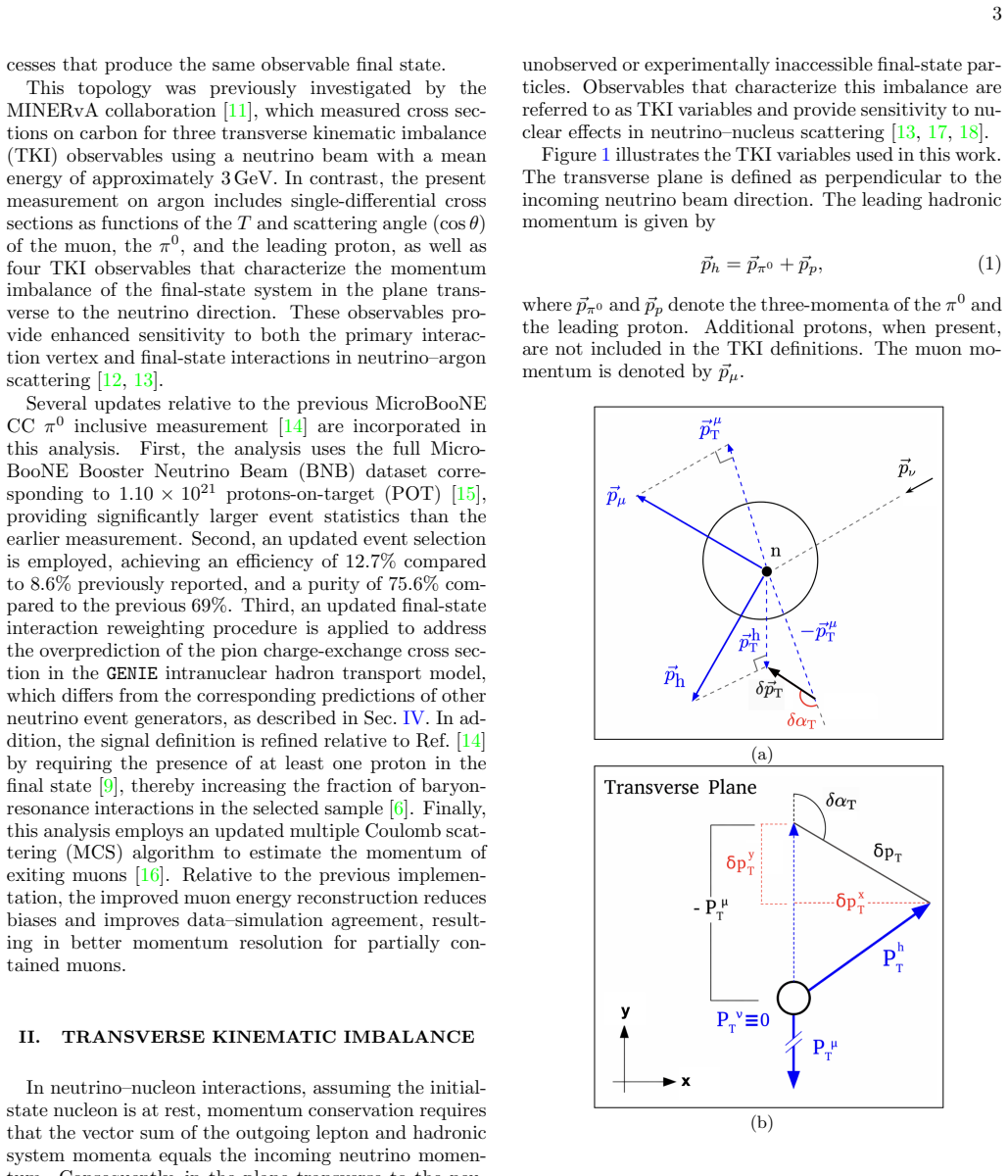
Transverse kinematic imbalance variables formed from muon, leading-proton, and neutral-pion momenta; these quantities are constructed to be sensitive to final-state interactions.
If this is right
- Improved constraints on resonance production and final-state interactions near the DUNE neutrino energy peak.
- Direct input for tuning neutrino event generators used in oscillation analyses.
- Identification of specific kinematic regions where current models fail.
- A benchmark data set for testing future nuclear-effect calculations on argon.
Where Pith is reading between the lines
- The mismatch across observables points to incomplete treatment of pion rescattering or absorption inside the nucleus.
- Similar imbalance variables could be applied to other final states to isolate different nuclear processes.
- The measurement supplies a concrete target for new theoretical calculations that aim to describe argon targets without additional free parameters.
Load-bearing premise
The selected events are dominated by resonance-like interactions and the momenta of the muon, proton, and pion are reconstructed with enough accuracy for the imbalance variables to be meaningful.
What would settle it
An independent analysis that either shows the selected sample contains a large non-resonance component or demonstrates that one of the tested models reproduces all observables within the reported uncertainties.
Figures

read the original abstract
Neutrino-nucleus cross-section measurements are needed to improve interaction modeling and to enable precision neutrino oscillation measurements in upcoming experiments such as the Deep Underground Neutrino Experiment (DUNE), Hyper-Kamiokande, and the Short-Baseline Neutrino program. Baryon-resonance neutrino interactions constitute a dominant contribution near the peak of the DUNE neutrino energy spectrum. We present the first measurement of muon neutrino charged-current resonance-like interactions on argon using transverse kinematic imbalance variables with the MicroBooNE detector. These observables are highly sensitive to the modeling of final-state interactions. This measurement probes kinematic imbalances using the reconstructed momenta of the muon, leading proton, and neutral pion. A comprehensive characterization of the $\pi^0$-proton final state is presented; however, none of the models considered are able to simultaneously reproduce all measured observables.
Editorial analysis
A structured set of objections, weighed in public.
Referee Report
Summary. The manuscript reports the first measurement of muon-neutrino charged-current resonance-like interactions on argon using transverse kinematic imbalance observables constructed from reconstructed muon, leading-proton, and neutral-pion momenta in the MicroBooNE detector. A comprehensive characterization of the π⁰-proton final state is presented, with the central conclusion that none of the models considered simultaneously reproduce all measured observables.
Significance. If robust, the result supplies the first argon-target data on transverse kinematic imbalance in the resonance region, directly testing final-state interaction modeling that is critical for DUNE and SBN oscillation analyses. The choice of transverse imbalance variables is a methodological strength because they are designed to isolate nuclear effects with reduced dependence on the incoming neutrino energy.
major comments (2)
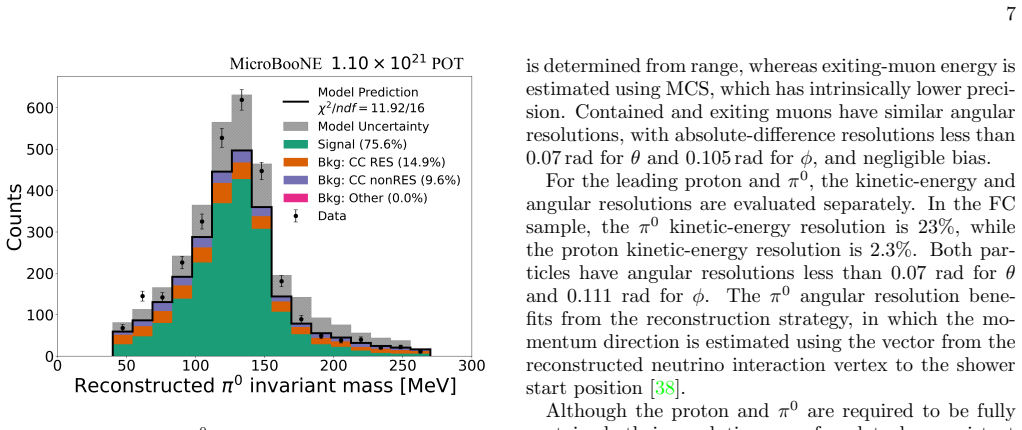
- [Event selection] Event selection and sample composition: the central claim that discrepancies with models reflect deficiencies in FSI modeling presupposes that the selected sample is dominated by resonance-like CC interactions. No purity, background fraction, or efficiency-corrected yield is quoted, leaving open the possibility that non-resonant or mis-reconstructed contributions drive the reported model failures.
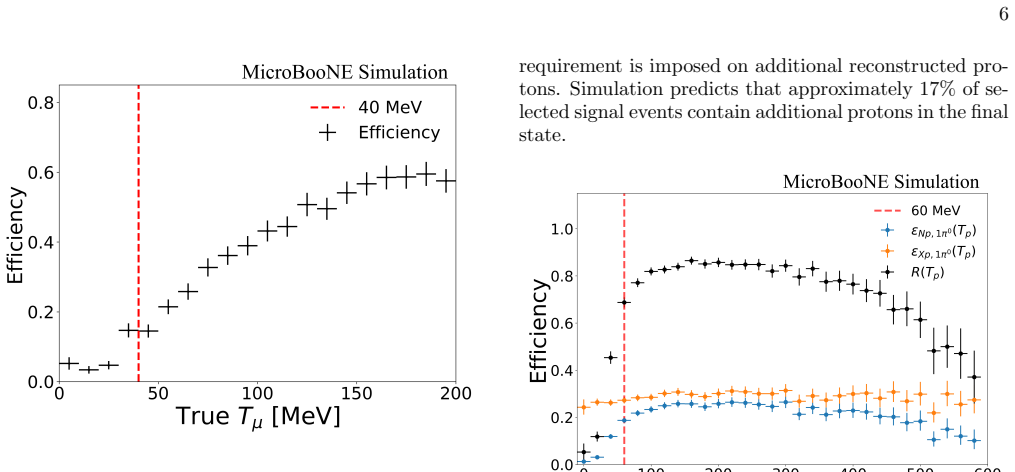
- [Reconstruction and detector response] Momentum reconstruction and resolution: the transverse imbalance observables rely on accurate reconstruction of muon, proton, and especially π⁰ (two-photon) momenta. No resolution functions, bias studies, or efficiency numbers for these three particles are supplied, which directly affects whether the observed model disagreements can be interpreted as physics rather than reconstruction artifacts.
Simulated Author's Rebuttal
We thank the referee for their detailed and constructive feedback on our manuscript. We have carefully considered each major comment and provide point-by-point responses below. Where appropriate, we have revised the manuscript to address the concerns raised.
read point-by-point responses
-
Referee: [Event selection] Event selection and sample composition: the central claim that discrepancies with models reflect deficiencies in FSI modeling presupposes that the selected sample is dominated by resonance-like CC interactions. No purity, background fraction, or efficiency-corrected yield is quoted, leaving open the possibility that non-resonant or mis-reconstructed contributions drive the reported model failures.
Authors: We agree that explicit quantification of the sample composition is essential to support our conclusions. In the revised manuscript, we have added a new subsection detailing the event selection criteria, along with estimates of the purity of the resonance-like CCπ⁰ sample (approximately 70% based on simulation), background contributions from non-resonant and other processes, and efficiency-corrected yields. These additions demonstrate that the selected events are predominantly from resonance-like interactions, thereby reinforcing that the observed discrepancies with models are attributable to deficiencies in FSI modeling rather than sample impurities. revision: yes
-
Referee: [Reconstruction and detector response] Momentum reconstruction and resolution: the transverse imbalance observables rely on accurate reconstruction of muon, proton, and especially π⁰ (two-photon) momenta. No resolution functions, bias studies, or efficiency numbers for these three particles are supplied, which directly affects whether the observed model disagreements can be interpreted as physics rather than reconstruction artifacts.
Authors: We acknowledge the importance of documenting the reconstruction performance. The revised manuscript now includes dedicated figures and text presenting the momentum resolution functions for the muon, leading proton, and π⁰, as well as bias studies and efficiency numbers obtained from both Monte Carlo simulations and data-driven techniques. These studies show that the resolutions are sufficient for the transverse imbalance observables and that the model disagreements persist even after accounting for reconstruction effects, indicating they reflect underlying physics modeling issues. revision: yes
Circularity Check
No circularity: experimental measurement with external model comparison
full rationale
This is a pure measurement paper that extracts transverse kinematic imbalance observables directly from MicroBooNE detector data on argon and compares them to pre-existing external models. No parameters are fitted inside the paper and then relabeled as predictions; no derivation chain reduces to self-definition or self-citation; the central result (model discrepancies) rests on data rather than on any internal ansatz or uniqueness theorem. The reader's note correctly identifies the work as non-circular.
Axiom & Free-Parameter Ledger
Reference graph
Works this paper leans on
-
[1]
Benhar, P
O. Benhar, P. Huber, C. Mariani, and D. Meloni, Neutrino–nucleus interactions and the determination of oscillation parameters, Phys. Rep.700, 1 (2017)
2017
-
[2]
Katori and M
T. Katori and M. Martini, Neutrino–nucleus cross sec- tions for oscillation experiments, Prog. Part. Nucl. Phys. 112, 103773 (2020)
2020
-
[3]
Abiet al.(DUNE Collaboration), Deep underground neutrino experiment (DUNE), far detector technical de- sign report, J
B. Abiet al.(DUNE Collaboration), Deep underground neutrino experiment (DUNE), far detector technical de- sign report, J. Instrum.15, T08008
-
[4]
Alvarez-Rusoet al.(NuSTEC Collaboration), NuSTEC white paper: Status and challenges of neutrino– nucleus scattering, Prog
L. Alvarez-Rusoet al.(NuSTEC Collaboration), NuSTEC white paper: Status and challenges of neutrino– nucleus scattering, Prog. Part. Nucl. Phys.100, 1 (2018)
2018
-
[5]
Coloma, P
P. Coloma, P. Huber, C.-M. Jen, and C. Mariani, Neutrino–nucleus cross section uncertainties and their role in long-baseline oscillation experiments, Phys. Rev. D89, 073015 (2014)
2014
-
[6]
Mosel, Neutrino interactions with nucleons and nu- clei: Importance for long-baseline experiments, Phys
U. Mosel, Neutrino interactions with nucleons and nu- clei: Importance for long-baseline experiments, Phys. Rep.645, 1 (2016)
2016
-
[7]
J. A. Formaggio and G. P. Zeller, From eV to EeV: Neu- trino cross sections across energy scales, Rev. Mod. Phys. 84, 1307 (2012)
2012
-
[8]
Rein and L
D. Rein and L. M. Sehgal, Neutrino-excitation of baryon resonances and single pion production, Ann. Phys.133, 79 (1981)
1981
-
[9]
Hern´ andez, J
E. Hern´ andez, J. Nieves, and M. J. Vicente Vacas, Single pion production in neutrino–nucleon interactions, Phys. Rev. D87, 113009 (2013)
2013
-
[10]
A. A. Aguilar-Arevaloet al.(MiniBooNE Collaboration), Measurement of neutral currentπ 0 production in neu- 20 trino interactions on mineral oil, Phys. Rev. D81, 013005 (2010)
2010
-
[11]
Aliagaet al.(MINERvA Collaboration), Probing nu- clear effects with neutrino-induced charged-current neu- tral pion production, Phys
L. Aliagaet al.(MINERvA Collaboration), Probing nu- clear effects with neutrino-induced charged-current neu- tral pion production, Phys. Rev. D102, 072007 (2020)
2020
-
[12]
L. Bathe-Peters, S. Gardiner, and R. Guenette, Compar- ing generator predictions of transverse kinematic imbal- ance in neutrino–argon scattering, arXiv preprint (2022), FERMILAB-PUB-22-007-SCD, arXiv:2201.04664 [hep- ph]
arXiv 2022
-
[13]
X.-G. Lu, L. Pickering, S. Dolan, G. Barr, D. Coplowe, Y. Uchida, D. Wark, M. O. Wascko, A. Weber, and T. Yuan, Measurement of nuclear effects in neutrino in- teractions with minimal dependence on neutrino energy, Phys. Rev. C94, 015503 (2016)
2016
-
[14]
P. Abratenkoet al.(MicroBooNE Collaboration), Mea- surement of the differential cross section for neutral pion production in charged-current muon neutrino interac- tions on argon with the MicroBooNE detector, Phys. Rev. D110, 092014 (2024)
2024
-
[15]
Acciarriet al.(MicroBooNE Collaboration), Design and construction of the MicroBooNE detector, J
R. Acciarriet al.(MicroBooNE Collaboration), Design and construction of the MicroBooNE detector, J. In- strum.12, P02017
-
[16]
MicroBooNE Collaboration, Improved muon energy es- timation using a detailed model of multiple coulomb scattering in the MicroBooNE LArTPC, arXiv preprint (2026), arXiv:2605.03048 [hep-ex]
Pith/arXiv arXiv 2026
-
[17]
Abeet al.(T2K Collaboration), Measurement of transverse kinematic imbalance in neutrino–nucleus in- teractions, Phys
K. Abeet al.(T2K Collaboration), Measurement of transverse kinematic imbalance in neutrino–nucleus in- teractions, Phys. Rev. D98, 032003 (2018)
2018
-
[18]
P. Abratenkoet al.(MicroBooNE Collaboration), Mea- surement of nuclear effects in neutrino–argon interactions using generalized kinematic imbalance variables with the MicroBooNE detector, Phys. Rev. D109, 092007 (2024)
2024
-
[19]
X.-G. Lu, D. Coplowe, R. Shah, G. Barr, D. Wark, and A. Weber, Reconstruction of energy spectra of neutrino beams independent of nuclear effects, Phys. Rev. D92, 051302 (2015)
2015
-
[20]
K. Abeet al.(T2K Collaboration), First T2K measure- ment of transverse kinematic imbalance in the muon neu- trino charged-current single-π + production channel con- taining at least one proton, Phys. Rev. D103, 112009 (2021)
2021
-
[21]
A. A. Aguilar-Arevaloet al.(MiniBooNE Collaboration), The neutrino flux prediction at MiniBooNE, Phys. Rev. D79, 072002 (2009)
2009
-
[22]
Acciarriet al.(MicroBooNE Collaboration), Cosmic ray background removal in the MicroBooNE LArTPC, J
R. Acciarriet al.(MicroBooNE Collaboration), Cosmic ray background removal in the MicroBooNE LArTPC, J. Instrum.12, P12030
-
[23]
Agostinelliet al.(GEANT4 Collaboration), GEANT4–a simulation toolkit, Nucl
S. Agostinelliet al.(GEANT4 Collaboration), GEANT4–a simulation toolkit, Nucl. Instrum. Meth. A 506, 250 (2003)
2003
-
[24]
Andreopouloset al.(GENIE Collaboration), The GE- NIE neutrino Monte Carlo generator: physics and user manual, Nucl
C. Andreopouloset al.(GENIE Collaboration), The GE- NIE neutrino Monte Carlo generator: physics and user manual, Nucl. Instrum. Meth. A614, 87 (2010)
2010
-
[25]
Abratenkoet al.(MicroBooNE Collaboration), New CC0πGENIE model tune for MicroBooNE, Phys
P. Abratenkoet al.(MicroBooNE Collaboration), New CC0πGENIE model tune for MicroBooNE, Phys. Rev. D105, 072001 (2022)
2022
-
[26]
Berger and L
C. Berger and L. M. Sehgal, Lepton mass effects in single pion production by neutrinos, Phys. Rev. D76, 113004 (2007)
2007
-
[27]
R. A. Freedman, G. A. Miller, and E. M. Henley, Pion nucleus scattering and systematics of the ∆-nucleus po- tential, Phys. Lett. B103, 397 (1981)
1981
-
[28]
Tena-Vidalet al., Neutrino–nucleus modeling in GE- NIE v3, Phys
J. Tena-Vidalet al., Neutrino–nucleus modeling in GE- NIE v3, Phys. Rev. D104, 072009 (2021)
2021
-
[29]
S. G. Mashnik, A. J. Sierk, K. K. Gudima, and M. I. Baz- nat, CEM03 and LAQGSM03—new modeling tools for nuclear applications, J. Phys. Conf. Ser.41, 340 (2006)
2006
-
[30]
Dytman, Y
S. Dytman, Y. Hayato, R. Raboanary, J. T. Sobczyk, J. Tena-Vidal, and N. Vololoniaina, Comparison of vali- dation methods of simulations for final-state interactions in hadron production experiments, Phys. Rev. D104, 053006 (2021)
2021
-
[31]
H. R. Sharma, S. Nagu, J. Singh, and R. B. Singh, Study of pion production inν µ interactions on 40Ar in DUNE using GENIE and NuWro event generators, Phys. Part. Nucl. Lett.19, 724 (2022)
2022
-
[32]
GENIE Collaboration, GENIE neutrino Monte Carlo generator,https://github.com/GENIE-MC/Generator, accessed: 2026-02-16
2026
-
[33]
E. D. Church, Larsoft: A software package for liquid argon time projection drift chambers, arXiv preprint (2013), arXiv:1311.6774 [physics.ins-det]
Pith/arXiv arXiv 2013
-
[34]
Acciarriet al.(MicroBooNE Collaboration), Ioniza- tion electron signal processing in single-phase LArTPCs
R. Acciarriet al.(MicroBooNE Collaboration), Ioniza- tion electron signal processing in single-phase LArTPCs. Part I. algorithm description and quantitative evaluation with MicroBooNE simulation, J. Instrum.13, P07006
-
[35]
Acciarriet al.(MicroBooNE Collaboration), A study of electron recombination using highly ionizing parti- cles in the ArgoNeuT liquid argon TPC, J
R. Acciarriet al.(MicroBooNE Collaboration), A study of electron recombination using highly ionizing parti- cles in the ArgoNeuT liquid argon TPC, J. Instrum.8, P08005
-
[36]
Abratenkoet al.(MicroBooNE Collaboration), Inclu- sive cross section measurements in final states with and without protons for charged-currentν µ–ar scattering in MicroBooNE, Phys
P. Abratenkoet al.(MicroBooNE Collaboration), Inclu- sive cross section measurements in final states with and without protons for charged-currentν µ–ar scattering in MicroBooNE, Phys. Rev. D110, 013006 (2024)
2024
-
[37]
Abratenkoet al.(MicroBooNE Collaboration), Mea- surement of inclusive muon neutrino charged-current dif- ferential cross sections on argon with Wire-Cell recon- struction, Phys
P. Abratenkoet al.(MicroBooNE Collaboration), Mea- surement of inclusive muon neutrino charged-current dif- ferential cross sections on argon with Wire-Cell recon- struction, Phys. Rev. Lett.123, 131801 (2019)
2019
-
[38]
Wanget al., Wire-Cell 3D imaging reconstruction in liquid argon time projection chambers, J
Y. Wanget al., Wire-Cell 3D imaging reconstruction in liquid argon time projection chambers, J. Instrum.13, P07016
-
[39]
Shibamura, A
E. Shibamura, A. Hitachi, T. Doke, T. Takahashi, S. Kubota, and M. Miyajima, Drift velocities of electrons, saturation characteristics of ionization and w-values for conversion electrons in liquid argon, liquid argon–gas mixtures and liquid xenon, Nucl. Instrum. Meth.131, 249 (1975)
1975
-
[40]
P. Abratenkoet al.(MicroBooNE Collaboration), First double-differential cross section measurement of neutral- currentπ 0 production in neutrino–argon scattering in the MicroBooNE detector, Phys. Rev. Lett.134, 161802 (2025)
2025
-
[41]
See Supplemental Material at [URL will be inserted by publisher] for additional details
-
[42]
Abratenkoet al.(MicroBooNE Collaboration), Mea- surement of neutral pion production inν µ charged- current interactions on argon with the MicroBooNE de- tector, Phys
P. Abratenkoet al.(MicroBooNE Collaboration), Mea- surement of neutral pion production inν µ charged- current interactions on argon with the MicroBooNE de- tector, Phys. Rev. D107, 012004 (2023)
2023
-
[43]
Abratenkoet al.(MicroBooNE Collaboration), Novel approach for evaluating detector-related uncertainties in a LArTPC using MicroBooNE data, Eur
P. Abratenkoet al.(MicroBooNE Collaboration), Novel approach for evaluating detector-related uncertainties in a LArTPC using MicroBooNE data, Eur. Phys. J. C82, 454 (2022)
2022
-
[44]
Calcutt, C
J. Calcutt, C. Thorpe, K. Mahn, and L. Fields, Geant4Reweight: a framework for evaluating and prop- agating hadronic interaction uncertainties in Geant4, J. Instrum.16(08), P08042. 21
-
[45]
MicroBooNE Collaboration, Scintillation light calibra- tions, systematic uncertainties, and triggering efficiency in the MicroBooNE detector, arXiv preprint (2026), arXiv:2603.23691 [physics.ins-det]
arXiv 2026
-
[46]
Abratenkoet al.(MicroBooNE Collaboration), Mea- surement of three-dimensional inclusive muon-neutrino charged-current cross sections on argon with the Micro- BooNE detector, Phys
P. Abratenkoet al.(MicroBooNE Collaboration), Mea- surement of three-dimensional inclusive muon-neutrino charged-current cross sections on argon with the Micro- BooNE detector, Phys. Lett. B870, 139939 (2025)
2025
-
[47]
S. Gardiner, Mathematical methods for neutrino cross- section extraction, arXiv preprint (2024), FERMILAB- PUB-23-692-CSAID, arXiv:2401.04065 [hep-ex]
arXiv 2024
-
[48]
Koch and S
L. Koch and S. Dolan, Treatment of flux shape uncer- tainties in unfolded, flux-averaged neutrino cross-section measurements, Phys. Rev. D102, 113012 (2020)
2020
-
[49]
Abratenkoet al.(MicroBooNE Collaboration), Data- driven model validation for neutrino–nucleus cross sec- tion measurements, Phys
P. Abratenkoet al.(MicroBooNE Collaboration), Data- driven model validation for neutrino–nucleus cross sec- tion measurements, Phys. Rev. D111, 092010 (2025)
2025
-
[50]
W. Tang, X. Li, X. Qian, H. Wei, and C. Zhang, Data unfolding with Wiener-SVD method, J. Instrum.12, P10002
-
[51]
Stowellet al., NUISANCE: A neutrino cross-section generator tuning and comparison framework, J
P. Stowellet al., NUISANCE: A neutrino cross-section generator tuning and comparison framework, J. Instrum. 12, P01016
-
[52]
Nieves, J
J. Nieves, J. E. Amaro, and M. Valverde, Inclusive quasielastic charged-current neutrino–nucleus reactions, Phys. Rev. C70, 055503 (2004)
2004
-
[53]
R. Gran, J. Nieves, F. Sanchez, and M. J. Vicente Vacas, Neutrino–nucleus quasielastic and 2p2h interactions up to 10 GeV, Phys. Rev. D88, 113007 (2013)
2013
-
[54]
T. Yang, C. Andreopoulos, H. Gallagher, K. Hofmann, and P. Kehayias, A hadronization model for few-GeV neutrino interactions, Eur. Phys. J. C63, 1 (2009)
2009
-
[55]
Chakraniet al., Parametrized uncertainties in the spectral function model of neutrino charged-current quasielastic interactions for oscillation analyses, Phys
J. Chakraniet al., Parametrized uncertainties in the spectral function model of neutrino charged-current quasielastic interactions for oscillation analyses, Phys. Rev. D109, 072006 (2024)
2024
-
[56]
Dolan, G
S. Dolan, G. D. Megias, and S. Bolognesi, Implementa- tion of the SuSAv2 meson-exchange current 1p1h and 2p2h models in GENIE and analysis of nuclear effects in T2K measurements, Phys. Rev. D101, 033003 (2020)
2020
-
[57]
Q. Yan, K. Niewczas, A. Nikolakopoulos, R. Gonz´ alez- Jim´ enez, N. Jachowicz, X. Lu, J. Sobczyk, and Y. Zheng, The Ghent hybrid model in NuWro: A new neutrino single-pion production model in the GeV regime, J. High Energy Phys.2024, 141
2024
- [58]
-
[59]
L. L. Salcedo, E. Oset, M. J. Vicente Vacas, and C. Garcia-Recio, Computer simulation of inclusive pion nuclear reactions, Nucl. Phys. A484, 557 (1988)
1988
- [60]
-
[61]
Hayato and L
Y. Hayato and L. Pickering, The NEUT neutrino interac- tion simulation program library, Eur. Phys. J. Spec. Top. 230, 4469 (2021)
2021
-
[62]
O. Buss, T. Gaitanos, K. Gallmeister, H. van Hees, M. Kaskulov, O. Lalakulich, A. Larionov, T. Leitner, J. Weil, and U. Mosel, Transport-theoretical description of nuclear reactions, Phys. Rep.512, 1–124 (2012)
2012
-
[63]
Q. Yan, K. Wen, K. Gallmeister, X. Lu, U. Mosel, and Y. Zheng, Understanding neutrino pion production with the GiBUU model, Phys. Rev. D112, 093007 (2025)
2025
-
[64]
C. Andreopoulos, C. Barry, S. Dytman, H. Gallagher, T. Golan, R. Hatcher, G. Perdue, and J. Yarba, The GENIE neutrino Monte Carlo Generator: Physics and user manual (2015), FERMILAB-FN-1004-CD, arXiv:1510.05494 [hep-ph]
Pith/arXiv arXiv 2015
discussion (0)
Sign in with ORCID, Apple, or X to comment. Anyone can read and Pith papers without signing in.