Resolving support-mismatch by local basis rotation in variational Monte Carlo
Pith reviewed 2026-06-26 06:24 UTC · model grok-4.3
The pith
A local rotation of the sampling basis restores full support after a charged local operator in variational Monte Carlo.
A machine-rendered reading of the paper's core claim, the machinery that carries it, and where it could break.
Core claim
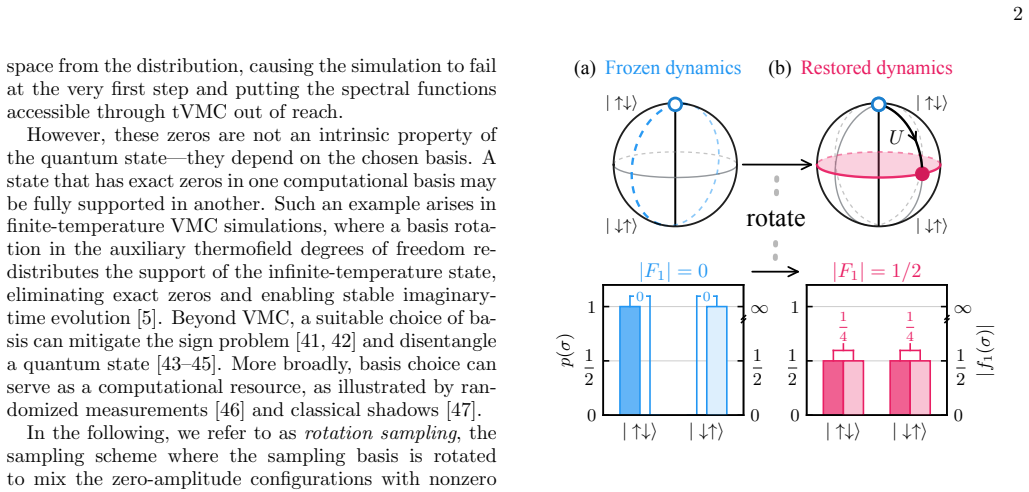
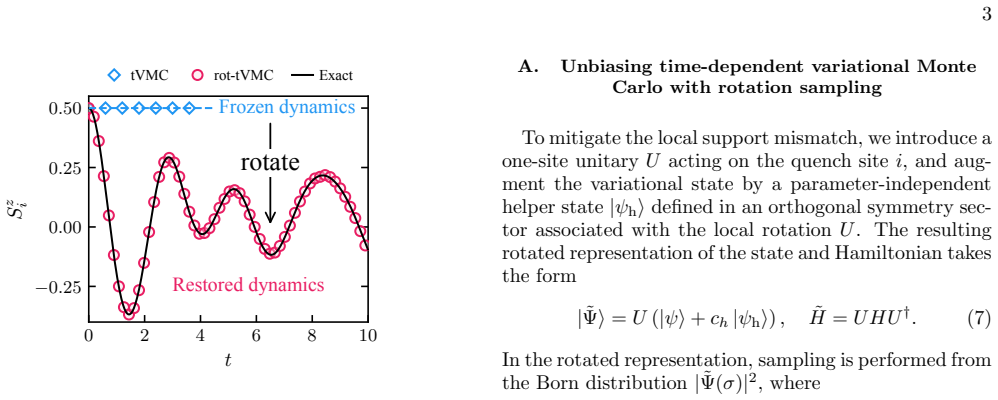
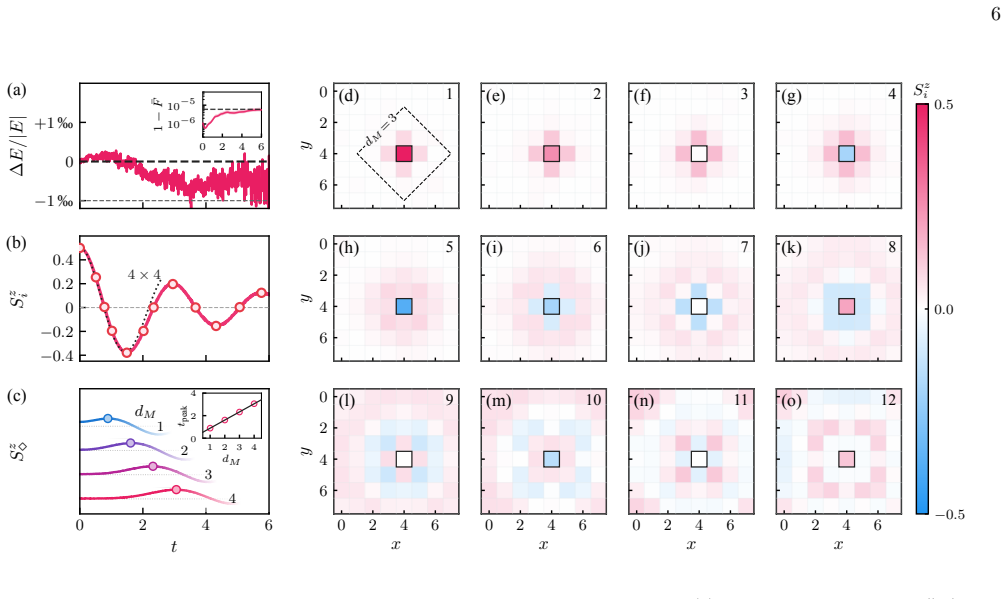
The support mismatch generated by a charged local operator is itself local. Rotating the sampling basis locally restores the missing support, allowing unbiased real-time evolution after the quench while leaving the underlying variational dynamics unchanged.
What carries the argument
Local basis-rotation sampling scheme that applies a local unitary rotation to the chosen sampling basis to recover configurations eliminated by the quench operator.
If this is right
- VMC can now compute dynamical structure factors in one dimension.
- Unbiased local-operator quench dynamics become accessible in two dimensions.
- The rotation scheme integrates directly into existing variational Monte Carlo codes.
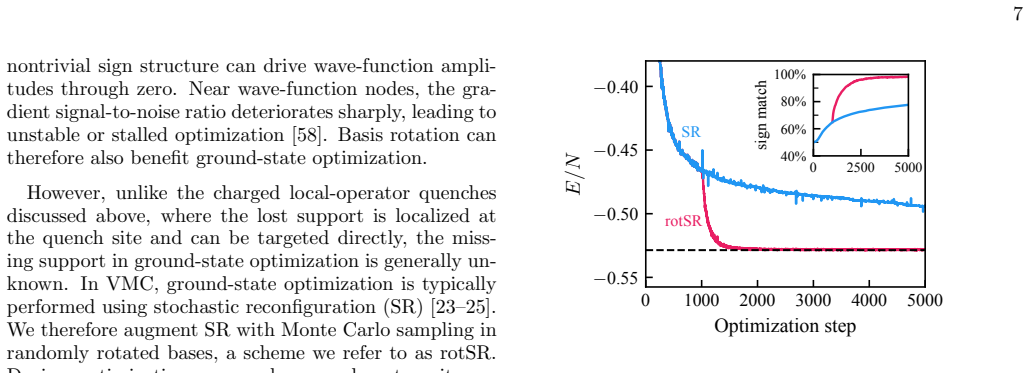
- The same local-rotation idea may improve ground-state variational Monte Carlo sampling.
Where Pith is reading between the lines
- If locality of the mismatch holds for other operators, the method could apply to a wider class of time-dependent problems.
- The approach highlights that sampling-basis choice can be adjusted locally without global changes to the wave-function ansatz.
- In higher dimensions the cost of identifying the local rotation may grow, suggesting a possible trade-off between locality and computational overhead.
Load-bearing premise
The support mismatch created by the charged local operator remains sufficiently local that a local basis rotation can restore it without new sampling biases.
What would settle it
Run the rotated-basis scheme on a small exactly solvable 1D chain after a local quench and check whether the computed real-time correlators match the exact diagonalization result at long times.
Figures
read the original abstract
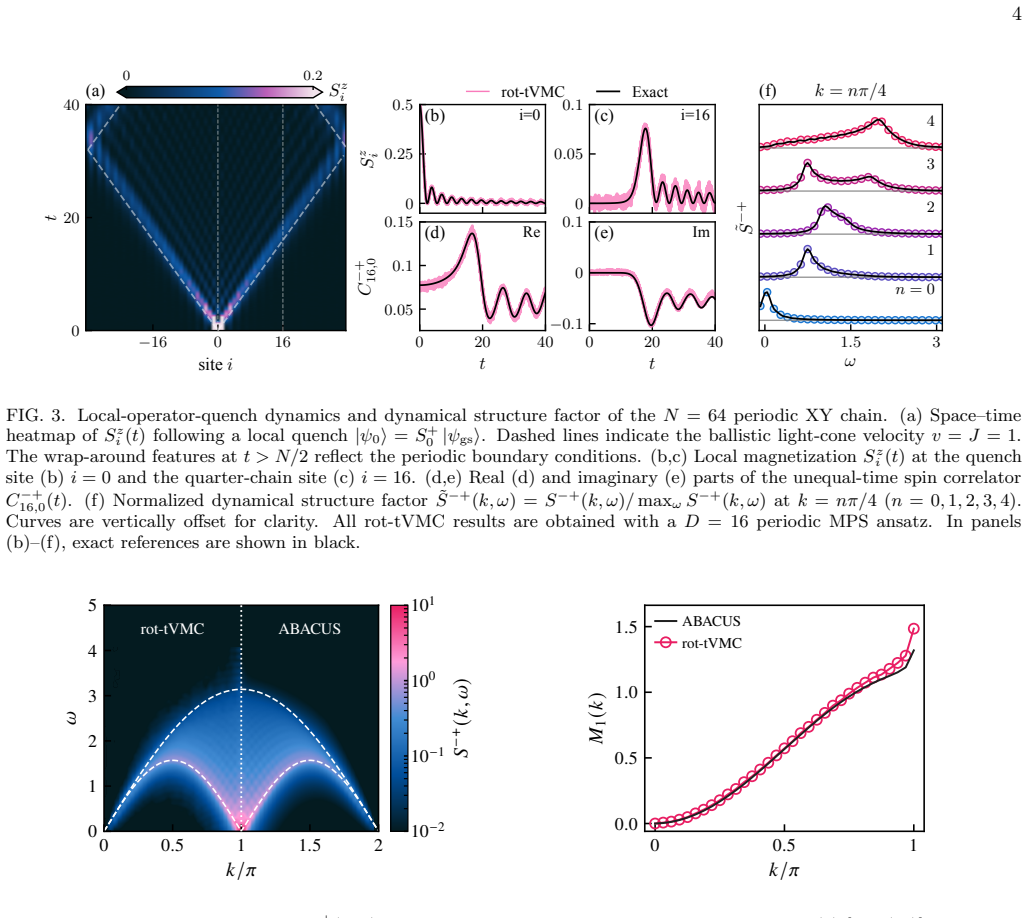
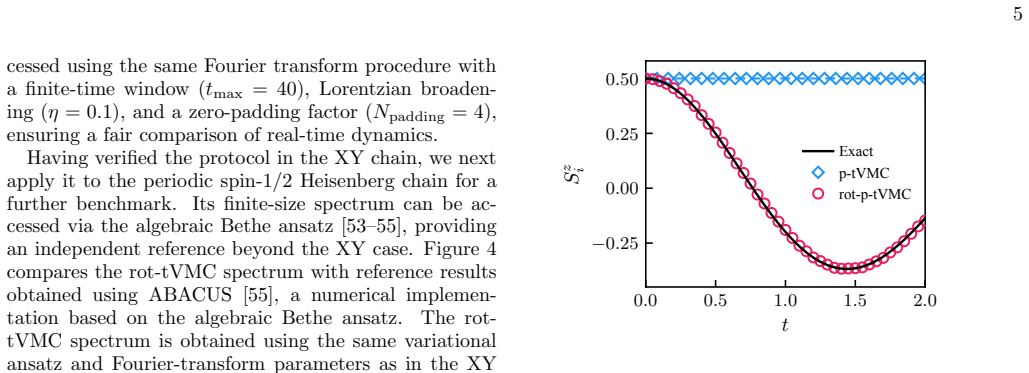
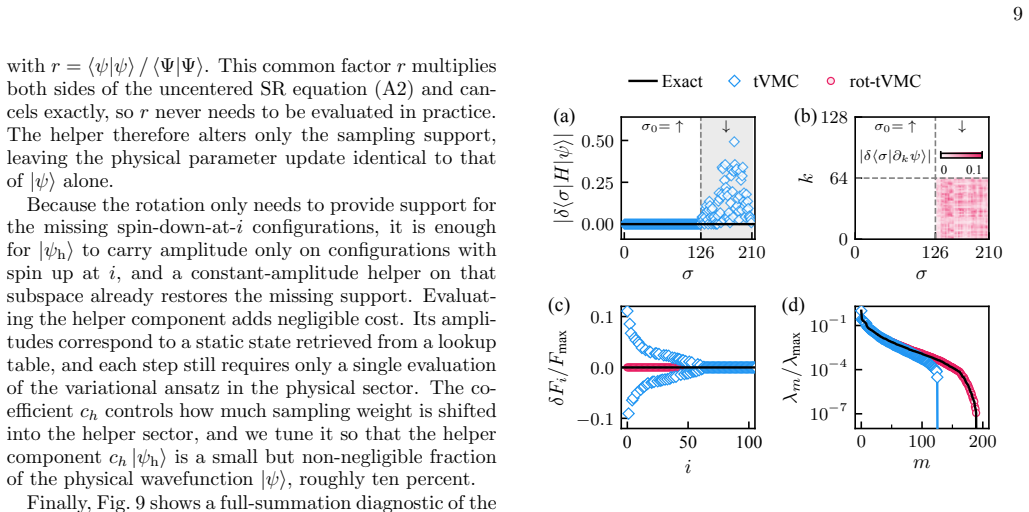
Real-time dynamics after a local quench by a charged operator encodes the response functions measured in spectroscopic experiments, yet they have long posed a challenge for variational Monte Carlo calculations. The obstacle is a support mismatch: the projective action by a charged local operator forces an exponentially large number of configurations to vanish, but these configurations may still contribute to the dynamics, biasing the estimators and freezing the evolution at the very first step. This difficulty is an artifact of the chosen sampling basis, and the support mismatch generated by a charged local operator is itself local. We demonstrate that the missing support can be restored by a local rotation of the sampling basis, without changing the underlying variational dynamics. We propose a local basis-rotation sampling scheme that resolves the support-mismatch problem and can be readily incorporated into existing variational Monte Carlo algorithms. Benchmarks show that rotation sampling accurately captures long-time quantum dynamics, enabling variational Monte Carlo calculations of dynamical structure factors in one dimension and unbiased local-operator quench dynamics in two dimensions. We also show that this resolution of the support-mismatch problem extends beyond real-time dynamics, and may also be helpful for ground state variational Monte Carlo calculations.
Editorial analysis
A structured set of objections, weighed in public.
Referee Report
Summary. The paper claims that support mismatch in variational Monte Carlo for real-time dynamics after local quenches by charged operators arises as an artifact of the sampling basis; because the mismatch generated by a charged local operator is itself local, a local rotation of the sampling basis restores full support without changing the underlying variational wavefunction or dynamics. The method is implemented as a local basis-rotation sampling scheme integrable into existing VMC algorithms and is benchmarked on dynamical structure factors in one dimension and local-operator quench dynamics in two dimensions, with an additional claim of utility for ground-state calculations.
Significance. If the numerical evidence holds, the technique removes a long-standing bias in VMC estimators for post-quench dynamics and response functions, enabling previously inaccessible calculations in strongly correlated systems while preserving unbiased sampling with respect to the original variational projector. The explicit construction, locality argument, and compatibility with existing codes constitute practical strengths.
major comments (1)
- [Benchmarks] Benchmarks section: the assertion that rotation sampling 'accurately captures long-time quantum dynamics' is not accompanied by error bars on the reported quantities, direct baseline comparisons against exact or known results, or an explicit description of how post-quench estimators are constructed; these omissions make it impossible to verify that the central claim of unbiased long-time evolution has been demonstrated.
Simulated Author's Rebuttal
We thank the referee for their careful reading, positive assessment of the work, and recommendation for minor revision. We address the major comment below.
read point-by-point responses
-
Referee: Benchmarks section: the assertion that rotation sampling 'accurately captures long-time quantum dynamics' is not accompanied by error bars on the reported quantities, direct baseline comparisons against exact or known results, or an explicit description of how post-quench estimators are constructed; these omissions make it impossible to verify that the central claim of unbiased long-time evolution has been demonstrated.
Authors: We agree that the benchmarks section would be strengthened by the inclusion of statistical error bars, direct comparisons to exact or known results (such as ED or DMRG for the 1D cases), and an explicit description of the post-quench estimator construction. In the revised manuscript we will add error bars to all reported dynamical quantities, include baseline comparisons where feasible, and expand the methods section with a detailed account of how the estimators are formed after the local quench. These changes will make the verification of unbiased long-time evolution explicit. revision: yes
Circularity Check
No significant circularity in derivation chain
full rationale
The paper's central claim is that support mismatch from a charged local operator is local and can be restored by a local basis rotation applied only to the sampling basis, leaving the variational wavefunction and projector unchanged. This is presented via explicit construction of the rotation scheme, with benchmarks against exact results in 1D and 2D. No equations reduce any result to a fitted parameter renamed as prediction, no self-citation chain is load-bearing for the locality argument, and the method is an independent modification to sampling without self-definitional loops or ansatz smuggling. The derivation is self-contained against external benchmarks.
Axiom & Free-Parameter Ledger
axioms (1)
- domain assumption Standard assumptions of variational Monte Carlo sampling and projective dynamics
Reference graph
Works this paper leans on
-
[1]
Carleo, F
G. Carleo, F. Becca, M. Schir` o, and M. Fabrizio, Lo- calization and glassy dynamics of many-body quantum systems, Sci. Rep.2, 243 (2012)
2012
-
[2]
Carleo, F
G. Carleo, F. Becca, L. Sanchez-Palencia, S. Sorella, and M. Fabrizio, Light-cone effect and supersonic correlations in one- and two-dimensional bosonic superfluids, Phys. Rev. A89, 031602 (2014)
2014
- [3]
-
[4]
Carleo and M
G. Carleo and M. Troyer, Solving the quantum many- body problem with artificial neural networks, Science 355, 602 (2017)
2017
-
[5]
J. Nys, Z. Denis, and G. Carleo, Real-time quantum dy- namics of thermal states with neural thermofields, Phys. Rev. B109, 235120 (2024)
2024
-
[6]
Mendes-Santos, M
T. Mendes-Santos, M. Schmitt, and M. Heyl, Highly re- solved spectral functions of two-dimensional systems with neural quantum states, Phys. Rev. Lett.131, 046501 (2023)
2023
-
[7]
Schmitt and M
M. Schmitt and M. Heyl, Quantum many-body dynamics in two dimensions with artificial neural networks, Phys. Rev. Lett.125, 100503 (2020)
2020
-
[8]
Medvidovi´ c and D
M. Medvidovi´ c and D. Sels, Variational quantum dynam- ics of two-dimensional rotor models, PRX Quantum4, 040302 (2023)
2023
-
[9]
I. L. Guti´ errez and C. B. Mendl, Real time evolution with neural-network quantum states, Quantum6, 627 (2022)
2022
-
[10]
Donatella, Z
K. Donatella, Z. Denis, A. Le Boit´ e, and C. Ciuti, Dy- namics with autoregressive neural quantum states: Ap- plication to critical quench dynamics, Phys. Rev. A108, 022210 (2023)
2023
-
[11]
Carleo, L
G. Carleo, L. Cevolani, L. Sanchez-Palencia, and M. Holzmann, Unitary dynamics of strongly interacting Bose gases with the time-dependent variational Monte Carlo method in continuous space, Phys. Rev. X7, 031026 (2017)
2017
-
[12]
Schmitt and M
M. Schmitt and M. Heyl, Quantum dynamics in transverse-field Ising models from classical networks, Sci- Post Phys.4, 013 (2018)
2018
-
[13]
Czischek, M
S. Czischek, M. G¨ arttner, and T. Gasenzer, Quenches near Ising quantum criticality as a challenge for artificial neural networks, Phys. Rev. B98, 024311 (2018)
2018
-
[14]
Verdel, M
R. Verdel, M. Schmitt, Y.-P. Huang, P. Karpov, and M. Heyl, Variational classical networks for dynamics in interacting quantum matter, Phys. Rev. B103, 165103 (2021)
2021
-
[15]
Burau and M
H. Burau and M. Heyl, Unitary long-time evolution with quantum renormalization groups and artificial neural networks, Phys. Rev. Lett.127, 050601 (2021)
2021
-
[16]
Lin and F
S.-H. Lin and F. Pollmann, Scaling of neural-network quantum states for time evolution, Phys. Status Solidi B259, 2100172 (2022)
2022
-
[17]
Hofmann, G
D. Hofmann, G. Fabiani, J. H. Mentink, G. Carleo, and M. A. Sentef, Role of stochastic noise and generalization error in the time propagation of neural-network quantum states, SciPost Phys.12, 165 (2022)
2022
-
[18]
Van de Walle, M
A. Van de Walle, M. Schmitt, and A. Bohrdt, Many-body dynamics with explicitly time-dependent neural quantum states, Mach. Learn.: Sci. Technol.6, 045011 (2025)
2025
-
[19]
M. J. Hartmann and G. Carleo, Neural-network approach to dissipative quantum many-body dynamics, Phys. Rev. Lett.122, 250502 (2019)
2019
-
[20]
Nagy and V
A. Nagy and V. Savona, Variational quantum Monte Carlo method with a neural-network ansatz for open quantum systems, Phys. Rev. Lett.122, 250501 (2019)
2019
-
[21]
M. Reh, M. Schmitt, and M. G¨ arttner, Time-dependent variational principle for open quantum systems with ar- tificial neural networks, Phys. Rev. Lett.127, 230501 (2021)
2021
-
[22]
Haegeman, J
J. Haegeman, J. I. Cirac, T. J. Osborne, I. Piˇ zorn, H. Ver- schelde, and F. Verstraete, Time-dependent variational principle for quantum lattices, Phys. Rev. Lett.107, 070601 (2011)
2011
-
[23]
Sorella, Green function monte carlo with stochastic reconfiguration, Phys
S. Sorella, Green function monte carlo with stochastic reconfiguration, Phys. Rev. Lett.80, 4558 (1998)
1998
-
[24]
Sorella, Generalized lanczos algorithm for variational quantum monte carlo, Phys
S. Sorella, Generalized lanczos algorithm for variational quantum monte carlo, Phys. Rev. B64, 024512 (2001)
2001
-
[25]
Sorella, Wave function optimization in the variational monte carlo method, Phys
S. Sorella, Wave function optimization in the variational monte carlo method, Phys. Rev. B71, 241103 (2005)
2005
-
[26]
Sinibaldi, C
A. Sinibaldi, C. Giuliani, G. Carleo, and F. Vicentini, Un- biasing time-dependent variational monte carlo by pro- jected quantum evolution, Quantum7, 1131 (2023)
2023
-
[27]
Z.-Q. Wan, R. Wiersema, and S. Zhang, Removing nodal and support-mismatch pathologies in variational monte carlo via blurred sampling (2026), arXiv:2603.18148 [cond-mat.str-el]
arXiv 2026
-
[28]
D. M. Ceperley, Fermion nodes, Journal of Statistical Physics63, 1237 (1991)
1991
-
[29]
Liang, W.-Y
X. Liang, W.-Y. Liu, P.-Z. Lin, G.-C. Guo, Y.-S. Zhang, and L. He, Solving frustrated quantum many-particle models with convolutional neural networks, Phys. Rev. B98, 104426 (2018)
2018
-
[30]
K. Choo, T. Neupert, and G. Carleo, Two-dimensional frustratedJ 1−J2 model studied with neural network quantum states, Phys. Rev. B100, 125124 (2019)
2019
-
[31]
Westerhout, N
T. Westerhout, N. Astrakhantsev, K. S. Tikhonov, M. I. Katsnelson, and A. A. Bagrov, Generalization properties of neural network approximations to frustrated magnet ground states, Nature Communications11, 1593 (2020)
2020
-
[32]
A. Chen, K. Choo, N. Astrakhantsev, and T. Neupert, Neural network evolution strategy for solving quantum sign structures, Phys. Rev. Res.4, L022026 (2022)
2022
-
[33]
L. L. Viteritti, R. Rende, S. Sachdev, and G. Carleo, Ap- proaching the thermodynamic limit with neural-network quantum states (2026), arXiv:2602.02665 [cond-mat.str- el]
arXiv 2026
-
[34]
M. A. Nielsen and I. L. Chuang,Quantum Computa- tion and Quantum Information: 10th Anniversary Edi- tion(Cambridge University Press, 2010)
2010
-
[35]
L. Gravina, V. Savona, and F. Vicentini, Neural pro- jected quantum dynamics: a systematic study, Quantum 9, 1803 (2025), arXiv:2410.10720
arXiv 2025
-
[36]
W. Krinitsin and M. Schmitt, Time-dependent varia- tional monte carlo without bias (2026), arXiv:2605.03930 [quant-ph]
Pith/arXiv arXiv 2026
-
[37]
Villa, J
L. Villa, J. Despres, S. J. Thomson, and L. Sanchez- Palencia, Local quench spectroscopy of many-body quan- tum systems, Phys. Rev. A102, 033337 (2020)
2020
-
[38]
S. R. White and I. Affleck, Spectral function for theS= 1 Heisenberg antiferromagetic chain, Phys. Rev. B77, 12 134437 (2008)
2008
-
[39]
L. Wang and H.-Q. Lin, Dynamic structure factor from real time evolution and exact correction vectors with matrix product states (2019), arXiv:1901.07751 [cond- mat.str-el]
Pith/arXiv arXiv 2019
-
[40]
Ferrari and F
F. Ferrari and F. Becca, Spectral signatures of fractional- ization in the frustrated heisenberg model on the square lattice, Phys. Rev. B98, 100405 (2018)
2018
-
[41]
D. Hangleiter, I. Roth, D. Nagaj, and J. Eis- ert, Easing the monte carlo sign prob- lem, Science Advances6, eabb8341 (2020), https://www.science.org/doi/pdf/10.1126/sciadv.abb8341
-
[42]
A. J. Kim, P. Werner, and R. Valent´ ı, Alleviating the sign problem in quantum monte carlo simulations of spin- orbit-coupled multiorbital hubbard models, Phys. Rev. B 101, 045108 (2020)
2020
-
[43]
X. Qian, J. Huang, and M. Qin, Augmenting density ma- trix renormalization group with clifford circuits, Phys. Rev. Lett.133, 190402 (2024)
2024
-
[44]
X. Qian, J. Huang, and M. Qin, Clifford circuits aug- mented time-dependent variational principle, Phys. Rev. Lett.134, 150404 (2025)
2025
-
[45]
C. Fan, X. Qian, H.-C. Zhang, R.-Z. Huang, M. Qin, and T. Xiang, Disentangling critical quantum spin chains with clifford circuits, Phys. Rev. B111, 085121 (2025)
2025
-
[46]
Elben, S
A. Elben, S. T. Flammia, H.-Y. Huang, R. Kueng, J. Preskill, B. Vermersch, and P. Zoller, The random- ized measurement toolbox, Nature Reviews Physics5, 9 (2023)
2023
-
[47]
Huang, R
H.-Y. Huang, R. Kueng, and J. Preskill, Predicting many properties of a quantum system from very few measure- ments, Nature Physics16, 1050 (2020)
2020
-
[48]
E. Lieb, T. Schultz, and D. Mattis, Two soluble models of an antiferromagnetic chain, Annals of Physics16, 407 (1961)
1961
-
[49]
Jordan and E
P. Jordan and E. Wigner, ¨Uber das paulische ¨Aquivalenzverbot, Zeitschrift f¨ ur Physik47, 631 (1928)
1928
-
[50]
Perez-Garcia, F
D. Perez-Garcia, F. Verstraete, M. M. Wolf, and J. I. Cirac, Matrix product state representations, Quantum Info. Comput.7, 401–430 (2007)
2007
-
[51]
Xiang,Density Matrix and Tensor Network Renormal- ization(Cambridge University Press, Cambridge, 2023)
T. Xiang,Density Matrix and Tensor Network Renormal- ization(Cambridge University Press, Cambridge, 2023)
2023
-
[52]
E. H. Lieb and D. W. Robinson, The finite group velocity of quantum spin systems, Communications in Mathemat- ical Physics28, 251 (1972)
1972
-
[53]
Caux and J
J.-S. Caux and J. M. Maillet, Computation of dynamical correlation functions of heisenberg chains in a magnetic field, Phys. Rev. Lett.95, 077201 (2005)
2005
-
[54]
J.-S. Caux, R. Hagemans, and J. M. Maillet, Compu- tation of dynamical correlation functions of heisenberg chains: the gapless anisotropic regime, Journal of Statis- tical Mechanics: Theory and Experiment2005, P09003 (2005)
2005
-
[55]
Caux, Correlation functions of integrable models: A description of the abacus algorithm, Journal of Math- ematical Physics50, 095214 (2009)
J.-S. Caux, Correlation functions of integrable models: A description of the abacus algorithm, Journal of Math- ematical Physics50, 095214 (2009)
2009
-
[56]
M¨ uller, H
G. M¨ uller, H. Thomas, H. Beck, and J. C. Bonner, Quan- tum spin dynamics of the antiferromagnetic linear chain in zero and nonzero magnetic field, Phys. Rev. B24, 1429 (1981)
1981
-
[57]
Park and M
C.-Y. Park and M. J. Kastoryano, Geometry of learning neural quantum states, Phys. Rev. Res.2, 023232 (2020)
2020
- [58]
-
[59]
Marshall, Antiferromagnetism, Proceedings of the Royal Society of London
W. Marshall, Antiferromagnetism, Proceedings of the Royal Society of London. A. Mathe- matical and Physical Sciences232, 48 (1955), https://royalsocietypublishing.org/rspa/article- pdf/232/1188/48/49224/rspa.1955.0200.pdf
arXiv 1955
-
[60]
C. Fan, B. Zhan, Y. Gu, T. Liu, Y. Wu, M. Qin, D. Lv, and T. Xiang, Disentangling tensor network states with deep neural network (2026), arXiv:2603.14425 [cond- mat.str-el]
arXiv 2026
-
[61]
Carleo, K
G. Carleo, K. Choo, D. Hofmann, J. E. Smith, T. Wester- hout, F. Alet, E. J. Davis, S. Efthymiou, I. Glasser, S.-H. Lin, M. Mauri, G. Mazzola, C. B. Pereira, and F. Vicen- tini, Netket: A machine learning toolkit for many-body quantum systems, SoftwareX10, 100311 (2019)
2019
-
[62]
Vicentini, D
F. Vicentini, D. Hofmann, A. Szab´ o, D. Wu, C. Roth, C. Giuliani, G. Pescia, J. Nys, V. Vargas-Calder´ on, N. Astrakhantsev, and G. Carleo, Netket 3: Machine learning toolbox for many-body quantum systems, Sci- Post Phys. Codebases , 7 (2022)
2022
-
[63]
Gravina and F
L. Gravina and F. Vicentini, ptvmc-systematic-study package (2025)
2025
-
[64]
J. C. Butcher,Numerical Methods for Ordinary Differ- ential Equations, 3rd ed. (John Wiley & Sons, 2016)
2016
-
[65]
W. H. Press, S. A. Teukolsky, W. T. Vetterling, and B. P. Flannery,Numerical Recipes 3rd Edition: The Art of Sci- entific Computing(Cambridge University Press, 2007)
2007
discussion (0)
Sign in with ORCID, Apple, or X to comment. Anyone can read and Pith papers without signing in.