A Reduced Order Model for Emergent Mechanics in Woven Systems
Pith reviewed 2026-06-26 08:01 UTC · model grok-4.3
The pith
A reduced-order model with four stiffness elements captures emergent weave behaviors such as crimp-driven Poisson response and programmable anisotropy.
A machine-rendered reading of the paper's core claim, the machinery that carries it, and where it could break.
Core claim
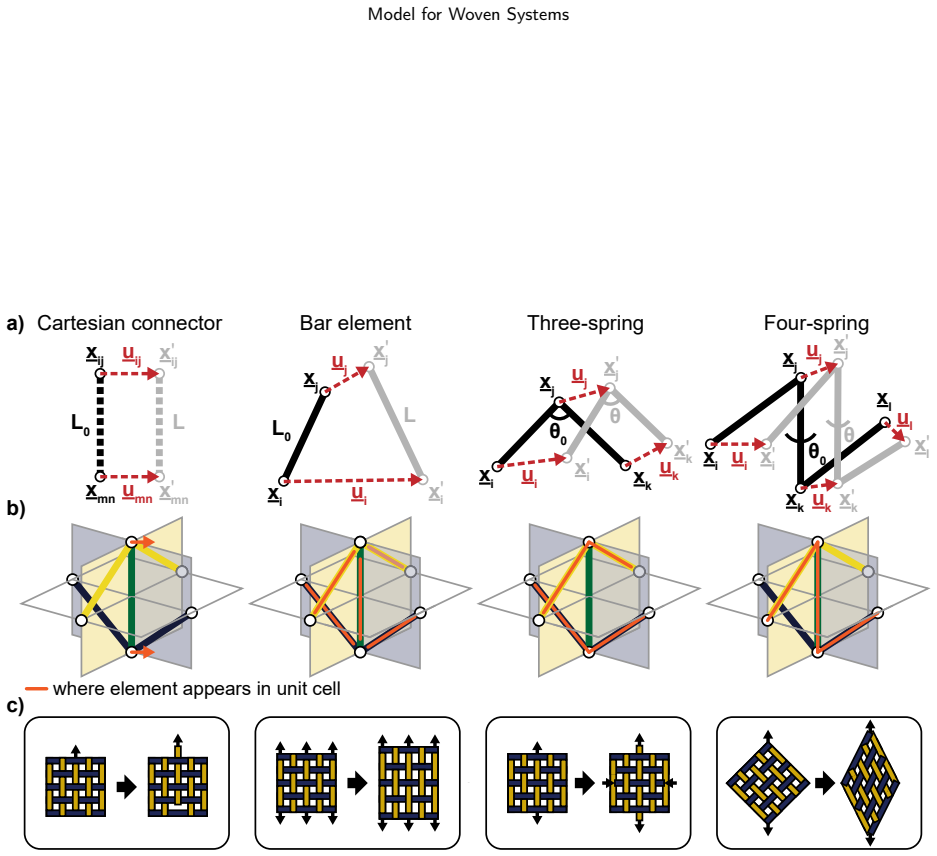
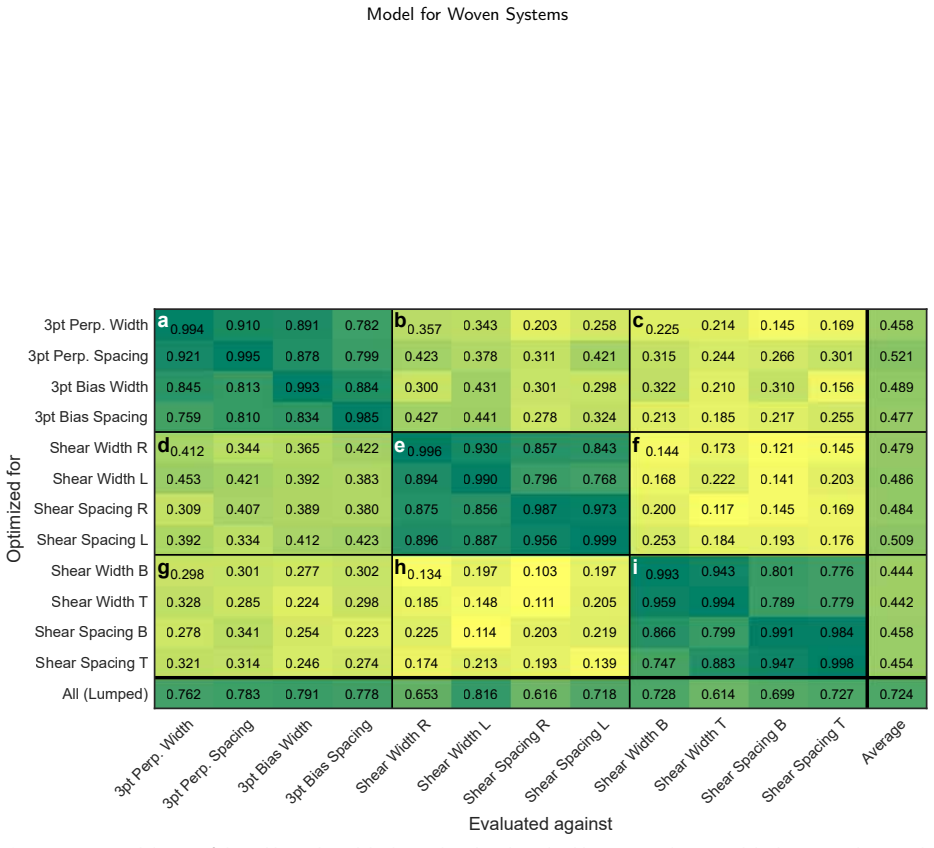
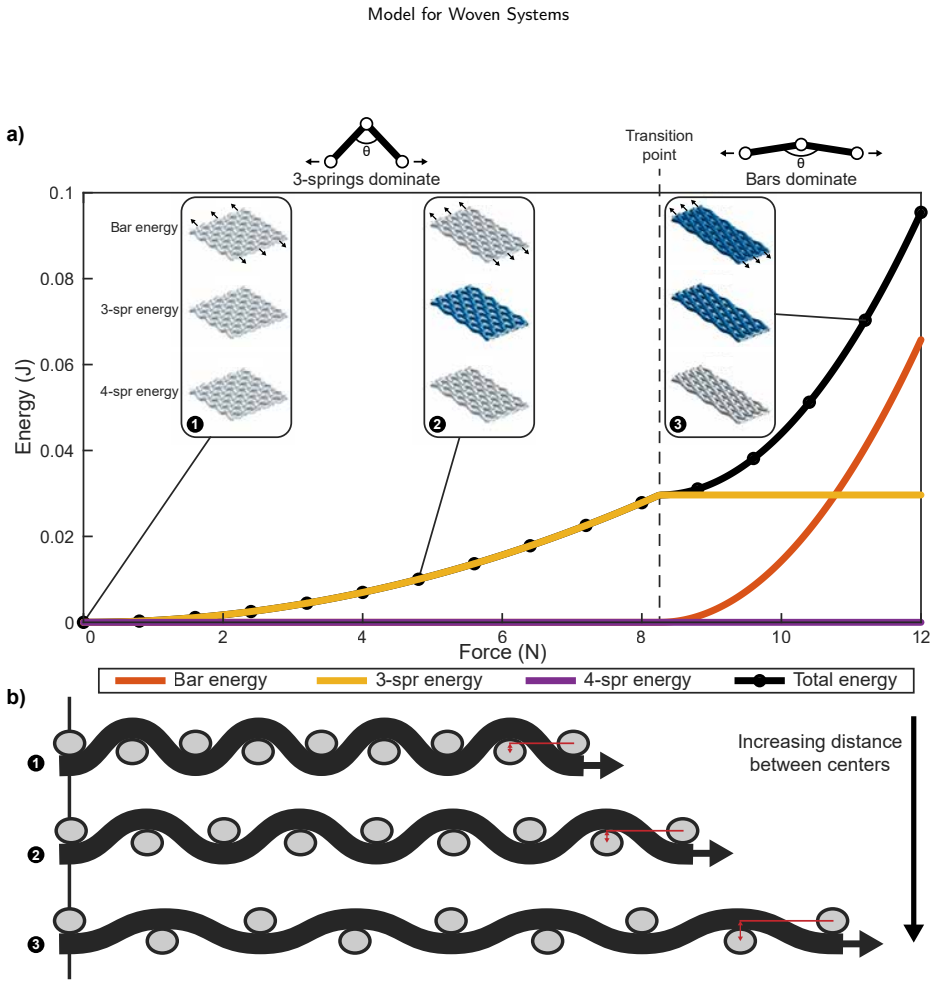
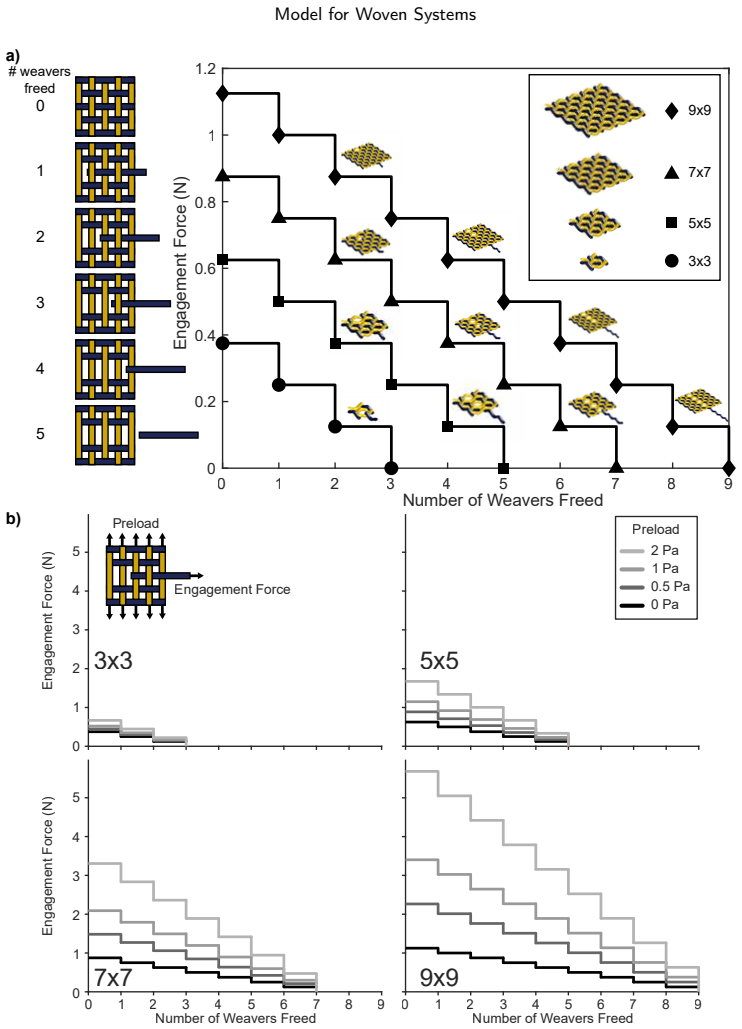
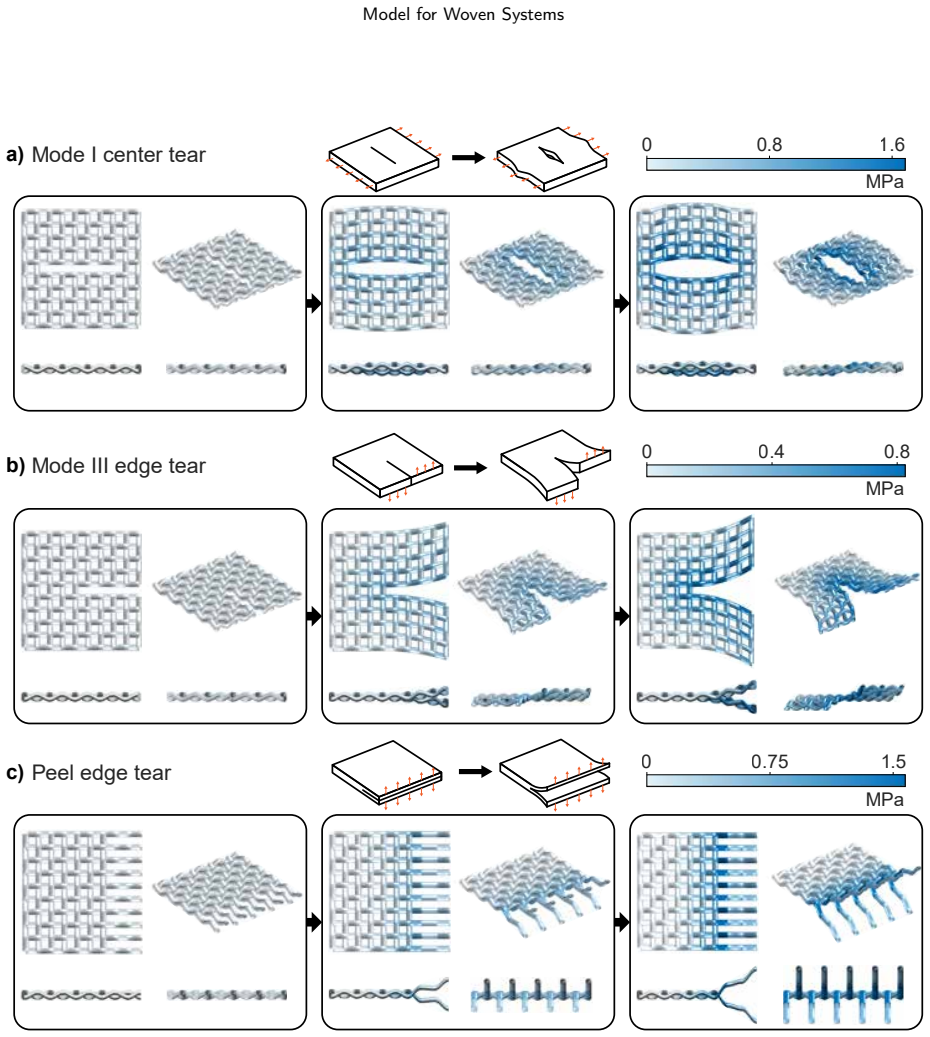
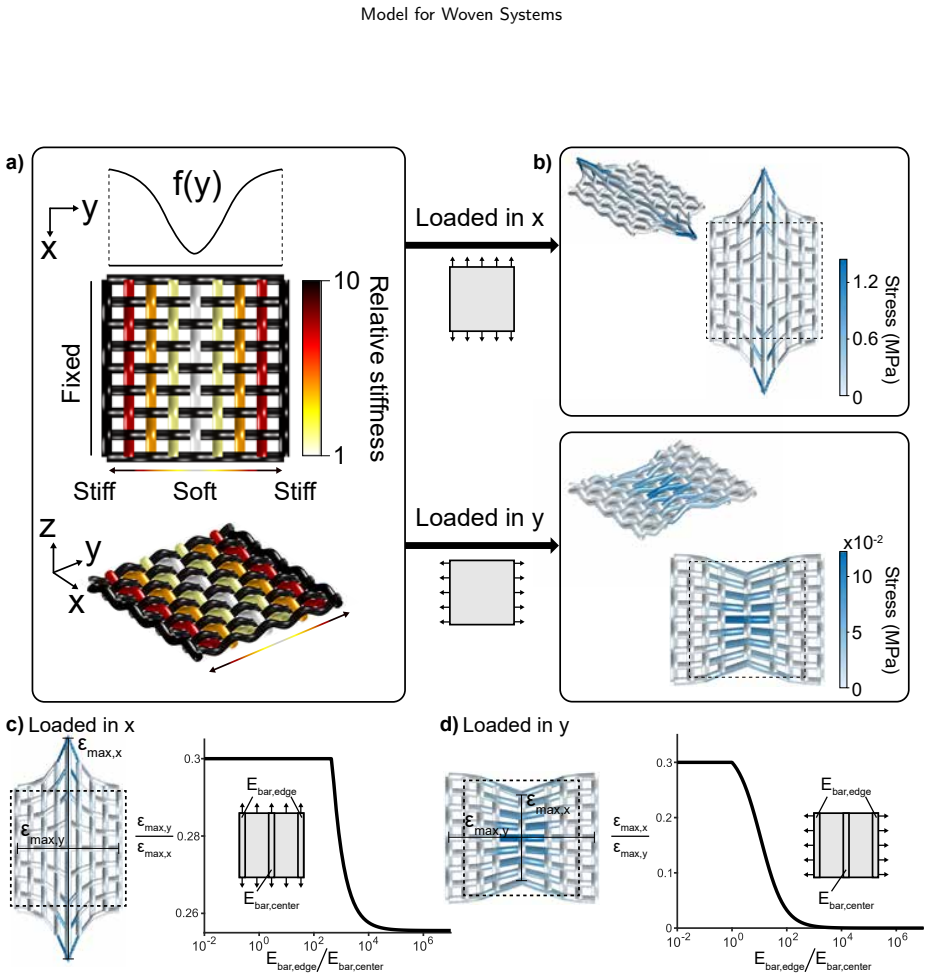
The validated model demonstrates capabilities beyond continuum approaches including the emergent Poisson's response arising from crimp interchange, stepwise force reduction during progressive weaver pullout, stress localization under three distinct tearing configurations, and programmable mechanical anisotropy through spatially graded weaver stiffness. Eigenvalue analysis confirms each of the four elements is necessary for a complete kinematic and mechanistic description of the unit cell.
What carries the argument
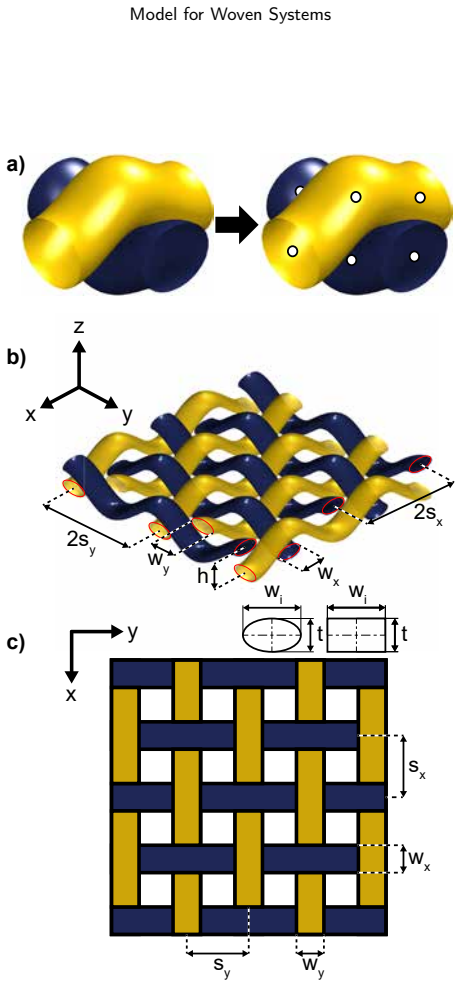
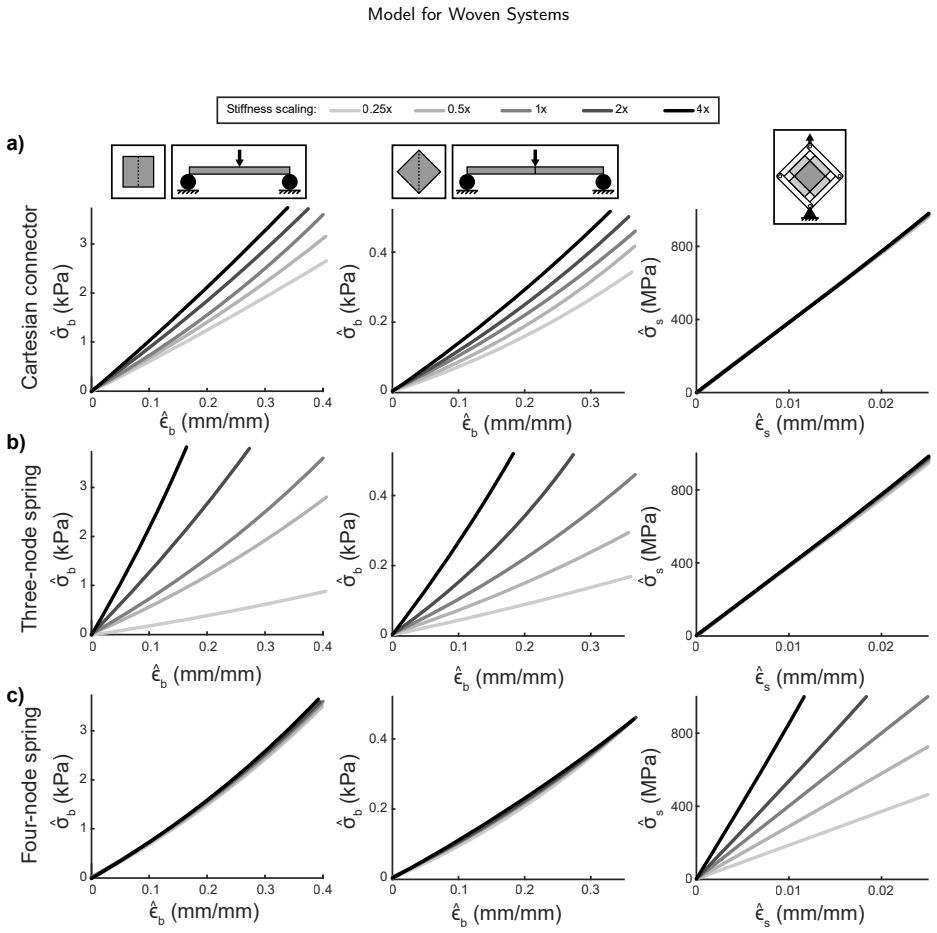
A network of nodes connected by four physically interpretable stiffness elements for axial deformation, in-plane uncrimping, inter-weaver shear, and frictional slip.
If this is right
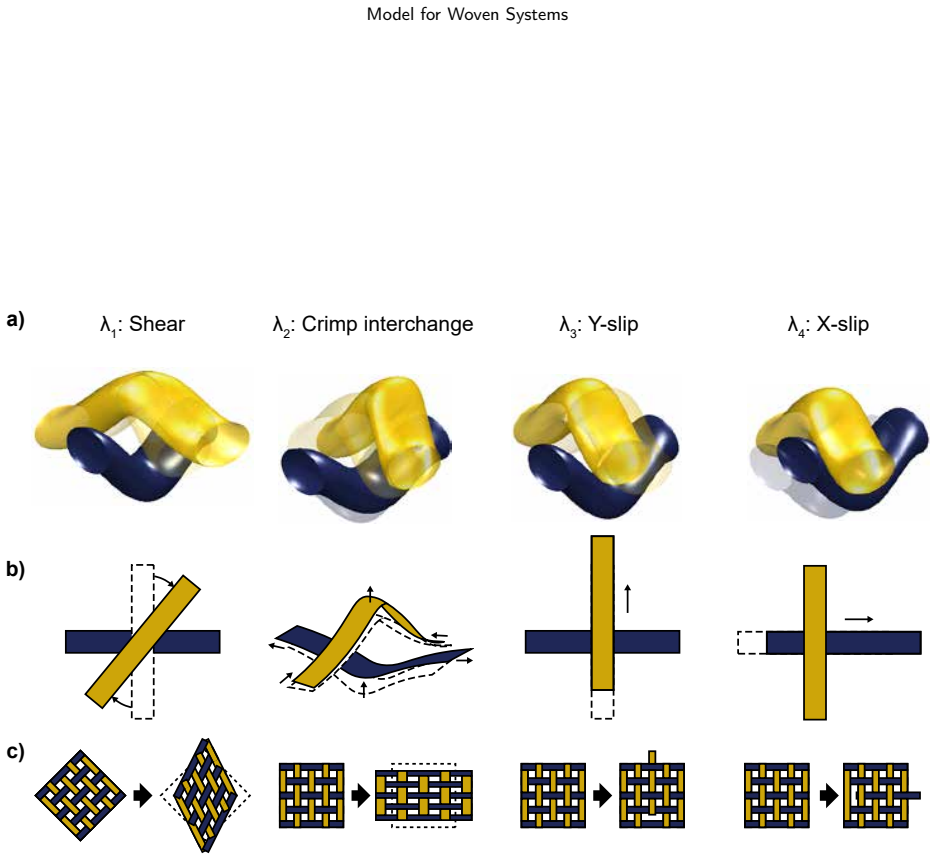
- The model predicts an emergent Poisson's ratio arising purely from crimp interchange in the weave geometry.
- It shows stepwise reductions in force as individual weavers are progressively pulled out.
- Stress localizes differently under three distinct tearing configurations.
- Mechanical anisotropy can be programmed by spatially grading the stiffness of weavers.
Where Pith is reading between the lines
- The physical interpretability of the four elements could support inverse design to achieve target macroscopic responses by optimizing local stiffness values.
- Similar node-spring reductions might apply to other periodic systems such as textile composites or kirigami sheets under large deformation.
- Extending the calibration to include dynamic or cyclic loading would test whether the same four elements suffice for time-dependent behaviors.
Load-bearing premise
That stiffness parameters calibrated solely on three-point bending and shear experiments will accurately predict pullout, tearing, and graded anisotropy behaviors without any further tuning.
What would settle it
An experiment measuring the force-displacement curve during weaver pullout in a woven sample and comparing it to the model's predicted stepwise force reductions; mismatch beyond 5 percent would falsify the generalization claim.
Figures
read the original abstract
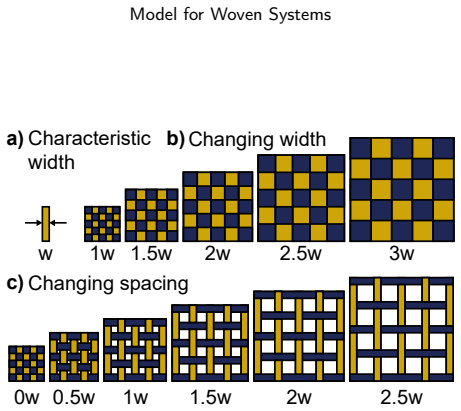
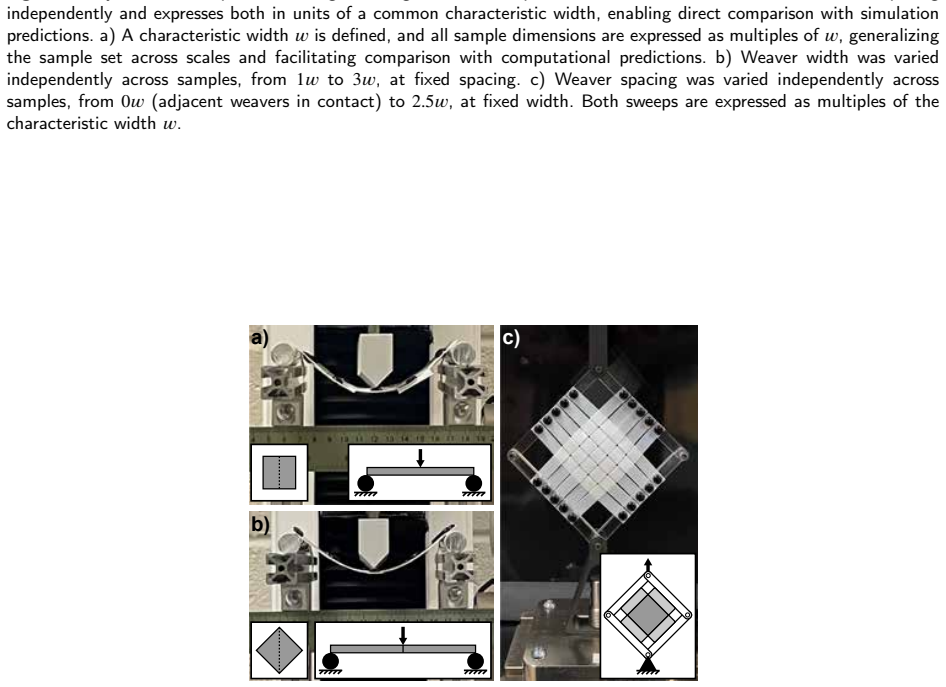
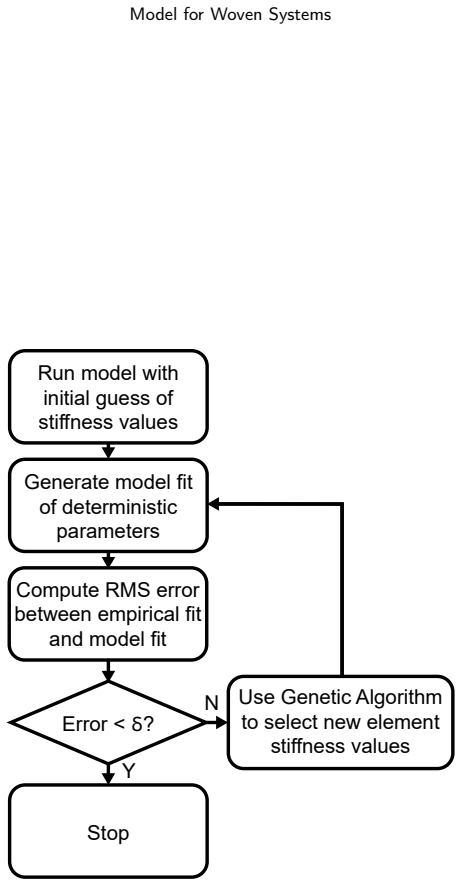
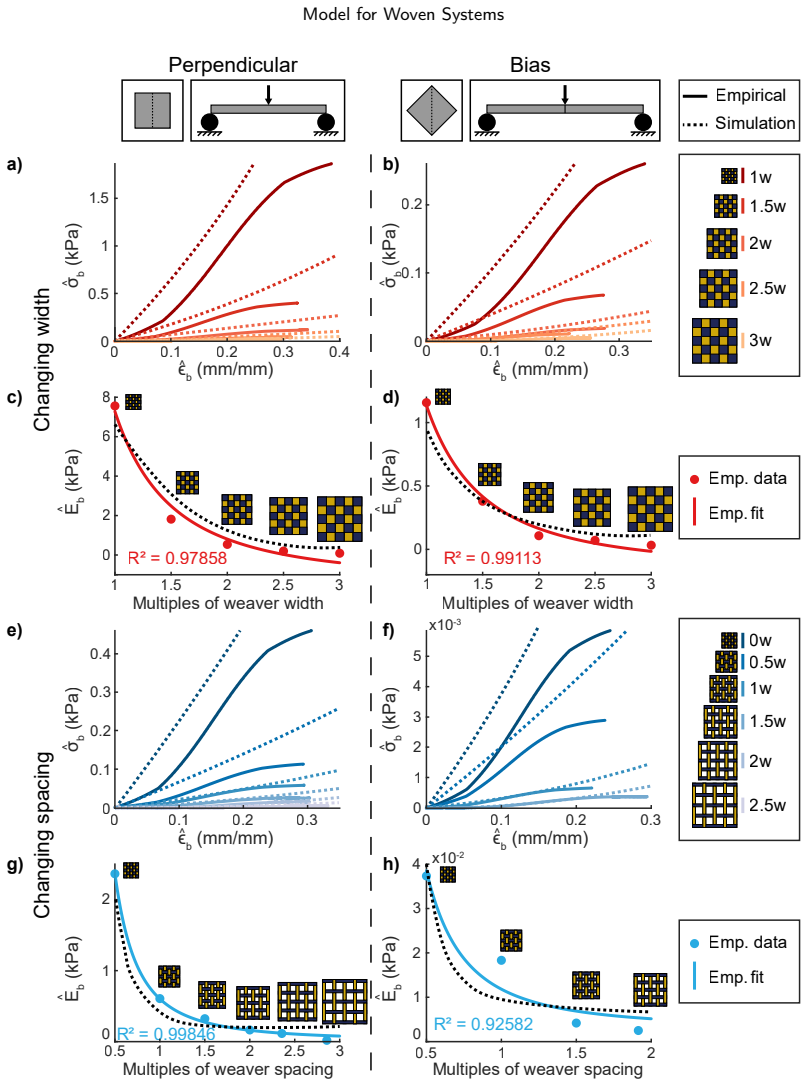
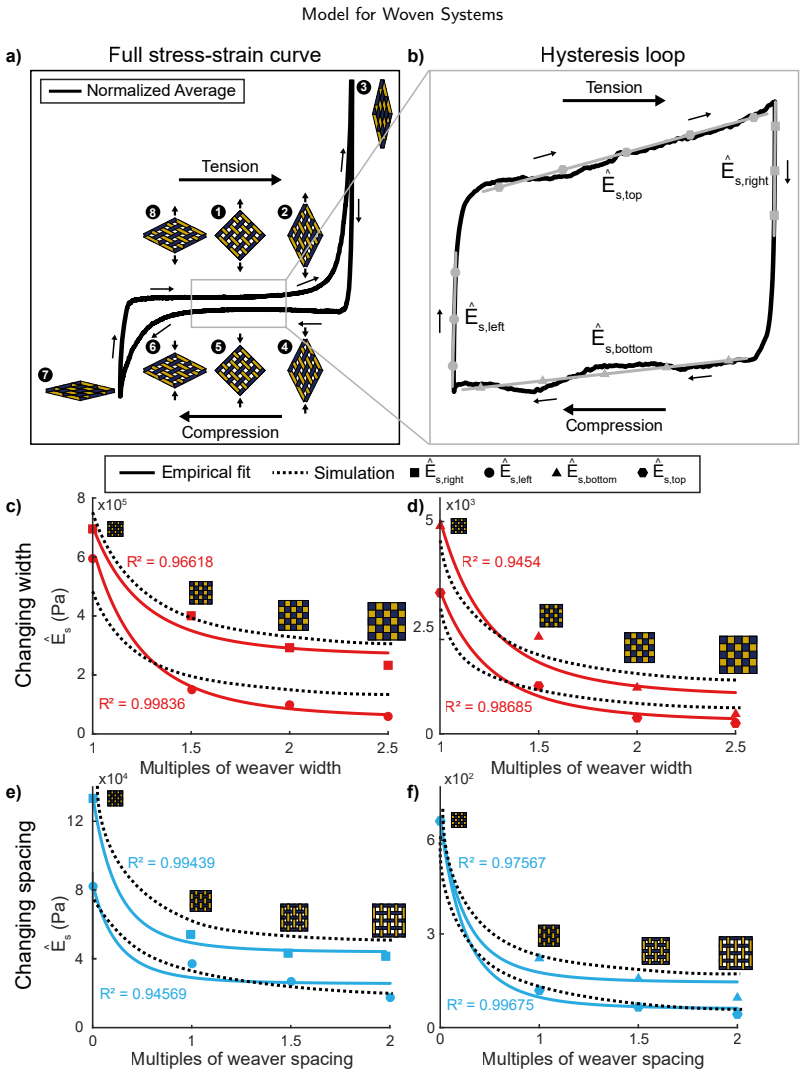
Woven structures exhibit rich mechanical behaviors including anisotropic stiffness, shear-induced locking, and crimp interchange that emerge purely from the geometric arrangement of individual weavers rather than from constituent material properties. Existing models either homogenize these interactions or resolve them at prohibitive computational cost. We introduce a reduced-order model that bridges this gap by representing individual weaver interactions through a system of nodes and four physically interpretable stiffness elements capturing axial deformation, in-plane uncrimping, inter-weaver shear, and frictional slip. Eigenvalue analysis of the unit cell confirms that the lowest-energy deformation modes correspond directly to known weave-specific phenomena, and that each element is necessary for a complete kinematic and mechanistic description. Element stiffness parameters are calibrated against empirical three-point bending and shear data, achieving agreement within 5% across varied weaver widths and spacings. The validated model is then applied to demonstrate capabilities beyond the reach of continuum approaches including: the emergent Poisson's response arising from crimp interchange, stepwise force reduction during progressive weaver pullout, stress localization under three distinct tearing configurations, and programmable mechanical anisotropy through spatially graded weaver stiffness. The physical transparency and computational efficiency of the framework position it as a practical tool for the analysis and design of woven architected materials with programmable mechanical response.
Editorial analysis
A structured set of objections, weighed in public.
Referee Report
Summary. The manuscript introduces a reduced-order model for woven structures that represents individual weaver interactions via nodes connected by four physically interpretable stiffness elements (axial deformation, in-plane uncrimping, inter-weaver shear, and frictional slip). Eigenvalue analysis of the unit cell is used to confirm that the lowest-energy modes align with known weave phenomena and that each element is necessary. Element stiffness parameters are calibrated to three-point bending and shear experiments, achieving agreement within 5% across varied weaver widths and spacings. The calibrated model is then applied to forward-simulate emergent behaviors including Poisson response from crimp interchange, stepwise force reduction during progressive pullout, stress localization under three tearing configurations, and programmable anisotropy via spatially graded weaver stiffness.
Significance. If the generalization from the calibration data holds, the framework supplies a computationally efficient and physically transparent alternative to both continuum homogenization and full-resolution discrete-element models for woven architected materials. The explicit linkage of element stiffnesses to kinematic modes via eigenvalue analysis and the emphasis on parameter interpretability are positive features that could support design of materials with programmable response.
major comments (2)
- [Abstract] Abstract: the statement that the model is 'validated' on bending/shear data and then 'applied to demonstrate' the Poisson, pullout, tearing, and anisotropy behaviors does not specify whether these demonstrations include independent experimental comparisons or are purely numerical predictions from the same four fitted parameters; this distinction is load-bearing for the central generalization claim.
- [Calibration and demonstration sections] Calibration and demonstration sections: stiffness parameters are obtained solely from three-point bending and shear experiments; the subsequent predictions for crimp-interchange Poisson effect and progressive weaver pullout therefore rest on the assumption that the chosen four-element set captures the new kinematics without hidden parameter sensitivity or missing physics, yet no withheld experimental benchmarks for these cases are reported.
Simulated Author's Rebuttal
We thank the referee for the constructive feedback. We address each major comment below, clarifying the nature of our demonstrations and the basis for our predictions.
read point-by-point responses
-
Referee: [Abstract] Abstract: the statement that the model is 'validated' on bending/shear data and then 'applied to demonstrate' the Poisson, pullout, tearing, and anisotropy behaviors does not specify whether these demonstrations include independent experimental comparisons or are purely numerical predictions from the same four fitted parameters; this distinction is load-bearing for the central generalization claim.
Authors: We agree that the distinction is important and should be stated explicitly. The demonstrations of Poisson response, progressive pullout, tearing, and anisotropy are forward numerical simulations performed with the four stiffness parameters calibrated exclusively from the three-point bending and shear experiments; no independent experimental data for these behaviors are reported. The generalization claim is grounded in the eigenvalue analysis of the unit cell, which shows that the four elements produce the lowest-energy modes corresponding to known weave kinematics. We will revise the abstract to replace 'applied to demonstrate' with 'used to numerically predict' (or equivalent wording) to remove any ambiguity. revision: yes
-
Referee: [Calibration and demonstration sections] Calibration and demonstration sections: stiffness parameters are obtained solely from three-point bending and shear experiments; the subsequent predictions for crimp-interchange Poisson effect and progressive weaver pullout therefore rest on the assumption that the chosen four-element set captures the new kinematics without hidden parameter sensitivity or missing physics, yet no withheld experimental benchmarks for these cases are reported.
Authors: The four elements were deliberately chosen to encode the distinct kinematic contributions: axial and uncrimping for crimp interchange (hence Poisson), shear for inter-weaver sliding, and frictional slip for pullout. The eigenvalue analysis directly verifies that these modes are the dominant low-energy deformations and that each element is required; omitting any one eliminates the corresponding physical behavior. While we acknowledge that no withheld experimental benchmarks for Poisson or pullout are provided, the model achieves <5% error on the calibration data across multiple weaver widths and spacings, and the parameters retain direct physical meaning. This mechanistic construction, rather than additional fitting, is what supports extrapolation to the new loading cases. revision: no
Circularity Check
No circularity: model construction, eigenvalue confirmation, and calibration are independent of demonstration cases
full rationale
The paper constructs a reduced-order model using four stiffness elements, confirms via eigenvalue analysis that modes match known phenomena, calibrates parameters solely on three-point bending and shear experiments (agreement <5%), and then runs forward simulations on pullout, tearing, Poisson, and anisotropy cases. These demonstrations are applications of the already-calibrated model rather than quantities that reduce to the calibration data by construction or via self-citation. No equations equate a claimed prediction to a fitted input, no uniqueness theorems are imported from prior author work, and no ansatz is smuggled via citation. The derivation chain remains self-contained against external benchmarks.
Axiom & Free-Parameter Ledger
free parameters (1)
- four element stiffness parameters
axioms (1)
- domain assumption The four stiffness elements (axial deformation, in-plane uncrimping, inter-weaver shear, frictional slip) are necessary and sufficient for a complete kinematic and mechanistic description of weave interactions.
invented entities (1)
-
four physically interpretable stiffness elements
no independent evidence
Reference graph
Works this paper leans on
-
[1]
Journal of Industrial Textiles 55, 15280837251346789
Intelligent and electronic textile materials for adaptive apparel: Innovations, functional design, and future directions. Journal of Industrial Textiles 55, 15280837251346789. ASTM International, 2017a. Standard test method for in-plane shear properties of sandwich panels using a picture frame fixture. doi:10.1520/ D8067\_D8067M-17. ASTMInternational,2017...
-
[2]
Advances in architectural geometry 2018 , 72–93
Beyond the basket case: A principled approach to the modelling of kagome weave patterns for the fabrication of interlaced lattice structures using straight strips. Advances in architectural geometry 2018 , 72–93. Baek, C., Martin, A.G., Poincloux, S., Chen, T., Reis, P.M.,
2018
-
[3]
Physical Review Letters 127, 104301
Smooth triaxial weaving with naturally curved ribbons. Physical Review Letters 127, 104301. doi:10.1103/PhysRevLett.127.104301. Beatini,V.,Gatheeshgar,P.,Rajanayagam,H.,Poologanathan,K.,Suntharalingam,T.,Perera,D.,Kanthasamy,E.,Nagaratnam,B.,2022.Integration of origami and deployable concept in volumetric modular units. Scientific Reports 12, 19180. Buckn...
-
[4]
Proceedings of the National Academy of Sciences 117, 25360–25369
Roboticizing fabric by integrating functional fibers. Proceedings of the National Academy of Sciences 117, 25360–25369. doi:10.1073/pnas.2006211117. Butz, S., Jung, P., Filippenko, L., Koshelets, V., Ustinov, A.,
-
[5]
Advanced Materials 36, 2404369
Tailoring stress–strain curves of flexible snapping mechanical metamaterial for on-demand mechanical responses via data-driven inverse design. Advanced Materials 36, 2404369. Chen,M.,Shen,X.,Chen,Z.,Lo,J.H.Y.,Liu,Y.,Xu,X.,Wu,Y.,Xu,L.,2022. Realizingthemultifunctionalmetamaterialforfluidflowinaporous medium. Proceedings of the National Academy of Sciences ...
2022
-
[6]
Textile Research Journal 81, 932–944
An overview on fabrication of three-dimensional woven textile preforms for composites. Textile Research Journal 81, 932–944. doi:10.1177/0040517510392471. Cheng, X., Shen, D., Zheng, K., Wu, Z., Shi, L., Hu, X.,
-
[7]
Yarn-level simulation of woven cloth. ACM Transactions on Graphics 33, 1–11. doi:10.1145/2661229.2661279. Coulais, C., Kettenis, C., van Hecke, M.,
-
[8]
International Journal of Material Forming 3, 1241–1251
Simulation of the mechanical behaviour of woven fabrics at the scale of fibers. International Journal of Material Forming 3, 1241–1251. doi:10.1007/s12289-009-0674-7. Fan, C., Gao, Y., Huang, J.,
-
[9]
Programmablesurfacedimplingoftextilemetamaterialsforaerodynamic control
Farrell,D.T.,McCann,C.M.,Forte,A.E.,Walsh,C.J.,Bertoldi,K.,2025. Programmablesurfacedimplingoftextilemetamaterialsforaerodynamic control. Advanced Materials 37, 2505817. Filipov, E.T., Liu, K., Tachi, T., Schenk, M., Paulino, G.H.,
2025
-
[10]
Proceedings of the National Academy of Sciences 116, 23960–23965
Metamaterials with engineered failure load and stiffness. Proceedings of the National Academy of Sciences 116, 23960–23965. Iwata,A.,Inoue,T.,Naouar,N.,Boisse,P.,Lomov,S.V.,2019. Coupledmeso-macrosimulationofwovenfabriclocaldeformationduringdraping. Composites Part A: Applied Science and Manufacturing 118, 267–280. doi:10.1016/j.compositesa.2019.01.004. J...
-
[11]
Polymer Composites 35, 1583–1591
Comparison of mechanical and ballistic performance of composite laminates produced from single-layer and double-layer interlocked woven structures. Polymer Composites 35, 1583–1591. doi:10.1002/pc.22811. Kang, G., Kim, Y.J., Lee, S.J., Kim, S.K., Lee, D.Y., Song, K.,
-
[12]
Journal of the Textile Institute 83, 104–119
Non-linear theory of the biaxial deformation of a triaxial-weave fabric. Journal of the Textile Institute 83, 104–119. doi:10.1080/00405009208631180. Kawabata, S., Niwa, M., Kawai, H., 1973a. 3—the finite-deformation theory of plain-weave fabrics Part I: The biaxial-deformation theory. The Journal of The Textile Institute 64, 21–46. doi:10.1080/0040500730...
-
[13]
International Journal of Solids and Structures 42, 3867–3896
A continuum constitutive model for the mechanical behavior of woven fabrics. International Journal of Solids and Structures 42, 3867–3896. doi:10.1016/j.ijsolstr.2004.10.030. Kuwazuru, O., Yoshikawa, N.,
-
[14]
Advanced Materials 36, 2305254
Data-driven design for metamaterials and multiscale systems: a review. Advanced Materials 36, 2305254. Liu,K.,Hacker,F.,Daraio,C.,2021. Roboticsurfaceswithreversible,spatiotemporalcontrolforshapemorphingandobjectmanipulation. Science Robotics 6, eabf5116. Liu, K., Paulino, G.H.,
2021
-
[15]
Proceedings of the Royal Society A: Mathematical, Physical and Engineering Sciences 473, 20170348
Nonlinear mechanics of non-rigid origami: an efficient computational approach. Proceedings of the Royal Society A: Mathematical, Physical and Engineering Sciences 473, 20170348. doi:10.1098/rspa.2017.0348. McGuire, W., Gallagher, R.H., Ziemian, R.D.,
-
[16]
Proceedings of the National Academy of Sciences 112, 11502–11507
Resilient 3D hierarchical architected metamaterials. Proceedings of the National Academy of Sciences 112, 11502–11507. Misseroni,D.,Pratapa,P.P.,Liu,K.,Kresling,B.,Chen,Y.,Daraio,C.,Paulino,G.H.,2024. Origamiengineering. NatureReviewsMethodsPrimers 4,
2024
-
[17]
Shape morphing kirigami mechanical metamaterials. Scientific Reports 6, 31067. Parsons,E.M.,King,M.J.,Socrate,S.,2013. Modelingyarnslipinwovenfabricatthecontinuumlevel:Simulationsofballisticimpact. Journalof the Mechanics and Physics of Solids 61, 265–292. doi:10.1016/j.jmps.2012.05.005. Parsons, E.M., Weerasooriya, T., Sarva, S., Socrate, S.,
-
[18]
Journal of the Mechanics and Physics of Solids 58, 1995–2021
Impact of woven fabric: Experiments and mesostructure-based continuum-level simulations. Journal of the Mechanics and Physics of Solids 58, 1995–2021. doi:10.1016/j.jmps.2010.05.006. Patil, H.Y., Filipov, E.T.,2026. Three-node torsional springelement formulation for the analysis ofreconfigurable bar-linked structures. Journal of Applied Mechanics 93, 0345...
-
[19]
ACM Transactions on Graphics 40, 1–15
3D weaving with curved ribbons. ACM Transactions on Graphics 40, 1–15. doi:10.1145/3450626.3459788. Pradhan et al.:Preprint submitted to ElsevierPage 36 of 37 Model for Woven Systems Sanchez, V., Walsh, C.J., Wood, R.J.,
-
[20]
doi:10.1002/adfm.202008278. Schenk, M., Guest, S.D.,
-
[21]
A yarn-scale woven fabric model including significant slippage formulated within the arbitrary Lagrangian Eulerian framework. Computer Methods in Applied Mechanics and Engineering 420, 116741. doi:10.1016/j.cma. 2023.116741. Singal,K.,Dimitriyev,M.S.,Gonzalez,S.E.,Cachine,A.P.,Quinn,S.,Matsumoto,E.A.,2024. Programmingmechanicsinknittedmaterials,stitch by ...
-
[22]
Physical Review Research 7, 033193
Corner topology makes woven baskets into stiff, yet resilient metamaterials. Physical Review Research 7, 033193. Vangelatos,Z.,Gu,G.X.,Grigoropoulos,C.P.,2019. Architectedmetamaterialswithtailored3Dbucklingmechanismsatthemicroscale. Extreme Mechanics Letters 33, 100580. Voorwinden, M., Andersen, K., McQuillan, H.,
2019
-
[23]
Multistable leno woven textiles, in: Companion of the 2025 ACM International Joint Conference on Pervasive and Ubiquitous Computing, pp. 534–538. Wang,L.,Boddapati,J.,Liu,K.,Zhu,P.,Daraio,C.,Chen,W.,2022. Mechanicalcloakviadata-drivenaperiodicmetamaterialdesign. Proceedings of the National Academy of Sciences 119, e2122185119. Wang, Y., Li, L., Hofmann, D...
2025
-
[24]
Structured fabrics with tunable mechanical properties. Nature 596, 238–243. doi:10.1038/s41586-021-03698-7. Watts, C.M., Liu, X., Padilla, W.J.,
-
[25]
Modular chiral origami metamaterials. Nature 640, 931–940. Zhu,Y.,2025. Alumped-parametermodelforthemechanicsofinterlockedgeometries:Ribbons,origami,andwovenstructures. ComputerMethods in Applied Mechanics and Engineering 446, 118283. doi:10.1016/j.cma.2025.118283. Zhu, Y., Filipov, E.T.,
-
[26]
International Journal of Mechanical Sciences , 106537doi:10.1016/j.ijmecsci.2021.106537
Rapid multi-physics simulation for electro-thermal origami systems. International Journal of Mechanical Sciences , 106537doi:10.1016/j.ijmecsci.2021.106537. Zhu,Y.,Schenk,M.,Filipov,E.T.,2022. Areviewonorigamisimulations:Fromkinematics,tomechanics,towardmultiphysics. AppliedMechanics Reviews 74, 030801. doi:10.1115/1.4054552. Pradhan et al.:Preprint submi...
discussion (0)
Sign in with ORCID, Apple, or X to comment. Anyone can read and Pith papers without signing in.