First Results from the LSST Shadow Survey: The Restless Luminous Blue Variable AT2017des in the Virgo-Cluster Galaxy, NGC4532
Pith reviewed 2026-06-26 07:07 UTC · model grok-4.3
The pith
The LBV AT2017des shows outburst peaks brightening at an average 0.05 magnitudes per year, possibly approaching a terminal explosion.
A machine-rendered reading of the paper's core claim, the machinery that carries it, and where it could break.
Core claim
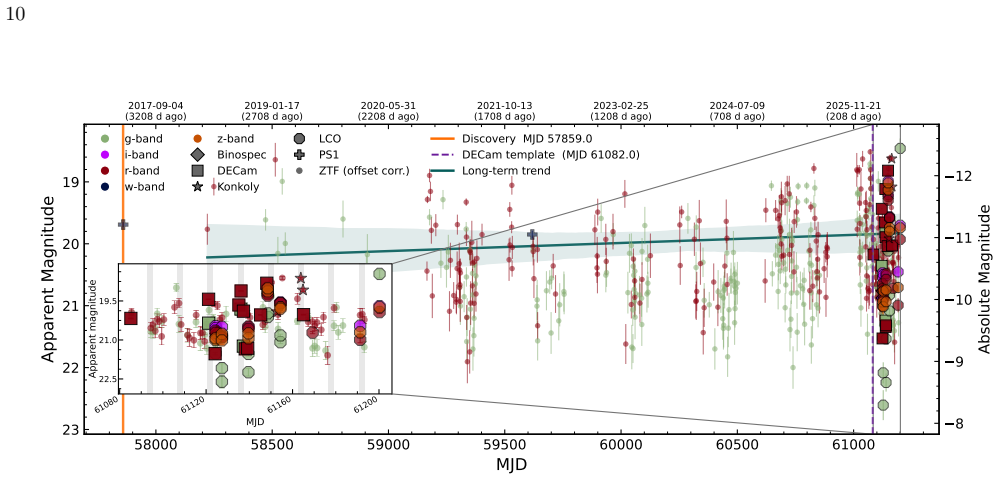
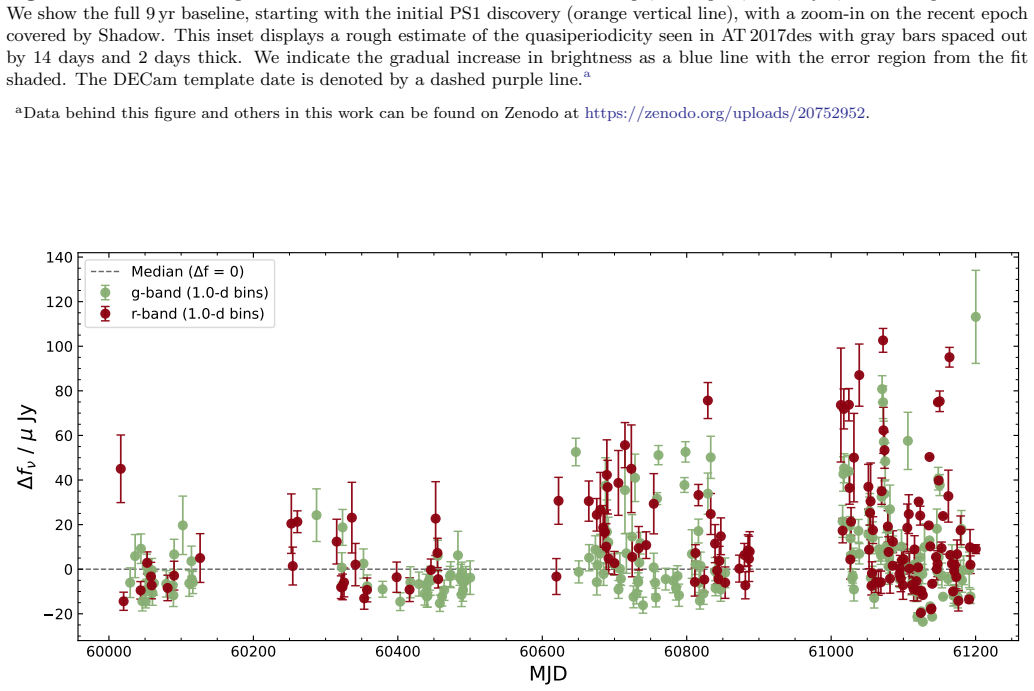
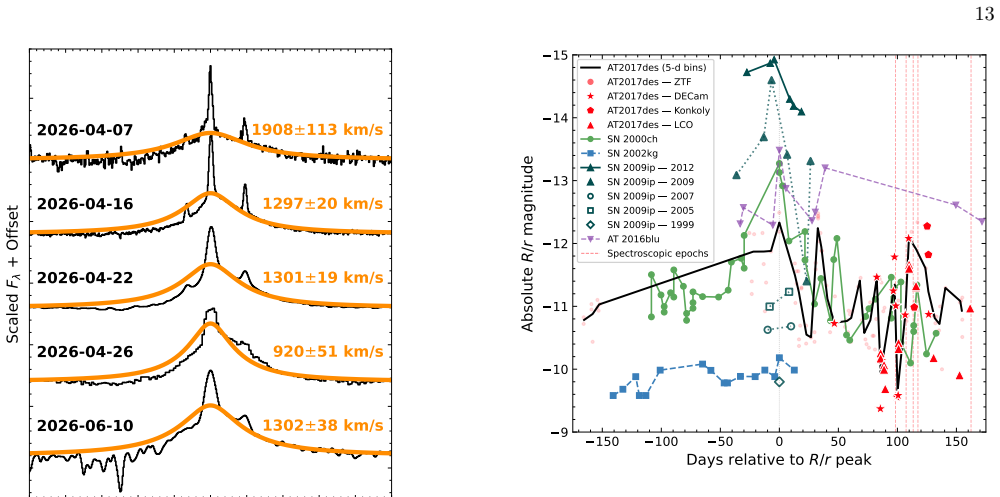
AT2017des exhibits fitful LBV eruptions with variability on ~10-day timescales and spectral features typical of hot LBVs and SN impostors. Long-baseline photometry from multiple facilities shows the peaks of these outbursts are getting brighter over time at an average rate of ~0.05 mag yr^{-1}, reaching luminosities higher than most other LBVs and comparable only to bright precursors such as SN2009ip.
What carries the argument
The secular increase in peak outburst luminosity measured across 2023-2026 photometry from multiple observatories.
If this is right
- If the brightening continues, AT2017des could explode as a supernova within years, enabling direct pre-explosion monitoring.
- High-cadence Shadow Survey data combined with LSST will allow similar tracking of other LBV and SN-impostor candidates.
- The light curve provides a concrete template for identifying stars whose activity is increasing toward terminal collapse.
Where Pith is reading between the lines
- Continued monitoring could test whether the brightening rate accelerates or plateaus before any explosion.
- The pattern may link to other documented SN impostors whose activity also increased before core collapse.
- The survey's nightly cadence on cluster fields offers a practical way to catch the earliest phases of such events across the local volume.
Load-bearing premise
The observed year-to-year rise in outburst peak brightness reflects real changes in the star rather than differences in calibration, sampling, or selection across facilities.
What would settle it
Future photometry showing that the peak luminosities stop increasing or begin to decline would indicate the brightening trend is not a sustained precursor to explosion.
Figures
read the original abstract
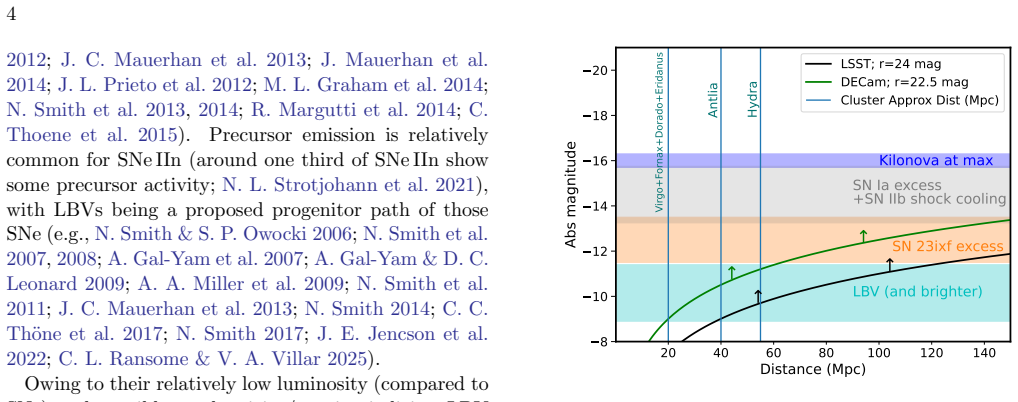
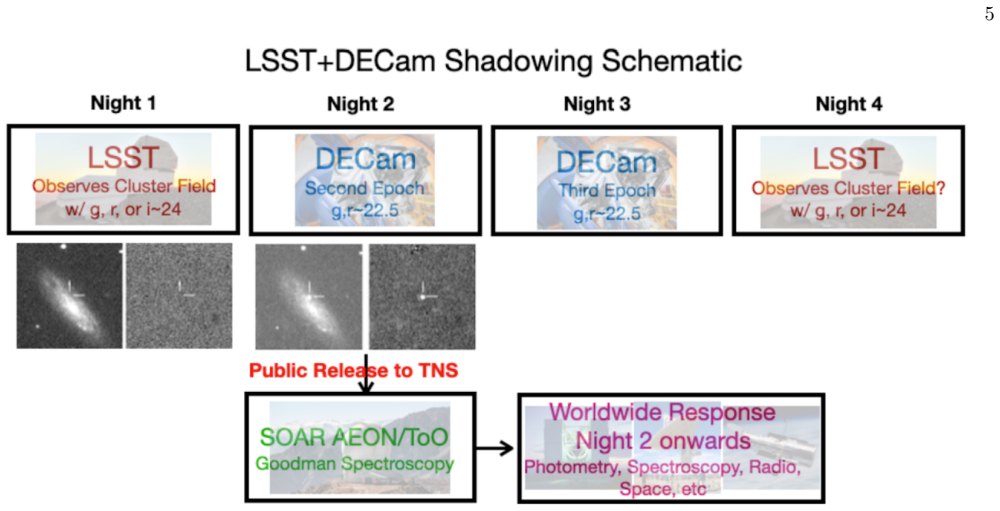
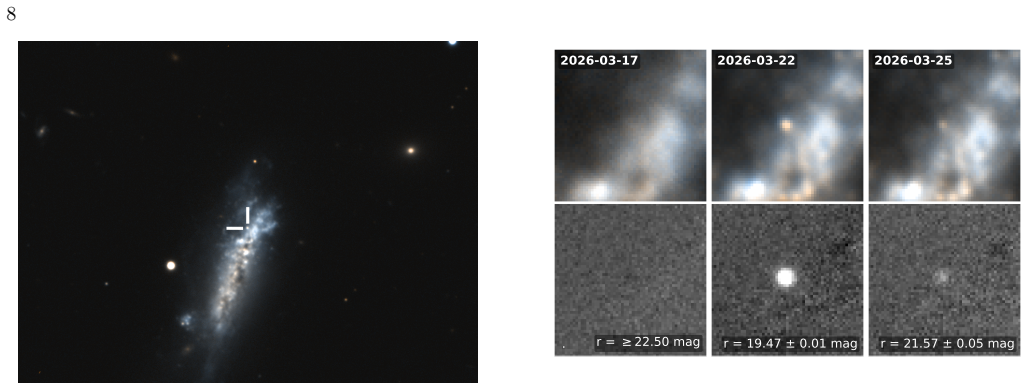
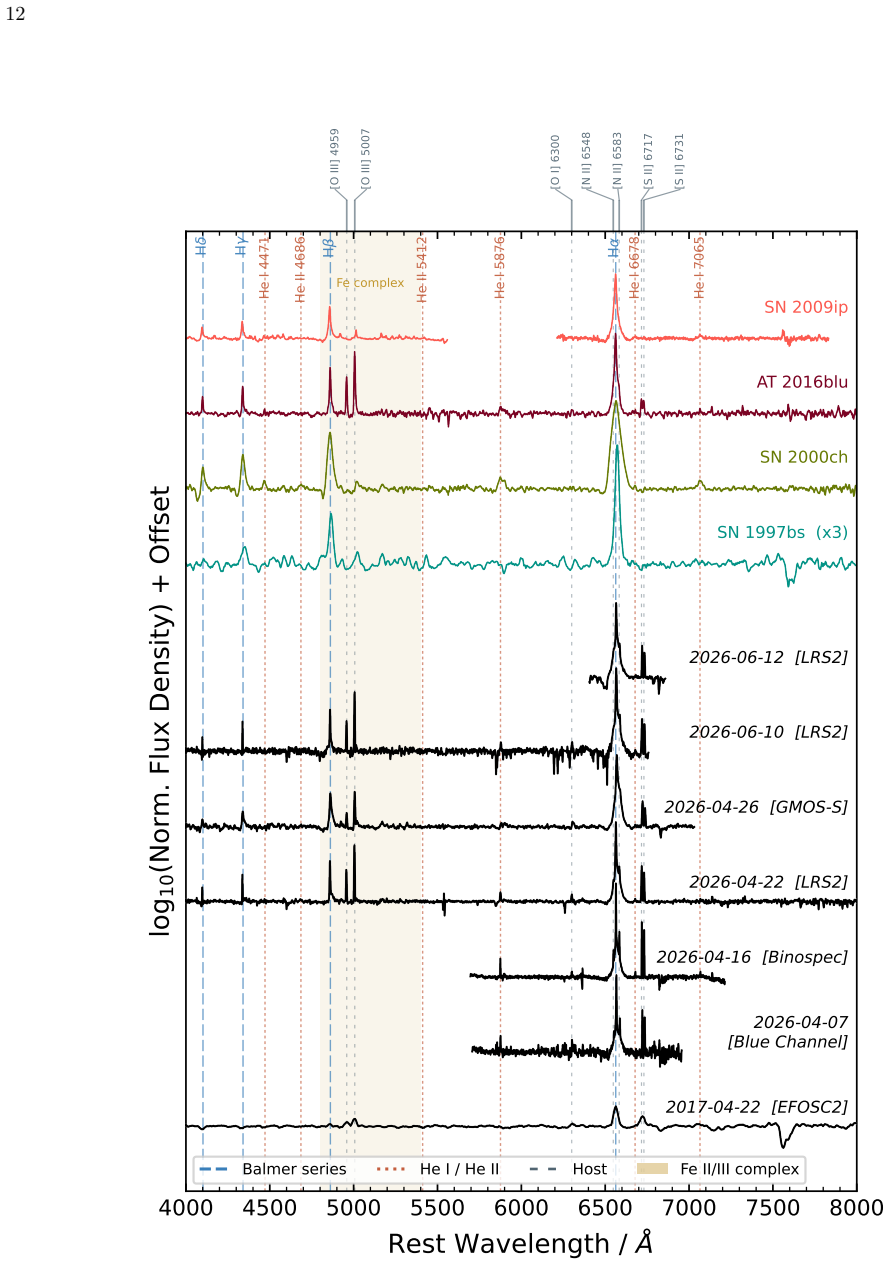
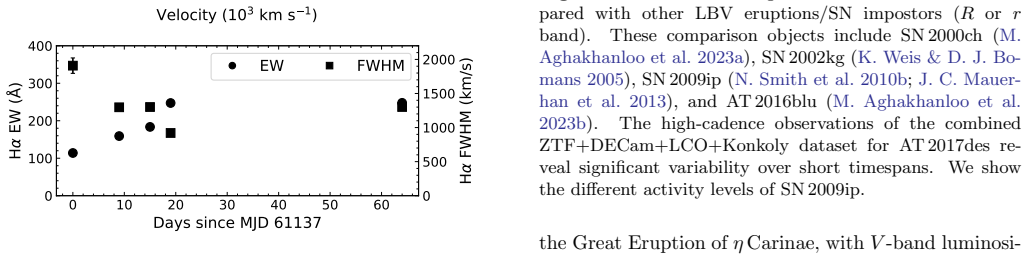
The Legacy Survey of Space and Time (LSST) will start in late-summer 2026, revolutionizing transient astronomy. Here, we present the Dark Energy Camera (DECam) Shadow Survey, which is designed to maximize the science potential of LSST by shadowing LSST observations of local galaxy-cluster fields, producing a nightly cadence of these fields. The Shadow Survey will discover extremely young supernovae (SNe), SN precursors, as well as other explosive transients and exotic phenomena, helping to characterize such transients at unprecedented cadence and depth when combined with LSST. We describe our workflow, pipeline, public data releases, and candidate vetting. As an early result of Shadow, we present the fitful luminous blue variable (LBV) eruptions of AT2017des in the Virgo-Cluster galaxy NGC4532. AT2017des has short-timescale variability (of order 10 days), peaking at around $M_r=-12.5$mag, brighter than normal LBVs, and similar to the more extreme flaring of hot LBVs/SN impostors such as SN2000ch, AT2016blu, and the precursor activity of SN2009ip. Our spectral time-series reveals features typical of these hot LBVs and SN impostors/precursors. Combining our data with long-baseline photometry from additional observatories, we find that the peaks of the outbursts of AT2017des are getting brighter over time, with 2026 peak fluxes being up to 5 times greater than in 2023 and an average brightening of $\sim0.05$ mag yr$^{-1}$. The peaks of AT2017des are more luminous than those of most other LBVs, only being fainter than bright precursors such as SN2009ip, and extreme SN impostors such as AT2016blu. AT2017des may therefore be ``ramping up'' to a terminal explosion.
Editorial analysis
A structured set of objections, weighed in public.
Referee Report
Summary. The manuscript introduces the DECam Shadow Survey, a nightly-cadence program shadowing LSST observations of local galaxy-cluster fields to enable early discovery of young supernovae, precursors, and other transients. As an early result, it presents multi-epoch photometry and spectroscopy of the luminous blue variable AT2017des in NGC4532, noting short-timescale (~10 day) variability with peaks around M_r = -12.5 mag, spectral features typical of hot LBVs and SN impostors, and a secular increase in outburst peak luminosity of ~0.05 mag yr^{-1} (2026 peaks up to 5 times brighter than 2023) when combining DECam data with long-baseline photometry from other facilities; the authors suggest this indicates the object may be ramping up to a terminal explosion.
Significance. If the reported secular brightening trend is shown to be intrinsic rather than systematic, the result would add a well-observed case to the small sample of LBVs with apparently increasing pre-explosion activity (comparable to SN2009ip and AT2016blu), with implications for massive-star evolution and the connection between LBV outbursts and core-collapse supernovae. The survey concept itself is a practical bridge to LSST-era transient science in cluster environments.
major comments (2)
- [Abstract and photometry description] Abstract and photometry description: The central claim of an intrinsic secular brightening trend (~0.05 mag yr^{-1}) rests on combining DECam Shadow Survey data with long-baseline photometry from additional observatories, yet no information is supplied on filter transformations, zero-point consistency across facilities, or whether all historical peaks were sampled with comparable completeness. If cross-calibration systematics or incomplete peak sampling dominate, the trend is not necessarily stellar evolution and the 'ramping up' inference does not follow.
- [Results section on AT2017des] Results section on AT2017des: No error analysis, uncertainty budgets, or data tables for the light-curve peaks are presented, preventing assessment of whether the reported brightening rate is robust to calibration choices or sampling cadence, which directly affects the load-bearing assumption that the observed increase reflects intrinsic evolution.
minor comments (1)
- [Abstract] The abstract refers to 'fitful' variability without a quantitative definition or reference to the light-curve figure that would clarify the term.
Simulated Author's Rebuttal
We thank the referee for their careful and constructive review. The comments highlight important areas where additional detail is required to support the central claims regarding the secular brightening of AT2017des. We address each major comment below and have revised the manuscript accordingly.
read point-by-point responses
-
Referee: [Abstract and photometry description] Abstract and photometry description: The central claim of an intrinsic secular brightening trend (~0.05 mag yr^{-1}) rests on combining DECam Shadow Survey data with long-baseline photometry from additional observatories, yet no information is supplied on filter transformations, zero-point consistency across facilities, or whether all historical peaks were sampled with comparable completeness. If cross-calibration systematics or incomplete peak sampling dominate, the trend is not necessarily stellar evolution and the 'ramping up' inference does not follow.
Authors: We agree that the original manuscript lacked sufficient detail on cross-calibration. In the revised version we have added a new subsection in the photometry description that details the filter transformations applied between facilities (including color-term corrections derived from standard stars), zero-point consistency checks using overlapping observations of field stars, and an assessment of peak sampling completeness across the multi-year baseline. We also quantify the impact of potential systematics on the derived brightening rate and argue that the trend remains significant after these considerations. revision: yes
-
Referee: [Results section on AT2017des] Results section on AT2017des: No error analysis, uncertainty budgets, or data tables for the light-curve peaks are presented, preventing assessment of whether the reported brightening rate is robust to calibration choices or sampling cadence, which directly affects the load-bearing assumption that the observed increase reflects intrinsic evolution.
Authors: We acknowledge this omission. The revised Results section now includes a full uncertainty budget for the outburst peaks that incorporates photometric measurement errors, zero-point uncertainties from each facility, and sampling-cadence effects. We have also added a data table (new Table 2) listing every identified peak magnitude, its uncertainty, the facility and filter, and the observation date. This allows direct evaluation of the robustness of the ~0.05 mag yr^{-1} trend. revision: yes
Circularity Check
No circularity: purely observational photometry with no derivations or fitted predictions
full rationale
The manuscript reports direct observations of AT2017des outbursts using DECam Shadow Survey data combined with external photometry. The secular brightening trend (~0.05 mag yr^{-1}) is presented as a measured empirical result, not derived from any model, equation, or self-referential fit. No self-definitional steps, fitted-input predictions, uniqueness theorems, or ansatzes appear. The central claim rests on the data themselves rather than reducing to its own inputs by construction. This is the expected outcome for an observational transient report.
Axiom & Free-Parameter Ledger
axioms (1)
- domain assumption Standard assumptions of photometric calibration and distance to NGC4532 are valid.
Reference graph
Works this paper leans on
-
[1]
2023a, MNRAS, 521, 1941, doi: 10.1093/mnras/stad630
Aghakhanloo, M., Smith, N., Milne, P., et al. 2023a, MNRAS, 521, 1941, doi: 10.1093/mnras/stad630
-
[2]
2023b, MNRAS, 526, 456, doi: 10.1093/mnras/stad2702
Aghakhanloo, M., Smith, N., Milne, P., et al. 2023b, MNRAS, 526, 456, doi: 10.1093/mnras/stad2702
-
[3]
Aghakhanloo, M., Smith, N., Andrews, J. E., et al. 2025, MNRAS, 539, 1317, doi: 10.1093/mnras/staf568
-
[4]
Alam, S., Albareti, F. D., Prieto, C. A., et al. 2015, The Astrophysical Journal Supplement Series, 219, 12, doi: 10.1088/0067-0049/219/1/12
-
[5]
Angel, J. R. P., Hilliard, R. L., & Weymann, R. J. 1979, in The MMT and the Future of Ground-Based Astronomy, ed. T. C. Weekes, Vol. 385, 87
1979
-
[7]
2021, MNRAS, 500, 1633, doi: 10.1093/mnras/staa2587
Beck, R., Szapudi, I., Flewelling, H., et al. 2021, MNRAS, 500, 1633, doi: 10.1093/mnras/staa2587
-
[8]
Bellm, E. C., Kulkarni, S. R., Graham, M. J., et al. 2019, PASP, 131, 018002, doi: 10.1088/1538-3873/aaecbe
-
[9]
2009, The Astronomer’s Telegram, 2184, 1
Berger, E., Foley, R., & Ivans, I. 2009, The Astronomer’s Telegram, 2184, 1
2009
-
[10]
doi:10.1051/aas:1996164 , author =
Bertin, E., & Arnouts, S. 1996, A&AS, 117, 393, doi: 10.1051/aas:1996164
-
[11]
Bianco, F. B., Jones, R. L., Ivezi´ c,ˇZ., Ritz, S. M., & Rubin Observatory Project Science Team. 2025, Updated estimates of the Rubin system throughput and expected LSST image depth, Project Science Technical Note PSTN-054, NSF-DOE Vera C. Rubin Observatory, doi: 10.71929/rubin/2584366
-
[12]
Bianco, F. B., Ivezi´ c,ˇZ., Jones, R. L., et al. 2022, ApJS, 258, 1, doi: 10.3847/1538-4365/ac3e72
-
[13]
P., Jord´ an, A., Mei, S., et al
Blakeslee, J. P., Jord´ an, A., Mei, S., et al. 2009, ApJ, 694, 556, doi: 10.1088/0004-637X/694/1/556
-
[14]
Boian, I., & Groh, J. H. 2018, Astronomy & Astrophysics, 617, A115, doi: 10.1051/0004-6361/201731794
-
[15]
A., Pearson, J., Shrestha, M., et al
Bostroem, K. A., Pearson, J., Shrestha, M., et al. 2023, ApJL, 956, L5, doi: 10.3847/2041-8213/acf9a4
-
[16]
J., Elias-Rosa, N., Fraser, M., Van Dyk, S
Brennan, S. J., Elias-Rosa, N., Fraser, M., Van Dyk, S. D., & Lyman, J. D. 2022, A&A, 664, L18, doi: 10.1051/0004-6361/202244262
-
[17]
Brown, T. M., Baliber, N., Bianco, F. B., et al. 2013, PASP, 125, 1031, doi: 10.1086/673168
work page internal anchor Pith review doi:10.1086/673168 2013
-
[18]
J., Gal-Yam, A., Schulze, S., et al
Bruch, R. J., Gal-Yam, A., Schulze, S., et al. 2020, arXiv e-prints, arXiv:2008.09986. https://arxiv.org/abs/2008.09986
arXiv 2020
-
[19]
J., Gal-Yam, A., Yaron, O., et al
Bruch, R. J., Gal-Yam, A., Yaron, O., et al. 2023, ApJ, 952, 119, doi: 10.3847/1538-4357/acd8be
-
[20]
2024, PhRvD, 110, 123029, doi: 10.1103/PhysRevD.110.123029
Cabrera, T., Palmese, A., Hu, L., et al. 2024, PhRvD, 110, 123029, doi: 10.1103/PhysRevD.110.123029
-
[21]
2017, The Astrophysical Journal, 836, 97, doi: 10.3847/1538-4357/836/1/97
Maureira, J.-C. 2017, The Astrophysical Journal, 836, 97, doi: 10.3847/1538-4357/836/1/97
-
[22]
Z., Pastorello, A., Fraser, M., et al
Cai, Y. Z., Pastorello, A., Fraser, M., et al. 2021, A&A, 654, A157, doi: 10.1051/0004-6361/202141078
-
[23]
Cardelli, J. A., Clayton, G. C., & Mathis, J. S. 1989, ApJ, 345, 245, doi: 10.1086/167900 C´ ardenas, C., Khaulsay, J., K, A. S., et al. 2026, Transient Name Server Classification Report, 2026-1935, 1
-
[24]
Chambers, K. C., Magnier, E. A., Metcalfe, N., et al. 2016, arXiv e-prints, arXiv:1612.05560, doi: 10.48550/arXiv.1612.05560
work page internal anchor Pith review Pith/arXiv arXiv doi:10.48550/arxiv.1612.05560 2016
-
[25]
C., Huber, M
Chambers, K. C., Huber, M. E., Flewelling, H., et al. 2017, Transient Name Server Discovery Report, 2017-448, 1
2017
-
[26]
Chonis, T. S., Hill, G. J., Lee, H., Tuttle, S. E., & Vattiat, B. L. 2014, in Society of Photo-Optical Instrumentation Engineers (SPIE) Conference Series, Vol. 9147, Ground-based and Airborne Instrumentation for Astronomy V, ed. S. K. Ramsay, I. S. McLean, & H. Takami, 91470A, doi: 10.1117/12.2056005
-
[27]
Chonis, T. S., Hill, G. J., Lee, H., et al. 2016, in Society of Photo-Optical Instrumentation Engineers (SPIE) Conference Series, Vol. 9908, Ground-based and Airborne Instrumentation for Astronomy VI, ed. C. J. Evans, L. Simard, & H. Takami, 99084C, doi: 10.1117/12.2232209
-
[28]
Christy, C. T., Jayasinghe, T., Stanek, K. Z., et al. 2023, Monthly Notices of the Royal Astronomical Society, 519, 5271, doi: 10.1093/mnras/stac3801
-
[29]
Clark, J. S., Larionov, V. M., & Arkharov, A. 2005, A&A, 435, 239, doi: 10.1051/0004-6361:20042563
-
[30]
Conti, P. S. 1984, in IAU Symposium, Vol. 105, Observational Tests of the Stellar Evolution Theory, ed. A. Maeder & A. Renzini, 233
1984
-
[31]
Darnley, M. J., Hounsell, R., O’Brien, T. J., et al. 2019, Nature, 565, 460, doi: 10.1038/s41586-018-0825-4 DESI Collaboration, Adame, A. G., Aguilar, J., et al. 2024, The Astronomical Journal, 168, 58, doi: 10.3847/1538-3881/ad3217
-
[32]
2017, A&A, 605, A83, doi: 10.1051/0004-6361/201730942
Dessart, L., John Hillier, D., & Audit, E. 2017, A&A, 605, A83, doi: 10.1051/0004-6361/201730942
-
[33]
Dong, Y., & Villar, V. A. 2026, Transient Name Server Classification Report, 2026-1311, 1
2026
-
[34]
Dong, Y., Sand, D. J., Valenti, S., et al. 2023, ApJ, 957, 28, doi: 10.3847/1538-4357/acef18
-
[35]
K., et al
Dong, Y., Nugent, A., Yadavalli, S. K., et al. 2026, Transient Name Server Classification Report, 2026-1740, 1
2026
-
[36]
J., Ackley, K., Jim´ enez-Ibarra, F., et al
Dyer, M. J., Ackley, K., Jim´ enez-Ibarra, F., et al. 2024, in Society of Photo-Optical Instrumentation Engineers (SPIE) Conference Series, Vol. 13094, Ground-based and Airborne Telescopes X, ed. H. K. Marshall, J. Spyromilio, & T. Usuda, 130941X, doi: 10.1117/12.3018305 D´ alya, G., D´ ıaz, R., Bouchet, F. R., et al. 2022, Monthly Notices of the Royal As...
-
[37]
2016, MNRAS, 463, 3894, doi: 10.1093/mnras/stw2253
Elias-Rosa, N., Pastorello, A., Benetti, S., et al. 2016, MNRAS, 463, 3894, doi: 10.1093/mnras/stw2253
-
[38]
2019, PASP, 131, 075004, doi: 10.1088/1538-3873/ab1d78
Fabricant, D., Fata, R., Epps, H., et al. 2019, PASP, 131, 075004, doi: 10.1088/1538-3873/ab1d78
-
[39]
Filippenko, A. V. 1989, AJ, 97, 726, doi: 10.1086/115018 19
-
[40]
Filippenko, A. V. 1997, ARA&A, 35, 309, doi: 10.1146/annurev.astro.35.1.309
-
[41]
Filippenko, A. V., Barth, A. J., Bower, G. C., et al. 1995, AJ, 110, 2261, doi: 10.1086/117687
-
[42]
V., Chornock, R., Swift, B., et al
Filippenko, A. V., Chornock, R., Swift, B., et al. 2003, IAUC, 8159, 2
2003
-
[43]
Filippenko, A. V., Li, W. D., Treffers, R. R., & Modjaz, M. 2001, International Astronomical Union Colloquium, 183, 121–130, doi: 10.1017/S0252921100078738
-
[44]
Flaugher, B., Diehl, H. T., Honscheid, K., et al. 2015, AJ, 150, 150, doi: 10.1088/0004-6256/150/5/150
-
[45]
Flesch, E. W. 2023, The Open Journal of Astrophysics, 6, 49, doi: 10.21105/astro.2308.01505
-
[46]
Flewelling, H. A., Magnier, E. A., Chambers, K. C., et al. 2020, ApJS, 251, 7, doi: 10.3847/1538-4365/abb82d
-
[47]
Fransson, C., Sollerman, J., Strotjohann, N. L., et al. 2022, A&A, 666, A79, doi: 10.1051/0004-6361/202243452
-
[48]
Franz, N., Subrayan, B., Kilpatrick, C. D., et al. 2025, ApJL, 994, L45, doi: 10.3847/2041-8213/ae17a8
-
[49]
2013, MNRAS, 433, 1312, doi: 10.1093/mnras/stt813
Fraser, M., Inserra, C., Jerkstrand, A., et al. 2013, MNRAS, 433, 1312, doi: 10.1093/mnras/stt813
-
[50]
Freedman, W. L., Madore, B. F., Mould, J. R., et al. 1994, Nature, 371, 757, doi: 10.1038/371757a0
-
[51]
J., Smith, K
Fulton, M., Smartt, S. J., Smith, K. W., et al. 2022, Transient Name Server AstroNote, 36, 1
2022
-
[52]
Fulton, M. D., Smartt, S. J., Huber, M. E., et al. 2025, MNRAS, 542, 541, doi: 10.1093/mnras/staf1165
-
[53]
Gagliano, A., Berger, E., Villar, V. A., et al. 2025a, ApJ, 978, 110, doi: 10.3847/1538-4357/ad9748
-
[54]
Gagliano, A., Villar, V. A., Matsumoto, T., et al. 2025b, arXiv e-prints, arXiv:2502.19469, doi: 10.48550/arXiv.2502.19469 Gaia Collaboration, Vallenari, A., Brown, A. G. A., et al. 2023, Astronomy and Astrophysics, 674, A1, doi: 10.1051/0004-6361/202243940
-
[55]
Gal-Yam, A., & Leonard, D. C. 2009, Nature, 458, 865, doi: 10.1038/nature07934
-
[56]
Gal-Yam, A., Leonard, D. C., Fox, D. B., et al. 2007, ApJ, 656, 372, doi: 10.1086/510523
-
[57]
Gal-Yam, A., Arcavi, I., Ofek, E. O., et al. 2014, Nature, 509, 471, doi: 10.1038/nature13304
-
[58]
Filippenko, A. V. 1989, ApJ, 342, 908, doi: 10.1086/167646
-
[59]
2025, arXiv e-prints, arXiv:2504.15988, doi: 10.48550/arXiv.2504.15988
Goto, S., Yamanaka, M., Nagayama, T., et al. 2025, arXiv e-prints, arXiv:2504.15988, doi: 10.48550/arXiv.2504.15988
-
[60]
Graham, M. L., Sand, D. J., Valenti, S., et al. 2014, ApJ, 787, 163, doi: 10.1088/0004-637X/787/2/163
-
[61]
Green, G. M., Schlafly, E. F., Finkbeiner, D., et al. 2018, MNRAS, 478, 651, doi: 10.1093/mnras/sty1008
-
[63]
Groh, J. H., Hillier, D. J., & Damineli, A. 2011b, ApJ, 736, 46, doi: 10.1088/0004-637X/736/1/46
-
[64]
Groh, J. H., Hillier, D. J., Damineli, A., et al. 2009, ApJ, 698, 1698, doi: 10.1088/0004-637X/698/2/1698
-
[65]
P., Cartier, R., & Yaron, O
Gutierrez, C. P., Cartier, R., & Yaron, O. 2017, Transient Name Server Classification Report, 2017-468, 1
2017
-
[66]
Guy, L. P., AlSayyad, Y., Bechtol, K., et al. 2026, Rubin Observatory Plans for an Early Science Program, Technical Note RTN-011, NSF-DOE Vera C. Rubin Observatory, doi: 10.71929/rubin/2584021
-
[67]
J., Palmese, A., O’Connor, B., et al
Hall, X. J., Palmese, A., O’Connor, B., et al. 2026a, ApJL, 1001, L20, doi: 10.3847/2041-8213/ae4338
-
[68]
Hall, X. J., Ahumada, T., Gassert, J., et al. 2026b, arXiv e-prints, arXiv:2605.10940, doi: 10.48550/arXiv.2605.10940
work page internal anchor Pith review Pith/arXiv arXiv doi:10.48550/arxiv.2605.10940
-
[69]
Hamuy, M., & Pinto, P. A. 1999, AJ, 117, 1185, doi: 10.1086/300759
-
[70]
He, K., Zhang, X., Ren, S., & Sun, J. 2016, in 2016 IEEE Conference on Computer Vision and Pattern Recognition Workshops (CVPRW) (IEEE), 1, doi: 10.1109/CVPR.2016.90
-
[71]
Hinkle, J. T., Holoien, T. W.-S., Shappee, B. J., et al. 2022, ApJ, 930, 12, doi: 10.3847/1538-4357/ac5f54
-
[72]
2024, ApJ, 964, 181, doi: 10.3847/1538-4357/ad2854
Hiramatsu, D., Matsumoto, T., Berger, E., et al. 2024, ApJ, 964, 181, doi: 10.3847/1538-4357/ad2854
-
[73]
Ho, A. Y. Q., Perley, D. A., Gal-Yam, A., et al. 2023, ApJ, 949, 120, doi: 10.3847/1538-4357/acc533
-
[74]
Honscheid, K., & DePoy, D. L. 2008, arXiv e-prints, arXiv:0810.3600, doi: 10.48550/arXiv.0810.3600
-
[75]
Hosseinzadeh, G., Sand, D. J., Valenti, S., et al. 2017, ApJL, 845, L11, doi: 10.3847/2041-8213/aa8402
-
[76]
Hosseinzadeh, G., Sand, D. J., Lundqvist, P., et al. 2022, ApJL, 933, L45, doi: 10.3847/2041-8213/ac7cef
-
[77]
2023a, ApJL, 953, L16, doi: 10.3847/2041-8213/ace4c4
Hosseinzadeh, G., Farah, J., Shrestha, M., et al. 2023a, ApJL, 953, L16, doi: 10.3847/2041-8213/ace4c4
-
[78]
Hosseinzadeh, G., Sand, D. J., Sarbadhicary, S. K., et al. 2023b, ApJL, 953, L15, doi: 10.3847/2041-8213/ace7c0
-
[79]
Hosseinzadeh, G., Paterson, K., Rastinejad, J. C., et al. 2024, ApJ, 964, 35, doi: 10.3847/1538-4357/ad2170
-
[80]
J., et al
Hosseinzadeh, G., Andrews, J., Sand, D. J., et al. 2025, Transient Name Server AstroNote, 280, 1
2025
-
[81]
2019, in American Astronomical Society Meeting Abstracts, Vol
Howell, D. 2019, in American Astronomical Society Meeting Abstracts, Vol. 233, American Astronomical Society Meeting Abstracts #233, 258.16 20
2019
-
[83]
2022, ApJ, 936, 157, doi: 10.3847/1538-4357/ac7394
Hu, L., Wang, L., Chen, X., & Yang, J. 2022, ApJ, 936, 157, doi: 10.3847/1538-4357/ac7394
discussion (0)
Sign in with ORCID, Apple, or X to comment. Anyone can read and Pith papers without signing in.