Generative Modeling for Physiological Signals
Pith reviewed 2026-06-26 06:28 UTC · model grok-4.3
The pith
Generative models address data scarcity, noise, and privacy barriers in physiological signals by augmenting datasets and synthesizing recordings.
A machine-rendered reading of the paper's core claim, the machinery that carries it, and where it could break.
Core claim
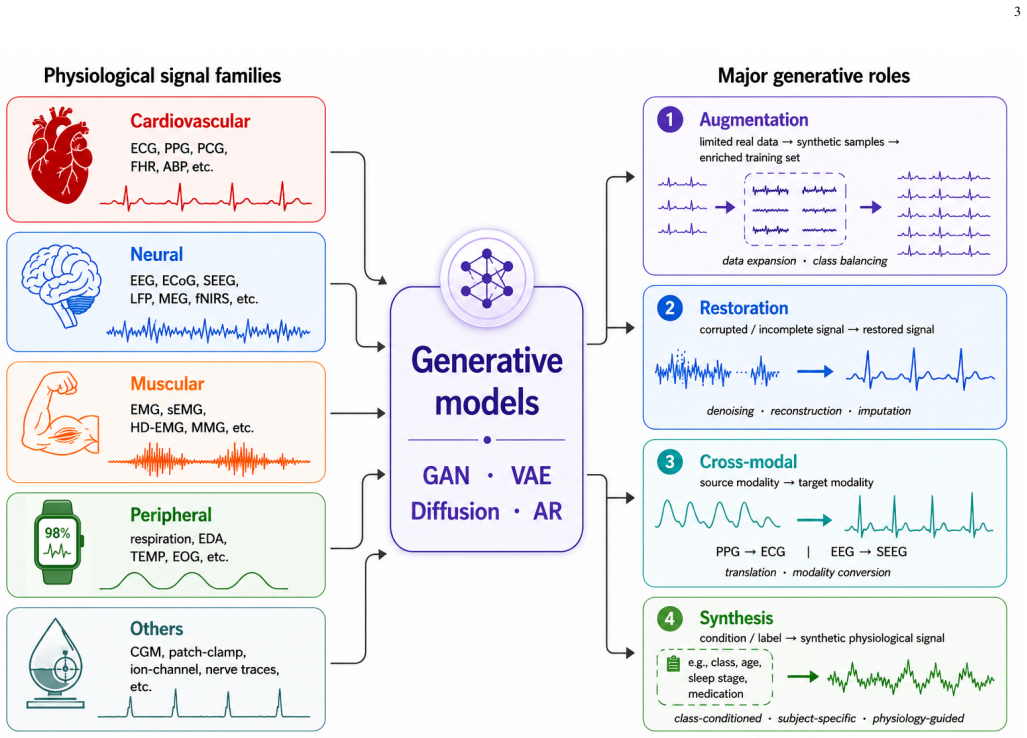
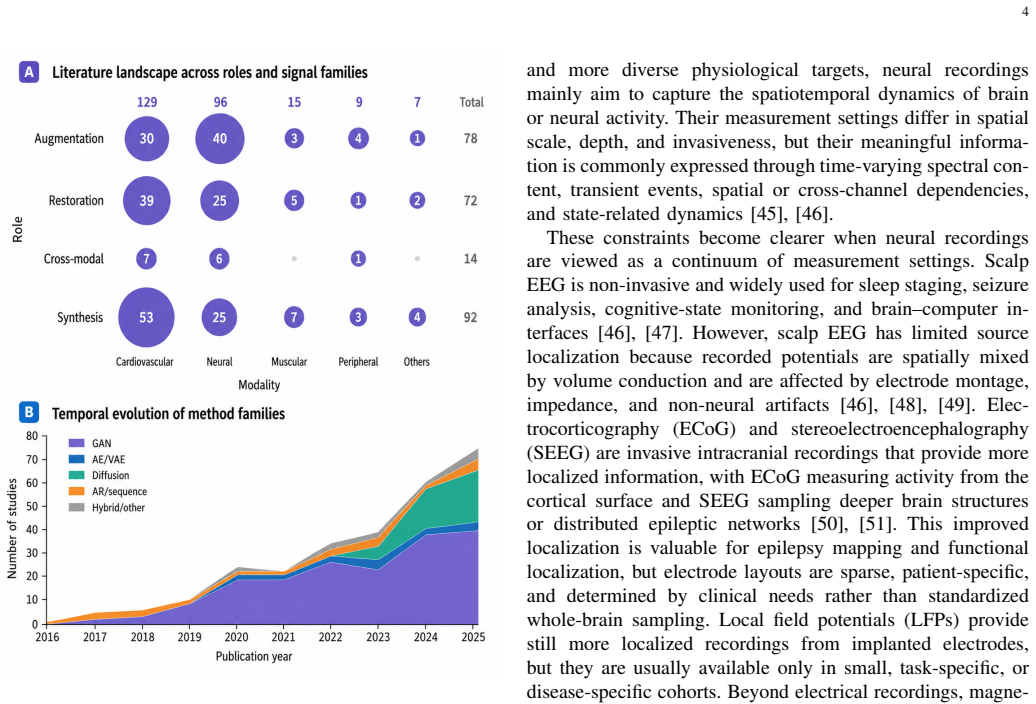
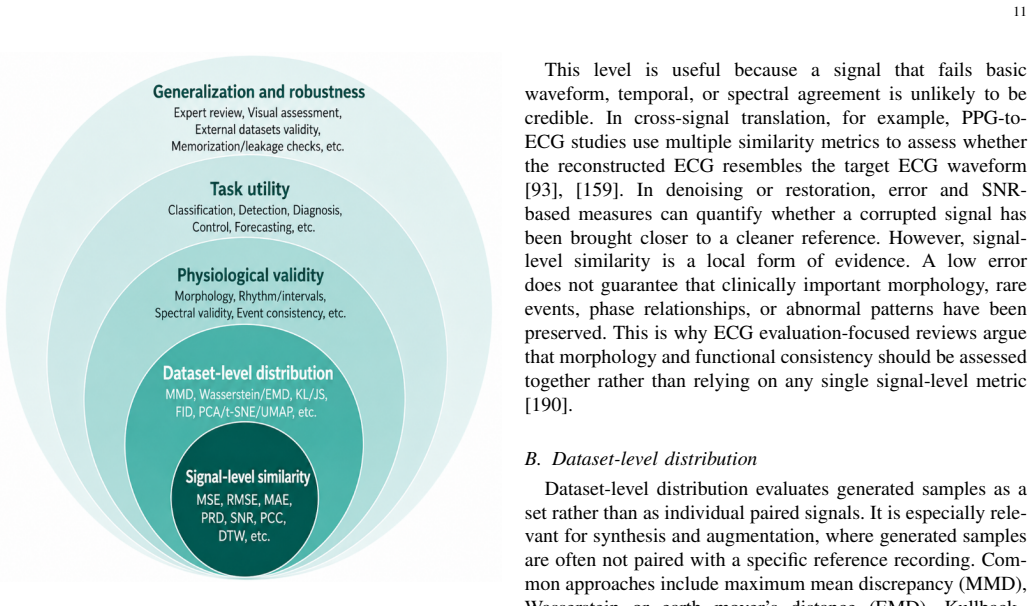
Recent studies have used generative models to augment scarce datasets, restore degraded recordings, translate between modalities, and synthesize conditional physiological waveforms. By organizing work on cardiovascular, neural, muscular, peripheral, and specialized signals according to model families and linking these to a hierarchical evaluation framework that spans signal-level similarity, dataset-level distribution, physiological validity, task-oriented utility, and assessments of generalization and robustness, the review supplies structured guidance for future use and evaluation of generative models in physiological-signal research.
What carries the argument
The hierarchical evaluation framework that organizes assessments from signal-level similarity through dataset distribution and physiological validity to task-oriented utility and generalization checks.
If this is right
- Researchers gain a map for matching generative roles such as augmentation or restoration to specific signal types and constraints.
- Evaluation can shift from isolated similarity metrics to include physiological validity and downstream task performance.
- Privacy-preserving synthesis becomes more feasible when models are chosen and tested under the organized framework.
- Hybrid model designs may be prioritized when handling heterogeneous acquisition settings across signal modalities.
Where Pith is reading between the lines
- The framework could be applied to benchmark new wearable sensor data streams to test whether current validity checks scale to continuous monitoring.
- Linking the evaluation levels to clinical outcome metrics might reveal where generative outputs improve diagnostic accuracy beyond statistical distribution matches.
- Extending the hierarchy to include real-time latency and power constraints would address deployment barriers left implicit in the review.
Load-bearing premise
The selected recent studies on the listed model families and signal types adequately represent the major advances and evaluation practices in the field.
What would settle it
A later survey finding that most new generative work on physiological signals relies on model families or evaluation criteria outside the five categories and signal groupings covered here would show the guidance is incomplete.
Figures
read the original abstract
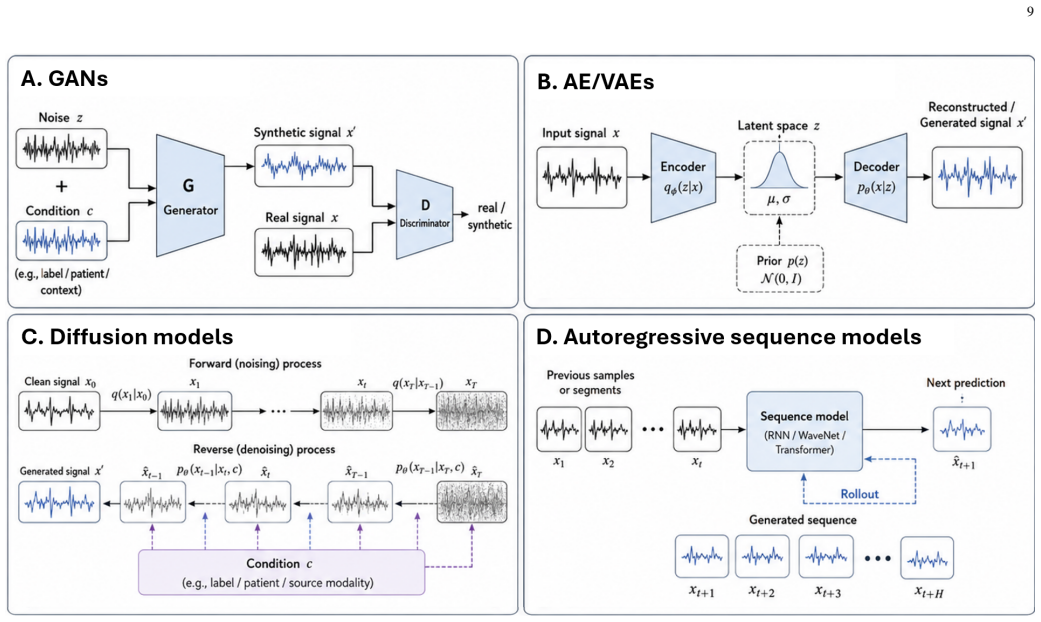
Physiological signals support clinical diagnosis, health monitoring, rehabilitation, wearable sensing, and human--machine interaction. However, their applications are often constrained by limited labeled data, class imbalance, noisy or incomplete recordings, heterogeneous acquisition settings, and privacy restrictions. Generative modeling has therefore attracted increasing attention as a means of addressing some of these barriers. Recent studies have used generative models to augment scarce datasets, restore degraded recordings, translate between modalities, and synthesize conditional physiological waveforms. This review summarizes recent work on generative modeling for cardiovascular, neural, muscular, peripheral, and specialized physiological signals. Major model families are covered, including generative adversarial networks (GANs), autoencoders and variational autoencoders (AEs/VAEs), diffusion models, autoregressive sequence models, and hybrid architectures. In addition, it organizes existing evaluation practices into a hierarchical framework spanning signal-level similarity, dataset-level distribution, physiological validity, task-oriented utility, and assessments of generalization and robustness. By linking signal-specific constraints, generative roles, model families, and evaluation evidence, this review provides structured guidance for the future use and evaluation of generative models in physiological-signal research.
Editorial analysis
A structured set of objections, weighed in public.
Referee Report
Summary. This manuscript is a survey reviewing the application of generative models—including GANs, autoencoders/VAEs, diffusion models, autoregressive sequence models, and hybrid architectures—to physiological signals in cardiovascular, neural, muscular, peripheral, and specialized domains. It describes how these models address challenges such as limited labeled data, class imbalance, noise, heterogeneity, and privacy constraints through data augmentation, restoration, modality translation, and conditional synthesis. The central contribution is a proposed hierarchical evaluation framework spanning signal-level similarity, dataset-level distribution matching, physiological validity, task-oriented utility, and assessments of generalization and robustness.
Significance. The taxonomic organization of the literature and the introduction of a multi-level evaluation hierarchy constitute a useful contribution. By explicitly connecting signal-specific constraints, generative roles, model families, and evaluation practices, the survey can provide structured guidance for researchers working on physiological signal processing. The emphasis on physiological validity and task utility beyond basic similarity metrics is a strength that aligns with clinical needs.
minor comments (2)
- [Abstract] The abstract states that the review 'organizes existing evaluation practices into a hierarchical framework,' but the manuscript should include a dedicated section or table that explicitly maps the cited studies onto each level of the hierarchy to demonstrate consistent application.
- Ensure the literature selection criteria and search methodology are described with sufficient detail (e.g., databases, keywords, inclusion dates) so that readers can assess the representativeness of the covered studies across the five signal categories.
Simulated Author's Rebuttal
We thank the referee for the positive summary, significance assessment, and recommendation of minor revision. The report contains no major comments, so we have no specific points to address point-by-point. We will handle any minor issues during revision.
Circularity Check
No significant circularity: survey with no derivations
full rationale
This paper is a literature survey that organizes existing work on generative models for physiological signals and proposes an evaluation hierarchy. It contains no new equations, predictions, fitted parameters, theorems, or empirical results whose validity depends on internal consistency. All claims are descriptive summaries of cited external studies, with no load-bearing steps that reduce by construction to the paper's own inputs or self-citations. The work is therefore self-contained as a review and exhibits no circularity of any enumerated kind.
Axiom & Free-Parameter Ledger
Reference graph
Works this paper leans on
-
[1]
D. C. Reddy,Biomedical Signal Processing: Principles and Techniques. New Delhi: Tata McGraw-Hill, 2005
2005
-
[2]
Machine learning in biosignal analysis from wearable devices,
I. Jeong, W. G. Chung, E. Kim, W. Park, H. Song, J. Lee, M. Oh, E. Kim, J. Paek, T. Lee, D. Kim, S. H. An, S. Kim, H. Cho, and J.-U. Park, “Machine learning in biosignal analysis from wearable devices,” Materials Horizons, vol. 12, no. 17, pp. 6587–6621, 2025
2025
-
[3]
A novel method for measuring the timing of heart sound components through digital phonocardiography,
N. Giordano and M. Knaflitz, “A novel method for measuring the timing of heart sound components through digital phonocardiography,” Sensors, vol. 19, no. 8, p. 1868, 2019
2019
-
[4]
Analysis of ecg and pcg time delay around auscultation sites
X. Bao, Y . Deng, N. Gall, and E. N. Kamavuako, “Analysis of ecg and pcg time delay around auscultation sites.” inBIOSIGNALS, 2020, pp. 206–213
2020
-
[5]
Deep generative models for physiological signals: A systematic literature review,
N. Neifar, A. Mdhaffar, A. Ben-Hamadou, and M. Jmaiel, “Deep generative models for physiological signals: A systematic literature review,”Artificial Intelligence in Medicine, vol. 165, p. 103127, 2025
2025
-
[6]
Sig- nal acquisition of brain–computer interfaces: A medical-engineering crossover perspective review,
Y . Sun, X. Chen, B. Liu, L. Liang, Y . Wang, S. Gao, and X. Gao, “Sig- nal acquisition of brain–computer interfaces: A medical-engineering crossover perspective review,”Fundamental Research, vol. 5, no. 1, pp. 3–16, 2025
2025
-
[7]
A survey of few-shot learning for biomedical time series,
C. Li, T. Denison, and T. Zhu, “A survey of few-shot learning for biomedical time series,”IEEE Reviews in Biomedical Engineering, vol. 18, pp. 192–210, 2025
2025
-
[8]
The impact of inconsistent human annotations on ai driven clinical decision making,
A. Sylolypavan, D. Sleeman, H. Wu, and M. Sim, “The impact of inconsistent human annotations on ai driven clinical decision making,” npj Digital Medicine, vol. 6, no. 1, p. 26, 2023
2023
-
[9]
The future of digital health with federated learning,
N. Rieke, J. Hancox, W. Li, F. Milletar `ı, H. R. Roth, S. Albarqouni, S. Bakas, M. N. Galtier, B. A. Landman, K. Maier-Hein, S. Ourselin, M. Sheller, R. M. Summers, A. Trask, D. Xu, M. Baust, and M. J. Cardoso, “The future of digital health with federated learning,”npj Digital Medicine, vol. 3, no. 1, p. 119, 2020
2020
-
[10]
Mitigating data quality challenges in ambulatory wrist-worn wearable monitoring through analytical and practical approaches,
J. V . D. Donckt, N. Vandenbussche, J. V . D. Donckt, S. Chen, M. Stojchevska, M. D. Brouwer, B. Steenwinckel, K. Paemeleire, F. Ongenae, and S. V . Hoecke, “Mitigating data quality challenges in ambulatory wrist-worn wearable monitoring through analytical and practical approaches,”Scientific Reports, vol. 14, no. 1, p. 17545, 2024
2024
-
[11]
A review on multi- sensor data fusion for wearable health monitoring,
A. John, A. P. James, B. Cardiff, and D. John, “A review on multi- sensor data fusion for wearable health monitoring,”Information Fusion, vol. 133, p. 104319, 2026
2026
-
[12]
Time synchronization of multimodal physiological signals through alignment of common signal types and its technical considerations in digital health,
R. Xiao, C. Ding, and X. Hu, “Time synchronization of multimodal physiological signals through alignment of common signal types and its technical considerations in digital health,”Journal of Imaging, vol. 8, no. 5, p. 120, 2022
2022
-
[13]
I. J. Goodfellow, J. Pouget-Abadie, M. Mirza, B. Xu, D. Warde-Farley, S. Ozair, A. Courville, and Y . Bengio, “Generative adversarial nets,” inAdvances in Neural Information Processing Systems, vol. 27, 2014, pp. 2672–2680. [Online]. Available: https://arxiv.org/abs/1406.2661
Pith/arXiv arXiv 2014
-
[14]
Auto-encoding variational bayes,
D. P. Kingma and M. Welling, “Auto-encoding variational bayes,” in International Conference on Learning Representations, 2014
2014
-
[15]
Denoising diffusion probabilistic models,
J. Ho, A. Jain, and P. Abbeel, “Denoising diffusion probabilistic models,” inAdvances in Neural Informa- tion Processing Systems, vol. 33, 2020, pp. 6840–6851. [Online]. Available: https://proceedings.neurips.cc/paper/2020/hash/ 4c5bcfec8584af0d967f1ab10179ca4b-Abstract.html
2020
-
[16]
Wavenet: A generative model for raw audio,
A. van den Oord, S. Dieleman, H. Zen, K. Simonyan, O. Vinyals, A. Graves, N. Kalchbrenner, A. Senior, and K. Kavukcuoglu, “Wavenet: A generative model for raw audio,” 2016
2016
-
[17]
Generative ai models in time-varying biomedical data: Scoping review,
R. Y . He, V . Sarwal, X. Qiu, Y . Zhuang, L. Zhang, Y . Liu, and J. N. Chiang, “Generative ai models in time-varying biomedical data: Scoping review,”Journal of Medical Internet Research, vol. 27, p. e59792, 2025
2025
-
[18]
A review on generative ai models for synthetic medical text, time series, and longitudinal data,
M. Loni, F. Poursalim, M. Asadi, and A. Gharehbaghi, “A review on generative ai models for synthetic medical text, time series, and longitudinal data,”npj Digital Medicine, vol. 8, p. 281, 2025
2025
-
[19]
Generative adversarial networks in electrocardiogram synthesis: Recent developments and challenges,
L. Berger, M. Haberbusch, and F. Moscato, “Generative adversarial networks in electrocardiogram synthesis: Recent developments and challenges,”Artificial Intelligence in Medicine, vol. 143, p. 102632, 2023
2023
-
[20]
Synthetic ecg signals generation: A scoping review,
B. Zanchi, G. Monachino, L. Fiorillo, G. Conte, A. Auricchio, A. Tzo- vara, and F. D. Faraci, “Synthetic ecg signals generation: A scoping review,”Computers in Biology and Medicine, vol. 184, p. 109453, 2025
2025
-
[21]
X. Bao, J. Bi, X. Chen, E. N. Kamavuako, and S. Chatterjee, “Diffusion-based heart sound generation: Evaluation with physiolog- ical signal metrics, classifiers, and expert listening,”arXiv preprint arXiv:2606.02448, 2026
Pith/arXiv arXiv 2026
-
[22]
Domain-adversarial pretrained encoder for ecg-based chagas disease screening,
T. Dong, X. Bao, J. Bi, and S. Chatterjee, “Domain-adversarial pretrained encoder for ecg-based chagas disease screening,” in52nd International Computing in Cardiology, CinC 2025, Sao Paulo, Brazil, September 14-17, 2025. Computing in Cardiology, 2025
2025
-
[23]
Paroxysmal atrial fibrillation detection by combined recurrent neural network and feature extraction on ecg signals,
X. Bao, F. Hu, Y . Xu, M. Trabelsi, and E. Kamavuako, “Paroxysmal atrial fibrillation detection by combined recurrent neural network and feature extraction on ecg signals,” inProceedings of the 15th International Joint Conference on Biomedical Engineering Systems and Technologies, 2022, pp. 85–90
2022
-
[24]
Cardiogan: Attentive generative adversarial network with dual discriminators for synthesis of ecg from ppg,
P. Sarkar and A. Etemad, “Cardiogan: Attentive generative adversarial network with dual discriminators for synthesis of ecg from ppg,” in 15 Proceedings of the AAAI Conference on Artificial Intelligence, vol. 35, no. 1, 2021, pp. 488–496
2021
-
[25]
The impact of the mit-bih arrhythmia database,
G. B. Moody and R. G. Mark, “The impact of the mit-bih arrhythmia database,”IEEE Engineering in Medicine and Biology Magazine, vol. 20, no. 3, pp. 45–50, 2001
2001
-
[26]
PTB-XL, a large publicly available electrocardiography dataset,
P. Wagner, N. Strodthoff, R.-D. Bousseljot, D. Kreiseler, F. I. Lunze, W. Samek, and T. Schaeffter, “PTB-XL, a large publicly available electrocardiography dataset,”Scientific Data, vol. 7, p. 154, 2020
2020
-
[27]
A large-scale multi-label 12-lead electrocardiogram database with standardized diagnostic statements,
H. Liu, D. Chen, D. Chen, X. Zhang, H. Li, L. Bian, M. Shu, and Y . Wang, “A large-scale multi-label 12-lead electrocardiogram database with standardized diagnostic statements,”Scientific Data, vol. 9, no. 1, p. 272, 2022
2022
-
[28]
Photoplethysmography and its application in clinical physi- ological measurement,
J. Allen, “Photoplethysmography and its application in clinical physi- ological measurement,”Physiological Measurement, vol. 28, no. 3, pp. R1–R39, 2007
2007
-
[29]
Photoplethysmogram analysis and applications: An integrative review,
J. Park, H. S. Seok, S.-S. Kim, and H. Shin, “Photoplethysmogram analysis and applications: An integrative review,”Frontiers in Physiol- ogy, vol. 12, p. 808451, 2022
2022
-
[30]
A review on wearable photoplethysmography sensors and their potential future applications in health care,
D. Castaneda, A. Esparza, M. Ghamari, C. Soltanpur, and H. Naz- eran, “A review on wearable photoplethysmography sensors and their potential future applications in health care,”International Journal of Biosensors & Bioelectronics, vol. 4, no. 4, pp. 195–202, 2018
2018
-
[31]
Wearable photoplethysmography for cardiovascular monitoring,
P. H. Charlton, P. A. Kyriacou, J. Mant, V . Marozas, P. Chowienczyk, and J. Alastruey, “Wearable photoplethysmography for cardiovascular monitoring,”Proceedings of the IEEE, vol. 110, no. 3, pp. 355–381, 2022
2022
-
[32]
Photoplethysmography in wearable de- vices: A comprehensive review of technological advances, current challenges, and future directions,
K.-B. Kim and H. J. Baek, “Photoplethysmography in wearable de- vices: A comprehensive review of technological advances, current challenges, and future directions,”Electronics, vol. 12, no. 13, p. 2923, 2023
2023
-
[33]
Photoplethysmographic sensors: Potential and limitations,
F. Scardulla, G. Cosoli, S. Spinsante, A. Poli, G. Iadarola, and R. Pernice, “Photoplethysmographic sensors: Potential and limitations,” Measurement, vol. 212, p. 112706, 2023
2023
-
[34]
Reliable wrist PPG monitoring by mitigating poor skin sensor con- tact,
H. M. Pham, M. Y . Ho, Y . Zhang, D. Spathis, A. Saeed, and D. Ma, “Reliable wrist PPG monitoring by mitigating poor skin sensor con- tact,”Scientific Reports, vol. 15, no. 1, p. 45046, 2025
2025
-
[35]
Establishing best practices in photoplethysmography signal acquisition and processing,
P. H. Charlton, K. Pilt, and P. A. Kyriacou, “Establishing best practices in photoplethysmography signal acquisition and processing,”Physio- logical Measurement, vol. 43, no. 5, p. 050301, 2022
2022
-
[36]
Fhrgan: Generative adversarial networks for synthetic fetal heart rate signal generation in low-resource settings,
Y . Zhang, Z. Zhao, Y . Deng, and X. Zhang, “Fhrgan: Generative adversarial networks for synthetic fetal heart rate signal generation in low-resource settings,”Information Sciences, vol. 594, pp. 136–150, 2022
2022
-
[37]
Figo con- sensus guidelines on intrapartum fetal monitoring: Cardiotocography,
D. Ayres-de Campos, C. Y . Spong, and E. Chandraharan, “Figo con- sensus guidelines on intrapartum fetal monitoring: Cardiotocography,” International Journal of Gynecology & Obstetrics, vol. 131, no. 1, pp. 13–24, 2015
2015
-
[38]
Parametric modelling of cardiac system multiple mea- surement signals: An open-source computer framework for perfor- mance evaluation of ecg, pcg and abp event detectors,
M. R. Homaeinezhad, P. Sabetian, A. Feizollahi, A. Ghaffari, and R. Rahmani, “Parametric modelling of cardiac system multiple mea- surement signals: An open-source computer framework for perfor- mance evaluation of ecg, pcg and abp event detectors,”Journal of Medical Engineering & Technology, vol. 36, no. 2, pp. 117–134, 2012
2012
-
[39]
The effect of signal duration on the classification of heart sounds: A deep learning approach,
X. Bao, Y . Xu, and E. N. Kamavuako, “The effect of signal duration on the classification of heart sounds: A deep learning approach,”sensors, vol. 22, no. 6, p. 2261, 2022
2022
-
[40]
Hierarchical multi- scale convolutional network for murmurs detection on pcg signals,
Y . Xu, X. Bao, H.-K. Lam, and E. N. Kamavuako, “Hierarchical multi- scale convolutional network for murmurs detection on pcg signals,” in 2022 Computing in Cardiology (CinC), vol. 498. IEEE, 2022, pp. 1–4
2022
-
[41]
Time-frequency distributions of heart sound signals: A comparative study using convolutional neural networks,
X. Bao, Y . Xu, H.-K. Lam, M. Trabelsi, I. Chihi, L. Sidhom, and E. N. Kamavuako, “Time-frequency distributions of heart sound signals: A comparative study using convolutional neural networks,”Biomedical Engineering Advances, vol. 5, p. 100093, 2023
2023
-
[42]
Signal statistics of heart sound recordings: A comparative study between smartphones and electronic stethoscopes,
X. Bao, P. Lamata, and E. Kamavuako, “Signal statistics of heart sound recordings: A comparative study between smartphones and electronic stethoscopes,” in2024 IEEE 22nd Mediterranean Electrotechnical Conference (MELECON). IEEE, 2024, pp. 1089–1094
2024
-
[43]
Classifica- tion of heart sound recordings: The physionet/computing in cardiology challenge 2016,
C. Liu, D. Springer, Q. Li, B. Moody, R. A. Juan, F. J. Chorro, F. Castells, J. M. Roig, I. Silva, A. E. W. Johnson, Z. Syed, S. E. Schmidt, C. D. Papadaniil, L. Hadjileontiadis, H. Naseri, A. Mouka- dem, A. Dieterlen, C. Brandt, H. Tang, M. Samieinasab, M. R. Samieinasab, R. Sameni, R. G. Mark, and G. D. Clifford, “Classifica- tion of heart sound recordi...
2016
-
[44]
The CirCor DigiScope phonocardiogram dataset,
J. Oliveira, F. Renna, T. Mantadelis, and M. T. Coimbra, “The CirCor DigiScope phonocardiogram dataset,”PhysioNet, 2022
2022
-
[45]
Virtual electroencephalogram acquisition: A review on electroencephalogram generative methods,
Z. You, Y . Guo, X. Zhang, and Y . Zhao, “Virtual electroencephalogram acquisition: A review on electroencephalogram generative methods,” Sensors, vol. 25, no. 10, p. 3178, 2025
2025
-
[46]
Eeg and meg: Relevance to neuroscience,
F. L. da Silva, “Eeg and meg: Relevance to neuroscience,”Neuron, vol. 80, no. 5, pp. 1112–1128, 2013
2013
-
[47]
Recent progress in wearable brain–computer interface (BCI) devices based on electroencephalogram (EEG) for medical applications: A review,
J. Zhang, J. Li, Z. Huang, D. Huang, H. Yu, and Z. Li, “Recent progress in wearable brain–computer interface (BCI) devices based on electroencephalogram (EEG) for medical applications: A review,” Health Data Science, vol. 3, p. 0096, 2023
2023
-
[48]
Spatial and temporal resolutions of EEG: Is it really black and white? a scalp current density view,
B. Burle, L. Spieser, C. Roger, L. Casini, T. Hasbroucq, and F. Vidal, “Spatial and temporal resolutions of EEG: Is it really black and white? a scalp current density view,”International Journal of Psychophysiology, vol. 97, no. 3, pp. 210–220, 2015
2015
-
[49]
Motion artifact removal techniques for wearable eeg and ppg sensor systems,
D. Seok, S. Lee, M. Kim, J. Cho, and C. Kim, “Motion artifact removal techniques for wearable eeg and ppg sensor systems,”Frontiers in Electronics, vol. 2, p. 685513, 2021
2021
-
[50]
Promises and limitations of human intracra- nial electroencephalography,
J. Parvizi and S. Kastner, “Promises and limitations of human intracra- nial electroencephalography,”Nature Neuroscience, vol. 21, no. 4, pp. 474–483, 2018
2018
-
[51]
E2sgan: Eeg-to-seeg translation with generative adversarial networks,
M. Hu, J. Chen, S. Jiang, W. Ji, S. Mei, L. Chen, and X. Wang, “E2sgan: Eeg-to-seeg translation with generative adversarial networks,” Frontiers in Neuroscience, vol. 16, p. 971829, 2022
2022
-
[52]
Magnetoencephalography for brain electrophysiology and imaging,
S. Baillet, “Magnetoencephalography for brain electrophysiology and imaging,”Nature Neuroscience, vol. 20, no. 3, pp. 327–339, 2017
2017
-
[53]
Best practices for fNIRS publications,
M. A. Y ¨ucel, A. v. L ¨uhmann, F. Scholkmann, J. Gervain, I. Dan, H. Ayaz, D. A. Boas, R. J. Cooper, J. Culver, C. E. Elwell, A. T. Eggebrecht, M. A. Franceschini, C. Grova, F. Homae, F. Lesage, H. Obrig, I. Tachtsidis, S. Tak, Y . Tong, and V . Toronov, “Best practices for fNIRS publications,”Neurophotonics, vol. 8, no. 1, p. 012101, 2021
2021
-
[54]
Optimizing spatial specificity and signal quality in fNIRS,
F. Klein, F. Klein, E. J. H. Jones, and S. Lloyd-Fox, “Optimizing spatial specificity and signal quality in fNIRS,”NeuroImage, vol. 290, p. 120549, 2024
2024
-
[55]
Virtual eeg-electrodes: Convolutional neural networks as a method for upsam- pling or restoring channels,
M. Svantesson, H. Olausson, A. Eklund, and M. Thordstein, “Virtual eeg-electrodes: Convolutional neural networks as a method for upsam- pling or restoring channels,”Journal of Neuroscience Methods, vol. 355, p. 109126, 2021
2021
-
[56]
Evaluating the impact of input noise and erp-based penalties on the physiological plausibility of eeg generation using wgan-gp,
X. Li, M. K. van Vugt, and N. M. Maurits, “Evaluating the impact of input noise and erp-based penalties on the physiological plausibility of eeg generation using wgan-gp,”Computers in Biology and Medicine, vol. 199, p. 111296, 2025
2025
-
[57]
Surface emg in clinical assessment and neurorehabilitation: Barriers limiting its use,
I. Campanini, C. Disselhorst-Klug, W. Z. Rymer, and R. Merletti, “Surface emg in clinical assessment and neurorehabilitation: Barriers limiting its use,”Frontiers in Neurology, vol. 11, p. 934, 2020
2020
-
[58]
On the usability of intramuscular emg for prosthetic control: A fitts’ law approach,
E. N. Kamavuako, E. J. Scheme, and K. B. Englehart, “On the usability of intramuscular emg for prosthetic control: A fitts’ law approach,” Journal of Electromyography and Kinesiology, vol. 24, no. 5, pp. 770– 777, 2014
2014
-
[59]
Surface electromyog- raphy as a natural human–machine interface: A review,
M. Zheng, M. S. Crouch, and M. S. Eggleston, “Surface electromyog- raphy as a natural human–machine interface: A review,”IEEE Sensors Journal, vol. 22, no. 10, pp. 9198–9214, 2022
2022
-
[60]
Chatemg: Synthetic data generation to control a robotic hand orthosis for stroke,
J. Xu, R. Wang, S. Shang, A. Chen, L. Winterbottom, T.-L. Hsu, W. Chen, K. Ahmed, P. L. L. Rotta, X. Zhu, D. M. Nilsen, J. Stein, and M. Ciocarlie, “Chatemg: Synthetic data generation to control a robotic hand orthosis for stroke,”IEEE Robotics and Automation Letters, vol. 10, no. 2, pp. 907–914, 2025
2025
-
[61]
Emg-based hand gesture classifier robust to daily variation: Recursive domain adversarial neural network with data synthesis,
D. Lee, D. You, G. Cho, H. Lee, E. Shin, T. Choi, S. Kim, S. Lee, and W. Nam, “Emg-based hand gesture classifier robust to daily variation: Recursive domain adversarial neural network with data synthesis,” Biomedical Signal Processing and Control, vol. 88, p. 105600, 2024
2024
-
[62]
Surface electromyography signal processing and classification techniques,
R. H. Chowdhury, M. B. I. Reaz, M. A. B. M. Ali, A. A. A. Bakar, K. Chellappan, and T. G. Chang, “Surface electromyography signal processing and classification techniques,”Sensors, vol. 13, no. 9, pp. 12 431–12 466, 2013
2013
-
[63]
A novel semg data augmentation based on wgan-gp,
F. Coelho, M. F. Pinto, A. G. Melo, G. S. Ramos, and A. L. M. Marcato, “A novel semg data augmentation based on wgan-gp,”Computer Methods in Biomechanics and Biomedical Engineering, vol. 26, no. 9, pp. 1008–1017, 2023
2023
-
[64]
Deep convolutional genera- tive adversarial network-based emg data enhancement for hand motion classification,
Z. Chen, Y . Qian, Y . Wang, and Y . Fang, “Deep convolutional genera- tive adversarial network-based emg data enhancement for hand motion classification,”Frontiers in Bioengineering and Biotechnology, vol. 10, p. 909653, 2022
2022
-
[65]
Conditional GAN based augmen- tation for predictive modeling of respiratory signals,
S. Jayalakshmy and G. F. Sudha, “Conditional GAN based augmen- tation for predictive modeling of respiratory signals,”Computers in Biology and Medicine, vol. 138, p. 104930, 2021
2021
-
[66]
An end-to-end and accurate PPG-based respiratory rate estimation approach using cycle generative adversarial networks,
S. A. H. Aqajari, R. Cao, A. H. A. Zargari, and A. M. Rahmani, “An end-to-end and accurate PPG-based respiratory rate estimation approach using cycle generative adversarial networks,” inProceedings 16 of the 43rd Annual International Conference of the IEEE Engineering in Medicine and Biology Society (EMBC), 2021, pp. 744–747
2021
-
[67]
Data augmen- tation using variational autoencoders for improvement of respiratory disease classification,
J. Saldanha, S. Chakraborty, S. Patil, and K. Kotecha, “Data augmen- tation using variational autoencoders for improvement of respiratory disease classification,”PLOS ONE, vol. 17, no. 8, p. e0266467, 2022
2022
-
[68]
A conditional GAN for generating time series data for stress detection in wearable physiological sensor data,
M. Ehrhart, B. Resch, C. Havas, and D. Niederseer, “A conditional GAN for generating time series data for stress detection in wearable physiological sensor data,”Sensors, vol. 22, no. 16, p. 5969, 2022
2022
-
[69]
Generating synthetic health sensor data for privacy-preserving wearable stress detection,
L. Lange, N. Wenzlitschke, and E. Rahm, “Generating synthetic health sensor data for privacy-preserving wearable stress detection,”Sensors, vol. 24, no. 10, p. 3052, 2024
2024
-
[70]
Electroocu- lography signal generation with conditional diffusion models for eye movement classification,
H.-T. Choi, E. A. B. Eh Mi, B.-K. Kim, and W.-D. Chang, “Electroocu- lography signal generation with conditional diffusion models for eye movement classification,”Biomedical Signal Processing and Control, vol. 110, p. 108211, 2025
2025
-
[71]
Respiratory rate: The neglected vital sign,
M. A. Cretikos, R. Bellomo, K. Hillman, J. Chen, S. Finfer, and A. Flabouris, “Respiratory rate: The neglected vital sign,”Medical Journal of Australia, vol. 188, no. 11, pp. 657–659, 2008
2008
-
[72]
Advances in respiratory monitoring: A comprehensive review of wearable and remote tech- nologies,
D. Vitazkova, E. Foltan, H. Kosnacova, M. Micjan, M. Donoval, A. Kuzma, M. Kopani, and E. Vavrinsky, “Advances in respiratory monitoring: A comprehensive review of wearable and remote tech- nologies,”Biosensors, vol. 14, no. 2, p. 90, 2024
2024
-
[73]
Comparison between embroidered and gel electrodes on ecg-derived respiration rate,
X. Bao, M. Howard, I. K. Niazi, and E. N. Kamavuako, “Comparison between embroidered and gel electrodes on ecg-derived respiration rate,” in2020 42nd Annual International Conference of the IEEE Engineering in Medicine & Biology Society (EMBC). IEEE, 2020, pp. 2622–2625
2020
-
[74]
Estimation of the respiratory rate from localised ecg at different auscultation sites,
X. Bao, A. K. Abdala, and E. N. Kamavuako, “Estimation of the respiratory rate from localised ecg at different auscultation sites,” Sensors, vol. 21, no. 1, p. 78, 2021
2021
-
[75]
Detect- ing moments of stress from measurements of wearable physiological sensors,
K. Kyriakou, B. Resch, G. Sagl, A. Petutschnig, C. Werner, D. Nieder- seer, M. Liedlgruber, F. H. Wilhelm, T. Osborne, and J. Pykett, “Detect- ing moments of stress from measurements of wearable physiological sensors,”Sensors, vol. 19, no. 17, p. 3805, 2019
2019
-
[76]
Wrist-based electrodermal activity monitoring for stress detection: A scoping review,
A. Almadhor, T. Ward, M. Gochoo, J. M. Di Martino, S. Hernandez, and A. G ´omez, “Wrist-based electrodermal activity monitoring for stress detection: A scoping review,”Sensors, vol. 23, no. 8, p. 3984, 2023
2023
-
[77]
The role of continuous glucose monitoring in physical activity and nutrition management: Perspectives on present and possible uses,
Y . I. Kim, Y . Choi, and J. Park, “The role of continuous glucose monitoring in physical activity and nutrition management: Perspectives on present and possible uses,”Physical Activity and Nutrition, vol. 27, no. 3, pp. 44–51, 2023
2023
-
[78]
Uncovering personalized glucose responses and circadian rhythms from multiple wearable biosensors with bayesian dynamical modeling,
N. E. Phillips, T.-H. Collet, and F. Naef, “Uncovering personalized glucose responses and circadian rhythms from multiple wearable biosensors with bayesian dynamical modeling,”Cell Reports Methods, vol. 3, no. 8, p. 100545, 2023
2023
-
[79]
A conditional generative adversarial network for synthesis of continuous glucose monitoring signals,
S. L. Cichosz and A. A. P. Xylander, “A conditional generative adversarial network for synthesis of continuous glucose monitoring signals,”Journal of Diabetes Science and Technology, vol. 16, no. 5, pp. 1220–1223, 2022
2022
-
[80]
GluGAN: Generating per- sonalized glucose time series using generative adversarial networks,
T. Zhu, K. Li, P. Herrero, and P. Georgiou, “GluGAN: Generating per- sonalized glucose time series using generative adversarial networks,” IEEE Journal of Biomedical and Health Informatics, vol. 27, no. 10, pp. 5122–5133, 2023
2023
discussion (0)
Sign in with ORCID, Apple, or X to comment. Anyone can read and Pith papers without signing in.