DissProve: Automated Verification of Distributed Protocols with Affine Communication
Pith reviewed 2026-06-26 05:33 UTC · model grok-4.3
The pith
Safety properties of affine distributed protocols with unbounded actors can be verified automatically by backward reasoning from error states using goal-directed materialization, causality, and summarization.
A machine-rendered reading of the paper's core claim, the machinery that carries it, and where it could break.
Core claim
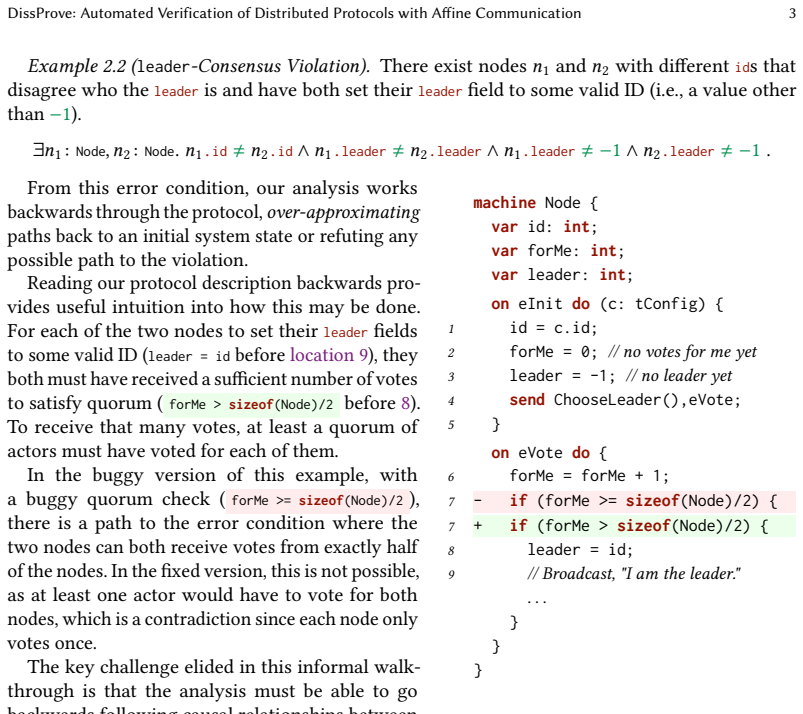
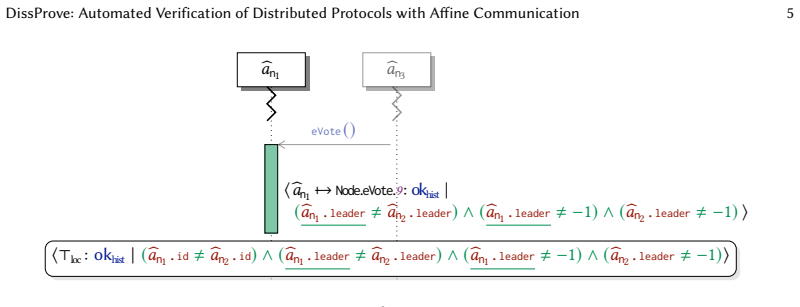
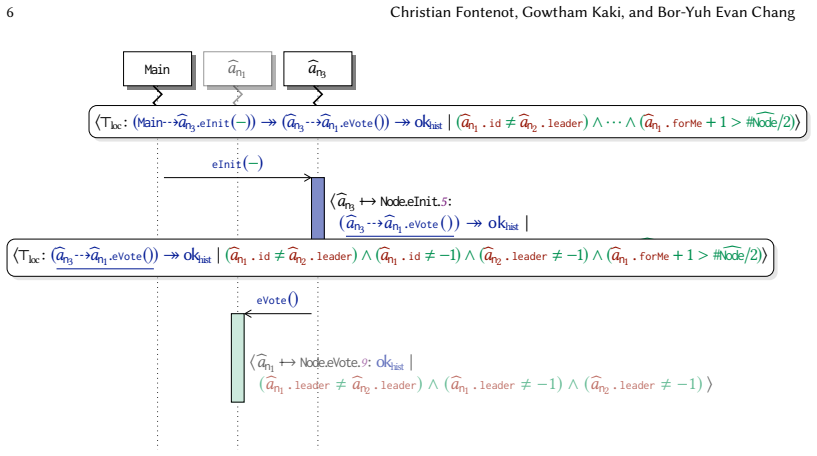
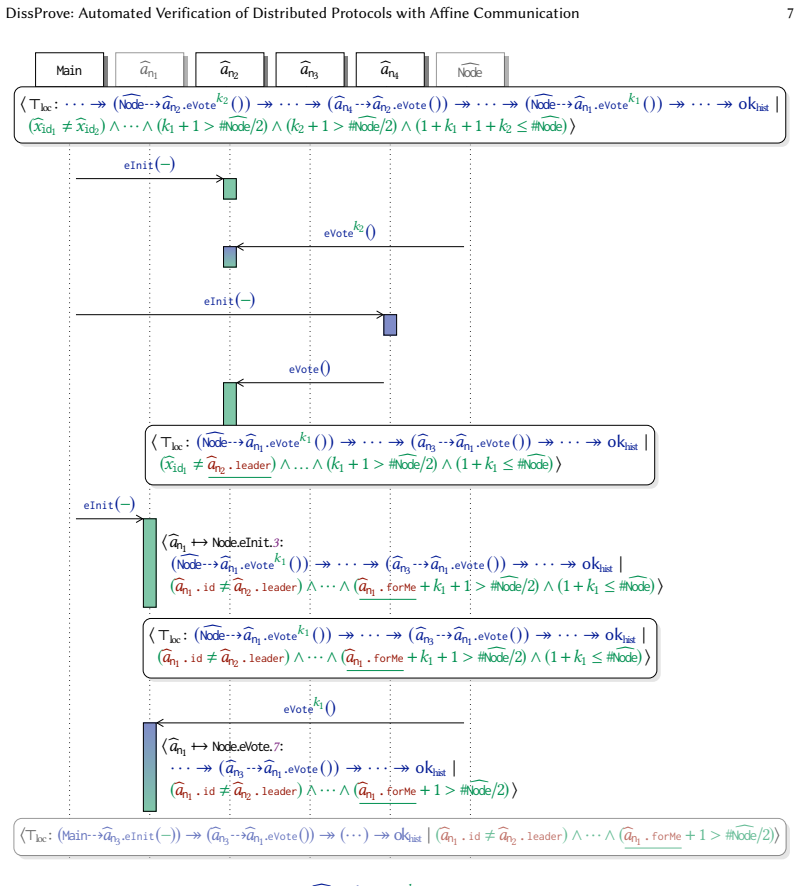
We present an automated verification technique based on proving unreachability backwards from error states in an actor system. One key insight is that the unboundedness from parametricity can be further classified into affine and non-affine protocols, where affine protocols have execution histories of unbounded length in a bounded number of communication rounds. We show how to use novel, goal-directed notions of materialization, causality, and summarization to verify safety properties of affine protocols with an unbounded number of actors in an automated manner.
What carries the argument
Goal-directed materialization, causality, and summarization operations that operate on affine protocols (bounded communication rounds despite unbounded history length) to perform backward unreachability proofs.
If this is right
- Safety verification of parametric actor systems becomes possible without constructing global invariants that span the entire system.
- Unbounded numbers of actors can be handled automatically when communication rounds remain bounded.
- Backward reasoning from error states replaces forward enumeration of histories that grow combinatorially with asynchrony.
- The classification into affine protocols separates cases that admit this automated treatment from those that do not.
Where Pith is reading between the lines
- The same backward machinery might be extended to check liveness or fairness properties if suitable summarization rules for those can be defined.
- Protocols that are not affine may still become verifiable if they can be decomposed into affine sub-protocols.
- The approach could reduce the manual effort required when porting verification from small fixed-size systems to their parametric versions.
Load-bearing premise
The protocols under verification must be affine, meaning their execution histories have unbounded length but only bounded communication rounds, and the materialization and summarization steps must capture every relevant history without omitting a counterexample.
What would settle it
An affine protocol containing a reachable safety violation that the DissProve tool reports as unreachable because its summarization operation failed to cover the violating execution history.
Figures
read the original abstract
We consider the problem of automatically proving safety properties of distributed protocols. Distributed protocols have been particularly challenging for automated verification due to their asynchronous and parametric nature. Compared to synchronous systems, asynchronous communication leads to a combinatorial explosion of possible execution histories of message handlers. And because distributed protocols are typically defined parametrically on the number of actors, these definitions lead to an unbounded number of possible execution histories of unbounded length. Existing verification techniques for such distributed protocols typically require global invariants about the entire actor system, which are complex even for simple protocols. In this paper, we present an automated verification technique based on proving unreachability backwards from error states in an actor system. One key insight is that the unboundedness from parametricity can be further classified into \emph{affine} and non-affine protocols, where affine protocols have execution histories of unbounded length in a bounded number of communication rounds. We show how to use novel, goal-directed notions of materialization, causality, and summarization to verify safety properties of affine protocols with an unbounded number of actors in an automated manner. Using our prototype verification tool DissProve, we provide evidence for the feasibility of automated safety verification of asynchronous parametrized systems with affine communication.
Editorial analysis
A structured set of objections, weighed in public.
Referee Report
Summary. The paper claims to solve automated safety verification for parametric asynchronous distributed protocols by classifying them into affine (unbounded-length histories in bounded communication rounds) and non-affine, then using novel goal-directed materialization, causality, and summarization operators to perform backwards unreachability proofs from error states; feasibility is shown via the DissProve prototype.
Significance. If the materialization/summarization operators are complete for the affine class, the work would be significant as it enables automated verification without requiring manually supplied global invariants, addressing a long-standing challenge in parametric distributed-systems verification.
major comments (2)
- [Abstract and definition of affine class / operators] The central soundness claim rests on the unproven assertion that the goal-directed materialization, causality, and summarization operators generate all safety-relevant histories for affine protocols (the axiom that 'affine protocols admit bounded-round unbounded-length histories that can be summarized without loss of safety-relevant behaviors'). No completeness argument, external citation, or independent validation is supplied for this reduction; if any histories are pruned, backwards proofs become unsound by missing counterexamples.
- [Prototype evaluation section] The paper provides no derivation details, error bounds, or concrete example proofs in the abstract or visible structure; without these it is impossible to assess whether the prototype actually discharges the parametric unboundedness or merely restricts to a subclass where the new operators happen to work.
minor comments (1)
- Notation for the new operators (materialization, summarization) should be introduced with explicit syntax and semantics before use in the main claims.
Simulated Author's Rebuttal
We thank the referee for the detailed and constructive feedback. We address the two major comments below and will revise the manuscript accordingly to strengthen the presentation of soundness and evaluation details.
read point-by-point responses
-
Referee: [Abstract and definition of affine class / operators] The central soundness claim rests on the unproven assertion that the goal-directed materialization, causality, and summarization operators generate all safety-relevant histories for affine protocols (the axiom that 'affine protocols admit bounded-round unbounded-length histories that can be summarized without loss of safety-relevant behaviors'). No completeness argument, external citation, or independent validation is supplied for this reduction; if any histories are pruned, backwards proofs become unsound by missing counterexamples.
Authors: The paper defines the affine class (Section 3) as protocols whose executions have unbounded-length histories confined to a bounded number of communication rounds. The materialization, causality, and summarization operators are presented as goal-directed constructions that exploit this bounded-round structure to preserve safety-relevant behaviors. While the technical development argues that the operators are sound and complete for this class by construction, we agree that an explicit standalone completeness theorem is not isolated as such. We will add a dedicated theorem and proof in the revised version establishing that, for any affine protocol, the operators generate all safety-relevant histories without pruning counterexamples. revision: yes
-
Referee: [Prototype evaluation section] The paper provides no derivation details, error bounds, or concrete example proofs in the abstract or visible structure; without these it is impossible to assess whether the prototype actually discharges the parametric unboundedness or merely restricts to a subclass where the new operators happen to work.
Authors: The evaluation (Section 6) reports successful verification runs on multiple affine protocols using DissProve, confirming that the tool handles parametric unboundedness for the defined class. As the procedure is a decision procedure rather than an approximation, error bounds do not apply. We acknowledge that the current presentation would benefit from expanded derivation details. We will revise the evaluation section and add an appendix containing concrete step-by-step example proofs for the case studies, making explicit how the operators discharge the unboundedness for the full affine class rather than a restricted subclass. revision: yes
Circularity Check
No significant circularity; derivation self-contained
full rationale
The paper defines the affine protocol class and introduces novel goal-directed materialization, causality, and summarization operators as part of its verification technique. These definitions and their application to backwards unreachability checking do not reduce to fitted inputs renamed as predictions, self-cited uniqueness theorems, or any other enumerated circular pattern. The central claim rests on the internal soundness of the new operators for the defined class rather than any self-referential reduction or external self-citation chain. This is a standard case of a self-contained new method with no load-bearing circular steps.
Axiom & Free-Parameter Ledger
axioms (2)
- domain assumption Actor systems can be modeled with asynchronous message passing and parametric actor counts.
- ad hoc to paper Affine protocols admit bounded-round unbounded-length histories that can be summarized without loss of safety-relevant behaviors.
invented entities (2)
-
affine protocol class
no independent evidence
-
goal-directed materialization operator
no independent evidence
Reference graph
Works this paper leans on
-
[1]
Parosh Aziz Abdulla, Yu-Fang Chen, Giorgio Delzanno, Frédéric Haziza, Chih-Duo Hong, and Ahmed Rezine. 2010. Con- strained monotonic abstraction: A CEGAR for parameterized verification. InInternational Conference on Concurrency Theory. Springer, 86–101
2010
-
[2]
Gul Agha. 1986. An overview of actor languages.ACM Sigplan Notices21, 10 (1986), 58–67
1986
-
[3]
Josh Berdine, Cristiano Calcagno, and Peter W. O’Hearn. 2005. Symbolic Execution with Separation Logic. In Programming Languages and Systems, Third Asian Symposium, APLAS 2005, Tsukuba, Japan, November 2-5, 2005, Proceedings (Lecture Notes in Computer Science, Vol. 3780), Kwangkeun Yi (Ed.). Springer, 52–68. https://doi.org/10. 1007/11575467_5
2005
-
[4]
Sam Blackshear, Bor-Yuh Evan Chang, and Manu Sridharan. 2013. Thresher: precise refutations for heap reachability. InACM SIGPLAN Conference on Programming Language Design and Implementation, PLDI ’13, Seattle, W A, USA, June 16-19, 2013, Hans-Juergen Boehm and Cormac Flanagan (Eds.). ACM, 275–286. https://doi.org/10.1145/2491956.2462186
-
[5]
Sam Blackshear, Bor-Yuh Evan Chang, and Manu Sridharan. 2015. Selective control-flow abstraction via jumping. In Proceedings of the 2015 ACM SIGPLAN International Conference on Object-Oriented Programming, Systems, Languages, and Applications, OOPSLA 2015, part of SPLASH 2015, Pittsburgh, PA, USA, October 25-30, 2015, Jonathan Aldrich and Patrick Eugster ...
-
[6]
Sascha Böhme and Tobias Nipkow. 2010. Sledgehammer: judgement day. InProceedings of the 5th International Conference on Automated Reasoning(Edinburgh, UK)(IJCAR’10). Springer-Verlag, Berlin, Heidelberg, 107–121. https: //doi.org/10.1007/978-3-642-14203-1_9
-
[7]
Sylvain Conchon, Amit Goel, Sava Krstić, Alain Mebsout, and Fatiha Zaïdi. 2012. Cubicle: a parallel SMT-based model checker for parameterized systems: tool paper. InInternational Conference on Computer Aided Verification. Springer, 718–724
2012
-
[8]
Patrick Cousot and Radhia Cousot. 1977. Abstract interpretation: a unified lattice model for static analysis of programs by construction or approximation of fixpoints. InProceedings of the 4th ACM SIGACT-SIGPLAN symposium on Principles of programming languages. 238–252
1977
-
[9]
Giorgio Delzanno. 2003. Constraint-based verification of parameterized cache coherence protocols.Formal Methods in System Design23, 3 (2003), 257–301
2003
-
[10]
Ankush Desai, Vivek Gupta, Ethan Jackson, Shaz Qadeer, Sriram Rajamani, and Damien Zufferey. 2013. P: safe asynchronous event-driven programming.ACM SIGPLAN Notices48, 6 (2013), 321–332
2013
-
[11]
Cormac Flanagan and Patrice Godefroid. 2005. Dynamic partial-order reduction for model checking software.ACM Sigplan Notices40, 1 (2005), 110–121
2005
-
[12]
Álvaro García-Pérez, Alexey Gotsman, Yuri Meshman, and Ilya Sergey. 2018. Paxos consensus, deconstructed and abstracted. InEuropean Symposium on Programming. Springer, 912–939
2018
-
[13]
Silvio Ghilardi and Silvio Ranise. 2010. Backward reachability of array-based systems by SMT solving: Termination and invariant synthesis.Logical Methods in Computer Science6 (2010)
2010
-
[14]
Jean-Yves Girard. 1987. Linear Logic.Theor. Comput. Sci.50 (1987), 1–102. https://doi.org/10.1016/0304-3975(87)90045-4
-
[15]
Jim Gray and Leslie Lamport. 2006. Consensus on transaction commit.ACM Trans. Database Syst.31, 1 (March 2006), 133–160. https://doi.org/10.1145/1132863.1132867
-
[16]
Nightingale, Matthew Renzelmann, Alex Shamis, Anirudh Badam, and Miguel Castro
Chris Hawblitzel, Jon Howell, Manos Kapritsos, Jacob R. Lorch, Bryan Parno, Michael L. Roberts, Srinath Setty, and Brian Zill. 2015. IronFleet: Proving Practical Distributed Systems Correct. InProceedings of the 25th Symposium on Operating Systems Principles(Monterey, California)(SOSP ’15). Association for Computing Machinery, New York, NY, USA, 1–17. htt...
-
[17]
Jonas Kastberg Hinrichsen, Jesper Bengtson, and Robbert Krebbers. 2019. Actris: Session-Type Based Reasoning in Separation Logic.Proc. ACM Program. Lang.4, POPL, Article 6 (dec 2019), 30 pages. https://doi.org/10.1145/3371074
-
[18]
Samin S. Ishtiaq and Peter W. O’Hearn. 2001. BI as an Assertion Language for Mutable Data Structures. InConference Record of POPL 2001: The 28th ACM SIGPLAN-SIGACT Symposium on Principles of Programming Languages, London, UK, January 17-19, 2001, Chris Hankin and Dave Schmidt (Eds.). ACM, 14–26. https://doi.org/10.1145/360204.375719
-
[19]
Nouraldin Jaber, Christopher Wagner, Swen Jacobs, Milind Kulkarni, and Roopsha Samanta. 2021. Quicksilver: modeling and parameterized verification for distributed agreement-based systems.Proceedings of the ACM on Programming Languages5, OOPSLA (2021), 1–31
2021
-
[20]
Gowtham Kaki, Kapil Earanky, KC Sivaramakrishnan, and Suresh Jagannathan. 2018. Safe replication through bounded concurrency verification.Proc. ACM Program. Lang.2, OOPSLA, Article 164 (Oct. 2018), 27 pages. https: //doi.org/10.1145/3276534
-
[21]
Zachary Kincaid, Jason Breck, Ashkan Forouhi Boroujeni, and Thomas Reps. 2017. Compositional recurrence analysis revisited. InProceedings of the 38th ACM SIGPLAN Conference on Programming Language Design and Implementation (Barcelona, Spain)(PLDI 2017). Association for Computing Machinery, New York, NY, USA, 248–262. https://doi.org/ 10.1145/3062341.30623...
-
[22]
Zachary Kincaid, John Cyphert, Jason Breck, and Thomas Reps. 2017. Non-linear reasoning for invariant synthesis. Proceedings of the ACM on Programming Languages2, POPL (2017), 1–33
2017
-
[23]
Igor Konnov, Jure Kukovec, and Thanh-Hai Tran. 2019. TLA+ model checking made symbolic.Proceedings of the ACM on Programming Languages3, OOPSLA (2019), 1–30
2019
-
[24]
Igor Konnov, Jure Kukovec, and Thanh-Hai Tran. 2019. TLA+ model checking made symbolic.Proc. ACM Program. Lang.3, OOPSLA, Article 123 (Oct. 2019), 30 pages. https://doi.org/10.1145/3360549
-
[25]
Morten Krogh-Jespersen, Amin Timany, Marit Edna Ohlenbusch, Simon Oddershede Gregersen, and Lars Birkedal
-
[26]
Aneris: A mechanised logic for modular reasoning about distributed systems. InProgramming Languages and Systems: 29th European Symposium on Programming, ESOP 2020, Held as Part of the European Joint Conferences on Theory and Practice of Software, ETAPS 2020, Dublin, Ireland, April 25–30, 2020, Proceedings 29. Springer International Publishing, 336–365
2020
-
[27]
Leslie Lamport. 1974. A new solution of Dijkstra’s concurrent programming problem.Commun. ACM17, 8 (Aug. 1974), 453–455. https://doi.org/10.1145/361082.361093
-
[28]
Leslie Lamport. 2001. Paxos made simple.ACM SIGACT News (Distributed Computing Column) 32, 4 (Whole Number 121, December 2001)(2001), 51–58
2001
-
[29]
Lukman, and Haryadi S
Tanakorn Leesatapornwongsa, Mingzhe Hao, Pallavi Joshi, Jeffrey F. Lukman, and Haryadi S. Gunawi. 2014. SAMC: semantic-aware model checking for fast discovery of deep bugs in cloud systems. InProceedings of the 11th USENIX Conference on Operating Systems Design and Implementation(Broomfield, CO)(OSDI’14). USENIX Association, USA, 399–414
2014
-
[30]
K Rustan M Leino. 2010. Dafny: An automatic program verifier for functional correctness. InInternational conference on logic for programming artificial intelligence and reasoning. Springer, 348–370
2010
-
[31]
Lewchenko, Gowtham Kaki, and Bor-Yuh Evan Chang
Nicholas V. Lewchenko, Gowtham Kaki, and Bor-Yuh Evan Chang. 2025. Bolt-On Strong Consistency: Specification, Implementation, and Verification.Proc. ACM Program. Lang.9, OOPSLA1, Article 137 (April 2025), 28 pages. https: //doi.org/10.1145/3720502
-
[32]
Haojun Ma, Aman Goel, Jean-Baptiste Jeannin, Manos Kapritsos, Baris Kasikci, and Karem A Sakallah. 2019. I4: incremental inference of inductive invariants for verification of distributed protocols. InProceedings of the 27th ACM Symposium on Operating Systems Principles. 370–384
2019
-
[33]
Antoni Mazurkiewicz. 1984. Traces, histories, graphs: Instances of a process monoid. InInternational Symposium on Mathematical Foundations of Computer Science. Springer, 115–133
1984
-
[34]
Shawn Meier, Sergio Mover, Gowtham Kaki, and Bor-Yuh Evan Chang. 2023. Historia: Refuting Callback Reachability with Message-History Logics.Proceedings of the ACM on Programming Languages7, OOPSLA2 (2023), 1905–1934
2023
-
[35]
Diego Ongaro and John Ousterhout. 2014. In search of an understandable consensus algorithm. InProceedings of the 2014 USENIX Conference on USENIX Annual Technical Conference(Philadelphia, PA)(USENIX ATC’14). USENIX Association, USA, 305–320
2014
-
[36]
Oded Padon, Giuliano Losa, Mooly Sagiv, and Sharon Shoham. 2017. Paxos made EPR: decidable reasoning about distributed protocols.Proceedings of the ACM on Programming Languages1, OOPSLA (2017), 1–31
2017
-
[37]
Oded Padon, Kenneth L McMillan, Aurojit Panda, Mooly Sagiv, and Sharon Shoham. 2016. Ivy: safety verification by interactive generalization. InProceedings of the 37th ACM SIGPLAN Conference on Programming Language Design and Implementation. 614–630
2016
-
[38]
Lauren Pick, Ankush Desai, and Aarti Gupta. 2023. Psym: Efficient Symbolic Exploration of Distributed Systems. Proceedings of the ACM on Programming Languages7, PLDI (2023), 660–685
2023
-
[39]
Jeff Polakow and Frank Pfenning. 1999. Natural deduction for intuitionistic non-commutative linear logic. InInterna- tional Conference on Typed Lambda Calculi and Applications. Springer, 295–309
1999
-
[40]
John C. Reynolds. 2002. Separation Logic: A Logic for Shared Mutable Data Structures. In17th IEEE Symposium on Logic in Computer Science (LICS 2002), 22-25 July 2002, Copenhagen, Denmark, Proceedings. IEEE Computer Society, 55–74. https://doi.org/10.1109/LICS.2002.1029817
-
[41]
Ilya Sergey, James R Wilcox, and Zachary Tatlock. 2017. Programming and proving with distributed protocols. Proceedings of the ACM on Programming Languages2, POPL (2017), 1–30
2017
-
[42]
Upamanyu Sharma, Ralf Jung, Joseph Tassarotti, Frans Kaashoek, and Nickolai Zeldovich. 2023. Grove: a separation- logic library for verifying distributed systems. InProceedings of the 29th Symposium on Operating Systems Principles. 113–129
2023
-
[43]
Wolf, Peter Müller, Martin Clochard, and David Basin
Christoph Sprenger, Tobias Klenze, Marco Eilers, Felix A. Wolf, Peter Müller, Martin Clochard, and David Basin. 2020. Igloo: Soundly Linking Compositional Refinement and Separation Logic for Distributed System Verification.Proc. ACM Program. Lang.4, OOPSLA, Article 152 (nov 2020), 31 pages. https://doi.org/10.1145/3428220
-
[44]
McMillan, Oded Padon, Mooly Sagiv, Sharon Shoham, James R
Marcelo Taube, Giuliano Losa, Kenneth L. McMillan, Oded Padon, Mooly Sagiv, Sharon Shoham, James R. Wilcox, and Doug Woos. 2018. Modularity for decidability of deductive verification with applications to distributed systems. SIGPLAN Not.53, 4 (June 2018), 662–677. https://doi.org/10.1145/3296979.3192414 28 Christian Fontenot, Gowtham Kaki, and Bor-Yuh Evan Chang
-
[45]
Gleissenthall, Rami Gökhan Kıcı, Alexander Bakst, Deian Stefan, and Ranjit Jhala
Klaus v. Gleissenthall, Rami Gökhan Kıcı, Alexander Bakst, Deian Stefan, and Ranjit Jhala. 2019. Pretend synchrony: synchronous verification of asynchronous distributed programs.Proceedings of the ACM on Programming Languages3, POPL (2019), 1–30
2019
-
[46]
David Van Horn and Matthew Might. 2010. Abstracting abstract machines. InProceedings of the 15th ACM SIGPLAN international conference on Functional programming. 51–62
2010
-
[47]
Wilcox, Doug Woos, Pavel Panchekha, Zachary Tatlock, Xi Wang, Michael D
James R. Wilcox, Doug Woos, Pavel Panchekha, Zachary Tatlock, Xi Wang, Michael D. Ernst, and Thomas Anderson
-
[48]
https://doi.org/10.1145/2813885.2737958
Verdi: A Framework for Implementing and Formally Verifying Distributed Systems.SIGPLAN Not.50, 6 (jun 2015), 357–368. https://doi.org/10.1145/2813885.2737958
-
[49]
Wilcox, Steve Anton, Zachary Tatlock, Michael D
Doug Woos, James R. Wilcox, Steve Anton, Zachary Tatlock, Michael D. Ernst, and Thomas Anderson. 2016. Planning for change in a formal verification of the raft consensus protocol. InProceedings of the 5th ACM SIGPLAN Conference on Certified Programs and Proofs(St. Petersburg, FL, USA)(CPP 2016). Association for Computing Machinery, New York, NY, USA, 154–...
-
[50]
Jianan Yao, Runzhou Tao, Ronghui Gu, and Jason Nieh. 2022. DuoAI: Fast, Automated Inference of Inductive Invariants for Verifying Distributed Protocols. In16th USENIX Symposium on Operating Systems Design and Implementation (OSDI 22). USENIX Association, Carlsbad, CA, 485–501. https://www.usenix.org/conference/osdi22/presentation/yao
2022
-
[51]
Jianan Yao, Runzhou Tao, Ronghui Gu, Jason Nieh, Suman Jana, and Gabriel Ryan. 2021. DistAI: Data-Driven Automated Invariant Learning for Distributed Protocols. In15th USENIX Symposium on Operating Systems Design and Implementation (OSDI 21). USENIX Association, 405–421. https://www.usenix.org/conference/osdi21/presentation/yao DissProve: Automated Verifi...
2021
discussion (0)
Sign in with ORCID, Apple, or X to comment. Anyone can read and Pith papers without signing in.