Evolution of Quadrupole Wakefield Driven by Transversely Asymmetric Electron Beams in Hollow Plasma Channels
Pith reviewed 2026-06-25 22:20 UTC · model grok-4.3
The pith
Asymmetric electron beams drive stable quadrupole wakes in hollow plasma channels only when simple criteria on driver dynamics and ion restoring forces are satisfied.
A machine-rendered reading of the paper's core claim, the machinery that carries it, and where it could break.
Core claim
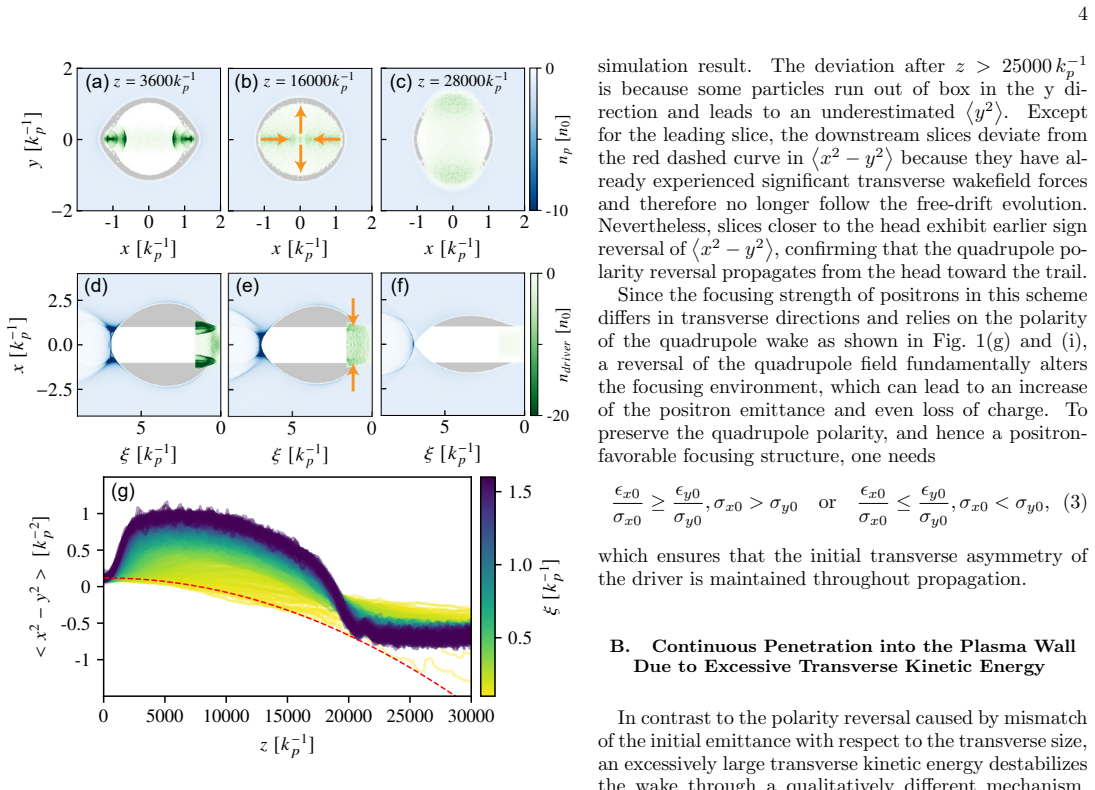
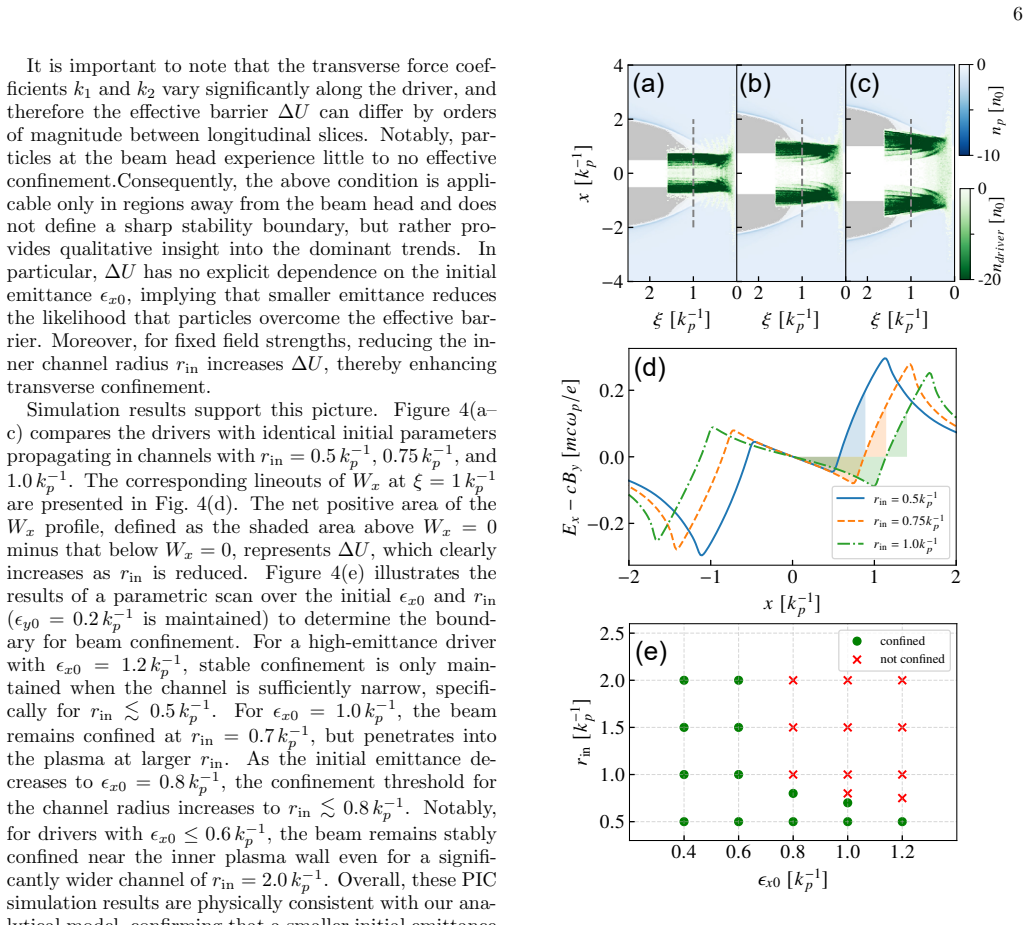
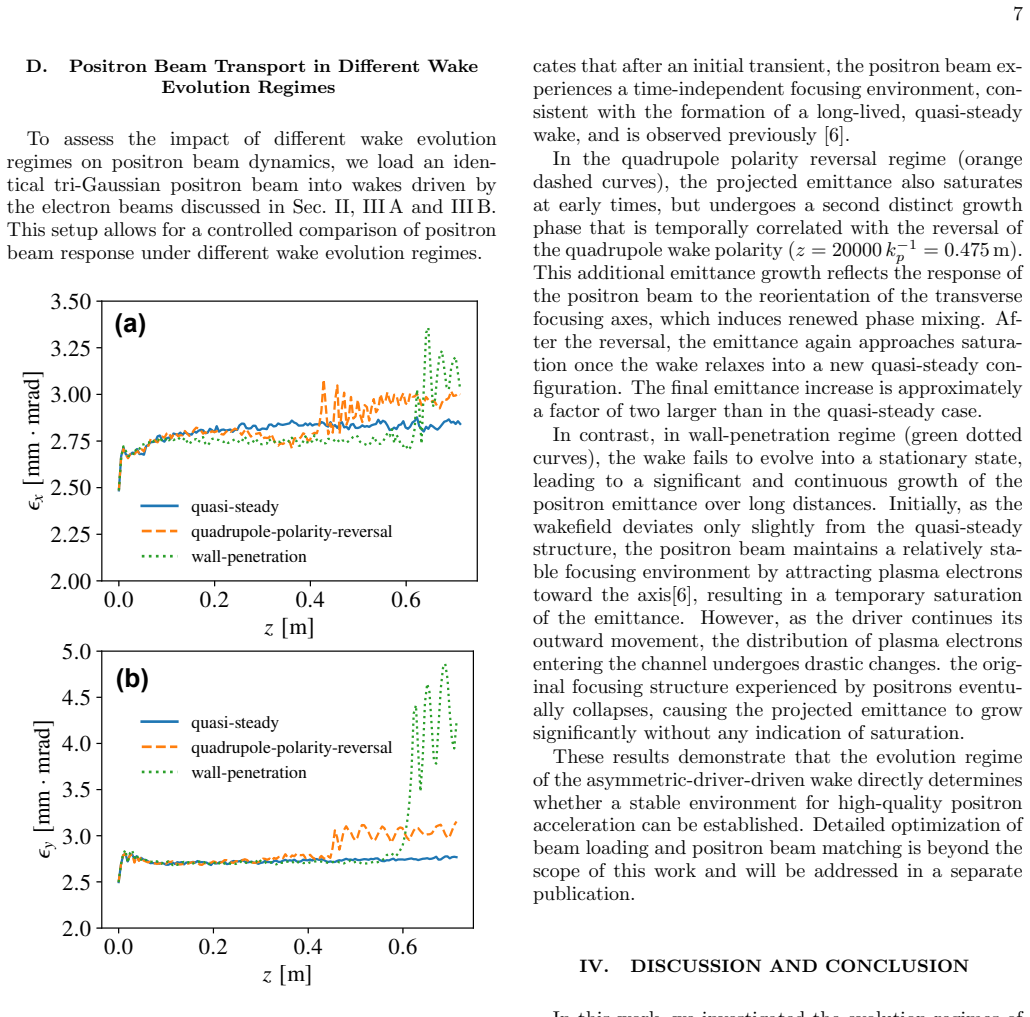
We identify two distinct unstable scenarios: a reversal of quadrupole field polarity and continuous penetration of the driver into the plasma wall. By analyzing the transverse dynamics of the driver and the restoring forces provided by the channel ions, we establish simple physical criteria that ensure stable propagation.
What carries the argument
The simple physical criteria for stable propagation, obtained by balancing the transverse dynamics of the asymmetric driver against the restoring forces from the channel ions.
If this is right
- The quadrupole wake remains transversely uniform and free of intrinsic defocusing for positrons when the criteria hold.
- Quasi-steady wakes can be sustained over distances useful for acceleration once the driver stays inside the channel without wall penetration.
- Beam and channel parameters can be chosen in advance to avoid the two identified unstable scenarios.
- The analysis supplies practical guidance for realizing long-lived wakes suitable for positron acceleration.
Where Pith is reading between the lines
- The criteria might be checked experimentally by scanning beam asymmetry while monitoring wake polarity and beam position over extended propagation.
- Similar force-balance reasoning could be applied to other plasma structures that rely on ion-channel restoring forces.
- If the criteria prove robust, they could narrow the parameter space that must be explored in future hollow-channel positron accelerator designs.
Load-bearing premise
The three-dimensional particle-in-cell simulations capture the dominant physical mechanisms without significant numerical artifacts or insufficient propagation distance, so the identified modes and criteria generalize beyond the simulated cases.
What would settle it
A long-distance simulation or experiment using beam and channel parameters that meet the derived criteria yet still exhibits either quadrupole polarity reversal or driver penetration into the wall would falsify the claim that those criteria guarantee stability.
Figures


read the original abstract
Plasma wakefield acceleration in hollow plasma channels has emerged as a promising approach for positron acceleration, since an electron beam can drive wakes with a transversely uniform accelerating field and no intrinsic defocusing force for positrons. Recently, it was proposed that a transversely asymmetric electron beam can excite quadrupole-dominated wakefield in a hollow channel, enabling the formation of accelerating and focusing fields suitable for positrons. However, the self-consistent evolution and stability of such asymmetric drivers, which are crucial for sustaining a usable wake over long distances, remain insufficiently understood. In this work, we investigate the evolution modes of wakefield driven by asymmetric electron beams in hollow plasma channels using fully three-dimensional particle-in-cell simulations. We identify two distinct unstable scenarios: a reversal of quadrupole field polarity and continuous penetration of the driver into the plasma wall. By analyzing the transverse dynamics of the driver and the restoring forces provided by the channel ions, we establish simple physical criteria that ensure stable propagation. These results clarify the fundamental constraints governing asymmetric-driver evolution and provide practical guidance for realizing long-lived, quasi-steady wakes in hollow plasma channels.
Editorial analysis
A structured set of objections, weighed in public.
Referee Report
Summary. The manuscript investigates the evolution of quadrupole wakefields driven by transversely asymmetric electron beams in hollow plasma channels via fully 3D particle-in-cell simulations. It identifies two distinct unstable modes—reversal of quadrupole field polarity and continuous penetration of the driver into the plasma wall—and derives simple physical criteria for stable propagation by analyzing the transverse dynamics of the driver beam together with the restoring forces exerted by the channel ions. These criteria are presented as practical guidance for realizing long-lived, quasi-steady wakes suitable for positron acceleration.
Significance. If the reported criteria prove robust, the work would supply concrete, physically motivated constraints that could aid experimental design of asymmetric drivers in hollow-channel plasma wakefield accelerators, addressing a recognized challenge in maintaining usable focusing and accelerating fields over extended distances.
major comments (2)
- [Simulation results section] The simulation results section provides no information on grid resolution, cell size, macroparticle count per cell, or total propagation distance. Because the central claim rests on the identification of the two unstable modes and the associated stability thresholds extracted from these runs, the absence of convergence or validation data leaves open the possibility that the observed thresholds are influenced by numerical artifacts.
- [Criteria derivation (analysis of transverse dynamics)] The physical criteria for stable propagation are obtained by post-processing the simulated ion forces and beam trajectories rather than from an independent analytic derivation. Without a demonstration that the same thresholds emerge from a reduced model or from runs at substantially higher resolution and longer distance, it is unclear whether the criteria generalize beyond the specific parameter sets simulated.
minor comments (2)
- [Abstract] The abstract would be strengthened by a single sentence summarizing the numerical parameters or validation steps used in the PIC campaign.
- [Figures] Figure captions should explicitly state the beam and channel parameters corresponding to each panel to allow direct comparison with the stability criteria.
Simulated Author's Rebuttal
We thank the referee for the constructive comments on numerical details and the derivation of the stability criteria. We address each major comment below and will revise the manuscript accordingly.
read point-by-point responses
-
Referee: [Simulation results section] The simulation results section provides no information on grid resolution, cell size, macroparticle count per cell, or total propagation distance. Because the central claim rests on the identification of the two unstable modes and the associated stability thresholds extracted from these runs, the absence of convergence or validation data leaves open the possibility that the observed thresholds are influenced by numerical artifacts.
Authors: We agree that the original manuscript omitted explicit numerical parameters. In the revised version we will insert a new subsection detailing the grid resolution (cells per plasma skin depth), cell sizes, macroparticle counts per cell, and total propagation distances. We will also add a short convergence test confirming that the two unstable modes and extracted thresholds remain unchanged under refined resolution. revision: yes
-
Referee: [Criteria derivation (analysis of transverse dynamics)] The physical criteria for stable propagation are obtained by post-processing the simulated ion forces and beam trajectories rather than from an independent analytic derivation. Without a demonstration that the same thresholds emerge from a reduced model or from runs at substantially higher resolution and longer distance, it is unclear whether the criteria generalize beyond the specific parameter sets simulated.
Authors: The criteria follow from an analysis of the transverse equations of motion, equating the beam's transverse momentum change to the integrated restoring force from the channel ions. We will rewrite the relevant section to present this reduced analytic model explicitly, showing how the stability thresholds arise directly from the force balance before comparing with simulation data. While the manuscript already uses resolution sufficient to resolve the relevant scales, we will include additional higher-resolution runs over longer distances to demonstrate robustness of the thresholds. revision: partial
Circularity Check
No circularity; criteria extracted from simulation analysis without reduction to inputs or self-citations
full rationale
The paper identifies unstable modes via 3D PIC simulations and derives physical criteria for stable propagation by direct analysis of driver transverse dynamics and channel-ion restoring forces. No load-bearing step reduces by construction to a fitted parameter, self-citation chain, or ansatz smuggled from prior work; the derivation chain remains self-contained against external benchmarks as the criteria are presented as outputs of the described analysis rather than inputs renamed as predictions.
Axiom & Free-Parameter Ledger
axioms (1)
- domain assumption 3D PIC simulations faithfully reproduce the transverse beam dynamics and ion restoring forces in hollow channels
Reference graph
Works this paper leans on
-
[1]
T. C. Chiou, T. Katsouleas, C. Decker, W. B. Mori, J. S. Wurtele, G. Shvets, and J. J. Su, Laser wake-field accel- eration and optical guiding in a hollow plasma channel, Physics of Plasmas2, 310 (1995)
1995
-
[2]
T. C. Chiou and T. Katsouleas, High beam quality and efficiency in plasma-based accelerators, Phys. Rev. Lett. 81, 3411 (1998)
1998
-
[3]
C. B. Schroeder, D. H. Whittum, and J. S. Wurtele, Mul- timode analysis of the hollow plasma channel wakefield accelerator, Phys. Rev. Lett.82, 1177 (1999)
1999
-
[4]
C. B. Schroeder, C. Benedetti, E. Esarey, and W. P. Lee- mans, Beam loading in a laser-plasma accelerator using a near-hollow plasma channel, Physics of Plasmas20, 123115 (2013)
2013
-
[5]
Gessner, E
S. Gessner, E. Adli, J. M. Allen, W. An, C. I. Clarke, C. E. Clayton, S. Corde, J. P. Delahaye, J. Fred- erico, S. Z. Green, C. Hast, M. J. Hogan, C. Joshi, C. A. Lindstrøm, N. Lipkowitz, M. Litos, W. Lu, K. A. Marsh, W. B. Mori, B. O’Shea, N. Vafaei-Najafabadi, D. Walz, V. Yakimenko, and G. Yocky, Demonstration of a positron beam-driven hollow channel pl...
2016
-
[6]
S. Zhou, J. Hua, W. An, W. B. Mori, C. Joshi, J. Gao, and W. Lu, High efficiency uniform wakefield accelera- tion of a positron beam using stable asymmetric mode in a hollow channel plasma, Phys. Rev. Lett.127, 174801 (2021)
2021
-
[7]
Lou, The circular electron positron collider, Nat
X. Lou, The circular electron positron collider, Nat. Rev. Phys.1, 232 (2019)
2019
-
[8]
Benedikt, A
M. Benedikt, A. Blondel, P. Janot, M. Klein, M. Mangano, M. McCullough, V. Mertens, K. Oide, W. Riegler, D. Schulte, and F. Zimmermann, Future cir- cular colliders, Annu. Rev. Nucl. Part. Sci69, 389 (2019)
2019
-
[9]
Michizono, The international linear collider, Nat
S. Michizono, The international linear collider, Nat. Rev. Phys.1, 244 (2019)
2019
-
[10]
Tajima and J
T. Tajima and J. M. Dawson, Laser electron accelerator, Phys. Rev. Lett.43, 267 (1979)
1979
-
[11]
P. Chen, J. M. Dawson, R. W. Huff, and T. Katsouleas, Acceleration of electrons by the interaction of a bunched electron beam with a plasma, Phys. Rev. Lett.54, 693 (1985)
1985
-
[12]
J. B. Rosenzweig, B. Breizman, T. Katsouleas, and J. J. Su, Acceleration and focusing of electrons in two- dimensional nonlinear plasma wake fields, Phys. Rev. A 44, R6189 (1991)
1991
-
[13]
W. Lu, C. Huang, M. Zhou, W. B. Mori, and T. Kat- souleas, Nonlinear theory for relativistic plasma wake- fields in the blowout regime, Phys. Rev. Lett.96, 165002 (2006)
2006
-
[14]
Blumenfeld, C
I. Blumenfeld, C. E. Clayton, F.-J. Decker, M. J. Hogan, C. Huang, R. Ischebeck, R. Iverson, C. Joshi, T. Kat- souleas, N. Kirby, W. Lu, K. A. Marsh, W. B. Mori, P. Muggli, E. Oz, R. H. Siemann, D. Walz, and M. Zhou, Energy doubling of 42 gev electrons in a metre-scale plasma wakefield accelerator, Nature445, 741 (2007)
2007
-
[15]
Picksley, J
A. Picksley, J. Stackhouse, C. Benedetti, K. Nakamura, H. E. Tsai, R. Li, B. Miao, J. E. Shrock, E. Rock- afellow, H. M. Milchberg, C. B. Schroeder, J. van Tilborg, E. Esarey, C. G. R. Geddes, and A. J. Gon- salves, Matched guiding and controlled injection in dark- current-free, 10-gev-class, channel-guided laser-plasma accelerators, Phys. Rev. Lett.133, ...
2024
-
[16]
G¨ otzfried, A
J. G¨ otzfried, A. D¨ opp, M. F. Gilljohann, F. M. Foerster, H. Ding, S. Schindler, G. Schilling, A. Buck, L. Veisz, and S. Karsch, Physics of high-charge electron beams in laser-plasma wakefields, Phys. Rev. X10, 041015 (2020)
2020
-
[17]
Litos, E
M. Litos, E. Adli, W. An, C. I. Clarke, C. E. Clayton, S. Corde, J. P. Delahaye, R. J. England, A. S. Fisher, J. Frederico, S. Gessner, S. Z. Green, M. J. Hogan, C. Joshi, W. Lu, K. A. Marsh, W. B. Mori, P. Mug- gli, N. Vafaei-Najafabadi, D. Walz, G. White, Z. Wu, V. Yakimenko, and G. Yocky, High-efficiency accelera- tion of an electron beam in a plasma w...
2014
-
[18]
C. A. Lindstrøm, J. M. Garland, S. Schr¨ oder, L. Boul- ton, G. Boyle, J. Chappell, R. D’Arcy, P. Gonzalez, A. Knetsch, V. Libov, G. Loisch, A. Martinez de la Ossa, P. Niknejadi, K. P˜ oder, L. Schaper, B. Schmidt, B. Sheeran, S. Wesch, J. Wood, and J. Osterhoff, Energy- spread preservation and high efficiency in a plasma- wakefield accelerator, Phys. Rev...
2021
-
[19]
G. R. Plateau, C. G. R. Geddes, D. B. Thorn, M. Chen, C. Benedetti, E. Esarey, A. J. Gonsalves, N. H. Matlis, K. Nakamura, C. B. Schroeder, S. Shiraishi, T. Sokol- lik, J. van Tilborg, C. Toth, S. Trotsenko, T. S. Kim, M. Battaglia, T. St¨ ohlker, and W. P. Leemans, Low- emittance electron bunches from a laser-plasma accelera- tor measured using single-sh...
2012
-
[20]
L. T. Ke, K. Feng, W. T. Wang, Z. Y. Qin, C. H. Yu, Y. Wu, Y. Chen, R. Qi, Z. J. Zhang, Y. Xu, X. J. Yang, Y. X. Leng, J. S. Liu, R. X. Li, and Z. Z. Xu, Near- gev electron beams at a few per-mille level from a laser wakefield accelerator via density-tailored plasma, Phys. Rev. Lett.126, 214801 (2021)
2021
-
[21]
Y. Wu, J. Hua, Z. Zhou, J. Zhang, S. Liu, B. Peng, Y. Fang, X. Ning, Z. Nie, F. Li, C. Zhang, C.-H. Pai, Y. Du, W. Lu, W. B. Mori, and C. Joshi, High- throughput injection–acceleration of electron bunches from a linear accelerator to a laser wakefield accelerator, Nature Physics17, 801 (2021)
2021
-
[22]
The International Linear Collider Technical Design Report - Volume 4: Detectors
T. Behnke, J. E. Brau, P. N. Burrows, J. Fuster, M. Pe- skin, M. Stanitzki, Y. Sugimoto, S. Yamada, and H. Ya- mamoto, The international linear collider technical de- sign report - volume 4: Detectors (2013), arXiv:1306.6329 [physics.ins-det]
work page internal anchor Pith review Pith/arXiv arXiv 2013
-
[23]
I. Agapov, M. Benedikt, A. Blondel, M. Boscolo, O. Brunner, M. C. Llatas, T. Charles, D. Denisov, W. Fischer, E. Gianfelice-Wendt, J. Gutleber, P. Janot, M. Koratzinos, R. Losito, S. Nagaitsev, K. Oide, T. Raubenheimer, R. Rimmer, J. Seeman, D. Shatilov, V. Shiltsev, M. Sullivan, U. Wienands, and F. Zimmer- mann, Future circular lepton collider fcc-ee: Ov...
- [24]
-
[25]
Vieira and J
J. Vieira and J. T. Mendon¸ ca, Nonlinear laser driven donut wakefields for positron and electron acceleration, Phys. Rev. Lett.112, 215001 (2014)
2014
-
[26]
L.-L. Yu, C. B. Schroeder, F.-Y. Li, C. Benedetti, M. Chen, S.-M. Weng, Z.-M. Sheng, and E. Esarey, Con- trol of focusing fields for positron acceleration in nonlin- ear plasma wakes using multiple laser modes, Physics of Plasmas21, 120702 (2014)
2014
-
[27]
N. Jain, T. M. Antonsen, and J. P. Palastro, Positron ac- celeration by plasma wakefields driven by a hollow elec- tron beam, Phys. Rev. Lett.115, 195001 (2015)
2015
-
[28]
Z. Y. Xu, C. F. Xiao, H. Y. Lu, R. H. Hu, J. Q. Yu, Z. Gong, Y. R. Shou, J. X. Liu, C. Z. Xie, S. Y. Chen, H. G. Lu, T. Q. Xu, R. X. Li, N. Hafz, S. Li, Z. Najmudin, P. P. Rajeev, D. Neely, and X. Q. Yan, New injection and acceleration scheme of positrons in the laser-plasma bub- ble regime, Phys. Rev. Accel. Beams23, 091301 (2020)
2020
-
[29]
Liu, X.-L
W.-Y. Liu, X.-L. Zhu, M. Chen, S.-M. Weng, F. He, Z.-M. Sheng, and J. Zhang, Tail-wave-assisted positron acceleration in nonlinear laser plasma wakefields, Phys. Rev. Appl.19, 044048 (2023)
2023
-
[30]
Diederichs, T
S. Diederichs, T. J. Mehrling, C. Benedetti, C. B. Schroeder, A. Knetsch, E. Esarey, and J. Osterhoff, Positron transport and acceleration in beam-driven plasma wakefield accelerators using plasma columns, Phys. Rev. Accel. Beams22, 081301 (2019)
2019
-
[31]
S. Zhou, S. Ding, W. An, Q. Su, J. Hua, F. Li, W. B. Mori, C. Joshi, and W. Lu, Positron beam loading and acceleration in the blowout regime of a plasma wakefield accelerator, Research8, 0878 (2025), https://spj.science.org/doi/pdf/10.34133/research.0878
-
[32]
Huang, V
C. Huang, V. Decyk, C. Ren, M. Zhou, W. Lu, W. Mori, J. Cooley, T. Antonsen, and T. Katsouleas, Quickpic: A highly efficient particle-in-cell code for modeling wake- field acceleration in plasmas, Journal of Computational Physics217, 658 (2006)
2006
-
[33]
W. An, V. K. Decyk, W. B. Mori, and T. M. Anton- sen, An improved iteration loop for the three dimensional quasi-static particle-in-cell algorithm: Quickpic, Journal of Computational Physics250, 165 (2013)
2013
discussion (0)
Sign in with ORCID, Apple, or X to comment. Anyone can read and Pith papers without signing in.