MinInter: Minimizing Trajectory Interpolation During Data Augmentation for Imitation Learning
Pith reviewed 2026-06-26 00:45 UTC · model grok-4.3
The pith
Selecting the demonstration needing the least interpolation for each new start state produces higher-quality synthetic trajectories for imitation learning.
A machine-rendered reading of the paper's core claim, the machinery that carries it, and where it could break.
Core claim
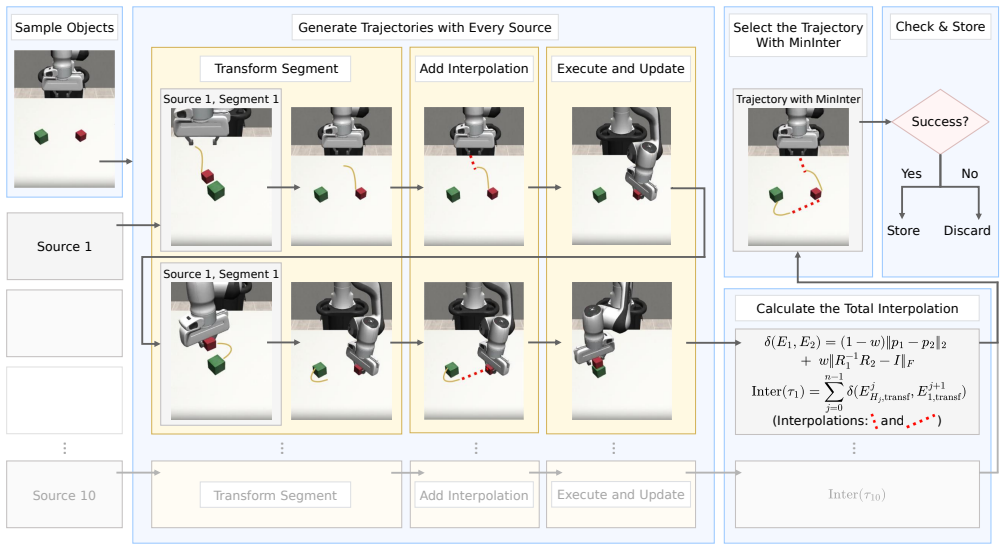
MinInter selects, for each sampled initial configuration, the source demonstration that minimizes the length or presence of interpolation segments needed to form a complete trajectory. The resulting synthetic demonstrations contain fewer non-expert segments and therefore train policies that achieve higher success rates on the original manipulation tasks.
What carries the argument
The MinInter selection rule that, for a given initial state, chooses the expert demonstration requiring the least interpolation to complete a full trajectory.
If this is right
- Data generation success rates increase because fewer attempted recombinations fail due to excessive interpolation.
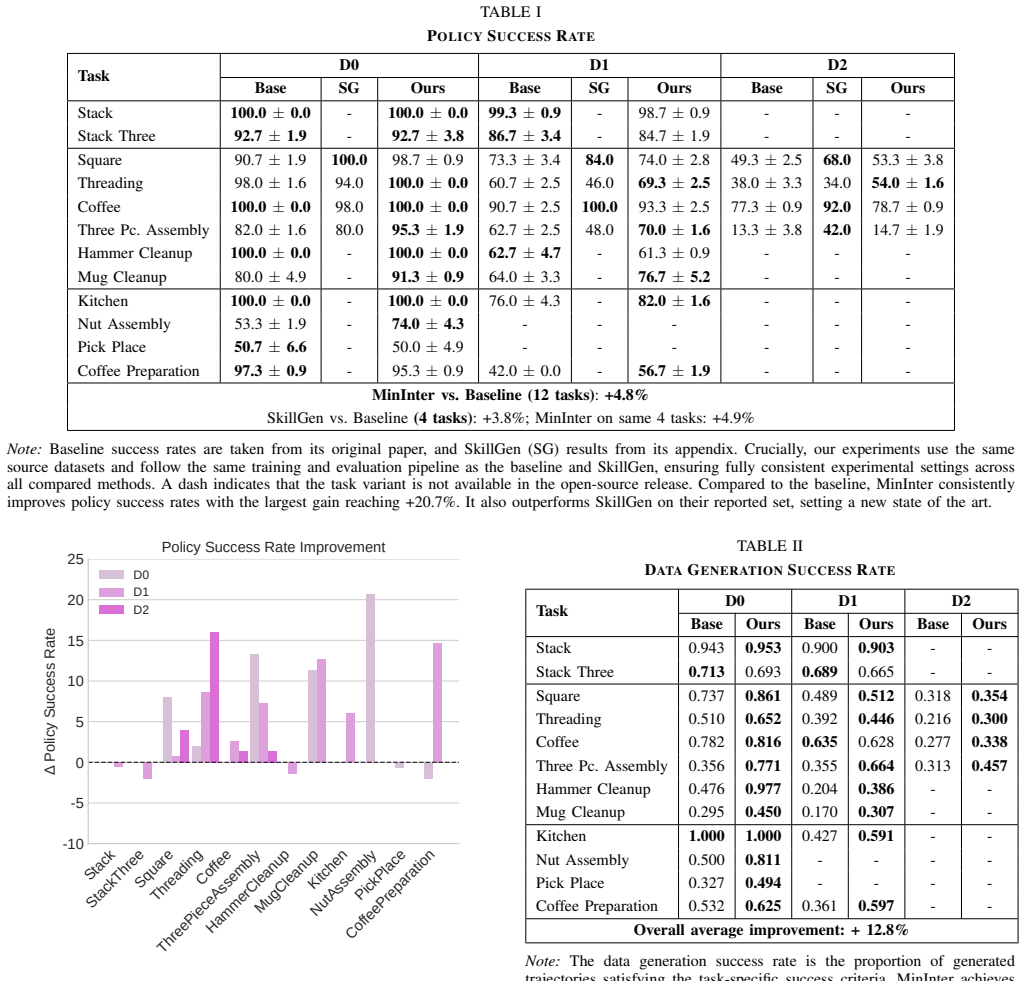
- Policy success rates rise on the target tasks, with the largest improvements occurring on contact-rich, long-horizon, and high-variance variants.
- The method integrates directly into existing trajectory-recombination frameworks without altering their interpolation engines.
- It produces higher policy success rates than the SkillGen framework despite remaining conceptually simpler.
Where Pith is reading between the lines
- The same least-interpolation selection idea could be tested in other sequential data-augmentation settings outside robotics.
- The result suggests that the expert-to-non-expert ratio inside each training trajectory may matter more than simply increasing the number of distinct start states.
- Future pipelines might combine MinInter with adaptive interpolation methods that further shorten or eliminate non-expert segments.
Load-bearing premise
That the amount of interpolation is the dominant factor controlling the quality of the synthetic trajectories rather than other unmeasured properties of the chosen demonstrations.
What would settle it
A controlled comparison in which trajectories chosen by MinInter yield no higher data-generation or policy success rates than trajectories chosen by random selection or by an alternative non-minimizing rule on the same MimicGen tasks.
Figures



read the original abstract
Imitation learning enables robots to acquire complex manipulation skills from demonstrations, but its effectiveness is limited by the cost of collecting high-quality data. Trajectory-level data augmentation methods alleviate this challenge by recombining expert demonstrations under varied initial states. However, such methods typically insert interpolations or other non-expert transition segments between disjoint parts, and such non-expert segments could reduce the quality of the generated data. This paper introduces Minimizing Interpolation (MinInter), an effective trajectory selection method that, for each sampled initial configuration, chooses the source demonstration requiring the least interpolation to form a complete trajectory. By explicitly minimizing interpolations during data generation, MinInter produces higher-quality synthetic demonstrations while remaining compatible with existing data generation frameworks. Experiments on 12 manipulation tasks with 26 variants from the MimicGen benchmark show that MinInter consistently improves both data generation success rates and policy success rates, with the largest gains on contact-rich, long-horizon and high-variance settings. Compared to the recent SkillGen framework, MinInter achieves higher policy success rates despite its conceptual simplicity, underscoring the value of interpolation minimization for data augmentation.
Editorial analysis
A structured set of objections, weighed in public.
Referee Report
Summary. The paper introduces MinInter, a simple trajectory selection heuristic for trajectory-level data augmentation in imitation learning. For each sampled initial state, it selects the expert demonstration that requires the shortest interpolation segment to produce a complete trajectory, with the goal of reducing non-expert transitions. The method is shown to be compatible with existing augmentation pipelines such as SkillGen. Experiments on 12 manipulation tasks (26 variants) from the MimicGen benchmark report consistent gains in both data-generation success and downstream policy success rates, with larger improvements on contact-rich, long-horizon, and high-variance settings.
Significance. If the central empirical claim holds after proper controls, the work supplies a lightweight, framework-agnostic improvement to data augmentation that directly targets a plausible source of quality degradation (interpolation segments). The evaluation on a public benchmark with a sizable number of task variants and the explicit comparison to SkillGen are positive features; the approach requires no new parameters or learned components.
major comments (2)
- [Experiments] Experiments section: the claim that MinInter's gains arise specifically from minimizing interpolation length is not isolated from other demonstration properties. No ablation is described that holds trajectory length, state-space overlap with the target initial condition, or expert-segment reliability fixed while varying only the interpolation criterion; without this, the reported improvements could be driven by correlated selection effects rather than interpolation minimization itself.
- [Abstract / Experiments] Abstract and Experiments section: success-rate improvements are described only qualitatively (“consistently improves,” “largest gains”) with no numerical deltas, confidence intervals, or statistical significance tests provided for either data-generation or policy success rates across the 26 variants.
minor comments (1)
- [Method] Method section: the precise definition and measurement of “interpolation length” (e.g., Euclidean distance, time steps, or a task-specific metric) should be stated explicitly with an equation or pseudocode to allow exact reproduction.
Simulated Author's Rebuttal
We thank the referee for the thoughtful review and for highlighting areas where the presentation and analysis can be strengthened. We address each major comment below and will incorporate revisions to improve clarity and rigor.
read point-by-point responses
-
Referee: [Experiments] Experiments section: the claim that MinInter's gains arise specifically from minimizing interpolation length is not isolated from other demonstration properties. No ablation is described that holds trajectory length, state-space overlap with the target initial condition, or expert-segment reliability fixed while varying only the interpolation criterion; without this, the reported improvements could be driven by correlated selection effects rather than interpolation minimization itself.
Authors: We agree that an explicit ablation isolating interpolation length from correlated factors such as trajectory length or state overlap would provide stronger evidence for the mechanism. The current experiments demonstrate consistent gains across 26 task variants when using the interpolation-minimization criterion, but do not include controls that vary only that criterion. In the revision we will add a targeted ablation comparing MinInter against length-based and overlap-based selection heuristics on a subset of tasks, while reporting the resulting interpolation lengths to help separate the effects. revision: yes
-
Referee: [Abstract / Experiments] Abstract and Experiments section: success-rate improvements are described only qualitatively (“consistently improves,” “largest gains”) with no numerical deltas, confidence intervals, or statistical significance tests provided for either data-generation or policy success rates across the 26 variants.
Authors: We accept that the current text relies on qualitative descriptors. The revision will replace these with concrete numerical results (mean success-rate deltas and standard deviations across the 26 variants for both data-generation and policy success), and will include 95% confidence intervals or equivalent for the main comparisons against SkillGen and the baseline. revision: yes
Circularity Check
No circularity; purely empirical selection rule validated on external benchmark
full rationale
The paper introduces a heuristic for choosing source demonstrations that minimize interpolation length during trajectory recombination, then reports success-rate improvements on the MimicGen benchmark. No equations, fitted parameters, or derivation chain exist. The central claim is an empirical comparison (MinInter vs. baselines on 12 tasks), not a reduction of any quantity to itself by definition or self-citation. External benchmark results are independent of any internal construction, satisfying the self-contained criterion.
Axiom & Free-Parameter Ledger
Reference graph
Works this paper leans on
-
[1]
Cyberdemo: Augmenting simulated human demonstration for real-world dexterous manipulation,
J. Wang, Y . Qin, K. Kuang, Y . Korkmaz, A. Gurumoorthy, H. Su, and X. Wang, “Cyberdemo: Augmenting simulated human demonstration for real-world dexterous manipulation,” in2024 IEEE/CVF Confer- ence on Computer Vision and Pattern Recognition (CVPR). IEEE Computer Society, 2024, pp. 17 952–17 963
2024
-
[2]
Mimicgen: A data generation system for scalable robot learning using human demonstrations,
A. Mandlekar, S. Nasiriany, B. Wen, I. Akinola, Y . Narang, L. Fan, Y . Zhu, and D. Fox, “Mimicgen: A data generation system for scalable robot learning using human demonstrations,” inConference on Robot Learning. PMLR, 2023, pp. 1820–1864
2023
-
[3]
Skillgen: Auto- mated demonstration generation for efficient skill learning and deploy- ment,
C. R. Garrett, A. Mandlekar, B. Wen, and D. Fox, “Skillgen: Auto- mated demonstration generation for efficient skill learning and deploy- ment,” in2nd CoRL Workshop on Learning Effective Abstractions for Planning
-
[4]
Dexmimicgen: Automated data generation for biman- ual dexterous manipulation via imitation learning,
Z. Jiang, Y . Xie, K. Lin, Z. Xu, W. Wan, A. Mandlekar, L. Fan, and Y . Zhu, “Dexmimicgen: Automated data generation for biman- ual dexterous manipulation via imitation learning,”arXiv preprint arXiv:2410.24185, 2024
-
[5]
Data augmentation for manipulation,
P. Mitrano and D. Berenson, “Data augmentation for manipulation,” Robotics: Science and Systems 2022, 2022
2022
-
[6]
A comprehensive survey on data augmentation,
Z. Wang, P. Wang, K. Liu, P. Wang, Y . Fu, C.-T. Lu, C. C. Aggarwal, J. Pei, and Y . Zhou, “A comprehensive survey on data augmentation,” CoRR, 2024
2024
-
[7]
A framework for efficient robotic manipulation,
A. Zhan, R. Zhao, L. Pinto, P. Abbeel, and M. Laskin, “A framework for efficient robotic manipulation,” inDeep RL Workshop NeurIPS 2021, 2021
2021
-
[8]
Reinforcement learning with augmented data,
M. Laskin, K. Lee, A. Stooke, L. Pinto, P. Abbeel, and A. Srinivas, “Reinforcement learning with augmented data,”Advances in neural information processing systems, vol. 33, pp. 19 884–19 895, 2020
2020
-
[9]
Image augmentation is all you need: Regularizing deep reinforcement learning from pixels,
I. Kostrikov, D. Yarats, and R. Fergus, “Image augmentation is all you need: Regularizing deep reinforcement learning from pixels,”arXiv preprint arXiv:2004.13649, 2020
-
[10]
Visual imitation made easy,
S. Young, D. Gandhi, S. Tulsiani, A. Gupta, P. Abbeel, and L. Pinto, “Visual imitation made easy,” inConference on Robot learning. PMLR, 2021, pp. 1992–2005
2021
-
[11]
Retinagan: An object-aware approach to sim-to-real transfer,
D. Ho, K. Rao, Z. Xu, E. Jang, M. Khansari, and Y . Bai, “Retinagan: An object-aware approach to sim-to-real transfer,” in2021 IEEE International Conference on Robotics and Automation (ICRA). IEEE, 2021, pp. 10 920–10 926
2021
-
[12]
S4rl: Surprisingly simple self-supervision for offline reinforcement learning in robotics,
S. Sinha, A. Mandlekar, and A. Garg, “S4rl: Surprisingly simple self-supervision for offline reinforcement learning in robotics,” in Conference on Robot Learning. PMLR, 2022, pp. 907–917
2022
-
[13]
Expert data augmentation in imitation learning (student abstract),
F. Han and Z. Zhang, “Expert data augmentation in imitation learning (student abstract),” inProceedings of the AAAI Conference on Artificial Intelligence, vol. 37, no. 13, 2023, pp. 16 220–16 221
2023
-
[14]
Roboagent: Generalization and efficiency in robot manipulation via semantic augmentations and action chunking,
H. Bharadhwaj, J. Vakil, M. Sharma, A. Gupta, S. Tulsiani, and V . Ku- mar, “Roboagent: Generalization and efficiency in robot manipulation via semantic augmentations and action chunking,” inFirst Workshop on Out-of-Distribution Generalization in Robotics at CoRL 2023
2023
-
[15]
Physically- based lighting augmentation for robotic manipulation,
S. Jin, L. Wang, B. Temming, and F. T. Pokorny, “Physically- based lighting augmentation for robotic manipulation,”arXiv preprint arXiv:2508.01442, 2025
-
[16]
Diffusion meets dagger: Supercharging eye-in-hand imitation learning,
X. Zhang, M. Chang, P. Kumar, and S. Gupta, “Diffusion meets dagger: Supercharging eye-in-hand imitation learning,” inRobotics science and systems. Robotics science and systems, 2024
2024
-
[17]
Zero-shot robotic manipulation with pre-trained image- editing diffusion models,
K. Black, M. Nakamoto, P. Atreya, H. Walke, C. Finn, A. Kumar, and S. Levine, “Zero-shot robotic manipulation with pre-trained image- editing diffusion models,” inNeurIPS 2023 Workshop on Goal- Conditioned Reinforcement Learning
2023
-
[18]
Cacti: A framework for scalable multi-task multi-scene visual imitation learning,
Z. Mandi, H. Bharadhwaj, V . Moens, S. Song, A. Rajeswaran, and V . Kumar, “Cacti: A framework for scalable multi-task multi-scene visual imitation learning,” inCoRL 2022 Workshop on Pre-training Robot Learning
2022
-
[19]
Learning robust real-world dexterous grasping policies via implicit shape augmentation,
Q. Chen, K. Van Wyk, Y .-W. Chao, W. Yang, A. Mousavian, A. Gupta, and D. Fox, “Learning robust real-world dexterous grasping policies via implicit shape augmentation,” inConference on Robot Learning. PMLR, 2023, pp. 1222–1232
2023
-
[20]
Rovi-aug: Robot and viewpoint augmentation for cross-embodiment robot learning,
L. Y . Chen, C. Xu, K. Dharmarajan, R. Cheng, K. Keutzer, M. Tomizuka, Q. Vuong, and K. Goldberg, “Rovi-aug: Robot and viewpoint augmentation for cross-embodiment robot learning,” in8th Annual Conference on Robot Learning
-
[21]
Imitating task and motion planning with visuomotor transformers,
M. Dalal, A. Mandlekar, C. R. Garrett, A. Handa, R. Salakhutdinov, and D. Fox, “Imitating task and motion planning with visuomotor transformers,” inConference on Robot Learning. PMLR, 2023, pp. 2565–2593
2023
-
[22]
Nod-tamp: Multi-step manipulation planning with neural object descriptors,
S. Cheng, C. R. Garrett, A. Mandlekar, and D. Xu, “Nod-tamp: Multi-step manipulation planning with neural object descriptors,” in CoRL 2023 Workshop on Learning Effective Abstractions for Planning (LEAP)
2023
-
[23]
Hybridgen: Vlm-guided hybrid planning for scalable data generation of imitation learning,
W. Wang and N. Tan, “Hybridgen: Vlm-guided hybrid planning for scalable data generation of imitation learning,”arXiv preprint arXiv:2503.13171, 2025
-
[24]
Physics-driven data generation for contact-rich manipulation via trajectory optimization,
L. Yang, H. Suh, T. Zhao, B. P. Graesdal, T. Kelestemur, J. Wang, T. Pang, and R. Tedrake, “Physics-driven data generation for contact-rich manipulation via trajectory optimization,”arXiv preprint arXiv:2502.20382, 2025
-
[25]
DreamGen: Unlocking Generalization in Robot Learning through Video World Models
J. Jang, S. Ye, Z. Lin, J. Xiang, J. Bjorck, Y . Fang, F. Hu, S. Huang, K. Kundalia, Y .-C. Linet al., “Dreamgen: Unlocking generaliza- tion in robot learning through video world models,”arXiv preprint arXiv:2505.12705, 2025
work page internal anchor Pith review Pith/arXiv arXiv 2025
-
[26]
Real2render2real: Scaling robot data without dynamics simulation or robot hardware,
J. Yu, L. Fu, H. Huang, K. El-Refai, R. A. Ambrus, R. Cheng, M. Z. Irshad, and K. Goldberg, “Real2render2real: Scaling robot data without dynamics simulation or robot hardware,”arXiv preprint arXiv:2505.09601, 2025
-
[27]
Robogen: Towards unleashing infinite data for automated robot learning via generative simulation,
Y . Wang, Z. Xian, F. Chen, T.-H. Wang, Y . Wang, K. Fragkiadaki, Z. Erickson, D. Held, and C. Gan, “Robogen: Towards unleashing infinite data for automated robot learning via generative simulation,” inInternational Conference on Machine Learning. PMLR, 2024, pp. 51 936–51 983
2024
-
[28]
Counterfactual data augmentation using locally factored dynamics,
S. Pitis, E. Creager, and A. Garg, “Counterfactual data augmentation using locally factored dynamics,”Advances in Neural Information Processing Systems, vol. 33, pp. 3976–3990, 2020
2020
-
[29]
Mocoda: Model- based counterfactual data augmentation,
S. Pitis, E. Creager, A. Mandlekar, and A. Garg, “Mocoda: Model- based counterfactual data augmentation,”Advances in Neural Infor- mation Processing Systems, vol. 35, pp. 18 143–18 156, 2022
2022
-
[30]
Rocoda: Coun- terfactual data augmentation for data-efficient robot learning from demonstrations,
E. Ameperosa, J. A. Collins, M. Jain, and A. Garg, “Rocoda: Coun- terfactual data augmentation for data-efficient robot learning from demonstrations,”arXiv preprint arXiv:2411.16959, 2024
-
[31]
Offline imitation learning through graph search and retrieval,
Z. Yin and P. Abbeel, “Offline imitation learning through graph search and retrieval,” inRobotics: Science and Systems (RSS), 2024
2024
-
[32]
Skillmimic-v2: Learning robust and generalizable interaction skills from sparse and noisy demonstrations,
R. Yu, Y . Wang, Q. Zhao, H. W. Tsui, J. Wang, P. Tan, and Q. Chen, “Skillmimic-v2: Learning robust and generalizable interaction skills from sparse and noisy demonstrations,” inProceedings of the Special Interest Group on Computer Graphics and Interactive Techniques Conference Conference Papers, 2025, pp. 1–11
2025
-
[33]
Model-based trajectory stitching for improved behavioural cloning and its applications,
C. A. Hepburn and G. Montana, “Model-based trajectory stitching for improved behavioural cloning and its applications,”Machine Learning, vol. 113, pp. 647–674, 2023
2023
-
[34]
Miles: Making imitation learning easy with self-supervision,
G. Papagiannis and E. Johns, “Miles: Making imitation learning easy with self-supervision,” in8th Annual Conference on Robot Learning
-
[35]
In- tervengen: Interventional data generation for robust and data-efficient robot imitation learning,
R. Hoque, A. Mandlekar, C. Garrett, K. Goldberg, and D. Fox, “In- tervengen: Interventional data generation for robust and data-efficient robot imitation learning,” in2024 IEEE/RSJ International Conference on Intelligent Robots and Systems (IROS). IEEE, 2024, pp. 2840– 2846
2024
-
[36]
robosuite: A Modular Simulation Framework and Benchmark for Robot Learning
Y . Zhu, J. Wong, A. Mandlekar, R. Martín-Martín, A. Joshi, S. Nasiri- any, and Y . Zhu, “robosuite: A modular simulation framework and benchmark for robot learning,”arXiv preprint arXiv:2009.12293, 2020
work page internal anchor Pith review Pith/arXiv arXiv 2009
discussion (0)
Sign in with ORCID, Apple, or X to comment. Anyone can read and Pith papers without signing in.