BRAVR: An AP-Assisted Online DRL Mechanism for Interactive VR Bitrate Adaptation over Wi-Fi
Pith reviewed 2026-06-25 21:59 UTC · model grok-4.3
The pith
BRAVR integrates Wi-Fi access point statistics into a decentralized DRL agent to adapt VR bitrates while preserving QoS and airtime fairness.
A machine-rendered reading of the paper's core claim, the machinery that carries it, and where it could break.
Core claim
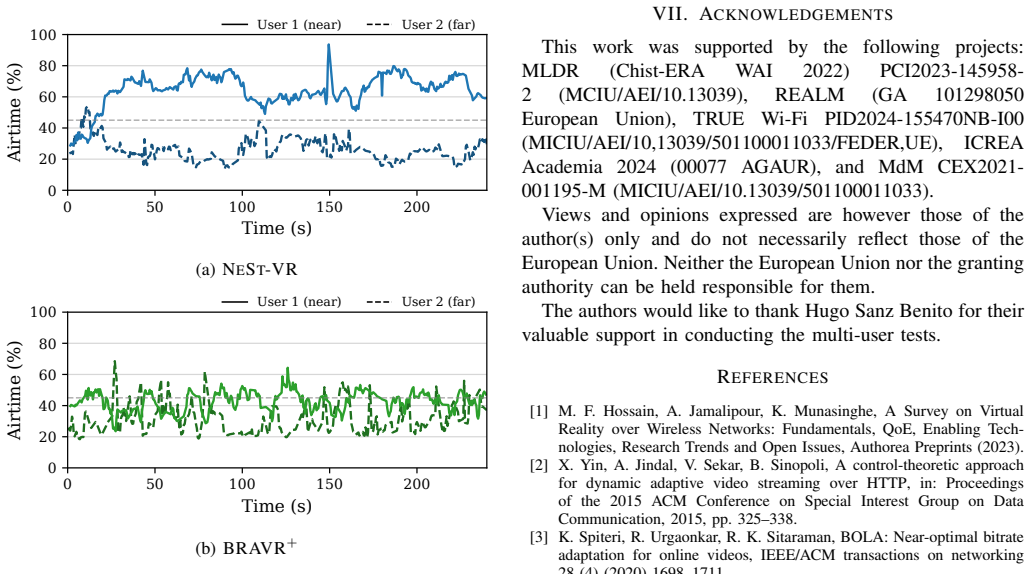
BRAVR is a decentralized deep reinforcement learning mechanism for interactive VR bitrate adaptation that incorporates lightweight wireless network statistics collected at the Wi-Fi access point. By integrating these AP-provided inputs with application-layer observations, it enables more informed decisions that optimize visual quality while maintaining streaming performance and promoting airtime fairness in multi-user scenarios. Evaluation in a real VR streaming system on a physical Wi-Fi testbed confirms that BRAVR achieves robust QoS, prevents sustained airtime overutilization, and outperforms an ablated variant without AP assistance.
What carries the argument
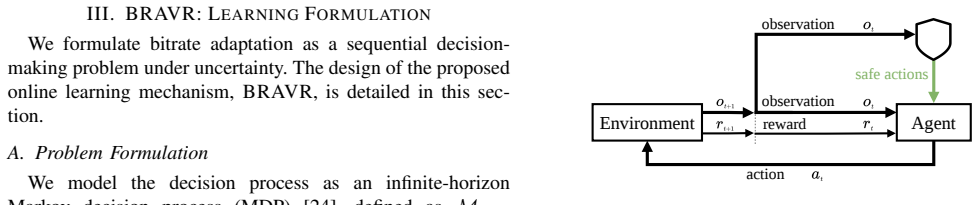
The AP-assisted online DRL control loop that fuses application observations with lightweight wireless network statistics for real-time bitrate decisions.
If this is right
- BRAVR delivers robust quality of service under dynamic channel conditions and shared-medium contention.
- It prevents sustained airtime overutilization among multiple VR users on the same access point.
- It outperforms a version without AP assistance, confirming value from network-level inputs in the control loop.
- AP-assisted online DRL is effective for decentralized interactive VR streaming over commodity Wi-Fi hardware.
Where Pith is reading between the lines
- The same lightweight AP-statistic approach could extend to other latency-sensitive traffic such as cloud gaming or remote robotics.
- Minimal network visibility at the access point may reduce the need for fully client-only or fully centralized adaptation schemes.
- The method suggests a practical path for edge-assisted learning in future wireless standards that already expose basic contention metrics.
Load-bearing premise
Lightweight wireless network statistics collected at the AP are sufficient, reliable, and non-disruptive to meaningfully improve the DRL agent's decisions under dynamic channel conditions and contention.
What would settle it
A controlled experiment in which BRAVR shows no improvement or degraded performance relative to the ablated version without AP statistics across varying levels of contention and channel dynamics would falsify the claimed benefit.
Figures

read the original abstract
Interactive virtual reality (VR) streaming over Wi-Fi requires stringent latency and reliability guarantees, which become increasingly difficult to achieve under dynamic channel conditions and shared medium contention. These challenges make real-time bitrate adaptation a critical yet fundamentally difficult control problem, particularly under limited visibility of the underlying network conditions. This paper formulates VR bitrate adaptation as a network-aware, online decision-making problem and proposes BRAVR, a decentralized deep reinforcement learning (DRL) mechanism designed to optimize visual quality while maintaining streaming performance and promoting airtime fairness in multi-user scenarios. BRAVR integrates application-layer observations with lightweight wireless network statistics collected at the Wi-Fi access point (AP) serving the VR client, enabling more informed bitrate adaptation decisions. We implement BRAVR in a real VR streaming system and evaluate it on a physical Wi-Fi testbed against a strong heuristic baseline and an ablated BRAVR variant without AP assistance. Experimental results show that BRAVR consistently achieves its design objectives, delivering robust quality of service (QoS) and preventing sustained airtime overutilization. It also outperforms its ablated counterpart, highlighting the benefits of incorporating network-level information into the bitrate adaptation control loop. Overall, these results demonstrate the effectiveness of AP-assisted online learning for decentralized interactive VR streaming over commodity Wi-Fi and provide practical insights into bitrate adaptation in shared wireless environments.
Editorial analysis
A structured set of objections, weighed in public.
Referee Report
Summary. The paper proposes BRAVR, a decentralized deep reinforcement learning mechanism for interactive VR bitrate adaptation over Wi-Fi. It integrates application-layer observations with lightweight wireless network statistics collected at the AP to optimize visual quality, maintain QoS, and promote airtime fairness under dynamic conditions and multi-user contention. The system is implemented in a real VR streaming setup and evaluated on a physical Wi-Fi testbed against a heuristic baseline and an ablated variant without AP assistance, with results indicating consistent achievement of design objectives and performance gains from the network-level inputs.
Significance. If the experimental results hold under the reported conditions, the work provides concrete evidence that AP-assisted network statistics can meaningfully improve DRL-based bitrate decisions for latency-sensitive VR over commodity Wi-Fi. The physical testbed evaluation and direct comparison to the ablated variant are strengths that support the central claim about the value of network-level information in the control loop.
minor comments (2)
- [Abstract] The abstract refers to 'lightweight wireless network statistics' without enumerating the specific metrics (e.g., airtime utilization, RSSI, or contention indicators); adding this detail in §3 or the evaluation section would improve reproducibility.
- The claim of 'preventing sustained airtime overutilization' would benefit from a precise definition or threshold in the problem formulation section to allow readers to assess how this is measured and enforced.
Simulated Author's Rebuttal
We thank the referee for the positive assessment of our work and the recommendation for minor revision. The provided summary accurately captures the core contributions of BRAVR, including the integration of AP-assisted network statistics into the DRL-based bitrate adaptation loop and the physical testbed evaluation.
Circularity Check
No significant circularity detected
full rationale
The paper describes an experimental DRL implementation for VR bitrate adaptation evaluated on a physical Wi-Fi testbed, with comparisons to a heuristic baseline and an ablated variant. No equations, derivations, or parameter-fitting steps are referenced in the provided material that reduce any claimed prediction or result to its own inputs by construction. The central claims rest on direct empirical measurements rather than self-referential definitions or self-citation chains, rendering the work self-contained.
Axiom & Free-Parameter Ledger
Reference graph
Works this paper leans on
-
[1]
M. F. Hossain, A. Jamalipour, K. Munasinghe, A Survey on Virtual Reality over Wireless Networks: Fundamentals, QoE, Enabling Tech- nologies, Research Trends and Open Issues, Authorea Preprints (2023)
2023
-
[2]
X. Yin, A. Jindal, V . Sekar, B. Sinopoli, A control-theoretic approach for dynamic adaptive video streaming over HTTP, in: Proceedings of the 2015 ACM Conference on Special Interest Group on Data Communication, 2015, pp. 325–338
2015
-
[3]
Spiteri, R
K. Spiteri, R. Urgaonkar, R. K. Sitaraman, BOLA: Near-optimal bitrate adaptation for online videos, IEEE/ACM transactions on networking 28 (4) (2020) 1698–1711
2020
-
[4]
H. Mao, R. Netravali, M. Alizadeh, Neural adaptive video streaming with pensieve, in: Proceedings of the conference of the ACM special interest group on data communication, 2017, pp. 197–210
2017
-
[5]
N. A. Hafez, M. S. Hassan, T. Landolsi, Reinforcement learning-based rate adaptation in dynamic video streaming, Telecommunication Systems 83 (4) (2023) 395–407
2023
-
[6]
Naresh, P
M. Naresh, P. Saxena, M. Gupta, Ppo-abr: Proximal policy optimization based deep reinforcement learning for adaptive bitrate streaming, in: 2023 International Wireless Communications and Mobile Computing (IWCMC), IEEE, 2023, pp. 199–204
2023
-
[7]
Information technology — Dynamic adaptive streaming over HTTP (DASH) — Part 5: Server and network assisted DASH (SAND), https: //www.iso.org/standard/78448.html, amendment 1 to ISO/IEC 23009- 5:2017 (2020)
2017
-
[8]
Mehrabi, M
A. Mehrabi, M. Siekkinen, A. Yl ¨a-J¨a¨aski, Edge computing assisted adap- tive mobile video streaming, IEEE Transactions on Mobile Computing 18 (4) (2018) 787–800
2018
-
[9]
J. W. Kleinrouweler, S. Cabrero, P. Cesar, Delivering stable high-quality video: An SDN architecture with DASH assisting network elements, in: Proceedings of the 7th International Conference on Multimedia Systems, 2016, pp. 1–10
2016
-
[10]
W. Wu, J. Yuan, S. Ma, M. Yang, AP-assisted adaptive video streaming in wireless networks with high-density clients, Computer Communica- tions 219 (2024) 53–63
2024
-
[11]
Liubogoshchev, E
M. Liubogoshchev, E. Korneev, E. Khorov, EVeREst: Bitrate adaptation for cloud VR, Electronics 10 (6) (2021) 678
2021
-
[12]
Korneev, M
E. Korneev, M. Liubogoshchev, D. Bankov, E. Khorov, How to Model Cloud VR: An Empirical Study of Features That Matter, IEEE Open Journal of the Communications Society (2024)
2024
-
[13]
Maura, M
F. Maura, M. Casasnovas, B. Bellalta, Experimenting with adaptive bi- trate algorithms for virtual reality streaming over Wi-Fi, in: Proceedings of the 30th Annual International Conference on Mobile Computing and Networking, 2024, pp. 1930–1937
2024
-
[14]
M. Casasnovas, F. Maura, I. Vandebroeck, H. Sukmawanto, E. Joris, B. Bellalta, NeSt-VR: An Adaptive Bitrate Algorithm for Virtual Reality Streaming over Wi-Fi, arXiv preprint arXiv:2502.14947 (2025)
arXiv 2025
-
[15]
Kougioumtzidis, V
G. Kougioumtzidis, V . K. Poulkov, P. I. Lazaridis, Z. D. Zaharis, Deep Reinforcement Learning-Based Resource Allocation for QoE Enhance- ment in Wireless VR Communications, IEEE Access (2025)
2025
-
[16]
Y . Sun, J. Chen, Z. Wang, M. Peng, S. Mao, Enabling mobile virtual reality with open 5g, fog computing and reinforcement learning, IEEE Network 36 (6) (2022) 142–149
2022
-
[17]
Singh, R
R. Singh, R. Sukapuram, S. Chakraborty, Mobility-aware multi-access edge computing for multiplayer augmented and virtual reality gaming, in: 2022 IEEE 21st International Symposium on Network Computing and Applications (NCA), V ol. 21, IEEE, 2022, pp. 191–200
2022
-
[18]
Lu, W.-X
S.-J. Lu, W.-X. Chen, Y .-S. Su, Y .-S. Chang, Y .-W. Liu, C.-Y . Li, G.-H. Tu, Practical Latency-Aware Scheduling for Low-Latency Elephant VR Flows in Wi-Fi Networks, in: 2024 IEEE International Conference on Pervasive Computing and Communications (PerCom), IEEE, 2024, pp. 57–68
2024
-
[19]
Jiang, X
Z. Jiang, X. Zhang, Y . Xu, Z. Ma, J. Sun, Y . Zhang, Reinforcement learning based rate adaptation for 360-degree video streaming, IEEE Transactions on Broadcasting 67 (2) (2020) 409–423
2020
-
[20]
N. Kan, J. Zou, C. Li, W. Dai, H. Xiong, RAPT360: Reinforcement learning-based rate adaptation for 360-degree video streaming with adap- tive prediction and tiling, IEEE Transactions on Circuits and Systems for Video Technology 32 (3) (2021) 1607–1623
2021
-
[21]
W. Quan, Y . Pan, B. Xiang, L. Zhang, Reinforcement learning driven adaptive vr streaming with optical flow based qoe, arXiv preprint arXiv:2003.07583 (2020)
arXiv 2003
-
[22]
Li, Federated deep reinforcement learning-based caching and bitrate adaptation for VR panoramic video in clustered MEC networks, Elec- tronics 11 (23) (2022) 3968
Y . Li, Federated deep reinforcement learning-based caching and bitrate adaptation for VR panoramic video in clustered MEC networks, Elec- tronics 11 (23) (2022) 3968
2022
-
[23]
ALVR Project, ALVR (Air Light VR), https://github.com/alvr-org/ ALVR, accessed: May 20, 2026 (2026)
2026
-
[24]
R. S. Sutton, A. G. Barto, et al., Reinforcement learning: An introduc- tion, V ol. 1, MIT press Cambridge, 1998
1998
-
[25]
Alshiekh, R
M. Alshiekh, R. Bloem, R. Ehlers, B. K ¨onighofer, S. Niekum, U. Topcu, Safe reinforcement learning via shielding, in: Proceedings of the AAAI conference on artificial intelligence, V ol. 32, 2018
2018
-
[26]
H. S. Rossi, K. Mitra, C. ˚Ahlund, I. Cotanis, QoE Models for Virtual Reality Cloud-based First Person Shooter Game over Mobile Networks, in: 2024 20th International Conference on Network and Service Man- agement (CNSM), IEEE, 2024, pp. 1–5
2024
-
[27]
Van Seijen, H
H. Van Seijen, H. Van Hasselt, S. Whiteson, M. Wiering, A theoretical and empirical analysis of expected sarsa, in: 2009 ieee symposium on adaptive dynamic programming and reinforcement learning, IEEE, 2009, pp. 177–184
2009
-
[28]
B. T. Polyak, A. B. Juditsky, Acceleration of stochastic approximation by averaging, SIAM journal on control and optimization 30 (4) (1992) 838–855
1992
-
[29]
P. J. Huber, Robust estimation of a location parameter, in: Breakthroughs in statistics: Methodology and distribution, Springer, 1992, pp. 492–518
1992
-
[30]
D. P. Kingma, J. Ba, Adam: A method for stochastic optimization, arXiv preprint arXiv:1412.6980 (2014)
Pith/arXiv arXiv 2014
-
[31]
Pascanu, T
R. Pascanu, T. Mikolov, Y . Bengio, On the difficulty of training recurrent neural networks, in: International conference on machine learning, Pmlr, 2013, pp. 1310–1318
2013
-
[32]
OpenWrt Project, OpenWrt, https://openwrt.org, accessed: May 20, 2026 (2026)
2026
-
[33]
Casasnovas, BRA VR-DRL: AP-Assisted Deep Reinforcement Learning for VR Bitrate Adaptation over Wi-Fi, https://github.com/ miguelcUPF/BRA VRDRL (2026)
M. Casasnovas, BRA VR-DRL: AP-Assisted Deep Reinforcement Learning for VR Bitrate Adaptation over Wi-Fi, https://github.com/ miguelcUPF/BRA VRDRL (2026)
2026
-
[34]
Casasnovas, M
M. Casasnovas, M. Carrascosa-Zamacois, B. Bellalta, Can cloud-based VR streaming handle Wi-Fi OBSS contention?, in: 2025 IEEE Confer- ence on Standards for Communications and Networking (CSCN), IEEE, 2025, pp. 1–6
2025
-
[35]
Bellalta, M
B. Bellalta, M. Casasnovas, F. Maura, A. Rodr ´ıguez, J. S. Marquerie, P. L. Garc ´ıa, F. Wilhelmi, J. Blat, Understanding the Wi-Fi and VR streaming interplay: A comprehensible simulation and experimental study, Journal of Network and Computer Applications (2025) 104391
2025
-
[36]
M. Casasnovas, F. Wilhelmi, B. Bellalta, AP-Assisted VR Streaming Dataset (BRA VR) (2026).doi:10.5281/zenodo.20072438. URL https://doi.org/10.5281/zenodo.20072438
-
[37]
Michaelides, M
C. Michaelides, M. Casanovas, D. N ´u˜nez, B. Bellalta, Lessons learned from a large-scale virtual reality experience over Wi-Fi, IEEE Transac- tions on Networking (2025)
2025
discussion (0)
Sign in with ORCID, Apple, or X to comment. Anyone can read and Pith papers without signing in.