First evidence of X(3872)toπ⁰chi_(c0)(1P) and search for X(3915)toπ⁰chi_(c1)(1P)
Pith reviewed 2026-06-25 21:27 UTC · model grok-4.3
The pith
The X(3872) shows first evidence of decaying to a neutral pion and chi_c0.
A machine-rendered reading of the paper's core claim, the machinery that carries it, and where it could break.
Core claim
We report the first evidence for the decay X(3872) to pi0 chi_c0 with a significance of 3.4 sigma including systematic uncertainties. We measure the product of branching fractions B(B+ to X(3872) K+) times B(X(3872) to pi0 chi_c0) equal to (20.0 plus or minus 6.8 plus or minus 2.3) times 10 to the minus 6 and the branching fraction ratio B(X(3872) to pi0 chi_c0) over B(X(3872) to pi+ pi- J/psi) equal to 2.3 plus or minus 0.8 plus or minus 0.4. The upper limits at 90 percent credibility on the products of branching fractions for the pi0 chi_c1 and pi0 chi_c2 modes are 7.5 times 10 to the minus 6 and 15.3 times 10 to the minus 6 respectively. No significant signal is seen for the X(3915) to pi
What carries the argument
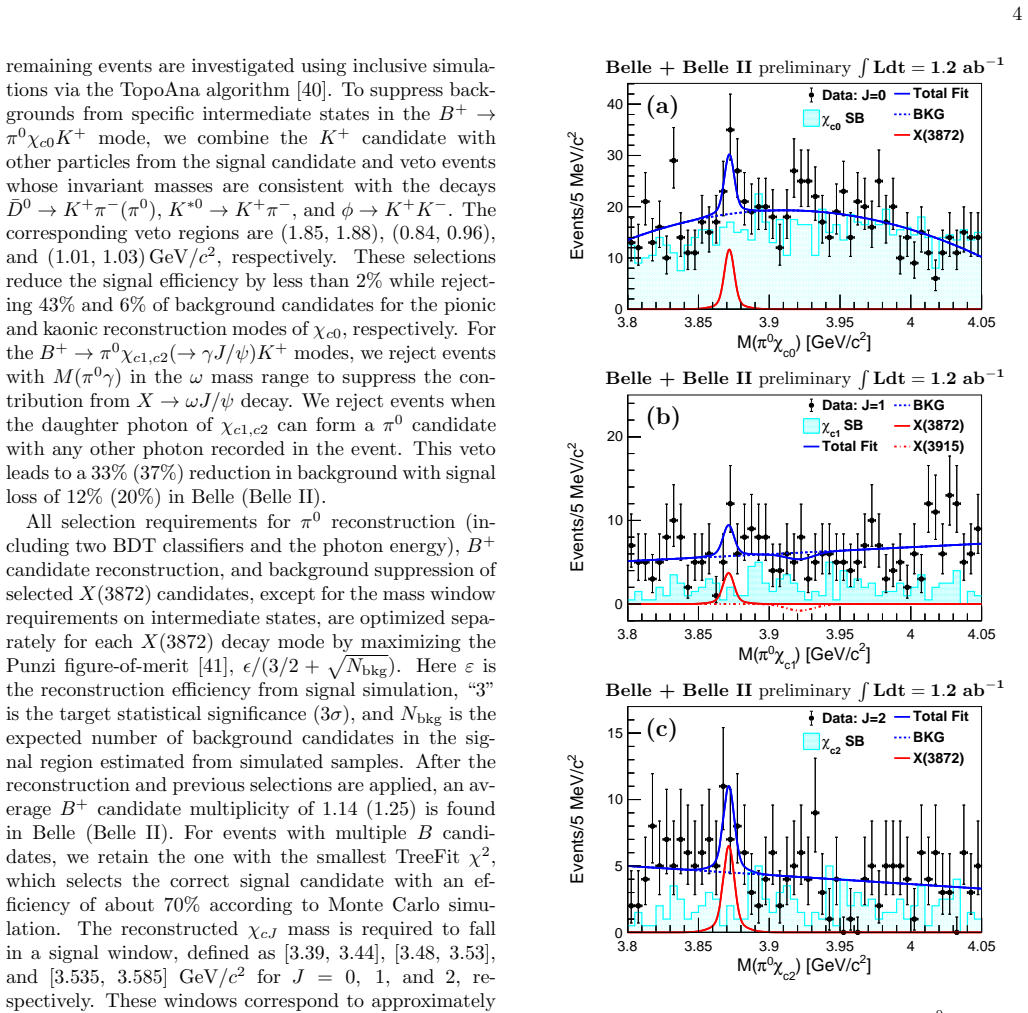
Invariant-mass fits to the pi0 chi_cJ K+ system in B+ decays that extract signal yields for the X(3872) resonance in the pi0 chi_c0 channel.
If this is right
- The measured ratio indicates the neutral-pion chi_c0 mode occurs at a rate comparable to the dominant pi+ pi- J/psi decay.
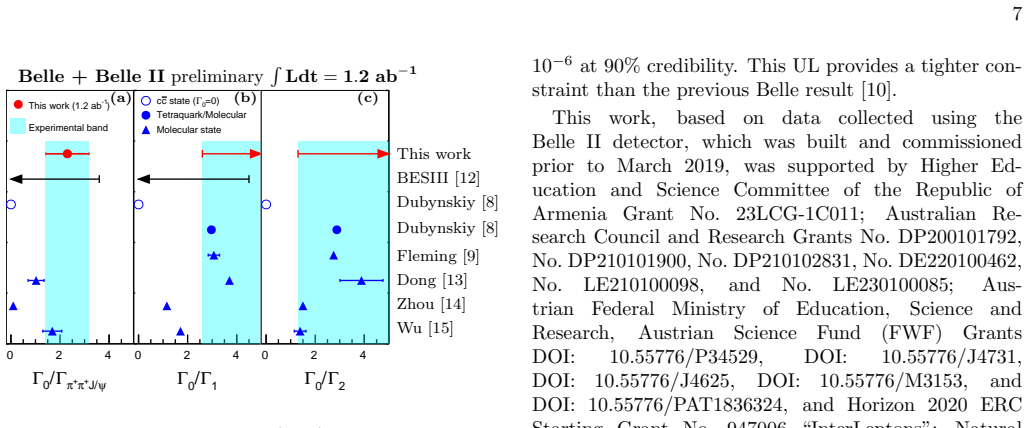
- The branching-fraction values match several predictions that assume a hadronic-molecule structure for the X(3872).
- Upper limits on the chi_c1 and chi_c2 modes constrain the allowed isospin-violating transitions.
- The null result for X(3915) to pi0 chi_c1 sets a direct bound on that decay chain.
Where Pith is reading between the lines
- Larger data samples could permit angular-distribution studies that further test the molecular versus compact interpretations.
- The same final state could be examined in other B-decay channels to cross-check the yield.
- The observed isospin violation in this mode offers a quantitative test for models that predict the size of such breaking in exotic states.
Load-bearing premise
The background shape and normalization in the invariant-mass fit are assumed to be correctly modeled with no significant unaccounted contributions from other resonances or sources.
What would settle it
An independent fit to the same or larger dataset using a different background parametrization that yields a signal consistent with zero would remove the 3.4 sigma evidence.
Figures
read the original abstract
We search for the pionic transitions $X(3872)\to\pi^0\chi_{cJ}(1P)$ $(J = 0,~1,~2)$ and $X(3915)\to\pi^0\chi_{c1}$ in $B^+\to \pi^0\chi_{cJ}K^+$ decays using the Belle and Belle~II data samples collected at the $\Upsilon(4S)$ resonance, corresponding to integrated luminosities of $711~\mathrm{fb}^{-1}$ and $492~\mathrm{fb}^{-1}$, respectively. We report the first evidence for the decay $X(3872)\to\pi^0\chi_{c0}$ with a significance of $3.4\sigma$, including systematic uncertainties. We measure the product of branching fractions ${\cal B}(B^+\to X(3872)K^+)\times{\cal B}(X(3872)\to\pi^0\chi_{c0})=(20.0\pm6.8\pm2.3)\times10^{-6}$ and the branching fraction ratio ${\cal B}(X(3872)\to\pi^0\chi_{c0})/{\cal B}(X(3872)\to\pi^+\pi^-J/\psi)=2.3\pm0.8\pm0.4$, where the first and second uncertainties are statistical and systematic, respectively. The upper limits at 90\% credibility on the products of branching fractions for the $\pi^0\chi_{c1}$ and $\pi^0\chi_{c2}$ modes are $7.5\times10^{-6}$ and $15.3\times10^{-6}$, respectively. The corresponding upper limits on the branching fraction ratios relative to the $\pi^+\pi^-J/\psi$ decay are $0.9$ and $1.8$. The measured branching fractions for $X(3872)\to\pi^0\chi_{cJ}$ are consistent with several theoretical predictions based on the hadronic molecular interpretation of the $X(3872)$. No significant signal is seen for the $X(3915)\to\pi^0\chi_{c1}$ decay, and we set the 90\% credibility upper limit of ${\cal B}(B^+\to X(3915)K^+)\times{\cal B}(X(3915)\to\pi^0\chi_{c1})<6.6\times10^{-6}$, while the decays for $J=0$ and 2 are forbidden by parity conservation.
Editorial analysis
A structured set of objections, weighed in public.
Referee Report
Summary. The manuscript reports a search for the decays X(3872) → π⁰ χ_cJ(1P) (J=0,1,2) and X(3915) → π⁰ χ_c1(1P) in B⁺ → π⁰ χ_cJ K⁺ using combined Belle (711 fb⁻¹) and Belle II (492 fb⁻¹) data at the Υ(4S). It claims first evidence for X(3872) → π⁰ χ_c0 at 3.4σ significance (including systematics), with measured product branching fraction B(B⁺ → X(3872)K⁺) × B(X(3872) → π⁰ χ_c0) = (20.0 ± 6.8 ± 2.3) × 10^{-6} and ratio B(X(3872) → π⁰ χ_c0)/B(X(3872) → π⁺π⁻ J/ψ) = 2.3 ± 0.8 ± 0.4. Upper limits at 90% credibility are set for the other X(3872) modes and for the X(3915) channel; no significant signal is observed for X(3915).
Significance. If the central result holds, the measurement supplies the first experimental input on the pionic transition X(3872) → π⁰ χ_c0 and is consistent with several hadronic-molecule predictions for the X(3872) structure. The combined Belle + Belle II sample and the explicit ratio to the well-measured π⁺π⁻ J/ψ mode are strengths. The 3.4σ significance (including systematics) is correctly labeled as evidence rather than observation.
major comments (2)
- [Analysis / fit description (the section presenting the M(π⁰ χ_c0) distribution and likelihood fit)] The invariant-mass fit used to extract the signal yield for X(3872) → π⁰ χ_c0 (the source of the quoted 3.4σ significance and branching-fraction product) relies on a specific background parametrization whose correctness is not independently validated in the text. Any unaccounted resonant or combinatorial component directly scales the extracted yield, the 3.4σ figure, and the reported branching fractions.
- [Results / significance calculation] The procedure for incorporating systematic uncertainties into the final 3.4σ significance is stated but not shown explicitly; it is therefore impossible to verify that the quoted significance correctly reflects the total uncertainty on the signal yield.
minor comments (2)
- [Abstract and § on fit results] The abstract and results section should state the exact functional form and floating parameters of the background model used in the primary fit.
- [Figures showing invariant-mass spectra] Figure captions for the mass distributions should list the χ²/ndf or likelihood values of the fit to allow readers to judge goodness-of-fit.
Simulated Author's Rebuttal
We thank the referee for the careful review and constructive comments on our manuscript. We address the two major comments point by point below. Both points can be addressed by providing additional explicit details and validation material in a revised version.
read point-by-point responses
-
Referee: [Analysis / fit description (the section presenting the M(π⁰ χ_c0) distribution and likelihood fit)] The invariant-mass fit used to extract the signal yield for X(3872) → π⁰ χ_c0 (the source of the quoted 3.4σ significance and branching-fraction product) relies on a specific background parametrization whose correctness is not independently validated in the text. Any unaccounted resonant or combinatorial component directly scales the extracted yield, the 3.4σ figure, and the reported branching fractions.
Authors: We agree that explicit validation of the background model strengthens the result. The manuscript models the background in the M(π⁰ χ_c0) distribution with a second-order Chebyshev polynomial, with the order selected by a likelihood-ratio test on sideband data and the fit quality assessed via χ²/ndf. To address the concern, the revised manuscript will add an appendix containing: (i) a comparison of signal yields obtained with first-, second-, and third-order polynomials, (ii) results from fits to sideband-only samples, and (iii) toy-MC ensembles generated with alternative background shapes to quantify any bias on the extracted yield. These additions will demonstrate that the signal yield and significance are robust against reasonable variations in the background parametrization. revision: yes
-
Referee: [Results / significance calculation] The procedure for incorporating systematic uncertainties into the final 3.4σ significance is stated but not shown explicitly; it is therefore impossible to verify that the quoted significance correctly reflects the total uncertainty on the signal yield.
Authors: The significance is obtained from the profile-likelihood ratio test statistic, with systematic uncertainties incorporated by convolving the likelihood function with Gaussian nuisance parameters for each source (as referenced in the text). In the revised manuscript we will add an explicit appendix that: (i) lists the individual systematic contributions and their correlation assumptions, (ii) shows the analytic form of the convolved likelihood, and (iii) tabulates the test-statistic values before and after convolution, confirming that the final significance remains 3.4σ. This will allow direct verification of the quoted figure. revision: yes
Circularity Check
No circularity: direct experimental measurement from data fits
full rationale
This is a standard experimental search paper reporting signal yields, branching fractions, and significances extracted from fits to invariant-mass distributions in Belle/Belle II data. The central results (3.4σ evidence, product branching fraction (20.0±6.8±2.3)×10^{-6}, ratio 2.3±0.8±0.4) are obtained by counting events after background subtraction in the B⁺→X(3872)K⁺ channel. No derivation chain, ansatz, uniqueness theorem, or self-citation reduces any reported quantity to an input by construction. Background modeling is an assumption affecting the yield, but that is a standard experimental uncertainty, not circularity. The paper is self-contained against external benchmarks (data-driven fits) and receives the default non-finding.
Axiom & Free-Parameter Ledger
free parameters (1)
- signal yield in mass fit
axioms (1)
- domain assumption Background in the χ_cJ π⁰ invariant-mass spectrum is adequately described by the chosen functional form without additional resonant contributions.
Reference graph
Works this paper leans on
-
[1]
[GeV/cc0χ0πM(0 10 20 30 40 2 Events/5 MeV/c Data: J=0 SB c0χTotal Fit BKG X(3872) (a) Belle + Belle IIpreliminary R Ldt=1.2 ab −1 3.8 3.85 3.9 3.95 4 4.05 ]
-
[2]
[GeV/cc1χ0πM(0 10 20 2 Events/5 MeV/c Data: J=1 SB c1χTotal Fit BKG X(3872) X(3915) (b) Belle + Belle IIpreliminary R Ldt=1.2 ab −1 3.8 3.85 3.9 3.95 4 4.05 ]
-
[3]
[GeV/cc2χ0πM(0 5 10 15 2 Events/5 MeV/c Data: J=2 SB c2χTotal Fit BKG X(3872) (c) Belle + Belle IIpreliminary R Ldt=1.2 ab −1 Figure 1: The fitted invariant mass spectra ofπ 0χcJ forJ equal to (a) 0, (b) 1, and (c) 2, respectively, for combined Belle and Belle II data. For eachJ, a simultaneous fit to the M(π 0χcJ) spectra from all reconstruction modes in...
-
[4]
Navaset al.(Particle Data Group), Phys
S. Navaset al.(Particle Data Group), Phys. Rev. D110, 030001 (2024)
2024
-
[5]
S. L. Olsen, T. Skwarnicki, and D. Zieminska, Rev. Mod. Phys.90, 015003 (2018), arXiv:1708.04012 [hep-ph]
Pith/arXiv arXiv 2018
-
[6]
N. Brambillaet al., Phys. Rept.873, 1 (2020), arXiv:1907.07583 [hep-ex]
arXiv 2020
-
[7]
N. H¨ usken, E. S. Norella, and I. Polyakov, Mod. Phys. Lett. A40, 2530002 (2025), arXiv:2410.06923 [hep-ph]
arXiv 2025
-
[8]
S. K. Choiet al.(Belle Collaboration), Phys. Rev. Lett. 91, 262001 (2003), arXiv:hep-ex/0309032
Pith/arXiv arXiv 2003
-
[9]
Aaijet al.(LHCb Collaboration), Phys
R. Aaijet al.(LHCb Collaboration), Phys. Rev. Lett. 110, 222001 (2013), arXiv:1302.6269 [hep-ex]
Pith/arXiv arXiv 2013
-
[10]
S. K. Choiet al.(Belle Collaboration), Phys. Rev. D84, 052004 (2011), arXiv:1107.0163 [hep-ex]
Pith/arXiv arXiv 2011
-
[11]
S. Dubynskiy and M. B. Voloshin, Phys. Rev. D77, 014013 (2008), arXiv:0709.4474 [hep-ph]
Pith/arXiv arXiv 2008
-
[12]
S. Fleming and T. Mehen, Phys. Rev. D78, 094019 (2008), arXiv:0807.2674 [hep-ph]
Pith/arXiv arXiv 2008
-
[13]
Bhardwajet al.(Belle Collaboration), Phys
V. Bhardwajet al.(Belle Collaboration), Phys. Rev. D 99, 111101 (2019), arXiv:1904.07015 [hep-ex]
Pith/arXiv arXiv 2019
-
[14]
Ablikimet al.(BESIII Collaboration), Phys
M. Ablikimet al.(BESIII Collaboration), Phys. Rev. Lett.122, 202001 (2019), arXiv:1901.03992 [hep-ex]
Pith/arXiv arXiv 2019
-
[15]
Ablikimet al.(BESIII Collaboration), Phys
M. Ablikimet al.(BESIII Collaboration), Phys. Rev. D 105, 072009 (2022), arXiv:2202.00759 [hep-ex]
arXiv 2022
-
[16]
Y. Dong, A. Faessler, T. Gutsche, S. Kovalenko, and V. E. Lyubovitskij, Phys. Rev. D79, 094013 (2009), arXiv:0903.5416 [hep-ph]
Pith/arXiv arXiv 2009
-
[17]
Z.-Y. Zhou, M.-T. Yu, and Z. Xiao, Phys. Rev. D100, 094025 (2019), arXiv:1904.07509 [hep-ph]
arXiv 2019
- [18]
-
[19]
Abeet al.(Belle Collaboration), Phys
K. Abeet al.(Belle Collaboration), Phys. Rev. Lett.94, 182002 (2005), arXiv:hep-ex/0408126
arXiv 2005
-
[20]
J. P. Leeset al.(BaBar Collaboration), Phys. Rev. D86, 072002 (2012), arXiv:1207.2651 [hep-ex]
Pith/arXiv arXiv 2012
-
[21]
Aaijet al.(LHCb Collaboration), Phys
R. Aaijet al.(LHCb Collaboration), Phys. Rev. D102, 112003 (2020), arXiv:2009.00026 [hep-ex]
arXiv 2020
-
[22]
Abashianet al.(Belle Collaboration), Nucl
A. Abashianet al.(Belle Collaboration), Nucl. Instrum. Meth. A479, 117 (2002)
2002
-
[23]
Akaiet al., Nucl
K. Akaiet al., Nucl. Instrum. Meth. A499, 191 (2003)
2003
-
[24]
Abeet al., Prog
T. Abeet al., Prog. Theor. Exp. Phys.2013, 03A001 (2013)
2013
-
[25]
Abeet al.(Belle II Collaboration), KEK-REPORT- 2010-1, 2010, arXiv:1011.0352 [physics.ins-det]
T. Abeet al.(Belle II Collaboration), KEK-REPORT- 2010-1, 2010, arXiv:1011.0352 [physics.ins-det]
Pith/arXiv arXiv 2010
-
[26]
K. Akai, K. Furukawa, and H. Koiso, Nucl. Instrum. Meth. A907, 188 (2018), arXiv:1809.01958 [physics.acc- 9 ph]
arXiv 2018
-
[27]
D. J. Lange, Nucl. Instrum. Meth. A462, 152 (2001)
2001
-
[28]
T. Sjostrand, P. Eden, C. Friberg, L. Lonnblad, G. Miu, S. Mrenna, and E. Norrbin, Comput. Phys. Commun. 135, 238 (2001), arXiv:hep-ph/0010017
Pith/arXiv arXiv 2001
-
[29]
T. Sj¨ ostrand, S. Ask, J. R. Christiansen, R. Corke, N. De- sai, P. Ilten, S. Mrenna, S. Prestel, C. O. Rasmussen, and P. Z. Skands, Comput. Phys. Commun.191, 159 (2015), arXiv:1410.3012 [hep-ph]
Pith/arXiv arXiv 2015
-
[30]
S. Jadach, B. F. L. Ward, and Z. Was, Comput. Phys. Commun.130, 260 (2000), arXiv:hep-ph/9912214
Pith/arXiv arXiv 2000
-
[31]
Barberio and Z
E. Barberio and Z. Was, Comput. Phys. Commun.79, 291 (1994)
1994
-
[32]
R. Brun, F. Bruyant, M. Maire, A. C. McPherson, and P. Zanarini, CERN Report No. DD/EE/84-1, 1984
1984
-
[33]
Agostinelliet al.(GEANT4 Collaboration), Nucl
S. Agostinelliet al.(GEANT4 Collaboration), Nucl. In- strum. Meth. A506, 250 (2003)
2003
-
[34]
T. Kuhr, C. Pulvermacher, M. Ritter, T. Hauth, and N. Braun (Belle II Framework Software Group), Com- put. Softw. Big Sci.3, 1 (2019), arXiv:1809.04299 [physics.comp-ph]
Pith/arXiv arXiv 2019
-
[35]
M. Gelbet al., Comput. Softw. Big Sci.2, 9 (2018), arXiv:1810.00019 [hep-ex]
Pith/arXiv arXiv 2018
-
[36]
Nakano, Nucl
E. Nakano, Nucl. Instrum. Meth. A494, 402 (2002)
2002
-
[37]
K. Hanagaki, H. Kakuno, H. Ikeda, T. Iijima, and T. Tsukamoto, Nucl. Instrum. Meth. A485, 490 (2002), arXiv:hep-ex/0108044
Pith/arXiv arXiv 2002
-
[38]
Abashianet al., Nucl
A. Abashianet al., Nucl. Instrum. Meth. A491, 69 (2002)
2002
-
[39]
Adachiet al.(Belle II Collaboration), Eur
I. Adachiet al.(Belle II Collaboration), Eur. Phys. J. C 85, 1237 (2025), arXiv:2506.04355 [hep-ex]
arXiv 2025
-
[40]
Cheema, EPJ Web Conf.295, 09035 (2024)
P. Cheema, EPJ Web Conf.295, 09035 (2024)
2024
-
[41]
J. F. Krohnet al.(Belle II analysis software Group), Nucl. Instrum. Meth. A976, 164269 (2020), arXiv:1901.11198 [hep-ex]
arXiv 2020
-
[42]
G. C. Fox and S. Wolfram, Phys. Rev. Lett.41, 1581 (1978)
1978
-
[43]
X. Y. Zhou, S. X. Du, G. Li, and C. P. Shen, Comput. Phys. Commun.258, 107540 (2021), arXiv:2001.04016 [hep-ex]
arXiv 2021
-
[44]
Punzi, eConfC030908, MODT002 (2003), arXiv:physics/0308063
G. Punzi, eConfC030908, MODT002 (2003), arXiv:physics/0308063
Pith/arXiv arXiv 2003
-
[45]
S. S. Wilks, Annals Math. Statist.9, 60 (1938)
1938
-
[46]
Adachiet al.(Belle and Belle II Collaborations), JHEP 03, 061 (2025), arXiv:2412.10677 [hep-ex]
I. Adachiet al.(Belle and Belle II Collaborations), JHEP 03, 061 (2025), arXiv:2412.10677 [hep-ex]
arXiv 2025
-
[47]
Banerjeeet al.(Heavy Flavor Averaging Group), arXiv:2411.18639 [hep-ex]
S. Banerjeeet al.(Heavy Flavor Averaging Group), arXiv:2411.18639 [hep-ex]
discussion (0)
Sign in with ORCID, Apple, or X to comment. Anyone can read and Pith papers without signing in.